REVIEW 2 major objections 3 minor 1 cited by
DELVE-DEEP Survey: The Faint Satellite System of NGC 55
T0 review · 2 major / 3 minor · reviewed 2026-08-16 · deepseek-v4-flash
Pith's one-line read The paper's census of dwarf satellites around NGC 55, complete to $M_V \approx -7.8$, finds no new confirmed systems and a luminosity function consistent with ΛCDM predictions.
desk verdict A careful, honest satellite census of NGC 55 with a genuinely useful combined search method; the completeness limits rest on assumptions that deserve scrutiny, but the null result holds. read the letter →
The pith
A machine-rendered reading of the paper's core claim, the machinery that carries it, and where it could break.
The reading
What carries the argument
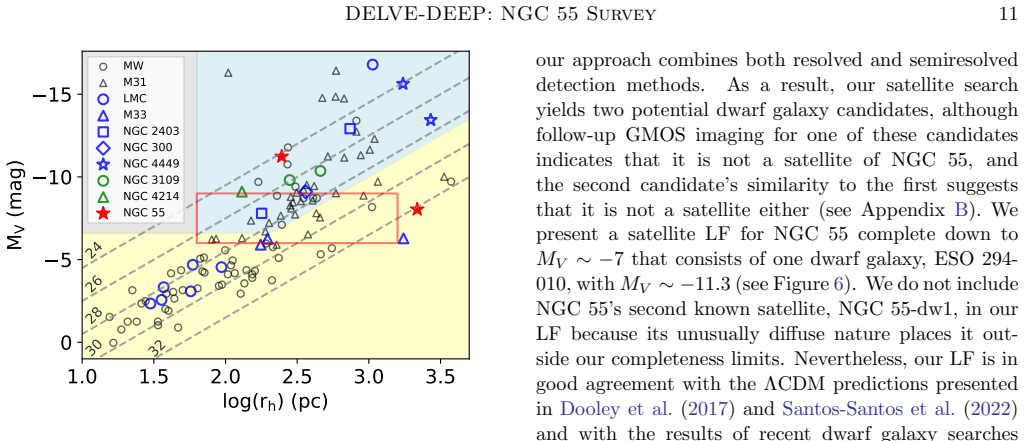
Two complementary detection pipelines run on the same images: a resolved-star search that counts red-giant-branch stars in a color-magnitude box and identifies binned overdensities, and a semiresolved search that selects shredded low-surface-brightness sources using SourceExtractor's flux-radius and effective-surface-brightness parameters and looks for their overdensities. The two candidate lists are merged by an outer join. Completeness is calibrated by injecting 2,287 artificial dwarf galaxies at the image level, with old, metal-poor stellar populations, exponential light profiles, and half-light radii $\log(r_h/\mathrm{pc})$ between 1.8 and 3.2, then running the identical detection and visual-inspection pipeline. Detection rates as a function of magnitude and size are convolved with a published size-luminosity relation to produce completeness as a function of $M_V$ alone.
What would settle it
A search of the same NGC 55 footprint that can resolve stars in dwarfs with half-light radii below $\log(r_h/\mathrm{pc})=1.8$ and reaches $M_V \approx -6.6$ would test the completeness claim by looking for a previously unknown satellite within the virial radius; alternatively, rerunning the injection tests with younger or more metal-rich stellar populations, or with a different initial mass function, and finding detection rates below 80% at $M_V \lesssim -7.8$ would show that the quoted completeness depends on the assumed dwarf model.
Extended reading notes
Core claim
The central claim is that a combined resolved and semiresolved search of deep DECam imaging around NGC 55 is complete enough to rule out previously undiscovered dwarf satellites brighter than $M_V \approx -7.8$ within the virial radius. No new confirmed satellites are found; the only confirmed systems are ESO 294-010 ($M_V \sim -11.3$) and the unusually diffuse NGC 55-dw1 ($M_V \sim -8.0$). Because NGC 55-dw1 has effective surface brightness $\mu \sim 32.3$ mag arcsec$^{-2}$, below the completeness limit, the paper's luminosity function includes only ESO 294-010 and is consistent with the predicted satellite populations of LMC-mass halos. The paper further claims that detection sensitivity extends to $M_V \lesssim -6.6$ and $\mu \lesssim 28.5$ mag arcsec$^{-2}$, and that the method probes a broader size-luminosity parameter space than previous satellite searches around such hosts.
Load-bearing premise
The completeness numbers assume that real satellites of NGC 55 resemble the injected dwarfs: old, metal-poor, Salpeter-initial-mass-function populations with exponential light profiles and half-light radii between about 63 pc and 1.6 kpc, and that the adopted size-luminosity relation applies to this host; if real dwarfs are much more compact, much more diffuse, or have different stellar populations, they could evade detection despite the quoted completeness.
Editorial extensions
If this is right
- If the completeness claim holds, the satellite system of an isolated LMC-mass host is sparse at the faint end: exactly one satellite completes the luminosity function to $M_V \approx -7$, and the total confirmed count is two.
- The agreement between the NGC 55 luminosity function and ΛCDM predictions adds a small-host data point to the small-scale dark-matter test, complementing results around NGC 2403 and NGC 3109.
- Combining resolved and semiresolved detection can push completeness to fainter, more compact dwarfs than either method alone, a technique that could be applied to other nearby hosts and to upcoming wide-area surveys.
- The unusually diffuse NGC 55-dw1 lies outside the completeness limits, so any census that adopts these limits must clearly separate completeness in luminosity from completeness in surface brightness.
- The methods and completeness calibration established here give a template for measuring satellite luminosity functions around the other Magellanic analogs in the same survey program.
Reading between the lines
- The following are editorial extensions, not claims of the paper: if the same dual-pipeline completeness calibration were applied to the other three DELVE-DEEP hosts, the resulting set of complete luminosity functions would directly test whether satellite abundance scales with host mass as ΛCDM predicts.
- The completeness is conditional on the injected parameter space; real ultra-faint dwarfs more compact than $\log(r_h/\mathrm{pc}) < 1.8$ could be hiding in the data, so a targeted search for very compact, high-surface-brightness systems would be a natural extension.
- The diffuse nature of NGC 55-dw1 and its possible tidal origin raise the possibility that some satellites are destroyed; if so, the intact-satellite luminosity function undercounts the original accreted population, which would matter when interpreting the agreement with simulations.
- The comparison to simulated satellite populations is partly self-referential: the same size-luminosity relation used to correct for completeness is also used to predict the observed counts, so a different relation would shift both sides of the comparison.
Signed reviews
Editorial analysis
A structured set of objections, weighed in public.
Referee Report
Summary. This paper presents a systematic search for faint satellite dwarf galaxies around the isolated, LMC-mass spiral NGC 55 using DELVE-DEEP g/i-band DECam imaging. The search combines two methods: a resolved RGB-star overdensity search and a semiresolved search for shredded unresolved low-surface-brightness light. The pipeline is calibrated with 2,287 injected artificial dwarf galaxies covering log(r_h/pc) = 1.8-3.2 and M_V from -6 to -9, together with artificial-star completeness tests. The search yields no new confirmed satellites beyond the two already known systems, ESO 294-010 and NGC 55-dw1. The authors convert the two-dimensional detection map into a luminosity-only completeness using the Brasseur et al. (2011) size-luminosity relation, claim roughly 80% completeness for M_V <= -7.8, construct a satellite luminosity function containing only ESO 294-010, and report consistency with the Lambda-CDM predictions of Dooley et al. (2017) and Santos-Santos et al. (2022).
Significance. The observational result and methodology are both valuable. A complete census of satellites around a low-mass host is still rare, and the dual resolved/semiresolved search, the large injection suite, and the blinded Zooniverse visual inspection are clear strengths. The direct null result (no new confirmed satellites) is not in doubt, and if the completeness model holds, the luminosity function provides one of the first constraints on LMC-mass-host satellite populations down to M_V about -7. The paper is also appropriately transparent about the main caveat, namely that NGC 55-dw1 is excluded from the luminosity function because of its extreme diffuseness. However, the quantitative completeness claims and the comparison to cosmological predictions depend on the assumed size-luminosity relation and on a single stellar-population model; these dependencies need to be quantified before the luminosity-function interpretation can be considered secure.
major comments (2)
- [Section 5, Figure 5, Figure 6] The luminosity-only completeness used to derive the roughly 80% completeness at M_V <= -7.8 and to convolve the Lambda-CDM predictions in Figure 6 is obtained by folding the two-dimensional detection map of Figure 5 with the Brasseur et al. (2011) size-luminosity relation. This relation is already violated within the target system: NGC 55-dw1 (M_V = -8.0, r_h ~ 2.2 kpc, mu_eff ~ 32.3; Table 1), which was detected by the resolved method but not counted in the visual search (Section 3.3), lies far outside the tested log(r_h/pc) = 1.8-3.2 and mu_eff <= 28.5 parameter space. If a non-negligible fraction of the true satellite population is as diffuse as NGC 55-dw1, the effective completeness at fixed M_V is lower than stated, and the agreement with Dooley et al. (2017) and Santos-Santos et al. (2022) is not robust. I request a robustness test that recomputes the M_V-only completeness and the Figure 6 comparison under an alternative size distribution (for example, one that includes dw1-like dwarfs, or one based on the observed scatter of Local Volume dwarfs), and a quantitative statement of how the inferred observed luminosity function changes.
- [Section 4] The completeness tests inject only a single stellar population: 10 Gyr, [Fe/H] = -2, Salpeter IMF, exponential profile, with all stars fainter than i = 27 treated as a smooth unresolved component. This may not be representative of the satellites of an LMC-mass host; the brighter known satellite ESO 294-010 contains young main-sequence stars and H I (Section 5), and a satellite population with younger or more metal-rich stars could have different resolved-to-unresolved light fractions and thus a different detection efficiency. Because the completeness map is load-bearing for both the headline completeness limits and the luminosity-function comparison, I request at least one sensitivity test with a different stellar population (for example, a younger isochrone or a different IMF) to show that the claimed completeness is not strongly population-dependent, or a quantitative justification of why the detection efficiency is insensitive to these choices.
minor comments (3)
- [Section 5] The sentence stating that NGC 55-dw1 'falls below our completeness limits' could be misread because its luminosity (M_V = -8.0) is brighter than the magnitude limit; the dwarf is excluded because of its surface brightness and size, not its total luminosity. Please clarify this distinction.
- [Figure 7 caption] The caption notes that completenesses outside the red rectangle are extrapolated, but the abstract and Section 5 quote specific completeness percentages without stating which portion of the (M_V, r_h) space contributing to those percentages is measured rather than extrapolated. Please add an explicit sentence in Section 5 linking the quoted 80% value to the tested parameter space and any extrapolation used.
- [Section 3.3] It is worth stating explicitly in the main text, not only in the appendix and Figure 7, that the visual-inspection cutout size was chosen for typical dwarf sizes and that this choice is why NGC 55-dw1 was not recovered, since this directly affects the interpretation of the search completeness for very diffuse systems.
Circularity Check
No significant circularity: the completeness is measured from injected galaxies and the LF comparison uses independent external simulations; no target result is assumed.
full rationale
The paper's central claims—sensitivity down to M_V ~ -6.6 and ~80% completeness at M_V <= -7.8—are measured rather than assumed: 2,287 artificial dwarfs are injected into 26 DELVE-DEEP coadds spanning log(r_h/pc) = 1.8-3.2 and M_V = -6.0 to -9.0, processed through the same SourceExtractor pipeline and Zooniverse visual inspection as real candidates, and the resulting detection grid is convolved with the external Brasseur et al. (2011) size-luminosity relation to obtain M_V-only completeness. The luminosity-function comparison uses independent Lambda-CDM predictions from Dooley et al. (2017) and Santos-Santos et al. (2022), convolved with the measured sensitivity; no parameter fitted to the NGC 55 data is renamed as a prediction. Self-citations (Drlica-Wagner et al. 2021/2022, Mutlu-Pakdil et al. 2021, McNanna et al. 2024) supply survey context, distance, and the old metal-poor isochrone assumption, but they are not used as a uniqueness theorem or to forbid alternatives. The only mild internal tuning is the choice of LSB selection cuts in Section 3.2 to maximize recovery of injected dwarfs before the Section 4 completeness is measured on the same injected set; this could bias the completeness estimate optimistically, and NGC 55-dw1 itself falls outside the tested size-luminosity region, but this is a statistical caveat about completeness, not a reduction of the result to its own inputs. There is no equation or fitted quantity that is equivalent by construction to the claimed prediction.
Assumptions & free parameters
free parameters (3)
- LSB selection cuts (FLUX_RADIUS and MU_EFF_MODEL) =
FLUX_RADIUS_G/I: 5-20; MU_EFF_MODEL_G: 24.2-31.2
- RGB selection box boundaries =
i-band 22.8 to 25.0, color range covering the RGB
- Completeness model logistic parameters =
g90% = 25.3 mag, i90% = 24.6 mag
assumptions (5)
- domain assumption Artificial dwarfs with 10 Gyr, [Fe/H] = -2, Salpeter IMF, exponential profiles, and log(r_h/pc) in [1.8, 3.2] are representative of real satellites around NGC 55.
- domain assumption The Brasseur et al. (2011) size-luminosity relation applies to the NGC 55 satellite population.
- domain assumption ESO 294-010 is a bound satellite of NGC 55 and belongs in the luminosity function even though it lies just outside the survey footprint.
- domain assumption NGC 55 is at 2.1 Mpc with a virial radius of about 120 kpc, so the 3.25 degree survey radius covers the halo.
- domain assumption The Lambda-CDM predictions from Dooley et al. (2017) and Santos-Santos et al. (2022) are appropriate benchmarks for this host.
Cite this review
Pith. "Pith review of DELVE-DEEP Survey: The Faint Satellite System of NGC 55." pith.science (2026). https://pith.science/paper/VQ7GOG2E
@misc{pith2026250418645,
  author       = {Pith},
  title        = {Pith review of: DELVE-DEEP Survey: The Faint Satellite System of NGC 55},
  year         = {2026},
  howpublished = {\url{https://pith.science/paper/VQ7GOG2E}},
  note         = {Machine review of arXiv:2504.18645}
}
abstract
We report the first comprehensive census of the satellite dwarf galaxies around NGC 55 ($2.1$ Mpc) as a part of the DECam Local Volume Exploration DEEP (DELVE-DEEP) survey. NGC 55 is one of four isolated, Magellanic analogs in the Local Volume around which DELVE-DEEP aims to identify faint dwarfs and other substructures. We employ two complementary detection methods: one targets fully resolved dwarf galaxies by identifying them as stellar over-densities, while the other focuses on semi-resolved dwarf galaxies, detecting them through shredded unresolved light components. As shown through extensive tests with injected galaxies, our search is sensitive to candidates down to $M_V \lesssim -6.6$ and surface brightness $\mu \lesssim 28.5$ mag arcsec$^{-2}$, and $\sim 80\%$ complete down to $M_V \lesssim -7.8$. We do not report any new confirmed satellites beyond two previously known systems, ESO 294-010 and NGC 55-dw1. We construct the satellite luminosity function of NGC 55 and find it to be consistent with the predictions from cosmological simulations. As one of the first complete luminosity functions for a Magellanic analog, our results provide a glimpse of the constraints on low-mass-host satellite populations that will be further explored by upcoming surveys, such as the Vera C. Rubin Observatory's Legacy Survey of Space and Time.
Figures


Figures from the paper (7 more)




Forward citations
Cited by 1 Pith paper
-
The NGC3109 Satellite System: The First Systematic Resolved Search for Dwarf Galaxies Around a SMC-mass Host
A resolved-star search around the SMC-mass galaxy NGC 3109 recovers both known satellites, finds no new ones, and places the bright-satellite count within the scatter of cold dark matter predictions.
Reference graph
Works this paper leans on
-
[1]
DELVE-DEEP: NGC 55 Survey 13 Abbott, T. M. C., Adam´ ow, M., Aguena, M., et al. 2021, ApJS, 255, 20 Arias, J. M., Bell, E. F., Gozman, K., et al. 2025, The Astrophysical Journal Letters, 982, L3. https://dx.doi.org/10.3847/2041-8213/adb433 Astropy Collaboration, Robitaille, T. P., Tollerud, E. J., et al. 2013, A&A, 558, A33 Astropy Collaboration, Price-Wh...
arXiv 2021
-
[10]
https://dx.doi.org/10.3847/0004-637X/818/1/10 Homma, D., Chiba, M., Komiyama, Y., et al. 2024, PASJ, 76, 733 Hook, I. M., Jørgensen, I., Allington-Smith, J. R., et al. 2004, PASP, 116, 425 Hunter, L. C., Mutlu-Pakd ˙Il, B., Sand, D. J., et al. 2025, The Astrophysical Journal, 989,
-
[13]
The corresponding detection method is given in the title
The left panel includes only the sources within a radius of 0.3 arcmin surrounding the candidate, indicated by the red circle in the middle panel. The corresponding detection method is given in the title. The right panel highlights each source from the left panel on the i-band image. 18 Initial data reduction was conducted using DRAGONS (Labrie et al. 202...
work page 2018
-
[14]
Left: Deep color-magnitude diagram of the region within a 0.3 arcmin radius of the candidate. Isochrone with age = 10 Gyr and metallicity [Fe/H] = −2 at the distance of NGC 55 is shown in red (Dotter et al. 2008). Middle: Same as left but for a background region of equal area. Right: An i-band image with a dashed red circle of a radius 0.3 arcmin surround...
work page 2008
-
[21]
https://dx.doi.org/10.3847/1538-4357/ade9b8 Dooley, G. A., Peter, A. H. G., Carlin, J. L., et al. 2017, MNRAS, 472, 1060 Dotter, A., Chaboyer, B., Jevremovi´ c, D., et al. 2008, ApJS, 178, 89 Drlica-Wagner, A., Bechtol, K., Rykoff, E. S., et al. 2015, ApJ, 813, 109 Drlica-Wagner, A., Carlin, J. L., Nidever, D. L., et al. 2021, ApJS, 256, 2 Drlica-Wagner, ...
-
[55]
Isochrones are generated using the Dartmouth Stellar Evolution Database (Dotter et al. 2008). 23 24 25 26 27 28 Input Magnitude 0.0 0.2 0.4 0.6 0.8 1.0Completeness g Average g ± 1 i Average i ± 1 g TRGB (24.3) i TRGB (22.6) Figure
work page 2008
-
[58]
https://dx.doi.org/10.3847/1538-4357/ade9a4 Ivezi´ c,ˇZ., Kahn, S. M., Tyson, J. A., et al. 2019, ApJ, 873, 111 Jerjen, H., Freeman, K. C., & Binggeli, B. 1998, AJ, 116, 2873 Jethwa, P., Erkal, D., & Belokurov, V. 2016, Monthly Notices of the Royal Astronomical Society, 461,
-
[72]
2025, The Astrophysical Journal, 989,
https://dx.doi.org/10.3847/1538-4357/acdcf6 Doliva-Dolinsky, A., Mutlu-Pakdil, B., Crnojevi´ c, D., et al. 2025, The Astrophysical Journal, 989,
Show all 14 references
-
[121]
2020, A&A, 641, A6 Prole, D
http://dx.doi.org/10.3847/1538-4357/ab7b75 Planck Collaboration, Aghanim, N., Akrami, Y., et al. 2020, A&A, 641, A6 Prole, D. J., Davies, J. I., Keenan, O. C., & Davies, L. J. M. 2018, MNRAS, 478, 667 Rich, R. M., Collins, M. L. M., Black, C. M., et al. 2012, Nature, 482, 192–...
2020 arXiv
-
[135]
F., Yuan, Z., et al
https://dx.doi.org/10.3847/1538-4357/ac6fd5 Doliva-Dolinsky, A., Martin, N. F., Yuan, Z., et al. 2023, The Astrophysical Journal, 952,
2023 doi
-
[844]
E., Sand, D
https://doi.org/10.1093/mnras/stv2970 Fielder, C. E., Sand, D. J., Jones, M. G., et al. 2025, Streams, Shells, and Substructures in the Accretion-Built Stellar Halo of NGC 300, , , arXiv:2501.04089. https://arxiv.org/abs/2501.04089 Flaugher, B., Diehl, H. T., Honscheid, K., et...
2025 arXiv
-
[2004]
on the Gemini South telescope (GS-2024B-FT-204; PI: J. Medoff). The GMOS images have a∼5.5′×5.5′field of view and 0.16′′pixel−1 scale after binning. Both g andi-band imaging was taken with strict image quality constraints on 2024 December 25 (UT). We collected 9×300 sg-band ex...
2024
-
[2212]
P., Koposov, S
https://doi.org/10.1093/mnras/stw1343 Ji, A. P., Koposov, S. E., Li, T. S., et al. 2021, ApJ, 921, 32 Jones, M. G., Mutlu-Pakdil, B., Sand, D. J., et al. 2023, ApJL, 957, L5 Jordi, K., Grebel, E. K., & Ammon, K. 2006, A&A, 460, 339 Karachentsev, I. D., Makarov, D. I., & Kaisin...
2021 arXiv
-
[3108]
F., et al
https://doi.org/10.1093/mnras/stw2564 Gil de Paz, A., Boissier, S., Madore, B. F., et al. 2007, ApJS, 173, 185 14 Griffen, B. F., Ji, A. P., Dooley, G. A., et al. 2016, The Astrophysical Journal, 818,
2007 doi
Reviewed August 16, 2026 · model on record in the stance chip above.
Discussion (0). Continue with ORCID to comment.