REVIEW 2 major objections 5 minor 233 references
Optical spatiotemporal Fourier synthesis: Tutorial
T0 review · 2 major / 5 minor · reviewed 2026-08-16 · deepseek-v4-flash
Pith's one-line read A three-stage optical synthesizer prepares wave packets that keep their shape while moving at a user-set speed.
desk verdict A clear, rebuildable tutorial of the authors' own three-stage spatiotemporal Fourier synthesizer; the science is sound, the novelty is pedagogical, and the main gaps are quantitative error bars and a missing annulus-thickness-to-range analysis. read the letter →
The pith
A machine-rendered reading of the paper's core claim, the machinery that carries it, and where it could break.
The reading
What carries the argument
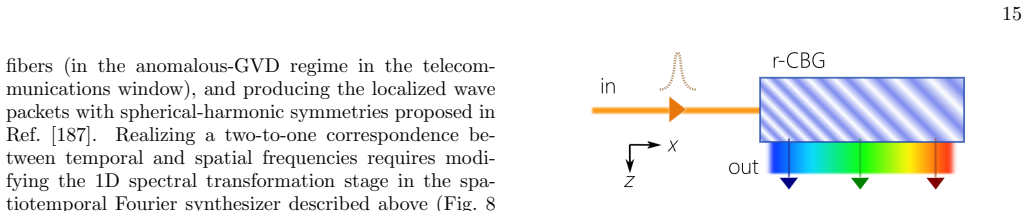
The load-bearing machinery is the three-stage map from an input pulse to the spatiotemporal Fourier plane: (1) a double-pass chirped-volume-Bragg-grating pair that converts the pulse spectrum into a collimated linear spatial chirp x1($\lambda$) = $\alpha$ ($\lambda$ - lambda_o); (2) a 1D logarithmic spectral re-organization x2 = A ln(x1/B) implemented by two SLM phase distributions; and (3) a fixed 2D log-polar transformation r = C exp(-x3/D), phi = y3/D implemented by two phase plates. The composition yields r($\lambda$) = C($\alpha$/B [$\lambda$ - lambda_o])^{A/D}; setting D = 2A delivers the square-root spectral law of Eq. (16). The identity doing the conceptual work is the light-cone representation: the STWP spectrum is the intersection of the light cone with a plane, and the synthesizer produces exactly that intersection for the cylindrically symmetric subclass.
What would settle it
Measure the propagation-invariant length of the prepared packets as a function of the annulus thickness and spectral uncertainty in the Fourier plane; if the axial intensity profile begins to spread at a distance much shorter than the theoretical diffraction-free length predicted from the ideal spectrum, or if the measured group velocity systematically deviates from the expected value as B is tuned across its full range, the central claim fails.
Extended reading notes
Core claim
The central discovery is that the restriction to azimuthally symmetric fields in which each radial spatial frequency is paired with a single temporal frequency turns spatiotemporal spectral synthesis into a coordinate-mapping problem. The synthesizer starts with a spatially resolved spectrum from a chirped volume Bragg grating, rearranges the wavelengths with a logarithmic 1D map, and then rolls the Cartesian axis into a radial sequence with a log-polar map. Choosing the log-polar scale D = 2A makes the annulus radius satisfy r($\lambda$) = C($\alpha$/B [$\lambda$ - lambda_o])^{A/D}, so that the radial spatial frequency becomes k_r($\lambda$) approximately C k_o/f $\sqrt$($\alpha$/B [$\lambda$ - lambda_o]), which reproduces Eq. (16), the STWP spectral constraint. Consequently the field envelope is psi(r,z;t) = psi(r,0;t-z/v), a rigidly translating wave packet whose group velocity is set by the free parameter B.
Load-bearing premise
The whole argument assumes that the field stays azimuthally symmetric with a strict one-to-one pairing of radial spatial frequency and wavelength, and that the CBG pair, the logarithmic phase plates, and the log-polar plates realize their ideal transformations with negligible aberration or discretization error; the paper gives no error analysis connecting the measured spectral uncertainty to a finite propagation-invariant distance.
Editorial extensions
If this is right
- Propagation-invariant wave packets with tunable group velocity become preparable in the laboratory from an ordinary 100-fs laser without nonlinear conversion.
- Because the group velocity is set by a single software parameter B in the spectral re-organization stage, subluminal, luminal, superluminal, and negative-group-velocity regimes are continuously accessible from the same device.
- Pulsed Bessel beams, X-waves, and STWPs appear as special cases of one spectral-shaping system, so the synthesizer unifies previously distinct preparation methods.
- The same architecture can be extended to two-to-one spectral correspondences, which would realize O-shaped space-time wave packets and optical de Broglie-Mackinnon wave packets with full 2D spatial spectra.
- The log-polar stage can be adapted to imprint orbital angular momentum along the azimuthal coordinate, yielding OAM-carrying, propagation-invariant STWPs without altering the 1D spectral re-organization.
Reading between the lines
- If the ideal phase plates are replaced by efficient diamond-turned or lithographic versions, the synthesizer's throughput and compactness could make propagation-invariant packets practical for free-space communications or laser-material processing, though the paper does not quantify efficiency.
- The square-root spectral law implies a conical angular dispersion that is non-differentiable at the reference frequency; a direct measurement of the pulse-front tilt across that point would test whether the STWP genuinely evades the usual angular-dispersion/pulse-front-tilt constraint.
- A natural extension is to apply the same log-polar map to frequency-comb sources with one spatial mode per line, producing discretized spectral supports whose propagation would reveal whether discrete modes still lock into a rigid packet or spread from mode-to-mode coupling.
- The paper's own list of future directions suggests that replacing the 1D spectral re-organization with a conformal map that assigns a finite spectral width to each position would open the subspace of accelerating or axially encoded pulses, a step beyond the strict one-to-one case.
Signed reviews
Editorial analysis
A structured set of objections, weighed in public.
Referee Report
Summary. This tutorial develops a framework for spatiotemporal Fourier optics, specialized to azimuthally symmetric pulsed fields in which each radial spatial frequency is associated with a single temporal frequency. It derives the spectral-support conditions for pulsed Bessel beams, X-waves, and space-time wave packets (STWPs), and then describes a three-stage experimental synthesizer: a chirped-volume-Bragg-grating spectral-analysis stage, a 1D logarithmic spectral reorganization, and a 2D log-polar coordinate transformation. The authors show that by setting the log-polar parameter D=2A, the radial chirp in the Fourier plane gives kr proportional to sqrt(lambda-lambda_o), matching the paraxial STWP condition of Eq. (16). They report measurements of subluminal (0.83c) and superluminal (1.37c) STWPs, including time-averaged intensity profiles, spatiotemporal intensity reconstructions, and group-velocity tuning via the parameter B.
Significance. If the claims hold, the tutorial provides a coherent and experimentally demonstrated route to synthesizing a broad class of cylindrically symmetric propagation-invariant wave packets. The derivation chain from the coordinate transformations to Eq. (25) is explicit and internally consistent under the stated paraxial and small-angle approximations. The experimental section is unusually complete for a tutorial, with spectral, spatial, and spatiotemporal characterization, and the demonstration of group-velocity tunability across subluminal and superluminal regimes is a valuable validation of the synthesis concept. The main weakness is quantitative: the effect of finite annulus thickness and of imperfect implementation of the coordinate transformations on the propagation-invariant range is not analyzed, so the experimental claim of propagation invariance is not backed by an error budget.
major comments (2)
- The paper claims that setting D=2A produces a spectral support 'corresponding to Eq. 16' and reports a 60-mm propagation-invariant range, but no quantitative connection is made between the finite thickness of the annuli and the achievable propagation distance. The CBG spectral resolution is about 10 pm (Fig. 10(a)), and the finite fiber mode size, phase-plate aperture, and SLM discretization all contribute a radial uncertainty delta-r in the Fourier plane. Since kz=(k^2-kr^2)^{1/2}, a radial spread delta-kr=(ko/f)delta-r implies delta-kz approx (kr/kz)delta-kr, and the accumulated phase delta-kz L must remain well below unity over L=60 mm. The manuscript itself notes in Sec. II.C.2 that finite annulus thickness limits realistic Bessel beams, yet it does not perform the analogous estimate for this synthesizer and reports no direct measurement of the annulus linewidth in the Fourier plane. Without such a bound, the observed axial invariance cannot be used to infer that the spectral support is close enough to Eq. (16) to justify the propagation-invariant claim.
- The spatiotemporal spectral characterization combines a measurement of the wavelength-to-x3 mapping (Fig. 15(a)) with a monochromatic slit-scan of the log-polar transformation (Fig. 15(b)). This does not directly measure the two-dimensional spatiotemporal spectrum |psi(kr,lambda)|^2 in the Fourier plane with spectral resolution. In particular, no estimate is reported of the radial linewidth of a single-wavelength annulus, and no residual analysis of the measured r(lambda) against Eq. (24) is provided. As a result, the experimental support for the central mapping in Eq. (25) is indirect, and possible contributions from chromatic phase-plate response, SLM discretization, and CBG resolution to the annulus thickness are not quantified.
minor comments (5)
- The central wavelength is given as lambda_o=796.1 nm in Sec. VII.B but as lambda_o approx 798 nm in Sec. VII.E; the chirp rate alpha also changes sign from +22.2 mm/nm to -22.2 mm/nm. Please reconcile these values and specify the sign convention for alpha and B so that the argument of the square root in Eq. (25) is well defined.
- The definition D=ymax3/pi together with 2ymax3=8 mm and D=1 mm is inconsistent: ymax3=4 mm would require D=4/pi approx 1.27 mm, while D=1 mm would give an angular span of +/-4 rad. Please specify the illuminated y-extent or adjust the parameter values so that the mapping closes the annulus without overlap.
- In the sentence near the end of the Introduction, 'spaiotemporal Fourier optics' should be 'spatiotemporal Fourier optics'.
- The phase distributions in Eqs. (21) and (23) depend on k=omega/c; the paper should state the design wavelength at which the SLM patterns were computed and briefly discuss any residual chromatic effects on the coordinate transformations over the 10-nm bandwidth.
- The plot of group velocity versus B in Fig. 16(e) would benefit from error bars or an estimate of the uncertainty in the inferred group velocities, particularly for the extreme values of B.
Circularity Check
No significant circularity: the synthesizer is an engineering implementation of the independently defined STWP spectral constraint, and the measured quantities are calibrations and demonstrations, not predictions forced by fitted parameters.
full rationale
The paper does not claim to derive propagation invariance from the synthesizer alone; it first derives the STWP spectral constraint (Eq. 16) from the light-cone geometry and the propagation-invariance condition (Eq. 14), and then engineers the three-stage system so that the radial chirp (Eq. 24) reproduces that constraint by setting D = 2A. This is a design-inverse problem, not a fitted-input-called-prediction loop: the measured spatial chirp rate alpha is a calibration of stage 1, and the subsequent r(lambda) and group-velocity measurements are characterizations of the implemented spectrum, not values inserted back into the derivation to force agreement. The self-citations (e.g., Refs. [60], [121-123]) document prior apparatus, contextual results, and classification claims, but the load-bearing optical relations (Eqs. 14, 16, 24, 25) are derived explicitly in the text from Fourier optics and the coordinate transformations. The finite-annulus-thickness concern raised by the skeptic is a robustness or error-analysis gap, not a circularity, since the paper's invariance claim is conditioned on ideal implementation and no quantitative bound is claimed from first principles. Overall, the derivation chain is self-contained and the experimental portion is a realization and verification of a prescribed spectral design, so no circular step is present.
Assumptions & free parameters
free parameters (2)
- B =
range [-15, 20] mm; yields group velocities 0.83c and 1.37c
- D/A ratio =
D = 2A = 1 mm (A = 0.5 mm)
assumptions (4)
- standard math Scalar paraxial diffraction theory and the light-cone representation kx^2+ky^2+kz^2=(omega/c)^2 are used throughout (Eqs. 2, 10).
- domain assumption Azimuthal symmetry and one-to-one spectral correspondence: each temporal frequency omega is associated with a single radial spatial frequency kr(omega) (Eq. 11, Fig. 3).
- domain assumption The paraxial (small-angle) approximation is used in deriving Eq. 16 and Eq. 25.
- ad hoc to paper The log-polar coordinate transformation (Eq. 22) is implemented exactly by the two phase distributions Phi3 and Phi4 (Eq. 23) with no aberration or discretization.
Cite this review
Pith. "Pith review of Optical spatiotemporal Fourier synthesis: Tutorial." pith.science (2026). https://pith.science/paper/QT3J6JAR
@misc{pith2026250418675,
  author       = {Pith},
  title        = {Pith review of: Optical spatiotemporal Fourier synthesis: Tutorial},
  year         = {2026},
  howpublished = {\url{https://pith.science/paper/QT3J6JAR}},
  note         = {Machine review of arXiv:2504.18675}
}
read the original abstract
Fourier synthesis is one of the foundations of physical optics. Spatial Fourier optics is a basis for understanding optical imaging, microscopy, and holography. In conventional Fourier optics, the complex spatial field distribution in the Fourier plane constitutes the spatial spectrum of the field to be realized in physical space. Analogously, in temporal Fourier optics the complex temporal spectrum can be manipulated for ultrafast pulse-shaping. We present here a tutorial on the emerging field of spatiotemporal Fourier optics whereby the spatial and temporal spectra are manipulated jointly to produce spatiotemporally structured optical fields that display unique propagation characteristics. In this tutorial, we focus on a subset of the overall class of non-separable spatiotemporally structured fields; namely, cylindrically symmetric fields in which each radial spatial frequency is associated with a single wavelength. This subset of fields comprises propagation-invariant wave packets that travel rigidly in linear media at a tunable group velocity, and includes space-time wave packets and other closely related structured fields. We describe a spatiotemporal Fourier synthesis system capable of preparing arbitrary optical fields belonging to this subclass.
Figures


Figures from the paper (13 more)



Reference graph
Works this paper leans on
-
[1]
Spatiotemporal spectral measurement We measure the spatiotemporal spectrum in the Fourier plane in two steps. First, we measure the spa- tiotemporal spectrum in the (x3,y 3)-plane by scanning a single-mode fiber alongx3 that is connected to an optical spectrum analyzer to determine the spatial chirp of the spectrum after spectral re-organization [Fig. 15(...
-
[2]
We plot in Fig
Time-averaged intensity measurements We measure the time-averaged intensity distribution I(x,y,z )= R dt|E(x,y,z ;t)|2 by scanning a CCD camera along the z-axis and capturing the 2D spatial intensity profile at each axial plane. We plot in Fig. 15(e) the cir- cularly symmetric 2D intensity profile at the axial plane z = 30 mm for a subluminal STWP ( ev = ...
-
[3]
We plot in Fig
and kr2 2d2 in Φ 3(x3,y 3) and Φ 4(x4,y 4), respectively. We plot in Fig. 13(a,b) an example of these two phase distributions plotted in terms of the height of a phase plate at a wavelength λ = 800 nm and refractive index n≈1.5. The phase distributions Φ 3 and Φ 4 can be imple- mented using SLMs, which have the advantage of pro- viding changing parameters...
-
[4]
Time-resolved intensity measurements To reconstruct the spatiotemporal intensity profile I(x,y,z ;t) = |E(x,y,z ;t)|2 at any axial plane z, we make use of the experimental configuration depicted in Fig. 16(a). We place the entire spatiotemporal Fourier synthesis system in one arm of a Mach-Zehnder interfer- ometer. A portion of the initial 100-fs laser pu...
-
[5]
Spatiotemporal Fourier optics maintaining one-to-one correspondence between spatial and temporal frequencies We have focused here on propagation-invariant, group- velocity-tunable wave packets involving one-to-one corre- spondence between the spatial and temporal frequencies [130–134]. However, a host of other intriguing behaviors stem from engineering th...
-
[6]
Discretized spatiotemporal spectra Discretizing the spatiotemporal spectrum leads to a host of phenomena related to the Talbot effect [172]. Uniformly sampling the spatial spectrum of monochro- matic light yields a spatially periodic field profile, whose profile is gradually lost with propagation, only to be re- constructed at equidistant axial planes sep...
-
[7]
Rather than the open spectral surfaces in Figs
Two-to-one spectral correspondence It is useful to consider fields endowed with a two-to- one correspondence; i.e., each spatial frequency is asso- ciated with two temporal frequencies. Rather than the open spectral surfaces in Figs. 4, 5, 6, and 7 realized with a one-to-one correspondence, closed spectral surfaces ne- cessitate a two-to-one correspondenc...
-
[8]
Finite-bandwidth spatiotemporal spectral association Novel phenomena emerge once the strict one-to-one or even two-to-one correspondence between spatial and temporal frequencies is abandoned. By associating a pre- scribed complex-valued spatial spectrum of narrow spa- tial bandwidth to each temporal frequency, controlled deviation from propagation invaria...
Show all 233 references
-
[9]
Full spatiotemporal Fourier optics The most general non-separable spatiotemporal spec- trum eψ(kr, Ω) for an azimuthally symmetric pulsed field conforms to none of the above cases. Synthesizing such a spatiotemporal spectrum requires the ability to encode an arbitrary temporal...
-
[10]
J. W. Goodman, Fourier Optics (Roberts & Company, 2005)
2005
-
[11]
B. E. A. Saleh and M. C. Teich, Fundamentals of Pho- tonics (Wiley, 2007)
2007
-
[12]
O. K. Ersoy, Diffraction, Fourier Optics and Imaging (John Wiley & Sons, Hoboken, New Jersey, 2007)
2007
-
[13]
R. L. Easton, Fourier Methods in Imaging (John Wiley & Sons, 2010)
2010
-
[14]
Scott, Introduction to Optics and Optical Imaging (IEEE Press, New York, 2015)
C. Scott, Introduction to Optics and Optical Imaging (IEEE Press, New York, 2015)
2015
-
[15]
Khare, M
K. Khare, M. Butola, and S. Rajora, Fourier Optics and Computational Imaging (Springer, Cham, Switzerland, 2023)
2023
-
[16]
J. T. Winthrop and C. R. Worthington, X-ray mi- croscopy by successive Fourier transformation, Phys. Lett. 15, 124 (1965)
1965
-
[17]
G. W. Stroke, Lensless Fourier-transform method for optical holography, Appl. Phys. Lett. 6, 201 (1965)
1965
-
[18]
J. T. Winthrop and C. R. Worthington, X-ray mi- croscopy by successive Fourier transformation 2. An op- tical analogue experiment, Phys. Lett. 21, 413 (1966)
1966
-
[19]
Mustafi and T
S. Mustafi and T. Latychevskaia, Fourier transform holography: A lensless imaging technique, its principles and applications, Photonics 10, 153 (2023)
2023
-
[20]
O’Neill, Spatial filtering in optics, IRE Trans
E. O’Neill, Spatial filtering in optics, IRE Trans. Inf. Theory 2, 56 (1956)
1956
-
[21]
Vander Lugt, Signal detection by complex filtering, IEEE Trans
A. Vander Lugt, Signal detection by complex filtering, IEEE Trans. Information Theory 10, 139 (1964)
1964
-
[22]
S. H. Lee, Optical Information Processing Fundamentals (Springer, Berlin, 1981)
1981
-
[23]
Preston, Coherent Optical Computers (McGraw-Hill, New York, 1972)
K. Preston, Coherent Optical Computers (McGraw-Hill, New York, 1972)
1972
-
[24]
H. H. Arsenault, T. Szoplik, and B. Macukow, Optical Processing and Computing (Academic Press, San Diego, California, 1989)
1989
-
[25]
H. J. Caulfield, Perspectives in optical computing, Com- puter 31, 22 (1998)
1998
-
[26]
Ambs, Optical computing: a 60-year adventure, Adv
P. Ambs, Optical computing: a 60-year adventure, Adv. Opt. Technol. 2010, 372652 (2010)
2010
-
[27]
P. L. McMahon, The physics of optical computing, Nat. Rev. Phys. 5, 717 (2023)
2023
-
[28]
Stark, Application of Optical Fourier Transforms (Academic Press, Orlando, Florida, 1982)
H. Stark, Application of Optical Fourier Transforms (Academic Press, Orlando, Florida, 1982)
1982
-
[29]
Shamir, Optical Systems and Processes (SPIE Press, Bellingham, Washington, 1999)
J. Shamir, Optical Systems and Processes (SPIE Press, Bellingham, Washington, 1999)
1999
-
[30]
Mendlovic and H
D. Mendlovic and H. M. Ozaktas, Fractional Fourier transforms and their optical implementation: I, J. Opt. Soc. Am. A 10, 1875 (1993)
1993
-
[31]
H. M. Ozaktas and D. Mendlovic, Fractional Fourier transforms and their optical implementation: II, J. Opt. Soc. Am. A 10, 2522 (1993)
1993
-
[32]
A. W. Lohmann, Image rotation, Wigner rotation, and the fractional Fourier transform, J. Opt. Soc. Am. A 10, 2181 (1993)
1993
-
[33]
H. M. Ozaktas and D. Mendlovic, Fractional Fourier optics, J. Opt. Soc. Am. A 12, 743 (1995)
1995
-
[34]
H. M. Ozaktas, Z. Zalevsky, and M. A. Kutay,The Frac- tional Fourier Transform: with Applications in Optics and Signal Processing (John Wiley & Sons, Chichester, 2001)
2001
-
[35]
J. A. Neff, R. A. Athale, and S. H. Lee, Two-dimensional spatial light modulators: a tutorial, Proc. IEEE 78, 826 (1990)
1990
-
[36]
Maurer, A
C. Maurer, A. Jesacher, S. Bernet, and M. Ritsch- Marte, What spatial light modulators can do for optical microscopy, Laser Photon. Rev. 5, 81 (2011)
2011
-
[37]
Jang and B
J.-S. Jang and B. Javidi, Three-dimensional projection integral imaging using micro-convex-mirror arrays, Opt. Express 12, 1077 (2004)
2004
-
[38]
M. S. Brennesholtz and E. H. Stupp,Projection Displays (John Wiley & Sons, Chichester, 2008)
2008
-
[39]
Hellman and Y
B. Hellman and Y. Takashima, Angular and spatial light modulation by single digital micromirror device for multi-image output and nearly-doubled ´ etendue, Opt. 18 Express 27, 21477 (2019)
2019
-
[40]
D. A. Buralli and G. M. Morris, Design of diffractive sin- glets for monochromatic imaging, Appl. Opt. 30, 2151 (1991)
1991
-
[41]
D. Gil, R. Menon, and H. I. Smith, The case for diffrac- tive optics in maskless lithography, J. Vac. Sci. Technol. B 21, 2810 (2003)
2003
-
[42]
Banerji, M
S. Banerji, M. Meem, A. Majumder, F. G. Vasquez, B. Sensale-Rodriguez, and R. Menon, Imaging with flat optics: metalenses or diffractive lenses?, Optica 6 (2019)
2019
-
[43]
N. Yu, P. Genevet, M. A. Kats, F. Aieta, J.-P. Tetienne, F. Capasso, and Z. Gaburro, Light propagation with phase discontinuities: Generalized laws of reflection and refraction, Science 334, 333 (2011)
2011
-
[44]
Morizur, L
J.-F. Morizur, L. Nicholls, P. Jian, S. Armstrong, N. Treps, B. Hage, M. Hsu, W. Bowen, J. Janousek, and H.-A. Bachor, Programmable unitary spatial mode manipulation, J. Opt. Soc. Am. A 27, 2524 (2010)
2010
-
[45]
N. K. Fontaine, R. Ryf, H. Chen, D. T. Neilson, K. Kim, and J. Carpenter, Laguerre-Gaussian mode sorter, Nat. Commun. 10, 1865 (2019)
2019
-
[46]
O. Lib, K. Sulimany, and Y. Bromberg, Processing entangled photons in high dimensions with a pro- grammable light converter, Phys. Rev. Appl.18, 014063 (2022)
2022
-
[47]
A. C. Martinez-Becerril, S. Luo, L. Li, J. Pag´ e, L. Giner, R. A. Abrahao, and J. S. Lundeen, Reconfigurable uni- tary transformations of optical beam arrays, Opt. Ex- press 32, 41111 (2024)
2024
-
[48]
Bland-Hawthorn and P
J. Bland-Hawthorn and P. Kern, Astrophotonics: a new era for astronomical instruments, Opt. Express 17, 1880–1884 (2009)
2009
-
[49]
S. G. Leon-Saval, A. Argyros, and J. Bland-Hawthorn, Photonic lanterns: a study of light propagation in multi- mode to single-mode converters, Opt. Express 18, 8430 (2010)
2010
-
[50]
J. J. Davenport, M. Diab, P. J. Deka, A. Tripathi, K. Madhav, and M. M. Roth, Photonic lanterns: a prac- tical guide to filament tapering, Opt. Mater. Express11, 2639 (2021)
2021
-
[51]
Forbes, M
A. Forbes, M. de Oliveira, and M. R. Dennis, Structured light, Nat. Photon. 15, 253 (2021)
2021
-
[52]
Ngcobo, I
S. Ngcobo, I. Litvin, L. Burger, and A. Forbes, A digital laser for on-demand laser modes, Nat. Commun.4, 2289 (2013)
2013
-
[53]
Naidoo, F
D. Naidoo, F. S. Roux, A. Dudley, I. Litvin, B. Piccir- illo, L. Marrucci, and A. Forbes, Controlled generation of higher-order Poincar´ e sphere beams from a laser, Nat. Photon. 10, 327 (2016)
2016
-
[54]
Maguid, R
E. Maguid, R. Chriki, M. Yannai, V. Kleiner, E. Has- man, A. A. Friesem, and N. Davidson, Topolog- ically controlled intracavity laser modes based on pancharatnam-berry phase, ACS Photon. 5, 1817 (2018)
2018
-
[55]
Piccardo, V
M. Piccardo, V. Ginis, A. Forbes, S. Mahler, A. A. Friesem, N. Davidson, H. Ren, A. H. Dorrah, F. Ca- passo, F. T. Dullo, B. S. Ahluwalia, A. Ambrosio, S. Gi- gan, N. Treps, M. Hiekkam¨ aki, R. Fickler, M. Kues, D. Moss, R. Morandotti, J. Riemensberger, T. J. Kip- penberg, J. ...
2022
-
[56]
Ginis, I.-C
V. Ginis, I.-C. Benea-Chelmus, J. Lu, M. Piccardo, and F. Capasso, Resonators with tailored optical path by cascaded-mode conversions, Nat. Commun. 14, 495 (2023)
2023
-
[57]
Forbes, L
A. Forbes, L. Mkhumbuza, and L. Feng, Orbital angular momentum lasers, Nat. Phys. Rev. 6, 352 (2024)
2024
-
[58]
Yaraghi, O
S. Yaraghi, O. Mhibik, M. Yessenov, J. k. Miller, M. Parto, E. G. Johnson, A. F. Abouraddy, and I. Divliansky, Resonance-free fabry-p´ erot cavity via unrestricted orbital-angular-momentum ladder-up, arXiv:2503.13712 (2025)
2025 arXiv
-
[59]
Diels and W
J.-C. Diels and W. Rudolph, Ultrashort Laser Pulse Phenomena: Fundamentals, Techniques, and Applica- tions on a Femtosecond Time Scale (Academic Press, Burlington, 2006)
2006
-
[60]
A. M. Weiner, Ultrafast Optics (John Wiley & Sons, Inc., 2009)
2009
-
[61]
A. M. Weiner, J. P. Heritage, and E. M. Kirschner, High-resolution femtosecond pulse shaping, J. Opt. Soc. Am. B 5, 1563 (1988)
1988
-
[62]
A. M. Weiner, Femtosecond pulse shaping using spatial light modulators, Rev. Sci. Instrum. 71, 1929 (2000)
2000
-
[63]
A. M. Weiner, Ultrafast optical pulse shaping: A tuto- rial review, Optics Communications 284, 3669 (2011)
2011
-
[64]
Tournois, Analogie optique de la compression d’impulsion, C
P. Tournois, Analogie optique de la compression d’impulsion, C. R. Acad. Sci. 258, 3839 (1964)
1964
-
[65]
S. A. Akhmanov, A. P. Sukhorukov, and A. S. Chirkin, Nonstationary phenomena and space-time analogy in nonlinear optics, Sov. Phys. JETP 28, 748 (1969)
1969
-
[66]
B. H. Kolner and M. Nazarathy, Temporal imaging with a time lens, Opt. Lett. 14, 630 (1989)
1989
-
[67]
B. H. Kolner, Space-time duality and the theory of tem- poral imaging, IEEE J. Quantum Electron. 30, 1951 (1994)
1994
-
[68]
Salem, M
R. Salem, M. A. Foster, and A. L. Gaeta, Application of space-time duality to ultrahigh-speed optical signal processing, Adv. Opt. Photon. 5, 274 (2013)
2013
-
[69]
Yessenov, A
M. Yessenov, A. A. Hall, K. L. Schepler, and A. F. Abouraddy, Space-time wave packets, Adv. Opt. Pho- ton. 14, 455 (2022)
2022
-
[70]
J. N. Brittingham, Focus wave modes in homogeneous Maxwell’s equations: Transverse electric mode, J. Appl. Phys. 54, 1179 (1983)
1983
-
[71]
I. M. Besieris, A. M. Shaarawi, and R. W. Ziolkowski, A bidirectional travelling plane representation of exact solutions of the scalar wave equation, J. Math. Phys. 30, 1254 (1989)
1989
-
[72]
A. M. Shaarawi, I. M. Besieris, and R. W. Ziolkowski, Localized energy pulse trains launched from an open, semi-infinite, circular waveguide, J. Appl. Phys. 65, 805 (1989)
1989
-
[73]
Heyman, Focus wave modes: a dilemma with causal- ity, IEEE Trans
E. Heyman, Focus wave modes: a dilemma with causal- ity, IEEE Trans. Antennas Propag. 37, 1604 (1989)
1989
-
[74]
R. W. Ziolkowski, Localized wave physics and engineer- ing, Phys. Rev. A 44, 3960 (1991)
1991
-
[75]
R. W. Ziolkowski, I. M. Besieris, and A. M. Shaarawi, Localized wave representations of acoustic and electro- magnetic radiation, Proc. IEEE 79, 1371 (1991)
1991
-
[76]
R. W. Ziolkowski, Properties of electromagnetic beams generated by ultra-wide bandwidth pulse-driven arrays, IEEE Trans. Antennas Propag. 40, 888 (1992). 19
1992
-
[77]
A. M. Shaarawi, R. W. Ziolkowski, and I. M. Besieris, On the evanescent fields and the causality of focus wave modes, J. Math. Phys. 36, 5565 (1995)
1995
-
[78]
A. M. Shaarawi and I. M. Besieris, Relativistic causal- ity and superluminal signalling using X-shaped localized waves, J. Phys. A 33, 7255 (2000)
2000
-
[79]
D. N. Christodoulides, N. K. Efremidis, P. Di Trapani, and B. A. Malomed, Bessel X waves in two- and three- dimensional bidispersive optical systems, Opt. Lett. 29, 1446 (2004)
2004
-
[80]
Zamboni-Rached, Unidirectional decomposition method for obtaining exact localized wave solutions to- tally free of backward components, Phys
M. Zamboni-Rached, Unidirectional decomposition method for obtaining exact localized wave solutions to- tally free of backward components, Phys. Rev. A 79, 013816 (2009)
2009
-
[81]
Saari and K
P. Saari and K. Reivelt, Evidence of X-shaped propagation-invariant localized light waves, Phys. Rev. Lett. 79, 4135 (1997)
1997
-
[82]
Reivelt and P
K. Reivelt and P. Saari, Localized wave solutions of the scalar homogeneous wave equation and their optical im- plementation, arxiv:physics/0309079 (2003)
2003 arXiv
-
[83]
Grunwald, U
R. Grunwald, U. Griebner, F. Tschirschwitz, E. T. J. Nibbering, T. Elsaesser, V. Kebbel, H.-J. Hartmann, and W. J¨ uptner, Generation of femtosecond Bessel beams with microaxicon arrays, Opt. Lett. 25, 981 (2000)
2000
-
[84]
Alexeev, K
I. Alexeev, K. Y. Kim, and H. M. Milchberg, Measure- ment of the superluminal group velocity of an ultrashort Bessel beam pulse, Phys. Rev. Lett. 88, 073901 (2002)
2002
-
[85]
Grunwald, V
R. Grunwald, V. Kebbel, U. Griebner, U. Neumann, A. Kummrow, M. Rini, E. T. J. Nibbering, M. Pich´ e, G. Rousseau, and M. Fortin, Generation and character- ization of spatially and temporally localized few-cycle optical wave packets, Phys. Rev. A 67, 063820 (2003)
2003
-
[86]
Bowlan, H
P. Bowlan, H. Valtna-Lukner, M. L˜ ohmus, P. Piksarv, P. Saari, and R. Trebino, Measuring the spatiotemporal field of ultrashort Bessel-X pulses, Opt. Lett. 34, 2276 (2009)
2009
-
[87]
Bonaretti, D
F. Bonaretti, D. Faccio, M. Clerici, J. Biegert, and P. Di Trapani, Spatiotemporal amplitude and phase retrieval of Bessel-X pulses using a Hartmann-Shack sensor, Opt. Express 17, 9804 (2009)
2009
-
[88]
Reivelt and P
K. Reivelt and P. Saari, Optical generation of focus wave modes, J. Opt. Soc. Am. A 17, 1785 (2000)
2000
-
[89]
Reivelt and P
K. Reivelt and P. Saari, Experimental demonstration of realizability of optical focus wave modes, Phys. Rev. E 66, 056611 (2002)
2002
-
[90]
Yessenov, B
M. Yessenov, B. Bhaduri, H. E. Kondakci, and A. F. Abouraddy, Classification of propagation-invariant space-time light-sheets in free space: Theory and ex- periments, Phys. Rev. A 99, 023856 (2019)
2019
-
[91]
Turunen and A
J. Turunen and A. T. Friberg, Propagation-invariant optical fields, Prog. Opt. 54, 1 (2010)
2010
-
[92]
Lu and J
J.-Y. Lu and J. F. Greenleaf, Nondiffracting X waves – exact solutions to free-space scalar wave equation and their finite aperture realizations, IEEE Trans. Ultrason. Ferroelec. Freq. Control 39, 19 (1992)
1992
-
[93]
Lu and J
J.-Y. Lu and J. F. Greenleaf, Experimental verification of nondiffracting X waves, IEEE Trans. Ultrason. Fer- roelec. Freq. Control 39, 441 (1992)
1992
-
[94]
H. E. Hern´ andez-Figueroa, E. Recami, and M. Zamboni- Rached, eds., Non-diffracting Waves (Wiley-VCH, 2014)
2014
-
[95]
Di Trapani, G
P. Di Trapani, G. Valiulis, A. Piskarskas, O. Je- drkiewicz, J. Trull, C. Conti, and S. Trillo, Sponta- neously generated X-shaped light bullets, Phys. Rev. Lett. 91, 093904 (2003)
2003
-
[96]
Faccio, M
D. Faccio, M. A. Porras, A. Dubietis, F. Bragheri, A. Couairon, and P. Di Trapani, Conical emission, pulse splitting, and X-wave parametric amplification in non- linear dynamics of ultrashort light pulses, Phys. Rev. Lett. 96, 193901 (2006)
2006
-
[97]
Faccio, A
D. Faccio, A. Averchi, A. Couairon, M. Kolesik, J. Moloney, A. Dubietis, G. Tamosauskas, P. Polesana, A. Piskarskas, and P. D. Trapani, Spatio-temporal re- shaping and X wave dynamics in optical filaments, Opt. Express 15, 13077 (2007)
2007
-
[98]
Faccio, A
D. Faccio, A. Couairon, and P. Di Trapani, Conical Waves, Filaments and Nonlinear Filamentation Optics (Aracne, Rome, 2007)
2007
-
[99]
Stefa´ nska, P
K. Stefa´ nska, P. B´ ejot, K. Tarnowski, and K. B, Ex- perimental observation of the spontaneous emission of a space-time wavepacket in a multimode optical fiber, ACS Photon. 10, 727 (2023)
2023
-
[100]
H. E. Kondakci and A. F. Abouraddy, Diffraction-free space-time beams, Nat. Photon. 11, 733 (2017)
2017
-
[101]
H. E. Kondakci and A. F. Abouraddy, Diffraction-free pulsed optical beams via space-time correlations, Opt. Express 24, 28659 (2016)
2016
-
[102]
H. E. Kondakci, M. Yessenov, M. Meem, D. Reyes, D. Thul, S. R. Fairchild, M. Richardson, R. Menon, and A. F. Abouraddy, Synthesizing broadband propagation- invariant space-time wave packets using transmissive phase plates, Opt. Express 26, 13628 (2018)
2018
-
[103]
Jhajj, I
N. Jhajj, I. Larkin, E. W. Rosenthal, S. Zahedpour, J. K. Wahlstrand, and H. M. Milchberg, Spatiotemporal optical vortices, Phys. Rev. X 6, 031037 (2016)
2016
-
[104]
S. W. Hancock, S. Zahedpour, A. Goffin, and H. M. Milchberg, Free-space propagation of spatiotemporal optical vortices, Optica 6, 1547 (2019)
2019
-
[105]
Chong, C
A. Chong, C. Wan, J. Chen, and Q. Zhan, Generation of spatiotemporal optical vortices with controllable trans- verse orbital angular momentum, Nat. Photon. 14, 350 (2020)
2020
-
[106]
S. W. Hancock, S. Zahedpour, and H. M. Milchberg, Second-harmonic generation of spatiotemporal optical vortices and conservation of orbital angular momentum, Optica 8, 594 (2021)
2021
-
[107]
Y. Shen, Q. Zhan, L. G. Wright, D. N. Christodoulides, F. W. Wise, A. E. Willner, Z. Zhao, K. Zou, C.-T. Liao, C. Hern´ andez-Garc´ ıa, M. Murnane, M. A. Por- ras, A. Chong, C. Wan, K. Y. Bliokh, M. Yessenov, A. F. Abouraddy, L. J. Wong, M. Go, S. Kumar, C. Guo, S. Fan, N. Pap...
2023
-
[108]
Durnin, J
J. Durnin, J. J. Miceli, and J. H. Eberly, Diffraction-free beams, Phys. Rev. Lett. 58, 1499 (1987)
1987
-
[109]
G. A. Siviloglou and D. N. Christodoulides, Accelerating finite energy Airy beams, Opt. Lett. 32, 979 (2007)
2007
-
[110]
Y. Hu, D. Bongiovanni, Z. Chen, and R. Morandotti, Multipath multicomponent self-accelerating beams through spectrum-engineered position mapping, Phys. Rev. A 88, 043809 (2013). 20
2013
-
[111]
Bongiovanni, B
D. Bongiovanni, B. Wetzel, Y. Hu, Z. Chen, and R. Morandotti, Optimal compression and energy con- finement of optical Airy bullets, Opt. Express 24, 26454 (2016)
2016
-
[112]
N. K. Efremidis, Z. Chen, M. Segev, and D. N. Christodoulides, Airy beams and accelerating waves: an overview of recent advances, Optica 6, 686 (2019)
2019
-
[113]
Donnelly and R
R. Donnelly and R. Ziolkowski, Designing localized waves, Proc. R. Soc. Lond. A 440, 541 (1993)
1993
-
[114]
McGloin and K
D. McGloin and K. Dholakia, Bessel beams: diffraction in a new light, Contemp. Phys. 46, 15 (2005)
2005
-
[115]
non-diffracting
M. Mazilu, D. Stevenson, F. Gunn-Moore, and K. Dho- lakia, Light beats the spread: “non-diffracting” beams, Laser Photon. Rev. 4, 529 (2010)
2010
-
[116]
Hebling, Derivation of the pulse front tilt caused by angular dispersion, Opt
J. Hebling, Derivation of the pulse front tilt caused by angular dispersion, Opt. Quant. Electron. 28, 1759 (1996)
1996
-
[117]
J. A. F¨ ul¨ op and J. Hebling, Applications of tilted-pulse- front excitation, in Recent Optical and Photonic Tech- nologies, edited by K. Y. Kim (InTech, 2010)
2010
-
[118]
J. P. Torres, M. Hendrych, and A. Valencia, Angular dispersion: an enabling tool in nonlinear and quantum optics, Adv. Opt. Photon. 2, 319 (2010)
2010
-
[119]
L. A. Hall, M. Yessenov, and A. F. Abouraddy, Space– time wave packets violate the universal relationship be- tween angular dispersion and pulse-front tilt, Opt. Lett. 46, 1672 (2021)
2021
-
[120]
L. A. Hall and A. F. Abouraddy, Consequences of non- differentiable angular dispersion in optics: tilted pulse fronts versus space-time wave packets, Opt. Express30, 4817 (2022)
2022
-
[121]
Hu and H
W. Hu and H. Guo, Ultrashort pulsed Bessel beams and spatially induced group-velocity dispersion, J. Opt. Soc. Am. A 19, 49 (2002)
2002
-
[122]
L¨ u and Z
B. L¨ u and Z. Liu, Propagation properties of ultrashort pulsed Bessel beams in dispersive media, J. Opt. Soc. Am. A 20, 582 (2003)
2003
-
[123]
L. A. Hall and A. F. Abouraddy, Spectral reorganization of space-time wave packets in presence of normal group- velocity dispersion, arXiv:2206.05387 (2022)
2022 arXiv
-
[124]
Malaguti and S
S. Malaguti and S. Trillo, Envelope localized waves of the conical type in linear normally dispersive media, Phys. Rev. A 79, 063803 (2009)
2009
-
[125]
Chong, W
A. Chong, W. H. Renninger, D. N. Christodoulides, and F. W. Wise, Airy–Bessel wave packets as versatile linear light bullets, Nat. Photon. 4, 103 (2010)
2010
-
[126]
L. A. Hall and A. F. Abouraddy, Non-differentiable an- gular dispersion as an optical resource, J. Opt. Soc. Am. A 39, 2016 (2022)
2022
-
[127]
Malaguti, G
S. Malaguti, G. Bellanca, and S. Trillo, Two- dimensional envelope localized waves in the anomalous dispersion regime, Opt. Lett. 33, 1117 (2008)
2008
-
[128]
Yessenov, B
M. Yessenov, B. Bhaduri, L. Mach, D. Mardani, H. E. Kondakci, M. A. Alonso, G. A. Atia, and A. F. Abouraddy, What is the maximum differential group delay achievable by a space-time wave packet in free space?, Opt. Express 27, 12443 (2019)
2019
-
[129]
Yessenov, B
M. Yessenov, B. Bhaduri, H. E. Kondakci, and A. F. Abouraddy, Weaving the rainbow: Space-time optical wave packets, Opt. Photon. News 30, 34 (2019)
2019
-
[130]
Yessenov, J
M. Yessenov, J. Free, Z. Chen, E. G. Johnson, M. P. J. Lavery, M. A. Alonso, and A. F. Abouraddy, Space-time wave packets localized in all dimensions, Nat. Commun. 13, 4573 (2022)
2022
-
[131]
Yessenov, Z
M. Yessenov, Z. Chen, M. P. J. Lavery, and A. F. Abouraddy, Vector space-time wave packets, Opt. Lett. 47, 4131 (2022)
2022
-
[132]
Yessenov, A
M. Yessenov, A. H. Dorrah, C. Guo, L. A. Hall, J.-S. Park, J. Free, E. G. Johnson, F. Capasso, S. Fan, and A. F. Abouraddy, Ultrafast space-time optical merons in momentum-energy space, arXiv:2503.11980 (2025)
2025 arXiv
-
[133]
S. Kaim, S. Mokhov, B. Y. Zeldovich, and L. B. Gle- bov, Stretching and compressing of short laser pulses by chirped volume Bragg gratings: analytic and numer- ical modeling, Opt. Eng. 53, 051509 (2014)
2014
-
[134]
Glebov, V
L. Glebov, V. Smirnov, E. Rotari, I. Cohanoschi, L. Gle- bova, O. Smolski, J. Lumeau, C. Lantigua, and A. Gle- bov, Volume-chirped Bragg gratings: monolithic com- ponents for stretching and compression of ultrafast laser pulses, Opt. Eng. 53, 051514 (2014)
2014
-
[135]
M. P. J. Lavery, D. J. Robertson, G. C. G. Berkhout, G. D. Love, M. J. Padgett, and J. Courtial, Refrac- tive elements for the measurement of the orbital angular momentum of a single photon, Opt. Express 20, 2110 (2012)
2012
-
[136]
W. Li, K. S. Morgan, Y. Li, J. K. Miller, G. White, R. J. Watkins, and E. G. Johnson, Rapidly tunable or- bital angular momentum (OAM) system for higher or- der Bessel beams integrated in time (HOBBIT), Opt. Express 27, 3920 (2019)
2019
-
[137]
L. A. Hall and A. F. Abouraddy, Universal angular- dispersion synthesizer, J. Opt. Soc. Am. A 41, 83 (2024)
2024
-
[138]
M. A. Romer, L. A. Hall, and A. F. Abouraddy, Syn- thesis and characterization of space-time light sheets: a tutorial, J. Opt. 27, 013501 (2025)
2025
-
[139]
Bhaduri, M
B. Bhaduri, M. Yessenov, and A. F. Abouraddy, Meters- long propagation of diffraction-free space-time light sheets, Opt. Express 26, 20111 (2018)
2018
-
[140]
H. E. Kondakci and A. F. Abouraddy, Optical space- time wave packets of arbitrary group velocity in free space, Nat. Commun. 10, 929 (2019)
2019
-
[141]
H. E. Kondakci, N. S. Nye, D. N. Christodoulides, and A. F. Abouraddy, Tilted-pulse-front space-time wave packets, ACS Photon. 6, 475 (2019)
2019
-
[142]
Bhaduri, M
B. Bhaduri, M. Yessenov, D. Reyes, J. Pena, M. Meem, S. R. Fairchild, R. Menon, M. C. Richardson, and A. F. Abouraddy, Broadband space-time wave packets prop- agating 70 m, Opt. Lett. 44, 2073 (2019)
2019
-
[143]
L. A. Hall, M. A. Romer, B. L. Turo, T. M. Hayward, R. Menon, and A. F. Abouraddy, Space-time wave pack- ets propagating a kilometer in air, arXiv:2209.03309 (2022)
2022 arXiv
-
[144]
H. E. Kondakci and A. F. Abouraddy, Self-healing of space-time light sheets, Opt. Lett. 43, 3830 (2018)
2018
-
[145]
Bhaduri, M
B. Bhaduri, M. Yessenov, and A. F. Abouraddy, Space- time wave packets that travel in optical materials at the speed of light in vacuum, Optica 6, 139 (2019)
2019
-
[146]
Bhaduri, M
B. Bhaduri, M. Yessenov, and A. F. Abouraddy, Anomalous refraction of optical space-time wave pack- ets, Nat. Photon. 14, 416 (2020)
2020
-
[147]
A. M. Allende Motz, M. Yessenov, and A. F. Abouraddy, Isochronous space–time wave packets, Opt. Lett. 46, 2260 (2021)
2021
-
[148]
Yessenov, B
M. Yessenov, B. Bhaduri, and A. F. Abouraddy, Refrac- tion of space-time wave packets: I. General principles, accompanying paper (2020). 21
2020
-
[149]
A. M. Allende Motz, M. Yessenov, B. Bhaduri, and A. F. Abouraddy, Refraction of space-time wave packets: II. experiments at normal incidence, J. Opt. Soc. Am. A 38, 1450 (2021)
2021
-
[150]
Yessenov, A
M. Yessenov, A. M. Allende Motz, B. Bhaduri, and A. F. Abouraddy, Refraction of space-time wave packets: III. experiments at oblique incidence, J. Opt. Soc. Am. A 38, 1462 (2021)
2021
-
[151]
Yessenov, L
M. Yessenov, L. A. Hall, and A. F. Abouraddy, Engi- neering the optical vacuum: Arbitrary magnitude, sign, and order of dispersion in free space using space–time wave packets, ACS Photonics 8, 2274 (2021)
2021
-
[152]
L. A. Hall and A. F. Abouraddy, Free-space group- velocity dispersion induced in space-time wave packets by V-shaped spectra, Phys. Rev. A 104, 013505 (2021)
2021
-
[153]
Yessenov, S
M. Yessenov, S. Faryadras, S. Benis, D. J. Hagan, E. W. Van Stryland, and A. F. Abouraddy, Refraction of space–time wave packets in a dispersive medium, Opt. Lett. 47, 1630 (2022)
2022
-
[154]
Dallaire, N
M. Dallaire, N. McCarthy, and M. Pich´ e, Spatiotempo- ral bessel beams: theory and experiments, Opt. Express 17, 18148 (2009)
2009
-
[155]
Jedrkiewicz, Y.-D
O. Jedrkiewicz, Y.-D. Wang, G. Valiulis, and P. Di Tra- pani, One dimensional spatial localization of polychro- matic stationary wave-packets in normally dispersive media, Opt. Express 21, 25000 (2013)
2013
-
[156]
H. He, C. Guo, and M. Xiao, Nondispersive space–time wave packets propagating in dispersive media, Laser Photon. Rev. 16, 2100634 (2022)
2022
-
[157]
L. A. Hall and A. F. Abouraddy, Canceling and invert- ing normal and anomalous group-velocity dispersion us- ing space-time wave packets, Laser Photon. Rev. 17, 2200119 (2023)
2023
-
[158]
L. A. Hall and A. F. Abouraddy, Observation of optical de Broglie-Mackinnon wave packets, Nat. Phys. 19, 435 (2023)
2023
-
[159]
L. A. Hall and A. F. Abouraddy, Abrupt X-to-O-wave structural field transition in presence of anomalous dis- persion, APL Photon. 9, 126106 (2024)
2024
-
[160]
Shiri, M
A. Shiri, M. Yessenov, S. Webster, K. L. Schepler, and A. F. Abouraddy, Hybrid guided space-time opti- cal modes in unpatterned films, Nat. Commun.11, 6273 (2020)
2020
-
[161]
Guo and S
C. Guo and S. Fan, Generation of guided space-time wave packets using multilevel indirect photonic transi- tions in integrated photonics, Phys. Rev. Res. 3, 033161 (2021)
2021
-
[162]
Shiri, S
A. Shiri, S. Webster, K. L. Schepler, and A. F. Abouraddy, Propagation-invariant space-time super- modes in a multimode waveguide, Optica 9, 913 (2022)
2022
-
[163]
Shiri and A
A. Shiri and A. F. Abouraddy, Severing the link between modal order and group index using hybrid guided space- time modes, ACS Photon. 9, 2246 (2022)
2022
-
[164]
Shiri, K
A. Shiri, K. L. Schepler, and A. F. Abouraddy, Theory of space–time supermodes in planar multimode waveg- uides, J. Opt. Soc. Am. A 40, 1142 (2023)
2023
-
[165]
Shabahang, H
S. Shabahang, H. E. Kondakci, M. L. Villinger, J. D. Perlstein, A. El Halawany, and A. F. Abouraddy, Omni- resonant optical micro-cavity, Sci. Rep.7, 10336 (2017)
2017
-
[166]
Shiri, M
A. Shiri, M. Yessenov, R. Aravindakshan, and A. F. Abouraddy, Omni-resonant space-time wave packets, Opt. Lett. 45 (2020)
2020
-
[167]
Shiri, K
A. Shiri, K. L. Schepler, and A. F. Abouraddy, Pro- grammable omni-resonance using space–time fields, APL Photon. 5 (2020)
2020
-
[168]
M. L. Villinger, A. Shiri, S. Shabahang, A. K. Jahromi, M. B. Nasr, C. Villinger, and A. F. Abouraddy, Dou- bling the near-infrared photocurrent in a solar cell via omni-resonant coherent perfect absorption, Adv. Opt. Mater. 9, 2001107 (2021)
2021
-
[169]
L. A. Hall, A. Shiri, and A. F. Abouraddy, Omni- resonant imaging across the visible, arXiv:2212.13351 (2022)
2022 arXiv
-
[170]
Shiri and A
A. Shiri and A. F. Abouraddy, Spatial resolution of omni-resonant imaging, Opt. Lett. 47, 3804 (2022)
2022
-
[171]
P. A. B´ elanger, Lorentz transformation of packetlike so- lutions of the homogeneous-wave equation, J. Opt. Soc. Am. A 3, 541 (1986)
1986
-
[172]
Longhi, Gaussian pulsed beams with arbitrary speed, Opt
S. Longhi, Gaussian pulsed beams with arbitrary speed, Opt. Express 12, 935 (2004)
2004
-
[173]
Yessenov and A
M. Yessenov and A. F. Abouraddy, Relativistic trans- formations of quasi-monochromatic paraxial optical beams, Phys. Rev. A 107, 042221 (2023)
2023
-
[174]
Yessenov, M
M. Yessenov, M. Romer, N. Ichiji, and A. F. Abouraddy, Experimental realization of lorentz boosts of space-time wave packets, Phys. Rev. A 109, 013509 (2024)
2024
-
[175]
R. R. Almeida, D. Ramsey, A. F. Abouraddy, J. P. Palastro, and J. Vieira, Universal structure of propagation-invariant optical pulses, arXiv:2503.13760 (2025)
2025 arXiv
-
[176]
Ramsey, A
D. Ramsey, A. D. Piazza, M. Formanek, P. Franke, D. H. Froula, B. Malaca, W. B. Mori, J. R. Pierce, T. T. Simpson, J. Vieira, M. Vranic, K. Weichman, and J. P. Palastro, Exact solutions for the electromagnetic fields of a flying focus, Phys. Rev. A 107, 013513 (2023)
2023
-
[177]
Saari and K
P. Saari and K. Reivelt, Generation and classification of localized waves by Lorentz transformations in Fourier space, Phys. Rev. E 69, 036612 (2004)
2004
-
[178]
K. Y. Bliokh and F. Nori, Spatiotemporal vortex beams and angular momentum, Phys. Rev. A 86, 033824 (2012)
2012
-
[179]
K. Y. Bliokh and F. Nori, Relativistic Hall effect, Phys. Rev. Lett. 108, 120403 (2012)
2012
-
[180]
K. Y. Bliokh, Y. V. Izdebskaya, and F. Nori, Transverse relativistic effects in paraxial wave interference, J. Opt. 15, 044003 (2013)
2013
-
[181]
H. F. Talbot, Facts relating to optical science. No. IV, Philos. Mag. 9, 401 (1836)
-
[182]
M. V. Berry and S. Klein, Integer, fractional and fractal Talbot effects, J. Mod. Opt. 43, 2139 (1996)
1996
-
[183]
Jannson and J
T. Jannson and J. Jannson, Temporal self-imaging effect in single-mode fibers, J. Opt. Soc. Am. 71, 1373 (1981)
1981
-
[184]
P. A. Andrekson, Linear propagation of optical picosec- ond pulse trains over oceanic distances, Opt. Lett. 18, 1621 (1993)
1993
-
[185]
Mitschke and U
F. Mitschke and U. Morgner, The temporal Talbot ef- fect, Opt. Photon. News 9, 45 (1998)
1998
-
[186]
Aza˜ na and M
J. Aza˜ na and M. A. Muriel, Temporal Talbot effect in fiber gratings and its applications, Appl. Opt. 38, 6700 (1999)
1999
-
[187]
Yessenov, L
M. Yessenov, L. A. Hall, S. A. Ponomarenko, and A. F. Abouraddy, Veiled Talbot effect, Phys. Rev. Lett. 125, 243901 (2020)
2020
-
[188]
L. A. Hall, S. Ponomarenko, and A. F. Abouraddy, Tem- poral Talbot effect in free space, 2021 46, 3107 (Opt. Lett.)
2021
-
[189]
L. A. Hall, M. Yessenov, S. A. Ponomarenko, and A. F. Abouraddy, The space-time Talbot effect, APL Photon. 22 6, 056105 (2021)
2021
-
[190]
Zhang, Q
Y. Zhang, Q. Cao, A. Chong, and Q. Zhan, Full space- time Talbot effect, Opt. Express 33, 12147 (2025)
2025
-
[191]
C. Guo, M. Xiao, M. Orenstein, and S. Fan, Structured 3D linear space–time light bullets by nonlocal nanopho- tonics, Light Sci. & Appl. 10, 160 (2021)
2021
-
[192]
H. E. Kondakci and A. F. Abouraddy, Airy wavepackets accelerating in space-time, Phys. Rev. Lett.120, 163901 (2018)
2018
-
[193]
L. J. Wong, Propagation-invariant space-time caustics of light, Opt. Express 29, 30682 (2021)
2021
-
[194]
Mackinnon, A nondispersive de Broglie wave packet, Found
L. Mackinnon, A nondispersive de Broglie wave packet, Found. Phys. 8, 157 (1978)
1978
-
[195]
Diouf, J
M. Diouf, J. A. Burrow, and K. C. Toussaint, Elusive phase wave caught, Nat. Phys. 19, 314 (2023)
2023
-
[196]
M. S. Mills, G. A. Siviloglou, N. Efremidis, T. Graf, E. M. Wright, J. V. Moloney, and D. N. Christodoulides, Localized waves with spherical harmonic symmetries, Phys. Rev. A 86, 063811 (2012)
2012
-
[197]
Clerici, D
M. Clerici, D. Faccio, A. Lotti, E. Rubino, O. Je- drkiewicz, J. Biegert, and P. D. Trapani, Finite-energy, accelerating Bessel pulses, Opt. Express 16, 19807 (2008)
2008
-
[198]
Valtna-Lukner, P
H. Valtna-Lukner, P. Bowlan, M. L˜ ohmus, P. Piksarv, R. Trebino, and P. Saari, Direct spatiotemporal mea- surements of accelerating ultrashort Bessel-type light bullets, Opt. Express 17, 14948 (2009)
2009
-
[199]
Yessenov and A
M. Yessenov and A. F. Abouraddy, Accelerating and de- celerating space-time optical wave packets in free space, Phys. Rev. Lett. 125, 233901 (2020)
2020
-
[200]
Li and J
Z. Li and J. Kawanaka, Velocity and acceleration freely tunable straight-line propagation light bullet, Sci. Rep. 10, 11481 (2020)
2020
-
[201]
Li and J
Z. Li and J. Kawanaka, Optical wave-packet with nearly-programmable group velocities, Commun. Phys. 3, 211 (2020)
2020
-
[202]
Z. Li, Y. Gu, and J. Kawanaka, Reciprocating propa- gation of laser pulse intensity in free space, Commun. Phys. 4, 87 (2021)
2021
-
[203]
L. A. Hall, M. Yessenov, and A. F. Abouraddy, Arbi- trarily accelerating space-time wave packets, Opt. Lett. 47, 694 (2022)
2022
-
[204]
A. M. Allende Motz, M. Yessenov, and A. F. Abouraddy, Axial spectral encoding of space-time wave packets, Phys. Rev. Appl. 15, 024067 (2021)
2021
-
[205]
Liang, Y
Z. Liang, Y. Liu, Y. Luo, H. Chen, and D. Deng, Space- time wave packets with both arbitrary transverse and longitudinal accelerations, Opt. Lett. 48, 2543 (2023)
2023
-
[206]
Mhibik, M
O. Mhibik, M. Yessenov, L. Mach, L. Glebov, A. F. Abouraddy, and I. Divliansky, Rotated chirped volume bragg gratings for compact spectral analysis, Opt. Lett. 48, 1180 (2023)
2023
-
[207]
Mhibik, M
O. Mhibik, M. Yessenov, L. Glebov, A. F. Abouraddy, and I. Divliansky, Compact dual-band spectral analysis via multiplexed rotated chirped volume bragg gratings, Opt. Lett. 48, 5137 (2023)
2023
-
[208]
Yessenov, O
M. Yessenov, O. Mhibik, L. Mach, T. M. Hay- ward, R. Menon, L. Glebov, I. Divliansky, and A. F. Abouraddy, Ultracompact system for synthesizing space-time wave packets, Opt. Lett. 48, 2500 (2023)
2023
-
[209]
Pariente and F
G. Pariente and F. Qu´ er´ e, Spatio-temporal light springs: extended encoding of orbital angular momentum in ul- trashort pulses, Opt. Lett. 40, 2037 (2015)
2015
-
[210]
Z. Zhao, H. Song, R. Zhang, K. Pang, C. Liu, H. Song, A. Almaiman, K. Manukyan, H. Zhou, B. Lynn, R. W. Boyd, M. Tur, and A. E. Willner, Dynamic spatiotem- poral beams that combine two independent and control- lable orbital-angular-momenta using multiple optical- frequency-com...
2020
-
[211]
K. Pang, K. Zou, H. Song, M. Karpov, M. Yessenov, Z. Zhao, A. Minoofar, R. Zhang, H. Song, H. Zhou, X. Su, N. Hu, T. J. Kippenberg, A. F. Abouraddy, M. Tur, and A. E. Willner, Synthesis of near-diffraction- free orbital-angular-momentum space-time wave pack- ets having a contr...
2022
-
[212]
K. Pang, K. Zou, Z. Zhao, H. Song, Y. Zhou, M. Kar- pov, M. Yessenov, A. Shiri, H. Song, R. Zhang, H. Zhou, X. Su, N. Hu, A. Minoofar, T. J. Kippenberg, R. W. Boyd, A. F. Abouraddy, M. Tur, and A. E. Willner, Experimental demonstration of dynamic spatiotempo- ral structured be...
2022
-
[213]
K. Zou, X. Su, M. Yessenov, K. Pang, N. Karapetyan, M. Karpov, H. Song, R. Zhang, H. Zhou, T. J. Kip- penberg, M. Tur, A. F. Abouraddy, and A. E. Willner, Tunability of space-time wave packet carrying tunable and dynamically changing OAM value by varying fre- quency comb line ...
2022
-
[214]
Minoofar, K
A. Minoofar, K. Zou, K. Pang, H. Song, M. Karpov, M. Yessenov, Z. Zhao, H. Song, H. Zhou, X. Su, T. J. Kippenberg, A. F. Abouraddy, M. Tur, and A. E. Will- ner, Generation of OAM-carrying space-time wave pack- ets with time-dependent beam radii using a coherent combination of ...
2022
-
[215]
K. Zou, K. Pang, H. Song, M. Karpov, X. Su, R. Zhang, H. Song, H. Zhou, T. J. Kippenberg, M. Tur, and A. E. Willner, Space–time wave packets with reduced diver- gence and tunable group velocity generated in free space after multi-mode fiber propagation, Opt. Lett. 48, 5695 (2023)
2023
-
[216]
X. Su, K. Zou, H. Zhou, H. Song, Y. Wang, R. Zeng, Z. Jiang, Y. Duan, M. Karpov, T. J. Kippenberg, M. Tur, D. N. Christodoulides, and A. E. Willner, Tem- porally and longitudinally tailored dynamic space-time wave packets, Opt. Express 32, 26653 (2024)
2024
-
[217]
C. Wan, Q. Cao, J. Chen, A. Chong, and Q. Zhan, Toroidal vortices of light, Nat. Photon. 16, 519 (2022)
2022
-
[218]
Zdagkas, Y
A. Zdagkas, Y. Shen, C. McDonnell, J. Deng, G. Li, T. Ellenbogen, N. Papasimakis, and N. I. Zheludev, Ob- servation of toroidal pulses of light, Nat. Photon. 16, 523 (2022)
2022
-
[219]
Sainte-Marie, O
A. Sainte-Marie, O. Gobert, and F. Qu´ er´ e, Controlling the velocity of ultrashort light pulses in vacuum through spatio-temporal couplings, Optica 4, 1298 (2017)
2017
-
[220]
D. H. Froula, D. Turnbull, A. S. Davies, T. J. Kessler, D. Haberberger, J. P. Palastro, S.-W. Bahk, I. A. Be- gishev, R. Boni, S. Bucht, J. Katz, and J. L. Shaw, Spatiotemporal control of laser intensity, Nat. Photon. 12, 262 (2018)
2018
-
[221]
S. W. Jolly, O. Gobert, A. Jeandet, and F. Qu´ er´ e, Con- trolling the velocity of a femtosecond laser pulse using refractive lenses, Opt. Express 28, 4888 (2020). 23
2020
-
[222]
J. J. Pigeon, P. Franke, M. Lim Pac Chong, J. Katz, R. Boni, C. Dorrer, J. P. Palastro, and D. H. Froula, Ul- trabroadband flying-focus using an axiparabola-echelon pair, Opt. Express 32, 576 (2024)
2024
-
[223]
L. Chen, W. Zhu, P. Huo, J. Song, H. J. Lezec, T. Xu, and A. Agrawal, Synthesizing ultrafast optical pulses with arbitrary spatiotemporal control, Sci. Adv. 8, eabq8314 (2022)
2022
-
[224]
Piccardo, M
M. Piccardo, M. de Oliveira, V. R. Policht, M. Russo, B. Ardini, M. Corti, G. Valentini, J. Vieira, C. Man- zoni, G. Cerullo, and A. Ambrosio, Broadband con- trol of topological–spectral correlations in space–time beams, Nat. Photon. 17, 822 (2023)
2023
-
[225]
Mounaix, N
M. Mounaix, N. K. Fontaine, D. T. Neilson, R. Ryf, H. Chen, J. C. Alvarado-Zacarias, and J. Carpenter, Time reversed optical waves by arbitrary vector spa- tiotemporal field generation, Nat. Commun. 11, 5813 (2020)
2020
-
[226]
Cruz-Delgado, S
D. Cruz-Delgado, S. Yerolatsitis, N. K. Fontaine, D. N. Christodoulides, R. Amezcua-Correa, and M. A. Ban- dres, Synthesis of ultrafast wavepackets with tailored spatiotemporal properties, Nat. Photon. 16, 686 (2022)
2022
-
[227]
W. Chen, W. Zhang, Y. Liu, F.-C. Meng, J. M. Dudley, and Y.-Q. Lu, Time diffraction-free transverse orbital angular momentum beams, Nat. Commun. 13, 4021 (2022)
2022
-
[228]
Q. Lin, F. Feng, Y. Cai, X. Lu, X. Zeng, C. Wang, S. Xu, J. Li, and X. Yuan, Direct space–time manipu- lation mechanism for spatio-temporal coupling of ultra- fast light field, Nat. Commun. 15, 2416 (2024)
2024
-
[229]
P. Huo, W. Chen, Z. Zhang, Y. Zhang, M. Liu, P. Lin, H. Zhang, Z. Chen, H. Lezec, W. Zhu, A. Agrawal, C. Peng, Y. Lu, and T. Xu, Observation of spatiotem- poral optical vortices enabled by symmetry-breaking slanted nanograting, Nat. Commun. 15, 3055 (2024)
2024
-
[230]
X. Liu, Q. Cao, N. Zhang, A. Chong, Y. Cai, and Q. Zhan, Spatiotemporal optical vortices with con- trollable radial and azimuthal quantum numbers, Nat. Commun. 15, 5435 (2024)
2024
-
[231]
Q. Cao, N. Zhang, A. Chong, and Q. Zhan, Spatiotem- poral hologram, Nat. Commun. 15, 7821 (2024)
2024
-
[232]
Huang, Z
S. Huang, Z. Li, J. Li, N. Zhang, X. Lu, K. Dorfman, J. Liu, and J. Yao, Spatiotemporal vortex strings, Sci. Adv. 10, eadn6206 (2024)
2024
-
[233]
Chen, A.-Z
W. Chen, A.-Z. Yu, Z. Zhou, L.-L. Ma, Z.-Y. Wang, J.- C. Yang, C.-W. Qiu, and Y.-Q. Lu, Tailoring spatiotem- poral wavepackets via two-dimensional space-time dual- ity, Nat. Commun. 16, 2818 (2025)
2025
Reviewed August 16, 2026 · model on record in the stance chip above.
Discussion (0). Continue with ORCID to comment.