REVIEW 3 major objections 4 minor 1 cited by
Generalised tree modules: Hom-sets and indecomposability
T0 review · 3 major / 4 minor · reviewed 2026-08-16 · deepseek-v4-flash
Pith's one-line read For ghost-free pairs of generalised tree modules, every Hom-space is spanned by finitely many generalised graph maps.
desk verdict A genuine extension of Crawley-Boevey's Hom basis to a broader class, but the central theorem currently depends on an unproved combinatorial lemma that needs to be either proved or made explicit before the result is established. read the letter →
The pith
A machine-rendered reading of the paper's core claim, the machinery that carries it, and where it could break.
The reading
What carries the argument
The load-bearing object is the 2-covering network $N^{[2]}$ associated with the pair of generalised tree modules: a two-sheeted cover of the pullback quiver of the two defining trees, in which each pullback vertex $(n,m)$ appears in two signed copies $(n,m,1)$ and $(n,m,-1)$, and each undirected edge that records a possible sign flip connects $(n,m,j)$ to $(n',m',-j)$. A subnetwork of $N^{[2]}$ is complete when it satisfies the existence conditions needed for the associated linear map to commute with the quiver action, and $R^{[2]}$-free when it satisfies the corresponding uniqueness conditions, expressed by forbidding certain length-two traversals inside triangles of the pullback network. A generalised graph map is a connected, involution-free, complete, $R^{[2]}$-free subnetwork; the machinery of the paper shows that the support of any homomorphism is complete, that completeness can be made $R^{[2]}$-free without changing the vertex set, and that under the ghost-free hypothesis a non-zero homomorphism always contains a generalised graph map, enabling an induction on support size that proves Theorem A.
What would settle it
Check the unproved Proposition 3.6 by exhaustive search over small trees: find a complete subnetwork of a 2-covering network that is $R^{[2]}$-free yet admits, at some vertex $(n,m,j)$, two distinct incoming arrows $(n',m',j)$ and $(n'',m'',j)$ both satisfying Condition (1a) of Definition 3.2. Such a configuration would falsify the uniqueness characterisation and break the proof of Proposition 3.9, hence of Theorem A.
Extended reading notes
Core claim
The central claim is Theorem A: for a ghost-free pair of generalised tree modules $M_1,M_2$, every homomorphism $H:M_1\to M_2$ is a finite linear combination of homomorphisms $H_G$ attached to generalised graph maps $G$. A generalised graph map is a non-empty, connected, involution-free subnetwork of the 2-covering network $N^{[2]}$ built from the pullback of the two defining trees, satisfying two conditions called completeness and $R^{[2]}$-freeness; the attached linear map sends each basis vector $v_n$ to the signed sum of basis vectors $w_m$ appearing as vertices $(n,m,j)$ with sign $j$ in the subnetwork. The proof takes the support of $H$, carves it into a complete $R^{[2]}$-free subnetwork with the same vertex set, extracts a generalised graph map whose support lies inside the support of $H$ under the ghost-free hypothesis, and then subtracts a scalar multiple to shrink the support, giving an induction. The ghost-free hypothesis rules out non-empty, connected, involution-invariant complete $R^{[2]}$-free subnetworks, which are algebraically invisible because they define the zero homomorphism. For ordinary tree modules the construction recovers the classical graph maps, and the generating set is in fact a basis.
Load-bearing premise
The load-bearing premise is that the pair of modules is ghost-free: the signed two-cover network contains no non-empty connected sign-invariant complete and $R^{[2]}$-free subnetwork, since the key lemma that extracts a generalised graph map from a homomorphism's support breaks down exactly when every connected component of the carved network is sign-invariant.
Editorial extensions
If this is right
- Hom-spaces between ghost-free pairs of generalised tree modules have a finite, explicitly described generating set: the homomorphisms attached to the generalised graph maps, which can be read off directly from the 2-covering network.
- A generalised tree module $M$ satisfying the ghost-free hypothesis is indecomposable whenever no generalised graph map from $M$ to itself contains a vertex $(n_1,n_2,j)$ with $n_1\neq n_2$ coming from a subtree of the form $n_1\leftarrow n\rightarrow n_2$ or $n_1\rightarrow n\leftarrow n_2$ with equal arrow images, and no two generalised graph maps contain $(n_1,n_2,j)$ and $(n_2,n_1,j')$ respecti
- For trees shaped like a central vertex with several branches satisfying a uniqueness condition on arrows, the existence of a generalised graph map containing $(n_1,n_2)$ in its support forces $M$ to decompose, and the paper conjectures that this decomposability criterion holds for every generalised tree module.
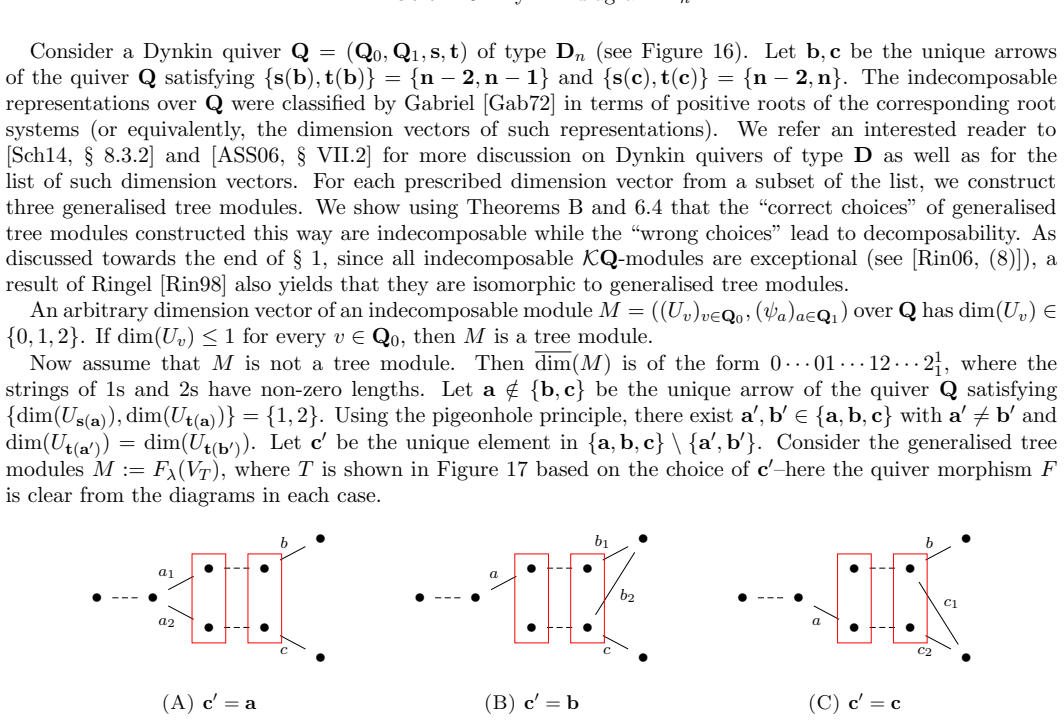
- Every indecomposable module over a Dynkin quiver of type $D$ is isomorphic to a generalised tree module; the paper constructs an explicit tree for each dimension vector and shows the correct tree choice is indecomposable while wrong choices give decomposable modules.
Reading between the lines
- If the answer to the paper's Question 5.8 is affirmative, the ghost-free condition is an artefact of the support-carving induction rather than a genuine obstruction; a direct test is to take the ghost of Example 5.4 and check whether the zero homomorphism it defines can be written as a combination of generalised graph maps with strictly smaller supports.
- Because the generalised graph maps are finite in number but not linearly independent in general, the dimension of the Hom-space can be computed by evaluating the finite set of homomorphisms $H_G$ on a basis and taking the rank, yielding a purely combinatorial dimension formula for ghost-free pairs.
- The explicit construction for type $D$ suggests a pattern for other Dynkin quivers: choose the defining tree so that completeness conditions fail at exactly the vertices that would create off-diagonal support, then apply Theorem B; since every indecomposable over a Dynkin quiver is exceptional, such explicit trees should exist, and finding them would turn the known existence theorem for exceptiona
- In characteristic 2 the 2-covering network collapses to the pullback network, so signs disappear and the distinction between graph maps and generalised graph maps vanishes; any statement that relies on the sign structure, including the ghost phenomenon, needs a separate formulation in characteristic 2.
Signed reviews
Editorial analysis
A structured set of objections, weighed in public.
Referee Report
Summary. The paper studies generalised tree modules over zero-relation algebras, obtained by dropping the injectivity condition in Crawley-Boevey's definition of tree module. The main result (Theorem A) claims that, when char(K) differs from 2 and the pair (M1,M2) is 'ghost-free', the space Hom(M1,M2) is spanned by homomorphisms attached to explicit finite combinatorial objects called generalised graph maps, defined as non-empty connected involution-free complete R[2]-free subnetworks of the 2-covering network N[2]. The proof proceeds by induction on the support of a homomorphism: Proposition 5.5 shows the support is complete, Proposition 4.5 carves out a complete R[2]-free subnetwork with the same vertices, Proposition 3.9 turns such subnetworks into homomorphisms, and Lemma 5.7 extracts a generalised graph map under the ghost-free hypothesis. Theorem B gives a sufficient condition for indecomposability of a generalised tree module, and Section 7 applies the results to construct indecomposable generalised tree modules for Dynkin quivers of type D, complementing Ringel's theorem that exceptional modules are generalised tree modules.
Significance. If the main theorem is correct, it is a meaningful extension of Crawley-Boevey's graph-map basis to a setting where basis elements may collide, giving a finite explicit generating set for Hom-spaces between generalised tree modules. The paper also provides a checkable indecomposability criterion and an explicit construction for type D Dynkin quivers, together with instructive examples of sign-flip homomorphisms and ghosts. The authors are transparent about the ghost-free scope and pose the natural open question whether it can be removed. However, the proof as written is not complete: Proposition 3.6 is stated without proof and is load-bearing for Proposition 3.9, while the carving arguments in Proposition 4.5 and Lemma 5.7 are underdetailed. The result is plausible, but the manuscript needs substantial revision before the central claim is established.
major comments (3)
- [Section 3, Proposition 3.6] Proposition 3.6 is stated with the words 'we mention without proof', yet it is used essentially in the proof of Proposition 3.9. Specifically, it supplies the uniqueness of arrows and edges needed for the partition into I2 and J2, for the existence and uniqueness of the arrow in Condition (2a), and for the injectivity of the maps F and F' that yield the equality of the sums over I3 and J3. The asserted equivalence between R[2]-freeness and the local exactly-one conditions is not a formal consequence of the definitions as far as the text shows; one must prove, for example, that two arrows satisfying Condition (1a) for the same incoming arrow of T1 would produce a traversal in R[2], and conversely that absence of all R[2]-traversals forces the exactly-one conditions at every vertex. A complete proof, or a precise reference, is required before Theorem A can be considered established.
- [Section 4, Proposition 4.5] The proof of Proposition 4.5 does not, as written, establish the claim. The construction partitions the vertices of each R[2]-system and chooses perfect matchings locally, but the text never verifies that the union of these choices is R[2]-free when hexagons overlap in antipodal vertices, a situation explicitly allowed by Remark 4.4. The completeness of the resulting subnetwork is also asserted rather than proved: the final sentence claims that for every removed link alpha there are links beta and gamma in M' with beta alpha and alpha gamma in R[2], but no construction or argument is supplied. Since Corollary 5.6 and hence the induction in Theorem A depend directly on this proposition, this is a load-bearing gap.
- [Section 5, Lemma 5.7] The proof of Lemma 5.7 is underdetailed at the two points that matter for the induction in Theorem A. First, the modification of M to M' is described by cases, but the argument does not show that the modified links do not create new blocked traversals together with links from adjacent R[2]-systems. Second, the completeness of G is asserted by saying that any link between two vertices of G0 present in M is already present in G; this is not immediate because M' was explicitly allowed to delete links from M, and a deleted link between two vertices of G0 would not be present in G. A direct verification of the completeness conditions at each vertex of G for every arrow of T1 and T2 is needed. As the inductive step of Theorem A, this lemma is load-bearing.
minor comments (4)
- [Definition 3.2(2b)] In Condition (2b), the displayed edge should be between (n,m,j) and (n,m'',-j); the printed version with (n'',m,-j) is inconsistent with the preceding vertex (n,m'',-j) and with the intended T2-sign-flip situation.
- [Proposition 3.9 proof] In the definition of J2, the set is written with set-minus I1; it should be set-minus J1, since J1 was already defined as the set of indices with zero coefficient.
- [Lemma 5.7] The line 'there exists (n0,m0,j0) in M'_0' refers to M' before M' has been defined; it should refer to the connected component M0 of the previously constructed subnetwork.
- [Proposition 3.9 proof] In the sentence discussing the coefficient of w_m, the subscript 0 is dropped; the intended coefficient is that of w_{m0}.
Circularity Check
No substantive circularity; the only self-citation is motivational and the central spanning theorem is proved from definitions.
full rationale
The paper's central claim Theorem A is not circular: generalised graph maps are defined directly as non-empty connected involution-free complete R[2]-free subnetworks of N[2] (Definition 3.10), and Proposition 3.9 independently proves that the associated linear maps are homomorphisms from the completeness and uniqueness conditions. The proof of Theorem A then shows by induction that every homomorphism is a finite linear combination of such maps; it uses Proposition 5.5 (support is complete), Proposition 4.5 (carving to a complete R[2]-free subnetwork), and Lemma 5.7 (extracting a generalised graph map from the support), none of which assumes the conclusion. No fitted parameters or definitions of the form 'X is defined as the object that makes the claimed conclusion true' occur. The only self-citation is [SK24] in Section 2, which is used solely as motivation for defining traversals; Definition 2.2 is self-contained and no proof relies on [SK24]. The ghost-free condition is an explicit hypothesis whose necessity is left open in Question 5.8, so it is a scope limitation rather than a circular assumption. I do flag Proposition 3.6 as stated without proof and load-bearing for Proposition 3.9 and hence for Theorem A; this is an omitted proof, not circularity, and therefore does not raise the circularity score. The Dynkin type D application is checked against explicit constructions and the quoted Ringel theorem, not derived from itself.
Assumptions & free parameters
assumptions (6)
- domain assumption The field K has characteristic not equal to 2.
- standard math Gabriel's theorem: tree modules over a zero-relation algebra are indecomposable.
- standard math Crawley-Boevey's basis theorem for Hom-sets of tree modules.
- standard math Assem-Simson-Skowronski criterion: a finite-dimensional module is indecomposable iff its endomorphism algebra has only two idempotents.
- standard math Ringel's theorem: all exceptional modules over the path algebra of a finite quiver are generalised tree modules.
- ad hoc to paper The pair (M1,M2) is ghost-free.
Cite this review
Pith. "Pith review of Generalised tree modules: Hom-sets and indecomposability." pith.science (2026). https://pith.science/paper/3ILMIZCY
@misc{pith2026250418996,
  author       = {Pith},
  title        = {Pith review of: Generalised tree modules: Hom-sets and indecomposability},
  year         = {2026},
  howpublished = {\url{https://pith.science/paper/3ILMIZCY}},
  note         = {Machine review of arXiv:2504.18996}
}
abstract
For a zero-relation algebra over a field $\mathcal K$, Crawley-Boevey introduced the concept of a tree module and provided a combinatorial description of a basis for the space of homomorphisms between two tree modules--the basis elements are called graph maps. The indecomposability of tree modules is essentially due to Gabriel. We relax a condition in the definition of a tree module to define generalised tree modules and when $\mathrm{char}(\mathcal K)\neq2$, under a certain condition, provide a combinatorial description of a finite generating set for the space of homomorphisms between two such modules--we call the generators generalised graph maps. As an application, we provide a sufficient condition for the (in)decomposability of certain generalised tree modules. We also show that all indecomposable modules over a Dynkin quiver of type $\mathbf D$ are isomorphic to generalised tree modules--this result also follows from a theorem of Ringel which states that all exceptional modules over the path algebra $\mathcal KQ$ of a finite quiver $Q$ are generalised tree modules.
Figures


Figures from the paper (17 more)




Forward citations
Cited by 1 Pith paper
-
Rooted tree modules
A rooted tree module over a zero-relation algebra is indecomposable (char K not 2) exactly when the defining tree has no nontrivial idempotent self-map, giving checkable splitting and construction algorithms.
Reference graph
Works this paper leans on
-
[2]
Covering spaces in representation-theory
Klaus Bongartz and Peter Gabriel. Covering spaces in representation-theory. Invent. Math. , 65:331--378, 1982
work page 1982
-
[1]
Elements of the Representation Theory of Associative Algebras: Volume 1: Techniques of Representation Theory
Ibrahim Assem, Daniel Simson, and Andrzej Skowronski. Elements of the Representation Theory of Associative Algebras: Volume 1: Techniques of Representation Theory . Cambridge University Press, 2006
2006
-
[3]
Crawley-Boevey
William W. Crawley-Boevey. Maps between representations of zero-relation algebras. Journal of Algebra , 126(2):259--263, 1989
1989
-
[4]
Unzerlegbare D arstellungen
Peter Gabriel. Unzerlegbare D arstellungen. I . Manuscripta Math. , 6:71--103; correction, ibid. 6 (1972), 309, 1972
1972
-
[5]
The universal cover of a representation-finite algebra
Peter Gabriel. The universal cover of a representation-finite algebra. In Representations of algebras ( P uebla, 1980) , volume 903 of Lecture Notes in Math. , pages 68--105. Springer, Berlin-New York, 1981
1980
-
[6]
Frank Harary and Ed Palmer. Enumeration of mixed graphs. Proceedings of the American Mathematical Society , 17(3):682--687, 1966
work page 1966
-
[7]
Rank functions on rooted tree quivers
Ryan Kinser. Rank functions on rooted tree quivers. Duke mathematical journal , 152(1):27 -- 92, 2010
work page 2010
-
[8]
Reduced representations of rooted trees
Valentin Katter and Nils Mahrt. Reduced representations of rooted trees. Journal of Algebra , 413:41--49, 2014
2014
Show all 13 references
-
[9]
Combinatorics on words , volume 17
Monsieur Lothaire. Combinatorics on words , volume 17. Cambridge University Press, 1997
1997
-
[10]
Exceptional modules are tree modules
Claus Michael Ringel. Exceptional modules are tree modules. Linear Algebra and its Applications , 275-276:471--493, 1998
1998
-
[11]
Tame algebras and integral quadratic forms , volume 1099
Claus M Ringel. Tame algebras and integral quadratic forms , volume 1099. Springer, 2006
2006
-
[12]
Quiver representations
Ralf Schiffler. Quiver representations . CMS Books in Mathematics. Springer, Cham, 2014
2014
-
[13]
Characterisation of band bricks over certain string algebras and a variant of perfectly clustering words
Annoy Sengupta and Amit Kuber. Characterisation of band bricks over certain string algebras and a variant of perfectly clustering words. arXiv preprint arXiv:2402.05656 , 2024
2024 arXiv
Reviewed August 16, 2026 · model on record in the stance chip above.
Discussion (0). Continue with ORCID to comment.