REVIEW 3 major objections 5 minor 78 references
SnuggleSense: Empowering Online Harm Survivors Through a Structured Sensemaking Process
T0 review · 3 major / 5 minor · reviewed 2026-08-16 · deepseek-v4-flash
Pith's one-line read A structured, restorative-justice-inspired process helps online harm survivors make sense of the harm, a controlled experiment finds.
desk verdict A genuinely new support system for online harm survivors with a solid but overclaimed evaluation: the 'unstructured' control is itself a structured writing task, so the size of the reported effect should be read with caution. read the letter →
The pith
A machine-rendered reading of the paper's core claim, the machinery that carries it, and where it could break.
The reading
What carries the argument
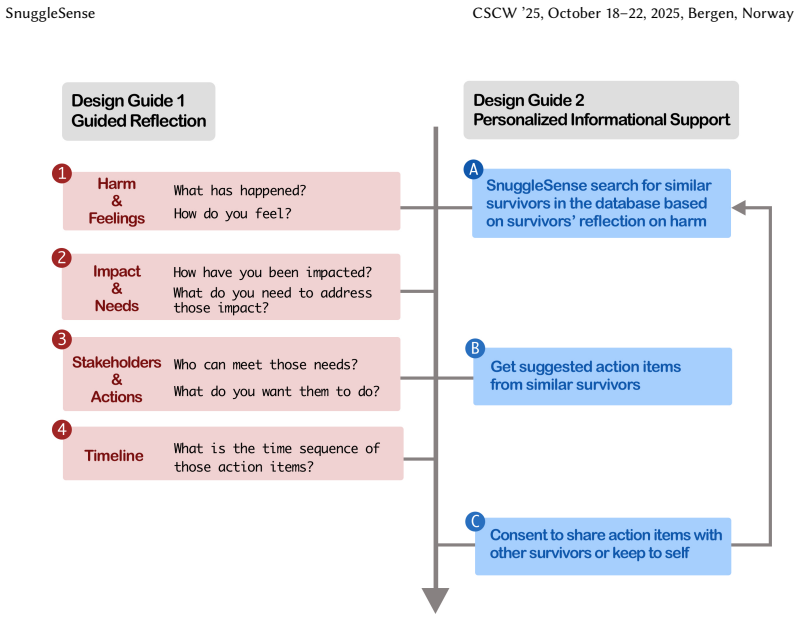
The central mechanism is SnuggleSense's structured sensemaking pipeline, modeled on restorative justice practices of pre-conference and circles: a guided reflection sequence asks survivors to describe the harm, their feelings, the impacts, and their needs; a similarity score over multiple-choice harm descriptors matches each survivor to three similar prior users whose action items are offered as recommendations; and survivors assemble stakeholder-action items on a chronological sticky-note timeline, with an option to contribute their own plan back to the shared repository. This pipeline is what carries the argument, because it converts the abstract idea of survivor-centered sensemaking into a concrete, repeatable procedure that can be compared against unguided planning.
What would settle it
A study that lets survivors make sense of harm with no imposed format, such as free writing, talking with a friend, or browsing support threads, and compares that against SnuggleSense on the same self-report scales would settle whether the structured process itself, rather than the sparse control prompt, drives the gains.
Extended reading notes
Core claim
In a within-subject experiment with 32 recent survivors, the paper found that participants rated the structured SnuggleSense process significantly higher than an unstructured writing task on sensemaking (M = 6.06 versus 4.75, p < .001), guidance, support, and empowerment, while ratings of agency did not differ significantly between the two conditions. Action plans produced with SnuggleSense contained more distinct stakeholders (M = 4.34 versus 3.16) and more action items (M = 6.25 versus 4.50), and the recommended items from similar survivors were adopted by 81.25% of participants. The paper interprets these results as evidence that a structured, restorative-justice-inspired process expands survivors' awareness of available resources and community support, shifting their plans away from self-focused coping such as ignoring, blocking, or deleting and toward involving family, friends, online community members, and even asking offenders to explain their motivations.
Load-bearing premise
The results assume that the control task, writing an action plan directly as a list of stakeholder-action items, is a fair stand-in for how survivors naturally make sense of harm; if unguided sensemaking is usually more free-form, social, or iterative, the measured advantage may be partly an artifact of how bare the control prompt is.
Editorial extensions
If this is right
- If the result holds, survivor-facing platforms can treat structured reflection plus peer suggestions as a viable complement to reporting and content moderation.
- Users in the structured condition produced action plans with significantly more stakeholders and more action items, suggesting the system widens the solution space survivors consider.
- Because agency ratings did not differ between conditions, the design suggests guidance can be added without making survivors feel they have lost control over their own plan.
- The observed shift from self-directed coping toward community involvement and requests for explanation aligns survivors' action plans more closely with restorative justice ideals of healing and restoration.
Reading between the lines
- Beyond the paper, a natural test is whether the larger action plans produced under SnuggleSense translate into actual steps taken over subsequent weeks; the paper itself flags longitudinal follow-up as future work.
- The similarity engine, which currently matches survivors on four multiple-choice harm descriptors, could be extended with needs-based or identity-based similarity measures to serve more diverse survivor populations, a possibility the paper leaves open.
- The same guided pipeline could be adapted for adjacent goals, such as evidence documentation, formal reporting, or community education, by changing the reflection prompts and the targets of the recommendations.
Signed reviews
Editorial analysis
A structured set of objections, weighed in public.
Referee Report
Summary. This paper presents SnuggleSense, a web-based system that supports online-harm survivors through a structured sensemaking process inspired by restorative justice: guided reflection on the harm, emotions, impacts, and needs; creation of stakeholder-and-action items on interactive sticky notes; recommendations from similar survivors; and chronological organization on a timeline. The authors evaluate the system in a within-subject, controlled experiment with 32 university students who had experienced online harm in the previous six months, comparing SnuggleSense to a control condition in which participants were asked to develop an action plan by directly writing a sequence of action items, each specifying a stakeholder and corresponding actions. The paper reports significantly higher self-report ratings for the structured condition on guidance, support, sensemaking, and empowerment, as well as significantly more stakeholders and action items in the plans produced with SnuggleSense. The qualitative data and participant quotes are used to illustrate the perceived benefits, and the authors discuss design implications for survivor-centered social computing and restorative justice.
Significance. If the central claim holds, the paper makes a useful contribution to the HCI/CSCW literature on survivor-centered responses to online harm. It offers a concrete, implemented system, a transparent similarity metric that is not fitted against outcome measures (§3.2.3), randomized order of conditions, a positionality statement, and a candid limitations section. The qualitative quotes substantiate that users found the structured process helpful. However, the headline quantitative claim is weakened by two construct-validity problems described below, and the experiment is best read as an exploratory demonstration of a design concept with a perceived-helpfulness evaluation, not as a rigorous causal test that SnuggleSense enhances sensemaking compared to genuinely unstructured sensemaking. With revised claims or additional control conditions, the work could be a valuable starting point for future restorative-justice-oriented tools.
major comments (3)
- [Abstract; §4.1] The abstract's claim that SnuggleSense 'significantly enhances sensemaking compared to an unstructured process of making sense of the harm' outruns the experiment. The control condition is described as participants being asked to 'develop an action plan by directly writing a sequence of action items, each specifying a stakeholder and their corresponding actions' (§4.1). This is itself a structured task that imposes the same stakeholder-action decomposition and linear output format that SnuggleSense scaffolds, while omitting the system's other elements. The data therefore support the more limited claim that SnuggleSense is rated more helpful than a writing-only baseline; they do not compare against the natural, open-ended, iterative, or social processes that 'unstructured sensemaking' would typically involve. The paper should either add a genuinely unstructured control condition (e.g., free-form reflection or journaling without an imposed schema) or revise the abstract, introduction, and discussion (§6.1.1) to describe the comparison to a text-only action-planning task.
- [§4.2.1; Figure 3] The central outcome—'assistance in sensemaking'—is a single-item, self-authored rating scale with no demonstrated reliability or validity. There is no multi-item scale, no prior validation, and no convergent or objective measure of sensemaking. Single-item self-reports are particularly weak for an abstract construct, because the rating may reflect the perceived structure of the interface rather than an improved psychological process. Demand characteristics are also salient: the five survey categories (guidance, support, agency, sensemaking, empowerment) explicitly mirror the system's design goals, the researcher was present via Zoom during the study (§4.5), and the within-subject design invites direct comparison between conditions. I recommend either (a) reporting a validated or at least multi-item sensemaking scale, (b) adding a behavioral or objective measure, or (c) explicitly reframing the conclusions to 'perceived improvement in sensemaking' and discussing these measurement threats in the limitations section.
- [§5.4; §6.1.1] The plan-complexity results (more stakeholders and more action items in the Structured condition; §5.4.1) are treated in §6.1.1 as evidence that the system 'enhances the knowledge survivors need to address the harm.' This inference is questionable because 42.22% of the action items in the Structured condition were adopted directly from the system's suggestions, and the reflection questions explicitly prompt users to consider multiple stakeholder types. More numerous actions and stakeholders may therefore reflect the scaffolding and the suggestion feature rather than a cognitive gain in sensemaking. The discussion should either test the incremental effect of the suggestion feature (e.g., by including a structured condition without recommendations) or soften the causal language about the content-level differences.
minor comments (5)
- [Page 1 (CCS Concepts and Keywords)] The ACM CCS Concepts and Additional Key Words fields contain placeholder text unrelated to the paper (e.g., 'Computer systems organization→ Embedded systems; Redundancy; Robotics; Networks→ Network reliability' and 'datasets, neural networks, gaze detection, text tagging'). These should be corrected before publication.
- [§3.2.3, Eq. (1)] The notation 'I_{ik,jk}' is unclear; the indicator function I should be defined explicitly as a function of whether survivors i and j both selected (or both did not select) a particular option. Also, the text 'if both survivors either selected or did not select an option, 1/n is added' should specify 'for that option and question' to make the summation in the equation concrete.
- [§5.4.2, Tables 4 and 5] Some entries are formatted inconsistently (e.g., '72%' versus '87.50%'), and the percentages per category exceed 100% because participants can appear in multiple categories; the table captions should state that percentages are per participant and are not mutually exclusive.
- [§6.3.4] The text contains a typo: 'SunggleSense' should read 'SnuggleSense' in the final paragraph of this subsection.
- [§4.1] Please clarify whether the full 15-minute allotment applied to the entire SnuggleSense process (including the reflection questions and browsing of recommendations) or only to the action-item creation phase; if the former, differing time pressure between conditions should be noted as a limitation, and if the latter, the condition comparison of effort is not balanced.
Circularity Check
No significant circularity: the study's claims rest on an experimental comparison, not on a fitted parameter or self-citation chain.
full rationale
The paper makes no formal predictive claim that reduces to its inputs. SnuggleSense's only algorithmic component is the similarity score S_ij defined in Section 3.2.3 from survivors' multiple-choice answers; it is not fitted to, or calibrated against, any of the study's outcome measures, and the recommendations it produces are not the quantities the experiment evaluates. The central empirical claim—that the Structured condition received higher self-reported sensemaking ratings than the Unstructured condition (Section 5.1, Figure 3)—is a direct comparison of two experimental conditions, and the rating scale is not constructed from the system's output. The paper's citations to the authors' prior restorative-justice work (e.g., Xiao et al., CHI 2022) supply design inspiration and conceptual framing rather than a theorem whose acceptance forces the reported result. The control-condition concern raised by the reader is a construct-validity or external-validity critique of whether the writing task represents 'unstructured sensemaking'; it is not a case where the claimed effect is equivalent to the input by construction. No fitted parameter is renamed as a prediction, no uniqueness theorem is imported from the authors' own prior papers, and no equation reduces to itself. The analysis therefore finds no significant circularity.
Assumptions & free parameters
free parameters (3)
- top_similar_survivors_k =
3
- initial_suggestion_count =
4
- harm_dimension_questions =
four multiple-choice dimensions (harm nature, location, number of offenders, relationship to offender)
assumptions (4)
- domain assumption The Unstructured condition is a valid proxy for an unstructured process of making sense of the harm.
- domain assumption Single-item 1-7 Likert ratings validly measure the constructs of guidance, support, agency, sensemaking, and empowerment.
- domain assumption Within-subject comparison using the same recalled harm event, with randomized order, adequately controls carryover and learning effects.
- standard math Paired t-tests on 1-7 Likert ratings are appropriate for the five design-goal comparisons.
invented entities (1)
-
SnuggleSense
Cite this review
Pith. "Pith review of SnuggleSense: Empowering Online Harm Survivors Through a Structured Sensemaking Process." pith.science (2026). https://pith.science/paper/DVDOGY44
@misc{pith2026250419158,
  author       = {Pith},
  title        = {Pith review of: SnuggleSense: Empowering Online Harm Survivors Through a Structured Sensemaking Process},
  year         = {2026},
  howpublished = {\url{https://pith.science/paper/DVDOGY44}},
  note         = {Machine review of arXiv:2504.19158}
}
read the original abstract
Online interpersonal harm, such as cyberbullying and sexual harassment, remains a pervasive issue on social media platforms. Traditional approaches, primarily content moderation, often overlook survivors' needs and agency. We introduce SnuggleSense, a system that empowers survivors through structured sensemaking. Inspired by restorative justice practices, SnuggleSense guides survivors through reflective questions, offers personalized recommendations from similar survivors, and visualizes plans using interactive sticky notes. A controlled experiment demonstrates that SnuggleSense significantly enhances sensemaking compared to an unstructured process of making sense of the harm. We argue that SnuggleSense fosters community awareness, cultivates a supportive survivor network, and promotes a restorative justice-oriented approach toward restoration and healing. We also discuss design insights, such as tailoring informational support and providing guidance while preserving survivors' agency.
Figures


Reference graph
Works this paper leans on
-
[1]
Ivo Aertsen, Daniela Bolívar, Nathalie Lauwers, et al. 2011. Restorative justice and the active victim: exploring the concept of empowerment. Temida 14, 1 (2011), 5–19
work page 2011
-
[2]
Tawfiq Ammari, Sarita Schoenebeck, and Daniel Romero. 2019. Self-declared throwaway accounts on Reddit: How platform affordances and shared norms enable parenting disclosure and support. Proceedings of the ACM on Human- Computer Interaction 3, CSCW (2019), 1–30
2019
-
[3]
Nazanin Andalibi and Patricia Garcia. 2021. Sensemaking and coping after pregnancy loss: the seeking and disruption of emotional validation online. Proceedings of the ACM on Human-Computer Interaction 5, CSCW1 (2021), 1–32
work page 2021
-
[4]
Nazanin Andalibi, Pinar Ozturk, and Andrea Forte. 2017. Sensitive self-disclosures, responses, and social support on Instagram: The case of# depression. In Proceedings of the 2017 ACM conference on computer supported cooperative work and social computing. 1485–1500
work page 2017
-
[5]
Kristen Barta, Katelyn Wolberg, and Nazanin Andalibi. 2023. Similar Others, Social Comparison, and Social Support in Online Support Groups. Proceedings of the ACM on Human-Computer Interaction 7, CSCW2 (2023), 1–35
work page 2023
-
[6]
Lindsay Blackwell, Tianying Chen, Sarita Schoenebeck, and Cliff Lampe. 2018. When Online Harassment Is Perceived as Justified. (2018), 10
work page 2018
-
[7]
Lindsay Blackwell, Jill Dimond, Sarita Schoenebeck, and Cliff Lampe. 2017. Classification and Its Consequences for Online Harassment: Design Insights from HeartMob. Proceedings of the ACM on Human-Computer Interaction 1 (Dec. 2017), 1–19. https://doi.org/10.1145/3134659
doi:10.1145/3134659 2017
-
[8]
Lindsay Blackwell, Nicole Ellison, Natasha Elliott-Deflo, and Raz Schwartz. 2019. Harassment in social virtual reality: Challenges for platform governance. Proceedings of the ACM on Human-Computer Interaction 3, CSCW (2019), 1–25
work page 2019
Show all 78 references
-
[9]
Magdalena Celuch, Reetta Oksa, Nina Savela, and Atte Oksanen. 2021. Longitudinal effects of cyberbullying at work on well-being and strain: A five-wave survey study. new media & society (2021), 14614448221100782
2021
-
[10]
Eshwar Chandrasekharan, Chaitrali Gandhi, Matthew Wortley Mustelier, and Eric Gilbert. 2019. Crossmod: A cross- community learning-based system to assist reddit moderators. Proceedings of the ACM on human-computer interaction 3, CSCW (2019), 1–30
2019
-
[11]
Gary Charness, Uri Gneezy, and Michael A Kuhn. 2012. Experimental methods: Between-subject and within-subject design. Journal of economic behavior & organization 81, 1 (2012), 1–8
2012
-
[12]
David M Chavis and Abraham Wandersman. 1990. Sense of community in the urban environment: A catalyst for participation and community development. American journal of community psychology 18, 1 (1990), 55–81
1990
-
[13]
Janet X Chen, Allison McDonald, Yixin Zou, Emily Tseng, Kevin A Roundy, Acar Tamersoy, Florian Schaub, Thomas Ristenpart, and Nicola Dell. 2022. Trauma-informed computing: Towards safer technology experiences for all. In Proceedings of the 2022 CHI conference on human factors ...
2022
-
[14]
Kathleen Daly. 2003. Restorative justice: The real story. Restorative justice: Critical issues 3, 1 (2003), 195
2003
-
[15]
Mithun Das, Binny Mathew, Punyajoy Saha, Pawan Goyal, and Animesh Mukherjee. 2020. Hate speech in online social media. ACM SIGWEB Newsletter Autumn (2020), 1–8
2020
-
[16]
Angela Dean and Daniel Voss. 1999. Design and analysis of experiments . Springer
1999
-
[17]
Jill P Dimond, Michaelanne Dye, Daphne LaRose, and Amy S Bruckman. 2013. Hollaback! The role of storytelling online in a social movement organization. In Proceedings of the 2013 conference on Computer supported cooperative work. 477–490
2013
-
[18]
Maeve Duggan. 2017. Online Harassment 2017. https://www.pewresearch.org/internet/2017/07/11/online-harassment- 2017/
2017
-
[19]
Matthew Evans. 2016. Structural Violence, Socioeconomic Rights, and Transformative Justice. Journal of Human Rights 15, 1 (Jan. 2016), 1–20. https://doi.org/10.1080/14754835.2015.1032223
2016
-
[20]
Stephen B Fawcett, Glen W White, Fabricio E Balcazar, Yolanda Suarez-Balcazar, R Mark Mathews, Adrienne Paine- Andrews, Tom Seekins, and John F Smith. 1994. A contextual-behavioral model of empowerment: Case studies involving people with physical disabilities. American Journal...
1994
-
[21]
Jesse Fox and Wai Yen Tang. 2017. Women’s experiences with general and sexual harassment in online video games: Rumination, organizational responsiveness, withdrawal, and coping strategies. New media & society 19, 8 (2017), 1290–1307
2017
-
[22]
Nancy Fraser. 1990. Rethinking the Public Sphere: A Contribution to the Critique of Actually Existing Democracy. Social Text 25/26 (1990), 56–80. https://doi.org/10.2307/466240 jstor:466240
1990 doi
-
[23]
Diana Freed, Natalie N Bazarova, Sunny Consolvo, Eunice Han, Patrick Gage Kelley, Kurt Thomas, and Dan Cosley
-
[24]
David Garland. 1993. Punishment and modern society: A study in social theory . University of Chicago Press
1993
-
[25]
Alix Gerber. 2018. Participatory speculation: Futures of public safety. In Proceedings of the 15th Participatory Design Conference: Short Papers, Situated Actions, Workshops and Tutorial-Volume 2 . 1–4. 25 CSCW ’25, October 18–22, 2025, Bergen, Norway Xiao et al
2018
-
[26]
Tarleton Gillespie. 2018. Custodians of the Internet: Platforms, content moderation, and the hidden decisions that shape social media. Yale University Press
2018
-
[27]
Nitesh Goyal, Leslie Park, and Lucy Vasserman. 2022. ”You have to prove the threat is real”: Understanding the needs of Female Journalists and Activists to Document and Report Online Harassment. In CHI Conference on Human Factors in Computing Systems. 1–17
2022
-
[28]
Maggie Hughes and Deb Roy. 2020. Keeper: An Online Synchronous Conversation Environment Informed by In-Person Facilitation Practices. In Conference Companion Publication of the 2020 on Computer Supported Cooperative Work and Social Computing. 275–279
2020
-
[29]
Jane Im, Jill Dimond, Melody Berton, Una Lee, Katherine Mustelier, Mark S Ackerman, and Eric Gilbert. 2021. Yes: Affirmative consent as a theoretical framework for understanding and imagining social platforms. In Proceedings of the 2021 CHI conference on human factors in compu...
2021
-
[30]
Jane Im, Sarita Schoenebeck, Marilyn Iriarte, Gabriel Grill, Daricia Wilkinson, Amna Batool, Rahaf Alharbi, Audrey Funwie, Tergel Gankhuu, Eric Gilbert, et al. 2022. Women’s Perspectives on Harm and Justice after Online Harassment. Proceedings of the ACM on Human-Computer Inte...
2022
-
[31]
Shagun Jhaver, Amy Bruckman, and Eric Gilbert. 2019. Does transparency in moderation really matter? User behavior after content removal explanations on reddit. Proceedings of the ACM on Human-Computer Interaction 3, CSCW (2019), 1–27
2019
-
[32]
Gerry Johnstone and Daniel Van Ness. 2013. Handbook of restorative justice . Routledge
2013
-
[33]
Naveena Karusala, Sohini Upadhyay, Rajesh Veeraraghavan, and Krzysztof Z Gajos. 2024. Understanding Contestability on the Margins: Implications for the Design of Algorithmic Decision-making in Public Services. In Proceedings of the CHI Conference on Human Factors in Computing ...
2024
-
[34]
Yubo Kou. 2021. Punishment and Its Discontents: An Analysis of Permanent Ban in an Online Game Community. Proceedings of the ACM on Human-Computer Interaction 5, CSCW2 (2021), 1–21
2021
-
[35]
Glenn Laverack. 2006. Improving health outcomes through community empowerment: a review of the literature. Journal of Health, Population and Nutrition (2006), 113–120
2006
-
[36]
Jooyoung Lee, Sarah Rajtmajer, Eesha Srivatsavaya, and Shomir Wilson. 2023. Online Self-Disclosure, Social Support, and User Engagement During the COVID-19 Pandemic. Trans. Soc. Comput. 6, 3–4, Article 7 (dec 2023), 31 pages. https://doi.org/10.1145/3617654
2023 doi
-
[37]
Hanlin Li, Lynn Dombrowski, and Erin Brady. 2018. Working toward empowering a community: How immigrant- focused nonprofit organizations use Twitter during political conflicts. In Proceedings of the 2018 ACM International Conference on Supporting Group Work. 335–346
2018
-
[38]
Wookjae Maeng and Joonhwan Lee. 2022. Designing and Evaluating a Chatbot for Survivors of Image-Based Sexual Abuse. In CHI Conference on Human Factors in Computing Systems . ACM, New Orleans LA USA, 1–21. https: //doi.org/10.1145/3491102.3517629
2022
-
[39]
Zhang, and David Karger
Kaitlin Mahar, Amy X. Zhang, and David Karger. 2018. Squadbox: A Tool to Combat Email Harassment Using Friendsourced Moderation. In Proceedings of the 2018 CHI Conference on Human Factors in Computing Systems . ACM, Montreal QC Canada, 1–13. https://doi.org/10.1145/3173574.3174160
2018
-
[40]
Paul McCold. 2000. Toward a mid-range theory of restorative criminal justice: A reply to the Maximalist model. Contemporary Justice Review 3, 4 (2000), 357–414
2000
-
[41]
social priming
Daniel C Molden. 2014. Understanding priming effects in social psychology: What is “social priming” and how does it occur? Social cognition 32, Supplement (2014), 1–11
2014
-
[42]
Tyler Musgrave, Alia Cummings, and Sarita Schoenebeck. 2022. Experiences of Harm, Healing, and Joy among Black Women and Femmes on Social Media. In CHI Conference on Human Factors in Computing Systems . 1–17
2022
-
[43]
Bich Ngoc, Joseph Seering, et al . 2025. The Design Space for Online Restorative Justice Tools: A Case Study with ApoloBot. In CHI Conference on Human Factors in Computing Systems . 1–15
2025
-
[44]
Jessica Pater and Elizabeth Mynatt. 2017. Defining digital self-harm. In Proceedings of the 2017 ACM Conference on Computer Supported Cooperative Work and Social Computing . 1501–1513
2017
-
[45]
João Paulo Pesce, Diego Las Casas, Gustavo Rauber, and Virgílio Almeida. 2012. Privacy attacks in social media using photo tagging networks: a case study with Facebook. In Proceedings of the 1st Workshop on Privacy and Security in Online Social Media. 1–8
2012
-
[46]
Kay Pranis. 2015. Little book of circle processes: A new/old approach to peacemaking . Simon and Schuster
2015
-
[47]
J Rappaport. 1987. Terms of Empowerment: Theories for Community Psychology. American Journal of Community Psychology 15, 2 (1987), 122–144
1987
-
[48]
Sarah T Roberts. 2019. Behind the screen. Yale University Press
2019
-
[49]
Oliver C Robinson. 2014. Sampling in interview-based qualitative research: A theoretical and practical guide.Qualitative research in psychology 11, 1 (2014), 25–41. Publisher: Taylor & Francis
2014
-
[50]
Niloufar Salehi. 2020. Do no harm. Logic Magazine (2020). 26 SnuggleSense CSCW ’25, October 18–22, 2025, Bergen, Norway
2020
-
[51]
Devansh Saxena and Shion Guha. 2024. Algorithmic harms in child welfare: Uncertainties in practice, organization, and street-level decision-making. ACM Journal on Responsible Computing 1, 1 (2024), 1–32
2024
-
[52]
Hanna Schneider, Malin Eiband, Daniel Ullrich, and Andreas Butz. 2018. Empowerment in HCI-A survey and framework. In Proceedings of the 2018 CHI Conference on Human Factors in Computing Systems . 1–14
2018
-
[53]
Sarita Schoenebeck, Amna Batool, Giang Do, Sylvia Darling, Gabriel Grill, Daricia Wilkinson, Mehtab Khan, Kentaro Toyama, and Louise Ashwell. 2023. Online Harassment in Majority Contexts: Examining Harms and Remedies across Countries. https://doi.org/10.1145/3544548.3581020 ar...
2023
-
[54]
Sarita Schoenebeck, Oliver L Haimson, and Lisa Nakamura. 2021. Drawing from justice theories to support targets of online harassment. new media & society 23, 5 (2021), 1278–1300
2021
-
[55]
Carol F Scott, Gabriela Marcu, Riana Elyse Anderson, Mark W Newman, and Sarita Schoenebeck. 2023. Trauma- informed social media: Towards solutions for reducing and healing online harm. In Proceedings of the 2023 CHI Conference on Human Factors in Computing Systems . 1–20
2023
-
[56]
Joseph Seering, Tony Wang, Jina Yoon, and Geoff Kaufman. 2019. Moderator engagement and community development in the age of algorithms. New Media & Society 21, 7 (2019), 1417–1443
2019
-
[57]
Kate Starbird, Ahmer Arif, and Tom Wilson. 2019. Disinformation as collaborative work: Surfacing the participatory nature of strategic information operations. Proceedings of the ACM on Human-Computer Interaction 3, CSCW (2019), 1–26
2019
-
[58]
Najmul Islam, Ishtiaque Syed, Ahmed, Mitrasree Deb, S M Raihanul Alam, Ashraful Amin, and Syed Ishtiaque Ahmed
Sharifa Sultana, Deb Mitrasree, Buet, Ananya Bhattacharjee, Shaid Hasan, S Raihanul, Alam Buet, Trishna Chakraborty, Prianka Roy, Samira Ahmed, Aparna Moitra, M Amin, A.K.M. Najmul Islam, Ishtiaque Syed, Ahmed, Mitrasree Deb, S M Raihanul Alam, Ashraful Amin, and Syed Ishtiaqu...
2021
-
[59]
Sharifa Sultana, Sadia Tasnuva Pritha, Rahnuma Tasnim, Anik Das, Rokeya Akter, Shaid Hasan, SM Raihanul Alam, Muhammad Ashad Kabir, and Syed Ishtiaque Ahmed. 2022. ‘ShishuShurokkha’: A Transformative Justice Approach for Combating Child Sexual Abuse in Bangladesh. In CHI Confe...
2022
-
[60]
It’s Common and a Part of Being a Content Creator
Kurt Thomas, Patrick Gage Kelley, Sunny Consolvo, Patrawat Samermit, and Elie Bursztein. 2022. “It’s Common and a Part of Being a Content Creator”: Understanding How Creators Experience and Cope with Hate and Harassment Online. In CHI Conference on Human Factors in Computing S...
2022
-
[61]
They Just Don’t Get It
Alexandra To, Wenxia Sweeney, Jessica Hammer, and Geoff Kaufman. 2020. " They Just Don’t Get It": Towards Social Technologies for Coping with Interpersonal Racism. Proceedings of the ACM on Human-Computer Interaction 4, CSCW1 (2020), 1–29
2020
-
[62]
Kristen Vaccaro, Ziang Xiao, Kevin Hamilton, and Karrie Karahalios. 2021. Contestability For Content Moderation. Proceedings of the ACM on Human-Computer Interaction 5, CSCW2 (2021), 1–28
2021
-
[63]
Daniel W Van Ness. 2016. An overview of restorative justice around the world. (2016)
2016
-
[64]
Jessica Vitak, Kalyani Chadha, Linda Steiner, and Zahra Ashktorab. 2017. Identifying women’s experiences with and strategies for mitigating negative effects of online harassment. In Proceedings of the 2017 ACM Conference on Computer Supported Cooperative Work and Social Comput...
2017
-
[65]
Emily A Vogels. 2021. The state of online harassment. Pew Research Center 13 (2021)
2021
-
[66]
Ron Wakkary, William Odom, Sabrina Hauser, Garnet Hertz, and Henry Lin. 2015. Material speculation: Actual artifacts for critical inquiry. In Proceedings of The Fifth Decennial Aarhus Conference on Critical Alternatives . 97–108
2015
-
[67]
Mazurek, Manya Sleeper, and Kurt Thomas
Noel Warford, Tara Matthews, Kaitlyn Yang, Omer Akgul, Sunny Consolvo, Patrick Gage Kelley, Nathan Malkin, Michelle L. Mazurek, Manya Sleeper, and Kurt Thomas. 2021. SoK: A Framework for Unifying At-Risk User Research. arXiv:arXiv:2112.07047
2021
-
[68]
Karl E Weick. 1995. Sensemaking in organizations. Vol. 3. Sage
1995
-
[69]
Wong and Tonya Nguyen
Richmond Y. Wong and Tonya Nguyen. 2021. Timelines: A World-Building Activity for Values Advocacy. InProceedings of the 2021 CHI Conference on Human Factors in Computing Systems . ACM, Yokohama Japan, 1–15. https://doi.org/10. 1145/3411764.3445447
2021
-
[70]
William R Wood and Masahiro Suzuki. 2016. Four challenges in the future of restorative justice. Victims & Offenders 11, 1 (2016), 149–172
2016
-
[71]
Sijia Xiao, Coye Cheshire, and Amy Bruckman. 2021. Sensemaking and the Chemtrail Conspiracy on the Internet: Insights from Believers and Ex-believers. Proceedings of the ACM on Human-Computer Interaction 5, CSCW2 (2021), 1–28
2021
-
[72]
Sijia Xiao, Coye Cheshire, and Niloufar Salehi. 2022. Sensemaking, Support, Safety, Retribution, Transformation: A Restorative Justice Approach to Understanding Adolescents’ Needs for Addressing Online Harm. In CHI Conference on Human Factors in Computing Systems . 1–15
2022
-
[73]
Sijia Xiao, Shagun Jhaver, and Niloufar Salehi. 2023. Addressing Interpersonal Harm in Online Gaming Communities: The Opportunities and Challenges for a Restorative Justice Approach. ACM Transactions on Computer-Human 27 CSCW ’25, October 18–22, 2025, Bergen, Norway Xiao et al...
2023
-
[74]
Mireia Yurrita, Dave Murray-Rust, Agathe Balayn, and Alessandro Bozzon. 2022. Towards a multi-stakeholder value-based assessment framework for algorithmic systems. In Proceedings of the 2022 ACM Conference on Fairness, Accountability, and Transparency. 535–563
2022
-
[75]
Marcel Zeelenberg and Seger M Breugelmans. 2008. The role of interpersonal harm in distinguishing regret from guilt. Emotion 8, 5 (2008), 589
2008
-
[76]
Howard Zehr. 2015. The little book of restorative justice: Revised and updated . Simon and Schuster
2015
-
[77]
Marc A Zimmerman. 2000. Empowerment theory. In Handbook of community psychology . Springer, 43–63. 28
2000
-
[2023]
Understanding Digital-Safety Experiences of Youth in the U.S. (2023)
2023
Reviewed August 16, 2026 · model on record in the stance chip above.
Discussion (0). Continue with ORCID to comment.