REVIEW 3 minor 15 references
Enumeration of Corona for Lozenge Tilings
T0 review · 0 major / 3 minor · reviewed 2026-05-22 · grok-4.3
Pith's one-line read Exact closed formulas for corona counts in lozenge tilings are proven via weighted adjacency matrices.
desk verdict The paper proves two OEIS conjectures on lozenge corona tilings via explicit weighted adjacency matrices and gives a parameterized generalization. read the letter →
The pith
A machine-rendered reading of the paper's core claim, the machinery that carries it, and where it could break.
The reading
What carries the argument
The weighted adjacency matrix of the dual graph, whose determinant encodes the generating function for valid lozenge placements.
What would settle it
Brute-force enumeration of all lozenge tilings of one specific corona region and direct comparison with the numerical value given by the closed formula derived from the matrix.
Extended reading notes
Core claim
The number of lozenge tilings of the corona regions equals a specific closed formula obtained from the weighted adjacency matrix of the dual graph. This confirms the conjectures listed as A380346 and A380416 and extends the enumeration technique to broader families of corona configurations.
Load-bearing premise
The weighted adjacency matrix of the dual graph for each corona region encodes precisely the valid lozenge placements and produces the correct generating function without omitted configurations or extraneous factors.
Editorial extensions
If this is right
- The conjectures for sequences A380346 and A380416 become proven theorems.
- The matrix method supplies exact counts for larger corona instances without listing every tiling.
- The approach carries over to a wider class of symmetric corona regions in lozenge tilings.
- Algebraic extraction from the adjacency matrix replaces case-by-case combinatorial casework.
Reading between the lines
- The same matrix construction may resolve additional open conjectures on tiling numbers for other symmetric regions.
- The generalization hints at a uniform algebraic pattern that could link enumerations across different families of tiling regions.
- Physical dimer models on planar graphs could supply interpretations or asymptotic formulas for these exact counts.
Editorial analysis
A structured set of objections, weighed in public.
Referee Report
Summary. The paper proves the conjectured closed-form enumerations for lozenge tilings of two specific corona regions (OEIS A380346 and A380416) by constructing explicit weighted adjacency matrices of the associated dual graphs and extracting the generating functions from their determinants (or appropriate evaluations). It further extends the same weighting and matrix-construction technique to a parameterized family of generalized corona regions.
Significance. If the matrix encodings are faithful, the work supplies the first rigorous proofs of these OEIS conjectures and demonstrates a reusable algebraic-combinatorial method for corona-type tiling problems. Such exact formulas are of interest in dimer models and plane-partition enumeration; the explicit, verifiable matrix constructions constitute a concrete strength of the manuscript.
minor comments (3)
- §2: The precise definition of the weighting scheme on the dual graph (especially the assignment of variables to boundary edges) should be stated as a numbered definition or displayed equation for easier reference.
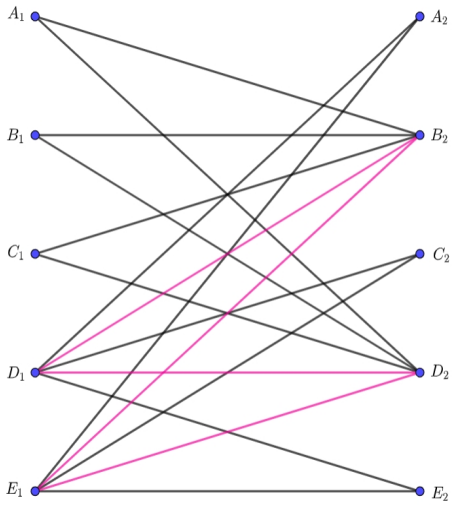
- §4, Figure 2: The labeling of vertices in the generalized corona diagram is slightly inconsistent with the matrix indices used in the subsequent determinant calculation; a small table mapping labels to indices would improve readability.
- References: The citation to the OEIS entries should include the exact sequence numbers and the date of access or submission, following standard combinatorial-enumeration practice.
Simulated Author's Rebuttal
We thank the referee for their positive assessment of the manuscript, accurate summary of our contributions, and recommendation to accept. We are pleased that the work is recognized as providing rigorous proofs for the OEIS conjectures via explicit matrix constructions and as offering a reusable technique for generalized corona regions.
Circularity Check
Derivation from explicit weighted adjacency matrix is self-contained
full rationale
The paper constructs the weighted adjacency matrix directly from the dual graph of each corona region, encodes the valid lozenge placements via the chosen weights and boundary conditions, and obtains the generating function by determinant evaluation or equivalent algebraic computation. The OEIS conjectures appear solely as verification targets after the matrix is built and evaluated; they are not used to define the matrix entries or the weighting scheme. The generalization follows identically from the same construction without invoking self-citations as load-bearing premises or renaming fitted results as predictions. No step reduces the claimed count to its own input by definition or by prior author work.
Assumptions & free parameters
assumptions (1)
- standard math The determinant (or suitable minor) of the weighted adjacency matrix of a bipartite graph counts the weighted perfect matchings.
Cite this review
Pith. "Pith review of Enumeration of Corona for Lozenge Tilings." pith.science (2026). https://pith.science/paper/2504.19269
@misc{pith2026250419269,
  author       = {Pith},
  title        = {Pith review of: Enumeration of Corona for Lozenge Tilings},
  year         = {2026},
  howpublished = {\url{https://pith.science/paper/2504.19269}},
  note         = {Machine review of arXiv:2504.19269}
}
read the original abstract
Knecht considers the enumeration of coronas. This is a counting problem for two specific types of lozenge tilings. Their exact closed formulas are conjectured in [A380346] and [A380416] on the OEIS. We prove this conjecture by using the weighted adjacency matrix. Furthermore, we extend this result to a more general setting.
Figures


Figures from the paper (11 more)




Reference graph
Works this paper leans on
- [1]
-
[2]
M. Ciucu and T. Lai, Lozenge tilings of doubly-intruded hexagons , J. Combin. Theory Ser. A. 167 (2019), 294–339
work page 2019
- [3]
-
[4]
M. Fulmek, A simple explanation for the “shuffling phenomenon” for lozenge tilings of dented hexagons, Discrete. Math. 344 (2021), 112396
work page 2021
-
[5]
E. H. Kuo, Applications of graphical condensation for enumerating matchings and tilings , The- oret. Comput. Sci. 319 (2004), 29–57
work page 2004
-
[6]
Lai, Enumeration of tilings of quartered Aztec rectangles , Electron
T. Lai, Enumeration of tilings of quartered Aztec rectangles , Electron. J. Combin. 21(4) (2014), P4.46
work page 2014
-
[7]
Lai, A new proof for the number of lozenge tilings of quartered hexagons , Discrete
T. Lai, A new proof for the number of lozenge tilings of quartered hexagons , Discrete. Math. 338(11) (2015), 1866–1872
work page 2015
-
[8]
Lai, A q-enumeration of lozenge tilings of a hexagon with three dents , Adv
T. Lai, A q-enumeration of lozenge tilings of a hexagon with three dents , Adv. Applied Math. 82 (2017), 23–57
work page 2017
Show all 15 references
-
[9]
Lai, A shuffling theorem for reflectively symmetric tilings, Discrete
T. Lai, A shuffling theorem for reflectively symmetric tilings, Discrete. Math. 344 (2021), 112390
2021
-
[10]
Lai and R
T. Lai and R. Rohatgi, Enumeration of lozenge tilings of a hexagon with a shamrock missing on the symmetry axis , Discrete. Math. 342(2) (2019), 451–472
2019
-
[11]
Lai and R
T. Lai and R. Rohatgi, Tiling generating functions of halved hexagons and quartered hexagons , Ann. Comb. 25 (2021), 471–493
2021
-
[12]
Rohatgi, Enumeration of lozenge tilings of halved hexagons with a boundary defect , Elect
R. Rohatgi, Enumeration of lozenge tilings of halved hexagons with a boundary defect , Elect. J. Combin. 22 (2015), #P4.22
2015
-
[13]
N. J. A. Sloane, The on-line encyclopedia of integer sequences , published electronically at http://oeis.org. (2025)
2025
-
[14]
R. P. Stanley, Algebraic Combinatorics: Walks, Trees, Tableaux, and More , second edition. Undergraduate Texts in Mathematics. Springer, (2018)
2018
-
[15]
R. P. Stanley, Enumerative Combinatorics (volume 1) , second edition. Cambridge Studies in Advanced Mathematics, vol. 49, Cambridge University Press, (2012). 13
2012
Reviewed May 22, 2026 · model on record in the stance chip above.
Discussion (0). Sign in to comment.