REVIEW 2 major objections 4 minor 47 references
Nonreciprocal scattering of elastic waves at time interfaces induced by spatiotemporal modulation
T0 review · 2 major / 4 minor · reviewed 2026-08-16 · deepseek-v4-flash
Pith's one-line read A spatiotemporally modulated temporal interlayer converts elastic longitudinal waves nonreciprocally: subsonic modulation gives frequency-converting one-way reflection, supersonic modulation gives one-way parametric amplification.
desk verdict A coherent mode-coupling framework for temporal scattering in modulated elastic media; the physics is credible, but the headline numbers rest on an untested N=3 truncation and amplitude-not-energy coefficients. read the letter →
The pith
A machine-rendered reading of the paper's core claim, the machinery that carries it, and where it could break.
The reading
What carries the argument
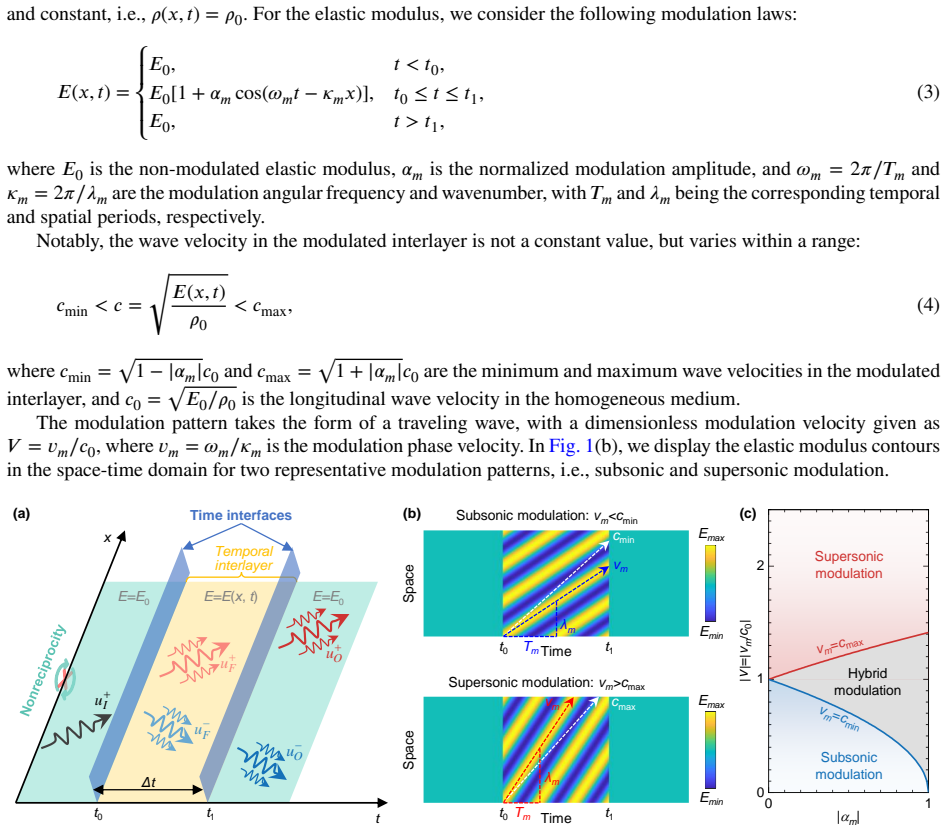
The mechanism is a mode-coupling theory built on the Floquet-Bloch eigenmodes of the infinite spatiotemporally modulated medium. Inside the interlayer the field is written as a superposition of forward and backward Floquet modes, each expanded in harmonics shifted by $n\omega_m$ and $n\kappa_m$; at the two time interfaces, displacement and velocity continuity are imposed, and spatial orthogonality of the harmonics selects the coupled amplitude equations. The result is a scattering relation $[\tilde{T}_{-N}\dots\tilde{T}_N,\tilde{R}_{-N}\dots\tilde{R}_N]^T = \mathbf{S} A_0$ with $\mathbf{S} = \mathbf{M}_4^{-1}\mathbf{M}_3\mathbf{M}_2^{-1}\mathbf{M}_1$, whose entries give the transmission and reflection coefficients (computed with truncation $N=3$). The differing physics of the two regimes enters through the dispersion relation: subsonic modulation opens frequency bandgaps with no real frequencies, while supersonic modulation opens wavenumber bandgaps whose complex frequencies imply temporal growth.
What would settle it
Recompute the scattering coefficients with truncation orders $N=5$ and $N=7$ for the same parameters: if the transmission dip $T_0\approx 0$ or the peak values ($R_{-1}=1.22$ for subsonic, $R_{-1}=13$ for supersonic) shift appreciably, the truncation is not converged and the theory's predictions are not stable. Experimentally, send a longitudinal pulse through a rod whose stiffness is modulated by a piezoelectric array for a finite window and compare the transmitted and reflected spectra at the predicted bandgap frequencies.
Extended reading notes
Core claim
The central claim is that a temporally bounded spatiotemporal modulation converts a single incident longitudinal mode into multiple temporally transmitted and reflected modes through wavenumber-preserving coupling at the two time interfaces, and that the conversion is nonreciprocal: reversing the incidence direction changes which frequency sideband carries the energy. For subsonic modulation, the forward directional bandgap near $\Omega_0 = 0.6$ (with $V=0.2$, $\alpha_m=0.1$) suppresses the 0th-order transmission to $T_0\approx 0$ and raises the $-1$st-order reflection to $R_{-1}=1.22$, a down-conversion; the opposite incidence at $\Omega_0=0.4$ gives up-conversion to $R_{+1}=0.82$. For supersonic modulation ($V=2$), the wavenumber bandgap supports growing complex frequencies, producing parametric amplification with peak coefficients $T_0=7.56$, $R_{-1}=13$ for one incidence and $T_0=7.58$, $R_{-1}=4.33$ for the other. The paper supports these analytic coefficients with finite-difference time-domain (FDTD) simulations and shows that increasing modulation duration $\Delta t$ and amplitude $\alpha_m$ strengthens both the nonreciprocal reversal and the amplification.
Load-bearing premise
The predictions depend on the assumption that inside the modulated window the wave field is exactly a truncated superposition of Floquet-Bloch modes of the infinite periodically modulated medium (the paper uses $N=3$ without a convergence study), so any significant energy in higher-order or non-Floquet components would change the computed scattering coefficients.
Editorial extensions
If this is right
- A finite spatiotemporally modulated interlayer acts as a one-way elastic filter: at the forward frequency bandgap, positive-going waves are reflected and down-converted while negative-going waves pass.
- Under supersonic modulation the same interlayer becomes a nonreciprocal parametric amplifier: within the wavenumber bandgap both transmitted and reflected waves grow, with growth tunable by interlayer duration and modulation amplitude.
- The same mode-coupling machinery applies to other one-dimensional systems, replacing Young's modulus by a bulk modulus for acoustic waves or by tension for string waves.
- The scattering coefficients are explicitly controllable: increasing $\Delta t$ and $\alpha_m$ deepens the transmission dip and raises the reflection and amplification peaks.
- A bounded temporal interlayer turns the otherwise unbounded supersonic instability into finite, predictable amplification, which is the basis for practical one-way amplifiers.
Reading between the lines
- If the $N=3$ truncation is convergent, the same scattering-matrix construction could be applied to two-dimensional plate or surface waves, where the preserved wavenumber becomes a vector and angular scattering could occur.
- The hybrid regime the paper identifies ($0.84<V<1.14$) is left unexplored; tuning across it should interpolate between the nonreciprocal mirror and the amplifier, which is a concrete prediction a mode-coupling calculation could test.
- Because the theory is linear and lossless, an experimental implementation with piezoelectric shunts will likely need to account for damping; the paper's formalism could accommodate complex frequencies to estimate how much the peaks $R_{-1}=13$ are reduced.
- Cascading several temporal interlayers with different modulation speeds could synthesize multi-step frequency conversion or broadband nonreciprocal gain, though the paper does not analyze such stacks.
Signed reviews
Editorial analysis
A structured set of objections, weighed in public.
Referee Report
Summary. The paper studies the temporal scattering of 1D longitudinal elastic waves by a rod whose Young's modulus is spatiotemporally modulated within a finite window [t0, t1]. The authors develop a mode-coupling theory: at the first time interface, the incident wave is decomposed onto forward/backward Floquet-Bloch eigenmodes of the infinite modulated medium; the interlayer field is their superposition (plane-wave truncation N=3); at the second interface, displacement and velocity continuity project the Floquet modes onto temporal transmission/reflection orders of the homogeneous medium, giving an explicit scattering matrix and coefficients T_n, R_n (Eqs. (34)-(36)). For subsonic modulation (V=0.2, alpha_m=0.1) the theory predicts an Omega-bandgap at Omega_0=0.6 with the 0th-order transmission dropping to about 0 and -1st-order reflection peaking at R_{-1,peak}=1.22; negative incidence gives the mirror case at Omega_0=0.4 (R_{+1,peak}=0.82). For supersonic modulation (V=2, alpha_m=0.1) the mu-bandgap at Omega_0=1.5 supports complex eigenfrequencies and yields parametric amplification: T_{0,peak}=7.56, R_{-1,peak}=13 for positive incidence; T_{0,peak}=7.58, R_{-1,peak}=4.33 for negative incidence. Parametric sweeps over Delta t and alpha_m (Figs. 6, 9) and FDTD validation (Figs. 4, 7) are reported.
Significance. If correct, this provides a quantitative, parameter-free framework for temporal elastic metamaterials: the scattering coefficients follow from Floquet eigenvalues/eigenvectors and continuity conditions, with no parameters fitted to the target outcome; the only inputs are the modulation amplitude, velocity, and duration. The predictions are falsifiable (specific conversion frequencies and amplitudes), and the FDTD simulations constitute an independent, qualitatively consistent check in both regimes. The Omega-bandgap versus mu-bandgap dichotomy, including the hybrid region (Appendix B), is a useful organizing principle. These are genuine strengths. The remaining gaps are: (i) all quantitative claims rest on a single truncation order (N=3) without a convergence study, and (ii) the 'energy' claims in the abstract and conclusions are expressed through displacement-amplitude coefficients rather than computed energy fluxes. The central mechanism is plausible; the headline quantitative statements are not yet fully certified.
major comments (2)
- [Section 2.2 (truncation) and Section 2.3, Eqs. (12)-(15), (34)-(36)] The headline quantitative results - R_{-1,peak}=1.22 in Fig. 4(b), R_{+1,peak}=0.82 in Fig. 4(e), T_{0,peak}=7.56 and R_{-1,peak}=13 in Figs. 7(a)-(b) - all come from the mode-coupling system truncated at N=3 ('we select a truncation order of N = 3', Section 2.2), yet no convergence study is reported. Because the incident field contains only the n=0 harmonic, the truncation confines all scattered content to |n| <= 3; if the 4th or higher Floquet harmonic carries non-negligible weight at alpha_m=0.1, the quoted peaks would change. The FDTD comparisons in Figs. 4 and 7 are visually supportive but do not certify convergence: no error metric is reported, and Appendix D does not specify how the individual coefficients T_n and R_n are extracted from the simulated wavefields. Please add a convergence check (e.g., compare T_0, R_{-1}, R_{+1} at the quoted peaks for N=3, 5, 7) and specify the FDTD extraction procedure with a quantitative agreement measure.
- [Sections 3.1 and 4.1; Eqs. (35)-(36); Abstract and Conclusions] The coefficients T_n and R_n are defined in Eqs. (35)-(36) as displacement-amplitude ratios |T_n/A_0| and |R_n/A_0|, but the central claims are phrased in terms of energy ('nonreciprocal energy reversal', 'nonreciprocal energy amplification'). The two are not interchangeable: the time-averaged energy flux of a harmonic wave in the homogeneous output medium scales as omega^2|u|^2, so for the subsonic positive-incidence peak the reflected flux is (Omega_{-1}/Omega_0)^2 R_{-1}^2 ~ (0.4/0.6)^2 (1.22)^2 ~ 0.66 of the incident flux under the same normalization, which is less than unity even though the displacement amplitude exceeds the incident amplitude. Please report energy-flux-based transmission and reflection coefficients (including the frequency weighting) or explicitly qualify the abstract and conclusions so that 'energy reversal/amplification' is tied to the computed coefficients rather than to a demonstrated energy flux.
minor comments (4)
- [Appendix A, Eq. (A4)] The prefactor in the double sum is written (kappa+n*kappa_m)(kappa+p*kappa_m), which is inconsistent with the eigenvalue problem derived from it in Eq. (A5); the second factor should be (kappa+n*kappa_m+p*kappa_m), equivalently (kappa+m*kappa_m) with m=n+p. In addition, the second displayed equation in the appendix is numbered (S2) but should be (A2).
- [Appendix D] The sentence 'a time domain of length T = 80*pi s, i.e., 80T_m/800T_m for subsonic/supersonic modulation' is ambiguous because it reads as a ratio; please state the two simulation durations separately, and describe how T_n and R_n are extracted from the FDTD time traces.
- [Fig. 2 caption] The axis labels 'Â(W)' and 'Á(W)' are garbled (they should be Re(Omega) and Im(Omega)); several other figure captions contain corrupted mathematical symbols that should be cleaned up.
- [Section 4.1] Since the mu-bandgap amplification rests on complex eigenfrequencies, please report the imaginary part of the eigenfrequency for the chosen parameters; a comparison of the FDTD growth rate inside the interlayer with Im(Omega) would strengthen the parametric-amplification interpretation beyond matching the final amplitudes.
Circularity Check
No significant circularity: scattering coefficients follow from a self-contained Floquet mode-coupling derivation, and the FDTD check is independent.
full rationale
The paper's derivation is self-contained. Starting from the equation of motion (Eq. (2)) and the modulation law (Eq. (3)), it constructs the plane-wave-expansion eigenproblem (Eq. (7), Appendix A), obtains the Floquet eigenvalues/eigenvectors of the modulated interlayer, and enforces displacement and velocity continuity at the two time interfaces (Eqs. (17)-(20)), leading to the scattering matrix S in Eq. (34). The transmission and reflection coefficients (Eqs. (35)-(36)) are then solved for a specified incident amplitude; no parameter is fitted to the reported peak values, and no load-bearing result is imported from a self-citation. The FDTD simulations (Appendix D) independently solve the discretized space-time wave equation with the same modulation parameters, so agreement in Figs. 4 and 7 provides an external check rather than a restatement of the inputs. The absence of a convergence study for the N=3 truncation (Section 2.2) and the use of displacement-amplitude ratios to support statements about energy reversal/amplification are accuracy and interpretation concerns, but they are not circularity: the analytical predictions are not equal to their inputs by construction.
Assumptions & free parameters
free parameters (3)
- Normalized modulation amplitude alpha_m =
0.1 (0.3 in dispersion plots)
- Dimensionless modulation velocity V =
0.2 (subsonic) or 2.0 (supersonic)
- Modulation duration Delta t =
4*pi s
assumptions (4)
- domain assumption The Floquet-Bloch ansatz and plane-wave expansion yield the correct dispersion and eigenvectors for the modulated medium.
- domain assumption The field inside the temporal interlayer is exactly representable as a superposition of the truncated set of infinite-medium Floquet modes.
- domain assumption Continuity of displacement and particle velocity at the time interfaces is sufficient to determine the scattering.
- domain assumption Material damping is negligible.
Cite this review
Pith. "Pith review of Nonreciprocal scattering of elastic waves at time interfaces induced by spatiotemporal modulation." pith.science (2026). https://pith.science/paper/QHGRR344
@misc{pith2026250419385,
  author       = {Pith},
  title        = {Pith review of: Nonreciprocal scattering of elastic waves at time interfaces induced by spatiotemporal modulation},
  year         = {2026},
  howpublished = {\url{https://pith.science/paper/QHGRR344}},
  note         = {Machine review of arXiv:2504.19385}
}
read the original abstract
Spatiotemporally modulated elastic metamaterials have garnered increasing interest for their potential applications in nonreciprocal wave devices. Most existing studies, however, focus on systems where spatiotemporal modulation is continuous and infinite in time. Here, we investigate the temporal dynamics of elastic waves at time interfaces created by the sudden activation or deactivation of spatiotemporal modulation in a medium's elastic properties. By developing an ad hoc mode-coupling theory, we reveal that such time interfaces enable controlled frequency and wavenumber conversion through mode redistribution and energy pumping. Specifically, we quantitatively evaluate the temporal scattering behavior of elastic longitudinal waves under two representative spatiotemporal modulations: subsonic and supersonic. These modulations give rise to frequency and wavenumber bandgaps, respectively. We demonstrate that subsonic modulation induces nonreciprocal energy reversal, while supersonic modulation leads to nonreciprocal energy amplification. Our findings pave the way for the development of temporal elastic metamaterials with practical applications in designing one-way elastic filters, amplifiers, and frequency converters.
Figures


Figures from the paper (6 more)


Reference graph
Works this paper leans on
-
[1]
write newline
" write newline "" before.all 'output.state := FUNCTION n.dashify 't := "" t empty not t #1 #1 substring "-" = t #1 #2 substring "--" = not "--" * t #2 global.max substring 't := t #1 #1 substring "-" = "-" * t #2 global.max substring 't := while if t #1 #1 substring * t #2 global.max substring 't := if while FUNCTION word.in bbl.in ":" * " " * FUNCTION f...
-
[2]
author Carminati, R. , author Chen, H. , author Pierrat, R. , author Shapiro, B. , year 2021 . title Universal statistics of waves in a random time-varying medium . journal Physical Review Letters volume 127 , pages 094101
work page 2021
-
[3]
author Cassedy, E.S. , year 1967 . title Dispersion relations in time-space periodic media part II-Unstable interactions . journal Proceedings of the IEEE volume 55 , pages 1154\--1168
work page 1967
-
[4]
author Cassedy, E.S. , author Oliner, A.A. , year 1963 . title Dispersion relations in time-space periodic media: part I-Stable interactions . journal Proceedings of the IEEE volume 51 , pages 1342\--1359
work page 1963
-
[5]
author Celli, P. , author Palermo, A. , year 2024 . title Time-modulated inerters as building blocks for nonreciprocal mechanical devices . journal Journal of Sound and Vibration volume 572 , pages 118178
work page 2024
-
[6]
author Chamanara, N. , author Taravati, S. , author Deck-L \'e ger, Z.L. , author Caloz, C. , year 2017 . title Optical isolation based on space-time engineered asymmetric photonic band gaps . journal Physical Review B volume 96 , pages 155409
work page 2017
-
[7]
Experimental demonstration of a space-time modulated airborne acoustic circulator
author Chen, T. , author Mallejac, M. , author Bi, C. , author Xia, B. , author Fleury, R. , year 2024 . title Experimental demonstration of a space-time modulated airborne acoustic circulator . journal arXiv preprint arXiv:2411.16057
work page Pith review arXiv 2024
-
[8]
author Chen, Y. , author Li, X. , author Nassar, H. , author Norris, A.N. , author Daraio, C. , author Huang, G. , year 2019 . title Nonreciprocal wave propagation in a continuum-based metamaterial with space-time modulated resonators . journal Physical Review Applied volume 11 , pages 064052
work page 2019
Show all 47 references
-
[9]
, author Prada, C
author Delory, A. , author Prada, C. , author Lanoy, M. , author Eddi, A. , author Fink, M. , author Lemoult, F. , year 2024 . title Elastic wave packets crossing a space-time interface . journal Physical Review Letters volume 133 , pages 267201
2024
-
[10]
, author Sharabi, Y
author Dikopoltsev, A. , author Sharabi, Y. , author Lyubarov, M. , author Lumer, Y. , author Tsesses, S. , author Lustig, E. , author Kaminer, I. , author Segev, M. , year 2022 . title Light emission by free electrons in photonic time-crystals . journal Proceedings of the Nat...
2022
-
[11]
, year 2023
author Engheta, N. , year 2023 . title Four-dimensional optics using time-varying metamaterials . journal Science volume 379 , pages 1190--1191
2023
-
[12]
, author Sounas, D.L
author Fleury, R. , author Sounas, D.L. , author Al \`u , A. , year 2015 . title Subwavelength ultrasonic circulator based on spatiotemporal modulation . journal Physical Review B volume 91 , pages 174306
2015
-
[13]
, author Tirole, R
author Galiffi, E. , author Tirole, R. , author Yin, S. , author Li, H. , author Vezzoli, S. , author Huidobro, P.A. , author Silveirinha, M.G. , author Sapienza, R. , author Al \`u , A. , author Pendry, J.B. , year 2022 . title Photonics of time-varying media . journal Advanc...
2022
-
[14]
, author Wallen, S.P
author Goldsberry, B.M. , author Wallen, S.P. , author Haberman, M.R. , year 2020 . title Nonreciprocal vibrations of finite elastic structures with spatiotemporally modulated material properties . journal Physical Review B volume 102 , pages 014312
2020
-
[15]
, author Pendry, J.B
author Horsley, S.A. , author Pendry, J.B. , year 2023 . title Quantum electrodynamics of time-varying gratings . journal Proceedings of the National Academy of Sciences volume 120 , pages e2302652120
2023
-
[16]
, author Kildishev, A.V
author Jones, T.R. , author Kildishev, A.V. , author Segev, M. , author Peroulis, D. , year 2024 . title Time-reflection of microwaves by a fast optically-controlled time-boundary . journal Nature Communications volume 15 , pages 6786
2024
-
[17]
, author Chong, C
author Kim, B.L. , author Chong, C. , author Daraio, C. , year 2024 . title Temporal refraction in an acoustic phononic lattice . journal Physical Review Letters volume 133 , pages 077201
2024
-
[18]
, author Fleury, R
author Koutserimpas, T.T. , author Fleury, R. , year 2018 . title Nonreciprocal gain in non-hermitian time-floquet systems . journal Physical Review Letters volume 120 , pages 087401
2018
-
[19]
, author Son, J
author Lee, K. , author Son, J. , author Park, J. , author Kang, B. , author Jeon, W. , author Rotermund, F. , author Min, B. , year 2018 . title Linear frequency conversion via sudden merging of meta-atoms in time-variant metasurfaces . journal Nature Photonics volume 12 , pa...
2018
-
[20]
, author Shen, C
author Li, J. , author Shen, C. , author Zhu, X. , author Xie, Y. , author Cummer, S.A. , year 2019 a. title Nonreciprocal sound propagation in space-time modulated media . journal Physical Review B volume 99 , pages 144311
2019
-
[21]
, author Ni, X
author Li, M. , author Ni, X. , author Weiner, M. , author Al \`u , A. , author Khanikaev, A.B. , year 2019 b. title Topological phases and nonreciprocal edge states in non-hermitian floquet insulators . journal Physical Review B volume 100 , pages 045423
2019
-
[22]
, author Lumer, Y
author Lyubarov, M. , author Lumer, Y. , author Dikopoltsev, A. , author Lustig, E. , author Sharabi, Y. , author Segev, M. , year 2022 . title Amplified emission and lasing in photonic time crystals . journal Science volume 377 , pages 425--428
2022
-
[23]
, author Riva, E
author Marconi, J. , author Riva, E. , author Di Ronco, M. , author Cazzulani, G. , author Braghin, F. , author Ruzzene, M. , year 2020 . title Experimental observation of nonreciprocal band gaps in a space-time-modulated beam using a shunted piezoelectric array . journal Phys...
2020
-
[24]
, author Mizuo, C
author Miyamaru, F. , author Mizuo, C. , author Nakanishi, T. , author Nakata, Y. , author Hasebe, K. , author Nagase, S. , author Matsubara, Y. , author Goto, Y. , author P \'e rez-Urquizo, J. , author Mad \'e o, J. , et al., year 2021 . title Ultrafast frequency-shift dynami...
2021
-
[25]
, author Xu, G
author Moussa, H. , author Xu, G. , author Yin, S. , author Galiffi, E. , author Ra’di, Y. , author Al \`u , A. , year 2023 . title Observation of temporal reflection and broadband frequency translation at photonic time interfaces . journal Nature Physics volume 19 , pages 863\--868
2023
-
[26]
, author Chen, H
author Nassar, H. , author Chen, H. , author Norris, A. , author Huang, G. , year 2017 a. title Non-reciprocal flexural wave propagation in a modulated metabeam . journal Extreme Mechanics Letters volume 15 , pages 97--102
2017
-
[27]
, author Xu, X
author Nassar, H. , author Xu, X. , author Norris, A. , author Huang, G. , year 2017 b. title Modulated phononic crystals: Non-reciprocal wave propagation and willis materials . journal Journal of the Mechanics and Physics of Solids volume 101 , pages 10\--29
2017
-
[28]
, author Yousefzadeh, B
author Nassar, H. , author Yousefzadeh, B. , author Fleury, R. , author Ruzzene, M. , author Al \`u , A. , author Daraio, C. , author Norris, A.N. , author Huang, G. , author Haberman, M.R. , year 2020 . title Nonreciprocity in acoustic and elastic materials . journal Nature R...
2020
-
[29]
, author Kim, S
author Ni, X. , author Kim, S. , author Al \`u , A. , year 2021 . title Topological insulator in two synthetic dimensions based on an optomechanical resonator . journal Optica volume 8 , pages 1024--1032
2021
-
[30]
, author Celli, P
author Palermo, A. , author Celli, P. , author Yousefzadeh, B. , author Daraio, C. , author Marzani, A. , year 2020 . title Surface wave non-reciprocity via time-modulated metamaterials . journal Journal of the Mechanics and Physics of Solids volume 145 , pages 104181
2020
-
[31]
, author Galiffi, E
author Pendry, J. , author Galiffi, E. , author Huidobro, P. , year 2021 . title Gain mechanism in time-dependent media . journal Optica volume 8 , pages 636--637
2021
-
[32]
, author Sounas, D.L
author Ramaccia, D. , author Sounas, D.L. , author Alu, A. , author Toscano, A. , author Bilotti, F. , year 2019 . title Phase-induced frequency conversion and doppler effect with time-modulated metasurfaces . journal IEEE Transactions on Antennas and Propagation volume 68 , p...
2019
-
[33]
, author Riva, E
author Santini, J. , author Riva, E. , year 2023 . title Elastic temporal waveguiding . journal New Journal of Physics volume 25 , pages 013031
2023
-
[34]
, author Al \`u , A
author Sounas, D.L. , author Al \`u , A. , year 2017 . title Non-reciprocal photonics based on time modulation . journal Nature Photonics volume 11 , pages 774--783
2017
-
[35]
, author Ruzzene, M
author Trainiti, G. , author Ruzzene, M. , year 2016 . title Non-reciprocal elastic wave propagation in spatiotemporal periodic structures . journal New Journal of Physics volume 18 , pages 083047
2016
-
[36]
, author Xia, Y
author Trainiti, G. , author Xia, Y. , author Marconi, J. , author Cazzulani, G. , author Erturk, A. , author Ruzzene, M. , year 2019 . title Time-periodic stiffness modulation in elastic metamaterials for selective wave filtering: Theory and experiment . journal Physical Revi...
2019
-
[37]
, author Liberal, I
author V \'a zquez-Lozano, J.E. , author Liberal, I. , year 2023 . title Incandescent temporal metamaterials . journal Nature Communications volume 14 , pages 4606
2023
-
[38]
, author Dutt, A
author Wang, K. , author Dutt, A. , author Wojcik, C.C. , author Fan, S. , year 2021 . title Topological complex-energy braiding of non-hermitian bands . journal Nature volume 598 , pages 59--64
2021
-
[39]
, author Shao, N
author Wang, S. , author Shao, N. , author Chen, H. , author Chen, J. , author Qian, H. , author Wu, Q. , author Duan, H. , author Alu, A. , author Huang, G. , year 2025 . title Temporal refraction and reflection in modulated mechanical metabeams: theory and physical observati...
2025
-
[40]
, author Yousefzadeh, B
author Wang, Y. , author Yousefzadeh, B. , author Chen, H. , author Nassar, H. , author Huang, G. , author Daraio, C. , year 2018 . title Observation of nonreciprocal wave propagation in a dynamic phononic lattice . journal Physical Review Letters volume 121 , pages 194301
2018
-
[41]
, year 2025
author Wapenaar, K. , year 2025 . title Green’s functions, propagation invariants, reciprocity theorems, wave-field representations and propagator matrices in two-dimensional time-dependent materials , in: booktitle Proceedings A , organization The Royal Society . p. pages 20240479
2025
-
[42]
, author Aichele, J
author Wapenaar, K. , author Aichele, J. , author van Manen, D.J. , year 2024 . title Waves in space-dependent and time-dependent materials: A systematic comparison . journal Wave Motion volume 130 , pages 103374
2024
-
[43]
, author Chen, H
author Wu, Q. , author Chen, H. , author Nassar, H. , author Huang, G. , year 2021 . title Non-reciprocal rayleigh wave propagation in space--time modulated surface . journal Journal of the Mechanics and Physics of Solids volume 146 , pages 104196
2021
-
[44]
, author Grbic, A
author Wu, Z. , author Grbic, A. , year 2019 . title Serrodyne frequency translation using time-modulated metasurfaces . journal IEEE Transactions on Antennas and Propagation volume 68 , pages 1599--1606
2019
-
[45]
, author Riva, E
author Xia, Y. , author Riva, E. , author Rosa, M.I. , author Cazzulani, G. , author Erturk, A. , author Braghin, F. , author Ruzzene, M. , year 2021 . title Experimental observation of temporal pumping in electromechanical waveguides . journal Physical Review Letters volume 1...
2021
-
[46]
, author Maywar, D.N
author Xiao, Y. , author Maywar, D.N. , author Agrawal, G.P. , year 2014 . title Reflection and transmission of electromagnetic waves at a temporal boundary . journal Optics letters volume 39 , pages 574--577
2014
-
[47]
, author Alam, M.Z
author Zhou, Y. , author Alam, M.Z. , author Karimi, M. , author Upham, J. , author Reshef, O. , author Liu, C. , author Willner, A.E. , author Boyd, R.W. , year 2020 . title Broadband frequency translation through time refraction in an epsilon-near-zero material . journal Nat...
2020
Reviewed August 16, 2026 · model on record in the stance chip above.
Discussion (0). Continue with ORCID to comment.