REVIEW 4 major objections 5 minor 1 cited by
On Solving the Dynamics of Constrained Rigid Multi-Body Systems with Kinematic Loops
T0 review · 4 major / 5 minor · reviewed 2026-08-16 · deepseek-v4-flash
Pith's one-line read Proximal ADMM is the most robust dual solver for constrained rigid-body simulation with kinematic loops.
desk verdict A substantial, honest benchmark with a suggestive mass-ratio finding, but the ADMM-vs-splitting comparison has methodological loose ends and no released artifacts. read the letter →
The pith
A machine-rendered reading of the paper's core claim, the machinery that carries it, and where it could break.
The reading
What carries the argument
The load-bearing object is the dual forward-dynamics NCP: find $\lambda$ in the composite cone $K$ such that the augmented constraint velocity $\hat v(\lambda)$ lies in $K^{*}$ and is complementary to $\lambda$. The problem data is the Delassus matrix $D = J^{T} M^{-1} J$ and the free velocity $v_f$; the nonlinearity comes from the De Saxcé correction $\Gamma(v^+(\lambda))$, which enforces maximal dissipation and is fixed iteratively to obtain a convex second-order cone program. ADMM-NCP solves that convexified problem with proximal ADMM, whose key device is an extra proximal term $\eta \|x - x^{-}\|^2$ added to the Delassus quadratic, making the regularized system strictly convex without biasing the solution; it then projects globally onto $K$ and updates the dual variable. The splitting solvers instead apply block-wise projected SOR with local projectors, either simple Euclidean cone projections or per-contact QCP solvers.
What would settle it
Re-run the identical curated Boxes-Fixed sample sequence using the actual production implementations of the splitting-based solvers (their native projectors, relaxation schedules, and termination criteria) instead of the in-house proxies; if any of them converges to ADMM-NCP-level residuals on a substantial fraction of the high-mass-ratio samples, the paper's central claim is falsified.
Extended reading notes
Core claim
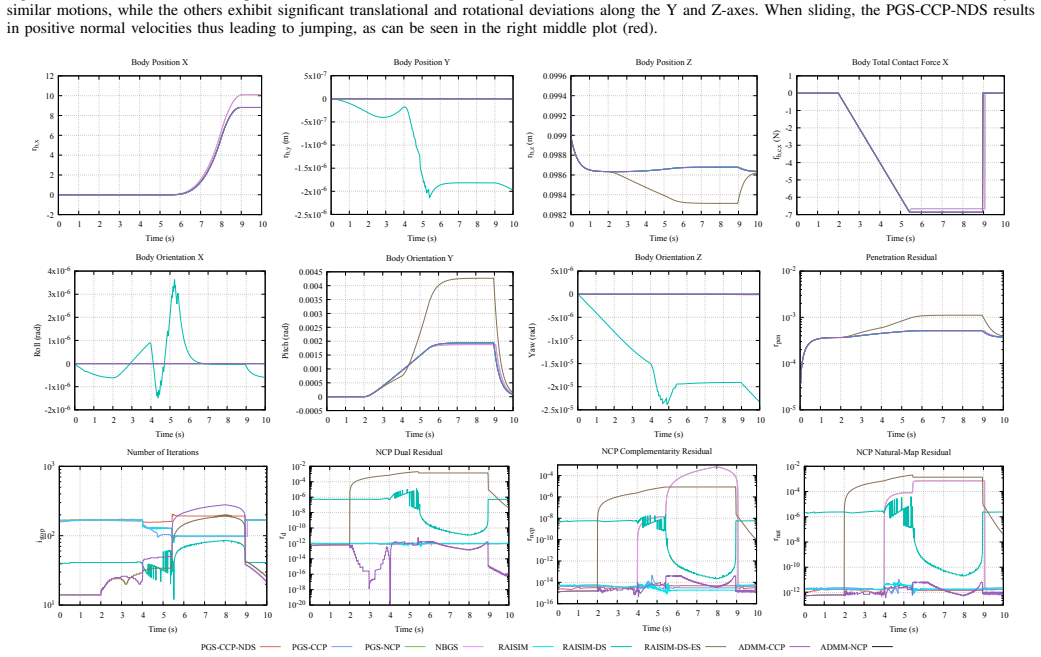
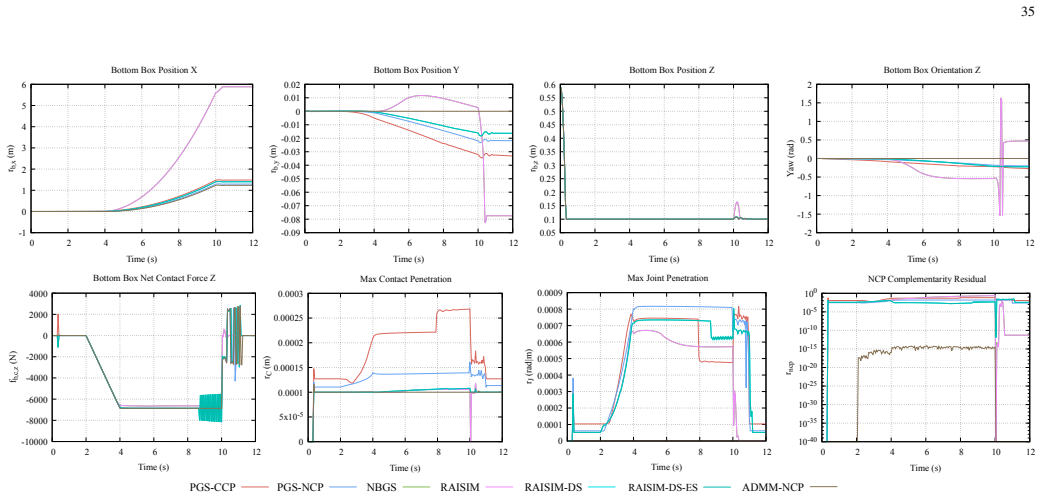
On the paper's own terms, the central discovery is empirical: a proximal ADMM applied to the NSOCP transcription of the dual forward dynamics is the most robust and accurate solver among those compared, especially when the Delassus matrix is ill-conditioned by hyperstatic kinematic loops and inertial disparity. The evidence is the Boxes-Fixed mass-ratio grid, where splitting-based methods degrade once the mass ratio exceeds roughly 1000, while ADMM-NCP keeps converging except at very high absolute mass scales tied to the spectral radius of $D$. ADMM's global simultaneous projection avoids the ordering bias of per-contact iteration, yields minimum-norm contact reactions with negligible internal coupling, and can still render usable forces even when it does not converge within the iteration budget.
Load-bearing premise
The comparison assumes the re-implemented splitting solvers faithfully represent the production physics-engine solvers they stand in for; if their local contact projections, relaxation schedules, or termination checks are unrepresentative, the measured superiority of ADMM-NCP could be an artifact of the proxies rather than a property of the methods.
Editorial extensions
If this is right
- Closed-loop mechanisms with passive joints and mass ratios above roughly 1000 should be simulated with an ADMM-based dual solver rather than projected Gauss-Seidel to avoid constraint drift and force underestimation.
- ADMM-NCP produces minimum-norm contact reactions with virtually no internal coupling, so contact force distributions on resting and sliding bodies are physically plausible without per-contact ordering heuristics.
- Constraint stabilization and softening improve constraint satisfaction for all solvers but do not overturn the relative ranking; the NCP's complementarity structure can be preserved under both augmentations.
- ADMM-NCP convergence depends more on the spectral radius of the Delassus matrix than on its condition number, so preconditioning the Delassus system is the natural next lever for making the method faster.
- Early stopping based on objective-function improvement drastically cuts iteration counts but costs multiple orders of magnitude in accuracy, so it is not a free performance win.
Reading between the lines
- Editorial inference: if the empirical ranking holds up, the engineering bottleneck shifts from crafting per-contact local projectors to building fast linear solvers and preconditioners for the regularized Delassus matrix, because ADMM turns each iteration into one dense linear solve plus a global projection.
- Editorial inference: the same dual ADMM should extend naturally to compliant, deformable, or viscoelastic contact models and to batched GPU simulation, where the global Delassus solve can be amortized across many problem instances.
- Editorial inference: the paper's mass-ratio grid suggests a minimal robustness benchmark — a two-body fixed-joint drag scenario sweeping the mass ratio from 10 to $10^6$ — that could be adopted as a standardized stress test for any new forward-dynamics solver.
- Editorial inference: a natural testable follow-up is whether the ADMM advantage persists at larger time-steps or with higher-order integrators, since the current study fixes semi-implicit Euler and the accuracy gap may narrow or widen with integration order.
Signed reviews
Editorial analysis
A structured set of objections, weighed in public.
Referee Report
Summary. The paper develops and evaluates dual solvers for the time-stepping forward dynamics of constrained rigid multi-body systems with kinematic loops, formulated as Nonlinear Complementarity Problems (NCPs) and their convex relaxations. The authors derive the dual NCP/NSOCP from an augmented-Lagrangian/proximal perspective, describe a set of projective splitting solvers (PGS variants, NBGS, RaiSim variants) and two ADMM-based solvers (ADMM-CCP and ADMM-NCP), and benchmark them on a suite of twelve problems ranging from toy examples to robotic and Audio-Animatronics systems. The central empirical claim is that ADMM-NCP is the most robust and accurate solver for ill-conditioned systems, with the Boxes-Fixed experiment showing that splitting-based solvers fail to propagate constraint reactions at mass ratios above roughly 1000, while ADMM-NCP remains accurate and converges on samples where no other solver converges.
Significance. If the comparison is accepted, the paper makes a practically important point: the splitting-based first-order solvers used in the majority of physics engines are not reliable for closed-loop mechanisms with large mass ratios, whereas a globally coupled ADMM with spectral penalty adaptation can be. The derivation of the dual problem and the proximal framework is standard and clearly presented, and the extensive benchmark suite, performance profiles, and explicit statement of solver configurations are genuine strengths. The paper also usefully documents artifacts such as non-minimum-norm internal forces and the effects of constraint softening and stabilization. The headline claim, however, rests on the fairness of the solver comparison, and on that point the manuscript currently leaves load-bearing gaps: termination criteria differ between solver classes, SOR parameters are not reported, and equal iteration counts are not shown to be equal computational budgets.
major comments (4)
- [Sec. VI-E and Sec. VIII-A] The comparison uses equal Nmax = 10^4 for all solvers, but the per-iteration cost is not equal: ADMM-NCP (Alg. 6, line 6) solves a dense regularized system (D + (eta + rho)I) each iteration, while the splitting solvers (Alg. 5) perform block projections. The reported 'Mean Iteration Time' metric (Sec. VII-D) is collected but is not used as the budget for the performance profiles; a solver that does more work per iteration is favored by an iteration-count comparison. Please report wall-clock time (or flop-equivalent cost) for the headline experiments and show that the conclusions are unchanged under equal-time budgets.
- [Sec. VI-F, Eqs. (170a-c)] ADMM-NCP terminates on proxy residuals defined on the ADMM iterates (r_p = x_i - y_i, r_d = eta(x_i - x_{i-1}) + rho(y_i - y_{i-1}), r_cp = [x_i^T z_i]), whereas the splitting solvers terminate on the actual NCP residuals (156)-(158). If the proxy residuals are systematically looser than the true residuals, the robustness advantage of ADMM-NCP in Figs. 15-19 could partly reflect a more permissive stopping rule. Please report, for the same samples, the true NCP residuals (156)-(158) achieved by each solver at termination, or otherwise justify that the proxy residuals are equivalent for these problems.
- [Sec. VI-E and Table I] The SOR parameters omega0, omega_min, and gamma used in Alg. 5 are not reported, and the PROX/SORProx baseline is omitted 'purely due to time considerations' (Sec. VI-E). Since the SOR relaxation factor strongly affects convergence of PGS-type methods, the comparison may not reflect the best achievable behavior of the splitting class. Please provide the parameter values used for each solver, and ideally a sensitivity study over the relaxation parameters, before drawing the broad conclusion that splitting-based solvers are unsuitable above mass ratio 1000.
- [Sec. VIII-C, Boxes-Fixed and Fig. 18] The mass-ratio conclusion is drawn from a single problem family in which the two bodies are connected by a fixed joint and only ADMM-NCP converges. The paper itself notes that ADMM-NCP is 'more sensitive to the absolute scale of the heaviest body' and that its convergence depends on the spectral radius rho(D) rather than only the condition number. This is a load-bearing qualification: the claim that splitting solvers fail above mass ratio ~1000 needs to be demonstrated across several problem classes (including the Fourbar mass-ratio run, Fig. 47) with reporting of both the mass ratio and the condition/spectral data, and with the solver-class comparison made at equivalent effort and equivalent termination residuals. As written, the evidence supports the weaker statement that, on these particular problems and with these particular configurations, the splitting solvers tested did not converge while ADMM-NCP did.
minor comments (5)
- [Abstract] The abstract contains 'particularly interest' and 'aggravatingly over the complete set'; both should be corrected (e.g., 'particularly interested' and 'aggregately').
- [Fig. 13 and Fig. 14 captions] Several figure labels contain typos: 'Boxes-on-Plane' in Fig. 13 should be 'Box-on-Plane', and 'PGS-CPP' in Fig. 14 should be 'PGS-CCP'.
- [Sec. VIII-C, Fourbar] The sentence 'An final curated run' should read 'A final curated run'.
- [Sec. V-C] References to 'Baumgarter' should be 'Baumgarte' to match the standard spelling in the literature.
- [Sec. VIII-A] The paper does not state whether the implementation, benchmark definitions, or raw data will be released; given that the experimental comparison is the core contribution, a code/data availability statement would substantially improve reproducibility.
Circularity Check
No derivation-level circularity; the curated benchmark protocol is the only self-referential element and it is not load-bearing.
full rationale
The paper's analytical derivation chain is standard and externally grounded: the dual NCP (15) is built from the Delassus matrix D=J^T M^{-1}J (11), the free velocity vf (12)/(80), and the De Saxcé-corrected cone complementarity (52)-(55), with the NSOCP equivalence attributed to Cadoux [51], De Saxcé [30], and Acary et al [31]. No step defines D, vf, or K in terms of ADMM-NCP's output, and no fitted parameter is renamed as a prediction; the solver comparison is an empirical benchmark. The only self-referential element is the curated-run protocol in Sec. VIII-C: 'we use ADMM-NCP as a reference solver to generate a sequence of problems that are then re-solved by all others.' This is a benchmark-design choice rather than a circular derivation, because the resulting samples are static dual problems re-solved by every solver under identical tolerances, and the central Boxes-Fixed claim is corroborated by independent-run time-series (Figs. 15-17) and the mass-ratio grid (Fig. 18). Sec. VI-E does state a coverage limitation: 'purely due to time considerations, the authors regretfully have not been able to include the PROX algorithm in this evaluation' — this weakens the generality of the splitter comparison but does not make the ADMM-NCP result equivalent to its inputs. Similarly, the exclusion of ADMM-CCP from Boxes-Fixed after divergence in initial testing is a methodological choice, not a circular reduction. Overall the derivation is self-contained and the empirical claims are falsifiable against external solvers, so circularity is minimal.
Assumptions & free parameters
free parameters (3)
- Constraint softening parameter set =
{d0=0.9, dw=0.95, w=0.001, m=0.5, p=2.0, T=0.02, beta=1.0}
- ADMM spectral adaptation parameters =
tau0=0.2, tau=0.05, alpha=10.0, eta=1e-6
- Solver budgets and tolerances =
Nmax=1e4, eps_abs=1e-12 (high-precision); Nmax=1e3, eps_abs=1e-6 (high-throughput)
assumptions (4)
- domain assumption The dual NCP is equivalent to the NSOCP (Eq. 16) as established by a 'coarse proof' in Carpentier et al. [32].
- domain assumption The De Saxce operator is invariant with respect to bias velocities v*, allowing restitution and stabilization terms to be absorbed into vf (Sec. V-B, V-C).
- ad hoc to paper If a method works in maximal-coordinate CRBD, it will also work in constrained articulated-body dynamics (CABD) because CABD reduces dimensionality.
- domain assumption Hard-contact rigid-body model with Coulomb friction and Newton restitution is a valid test model for physical plausibility.
Cite this review
Pith. "Pith review of On Solving the Dynamics of Constrained Rigid Multi-Body Systems with Kinematic Loops." pith.science (2026). https://pith.science/paper/YR4PI65E
@misc{pith2026250419771,
  author       = {Pith},
  title        = {Pith review of: On Solving the Dynamics of Constrained Rigid Multi-Body Systems with Kinematic Loops},
  year         = {2026},
  howpublished = {\url{https://pith.science/paper/YR4PI65E}},
  note         = {Machine review of arXiv:2504.19771}
}
read the original abstract
This technical report provides an in-depth evaluation of both established and state-of-the-art methods for simulating constrained rigid multi-body systems with hard-contact dynamics, using formulations of Nonlinear Complementarity Problems (NCPs). We are particularly interest in examining the simulation of highly coupled mechanical systems with multitudes of closed-loop bilateral kinematic joint constraints in the presence of additional unilateral constraints such as joint limits and frictional contacts with restitutive impacts. This work thus presents an up-to-date literature survey of the relevant fields, as well as an in-depth description of the approaches used for the formulation and solving of the numerical time-integration problem in a maximal coordinate setting. More specifically, our focus lies on a version of the overall problem that decomposes it into the forward dynamics problem followed by a time-integration using the states of the bodies and the constraint reactions rendered by the former. We then proceed to elaborate on the formulations used to model frictional contact dynamics and define a set of solvers that are representative of those currently employed in the majority of the established physics engines. A key aspect of this work is the definition of a benchmarking framework that we propose as a means to both qualitatively and quantitatively evaluate the performance envelopes of the set of solvers on a diverse set of challenging simulation scenarios. We thus present an extensive set of experiments that aim at highlighting the absolute and relative performance of all solvers on particular problems of interest as well as aggravatingly over the complete set defined in the suite.
Figures


Figures from the paper (47 more)






Forward citations
Cited by 1 Pith paper
-
A Splitting Architecture for Exact Reduced Coulomb Friction
A Tseng-style forward-backward-forward splitting solves the exact reduced Coulomb law by alternating a strongly convex cone QP with an explicit De Saxcé-Feng coupling correction.
Reference graph
Works this paper leans on
-
[1]
Learning agile and dynamic motor skills for legged robots,
J. Hwangbo, J. Lee, A. Dosovitskiy, D. Bellicoso, V . Tsounis, V . Koltun, and M. Hutter, “Learning agile and dynamic motor skills for legged robots,” Science Robotics , vol. 4, no. 26, p. eaau5872,
-
[2]
Isaac gym: High performance gpu-based physics simulation for robot learning,
V . Makoviychuk, L. Wawrzyniak, Y . Guo, M. Lu, K. Storey, M. Macklin, D. Hoeller, N. Rudin, A. Allshire, A. Handa, and G. State, “Isaac gym: High performance gpu-based physics simulation for robot learning,” CoRR, vol. abs/2108.10470, 2021. [Online]. Available: https://arxiv.org/abs/2108.10470
arXiv 2021
-
[3]
Optimal Control of Walkers with Parallel Actuation,
L. de Matteis, V . Batto, J. Carpentier, and N. Mansard, “Optimal Control of Walkers with Parallel Actuation,” Mar. 2025, working paper or preprint. [Online]. Available: https://hal.science/hal-04716938
2025
-
[4]
Learning to walk in minutes using massively parallel deep reinforcement learning,
N. Rudin, D. Hoeller, P. Reist, and M. Hutter, “Learning to walk in minutes using massively parallel deep reinforcement learning,” in Proceedings of the 5th Conference on Robot Learning , ser. Proceedings of Machine Learning Research, A. Faust, D. Hsu, and G. Neumann, Eds., vol. 164. PMLR, 08–11 Nov 2022, pp. 91–100. [Online]. Available: https://proceedin...
2022
-
[5]
Anymal parkour: Learning agile navigation for quadrupedal robots,
D. Hoeller, N. Rudin, D. Sako, and M. Hutter, “Anymal parkour: Learning agile navigation for quadrupedal robots,” Science Robotics , vol. 9, no. 88, p. eadi7566, 2024. [Online]. Available: https: //www.science.org/doi/abs/10.1126/scirobotics.adi7566
-
[6]
Facchinei and J.-S
F. Facchinei and J.-S. Pang, Finite-dimensional variational inequalities and complementarity problems . Springer, 2003
2003
-
[7]
On solving contact problems with Coulomb friction: formulations and numerical comparisons,
V . Acary, M. Br ´emond, and O. Huber, “On solving contact problems with Coulomb friction: formulations and numerical comparisons,” in Advanced Topics in Nonsmooth Dynamics - Transactions of the European Network for Nonsmooth Dynamics , S. I. Publishing, Ed., Jun. 2018, pp. 375–457. [Online]. Available: https://inria.hal.science/hal-01878539
2018
-
[9]
Optimal design of robotic character kinematics,
G. Maloisel, C. Schumacher, E. Knoop, R. Grandia, and M. B ¨acher, “Optimal design of robotic character kinematics,” ACM Trans. Graph., vol. 42, no. 6, Dec. 2023. [Online]. Available: https: //doi.org/10.1145/3618404
Show all 108 references
-
[10]
A versatile quaternion-based constrained rigid body dynamics,
——, “A versatile quaternion-based constrained rigid body dynamics,” ACM Transactions on Graphics (SIGGRAPH) , 2025
2025
-
[11]
Featherstone, Rigid body dynamics algorithms
R. Featherstone, Rigid body dynamics algorithms . Springer, 2014
2014
-
[12]
Convex and analytically-invertible dynamics with contacts and constraints: Theory and implementation in mujoco,
E. Todorov, “Convex and analytically-invertible dynamics with contacts and constraints: Theory and implementation in mujoco,” in 2014 IEEE International Conference on Robotics and Automation (ICRA) , 2014, pp. 6054–6061
2014
-
[13]
Proximal and sparse resolution of constrained dynamic equations,
J. Carpentier, R. Budhiraja, and N. Mansard, “Proximal and sparse resolution of constrained dynamic equations,” in Robotics: Science and Systems 2021, 2021
2021
-
[14]
Constrained articulated body dynamics algorithms,
A. S. Sathya and J. Carpentier, “Constrained articulated body dynamics algorithms,” IEEE Transactions on Robotics , 2024
2024
-
[15]
Constrained articulated body dynamics algorithms,
——, “Constrained articulated body dynamics algorithms,” Trans. Rob., vol. 41, p. 430–449, Jan. 2025. [Online]. Available: https: //doi.org/10.1109/TRO.2024.3502515
2025
-
[16]
Simulation tools for model-based robotics: Comparison of bullet, havok, mujoco, ode and physx,
T. Erez, Y . Tassa, and E. Todorov, “Simulation tools for model-based robotics: Comparison of bullet, havok, mujoco, ode and physx,” in2015 IEEE international conference on robotics and automation (ICRA) . IEEE, 2015, pp. 4397–4404
2015
-
[17]
Contact and friction simulation for computer graphics,
S. Andrews, K. Erleben, and Z. Ferguson, “Contact and friction simulation for computer graphics,” in ACM SIGGRAPH 2022 Courses, ser. SIGGRAPH ’22. New York, NY , USA: Association for Computing Machinery, 2022
2022
-
[18]
Ericson, Real-time collision detection
C. Ericson, Real-time collision detection . Crc Press, 2004
2004
-
[19]
Fcl: A general purpose library for collision and proximity queries,
J. Pan, S. Chitta, and D. Manocha, “Fcl: A general purpose library for collision and proximity queries,” in2012 IEEE international conference on robotics and automation . IEEE, 2012, pp. 3859–3866
2012
-
[20]
Bullet physics sdk: real-time collision detection and multi-physics simulation for vr, games, visual effects, robotics, machine learning etc
E. Coumans, “Bullet physics sdk: real-time collision detection and multi-physics simulation for vr, games, visual effects, robotics, machine learning etc.” https://github.com/bulletphysics/bullet3, 2022
2022
-
[21]
Coal: an extension of the flexible collision library,
J. Pan, S. Chitta, D. Manocha, F. Lamiraux, J. Mirabel, J. Carpentier, L. Montaut et al., “Coal: an extension of the flexible collision library,” https://github.com/coal-library/coal, 2015–2024
2015
-
[22]
Explicit equations of motion for constrained mechanical systems with singular mass matrices and applications to multi-body dynamics,
F. E. Udwadia and P. Phohomsiri, “Explicit equations of motion for constrained mechanical systems with singular mass matrices and applications to multi-body dynamics,” Proceedings of the Royal Society A: Mathematical, Physical and Engineering Sciences , vol. 462, no. 2071, pp....
2006
-
[23]
Set-valued force laws, ser. lecture notes in applied mathematics, f. pfeiffer, ed,
C. Glocker, “Set-valued force laws, ser. lecture notes in applied mathematics, f. pfeiffer, ed,” 2001
2001
-
[24]
D. E. Stewart, Dynamics with Inequalities . Society for Industrial and Applied Mathematics, 2011. [Online]. Available: https://epubs.siam. org/doi/abs/10.1137/1.9781611970715
2011 doi
-
[25]
Unilateral contact and dry friction in finite freedom dynamics,
J. J. Moreau, “Unilateral contact and dry friction in finite freedom dynamics,” in Nonsmooth mechanics and Applications. Springer, 1988, pp. 1–82
1988
-
[26]
An implicit time-stepping scheme for rigid body dynamics with inelastic collisions and coulomb friction,
D. E. Stewart and J. C. Trinkle, “An implicit time-stepping scheme for rigid body dynamics with inelastic collisions and coulomb friction,” International Journal for Numerical Methods in Engineering , vol. 39, no. 15, pp. 2673–2691, 1996
1996
-
[27]
New results on painlev ´e paradoxes,
F. G ´enot and B. Brogliato, “New results on painlev ´e paradoxes,” European Journal of Mechanics - A/Solids , vol. 18, no. 4, pp. 653– 677, 1999
1999
-
[28]
A primer on the differential calculus of 3d orientations,
M. Bloesch, H. Sommer, T. Laidlow, M. Burri, G. Nuetzi, P. Fankhauser, D. Bellicoso, C. Gehring, S. Leutenegger, M. Hutter, and R. Siegwart, “A primer on the differential calculus of 3d orientations,”
-
[29]
A new perspective on constrained motion,
F. E. Udwadia and R. E. Kalaba, “A new perspective on constrained motion,” Proceedings of the Royal Society of London. Series A: Mathematical and Physical Sciences , vol. 439, no. 1906, pp. 407–410,
1906
-
[30]
The bipotential method: A constructive approach to design the complete contact law with friction and improved numerical algorithms,
G. De Saxc ´e and Z.-Q. Feng, “The bipotential method: A constructive approach to design the complete contact law with friction and improved numerical algorithms,” Mathematical and Computer Modelling, vol. 28, no. 4, pp. 225–245, 1998, recent Advances in Contact Mechanics. [On...
1998
-
[31]
A formulation of the linear discrete coulomb friction problem via convex optimization,
V . Acary, F. Cadoux, C. Lemar ´echal, and J. Malick, “A formulation of the linear discrete coulomb friction problem via convex optimization,” ZAMM - Journal of Applied Mathematics and Mechanics / Zeitschrift f¨ur Angewandte Mathematik und Mechanik, vol. 91, no. 2, pp. 155–175, 2011
2011
-
[32]
From Compliant to Rigid Contact Simulation: a Unified and Efficient Approach,
J. Carpentier, Q. Le Lidec, and L. Montaut, “From Compliant to Rigid Contact Simulation: a Unified and Efficient Approach,” in 20th edition of the “Robotics: Science and Systems” (RSS) Conference, Delft, Netherlands, Jul. 2024. [Online]. Available: https://hal.science/hal-04588906
2024
-
[33]
Gauss’ least constraints prin- ciple and rigid body simulations,
S. Redon, A. Kheddar, and S. Coquillart, “Gauss’ least constraints prin- ciple and rigid body simulations,” in Proceedings 2002 IEEE Interna- tional Conference on Robotics and Automation (Cat. No.02CH37292) , vol. 1, 2002, pp. 517–522 vol.1
2002
-
[34]
Optimization-based simulation of nonsmooth rigid multibody dynamics,
M. Anitescu, “Optimization-based simulation of nonsmooth rigid multibody dynamics,” Mathematical Programming , vol. 105, no. 1, pp. 113–143, 2006. [Online]. Available: https://doi.org/10.1007/ s10107-005-0590-7
2006
-
[35]
Drumwright and D
E. Drumwright and D. A. Shell, Modeling Contact Friction and Joint Friction in Dynamic Robotic Simulation Using the Principle of Maximum Dissipation . Berlin, Heidelberg: Springer Berlin Heidelberg, 2011, pp. 249–266. [Online]. Available: https: //doi.org/10.1007/978-3-642-17452-0 15
2011 doi
-
[36]
A convex, smooth and invertible contact model for trajectory optimization,
E. Todorov, “A convex, smooth and invertible contact model for trajectory optimization,” in 2011 IEEE International Conference on Robotics and Automation . IEEE, 2011, pp. 1071–1076
2011
-
[37]
Mujoco: A physics engine for model-based control,
E. Todorov, T. Erez, and Y . Tassa, “Mujoco: A physics engine for model-based control,” in 2012 IEEE/RSJ International Conference on Intelligent Robots and Systems , IEEE. IEEE, 2012, pp. 5026–5033
2012
-
[38]
Contact models in robotics: A comparative analysis,
Q. Le Lidec, W. Jallet, L. Montaut, I. Laptev, C. Schmid, and J. Carpentier, “Contact models in robotics: A comparative analysis,” IEEE Transactions on Robotics , vol. 40, pp. 3716–3733, 2024
2024
-
[39]
On the realism of complementarity conditions in rigid body collisions,
A. Chatterjee, “On the realism of complementarity conditions in rigid body collisions,” Nonlinear Dynamics , vol. 20, no. 2, pp. 159–168,
-
[40]
Per-contact iteration method for solving contact dynamics,
J. Hwangbo, J. Lee, and M. Hutter, “Per-contact iteration method for solving contact dynamics,” IEEE Robotics and Automation Letters , vol. 3, no. 2, pp. 895–902, 2018
2018
-
[41]
Online documentation for the mujoco physics simulator
DeepMind, “Online documentation for the mujoco physics simulator.” https://mujoco.readthedocs.io/en/stable/computation/index.html, 2024
2024
-
[42]
Using nesterov’s method to accelerate multibody dynamics with friction and contact,
H. Mazhar, T. Heyn, D. Negrut, and A. Tasora, “Using nesterov’s method to accelerate multibody dynamics with friction and contact,” ACM Trans. Graph. , vol. 34, no. 3, May 2015. [Online]. Available: https://doi.org/10.1145/2735627 65
2015 doi
-
[43]
Chrono: An open source multi-physics dynamics engine,
A. Tasora, R. Serban, H. Mazhar, A. Pazouki, D. Melanz, J. Fleis- chmann, M. Taylor, H. Sugiyama, and D. Negrut, “Chrono: An open source multi-physics dynamics engine,” in High Performance Comput- ing in Science and Engineering , T. Kozubek, R. Blaheta, J. ˇS´ıstek, M. Rozlo ˇ...
2016
-
[44]
Warm starting the projected gauss–seidel algorithm for granular matter simulation,
D. Wang, M. Servin, and T. Berglund, “Warm starting the projected gauss–seidel algorithm for granular matter simulation,” Computational Particle Mechanics, vol. 3, pp. 43–52, 2016
2016
-
[45]
Solving variational inequalities and cone complementarity problems in nonsmooth dynamics using the alternating direction method of multipliers,
A. Tasora, D. Mangoni, S. Benatti, and R. Garziera, “Solving variational inequalities and cone complementarity problems in nonsmooth dynamics using the alternating direction method of multipliers,” International Journal for Numerical Methods in Engineering, vol. 122, no. 16, p...
2021 doi
-
[46]
Griepentrog, Index reduction methods for differential-algebraic equations
E. Griepentrog, Index reduction methods for differential-algebraic equations. Humboldt-Univ., Fachbereich Mathematik, Information- sstelle, 1991
1991
-
[47]
Baruh, Analytical dynamics , ser
H. Baruh, Analytical dynamics , ser. McGraw-Hill international editions. WCB/McGraw-Hill, 1999. [Online]. Available: https: //cir.nii.ac.jp/crid/1130282272764601984
1999
-
[48]
A set-valued force law for spatial coulomb–contensou friction,
R. Leine and C. Glocker, “A set-valued force law for spatial coulomb–contensou friction,” European Journal of Mechanics - A/Solids, vol. 22, no. 2, pp. 193–216, 2003. [Online]. Available: https://www.sciencedirect.com/science/article/pii/S0997753803000251
2003
-
[49]
S. P. Boyd and L. Vandenberghe, Convex optimization. Cambridge university press, 2004
2004
-
[50]
Application of convex analysis to some problems of dry friction,
J. J. Moreau, “Application of convex analysis to some problems of dry friction,” in Trends in applications of pure mathematics to mechanics . Pitman, 1977, pp. 263–280
1977
-
[51]
Optimization and convex analysis for nonsmooth dynamics,
F. Cadoux, “Optimization and convex analysis for nonsmooth dynamics,” HAL, vol. 2009, no. 0, 2009. [Online]. Available: http://dml.mathdoc.fr/item/tel-00440798
2009
-
[52]
New inequality and functional for contact with friction: the implicit standard material approach,
G. de Saxc ´e and Z.-Q. Feng, “New inequality and functional for contact with friction: the implicit standard material approach,” Journal of Structural Mechanics , vol. 19, no. 3, pp. 301–325, 1991
1991
-
[53]
Studer, Numerics of unilateral contacts and friction: modeling and numerical time integration in non-smooth dynamics
C. Studer, Numerics of unilateral contacts and friction: modeling and numerical time integration in non-smooth dynamics. Springer Science & Business Media, 2009, vol. 47
2009
-
[54]
Rigid body contact problems using proximal operators,
K. Erleben, “Rigid body contact problems using proximal operators,” in Proceedings of the ACM SIGGRAPH / Eurographics Symposium on Computer Animation , ser. SCA ’17. New York, NY , USA: Association for Computing Machinery, 2017. [Online]. Available: https://doi.org/10.1145/309...
2017
-
[55]
Stabilization of constraints and integrals of motion in dynamical systems,
J. Baumgarte, “Stabilization of constraints and integrals of motion in dynamical systems,” Computer methods in applied mechanics and engineering, vol. 1, no. 1, pp. 1–16, 1972
1972
-
[56]
The maximum dissipation principle in rigid-body dynamics with inelastic impacts,
T. Preclik, S. Eibl, and U. R ¨ude, “The maximum dissipation principle in rigid-body dynamics with inelastic impacts,” Computational Mechanics, vol. 62, no. 1, pp. 81–96, 2018. [Online]. Available: https://doi.org/10.1007/s00466-017-1486-0
2018 doi
-
[57]
Open dynamics engine,
R. Smith, “Open dynamics engine,” 2008, http://www.ode.org/. [Online]. Available: http://www.ode.org/
2008
-
[58]
Mujoco: A general purpose physics simulator for multi- joint dynamics with contact,
DeepMind, “Mujoco: A general purpose physics simulator for multi- joint dynamics with contact,” https://github.com/google-deepmind/ mujoco, 2024
2024
-
[59]
Numerical methods for the solution of ill-posed problems,
A. Tikhonov, A. Goncharsky, V . Stepanov, and A. Yagola, “Numerical methods for the solution of ill-posed problems,” Netherlands: Kluwer Academic, 1995
1995
-
[60]
Acary and B
V . Acary and B. Brogliato, Numerical methods for nonsmooth dynam- ical systems: applications in mechanics and electronics . Springer Science & Business Media, 2008
2008
-
[61]
On the equivalence between complementarity systems, projected systems and differential inclusions,
B. Brogliato, A. Daniilidis, C. Lemarechal, and V . Acary, “On the equivalence between complementarity systems, projected systems and differential inclusions,” Systems & Control Letters , vol. 55, no. 1, pp. 45–51, 2006
2006
-
[62]
Nocedal and S
J. Nocedal and S. J. Wright, Numerical optimization. Springer, 1999
1999
-
[63]
Proximal algorithms,
N. Parikh and S. Boyd, “Proximal algorithms,” Foundations and Trends® in Optimization , vol. 1, no. 3, pp. 127–239, 2014. [Online]. Available: http://dx.doi.org/10.1561/2400000003
2014 doi
-
[64]
Distributed optimization and statistical learning via the alternating direction method of multipliers,
S. Boyd, N. Parikh, E. Chu, B. Peleato, and J. Eckstein, “Distributed optimization and statistical learning via the alternating direction method of multipliers,” Foundations and Trends® in Machine Learning, vol. 3, no. 1, pp. 1–122, 2011. [Online]. Available: http://dx.doi.org...
2011 doi
-
[65]
R. T. Rockafellar and R. J.-B. Wets, Variational analysis. Springer Science & Business Media, 2009, vol. 317
2009
-
[66]
Solving normal cone inclusion problems in contact mechanics by iterative methods,
C. Studer and C. Glocker, “Solving normal cone inclusion problems in contact mechanics by iterative methods,” Journal of System Design and Dynamics, vol. 1, no. 3, pp. 458–467, 2007
2007
-
[67]
Augmented time-stepping integration of non-smooth dy- namical systems,
C. Studer, “Augmented time-stepping integration of non-smooth dy- namical systems,” Ph.D. dissertation, ETH Zurich, 2008
2008
-
[68]
Coordinate descent algorithms,
S. J. Wright, “Coordinate descent algorithms,” Mathematical Program- ming, vol. 151, no. 1, pp. 3–34, 2015
2015
-
[69]
Strang, Linear Algebra And Its Aapplications
G. Strang, Linear Algebra And Its Aapplications . Belmont, CA: Thomson, Brooks/Cole, 2006. [Online]. Available: http://www.amazon. com/Linear-Algebra-Its-Applications-Edition/dp/0030105676
2006
-
[70]
Quartic formulation of Coulomb 3D frictional contact,
O. Bonnefon and G. Daviet, “Quartic formulation of Coulomb 3D frictional contact,” INRIA, Technical Report RT-0400, Jan. 2011. [Online]. Available: https://inria.hal.science/inria-00553859
2011
-
[71]
J. M. Ortega and W. C. Rheinboldt, Iterative solution of nonlinear equations in several variables . SIAM, 2000
2000
-
[72]
Preclik, Models and algorithms for ultrascale simulations of non-smooth granular dynamics
T. Preclik, Models and algorithms for ultrascale simulations of non-smooth granular dynamics . Friedrich-Alexander-Universitaet Erlangen-Nuernberg (Germany), 2014
2014
-
[73]
Reconciling raisim with the maximum dissipation principle,
Q. Le Lidec and J. Carpentier, “Reconciling raisim with the maximum dissipation principle,” IEEE Transactions on Robotics , vol. 40, pp. 3638–3641, 2024
2024
-
[74]
On the basic theorem of complementarity,
B. C. Eaves, “On the basic theorem of complementarity,” Mathematical Programming, vol. 1, no. 1, pp. 68–75, 1971. [Online]. Available: https://doi.org/10.1007/BF01584073
1971 doi
-
[75]
Unilaterality and dry friction in the dynamics of rigid body collections,
M. Jean and J. J. Moreau, “Unilaterality and dry friction in the dynamics of rigid body collections,” in 1st Contact Mechanics International Symposium , Lausanne, Switzerland, 1992, pp. 31–48. [Online]. Available: https://hal.science/hal-01863710
1992
-
[76]
A gauss-seidel like algorithm to solve frictional contact problems,
F. Jourdan, P. Alart, and M. Jean, “A gauss-seidel like algorithm to solve frictional contact problems,” Computer Methods in Applied Mechanics and Engineering , vol. 155, no. 1, pp. 31–47, 1998. [Online]. Available: https://www.sciencedirect.com/science/article/pii/ S0045782597001370
1998
-
[77]
A fixed-point iteration approach for multibody dynamics with contact and small friction,
M. Anitescu and G. D. Hart, “A fixed-point iteration approach for multibody dynamics with contact and small friction,” Mathematical Programming, vol. 101, pp. 3–32, 2004
2004
-
[78]
Nvidia physx: a scalable, multi-physics sdk for simulating and modeling physics in robotics, autonomous vehicles, and vfx workflows
NVIDIA, “Nvidia physx: a scalable, multi-physics sdk for simulating and modeling physics in robotics, autonomous vehicles, and vfx workflows.” https://github.com/NVIDIA-Omniverse/PhysX, 2024
2024
-
[79]
Velocity-based shock propagation for multibody dynamics animation,
K. Erleben, “Velocity-based shock propagation for multibody dynamics animation,” ACM Trans. Graph. , vol. 26, no. 2, p. 12–es, Jun. 2007. [Online]. Available: https://doi.org/10.1145/1243980.1243986
2007
-
[80]
A matrix-free cone complementarity approach for solving large-scale, nonsmooth, rigid body dynamics,
A. Tasora and M. Anitescu, “A matrix-free cone complementarity approach for solving large-scale, nonsmooth, rigid body dynamics,” Computer Methods in Applied Mechanics and Engineering , vol. 200, no. 5, pp. 439–453, 2011
2011
-
[81]
Simple and scalable frictional contacts for thin nodal objects,
G. Daviet, “Simple and scalable frictional contacts for thin nodal objects,” ACM Trans. Graph. , vol. 39, no. 4, Aug. 2020. [Online]. Available: https://doi.org/10.1145/3386569.3392439
2020
-
[82]
Interactive hair simulation on the gpu using admm,
——, “Interactive hair simulation on the gpu using admm,” in ACM SIGGRAPH 2023 Conference Proceedings , ser. SIGGRAPH ’23. New York, NY , USA: Association for Computing Machinery, 2023. [Online]. Available: https://doi.org/10.1145/3588432.3591551
2023
-
[83]
Variations of augmented lagrangian for robotic multi-contact simulation,
J. Lee, M. Lee, S. Park, J. Yun, and D. Lee, “Variations of augmented lagrangian for robotic multi-contact simulation,” 2025. [Online]. Available: https://arxiv.org/abs/2502.16898
2025 arXiv
-
[84]
A general analysis of the convergence of admm,
R. Nishihara, L. Lessard, B. Recht, A. Packard, and M. I. Jordan, “A general analysis of the convergence of admm,” in Proceedings of the 32nd International Conference on International Conference on Machine Learning - Volume 37 , ser. ICML’15. JMLR.org, 2015, p. 343–352
2015
-
[85]
Praktische verfahren der gle- ichungsaufl¨osung
R. Mises and H. Pollaczek-Geiringer, “Praktische verfahren der gle- ichungsaufl¨osung.” ZAMM-Journal of Applied Mathematics and Me- chanics/Zeitschrift f ¨ur Angewandte Mathematik und Mechanik , vol. 9, no. 1, pp. 58–77, 1929
1929
-
[86]
FCLIB: a collection of discrete 3D Frictional Contact problems,
V . Acary, M. Br ´emond, T. Koziara, and F. P ´erignon, “FCLIB: a collection of discrete 3D Frictional Contact problems,” INRIA, France, Technical Report RT-0444, Feb. 2014. [Online]. Available: https://inria.hal.science/hal-00945820
2014
-
[87]
Primer on monotone operator methods,
E. K. Ryu and S. Boyd, “Primer on monotone operator methods,” Appl. comput. math, vol. 15, no. 1, pp. 3–43, 2016
2016
-
[88]
Benchmarking optimization software with performance profiles,
E. D. Dolan and J. J. Mor ´e, “Benchmarking optimization software with performance profiles,” Mathematical Programming , vol. 91, no. 2, pp. 201–213, 2002. [Online]. Available: https://doi.org/10.1007/ s101070100263 66
2002
-
[89]
Reducing the influence of tiny normwise relative errors on performance profiles,
N. J. Dingle and N. J. Higham, “Reducing the influence of tiny normwise relative errors on performance profiles,” ACM Trans. Math. Softw. , vol. 39, no. 4, Jul. 2013. [Online]. Available: https://doi.org/10.1145/2491491.2491494
2013
-
[90]
Eigen v3,
G. Guennebaud, B. Jacob et al., “Eigen v3,” http://eigen.tuxfamily.org, 2010
2010
-
[91]
An evaluation of methods for modeling contact in multibody simulation,
E. Drumwright and D. A. Shell, “An evaluation of methods for modeling contact in multibody simulation,” 2011 IEEE International Conference on Robotics and Automation , pp. 1695–1701, 2011. [Online]. Available: https://api.semanticscholar.org/CorpusID:9550173
2011
-
[92]
Stable, robust, and versatile multibody dynamics anima- tion,
K. Erleben, “Stable, robust, and versatile multibody dynamics anima- tion,” Ph. D. Thesis, University of Copenhagen, Copenhagen , pp. 1– 241, 2004
2004
-
[93]
Analysis of ackermann steering geometry,
W. C. Mitchell, A. Staniforth, and I. Scott, “Analysis of ackermann steering geometry,” SAE Technical Paper, Tech. Rep., 2006
2006
-
[94]
A general approach for the automation of hydraulic excavator arms using reinforcement learning,
P. Egli and M. Hutter, “A general approach for the automation of hydraulic excavator arms using reinforcement learning,” IEEE Robotics and Automation Letters , vol. 7, no. 2, pp. 5679–5686, 2022
2022
-
[95]
On the similarities and differences among contact models in robot simulation,
P. C. Horak and J. C. Trinkle, “On the similarities and differences among contact models in robot simulation,” IEEE Robotics and Au- tomation Letters, vol. 4, no. 2, pp. 493–499, 2019
2019
-
[96]
Design and fabrication of a bipedal robot using serial-parallel hybrid leg mechanism,
K. G. Gim, J. Kim, and K. Yamane, “Design and fabrication of a bipedal robot using serial-parallel hybrid leg mechanism,” in 2018 IEEE/RSJ International Conference on Intelligent Robots and Systems (IROS), 2018, pp. 5095–5100
2018
-
[97]
A versatile inverse kine- matics formulation for retargeting motions onto robots with kinematic loops,
C. Schumacher, E. Knoop, and M. B ¨acher, “A versatile inverse kine- matics formulation for retargeting motions onto robots with kinematic loops,” IEEE Robotics and Automation Letters , vol. 6, no. 2, pp. 943– 950, 2021
2021
-
[98]
Stable proportional-derivative controllers,
J. Tan, K. Liu, and G. Turk, “Stable proportional-derivative controllers,” IEEE Computer Graphics and Applications , vol. 31, no. 4, pp. 34–44, 2011
2011
-
[99]
Linear time stable pd controllers for physics- based character animation,
Z. Yin and K. Yin, “Linear time stable pd controllers for physics- based character animation,” Computer Graphics Forum, vol. 39, no. 8, pp. 191–200, 2020
2020
-
[100]
Optimization-based locomotion planning, estimation, and control design for the atlas humanoid robot,
S. Kuindersma, R. Deits, M. Fallon, A. Valenzuela, H. Dai, F. Per- menter, T. Koolen, P. Marion, and R. Tedrake, “Optimization-based locomotion planning, estimation, and control design for the atlas humanoid robot,” Autonomous robots, vol. 40, pp. 429–455, 2016
2016
-
[101]
Siconos: A software platform for modeling, simulation, analysis and control of nonsmooth dynamical systems,
V . Acary and F. P´erignon, “Siconos: A software platform for modeling, simulation, analysis and control of nonsmooth dynamical systems,” SNE Simulation News Europe , vol. 17, no. 3/4, pp. 19–26, 2007
2007
-
[102]
Dubois and R
F. Dubois and R. Mozul, “Lmgc90,” in 11e colloque national en calcul des structures, 2013
2013
-
[103]
Lu, A framework for comparison of methods for solving comple- mentarity problems that arise in multibody dynamics
Y . Lu, A framework for comparison of methods for solving comple- mentarity problems that arise in multibody dynamics . Rensselaer Polytechnic Institute, 2016
2016
-
[104]
Hierarchical Data Format, version 5,
The HDF Group, “Hierarchical Data Format, version 5,” [Online]. Available: https://github.com/HDFGroup/hdf5
-
[105]
Drake: Model-based design and verification for robotics,
R. Tedrake and the Drake Development Team, “Drake: Model-based design and verification for robotics,” 2019. [Online]. Available: https://drake.mit.edu
2019
-
[1992]
Available: https://royalsocietypublishing.org/doi/abs/ 10.1098/rspa.1992.0158
[Online]. Available: https://royalsocietypublishing.org/doi/abs/ 10.1098/rspa.1992.0158
1992
-
[1999]
Available: https://doi.org/10.1023/A:1008397905242
[Online]. Available: https://doi.org/10.1023/A:1008397905242
-
[2016]
Available: https://arxiv.org/abs/1606.05285
[Online]. Available: https://arxiv.org/abs/1606.05285
-
[2019]
Available: https://www.science.org/doi/abs/10.1126/ scirobotics.aau5872
[Online]. Available: https://www.science.org/doi/abs/10.1126/ scirobotics.aau5872
Reviewed August 16, 2026 · model on record in the stance chip above.
Discussion (0). Continue with ORCID to comment.