REVIEW 4 major objections 5 minor 1 cited by
Accretion and Recovery in Giant Eruptions of Massive Stars
T0 review · 4 major / 5 minor · reviewed 2026-08-16 · deepseek-v4-flash
Pith's one-line read A companion star accreting from an erupting massive star inflates to about a thousand solar radii and brightens an order of magnitude only when the accretion rate exceeds roughly 0.01 solar masses per year; below that, it stays hot and…
desk verdict A clean, reproducible MESA grid showing how massive companions respond to giant-eruption accretion, with a plausible 0.01 Msun/yr split that needs a deposition-sensitivity check before the threshold is quoted. read the letter →
The pith
A machine-rendered reading of the paper's core claim, the machinery that carries it, and where it could break.
The reading
What carries the argument
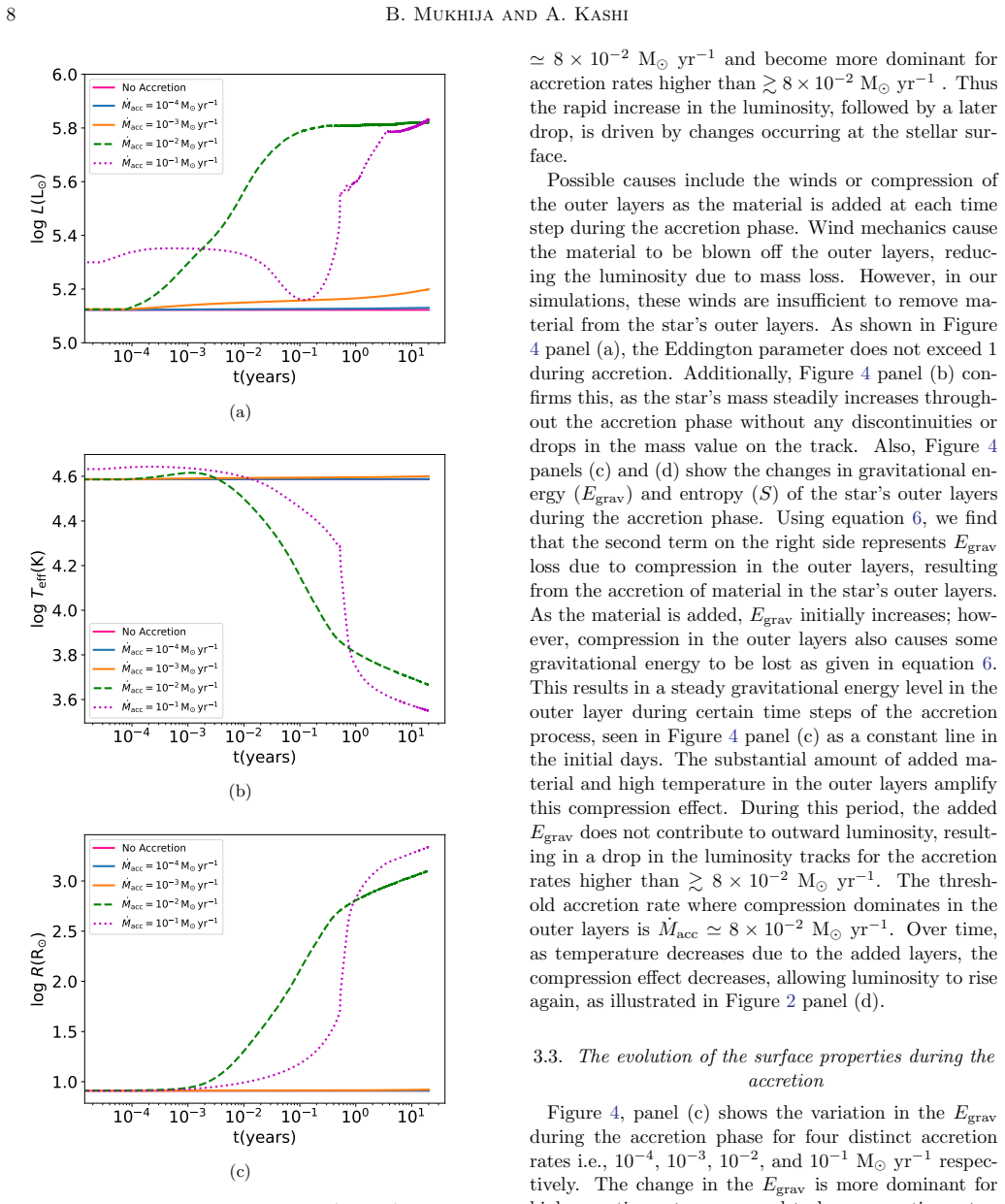
The mechanism carrying the argument is the competition between the accretion timescale and the local thermal timescale in the star's outer layers. Near the surface, the local thermal time $\tau_{\rm th}$ is shorter than the accretion time $\tau_{\rm acc}$, so the added gas has time to settle to the photosphere's entropy and the thermal state of the incoming material is irrelevant; the star radiates the accretion luminosity $L_{\rm acc}=GM\dot M_{\rm acc}/R$. When the accretion rate rises enough, the outer layers can no longer radiate the added gravitational energy fast enough, the star leaves thermal equilibrium, and the envelope inflates and cools. The numerical treatment adds gravitational energy to the outermost cell and includes a compression term that, at the very highest rates ($\gtrsim 8\times10^{-2}\,M_\odot\,\mathrm{yr}^{-1}$), temporarily suppresses the outward luminosity and produces the early luminosity dip. Recovery is governed by the same physics: once accretion stops, the bloated star radiates away the excess gravitational energy and contracts back toward the main sequence.
What would settle it
A concrete check is to repeat the same numerical experiment while varying what the paper assumes: assign the accreted gas a different entropy (for example, the donor's surface entropy instead of the photosphere's), or leave the stellar wind prescription on during the accretion phase. If the boundary between the two regimes moves away from $\sim0.01\,M_\odot\,\mathrm{yr}^{-1}$, or if the high-rate inflation disappears, the claimed dichotomy is an artifact of those assumptions. Observationally, monitoring the companion of $\eta$ Car or a similar system through its eruptive cycle and detecting whether it reaches $\log T_{\rm eff}\simeq 3.5$-$3.7$ K and $R\simeq 10^3\,R_\odot$ while $L$ jumps by $\sim0.7$ dex would settle whether the predicted high-rate regime occurs in nature.
Extended reading notes
Core claim
The paper claims that the response of a massive companion to accretion from a giant-erupting binary partner is bimodal, with a transition near $0.01\,M_\odot\,\mathrm{yr}^{-1}$. For lower rates, the star remains on the hot side of the HR diagram, its luminosity rises only slightly, and it does not expand, because the accretion timescale exceeds the thermal timescale by a larger factor. For higher rates, the companion's luminosity jumps by about one order of magnitude, the star inflates and cools, and it leaves thermal equilibrium. The inflated star is two-component: the original stellar structure underneath plus a distinct accreted layer with different density, temperature, pressure, and entropy. In recovery, high-rate accretors contract back toward the hotter side in roughly $7\times10^2$ years and then evolve as more massive stars, while low-rate accretors first shed wind mass and then expand. Eventually the accreted material mixes with the inner layers and the star continues as a more massive object.
Load-bearing premise
The results depend on the assumption that the accreted gas adopts the surface temperature structure of the star immediately, so how hot or cold it was before landing does not matter, and that winds are turned off during the accretion phase; a different boundary-layer behavior or continuing winds would move the threshold and change the recovery.
Editorial extensions
If this is right
- For accretion rates above roughly $0.01\,M_\odot\,\mathrm{yr}^{-1}$, a companion of an erupting massive star is a temporarily inflated, cool object, so light-curve and spectral models of giant eruptions should include its bloated photosphere rather than treating it as an unchanged main-sequence star.
- Below that threshold, the companion's brightness changes are minor, so any order-of-magnitude brightening seen in a giant-eruption event implies high accretion rates onto a companion.
- High-rate accretors recover by contracting back to the hot side of the HR diagram in roughly $7\times10^2$ years, then continue as more massive stars; low-rate accretors first shed wind mass and then expand, so the two regimes leave different observational signatures in the months and years after the eruption.
- At accretion rates above about $8\times10^{-2}\,M_\odot\,\mathrm{yr}^{-1}$, compression in the outer layers produces an early luminosity dip, which could be recognized as a fingerprint of extreme accretion rather than a primary eruption feature.
- The accreted mass (up to $2\,M_\odot$ for the highest rate) is eventually mixed into the star, meaning final masses and evolutionary fates of companions should be revised upward by the amount actually retained.
Reading between the lines
- A natural extension the paper does not pursue: binary population synthesis should treat the accreted fraction as a step function in accretion rate near $0.01\,M_\odot\,\mathrm{yr}^{-1}$; a fixed fractional accretion assumption will misassign retained mass for systems on either side of the threshold.
- One observational consequence to test: in a known erupting massive binary, a companion that inflates to $\sim10^3\,R_\odot$ should appear as a cool, red, luminous source with $\log T_{\rm eff}\lesssim 3.7$ K during and shortly after the eruption, while a low-rate companion should show no such redness; time-resolved spectroscopy can distinguish the two.
- The compression-induced luminosity dip at very high accretion rates suggests that early light-curve plateaus or dips in giant eruptions could be inverted to estimate the accretion rate onto the companion, providing a new diagnostic if calibrated with more detailed boundary-layer physics.
Signed reviews
Editorial analysis
A structured set of objections, weighed in public.
Referee Report
Summary. The paper uses MESA (r23.05.1) to evolve 20–60 Msun companion stars that accrete at constant rates between 1e-4 and 0.1 Msun/yr for 20 yr after a Giant Eruption, with stellar winds switched off during accretion and re-enabled during recovery. For the fiducial 30 Msun star, the authors find a qualitative dichotomy: at 1e-4 and 1e-3 Msun/yr the star stays on the hot side of the HR diagram with only a mild luminosity increase, while at 1e-2 and 1e-1 Msun/yr it inflates to radii ~10^3 Rsun, cools, and brightens by roughly 0.7 dex. The paper also reports an additional luminosity fluctuation for accretion rates above about 8e-2 Msun/yr, attributed to compression of the outer layers during accretion. The abstract states the central claim as a threshold near 0.01 Msun/yr separating these two behaviors, and the recovery tracks are presented as depending on that split.
Significance. If the dichotomy is robust, the paper provides concrete, falsifiable predictions for companions of erupting massive stars: transient inflation and order-of-magnitude brightening at high accretion rates, a comparatively mild response at lower rates, and mass- and rate-dependent recovery paths. The grid over five initial masses and four accretion rates is a useful first systematic study of this problem. The manuscript ships reproducible MESA inlists and input files on Zenodo, and the high-rate behavior is consistent with the 'hamster' models of Lau et al. (2024) and with the order-of-magnitude companion brightening estimated by Kashi & Soker (2010). The main significance, if the results hold, is in guiding interpretation of giant eruption and supernova impostor light curves and in motivating more detailed binary-parameter studies.
major comments (4)
- [Appendix, Eq. (4); Section 3.3] The central threshold near 0.01 Msun/yr rests on the cold-accretion deposition assumption: the added gas is assigned the photosphere entropy, and the accretion luminosity L_acc = Gm Mdot/R is assumed to radiate outward without affecting the star. At Mdot = 0.1 Msun/yr and R ~ 10 Rsun, L_acc exceeds the stellar luminosity by a large factor; if even a modest fraction of that energy is trapped below the photosphere, the outer layers acquire higher entropy than assumed, and inflation and cooling would begin at a lower accretion rate. The paper does not provide a sensitivity study varying the entropy of the added gas or the fraction of L_acc deposited, nor does it quantify the post-shock cooling timescale. Because the qualitative split in Figure 2 and the recovery tracks both depend on the outer-layer entropy at the end of accretion, this assumption is load-bearing for the stated threshold. I request a deposition-sensitivity test (e.g., adding material with different entropies, or explicitly depositing a fraction of L_acc) to show that the threshold location is not an artifact of this choice.
- [Section 2; Figure 4] The Dutch wind prescription is switched off during the 20-yr accretion phase and re-enabled only during recovery. At high accretion rates the star inflates and its surface temperature drops, so the assumption of zero wind mass loss is favorable to retaining the accreted envelope; if winds continued, outer layers could be partially stripped, reducing the inflation and shifting both the threshold and the recovery tracks. The statement in Section 3.2 that winds are insufficient to remove material is not a test of this, since the wind term is disabled by construction. A quantitative sensitivity run with winds on during accretion, or a justification based on the actual Eddington ratio along the inflated track, is needed to secure the recovery-phase conclusions.
- [Section 3.1; Figure 2; abstract] The abstract's threshold '≲0.01 vs ≳0.01 Msun/yr' is not bracketed by the simulation grid: the only rates below the claimed threshold are 1e-3 and 1e-4 Msun/yr, and the only rates at or above it are 1e-2 and higher, a factor of ten gap. The additional runs in Section 3.2 (2e-2 through 8e-2 Msun/yr) probe only the high-rate regime and do not constrain where the transition occurs. Additional runs at intermediate rates (e.g., 2e-3, 5e-3, and 8e-3 Msun/yr) are necessary to place the critical accretion rate; without them, the quantitative value 0.01 Msun/yr is an interpolation, not a measured result.
- [Section 3.3; Appendix] There is a tension between the text and the appendix on how the accretion energy is handled. Section 3.3 states that the added material 'has the same chemical composition and thermodynamic properties as the material that was present before the accretion' and later says 'we do not specify the fraction of thermal energy released during the accretion phase,' while the Appendix states that the thermal state of the incoming material is irrelevant and that L_acc radiates outward without impacting the added material's entropy. These statements should be reconciled, and the precise MESA mass_change implementation should be described, so the reader can see whether Eq. (4) is actually used or whether the code's default mass deposition is what sets the entropy.
minor comments (5)
- [Section 3.1] The phrase 'companion stars companion stars' appears to be duplicated in the first paragraph; please fix.
- [Section 3.1.2] The sentence 'the star with a lower accretion rate experiences radial inflation (as shown by the track from point B to D in Figure 1)' likely refers to Figure 2, not Figure 1; Figure 1 shows the no-accretion tracks.
- [Table 2] The entries for Eint,B, Eint,C, and ΔEint appear to be internally inconsistent (e.g., Eint,C = 3.70 versus Eint,B = 37.0 for the no-accretion row, with ΔEint = 0.6×10^-5). Please check the decimal points and units.
- [Section 2, Table 1] The table caption reads 'T able 1' with an extra space; please fix the spacing.
- [Reference list] The reference 'Mukhija & Kashi 2024, Submitted' should be updated with the publication status or clearly marked as in preparation, since it is cited as previous work.
Circularity Check
No significant circularity: the results are MESA simulation outputs, not fits or self-citation-forced quantities.
full rationale
The paper's central claims — the accretion-rate threshold near 0.01 Msun/yr separating a hot, mildly brightened companion from an inflated, cooled, order-of-magnitude-brighter companion, and the recovery tracks — are outputs of a MESA grid evolved with specified accretion rates, not quantities fitted to data and then renamed as predictions. The accretion energetics in the Appendix (L_acc = G m Mdot / R, Eq. 4) are standard results cited to Lau et al. (2024) and Nomoto (1982)/Townsley & Bildsten (2004), and the entropy-deposition assumption (accreted gas adopts the photosphere entropy because t_th < t_acc near the surface) is a stated physical approximation; it sets the boundary-layer treatment but is not constructed so that the 0.01 threshold follows by definition. The threshold itself emerges from the simulations (Figure 2; Table 2). Self-citations (Kashi & Soker 2010; Kashi 2010; Kashi et al. 2013) are used only to motivate the accretion-rate range and as a consistency comparison for the luminosity increase; the central derivation does not reduce to those citations, and no uniqueness theorem or ansatz is imported from the authors' prior work. The paper even emphasizes that it imposed no expansion-regulating prescription. Any concern about the cold-accretion deposition assumption is a correctness/robustness issue, not circularity, because the assumption is independent of the target prediction and could in principle falsify it. Hence the circularity score is low, at most 1.
Assumptions & free parameters
free parameters (6)
- Initial metallicity Z =
0.02
- Dutch wind scaling factor =
0.5
- Mixing parameters =
alpha_MLT = 1.5, alpha_sc = 0.01, alpha_th = 2.0, overshoot f1 = 0.005, f0 = 0.001
- Accretion timestep =
500 s
- Accretion start point =
log Teff ~ 4.58 K for the 30 M_sun star
- Accretion duration =
20 yr
assumptions (5)
- standard math MESA's stellar structure and evolution equations are a valid representation of the accreting companion.
- domain assumption Accretion is spherical, at a constant rate, onto a non-rotating single star; rotation, tides, magnetic fields, and the primary are ignored.
- domain assumption The thermal state of the accreted material is irrelevant because it adopts the photosphere entropy when tau_th < tau_acc near the surface.
- ad hoc to paper Stellar winds are switched off during the 20 yr accretion phase and re-enabled during recovery.
- domain assumption Massive 20 to 60 M_sun companions exist around erupting LBVs with close orbits.
Cite this review
Pith. "Pith review of Accretion and Recovery in Giant Eruptions of Massive Stars." pith.science (2026). https://pith.science/paper/S6VUF6MI
@misc{pith2026250419884,
  author       = {Pith},
  title        = {Pith review of: Accretion and Recovery in Giant Eruptions of Massive Stars},
  year         = {2026},
  howpublished = {\url{https://pith.science/paper/S6VUF6MI}},
  note         = {Machine review of arXiv:2504.19884}
}
abstract
Giant Eruptions (GEs) are episodic high-rate mass loss events that massive stars experience in the late stage of evolutions before exploding as a core-collapse supernova. If it occurs in a binary system, the companion star can accrete part of the mass. We use numerical simulations to analyze how the companion responds to accretion and how its structure and evolution are altered. We run a grid of massive stars with masses from $20~\rm M_{\odot}$ to $60~\rm M_{\odot}$, and accretion rates from $\rm 10^{-4}$ to $\rm 0.1~M_{\odot}~\rm yr^{-1}$, over a duration of $20$ yrs. For accretion rates $\rm \lesssim 0.01~M_{\odot}~\rm yr^{-1}$ the star remains on the hotter side of the HR diagram with a minor increase in luminosity without expanding, as the accretion timescale exceeds the thermal time scale by a larger factor. Mass loss through stellar winds leads to a minor drop in luminosity shortly after the accretion phase as the star enters the recovery phase. For $\rm \gtrsim 0.01~M_{\odot}~\rm yr^{-1}$ the companion star experiences a sudden increase in luminosity by about one order of magnitude, inflates, and cools. Under the accreted gas layer the star retains its structure and continues to eject radiation-driven wind during the recovery phase, namely the time it takes to regain equilibrium. Eventually, the accreted material mixes with the inner layers of the star, and the star continues to evolve as a more massive star.
Figures


Figures from the paper (5 more)



Forward citations
Cited by 1 Pith paper
-
High Power Accretion in Massive Binary Systems and the Impact of Metallicity
Higher-metallicity massive stars show larger accretion-driven luminosity increases despite being more extended, and flip to a cool inflated state at lower accretion rates than low-metallicity stars.
Reference graph
Works this paper leans on
-
[1]
, " * write output.state after.block = add.period write newline
ENTRY address archivePrefix author booktitle chapter doi edition editor eprint howpublished institution journal key month number organization pages publisher school series title misctitle type volume year version url label extra.label sort.label short.list INTEGERS output.state before.all mid.sentence after.sentence after.block FUNCTION init.state.consts ...
-
[2]
write newline
" write newline "" before.all 'output.state := FUNCTION format.url url empty "" new.block "" url * "" * if FUNCTION format.eprint eprint empty "" archivePrefix empty "" archivePrefix "arXiv" = new.block " " eprint * " " * new.block " " eprint * " " * if if if FUNCTION format.doi doi empty "" " " doi * " " * if FUNCTION format.pid doi empty eprint empty ur...
-
[3]
- [1] #1 = = ^ ^ ^ .\!\!^ d .\!\!^ h .\!\!^ m .\!\!^ s .\!\!^ @mss
thebibliography [1] 20pt to REFERENCES 6pt =0pt -12pt 10pt plus 3pt =0pt =0pt =1pt plus 1pt =0pt =0pt -12pt =13pt plus 1pt =20pt =13pt plus 1pt \@M =10000 =-1.0em =0pt =0pt 0pt =0pt =1.0em @enumiv\@empty 10000 10000 `\.\@m \@noitemerr \@latex@warning Empty `thebibliography' environment \@ifnextchar \@reference \@latexerr Missing key on reference command E...
2021
-
[4]
Almeida L. A., et al., 2017, @doi [ ] 10.1051/0004-6361/201629844 , https://ui.adsabs.harvard.edu/abs/2017A&A...598A..84A 598, A84
-
[5]
Bear E., Soker N., 2025, @doi [Research in Astronomy and Astrophysics] 10.1088/1674-4527/ada8ef , https://ui.adsabs.harvard.edu/abs/2025RAA....25b5010B 25, 025010
-
[6]
Berger E., et al., 2009, @doi [ ] 10.1088/0004-637X/699/2/1850 , https://ui.adsabs.harvard.edu/abs/2009ApJ...699.1850B 699, 1850
-
[7]
Blagorodnova N., et al., 2021, @doi [ ] 10.1051/0004-6361/202140525 , https://ui.adsabs.harvard.edu/abs/2021A&A...653A.134B 653, A134
-
[8]
B \"o hm-Vitense E., 1958, , https://ui.adsabs.harvard.edu/abs/1958ZA.....46..108B 46, 108
1958
Show all 87 references
-
[9]
Bondi H., Hoyle F., 1944, @doi [ ] 10.1093/mnras/104.5.273 , https://ui.adsabs.harvard.edu/abs/1944MNRAS.104..273B 104, 273
1944 doi
-
[10]
Bouffanais Y., Mapelli M., Santoliquido F., Giacobbo N., Iorio G., Costa G., 2021, @doi [Monthly Notices of the Royal Astronomical Society] 10.1093/mnras/stab1589 , 505, 3873–3882
2021 doi
-
[11]
M., Stevance H
Briel M. M., Stevance H. F., Eldridge J. J., 2023, @doi [Monthly Notices of the Royal Astronomical Society] 10.1093/mnras/stad399 , 520, 5724–5745
2023 doi
-
[12]
Cai Y., Reguitti A., Valerin G., Wang X., 2022a, @doi [Universe] 10.3390/universe8100493 , https://ui.adsabs.harvard.edu/abs/2022Univ....8..493C 8, 493
-
[13]
Z., et al., 2022b, @doi [ ] 10.1051/0004-6361/202244393 , https://ui.adsabs.harvard.edu/abs/2022A&A...667A...4C 667, A4
Cai Y. Z., et al., 2022b, @doi [ ] 10.1051/0004-6361/202244393 , https://ui.adsabs.harvard.edu/abs/2022A&A...667A...4C 667, A4
-
[14]
M., eds, Astrophysics and Space Science Library Vol
Davidson K., 2012, in Davidson K., Humphreys R. M., eds, Astrophysics and Space Science Library Vol. 384, Eta Carinae and the Supernova Impostors. p. 43, @doi 10.1007/978-1-4614-2275-4_3
2012 doi
-
[15]
M., 1997, @doi [ ] 10.1146/annurev.astro.35.1.1 , https://ui.adsabs.harvard.edu/abs/1997ARA&A..35....1D 35, 1
Davidson K., Humphreys R. M., 1997, @doi [ ] 10.1146/annurev.astro.35.1.1 , https://ui.adsabs.harvard.edu/abs/1997ARA&A..35....1D 35, 1
1997 doi
-
[16]
384, @doi 10.1007/978-1-4614-2275-4
Davidson K., Humphreys R., eds, 2012a, Eta Carinae and the Supernova Impostors Astrophysics and Space Science Library Vol. 384, @doi 10.1007/978-1-4614-2275-4
-
[18]
M., 2012c, @doi [Nature] 10.1038/nature11166 , 486, E1–E1
Davidson K., Humphreys R. M., 2012c, @doi [Nature] 10.1038/nature11166 , 486, E1–E1
-
[19]
Duch \^e ne G., Kraus A., 2013, @doi [ ] 10.1146/annurev-astro-081710-102602 , https://ui.adsabs.harvard.edu/abs/2013ARA&A..51..269D 51, 269
2013 doi
-
[20]
Gurevich O., Bear E., Soker N., 2022, @doi [ ] 10.1093/mnras/stac081 , https://ui.adsabs.harvard.edu/abs/2022MNRAS.511.1330G 511, 1330
2022 doi
-
[21]
Harpaz A., Soker N., 2009, @doi [ ] 10.1016/j.newast.2009.01.011 , https://ui.adsabs.harvard.edu/abs/2009NewA...14..539H 14, 539
2009 doi
-
[22]
S., Bodenheimer P., 1965, @doi [ ] 10.1086/148357 , https://ui.adsabs.harvard.edu/abs/1965ApJ...142..841H 142, 841
Henyey L., Vardya M. S., Bodenheimer P., 1965, @doi [ ] 10.1086/148357 , https://ui.adsabs.harvard.edu/abs/1965ApJ...142..841H 142, 841
1965 doi
- [23]
-
[24]
M., Davidson K., 1994, @doi [ ] 10.1086/133478 , https://ui.adsabs.harvard.edu/abs/1994PASP..106.1025H 106, 1025
Humphreys R. M., Davidson K., 1994, @doi [ ] 10.1086/133478 , https://ui.adsabs.harvard.edu/abs/1994PASP..106.1025H 106, 1025
1994 doi
-
[25]
M., Martin J
Humphreys R. M., Martin J. C., 2012, in Davidson K., Humphreys R. M., eds, Astrophysics and Space Science Library Vol. 384, Eta Carinae and the Supernova Impostors. p. 1, @doi 10.1007/978-1-4614-2275-4_1
2012 doi
-
[26]
M., Davidson K., Smith N., 1999, @doi [ ] 10.1086/316420 , https://ui.adsabs.harvard.edu/abs/1999PASP..111.1124H 111, 1124
Humphreys R. M., Davidson K., Smith N., 1999, @doi [ ] 10.1086/316420 , https://ui.adsabs.harvard.edu/abs/1999PASP..111.1124H 111, 1124
1999 doi
-
[27]
R., Tout C
Hurley J. R., Tout C. A., Pols O. R., 2002, @doi [ ] 10.1046/j.1365-8711.2002.05038.x , https://ui.adsabs.harvard.edu/abs/2002MNRAS.329..897H 329, 897
2002
-
[28]
A., Rogers F
Iglesias C. A., Rogers F. J., 1996, @doi [ ] 10.1086/177381 , https://ui.adsabs.harvard.edu/abs/1996ApJ...464..943I 464, 943
1996 doi
-
[29]
E., et al., 2019, @doi [ ] 10.3847/1538-4357/ab4a01 , https://ui.adsabs.harvard.edu/abs/2019ApJ...886...40J 886, 40
Jencson J. E., et al., 2019, @doi [ ] 10.3847/1538-4357/ab4a01 , https://ui.adsabs.harvard.edu/abs/2019ApJ...886...40J 886, 40
2019 doi
-
[30]
M., Hajduk M., 2021, @doi [ ] 10.1051/0004-6361/202039634 , https://ui.adsabs.harvard.edu/abs/2021A&A...646A...1K 646, A1
Kami \'n ski T., Steffen W., Bujarrabal V., Tylenda R., Menten K. M., Hajduk M., 2021, @doi [ ] 10.1051/0004-6361/202039634 , https://ui.adsabs.harvard.edu/abs/2021A&A...646A...1K 646, A1
2021 doi
-
[31]
Kashi A., 2010, @doi [ ] 10.1111/j.1365-2966.2010.16582.x , https://ui.adsabs.harvard.edu/abs/2010MNRAS.405.1924K 405, 1924
2010
-
[32]
Kashi A., 2017, @doi [ ] 10.1093/mnras/stw2303 , https://ui.adsabs.harvard.edu/abs/2017MNRAS.464..775K 464, 775
2017 doi
-
[33]
Kashi A., 2020, @doi [ ] 10.1093/mnras/staa203 , https://ui.adsabs.harvard.edu/abs/2020MNRAS.492.5261K 492, 5261
2020 doi
-
[34]
Kashi A., 2023, @doi [ ] 10.1093/mnras/stad1758 , https://ui.adsabs.harvard.edu/abs/2023MNRAS.523.5876K 523, 5876
2023 doi
-
[35]
Kashi A., Soker N., 2007, @doi [ ] 10.1111/j.1365-2966.2007.11908.x , https://ui.adsabs.harvard.edu/abs/2007MNRAS.378.1609K 378, 1609
2007
-
[36]
Kashi A., Soker N., 2008, @doi [ ] 10.1016/j.newast.2008.03.003 , https://ui.adsabs.harvard.edu/abs/2008NewA...13..569K 13, 569
2008 doi
-
[37]
Kashi A., Soker N., 2010, @doi [ ] 10.1088/0004-637X/723/1/602 , https://ui.adsabs.harvard.edu/abs/2010ApJ...723..602K 723, 602
2010 doi
-
[38]
Kashi A., Soker N., 2016, @doi [ ] 10.3847/0004-637X/825/2/105 , https://ui.adsabs.harvard.edu/abs/2016ApJ...825..105K 825, 105
2016 doi
-
[39]
Kashi A., Soker N., 2017, @doi [ ] 10.1093/mnras/stx767 , https://ui.adsabs.harvard.edu/abs/2017MNRAS.468.4938K 468, 4938
2017 doi
-
[40]
Kashi A., Frankowski A., Soker N., 2010, @doi [ ] 10.1088/2041-8205/709/1/L11 , https://ui.adsabs.harvard.edu/abs/2010ApJ...709L..11K 709, L11
2010 doi
-
[41]
Kashi A., Soker N., Moskovitz N., 2013, @doi [ ] 10.1093/mnras/stt1742 , https://ui.adsabs.harvard.edu/abs/2013MNRAS.436.2484K 436, 2484
2013 doi
-
[42]
M., 2016, @doi [ ] 10.3847/0004-637X/817/1/66 , https://ui.adsabs.harvard.edu/abs/2016ApJ...817...66K 817, 66
Kashi A., Davidson K., Humphreys R. M., 2016, @doi [ ] 10.3847/0004-637X/817/1/66 , https://ui.adsabs.harvard.edu/abs/2016ApJ...817...66K 817, 66
2016 doi
-
[43]
A., Soker N., Kastner J
Kashi A., Principe D. A., Soker N., Kastner J. H., 2021, @doi [ ] 10.3847/1538-4357/abfa9c , https://ui.adsabs.harvard.edu/abs/2021ApJ...914...47K 914, 47
2021 doi
-
[44]
Kashi A., Michaelis A., Kaminetsky Y., 2022, @doi [ ] 10.1093/mnras/stac1912 , https://ui.adsabs.harvard.edu/abs/2022MNRAS.516.3193K 516, 3193
2022 doi
-
[45]
Springer
Kippenhahn R., Weigert A., 1990, Stellar Structure and Evolution . Springer
1990
-
[46]
C., 1980, , https://ui.adsabs.harvard.edu/abs/1980A&A....91..175K 91, 175
Kippenhahn R., Ruschenplatt G., Thomas H. C., 1980, , https://ui.adsabs.harvard.edu/abs/1980A&A....91..175K 91, 175
1980
-
[47]
Kuiper R., Klahr H., Beuther H., Henning T., 2011, @doi [ ] 10.1088/0004-637X/732/1/20 , https://ui.adsabs.harvard.edu/abs/2011ApJ...732...20K 732, 20
2011 doi
-
[48]
Lau M. Y. M., Hirai R., Mandel I., Tout C. A., 2024, @doi [ ] 10.3847/2041-8213/ad3d50 , https://ui.adsabs.harvard.edu/abs/2024ApJ...966L...7L 966, L7
2024 doi
-
[49]
V., 2024, @doi [Azerbaijani Astronomical Journal] 10.59849/2078-4163.2024.2.73 , https://ui.adsabs.harvard.edu/abs/2024AzAJ...19b..73M 19, 73
Maryeva O. V., 2024, @doi [Azerbaijani Astronomical Journal] 10.59849/2078-4163.2024.2.73 , https://ui.adsabs.harvard.edu/abs/2024AzAJ...19b..73M 19, 73
2024
-
[50]
D., Hartkopf W
Mason B. D., Hartkopf W. I., Gies D. R., Henry T. J., Helsel J. W., 2009, @doi [ ] 10.1088/0004-6256/137/2/3358 , https://ui.adsabs.harvard.edu/abs/2009AJ....137.3358M 137, 3358
2009 doi
-
[51]
J., Humphreys R
Mehner A., Davidson K., Ferland G. J., Humphreys R. M., 2010, @doi [ ] 10.1088/0004-637X/710/1/729 , https://ui.adsabs.harvard.edu/abs/2010ApJ...710..729M 710, 729
2010 doi
-
[52]
M., Kashi A., Kochiashvili N., 2018, @doi [ ] 10.1016/j.newast.2018.06.001 , https://ui.adsabs.harvard.edu/abs/2018NewA...65...29M 65, 29
Michaelis A. M., Kashi A., Kochiashvili N., 2018, @doi [ ] 10.1016/j.newast.2018.06.001 , https://ui.adsabs.harvard.edu/abs/2018NewA...65...29M 65, 29
2018 doi
-
[53]
Moe M., Di Stefano R., 2017, @doi [ ] 10.3847/1538-4365/aa6fb6 , https://ui.adsabs.harvard.edu/abs/2017ApJS..230...15M 230, 15
2017 doi
-
[54]
Mukhija B., Kashi A., 2024, Submitted
2024
-
[55]
Nomoto K., 1982, @doi [ ] 10.1086/159682 , https://ui.adsabs.harvard.edu/abs/1982ApJ...253..798N 253, 798
1982 doi
-
[56]
Nuijten M., Nelemans G., 2025, @doi [ ] 10.1051/0004-6361/202451564 , https://ui.adsabs.harvard.edu/abs/2025A&A...695A.117N 695, A117
2025 doi
-
[57]
Paxton B., Bildsten L., Dotter A., Herwig F., Lesaffre P., Timmes F., 2011, @doi [ ] 10.1088/0067-0049/192/1/3 , https://ui.adsabs.harvard.edu/abs/2011ApJS..192....3P 192, 3
2011 doi
-
[58]
Paxton B., et al., 2013, @doi [ ] 10.1088/0067-0049/208/1/4 , https://ui.adsabs.harvard.edu/abs/2013ApJS..208....4P 208, 4
2013 doi
-
[59]
Paxton B., et al., 2015, @doi [ ] 10.1088/0067-0049/220/1/15 , https://ui.adsabs.harvard.edu/abs/2015ApJS..220...15P 220, 15
2015 doi
-
[60]
Paxton B., et al., 2018, @doi [ ] 10.3847/1538-4365/aaa5a8 , https://ui.adsabs.harvard.edu/abs/2018ApJS..234...34P 234, 34
2018 doi
-
[61]
Paxton B., et al., 2019, @doi [ ] 10.3847/1538-4365/ab2241 , https://ui.adsabs.harvard.edu/abs/2019ApJS..243...10P 243, 10
2019 doi
-
[62]
R., Schroeder K
Pols O. R., Schroeder K. P., Hurley J. R., Tout C. A., Eggleton P. P., 2009, VizieR Online Data Catalog, https://ui.adsabs.harvard.edu/abs/2009yCat..72980525P p. J/MNRAS/298/525
2009
-
[63]
Cambridge University Press
Prialnik D., 2009, An Introduction to the Theory of Stellar Structure and Evolution . Cambridge University Press
2009
-
[64]
J., Nayfonov A., 2002, @doi [ ] 10.1086/341894 , https://ui.adsabs.harvard.edu/abs/2002ApJ...576.1064R 576, 1064
Rogers F. J., Nayfonov A., 2002, @doi [ ] 10.1086/341894 , https://ui.adsabs.harvard.edu/abs/2002ApJ...576.1064R 576, 1064
2002 doi
-
[65]
Sana H., et al., 2012, @doi [Science] 10.1126/science.1223344 , https://ui.adsabs.harvard.edu/abs/2012Sci...337..444S 337, 444
2012 doi
-
[66]
Sana H., et al., 2014, @doi [ ] 10.1088/0067-0049/215/1/15 , https://ui.adsabs.harvard.edu/abs/2014ApJS..215...15S 215, 15
2014 doi
-
[67]
Schneider F. R. N., Podsiadlowski P., Laplace E., 2024, @doi [ ] 10.1051/0004-6361/202347854 , https://ui.adsabs.harvard.edu/abs/2024A&A...686A..45S 686, A45
2024 doi
-
[68]
Sch \"u rmann C., Langer N., 2024, @doi [ ] 10.1051/0004-6361/202450354 , https://ui.adsabs.harvard.edu/abs/2024A&A...691A.174S 691, A174
2024 doi
-
[69]
Scolnic A., Bear E., Soker N., 2025a, Open Journal of Astrophysics
-
[70]
Scolnic A., Bear E., Soker N., 2025b, @doi [ ] 10.1088/1538-3873/adb5c2 , https://ui.adsabs.harvard.edu/abs/2025PASP..137c4201S 137, 034201
-
[71]
Soker N., 2001a, @doi [ ] 10.1046/j.1365-8711.2001.04439.x , https://ui.adsabs.harvard.edu/abs/2001MNRAS.325..584S 325, 584
2001
-
[72]
Soker N., 2001b, @doi [ ] 10.1051/0004-6361:20011113 , https://ui.adsabs.harvard.edu/abs/2001A&A...377..672S 377, 672
-
[73]
Soker N., 2004, @doi [ ] 10.1086/422599 , https://ui.adsabs.harvard.edu/abs/2004ApJ...612.1060S 612, 1060
2004 doi
-
[74]
Soker N., 2007, @doi [The Astrophysical Journal] 10.1086/514811 , 661, 482–489
2007 doi
-
[75]
Soker N., 2020, @doi [Galaxies] 10.3390/galaxies8010026 , https://ui.adsabs.harvard.edu/abs/2020Galax...8...26S 8, 26
2020 doi
-
[76]
Soker N., 2023, @doi [ ] 10.1093/mnrasl/slad086 , https://ui.adsabs.harvard.edu/abs/2023MNRAS.524L..94S 524, L94
2023 doi
-
[77]
Soker N., Kashi A., 2012, @doi [ ] 10.1088/0004-637X/746/1/100 , https://ui.adsabs.harvard.edu/abs/2012ApJ...746..100S 746, 100
2012 doi
-
[78]
Soker N., Kashi A., 2016, @doi [ ] 10.1093/mnras/stw1686 , https://ui.adsabs.harvard.edu/abs/2016MNRAS.462..217S 462, 217
2016 doi
-
[79]
Strawn E., et al., 2023, @doi [ ] 10.1093/mnras/stad018 , https://ui.adsabs.harvard.edu/abs/2023MNRAS.519.5882S 519, 5882
2023 doi
-
[80]
C., 1977, @doi [ ] 10.1146/annurev.aa.15.090177.001015 , https://ui.adsabs.harvard.edu/abs/1977ARA&A..15..127T 15, 127
Thomas H. C., 1977, @doi [ ] 10.1146/annurev.aa.15.090177.001015 , https://ui.adsabs.harvard.edu/abs/1977ARA&A..15..127T 15, 127
1977
-
[81]
Tokovinin A., 2008, @doi [ ] 10.1111/j.1365-2966.2008.13613.x , https://ui.adsabs.harvard.edu/abs/2008MNRAS.389..925T 389, 925
2008
-
[82]
M., Bildsten L., 2004, @doi [ ] 10.1086/379647 , https://ui.adsabs.harvard.edu/abs/2004ApJ...600..390T 600, 390
Townsley D. M., Bildsten L., 2004, @doi [ ] 10.1086/379647 , https://ui.adsabs.harvard.edu/abs/2004ApJ...600..390T 600, 390
2004 doi
-
[83]
Vanbeveren D., De Loore C., Van Rensbergen W., 1998, @doi [ ] 10.1007/s001590050015 , https://ui.adsabs.harvard.edu/abs/1998A&ARv...9...63V 9, 63
1998 doi
-
[84]
M., eds, Astrophysics and Space Science Library Vol
Weis K., 2012, in Davidson K., Humphreys R. M., eds, Astrophysics and Space Science Library Vol. 384, Eta Carinae and the Supernova Impostors. p. 171, @doi 10.1007/978-1-4614-2275-4_8
2012 doi
-
[85]
Willcox R., MacLeod M., Mandel I., Hirai R., 2023, @doi [ ] 10.3847/1538-4357/acffb1 , https://ui.adsabs.harvard.edu/abs/2023ApJ...958..138W 958, 138
2023 doi
-
[86]
W., Schneider F
Wu S., Everson R. W., Schneider F. R. N., Podsiadlowski P., Ramirez-Ruiz E., 2020, @doi [ ] 10.3847/1538-4357/abaf48 , https://ui.adsabs.harvard.edu/abs/2020ApJ...901...44W 901, 44
2020 doi
-
[87]
Zhao X., Fuller J., 2020, @doi [ ] 10.1093/mnras/staa1097 , https://ui.adsabs.harvard.edu/abs/2020MNRAS.495..249Z 495, 249
2020 doi
-
[88]
de Groot M., 1988, Irish Astronomical Journal, https://ui.adsabs.harvard.edu/abs/1988IrAJ...18..163D 18, 163
1988
Reviewed August 16, 2026 · model on record in the stance chip above.
Discussion (0). Continue with ORCID to comment.