REVIEW 4 major objections 6 minor 72 references
Efficient Graph-Based Approximate Nearest Neighbor Search Achieving: Low Latency Without Throughput Loss
T0 review · 4 major / 6 minor · reviewed 2026-08-16 · deepseek-v4-flash
Pith's one-line read AverSearch claims that replacing fork-join parallelism with a fully asynchronous pipeline lets a graph ANNS engine cut latency without losing throughput, reporting up to 8.93x higher QPS at matching latency than iQAN.
desk verdict A genuinely novel asynchronous design for intra-query parallel graph ANNS, but the title overclaims and the missing drift bound plus no artifact keep it from being fully convincing. read the letter →
The pith
A machine-rendered reading of the paper's core claim, the machinery that carries it, and where it could break.
The reading
What carries the argument
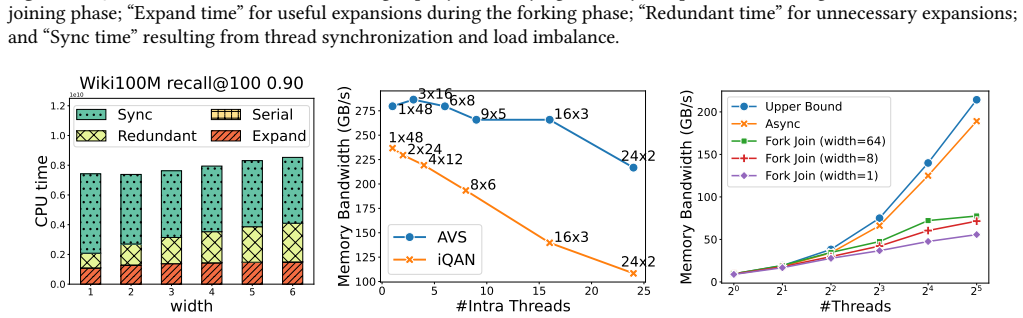
The central mechanism is the fully asynchronous decomposition of Best-First Search into three thread roles plus two shared structures. The distance array stores each computed query-vertex distance with a 'ready' flag so calculators and maintainers never hand data to each other directly; the approximate L-threshold, computed by a global balancer from stale sub-queue snapshots, lets maintainers prune without a global barrier. Its job is to keep distance-calculation threads continuously fed, raising effective memory bandwidth, and to prune only what serial search would also prune, lowering the redundant expansion ratio.
What would settle it
Run AverSearch against iQAN at the same 24x2 configuration on a dataset engineered to have many near-tie distances around the pruning boundary and check recall@100 at matched latency: if recall drops below iQAN's, or if the shared 'ready'-flag misses cause duplicate distance computations on a 128D dataset, the claim that the async design loses no throughput at equal accuracy fails.
Extended reading notes
Core claim
Stated on its own terms, the discovery is that parallel graph ANNS can be made fully asynchronous by replacing the global priority queue with per-subgroup sub-queues, letting each query's worker threads play three non-blocking roles. The sub-queue maintainer owns ordered candidates; distance calculators pull vertices and write distances to a shared distance array with ready flags, speculatively moving to the next unchecked vertex when the queue has not changed; a global balancer announces a slightly larger approximate L-threshold from asynchronous snapshots and steers pruning and work-stealing. Because no thread waits on a join, physical memory bandwidth stays high, and because the threshold and work-stealing are dynamic, the fraction of redundant expansions falls. The paper claims that AverSearch consistently beats iQAN on both throughput and latency under identical parallelism, reaching 8.93x higher throughput at comparable latency on DEEP100M and cutting minimum average latency by up to 1.96x.
Load-bearing premise
The load-bearing premise is that the approximate L-threshold, computed from stale asynchronous snapshots of the sub-queues, stays close enough to the true global order that pruning never discards vertices a serial search would expand; the paper offers no bound on that drift.
Editorial extensions
If this is right
- Under identical parallelism settings, AverSearch reports 1.23x-2.38x higher QPS than iQAN on SIFT100M and DEEP100M with 1.07x-2.35x lower latency, so the async design dominates on both axes for the same thread allocation.
- At comparable latency (within 20 percent), the reported throughput advantage is 2.17x on SE-OpenAI and up to 8.93x on DEEP100M, meaning the entire QPS-latency frontier shifts outward.
- Minimum average latency drops by 1.54x-1.96x across datasets, which is the metric that matters for RAG responses that issue multiple retrieval rounds and for attention-based retrieval.
- Against FAISS and Milvus, the system reports up to 9.82x lower latency and up to 5.68x higher throughput at high recall, suggesting production vector databases could adopt the asynchronous search path.
- The pipeline is graph-agnostic in the experiments: it runs on NSG, SSG, and Vamana indexes and inside a FAISS integration, so the gain is not tied to one index structure.
Reading between the lines
- Not claimed by the paper, but a natural generalization: the same three-role split (queue maintainer, distance calculator, global balancer) could be applied to other memory-bound priority-queue graph algorithms such as Dijkstra's shortest paths or personalized PageRank, where fork-join barriers create the same idle-bandwidth problem.
- The paper does not bound how far the approximate L-threshold drifts from the global order; a follow-up could instrument snapshot age against recall on a dataset with tight distance clusters to see whether the pruning slack can be reduced without hurting quality.
- The paper notes that static role assignment keeps low-dimensional datasets from reaching peak memory bandwidth; an adaptive scheme that lets idle distance calculators take over sub-queue maintenance when a queue drains is a plausible next step.
- For per-token attention retrieval in long-context inference, the paper's own data emphasize the 1.54x-1.96x minimum-latency reduction as the primary benefit, since those workloads query serially many times rather than maximize concurrent QPS.
Signed reviews
Editorial analysis
A structured set of objections, weighed in public.
Referee Report
Summary. The paper presents AverSearch, a CPU-based graph ANNS engine built on a fully asynchronous architecture. It decomposes each query into sub-queue maintainer threads, distance calculator threads, and a global balancer thread, and uses shared lock-free distance arrays, an approximate L-threshold, and work stealing to reduce synchronization and redundant computation. The authors claim that AverSearch consistently achieves higher throughput and lower latency than iQAN under the same intra-query/inter-query parallelism settings, with up to 2.1x-8.9x higher throughput at comparable latency and 1.5x-1.9x lower minimum average latency across six datasets, including 100M-vector and high-dimensional embedding datasets. The evaluation also reports PMB and redundancy-ratio measurements, a breakdown analysis, a FAISS integration, and comparisons with Milvus, ParlayANN, and quantization baselines.
Significance. If the central empirical claims hold, AverSearch is a practically significant contribution to intra-query parallel graph-based ANNS: it addresses a real limitation of fork-join engines by keeping memory-intensive distance computation continuously busy, and the main comparison against iQAN is carried out on shared NSG and Vamana indices, which is a credible experimental design. The paper deserves credit for reporting physical memory bandwidth via hardware counters, for decomposing CPU time into expand/sync/redundant/serial components, and for providing an ablation that separates the asynchronous architecture from work stealing and inlining. The paper also candidly notes limitations in §5.3, including that PMB does not always reach the machine maximum on short-vector datasets and that RR is comparable to iQAN on the two small Simple English datasets. However, the headline claim 'low latency without throughput loss' is stronger than the evidence, and the approximate L-threshold used by the asynchronous design has no correctness guarantee, so the recall-matched QPS advantage could be a partial artifact of over-pruning on unseen datasets.
major comments (4)
- [§4.2, Algorithms 3–5] The approximate L-threshold computed in Algorithm 3 from asynchronous sub-queue snapshots has no correctness bound. The balancer simulates pruning based only on the vertices currently visible in the sub-queues, while Algorithm 5 can write distances into the distance array that Algorithm 4 has not yet merged into any sub-queue. If such in-flight vertices are farther than the current threshold, the announced threshold can be strictly below the exact L-th nearest distance among all vertices discovered so far, and Algorithm 4 line 11 can permanently prune candidates that serial BFiS would expand. Since recall@100 is a measured outcome rather than an invariant, the reported QPS gains at fixed recall could partly reflect over-pruning, and the result may not transfer to datasets with different distance distributions. Please provide either a formal drift bound on the approximate threshold relative to the exact L-th order, or an empirical sensitivity study (for example, recall and QPS as functions of threshold-update frequency and snapshot staleness), and consider releasing the implementation for independent verification.
- [Title, Abstract, and §5.2 (Figures 1 and 10)] The claim 'low latency without throughput loss' is stronger than the data support. In Figures 1 and 10, AverSearch's own QPS decreases as intra-query parallelism increases, for example in the SIFT100M and Wiki100M panels at recall 0.90 and 0.995; the plotted configurations move left toward lower latency and downward in QPS as the intra-thread count grows. What the evaluation actually supports is that AverSearch dominates iQAN at the same parallelism configurations and achieves higher QPS at comparable latency. The title and the corresponding abstract/conclusion sentences should be revised to state the relative comparison precisely rather than implying that latency can be reduced with no throughput cost in absolute terms.
- [§3.2 and Table 1] The throughput formula Throughput ∝ PMB × (1 − RR) is introduced as an empirical formula but is not validated as a quantitative model. Table 1 reports a 2.2× predicted EMB improvement on Wiki100M against a 1.78× measured throughput difference, and the PMB and RR ratios vary substantially across datasets, yet no residual analysis, fitted constant, or correlation statistic is provided. The qualitative narrative that asynchrony improves PMB and reduces RR is consistent with the measurements, but the formula should be presented as a heuristic explanation rather than a predictive relation, or it should be validated with explicit error bounds.
- [§5.1–§5.2] The evaluation does not report how search hyperparameters (L, entry-point selection, recall targets) were chosen for each system, nor the achieved recall values around each target. Recall@100 is used as a target, but without a tolerance band or per-configuration recall numbers, a reader cannot determine whether the QPS comparisons are exactly at matched quality; small recall differences can translate into large QPS differences. Please include achieved recall and the corresponding L values for each plotted configuration, or state explicitly how the target recall was enforced and verified for every data point.
minor comments (6)
- [§2.3.1] There is a typo in 'controling the search precision'; it should be 'controlling'.
- [§2.3.2] The phrase 'bellowing l3' should read 'below line 3'.
- [§4.3] The sentence 'Regarding dependency ➁' appears twice in consecutive paragraphs; the second occurrence should refer to the next dependency being disentangled for clarity.
- [Figures 3, 8, and 9] The role of the thread that maintains a sub-queue is referred to inconsistently as 'sub-que thread' and 'sub-queue maintainer'; please unify the terminology.
- [Algorithm 3] Algorithm 3 is presented as pseudocode, but its body only states the assignment of L-threshold; please provide the actual merge-simulation steps, including how often the balancer runs and what it does when a sub-queue is empty.
- [§5.4] The Milvus and FAISS comparisons are acknowledged as not head-to-head; consider presenting them in a clearly labeled auxiliary subsection so that they are not read as direct system benchmarks.
Circularity Check
No circularity: headline QPS/latency gains are measured against external baselines on shared graphs; the EMB formula is a post-hoc explanatory heuristic, not a fitted input or self-citation.
full rationale
No significant circularity found. The paper's central performance claims are direct measurements against external baselines (iQAN, FAISS, Milvus, ParlayANN) on shared graphs with fixed total thread count, so the reported QPS and latency numbers are not derived from fitted parameters or from the authors' own prior results. The 'empirical formula' Throughput proportional to EMB = PMB x (1-RR) is introduced in Section 3.2 as a heuristic for reasoning about synchronization overhead and redundant computation, and it is checked against measured PMB/RR values in Section 5.3; it is not used to manufacture the headline QPS figures. The approximate L-threshold in Section 4.2 is an algorithmic approximation whose quality is a correctness/robustness concern rather than a circular derivation: its effect is validated by measured recall@100 against ground-truth neighbors, not guaranteed by construction. No self-citations are load-bearing; the paper cites external prior work such as iQAN, NSG, HNSW, and ParlayANN. The claimed gains are therefore self-contained empirical results.
Assumptions & free parameters
free parameters (2)
- search list length L =
not stated numerically; set per dataset and recall target (0.9 to 0.995)
- intra/inter thread configuration =
sweeps such as 1x48, 2x24, 4x12, 8x6, 16x3, 24x2 on 48 cores
assumptions (5)
- domain assumption Best-First Search with a bounded priority queue of size L returns approximate top-K neighbors with controllable recall.
- domain assumption The NSG and Vamana graphs used are searchable at the reported recall levels.
- ad hoc to paper Concurrent reads and writes to the shared distance array are benign in practice.
- ad hoc to paper Throughput is approximately proportional to PMB times (1 minus RR).
- ad hoc to paper The approximate L-threshold computed from asynchronous sub-queue snapshots does not materially degrade recall.
Cite this review
Pith. "Pith review of Efficient Graph-Based Approximate Nearest Neighbor Search Achieving: Low Latency Without Throughput Loss." pith.science (2026). https://pith.science/paper/PN3JUF6V
@misc{pith2026250420461,
  author       = {Pith},
  title        = {Pith review of: Efficient Graph-Based Approximate Nearest Neighbor Search Achieving: Low Latency Without Throughput Loss},
  year         = {2026},
  howpublished = {\url{https://pith.science/paper/PN3JUF6V}},
  note         = {Machine review of arXiv:2504.20461}
}
read the original abstract
The increase in the dimensionality of neural embedding models has enhanced the accuracy of semantic search capabilities but also amplified the computational demands for Approximate Nearest Neighbor Searches (ANNS). This complexity poses significant challenges in online and interactive services, where query latency is a critical performance metric. Traditional graph-based ANNS methods, while effective for managing large datasets, often experience substantial throughput reductions when scaled for intra-query parallelism to minimize latency. This reduction is largely due to inherent inefficiencies in the conventional fork-join parallelism model. To address this problem, we introduce AverSearch, a novel parallel graph-based ANNS framework that overcomes these limitations through a fully asynchronous architecture. Unlike existing frameworks that struggle with balancing latency and throughput, AverSearch utilizes a dynamic workload balancing mechanism that supports continuous, dependency-free processing. This approach not only minimizes latency by eliminating unnecessary synchronization and redundant vertex processing but also maintains high throughput levels. Our evaluations across various datasets, including both traditional benchmarks and modern large-scale model generated datasets, show that AverSearch consistently outperforms current state-of-the-art systems. It achieves up to 2.1-8.9 times higher throughput at comparable latency levels across different datasets and reduces minimum latency by 1.5 to 1.9 times.
Figures


Figures from the paper (6 more)



Reference graph
Works this paper leans on
-
[1]
2012. Deep1B. https://disk.yandex.ru/d/11eDCm7Dsn9GA
work page 2012
-
[2]
Ameer MS Abdelhadi, Christos-Savvas Bouganis, and George A Con- stantinides. 2019. Accelerated approximate nearest neighbors search through hierarchical product quantization. In 2019 International Conference on Field-Programmable Technology (ICFPT). IEEE, 90– 98
work page 2019
-
[3]
Alexandr Andoni, Piotr Indyk, Thijs Laarhoven, Ilya Razenshteyn, and Ludwig Schmidt. 2015. Practical and optimal LSH for angular distance. Advances in neural information processing systems 28 (2015)
2015
-
[4]
Martin Aumueller, Erik Bernhardsson, and Alec Faitfull. 2023. ANN- Benchmarks. https://ann-benchmarks.com/index.html
work page 2023
-
[5]
Martin Aumüller, Erik Bernhardsson, and Alexander Faithfull. 2020. ANN-Benchmarks: A benchmarking tool for approximate nearest neighbor algorithms. Information Systems 87 (2020), 101374
2020
-
[6]
Qi Chen, Haidong Wang, Mingqin Li, Gang Ren, Scarlett Li, Jeffery Zhu, Jason Li, Chuanjie Liu, Lintao Zhang, and Jingdong Wang. 2018. SPTAG: A library for fast approximate nearest neighbor search
2018
-
[7]
Qi Chen, Bing Zhao, Haidong Wang, Mingqin Li, Chuanjie Liu, Zengzhong Li, Mao Yang, and Jingdong Wang. 2021. Spann: Highly- efficient billion-scale approximate nearest neighbor search. arXiv preprint arXiv:2111.08566 (2021)
arXiv 2021
-
[8]
Zhuoming Chen, Ranajoy Sadhukhan, Zihao Ye, Yang Zhou, Jianyu Zhang, Niklas Nolte, Yuandong Tian, Matthijs Douze, Leon Bottou, Zhihao Jia, et al . 2024. MagicPIG: LSH Sampling for Efficient LLM Generation. arXiv preprint arXiv:2410.16179 (2024)
arXiv 2024
Show all 72 references
-
[9]
Yuze Chi, Guohao Dai, Yu Wang, Guangyu Sun, Guoliang Li, and Huazhong Yang. 2016. Nxgraph: An efficient graph processing system on a single machine. In 2016 IEEE 32nd International Conference on Data Engineering (ICDE). IEEE, 409–420
2016
-
[10]
cohere.ai. 2022. Cohere/wikipedia-22-12. https://huggingface.co/dat asets/Cohere/wikipedia-22-12
2022
-
[11]
cohere.ai. 2022. Develop, test, and experiment with the industry’s first multilingual text understanding model that supports 100+ languages. https://cohere.com/blog/multilingual
2022
-
[12]
cohere.ai. 2023. Cohere/wikipedia-2023-11-embed-multilingual-v3. https://huggingface.co/datasets/Cohere/wikipedia-2023-11-embed- multilingual-v3
2023
-
[13]
Leonardo Dagum and Ramesh Menon. 1998. OpenMP: an industry standard API for shared-memory programming. IEEE computational science and engineering 5, 1 (1998), 46–55
1998
-
[14]
Guohao Dai, Tianhao Huang, Yuze Chi, Ningyi Xu, Yu Wang, and Huazhong Yang. 2017. ForeGraph: Exploring large-scale graph processing on multi-FPGA architecture. In Proceedings of the 2017 ACM/SIGDA International Symposium on Field-Programmable Gate Arrays. 217–226
2017
-
[15]
Matthijs Douze, Alexandr Guzhva, Chengqi Deng, Jeff Johnson, Gergely Szilvasy, Pierre-Emmanuel Mazaré, Maria Lomeli, Lucas Hosseini, and Hervé Jégou. 2024. The Faiss library. (2024). arXiv:2401.08281 [cs.LG]
2024 arXiv
-
[16]
facebookresearch. 2022. facebookresearch/faiss. https://github.com/f acebookresearch/faiss
2022
-
[17]
Cong Fu and Deng Cai. 2016. Efanna: An extremely fast approximate nearest neighbor search algorithm based on knn graph.arXiv preprint arXiv:1609.07228 (2016). Efficient Graph-Based Approximate Nearest Neighbor Search Achieving: Low Latency Without Throughput Loss , ,
2016 arXiv
-
[18]
Cong Fu, Changxu Wang, and Deng Cai. 2021. High dimensional similarity search with satellite system graph: Efficiency, scalability, and unindexed query compatibility. IEEE Transactions on Pattern Analysis and Machine Intelligence 44, 8 (2021), 4139–4150
2021
-
[19]
Cong Fu, Chao Xiang, Changxu Wang, and Deng Cai. 2017. Fast approximate nearest neighbor search with the navigating spreading- out graph. arXiv preprint arXiv:1707.00143 (2017)
2017 arXiv
-
[20]
Tiezheng Ge, Kaiming He, Qifa Ke, and Jian Sun. 2013. Optimized product quantization for approximate nearest neighbor search. In Proceedings of the IEEE conference on computer vision and pattern recognition. 2946–2953
2013
-
[21]
Fabian Groh, Lukas Ruppert, Patrick Wieschollek, and Hendrik PA Lensch. 2022. Ggnn: Graph-based gpu nearest neighbor search. IEEE Transactions on Big Data 9, 1 (2022), 267–279
2022
-
[22]
Rentong Guo, Xiaofan Luan, Long Xiang, Xiao Yan, Xiaomeng Yi, Jigao Luo, Qianya Cheng, Weizhi Xu, Jiarui Luo, Frank Liu, et al. 2022. Manu: a cloud native vector database management system. Proceedings of the VLDB Endowment 15, 12 (2022), 3548–3561
2022
-
[23]
Kiana Hajebi, Yasin Abbasi-Yadkori, Hossein Shahbazi, and Hong Zhang. 2011. Fast approximate nearest-neighbor search with k-nearest neighbor graph. In Twenty-Second International Joint Conference on Artificial Intelligence
2011
-
[24]
Minyang Han and Khuzaima Daudjee. 2015. Giraph unchained: Barri- erless asynchronous parallel execution in pregel-like graph processing systems. Proceedings of the VLDB Endowment 8, 9 (2015), 950–961
2015
-
[25]
Ben Harwood and Tom Drummond. 2016. Fanng: Fast approximate nearest neighbour graphs. In Proceedings of the IEEE Conference on Computer Vision and Pattern Recognition. 5713–5722
2016
-
[26]
Intel. 2024. Intel Memory Latency Checker v3.11. https://www.inte l.com/content/www/us/en/developer/articles/tool/intelr-memory- latency-checker.html
2024
-
[27]
Junhyeok Jang, Hanjin Choi, Hanyeoreum Bae, Seungjun Lee, Miryeong Kwon, and Myoungsoo Jung. 2023. {CXL- ANNS}:{Software-Hardware} Collaborative Memory Disaggregation and Computation for{Billion-Scale} Approximate Nearest Neighbor Search. In 2023 USENIX Annual Technical Confer...
2023
-
[28]
Yahoo Japan. 2024. Neighborhood Graph and Tree for Indexing High- dimensional Data. https://github.com/yahoojapan/NGT
2024
-
[29]
Suhas Jayaram Subramanya, Fnu Devvrit, Harsha Vardhan Simhadri, Ravishankar Krishnawamy, and Rohan Kadekodi. 2019. Diskann: Fast accurate billion-point nearest neighbor search on a single node. Advances in Neural Information Processing Systems 32 (2019)
2019
-
[30]
Herve Jegou, Matthijs Douze, and Cordelia Schmid. 2010. Product quantization for nearest neighbor search.IEEE transactions on pattern analysis and machine intelligence 33, 1 (2010), 117–128
2010
-
[31]
Hervé Jégou, Romain Tavenard, Matthijs Douze, and Laurent Amsaleg
-
[32]
Jeff Johnson, Matthijs Douze, and Hervé Jégou. 2019. Billion-scale similarity search with GPUs.IEEE Transactions on Big Data 7, 3 (2019), 535–547
2019
-
[33]
Hervé Jégou Laurent Amsaleg. 2010. Datasets for approximate nearest neighbor search. http://corpus-texmex.irisa.fr/
2010
-
[34]
Shengwen Liang, Ying Wang, Ziming Yuan, Cheng Liu, Huawei Li, and Xiaowei Li. 2022. VStore: in-storage graph based vector search accelerator. InProceedings of the 59th ACM/IEEE Design Automation Conference. 997–1002
2022
-
[35]
Di Liu, Meng Chen, Baotong Lu, Huiqiang Jiang, Zhenhua Han, Qianxi Zhang, Qi Chen, Chengruidong Zhang, Bailu Ding, Kai Zhang, et al
-
[36]
Kejing Lu, Hongya Wang, Wei Wang, and Mineichi Kudo. 2020. VHP: approximate nearest neighbor search via virtual hypersphere partition- ing. Proceedings of the VLDB Endowment 13, 9 (2020), 1443–1455
2020
-
[37]
Kejing Lu, Chuan Xiao, and Yoshiharu Ishikawa. 2024. Probabilistic Routing for Graph-Based Approximate Nearest Neighbor Search.arXiv preprint arXiv:2402.11354 (2024)
2024 arXiv
-
[38]
Yury Malkov, Alexander Ponomarenko, Andrey Logvinov, and Vladimir Krylov. 2014. Approximate nearest neighbor algorithm based on navigable small world graphs. Information Systems 45 (2014), 61– 68
2014
-
[39]
Yu A Malkov and Dmitry A Yashunin. 2018. Efficient and robust ap- proximate nearest neighbor search using hierarchical navigable small world graphs. IEEE transactions on pattern analysis and machine intelligence 42, 4 (2018), 824–836
2018
-
[40]
Magdalen Dobson Manohar, Zheqi Shen, Guy Blelloch, Laxman Dhuli- pala, Yan Gu, Harsha Vardhan Simhadri, and Yihan Sun. 2024. Par- layANN: Scalable and Deterministic Parallel Graph-Based Approx- imate Nearest Neighbor Search Algorithms. In Proceedings of the 29th ACM SIGPLAN An...
2024
-
[41]
Marius Muja and David G Lowe. 2009. Fast approximate nearest neighbors with automatic algorithm configuration. VISAPP (1) 2, 331-340 (2009), 2
2009
-
[42]
Javier Vargas Munoz, Marcos A Gonçalves, Zanoni Dias, and Ricardo da S Torres. 2019. Hierarchical clustering-based graphs for large scale approximate nearest neighbor search. Pattern Recognition 96 (2019), 106970
2019
-
[43]
NeurIPS’2023. 2023. NeurIPS’23 Competition Track: Big-ANN. https: //big-ann-benchmarks.com/neurips23.html
2023
-
[44]
Donald Nguyen, Andrew Lenharth, and Keshav Pingali. 2013. A lightweight infrastructure for graph analytics. In Proceedings of the twenty-fourth ACM symposium on operating systems principles. 456– 471
2013
-
[45]
Hiroyuki Ootomo, Akira Naruse, Corey Nolet, Ray Wang, Tamas Feher, and Yong Wang. 2023. Cagra: Highly parallel graph construction and approximate nearest neighbor search for gpus. arXiv preprint arXiv:2308.15136 (2023)
2023 arXiv
-
[46]
OpenAI. 2023. OpenAI, all-MiniLM-L6-v2, GTE-small embeddings for Wikipedia Simple English. https://huggingface.co/datasets/Supaba se/wikipedia-en-embeddings
2023
-
[47]
OpenAI. 2023. OpenAI embeddings for Wikipedia Simple English. https://www.kaggle.com/datasets/stephanst/wikipedia-simple- openai-embeddings
2023
-
[48]
OpenAI. 2024. Introducing OpenAI o1. https://openai.com/o1/
2024
-
[49]
OpenAI. 2024. New embedding models and API updates. https: //openai.com/blog/new-embedding-models-and-api-updates
2024
-
[50]
Zhen Peng, Minjia Zhang, Kai Li, Ruoming Jin, and Bin Ren. 2023. iQAN: Fast and Accurate Vector Search with Efficient Intra-Query Par- allelism on Multi-Core Architectures. InProceedings of the 28th ACM SIGPLAN Annual Symposium on Principles and Practice of Parallel Programmin...
2023
-
[51]
Jie Ren, Minjia Zhang, and Dong Li. 2020. Hm-ann: Efficient billion- point nearest neighbor search on heterogeneous memory. Advances in Neural Information Processing Systems 33 (2020), 10672–10684
2020
-
[52]
Chanop Silpa-Anan and Richard Hartley. 2008. Optimised KD-trees for fast image descriptor matching. In2008 IEEE Conference on Computer Vision and Pattern Recognition. IEEE, 1–8
2008
-
[53]
Narayanan Sundaram, Aizana Turmukhametova, Nadathur Satish, Todd Mostak, Piotr Indyk, Samuel Madden, and Pradeep Dubey. 2013. Streaming similarity search over one billion tweets using parallel locality-sensitive hashing. Proceedings of the VLDB Endowment 6, 14 (2013), 1930–1941
2013
-
[54]
, , Jingjia Luo, Mingxing Zhang, Kang Chen Xia Liao, Yingdi Shan, Jinlei Jiang, Yongwei Wu
Jianguo Wang, Xiaomeng Yi, Rentong Guo, Hai Jin, Peng Xu, Shengjun Li, Xiangyu Wang, Xiangzhou Guo, Chengming Li, Xiaohai Xu, et al. , , Jingjia Luo, Mingxing Zhang, Kang Chen Xia Liao, Yingdi Shan, Jinlei Jiang, Yongwei Wu
-
[55]
Runhui Wang and Dong Deng. 2020. DeltaPQ: lossless product quan- tization code compression for high dimensional similarity search. Proceedings of the VLDB Endowment 13, 13 (2020), 3603–3616
2020
-
[56]
Chuangxian Wei, Bin Wu, Sheng Wang, Renjie Lou, Chaoqun Zhan, Feifei Li, and Yuanzhe Cai. 2020. Analyticdb-v: A hybrid analytical engine towards query fusion for structured and unstructured data. Proceedings of the VLDB Endowment 13, 12 (2020), 3152–3165
2020
-
[57]
Wikipedia. 2024. Wikipedia (simple English). https://simple.wikiped ia.org/wiki/Main_Page
2024
-
[58]
WPJiang. 2024. HWTL_SDU-ANNS. https://github.com/WPJiang/H WTL_SDU-ANNS
2024
-
[59]
Xiang Wu, Ruiqi Guo, Ananda Theertha Suresh, Sanjiv Kumar, Daniel N Holtmann-Rice, David Simcha, and Felix Yu. 2017. Mul- tiscale quantization for fast similarity search. Advances in neural information processing systems 30 (2017)
2017
-
[60]
Ming Yang, Yuzheng Cai, and Weiguo Zheng. [n.d.]. CSPG: Crossing Sparse Proximity Graphs for Approximate Nearest Neighbor Search. In The Thirty-eighth Annual Conference on Neural Information Processing Systems
-
[61]
Mingyu Yang, Wentao Li, and Wei Wang. 2024. Fast High-dimensional Approximate Nearest Neighbor Search with Efficient Index Time and Space. arXiv preprint arXiv:2411.06158 (2024)
2024
-
[62]
Rahul Yesantharao. 2022. Parallel Batch-Dynamic kd-trees. Ph.D. Dis- sertation. Massachusetts Institute of Technology
2022
-
[63]
Yuanhang Yu, Dong Wen, Ying Zhang, Lu Qin, Wenjie Zhang, and Xuemin Lin. 2022. GPU-accelerated Proximity Graph Approxi- mate Nearest Neighbor Search and Construction. In 2022 IEEE 38th International Conference on Data Engineering (ICDE). IEEE, 552–564
2022
-
[64]
Zhenrui Yue, Honglei Zhuang, Aijun Bai, Kai Hui, Rolf Jagerman, Hansi Zeng, Zhen Qin, Dong Wang, Xuanhui Wang, and Michael Ben- dersky. 2024. Inference Scaling for Long-Context Retrieval Augmented Generation. arXiv preprint arXiv:2410.04343 (2024)
2024 arXiv
-
[65]
Hailin Zhang, Xiaodong Ji, Yilin Chen, Fangcheng Fu, Xupeng Miao, Xiaonan Nie, Weipeng Chen, and Bin Cui. 2024. Pqcache: Product quantization-based kvcache for long context llm inference. arXiv preprint arXiv:2407.12820 (2024)
2024 arXiv
-
[66]
Jialiang Zhang, Soroosh Khoram, and Jing Li. 2018. Efficient large- scale approximate nearest neighbor search on OpenCL FPGA. In Proceedings of the IEEE Conference on Computer Vision and Pattern Recognition. 4924–4932
2018
-
[67]
Weijie Zhao, Shulong Tan, and Ping Li. 2020. Song: Approximate nearest neighbor search on gpu. In 2020 IEEE 36th International Conference on Data Engineering (ICDE). IEEE, 1033–1044
2020
-
[68]
Xi Zhao, Yao Tian, Kai Huang, Bolong Zheng, and Xiaofang Zhou
-
[2011]
In 2011 IEEE International Conference on Acoustics, Speech and Signal Processing (ICASSP)
Searching in one billion vectors: re-rank with source coding. In 2011 IEEE International Conference on Acoustics, Speech and Signal Processing (ICASSP). IEEE, 861–864
2011
-
[2021]
In Proceedings of the 2021 International Conference on Management of Data
Milvus: A Purpose-Built Vector Data Management System. In Proceedings of the 2021 International Conference on Management of Data. 2614–2627
2021
-
[2023]
Towards efficient index construction and approximate nearest neighbor search in high-dimensional spaces.Proceedings of the VLDB Endowment 16, 8 (2023), 1979–1991
2023
-
[2024]
arXiv preprint arXiv:2409.10516 (2024)
Retrievalattention: Accelerating long-context llm inference via vector retrieval. arXiv preprint arXiv:2409.10516 (2024)
2024 arXiv
Reviewed August 16, 2026 · model on record in the stance chip above.
Discussion (0). Continue with ORCID to comment.