REVIEW 3 major objections 4 minor 62 references
Cell-free Fluid Antenna Multiple Access Networks
T0 review · 3 major / 4 minor · reviewed 2026-08-16 · deepseek-v4-flash
Pith's one-line read In a cell-free network with MRT precoding and fluid-antenna users, slow port switching can outperform fast port switching once the base station antenna array is large enough, and the paper derives integral outage expressions for both modes.
desk verdict Useful extension of FAMA to MRT-based cell-free networks, but the headline s-FAMA crossover rests on a theorem whose condition fails in the paper's own simulations. read the letter →
The pith
A machine-rendered reading of the paper's core claim, the machinery that carries it, and where it could break.
The reading
What carries the argument
The load-bearing object is the joint distribution of the K correlated fluid-antenna port magnitudes. For the desired signal this is a correlated Nakagami law with shape $\omega = N$ and spread $\iota = r_0^{-\alpha} N \sigma^2$; for the fast-FAMA interference each port's magnitude is Rayleigh with variance $\sigma_I^2 = \sum_i r_i^{-\alpha} \sigma^2 \sigma_s^2$; and for slow-FAMA interference the port magnitude is approximated by a Nakagami law with shape $\Omega = (\sum_i r_i^{-\alpha})^2 / \sum_i r_i^{-2\alpha}$ and spread $\phi = \sigma^2 \sum_i r_i^{-\alpha}$, obtained by matching the first two moments of the sum of Gamma-distributed interference powers. Ports are correlated through a parameter $\mu^2$ determined by a Bessel-function model of the fluid antenna's spatial correlation. The port-selection event, in which the user keeps the port with the largest ratio of desired-signal magnitude to interference magnitude, is converted via the joint CDF and an integral identity for Marcum Q-functions and modified Bessel functions into the integral outage formulas (22) and (28).
What would settle it
Re-run the Monte Carlo simulations of Section IV with unequal interference distances r = [200, 400, 600, 800] and $N=8$, $K=10$, $\alpha=3$, comparing the empirical outage probability with expression (28); because the Gamma approximation in Theorem 5 is exact only when all interference distances are equal, a mismatch concentrated in the low-SIR tail would show that the moment-matched Nakagami model, not the port-selection mechanics, is responsible for the reported slow-FAMA crossover.
Extended reading notes
Core claim
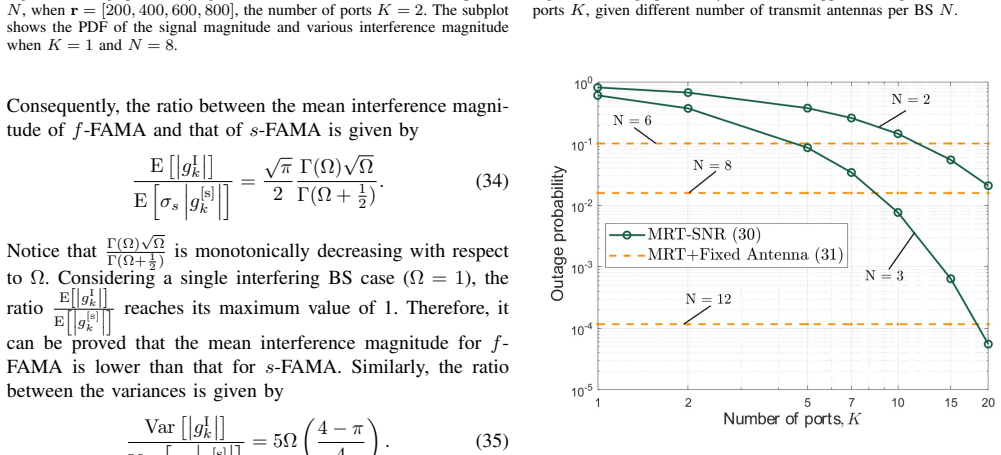
The central claim is that, in an interference-limited cell-free FAMA network with MRT precoding, the outage probability of a typical user is accurately captured by the double-integral expression (22) for fast FAMA and by (28) for slow FAMA, and that these expressions reveal a crossover: fast FAMA wins when each base station has few antennas (below $N=3$ in the simulated settings), while slow FAMA wins once $N$ is large, with the crossover moving from $N=4$ to $N=5$ as the SIR threshold rises from 14 to 18. The paper also claims that user-side fluid antennas substantially reduce the base-station burden: in the simulated interference-limited scenario, a user with a 12-port fluid antenna needs only 2 base-station antennas to reach an outage probability below $10^{-3}$, while a fixed-antenna user needs 15. The same benefit appears under noise-limited conditions, though with smaller savings. The analysis treats the fast-FAMA interference distribution exactly, and the slow-FAMA interference distribution approximately; the paper validates both against Monte Carlo results and attributes a slight visible discrepancy in the slow-FAMA case to the approximation.
Load-bearing premise
The slow-FAMA outage analysis rests on approximating the combined interference from several base stations at different distances by a single Nakagami distribution matched only through its first two moments, then assuming the K ports share the same correlated structure as the desired signal; if that approximation is inaccurate for heterogeneous base-station distances, the outage curve and the slow-versus-fast crossover shift, and the paper itself notes a slight discrepancy in Fig. 2, while the condition $\Omega > \omega$ used in Theorem 7 is not met by some simulated parameter choices.
Editorial extensions
If this is right
- With a sufficient number of base-station antennas, slow FAMA outperforms fast FAMA in the interference-limited regime, so per-symbol fast switching is not always the better mode.
- User-side fluid antennas can substitute for base-station antennas: in the paper's simulations a 12-port FAS user needs only 2 BS antennas for outage below $10^{-3}$, while a fixed-antenna user needs 15.
- The outage expressions (22) and (28) apply for arbitrary base-station distances and path-loss exponents, extending single-cell FAMA analysis to cell-free deployments.
- In noise-limited conditions, FAS still reduces the number of BS antennas required, but the savings are smaller than in interference-limited conditions.
- Because each BS needs only MRT-precoding CSI for its own user, FAMA-equipped cell-free networks can avoid the network-wide CSI sharing that zero-forcing-style interference management requires.
Reading between the lines
- An implicit consequence the paper does not draw out: the regime where slow FAMA wins is also the regime where CSI estimation is easiest, since slow switching only needs port selection once per coherence time, so the practical gain of the crossover is larger than the outage curves alone suggest.
- The two-moment matching suggests an accuracy boundary: when one interfering base station dominates (large spread in distances), the Gamma sum is far from a single Gamma law, so the outage prediction should degrade; a testable extension is a mixture-Nakagami or log-moment-matched approximation that restores accuracy in that regime.
- The antenna-tradeoff numbers imply a design curve between base-station array size $N$ and fluid-antenna port count $K$; if the paper is right, operators could trade BS antennas for user-side ports at a target outage, and the crossover's dependence on the SIR threshold shows the trade sharpens as the threshold rises.
- The result motivates an architectural division of labor: base stations use only single-user MRT while users handle residual interference locally, removing the need for network-wide channel knowledge; this is a consequence the paper points to but does not itself simulate.
Signed reviews
Editorial analysis
A structured set of objections, weighed in public.
Referee Report
Summary. The paper studies a downlink cell-free network in which each base station (BS) has N fixed antennas using maximum ratio transmission (MRT) precoding and each user has a single fluid antenna with K ports. Assuming interference-limited conditions, it derives integral-form outage probabilities for fast FAMA (Eq. (22)) and slow FAMA (Eq. (28)), based on joint distributions of the desired-signal magnitude and the interference magnitude. The numerical section reports two headline findings: with sufficiently large N, s-FAMA can outperform f-FAMA (Fig. 3), and user-side FAS can substantially reduce the number of BS antennas and the CSI burden on the BS (Figs. 4-5). Monte Carlo simulations are provided for the cases shown.
Significance. The contribution is potentially useful for the FAMA literature: it extends FAMA to a cell-free MRT downlink and provides integral outage expressions that are compared with Monte Carlo simulations for the f-FAMA case and one s-FAMA example. The claim that slow switching can beat fast switching is counterintuitive and, if correct, would be an interesting design insight. The paper is also careful to distinguish the exact f-FAMA derivations from the approximate s-FAMA treatment. However, the s-FAMA analysis is the weakest link: the theorem underlying the s-FAMA outage expression is stated under a condition that the paper's own simulation parameters violate, and the moment-matched Gamma approximation is not quantified outside one geometry. The central crossover claim currently rests on expressions that are not valid as written.
major comments (3)
- [Section III-C, Theorem 7; Section IV, Figs. 2-3] Theorem 7 states that the s-FAMA outage probability expression (27)/(28) holds when Ω>ω, where ω=N is the desired-signal Nakagami shape parameter. For the geometry r=[200,400,600,800] and α=3 used in Figs. 2 and 3, Eq. (25) gives Ω≈1.36, so the condition Ω>ω fails for every N≥2, including the crossover region N=4-5 in Fig. 3 where s-FAMA is claimed to outperform f-FAMA. The s-FAMA curves in these figures are therefore not covered by the theorem that produces them, and the paper's headline claim is not established as written.
- [Eqs. (27)-(28) and Theorem 7] Independently of the condition Ω>ω, the finite sums in (27) and (28) run over q=0,...,b-1 and p=0,...,b-q-1 with b=ω+Ω-1. For the paper's own parameters, Ω≈1.36 and ω=N, so b is non-integer (e.g., b=2.36 for N=2); such upper summation limits are not defined literally. The authors do not provide a convention for non-integer b or a generalized expression, and the acknowledgment of a 'slight discrepancy' in Section IV does not address this definitional gap. Since the s-FAMA curves in Fig. 3 are evaluated using (28), this issue is load-bearing.
- [Section III-C, Theorem 5; Section IV, Fig. 2 vs. Fig. 3] The s-FAMA analysis replaces the sum of scaled Gamma random variables by a moment-matched Nakagami distribution. The validation shown in Fig. 2 is for a single geometry and reports only a 'slight discrepancy'; no error metric or parameter sweep is provided, and Fig. 3 does not overlay Monte Carlo points in the crossover regime. Because the approximation error can depend on the number of interfering BSs and the heterogeneity of the distances r_i, the crossover location and even the existence of the s-FAMA/f-FAMA crossover could shift; a robustness check is needed before the central claim can be accepted.
minor comments (4)
- [Appendix A, proof of Theorem 1] The sentence 'Additionally, ι = Nσ^2 Σ_{i=1}^U r_i^{-α} > 0' is inconsistent with the definition ι = r_0^{-α} Nσ^2 in Eq. (16); presumably r_0^{-α} Nσ^2 is intended.
- [Remark 1 and Eq. (4)] Remark 1 states that the correlation parameter is reduced to μ=1 for K=1, but Eq. (4) is undefined (division by zero) for K=1; please clarify the convention used for this special case.
- [Section IV, discussion of Fig. 4] The sentence 'In the case with with 4 transmit BS antennas' contains a duplicated 'with'.
- [Eq. (33)] The notation E[σ_s |g_k^[s]|] and Var[σ_s |g_k^[s]|] is confusing because σ_s appears inside the expectation on the left but the subsequent variance expression is written as σ_s^2 times a bracket; please make the role of σ_s explicit and align the notation with Eqs. (11)-(12).
Circularity Check
No significant circularity: the outage derivations are self-contained and validated against independent Monte Carlo, and the cited prior FAS/FAMA results are not load-bearing.
full rationale
The central derivation chain is self-contained. Theorem 1 obtains the desired-signal magnitude as the square root of a Gamma sum (Nakagami with omega=N and iota=r0^{-alpha} N sigma^2), while Theorem 5 obtains the slow-FAMA interference magnitude by matching the first two moments of a sum of Gamma random variables, with parameters Omega=(sum_i r_i^{-alpha})^2 / sum_i r_i^{-2alpha} and phi=sigma^2 sum_i r_i^{-alpha} in (25). These parameters are closed-form functions of the channel model, not fitted to any target outage or to the s-FAMA/f-FAMA crossover. The outage expressions (22) and (28) are derived from these distributions by the law of total probability and are checked against Monte-Carlo simulation in Figs. 2-7, so the claimed crossover is not produced by construction. The paper's self-citations ([12], [39], [40], [41]) are external published works, and the paper explicitly states that (21)/(22) generalize [39], (27)/(28) generalize [41], and (30) relates to [12], which is transparent lineage rather than load-bearing self-support. There is no imported uniqueness theorem and no ansatz smuggled in solely by citation; the correlated Nakagami joint model is taken from the external reference [53]. A separate correctness concern, acknowledged in the paper's Fig. 2 discussion and the Theorem 7 condition, is that Theorem 7 is stated only for Omega > omega while the simulation distances give Omega approximately 1.36, so the condition fails for the plotted N >= 2 cases and the sums in (28) are not literally defined for non-integer b; this is a calculational and validity gap, not circular reasoning, and it does not affect the circularity score.
Assumptions & free parameters
assumptions (5)
- domain assumption Correlated Nakagami joint PDF/CDF for the K FAS ports (eqs. 17-19 from [53]) models the MRT-precoded desired signal across ports.
- domain assumption After MRT at interfering BSs, each interfering channel is complex Gaussian with variance r_i^{-alpha} sigma^2, making the sum interference magnitude Rayleigh (Lemma 1).
- ad hoc to paper The slow-FAMA interference magnitude is approximated as Nakagami with shape Omega = (sum r_i^{-alpha})^2 / sum r_i^{-2alpha} and spread phi = sigma^2 sum r_i^{-alpha} (Theorem 5).
- domain assumption The system is interference-limited (noise neglected), and constant-modulus symbols justify |s|^2 = sigma_s^2 in the outage expressions.
- domain assumption Each of the U+1 BSs serves its nearest user with equal transmit power on the same time-frequency channel, with power-law path loss exponent alpha.
Cite this review
Pith. "Pith review of Cell-free Fluid Antenna Multiple Access Networks." pith.science (2026). https://pith.science/paper/J2M2MTUE
@misc{pith2026250420623,
  author       = {Pith},
  title        = {Pith review of: Cell-free Fluid Antenna Multiple Access Networks},
  year         = {2026},
  howpublished = {\url{https://pith.science/paper/J2M2MTUE}},
  note         = {Machine review of arXiv:2504.20623}
}
read the original abstract
Fluid antenna enables position reconfigurability that gives transceiver access to a high-resolution spatial signal and the ability to avoid interference through the ups and downs of fading channels. Previous studies investigated this fluid antenna multiple access (FAMA) approach in a single-cell setup only. In this paper, we consider a cell-free network architecture in which users are associated with the nearest base stations (BSs) and all users share the same physical channel. Each BS has multiple fixed antennas that employ maximum ratio transmission (MRT) to beam to its associated users while each user relies on its fluid antenna system (FAS) on one radio frequency (RF) chain to overcome the inter-user interference. Our aim is to analyze the outage probability performance of such cell-free FAMA network when both large- and small-scale fading effects are considered. To do so, we derive the distribution of the received \textcolor{black}{magnitude} for a typical user and then the interference distribution under both fast and slow port switching techniques. The outage probability is finally obtained in integral form in each case. Numerical results demonstrate that in an interference-limited situation, although fast port switching is typically understood as the superior method for FAMA, slow port switching emerges as a more effective solution when there is a large antenna array at the BS. Moreover, it is revealed that FAS at each user can serve to greatly reduce the burden of BS in terms of both antenna costs and CSI estimation overhead, thereby enhancing the scalability of cell-free networks.
Figures


Figures from the paper (2 more)

Reference graph
Works this paper leans on
-
[1]
A joint-channel diago- nalization for multiuser MIMO antenna systems,
K. K. Wong, R. D. Murch, and K. B. Letaief, “A joint-channel diago- nalization for multiuser MIMO antenna systems,” IEEE Trans. Wireless Commun., vol. 2, no. 4, pp. 773–786, Jul. 2003
work page 2003
-
[2]
Zero-forcing meth- ods for downlink spatial multiplexing in multiuser MIMO channels,
Q. H. Spencer, A. L. Swindlehurst, and M. Haardt, “Zero-forcing meth- ods for downlink spatial multiplexing in multiuser MIMO channels,” IEEE Trans. Sig. Proc. , vol. 52, pp. 461–471, Feb. 2004
work page 2004
-
[3]
D. A. Urquiza Villalonga, H. OdetAlla, M. J. Fern ´andez-Getino Garcia, and A. Flizikowski, “Spectral efficiency of precoded 5G-NR in single and multi-user scenarios under imperfect channel knowledge: A compre- hensive guide for implementation,” Electronics, vol. 11, no. 24 (article number: 4237), Dec. 2022
work page 2022
-
[4]
Noncooperative cellular wireless with unlimited num- bers of base station antennas,
T. L. Marzetta, “Noncooperative cellular wireless with unlimited num- bers of base station antennas,” IEEE Trans. Wireless Commun. , vol. 9, no. 11, pp. 3590–3600, Nov. 2010
2010
-
[5]
T. K. Y . Lo, “Maximum ratio transmission,” IEEE Trans. Commun., vol. 47, no. 10, pp. 1458–1461, Oct. 1999
work page 1999
-
[6]
Extremely large-scale MIMO: Fundamentals, chal- lenges, solutions, and future directions,
Z. Wang et al. , “Extremely large-scale MIMO: Fundamentals, chal- lenges, solutions, and future directions,” IEEE Wireless Commun. , vol. 31, no. 3, pp. 117–124, Jun. 2024
2024
-
[7]
Implementation challenges and opportunities in beyond-5G and 6G communication,
U. Gustavsson et al. , “Implementation challenges and opportunities in beyond-5G and 6G communication,” IEEE J. Microw., vol. 1, no. 1, pp. 86–100, Jan. 2021
work page 2021
-
[8]
A coordinated approach to channel estimation in large-scale multiple-antenna systems,
H. Yin, D. Gesbert, M. Filippou and Y . Liu, “A coordinated approach to channel estimation in large-scale multiple-antenna systems,” IEEE J. Select. Areas Commun. , vol. 31, no. 2, pp. 264–273, Feb. 2013
work page 2013
Show all 62 references
-
[9]
Deep learning-based channel estimation for beamspace mmWave massive MIMO systems,
H. He, C.-K. Wen, S. Jin and G. Y . Li, “Deep learning-based channel estimation for beamspace mmWave massive MIMO systems,” IEEE Wireless Commun. Lett. , vol. 7, no. 5, pp. 852–855, Oct. 2018
2018
-
[10]
Bruce Lee- inspired fluid antenna system: Six research topics and the potentials for 6G,
K.-K. Wong, K.-F. Tong, Y . Shen, Y . Chen, and Y . Zhang, “Bruce Lee- inspired fluid antenna system: Six research topics and the potentials for 6G,” Frontiers Commun. Netw., vol. 3, no. 853416, Mar. 2022
2022
-
[11]
Performance limits of fluid antenna systems,
K. K. Wong, A. Shojaeifard, K. F. Tong, and Y . Zhang, “Performance limits of fluid antenna systems,” IEEE Commun. Lett. , vol. 24, no. 11, pp. 2469–2472, Nov. 2020
2020
-
[12]
Fluid antenna systems,
K.-K. Wong, A. Shojaeifard, K.-F. Tong, and Y . Zhang, “Fluid antenna systems,” IEEE Trans. Wireless Commun., vol. 20, no. 3, pp. 1950–1962, Mar. 2021
1950
-
[13]
Closed-form expressions for spatial correlation parameters for performance analysis of fluid antenna systems,
K. K. Wong, K. F. Tong, Y . Chen, and Y . Zhang, “Closed-form expressions for spatial correlation parameters for performance analysis of fluid antenna systems,” Elect. Lett., vol. 58, no. 11, pp. 454–457, Apr. 2022
2022
-
[14]
A new analytical ap- proximation of the fluid antenna system channel,
M. Khammassi, A. Kammoun and M.-S. Alouini, “A new analytical ap- proximation of the fluid antenna system channel,” IEEE Trans. Wireless Commun., vol. 22, no. 12, pp. 8843–8858, Dec. 2023
2023
-
[15]
A new spatial block-correlation model for fluid antenna systems,
P. Ram ´ırez-Espinosa, D. Morales-Jimenez, and K.-K. Wong, “A new spatial block-correlation model for fluid antenna systems,” IEEE Trans. Wireless Commun., vol. 23, no. 11, pp. 15829–15843, Nov. 2024
2024
-
[16]
Fluid antenna system: New insights on outage probability and diversity gain,
W. K. New, K.-K. Wong, H. Xu, K.-F. Tong, and C.-B. Chae, “Fluid antenna system: New insights on outage probability and diversity gain,” IEEE Trans. Wireless Commun. , vol. 23, no. 1, pp. 128–140, Jan. 2024
2024
-
[17]
An information-theoretic characterization of MIMO-FAS: Optimiza- tion, diversity-multiplexing tradeoff andq-outage capacity,
W. K. New, K. K. Wong, H. Xu, K. F. Tong and C.-B. Chae, “An information-theoretic characterization of MIMO-FAS: Optimiza- tion, diversity-multiplexing tradeoff andq-outage capacity,” IEEE Trans. Wireless Commun., vol. 23, no. 6, pp. 5541–5556, Jun. 2024
2024
-
[18]
Continuous fluid antenna systems: Modeling and analysis,
C. Psomas, P. J. Smith, H. A. Suraweera and I. Krikidis, “Continuous fluid antenna systems: Modeling and analysis,” IEEE Commun. Lett. , vol. 27, no. 12, pp. 3370–3374, Dec. 2023
2023
-
[19]
Capacity maximization for FAS-assisted multiple access channels,
H. Xu et al. , “Capacity maximization for FAS-assisted multiple access channels,” IEEE Trans. Commun., doi:10.1109/TCOMM.2024.3516499, 2024
2024
-
[20]
Fluid antenna system enhancing orthogonal and non-orthogonal multiple access,
W. K. New et al. , “Fluid antenna system enhancing orthogonal and non-orthogonal multiple access,” IEEE Commun. Lett. , vol. 28, no. 1, pp. 218–222, Jan. 2024
2024
-
[21]
Exploring fairness for FAS-assisted communication systems: From NOMA to OMA,
J. Yao et al. , “Exploring fairness for FAS-assisted communication systems: From NOMA to OMA,” IEEE Trans. Wireless Commun. , doi:10.1109/TWC.2025.3531056, 2025
2025
-
[22]
Fluid antenna system liberating multiuser MIMO for ISAC via deep reinforcement learning,
C. Wang et al. , “Fluid antenna system liberating multiuser MIMO for ISAC via deep reinforcement learning,” IEEE Trans. Wireless Commun., vol. 23, no. 9, pp. 10879–10894, Sept. 2024
2024
-
[23]
AI-empowered fluid antenna systems: Opportunities, challenges and future directions,
C. Wang et al. , “AI-empowered fluid antenna systems: Opportunities, challenges and future directions,” IEEE Wireless Commun. , vol. 31, no. 5, pp. 34–41, Oct. 2024
2024
-
[24]
Fluid antenna with linear MMSE channel estimation for large-scale cellular networks,
C. Skouroumounis and I. Krikidis, “Fluid antenna with linear MMSE channel estimation for large-scale cellular networks,” IEEE Trans. Com- mun., vol. 71, no. 2, pp. 1112–1125, Feb. 2023
2023
-
[25]
Successive Bayesian reconstructor for channel estimation in fluid antenna systems,
Z. Zhang, J. Zhu, L. Dai, and R. W. Heath Jr, “Successive Bayesian reconstructor for channel estimation in fluid antenna systems,” IEEE Trans. Wireless Commun. , vol. 24, no. 3, pp. 1992–2006, Mar. 2025
1992
-
[26]
Channel estimation for FAS-assisted multiuser mmWave systems,
H. Xu et al. , “Channel estimation for FAS-assisted multiuser mmWave systems,” IEEE Commun. Lett. , vol. 23, no. 3, pp. 632–636, Mar. 2024
2024
-
[27]
Frequency, radiation pattern and polarization reconfigurable antenna using a parasitic pixel layer,
D. Rodrigo, B. A. Cetiner and L. Jofre, “Frequency, radiation pattern and polarization reconfigurable antenna using a parasitic pixel layer,” IEEE Trans. Antennas & Propag. , vol. 62, no. 6, pp. 3422–3427, Jun. 2014
2014
-
[28]
Compact pattern reconfigurable pixel antenna with diagonal pixel connections,
L. Jing, M. Li and R. Murch, “Compact pattern reconfigurable pixel antenna with diagonal pixel connections,” IEEE Trans. Antennas & Propag., vol. 70, no. 10, pp. 8951–8961, Oct. 2022
2022
-
[29]
Computa- tional polarimetric imaging using two-dimensional dynamic metasurface apertures,
T. V . Hoang, V . Fusco, T. Fromenteze and O. Yurduseven, “Computa- tional polarimetric imaging using two-dimensional dynamic metasurface apertures,” IEEE Open J. Antennas & Propag. , vol. 2, pp. 488–497, 2021
2021
-
[30]
Reconfigurable holographic surfaces for ultra-massive MIMO in 6G: Practical design, optimization and implementation,
R. Deng et al. , “Reconfigurable holographic surfaces for ultra-massive MIMO in 6G: Practical design, optimization and implementation,” IEEE J. Select. Areas Commun. , vol. 41, no. 8, pp. 2367–2379, Aug. 2023
2023
-
[31]
Design and synthesis of antenna array with movable elements along semicircular paths,
S. Basbug, “Design and synthesis of antenna array with movable elements along semicircular paths,” IEEE Antennas & Wireless Propag. Lett., vol. 16, pp. 3059–3062, Oct. 2017
2017
-
[32]
A tutorial on fluid antenna system for 6G networks: Encompassing communication theory, optimization methods and hard- ware designs,
W. K. New et al. , “A tutorial on fluid antenna system for 6G networks: Encompassing communication theory, optimization methods and hard- ware designs,” IEEE Commun. Surv. & Tut. , doi:10.1109/COMST.2024. 3498855, 2024
2024 doi
-
[33]
Design and implementation of mmWave surface wave enabled fluid antennas and experimental results for fluid antenna multi- ple access,
Y . Shen et al. , “Design and implementation of mmWave surface wave enabled fluid antennas and experimental results for fluid antenna multi- ple access,” arXiv preprint, arXiv:2405.09663, May 2024
2024
-
[34]
A novel pixel-based reconfigurable antenna applied in fluid antenna systems with high switching speed,
J. Zhang et al. , “A novel pixel-based reconfigurable antenna applied in fluid antenna systems with high switching speed,” IEEE Open J. Antennas & Propag. , vol. 6, no. 1, pp. 212–228, Feb. 2025
2025
-
[35]
Historical review of fluid antenna and movable antenna,
L. Zhu and K. K. Wong, “Historical review of fluid antenna and movable antenna,” arXiv preprint, arXiv:2401.02362v2, 2024
2024 arXiv
-
[36]
Multiuser commu- nications with movable-antenna base station: Joint antenna positioning, receive combining, and power control,
Z. Xiao, X. Pi, L. Zhu, X.-G. Xia and R. Zhang, “Multiuser commu- nications with movable-antenna base station: Joint antenna positioning, receive combining, and power control,” IEEE Trans. Wireless Commun., vol. 23, no. 12, pp. 19744–19759, Dec. 2024. 14 Z ∞ tk=0 2tΩ ke − Ωt2 ...
2024
-
[37]
Multi-beam forming with movable- antenna array,
W. Ma, L. Zhu and R. Zhang, “Multi-beam forming with movable- antenna array,” IEEE Commun. Lett. , vol. 28, no. 3, pp. 697–701, Mar. 2024
2024
-
[38]
Movable antenna enabled near-field communications: Channel modeling and performance optimization,
L. Zhu, W. Ma, Z. Xiao, R. Zhang, “Movable antenna enabled near-field communications: Channel modeling and performance optimization,” arXiv preprint, arXiv:2409.19316, 2024
2024 arXiv
-
[39]
Fluid antenna multiple access,
K. K. Wong and K. F. Tong, “Fluid antenna multiple access,” IEEE Trans. Wireless Commun. , vol. 21, no. 7, pp. 4801–4815, Jul. 2022
2022
-
[40]
Fast fluid antenna multiple access enabling massive connectivity,
K. K. Wong, K. F. Tong, Y . Chen, and Y . Zhang, “Fast fluid antenna multiple access enabling massive connectivity,” IEEE Commun. Lett. , vol. 27, no. 2, pp. 711–715, Feb. 2023
2023
-
[41]
Slow fluid antenna multiple access,
K. K. Wong, D. Morales-Jimenez, K. F. Tong, and C. B. Chae, “Slow fluid antenna multiple access,” IEEE Trans. Commun. , vol. 71, no. 5, pp. 2831–2846, May 2023
2023
-
[42]
Opportunistic fluid antenna multiple access,
K. K. Wong, K. F. Tong, Y . Chen, Y . Zhang, and C. B. Chae, “Opportunistic fluid antenna multiple access,” IEEE Trans. Wireless Commun., vol. 22, no 11, pp. 7819–7833, Nov. 2023
2023
-
[43]
Opportunistic fluid antenna multiple access via team- inspired reinforcement learning,
N. Waqar et al. , “Opportunistic fluid antenna multiple access via team- inspired reinforcement learning,” IEEE Trans. Wireless Commun. , vol. 23, no. 9, pp. 12068–12083, Sept. 2024
2024
-
[44]
Port selection for fluid antenna systems,
Z. Chai, K. K. Wong, K.-F. Tong, Y . Chen and Y . Zhang, “Port selection for fluid antenna systems,” IEEE Commun. Lett. , vol. 26, no. 5, pp. 1180–1184, May 2022
2022
-
[45]
Deep learning enabled slow fluid antenna multiple access,
N. Waqar, K. K. Wong, K.-F. Tong, A. Sharples and Y . Zhang, “Deep learning enabled slow fluid antenna multiple access,” IEEE Commun. Lett., vol. 27, no. 3, pp. 861–865, Mar. 2023
2023
-
[46]
cGAN-based slow fluid antenna multiple access,
M. Eskandari, A. G. Burr, K. Cumanan and K. K. Wong, “cGAN-based slow fluid antenna multiple access,” IEEE Wireless Commun. Lett. , vol. 13, no. 10, pp. 2907–2911, Oct. 2024
2024
-
[47]
Learning-induced channel extrapolation for fluid antenna systems using asymmetric graph masked autoencoder,
H. Zhang et al. , “Learning-induced channel extrapolation for fluid antenna systems using asymmetric graph masked autoencoder,” IEEE Wireless Commun. Lett. , vol. 13, no. 6, pp. 1665–1669, Jun. 2024
2024
-
[48]
A survey on fluid antenna multiple access for 6G: A new multiple access technology that provides great diversity in a small space,
A. F. M. S. Shah, M. Ali Karabulut, E. Cinar and K. M. Rabie, “A survey on fluid antenna multiple access for 6G: A new multiple access technology that provides great diversity in a small space,” IEEE Access, vol. 12, pp. 88410–88425, Jun. 2024
2024
-
[49]
Cell-free massive MIMO versus small cells,
H. Q. Ngo, A. Ashikhmin, H. Yang, E. G. Larsson and T. L. Marzetta, “Cell-free massive MIMO versus small cells,” IEEE Trans. Wireless Commun., vol. 16, no. 3, pp. 1834–1850, Mar. 2017
2017
-
[50]
Novel simple representations for Gaussian class multivariate distributions with generalized correla- tion,
N. C. Beaulieu and K. T. Hemachandra, “Novel simple representations for Gaussian class multivariate distributions with generalized correla- tion,” IEEE Trans. Inf. Theory , vol. 57, no. 12, pp. 8072–8083, Dec. 2011
2011
-
[51]
Maximal ratio transmission in wireless Poisson networks under spatially correlated fading channels,
G. C. Alexandropoulos and M. Kountouris, “Maximal ratio transmission in wireless Poisson networks under spatially correlated fading channels,” in Proc. IEEE Global Commun. Conf. , 6-10 Dec. 2015, San Diego, CA, USA
2015
-
[52]
Performance analysis of maximal ratio combining and comparison with optimum combining for mobile radio communications with cochannel interference,
A. Shah and A. M. Haimovich, “Performance analysis of maximal ratio combining and comparison with optimum combining for mobile radio communications with cochannel interference,” IEEE Trans. V eh. Technol., vol. 49, no. 4, pp. 1454–1463, Jul. 2000
2000
-
[53]
Enhancing QoS through fluid antenna systems over correlated Nakagami-m fading channels,
L. Tlebaldiyeva, G. Nauryzbayev, S. Arzykulov, A. Eltawil, and T. Tsift- sis, “Enhancing QoS through fluid antenna systems over correlated Nakagami-m fading channels,” in Proc. IEEE Wireless Commun. & Netw. Conf. (WCNC) , pp. 78–83, 10-13 Apr. 2022, Austin, TX, USA
2022
-
[54]
Billingsley, Probability and measure
P. Billingsley, Probability and measure . John Wiley & Sons, 2017
2017
-
[55]
Connections between the generalized marcum Q- function and a class of hypergeometric functions,
D. Morales-Jimenez, F. J. Lopez-Martinez, E. Martos-Naya, J. F. Paris, and A. Lozano, “Connections between the generalized marcum Q- function and a class of hypergeometric functions,” IEEE Trans. Inf. Theory, vol. 60, no. 2, pp. 1077–1082, Feb. 2013
2013
-
[56]
Laplace transform of product of gen- eralized Marcum Q, Bessel I, and power functions with applications,
N. Y . Ermolova and O. Tirkkonen, “Laplace transform of product of gen- eralized Marcum Q, Bessel I, and power functions with applications,” IEEE Trans. Sig. Proc. , vol. 62, no. 11, pp. 2938–2944, Jun. 2014
2014
-
[57]
Abramowitz and I
M. Abramowitz and I. A. Stegun, Handbook of mathematical functions with formulas, graphs, and mathematical tables , vol. 55. US Govern- ment printing office, 1968
1968
-
[58]
Statistical analysis and characterization of the indoor propagation channel,
F. Babich and G. Lombardi, “Statistical analysis and characterization of the indoor propagation channel,” IEEE Trans. Commun. , vol. 48, no. 3, pp. 455–464, Mar. 2000
2000
-
[59]
A simple approximation to the convolution of Gamma distributions,
T. Stewart, L. Strijbosch, H. Moors, and P. v. Batenburg, “A simple approximation to the convolution of Gamma distributions,” Sept. 2007
2007
-
[60]
Multiuser MIMO in distributed antenna systems with out-of-cell interference,
R. W. Heath Jr, T. Wu, Y . H. Kwon, and A. C. Soong, “Multiuser MIMO in distributed antenna systems with out-of-cell interference,” IEEE Trans. Sig. Proc. , vol. 59, no. 10, pp. 4885–4899, Oct. 2011
2011
-
[61]
Rappaport, Wireless Communications: Principles and Practice , 2nd ed
T. Rappaport, Wireless Communications: Principles and Practice , 2nd ed. Cambridge University Press, 2024
2024
-
[62]
The m-distribution general formula of intensity distri- bution of rapid fading,
M. Nakagami, “The m-distribution general formula of intensity distri- bution of rapid fading,” in Statistical Methods Radio Wave Propag. , pp. 3–36, Elsevier, Jun. 1960
1960
Reviewed August 16, 2026 · model on record in the stance chip above.
Discussion (0). Continue with ORCID to comment.