REVIEW 3 major objections 6 minor 49 references
Effect of Avatar Head Movement on Communication Behaviour, Experience of Presence and Conversation Success in Triadic Conversations
T0 review · 3 major / 6 minor · reviewed 2026-08-16 · deepseek-v4-flash
Pith's one-line read When avatars' heads move, VR conversation behaviour changes
desk verdict Useful, well-documented empirical study of avatar head movement in triadic VR conversation, but the headline claim that head movement must be transmitted overreaches the data because the strongest effects come from a video condition that bundles head movement with facial expression, lip-sync, gaze, and skin texture. read the letter →
The pith
A machine-rendered reading of the paper's core claim, the machinery that carries it, and where it could break.
The reading
What carries the argument
The carrying mechanism is the animation-level manipulation in a 2 x 4 repeated-measures design: two noise levels (quiet and babble at roughly 69 dB SPL) crossed with four interlocutor representations (static head; automated head and gaze cued by speech-level onsets; head motion transmitted from inertial sensors worn by the confederates; and a live head-and-shoulders video texture). The telepresence setup transmitted speech, head-motion data, and video with low delay to keep the conversation interactive while allowing the authors to change only the visual representation. Behavioural measures came from room microphones and optical head tracking; experience came from ten rating questions covering presence, realism, and conversation success. This design is what allows the authors to attribute changes in participant behaviour to the visual animation level rather than to the audio scene.
What would settle it
A controlled comparison with the same video textures but the head motion frozen—or with animated heads but no facial expression—would separate head movement from facial cues; if static-video and moving-video conditions produce the same behaviour and ratings, the head-movement claim would be falsified.
Extended reading notes
Core claim
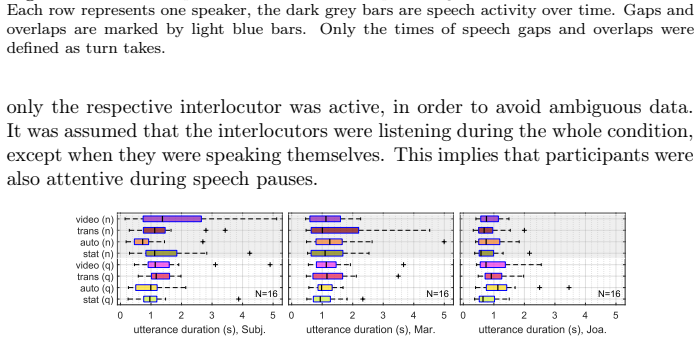
The central claim is that head movement in virtual interlocutors is not decoration: it changes the listener's own behaviour. More animated heads made participants use a wider range of head orientations while speaking, orient their heads more accurately toward the avatar (2.1 degrees closer in video than in static), produce longer utterances (video vs. automated by 0.79 seconds), and rate the avatars as more realistic (static vs. video, +1.9 points). Participants also reported being spoken to in a more helpful way when head movement was transmitted compared with static avatars. Automated speech-cued head movements were statistically indistinguishable from transmitted movements on most measures. Background noise independently caused a 10.6 dB Lombard shift (raising the voice in noise), longer speech gaps, shorter overlaps, wider head-orientation range, and a 3 cm forward lean. The paper concludes that representing interlocutors with sufficient head movement—nodding or orienting toward the active speaker—is necessary for natural conversational behaviour in interactive VR.
Load-bearing premise
The 'video' condition, which produced the strongest effects, displayed a live head-and-shoulders video with real facial expressions, lip movement, gaze, and skin texture, so the conclusion that head movement specifically must be included assumes those extra cues are not what drove the effects.
Editorial extensions
If this is right
- VR scenes built to evaluate hearing devices should animate interlocutor heads—at minimum speech-cued orientation or nodding—if the goal is to observe natural head-orientation behaviour from listeners.
- Because automated and transmitted head movements rarely differed significantly, speech-onset-driven animation may be a practical substitute for motion capture in such scenes.
- Static avatars flatten the head-orientation range a listener uses while speaking, so tests of gaze-steered or head-tracking hearing-aid algorithms in static scenes may not reflect real conversation.
- Background noise produces large, independent effects on speech level, turn-taking timing, and head movement, so noise level remains a primary lever for controlling task difficulty in evaluative VR conversations.
Reading between the lines
- The video condition bundles head movement together with facial expression, lip-sync, gaze, and skin texture; the paper's strongest evidence for 'head movement specifically' therefore remains circumstantial until a control condition freezes the head in the video or animates a video face without motion.
- If the head-movement effect generalizes, static-avatar paradigms may systematically underestimate how much listeners move their heads and thus how much benefit directional microphones could provide in real conversations; a direct aided-versus-unaided comparison under static versus animated avatars would test this.
- The large individual differences in head-yaw range and the use of young normal-hearing participants leave open whether older or hearing-impaired listeners, who may rely more on visual cues, would show larger animation effects; the authors acknowledge this limits generalization.
- The finding that transmitted head movement made participants feel spoken to in a more helpful way, while automated movements behaved similarly, suggests that practical VR conversation systems can use simple speech-level automation rather than full motion capture.
Signed reviews
Editorial analysis
A structured set of objections, weighed in public.
Referee Report
Summary. The paper reports an experiment on how the head-movement animation level of virtual interlocutor avatars affects communication behaviour, sense of presence, and conversation success in triadic conversations conducted in a telepresence VR setup. Sixteen normal-hearing participants conversed with two confederates under a 2x4 factorial design crossing quiet/noise with four visual conditions: static head, automatic speech-cued head movements, transmitted real head movements, and a video texture condition. Outcome measures were objective speech/silence durations, head orientation and translation from motion capture, and a ten-item rating questionnaire. The authors report significant main effects of animation on several behavioural and subjective measures, with the largest consistent differences occurring between the static and video conditions, and they conclude that representations of interlocutors must include a sufficient amount of head movement to elicit natural conversational behaviour.
Significance. If the causal claim about head movement were supported, the result would be directly useful for the design of interactive VR scenes for hearing-device evaluation, an area that increasingly relies on ecologically valid behavioural protocols. The paper has concrete strengths: it uses objective sensor-based behavioural measures, a realistic live telepresence conversation task, and it provides open data and analysis scripts (Zenodo links in the Data availability statement). It also supplies useful evidence that the visual representation of interlocutors changes participants' behaviour and experience in virtual conversations. However, the central conclusion is stronger than the experimental design can support because the video condition, which drives most of the significant effects, is confounded with facial expression, lip-sync, gaze, and skin texture, and because the confederate who is also the experimenter was not blind to condition. The manuscript therefore merits revision but has a solid empirical core.
major comments (3)
- [Methods, 'Virtual environment' paragraph; General discussion; Conclusions] The conclusion that 'the representation of interlocutors must include a sufficient amount of head movement' is not supported by the design, because the strongest and most consistent effects come from the 'video' condition, which adds facial expression, lip-sync, gaze cues, and realistic skin appearance on top of any head movement (Methods, 'Virtual environment' paragraph). The pairwise results in Table 3 show that 'static' vs 'transmitted' is significant only for Q6 ('being spoken to in a helpful way'), with Q5 (realism of avatars) at p = 0.064, and the General discussion states that 'automatic' and 'transmitted' never differ significantly. The data support the weaker claim that a more realistic visual representation of interlocutors affects participants' behaviour and experience; they do not isolate head movement as the active ingredient. The conclusions and General discussion should be reworded to this weaker claim, and the Limitations section should explicitly state that the video condition confound prevents attribution of the video-vs-static differences to head movement alone.
- [Methods, 'Design and task'] The confederate 'Mar', who is also the experimenter controlling the session, was not blind to condition ('One confederate (Mar) controlled the ongoing experiment and was therefore not blind to the measurement conditions'). Because Mar is an active interlocutor in every triad, controls the timing of condition switches, and knows which visual condition is active, his conversational behaviour could systematically differ across conditions and thereby influence the participant's speech timing, head orientation, and subjective ratings such as Q6. This is a threat to the internal validity of the animation effects on interactive measures, and it is not acknowledged or discussed in the Limitations section. The authors should either provide an argument that this bias could not account for the observed pattern or explicitly discuss its direction and plausible magnitude.
- [Results, Table 3; General discussion] The summary statement in the General discussion that the expected animation effect was 'reflected in about two thirds of our selected measures' is not consistent with Table 3. Of the eighteen dependent variables listed, only eight show a significant main effect of animation, and for two of those (speech level and Q8) no pairwise comparison survives Bonferroni correction. The narrative should not count the uncorrected main effects and the Bonferroni-adjusted pairwise differences as equivalent evidence; a more precise accounting of which measures are supported by pairwise differences would improve the accuracy of the interpretations.
minor comments (6)
- [Introduction, second paragraph] The text contains 'did not find an affect of noise level'; 'affect' should be 'effect'.
- [General discussion, first paragraph] The phrase 'but indicted to be equally able to share information' should be 'but indicated to be equally able to share information'.
- [Discussion, 'Measures of head movement behaviour' section] The sentence 'rbal information is used in the background noise if it is offered' appears to be a typographical fragment; it should be completed or removed.
- [Appendix, Table 4 caption] 'Questionniare' should be spelled 'Questionnaire'.
- [Results, Table 3] The head orientation range (listening) row lists p = 0.9; given the F value and the text this is likely a typo for p = 0.09, which should be corrected.
- [Methods, 'Statistical analysis'] The Bonferroni correction is described only for pairwise comparisons; the manuscript does not state whether correction was applied across the many dependent variables or only within each measure. A sentence clarifying this would help readers assess the risk of inflated Type I error across the multiple ANOVAs.
Circularity Check
No circularity: the animation-level manipulation and all outcome measures are defined independently; self-citations are implementation citations, not definitional inputs.
full rationale
The paper's derivation chain is empirical rather than definitional: it manipulates four visual-representation conditions and measures speech and head-movement behaviour with physical sensors, plus subjective ratings with a 10-item questionnaire. The conclusion that interlocutor representations must include sufficient head movement is an interpretation of between-condition differences, not a quantity derived from its own inputs. No equation defines a predicted value in terms of fitted parameters, and no parameter is fitted to a subset of the data and then 'predicted' for a related subset. The automatic head-movement algorithm is cited from prior work, and TASCAR, OVBOX, and the pub environment are cited from the authors' previous publications, but these are implementation tools; the outcome measures are defined independently of those tools and were not used to construct the conditions. The closest concern, that the 'video' condition adds facial expression, lip-sync, gaze, and skin texture on top of head movement, is an internal-validity/confound limitation rather than circularity: it may mean the causal claim overreaches the evidence, but the conclusion is not identical to an input by construction. There is no self-citation chain that forces the central claim, no imported uniqueness theorem, and no renaming of a known result as a prediction. Accordingly, the paper receives a circularity score of 0.
Assumptions & free parameters
free parameters (1)
- speech activity detection threshold =
25% point of estimated dynamic range above noise floor, per person and condition
assumptions (4)
- domain assumption The experimenter confederate (Mar), who was not blind to condition, behaved consistently across conditions.
- domain assumption The 'video' condition's effects can be attributed to head movement rather than to facial expression, lip-sync, or skin texture.
- domain assumption The selected outcome measures (head orientation range, utterance duration, questionnaire ratings) are valid proxies for natural communication behaviour relevant to hearing device evaluation.
- domain assumption Transmission delays (audio 49.8 ms, head motion about 180 ms, video about 500 ms) did not materially alter conversation dynamics.
Cite this review
Pith. "Pith review of Effect of Avatar Head Movement on Communication Behaviour, Experience of Presence and Conversation Success in Triadic Conversations." pith.science (2026). https://pith.science/paper/CB3JZM6G
@misc{pith2026250420844,
  author       = {Pith},
  title        = {Pith review of: Effect of Avatar Head Movement on Communication Behaviour, Experience of Presence and Conversation Success in Triadic Conversations},
  year         = {2026},
  howpublished = {\url{https://pith.science/paper/CB3JZM6G}},
  note         = {Machine review of arXiv:2504.20844}
}
read the original abstract
Interactive communication in virtual reality can be used in experimental paradigms to increase the ecological validity of hearing device evaluations. This requires the virtual environment to elicit natural communication behaviour in listeners. This study evaluates the effect of virtual animated characters' head movements on participants' communication behaviour and experience. Triadic conversations were conducted between a test participant and two confederates. To facilitate the manipulation of head movements, the conversation was conducted in telepresence using a system that transmitted audio, head movement data and video with low delay. The confederates were represented by virtual animated characters (avatars) with different levels of animation: Static heads, automated head movement animations based on speech level onsets, and animated head movements based on the transmitted head movements of the interlocutors. A condition was also included in which the videos of the interlocutors' heads were embedded in the visual scene. The results show significant effects of animation level on the participants' speech and head movement behaviour as recorded by physical sensors, as well as on the subjective sense of presence and the success of the conversation. The largest effects were found for the range of head orientation during speech and the perceived realism of avatars. Participants reported that they were spoken to in a more helpful way when the avatars showed head movements transmitted from the interlocutors than when the avatars' heads were static. We therefore conclude that the representation of interlocutors must include sufficiently realistic head movements in order to elicit natural communication behaviour.
Figures

Figures from the paper (6 more)


Reference graph
Works this paper leans on
-
[1]
International Journal of Human-Computer Studies 164: 102819
Aburumman N, Gillies M, Ward JA and Hamilton AFC (2022) Nonverbal communication in virtual reality: Nodding as a social signal in virtual interactions. International Journal of Human-Computer Studies 164: 102819. doi:10.1016/j.ijhcs.2022.102819. ://linkinghub.elsevier.com/retrieve/pii/S1071581922000489
arXiv 2022
-
[2]
Speech Communication 100: 18--29
Beechey T, Buchholz JM and Keidser G (2018) Measuring communication difficulty through effortful speech production during conversation. Speech Communication 100: 18--29. doi:10.1016/j.specom.2018.04.007. ://linkinghub.elsevier.com/retrieve/pii/S0167639317302364
-
[3]
Best V, Roverud E, Streeter T, Mason CR and Kidd G (2017) The benefit of a visually guided beamformer in a dynamic speech task. Trends in Hearing 21: 1--11. doi:10.1177/2331216517722304
-
[4]
Philosophical Transactions of the Royal Society B: Biological Sciences 364(1535): 3485--3495
Boker SM, Cohn JF, Theobald BJ, Matthews I, Brick TR and Spies JR (2009) Effects of damping head movement and facial expression in dyadic conversation using real–time facial expression tracking and synthesized avatars. Philosophical Transactions of the Royal Society B: Biological Sciences 364(1535): 3485--3495. doi:10.1098/rstb.2009.0152
arXiv 2009
-
[5]
Ear & Hearing 35(5): e204--e212
Brimijoin WO, Whitmer WM, McShefferty D and Akeroyd MA (2014) The Effect of Hearing Aid Microphone Mode on Performance in an Auditory Orienting Task . Ear & Hearing 35(5): e204--e212. doi:10.1097/AUD.0000000000000053. ://journals.lww.com/00003446-201409000-00016
-
[6]
Behaviour 148(11-13): 1173--1198
Brumm H and Zollinger SA (2011) The evolution of the Lombard effect: 100 years of psychoacoustic research. Behaviour 148(11-13): 1173--1198. doi:10.1163/000579511X605759. ://brill.com/view/journals/beh/148/11-13/article-p1173_1.xml
-
[7]
Seminars in Hearing 43(04): 277--288
Carr K and Kihm J (2022) MarkeTrak — Tracking the Pulse of the Hearing Aid Market . Seminars in Hearing 43(04): 277--288. doi:10.1055/s-0042-1758380
- [8]
Show all 49 references
-
[9]
Trends in Hearing 22: 1--11
Favre-Félix A, Graversen C, Hietkamp RK, Dau T and Lunner T (2018) Improving speech intelligibility by hearing aid eye-gaze steering: Conditions with head fixated in a multitalker environment. Trends in Hearing 22: 1--11. doi:10.1177/2331216518814388
2018 doi
-
[10]
Neural Networks 64: 49--58
Gonzalez-Dominguez J, Lopez-Moreno I, Moreno PJ and Gonzalez-Rodriguez J (2015) Frame-by-frame language identification in short utterances using deep neural networks. Neural Networks 64: 49--58. doi:10.1016/j.neunet.2014.08.006. ://linkinghub.elsevier.com/retrieve/pii/S0893608...
2015 doi
-
[11]
://ovbox.de
Grimm G (2021) ORLANDOviols consort box (ovbox). ://ovbox.de
2021
-
[12]
doi:10.5281/ZENODO.7371406
Grimm G (2022) Hoertech-ggmbh/tascar: Tascar: Release 0.228. doi:10.5281/ZENODO.7371406
2022 doi
-
[13]
Acta Acoustica, in press doi:10.1051/aacus/2024011
Grimm G (2024) Interactive low delay music and speech communication via network connections (ovbox). Acta Acoustica, in press doi:10.1051/aacus/2024011
2024
-
[14]
doi:10.5281/ZENODO.5886987
Grimm G, Hendrikse M and Hohmann V (2021) Pub environment. doi:10.5281/ZENODO.5886987. ://zenodo.org/record/5886987
2021
-
[15]
Ear & Hearing 41(Supplement 1): 48S--55S
Grimm G, Hendrikse MME and Hohmann V (2020) Review of Self - Motion in the Context of Hearing and Hearing Device Research . Ear & Hearing 41(Supplement 1): 48S--55S. doi:10.1097/AUD.0000000000000940
2020 doi
-
[16]
VDE Verlag GmbH Berlin, Offenbach
Grimm G, Kayser H, Hendrikse MME and Hohmann V (2018) A gaze-based attention model for spatially-aware hearing aids. VDE Verlag GmbH Berlin, Offenbach. ISBN 9783800747672, pp. 231--235. ://ieeexplore.ieee.org/document/8578029
2018
-
[17]
doi:10.5281/ZENODO.13341921
Grimm G, Kothe A and Hohmann V (2019 a ) First Order Ambisonics field recordings for use in virtual acoustic environments in the context of audiology. doi:10.5281/ZENODO.13341921. ://zenodo.org/doi/10.5281/zenodo.13341921
2019 doi
-
[18]
Acta Acustica united with Acustica 105(3): 566--578
Grimm G, Luberadzka J and Hohmann V (2019 b ) A Toolbox for Rendering Virtual Acoustic Environments in the Context of Audiology . Acta Acustica united with Acustica 105(3): 566--578. doi:10.3813/AAA.919337
2019 doi
-
[19]
Scientific Reports 9(1): 10451
Hadley LV, Brimijoin WO and Whitmer WM (2019) Speech, movement, and gaze behaviours during dyadic conversation in noise. Scientific Reports 9(1): 10451. doi:10.1038/s41598-019-46416-0. ://www.nature.com/articles/s41598-019-46416-0
2019 doi
-
[20]
Psychonomic Bulletin & Review 28(2): 632--640
Hadley LV, Whitmer WM, Brimijoin WO and Naylor G (2021) Conversation in small groups: Speaking and listening strategies depend on the complexities of the environment and group. Psychonomic Bulletin & Review 28(2): 632--640. doi:10.3758/s13423-020-01821-9
2021 doi
-
[21]
In: 2021 IEEE Conference on Virtual Reality and 3D User Interfaces Abstracts and Workshops ( VRW )
Hartwig M, Hohmann V and Grimm G (2021) Speaking with avatars - influence of social interaction on movement behavior in interactive hearing experiments. In: 2021 IEEE Conference on Virtual Reality and 3D User Interfaces Abstracts and Workshops ( VRW ) . Lisbon, Portugal: IEEE ...
2021
- [22]
-
[23]
Journal of Phonetics 38(4): 555--568
Heldner M and Edlund J (2010) Pauses, gaps and overlaps in conversations. Journal of Phonetics 38(4): 555--568. doi:10.1016/j.wocn.2010.08.002. ://linkinghub.elsevier.com/retrieve/pii/S0095447010000628
2010 doi
-
[24]
Speech Communication 101: 70--84
Hendrikse MME, Llorach G, Grimm G and Hohmann V (2018) Influence of visual cues on head and eye movements during listening tasks in multi-talker audiovisual environments with animated characters. Speech Communication 101: 70--84. doi:10.1016/j.specom.2018.05.008. ://linkinghub...
2018 doi
-
[25]
Trends in Hearing 23: 233121651987236
Hendrikse MME, Llorach G, Hohmann V and Grimm G (2019) Movement and Gaze Behavior in Virtual Audiovisual Listening Environments Resembling Everyday Life . Trends in Hearing 23: 233121651987236. doi:10.1177/2331216519872362
2019 doi
-
[26]
Disability and Rehabilitation 37(22): 2070--2075
Hogan A, Phillips RL, Brumby SA, Williams W and Mercer-Grant C (2015) Higher social distress and lower psycho-social wellbeing: examining the coping capacity and health of people with hearing impairment. Disability and Rehabilitation 37(22): 2070--2075. doi:10.3109/09638288.20...
2015
-
[27]
Frontiers in Psychology 12: 693124
Holler J, Alday PM, Decuyper C, Geiger M, Kendrick KH and Meyer AS (2021) Competition Reduces Response Times in Multiparty Conversation . Frontiers in Psychology 12: 693124. doi:10.3389/fpsyg.2021.693124
2021
-
[28]
HNO 62(6): 443--448
Hoppe U, Hast A and Hocke T (2014) Sprachverstehen mit Hörgeräten in Abhängigkeit vom Tongehör . HNO 62(6): 443--448. doi:10.1007/s00106-013-2813-1
2014 doi
-
[29]
Journal of the American Academy of Audiology 27(07): 502--503
Keidser G (2016) Introduction to Special Issue : Towards Ecologically Valid Protocols for the Assessment of Hearing and Hearing Devices . Journal of the American Academy of Audiology 27(07): 502--503. doi:10.3766/jaaa.27.7.1
2016 doi
-
[30]
Yonsei Medical Journal 63(6): 570
Kim GY, Cho YS, Byun HM, Seol HY, Lim J, Park JG and Moon IJ (2022) Factors Influencing Hearing Aid Satisfaction in South Korea . Yonsei Medical Journal 63(6): 570. doi:10.3349/ymj.2022.63.6.570
2022 doi
-
[31]
Frontiers in Psychology 6
Levinson SC and Torreira F (2015) Timing in turn-taking and its implications for processing models of language. Frontiers in Psychology 6. doi:10.3389/fpsyg.2015.00731
2015
-
[32]
In: 2016 8th International Conference on Games and Virtual Worlds for Serious Applications ( VS - GAMES )
Llorach G, Evans A, Blat J, Grimm G and Hohmann V (2016) Web- Based Live Speech - Driven Lip - Sync . In: 2016 8th International Conference on Games and Virtual Worlds for Serious Applications ( VS - GAMES ) . Barcelona, Spain: IEEE. ISBN 978-1-5090-2722-4, pp. 1--4. doi:10.11...
2016
-
[33]
The Journal of the Acoustical Society of America 149(3): 1889--1900
Lu H, McKinney MF, Zhang T and Oxenham AJ (2021) Investigating age, hearing loss, and background noise effects on speaker-targeted head and eye movements in three-way conversations. The Journal of the Acoustical Society of America 149(3): 1889--1900. doi:10.1121/10.0003707
2021 doi
-
[34]
Psychological Science 15(2): 133--137
Munhall K, Jones JA, Callan DE, Kuratate T and Vatikiotis-Bateson E (2004) Visual Prosody and Speech Intelligibility : Head Movement Improves Auditory Speech Perception . Psychological Science 15(2): 133--137. doi:10.1111/j.0963-7214.2004.01502010.x
2004
-
[35]
Journal of the American Academy of Audiology 27(07): 504--514
Naylor G (2016) Theoretical Issues of Validity in the Measurement of Aided Speech Reception Threshold in Noise for Comparing Nonlinear Hearing Aid Systems . Journal of the American Academy of Audiology 27(07): 504--514. doi:10.3766/jaaa.15093. ://www.thieme-connect.de/DOI/DOI?...
2016 doi
-
[36]
International Journal of Audiology : 1--9doi:10.1080/14992027.2022.2095538
Nicoras R, Gotowiec S, Hadley LV, Smeds K and Naylor G (2022) Conversation success in one-to-one and group conversation: a group concept mapping study of adults with normal and impaired hearing. International Journal of Audiology : 1--9doi:10.1080/14992027.2022.2095538
2022
-
[37]
Pulkki V (1997) Virtual sound source positioning using vector base amplitude panning. J. Audio Eng. Soc 45: 456--466
1997
-
[38]
Journal of Deaf Studies and Deaf Education 16(4): 474--493
Punch R and Hyde M (2011) Social Participation of Children and Adolescents With Cochlear Implants : A Qualitative Analysis of Parent , Teacher , and Child Interviews . Journal of Deaf Studies and Deaf Education 16(4): 474--493. doi:10.1093/deafed/enr001
2011 doi
-
[39]
Educational Research Review 6(2): 135--147
Richardson JT (2011) Eta squared and partial eta squared as measures of effect size in educational research. Educational Research Review 6(2): 135--147. doi:10.1016/j.edurev.2010.12.001. ://linkinghub.elsevier.com/retrieve/pii/S1747938X11000029
2011 doi
-
[40]
Frontiers in Virtual Reality 2: 750729
Rogers SL, Broadbent R, Brown J, Fraser A and Speelman CP (2022) Realistic Motion Avatars are the Future for Social Interaction in Virtual Reality . Frontiers in Virtual Reality 2: 750729. doi:10.3389/frvir.2021.750729
2022
-
[41]
doi:https://www.blender.org/
Roosendaal T and Blender Foundation (2017) Blender Software . doi:https://www.blender.org/
2017
-
[42]
Journal of Experimental Psychology: Learning, Memory, and Cognition 48(4): 583--597
Saryazdi R and Chambers CG (2022) Gesture and reference to objects in the here-and-now: Listeners ’ use of gesture cues in quiet and in noise. Journal of Experimental Psychology: Learning, Memory, and Cognition 48(4): 583--597. doi:10.1037/xlm0001035
2022 doi
-
[43]
Presence: Teleoperators and Virtual Environments 10(3): 266--281
Schubert T, Friedmann F and Regenbrecht H (2001) The experience of presence: Factor analytic insights. Presence: Teleoperators and Virtual Environments 10(3): 266--281. doi:10.1162/105474601300343603. ://direct.mit.edu/pvar/article/10/3/266-281/18310
2001 doi
-
[44]
https://docs.vdo.ninja/
Seguin S (2022) VDO .ninja. https://docs.vdo.ninja/
2022
-
[45]
Journal of the American Academy of Audiology 32(08): 487--500
Smeds K, Larsson J, Dahlquist M, Wolters F and Herrlin P (2021) Live evaluation of auditory preference, a laboratory test for evaluating auditory preference. Journal of the American Academy of Audiology 32(08): 487--500. doi:10.1055/s-0041-1735213
2021 doi
-
[46]
In: International Symposium on Auditory and Audiological Research: Auditory Learning in Biological and Artificial Systems
S rensen AJM, MacDonald EN and Lunner T (2020) Timing of turn taking between normal-hearing and hearing-impaired interlocutors. In: International Symposium on Auditory and Audiological Research: Auditory Learning in Biological and Artificial Systems. ISAAR, pp. 37--44
2020
-
[47]
In: Proceedings of the 7th International Web Audio Conference ( WAC ),( Cannes , France )
Tsioutas K and Xylomenos G (2022) Audio Delay in Web Conference Tools . In: Proceedings of the 7th International Web Audio Conference ( WAC ),( Cannes , France )
2022
-
[48]
CyberPsychology & Behavior 6(5): 537--544
Whalen TE, Petriu DC, Yang L, Petriu EM and Cordea MD (2003) Capturing behaviour for the use of avatars in virtual environments. CyberPsychology & Behavior 6(5): 537--544. doi:10.1089/109493103769710569
2003 doi
-
[49]
Journal of the American Academy of Audiology 27(07): 527--540
Wolters F, Smeds K, Schmidt E, Christensen EK and Norup C (2016) Common Sound Scenarios : A Context - Driven Categorization of Everyday Sound Environments for Application in Hearing - Device Research . Journal of the American Academy of Audiology 27(07): 527--540. doi:10.3766/...
2016 doi
Reviewed August 16, 2026 · model on record in the stance chip above.
Discussion (0). Continue with ORCID to comment.