REVIEW 5 minor 1 cited by
Classifying group actions on hyperbolic spaces
T0 review · 0 major / 5 minor · reviewed 2026-08-16 · deepseek-v4-flash
Pith's one-line read Dichotomy: classifying hyperbolic group actions is either smooth or hopelessly wild.
desk verdict A careful, high-difficulty dichotomy paper—isotropic actions are smoothly classifiable by translation length, anisotropic ones are E_Kσ-complete—and the proofs hold up under scrutiny. read the letter →
The pith
A machine-rendered reading of the paper's core claim, the machinery that carries it, and where it could break.
The reading
What carries the argument
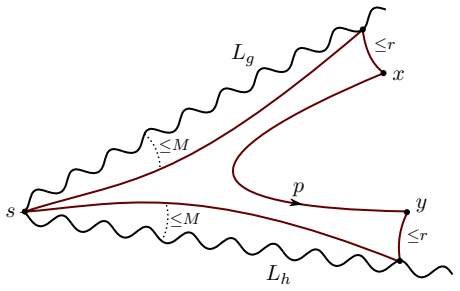
The central object is the dichotomy between isotropic and anisotropic weakly hyperbolic groups. An action is isotropic when equidistant pairs of points are coarsely equivalent modulo the group; a group is isotropic when every general type hyperbolic Cayley graph action is isotropic. The load-bearing technical inputs are: (1) Proposition 6.3, asserting that for general type actions on hyperbolic spaces the domination order $\preceq_A$ is captured exactly by the Lipschitz order on translation length functions; (2) Theorem 6.11, giving many equivalent characterizations of weakly isotropic actions, including minimality in the poset of actions; (3) the compression construction in Section 5, which produces infinitely many inequivalent general type actions from a single anisotropic action. The translation length function $\tau_X(g)=\liminf_{n\to\infty}|g^n|_X/n$ is the invariant that classifies isotropic actions, and its projective class $[\tau_X]$ is the smooth invariant.
What would settle it
Find a countable weakly hyperbolic group G and two general type actions on hyperbolic spaces that are equivalent in the domination order but whose translation length functions are not Lipschitz equivalent; this would directly contradict Proposition 6.3 and destroy the smooth classification for isotropic groups. A concrete place to look is a non-cobounded action of an isotropic group on a hyperbolic space that is not weakly isotropic, since the paper proves those cannot exist.
Extended reading notes
Core claim
The central result is Theorem 2.9: for any countable weakly hyperbolic group G, the equivalence relation $\sim$ on the space of general type hyperbolic Cayley graphs $\mathrm{Hyp}_{gt}(G)$ is Borel bi-reducible either to one of the equality relations $=_1,=_2,\ldots,=_N,=_\mathbb{R}$, or to the relation $E_{K_\sigma}$; all these possibilities are realized. In particular, the classification is either smooth or not classifiable by countable structures. The paper further characterizes the dichotomy: isotropic groups (those where every general type action is coarsely symmetric in all directions) give the smooth case, with equivalence detected by the projective class $[\tau_X]$ of the translation length function; anisotropic groups contain a hyperbolic Cayley graph that can be compressed in infinitely many independent directions, yielding an embedding of the $K_\sigma$ complete quasi-order $Q_{K_\sigma}$ into the poset of hyperbolic structures.
Load-bearing premise
The smooth half of the dichotomy rests on the rigidity statement that two general type actions dominate each other exactly when their translation length functions are Lipschitz equivalent; if that failed for some non-cobounded isotropic action, the smooth classification and the whole dichotomy would not follow.
Editorial extensions
If this is right
- For every countable weakly hyperbolic group, the classification problem for general type actions is either completely tractable (smooth) or maximally intractable ($E_{K_\sigma}$ complete); there is no intermediate complexity level.
- The poset of general type hyperbolic structures $H_{gt}(G)$ is either an antichain of size $1,2,\ldots,\aleph_0$, or $2^{\aleph_0}$ (all realized), or it contains chains and antichains of size $2^{\aleph_0}$ and embeds every poset of cardinality at most $\aleph_1$ (under CH, it is a universal poset of size $2^{\aleph_0}$).
- Uniformly perfect weakly hyperbolic groups are isotropic; in particular $SL_2(F)$ for countable $F\subseteq\mathbb{C}$ is isotropic.
- Acylindrically hyperbolic groups, including non-elementary hyperbolic groups, are anisotropic.
- If a weakly hyperbolic group is anisotropic, then its quasi-morphism space $\widehat{QH}(G)$ has infinite dimension, and any boundedly generated weakly hyperbolic group is isotropic.
Reading between the lines
- The dichotomy suggests that the geometric 'shape' of a group, not just its algebraic type, determines the descriptive complexity of its actions; one could test whether a similar isotropic/anisotropic split governs classification problems for actions on other negatively curved or median spaces.
- The isotropic case being smooth because translation length functions are complete invariants suggests an explicit algorithm or invariant that could be computed for a given action; a natural extension is to ask whether a similar projective-class invariant works for actions on CAT(0) spaces or on quasi-trees.
- The anisotropic case being $E_{K_\sigma}$ complete implies that the isomorphism problem for countable structures embeds into the classification of hyperbolic actions; one might expect this to persist for actions on more general hyperbolic-like spaces, such as injective hulls or hyperbolic complexes.
Signed reviews
Editorial analysis
A structured set of objections, weighed in public.
Referee Report
Summary. The paper formalizes the classification problem for isometric actions of a countable group on Gromov hyperbolic spaces in the language of Borel equivalence relations. The main result (Theorem 2.9, strengthened as Theorem 7.13) is a dichotomy: for every countable weakly hyperbolic group G, the equivalence relation ∼ on Hyp_gt(G), and on the corresponding space of general type hyperbolic pseudo-length functions HypPL_gt(G), is Borel bi-reducible either to equality on a finite set, on the natural numbers, on R, or to the relation E_Kσ; all possibilities are realized. The dichotomy is proved by separating isotropic groups, where general type actions are classified by the projective class of the translation length function (Theorems 2.14 and 6.15), from anisotropic groups, where E_Kσ is embedded via a Borel reduction built from modified generating sets along quasi-axes of inequivalent loxodromic elements (Theorem 2.16 and Corollary 7.12). The paper also proves translation-length rigidity (Proposition 6.3), gives a structural characterization of weakly isotropic actions (Theorem 6.11), describes the poset of general type hyperbolic structures (Corollary 2.18), and provides a wide range of examples, including SL_2(F), acylindrically hyperbolic groups, and certain HNN-extensions and amalgams.
Significance. This is a significant and well-executed advance that connects descriptive set theory with geometric group theory. It supplies a rigorous Borel formalization of a natural classification problem and proves a complete complexity dichotomy rather than isolated examples. The main load-bearing new inputs are Proposition 6.3, a translation-length rigidity statement for general type actions, and the compression construction in Proposition 5.6 with Lemma 5.5; both are proved in detail with explicit constants. The paper is also careful about definability: Proposition 7.4 and Proposition 7.5 use L_{ω1,ω} to show that Hyp(G) and Hyp_gt(G) are Borel, and Lemma 7.9 and Lemma 7.11 correctly handle the smooth and Kσ-complete sides. The examples are substantive and the application to the poset of hyperbolic structures is strong. I stress-tested the most delicate point, the converse direction of Proposition 6.3, and found the proof coherent: the choice of the loxodromic element z via Lemma 4.7, the use of Lemma 6.5 for the lower bound, and the contradiction with (6.2) all check out. I do not see a load-bearing gap.
minor comments (5)
- [Definition 2.4 and Section 4.1] The manuscript contains several typos, including 'straigtforward' in Definition 2.4 and 'tipically' in Section 4.1; a final proofreading pass would be helpful.
- [Definition 4.15] The condition is called the 'Bestwina-Fujiwara condition' in Definition 4.15, but the authors are Bestvina and Fujiwara elsewhere in the text and in the bibliography; this spelling should be made consistent.
- [Example 6.10] The text says that verification of this example is left to the reader. Since the example is not used in any proof, this is not a mathematical gap, but it would be preferable to supply a reference or a short proof sketch, or to remove the promise.
- [Theorem 7.13] In the isotropic case, the step 'Clearly, for any ℓ1, ℓ2 ∈ HypPL_gt(G), we have ℓ1 ∼PL ℓ2 if and only if X_ℓ1 ∼ X_ℓ2' is correct via Lemma 3.7 and transitivity, but a one-sentence justification would improve readability.
- [References] The reference [Mar07] (Marden, Outer Circles) does not appear to be cited in the text; it should either be cited where relevant or removed.
Circularity Check
No significant circularity: the dichotomy is established by independent rigidity theorems and explicit Borel embeddings.
full rationale
The main dichotomy (Theorem 2.9) is not circular. For isotropic groups, the smooth classification is derived from Theorem 6.15, whose key input is Proposition 6.3: G acts on S dominates G acts on T iff tau_{G acts on S} is Lipschitz-dominated by tau_{G acts on T}. This is a substantive rigidity statement proved directly from Lemma 6.5, Lemma 4.7, and hyperbolic boundary topology, not assumed as an input. The reduction X maps to [tau_X] is an explicit Borel reduction because equivalence on Hyp_gt(G) is characterized by projective equality of translation lengths, with no fitted constants or hidden normalizations. For anisotropic groups, E_Ksigma completeness is obtained from an explicitly constructed Borel map f(r)=W(2^{i-r(i)} N_i) (Eq. 5.6), and the equivalence f(r) is dominated by f(s) iff r Q_Ksigma s is verified by the estimates in Lemma 5.5 and the contradiction argument in Proposition 5.6; this is not a consequence of the definition of f. The paper cites its own earlier work ([ABO19], [JOO23]) for auxiliary examples and a Borel-formula lemma, but these are published results with proofs, and the load-bearing arguments (Theorem 6.11, Propositions 5.2 and 6.3) are reproved in the present text. No target equivalence relation is assumed, no fitted parameter is renamed as a prediction, and no uniqueness theorem is imported from the authors' prior work to force the choice of invariant. The only candidate weak point identified by the reader, Proposition 6.3, is a genuine geometric rigidity theorem with a self-contained proof, so no circular step can be exhibited.
Assumptions & free parameters
assumptions (7)
- standard math ZFC set theory.
- standard math Silver's dichotomy for smooth Borel equivalence relations.
- standard math Lopez-Escobar theorem: the set of models of an L_{omega_1,omega} sentence is Borel.
- standard math Isbell's injective hull construction and Lang's theorem that injective hulls of (H3) spaces are hyperbolic.
- standard math Parovichenko theorem: every Boolean algebra of cardinality at most aleph_1 embeds into P(N)/fin.
- domain assumption Bestvina-Fujiwara results on quasi-morphisms for non-equivalent loxodromic elements (Proposition 5 in [BF02]).
- domain assumption Countability of G and the bound on metric space cardinality (at most 2^{aleph_0}) to avoid proper classes.
Cite this review
Pith. "Pith review of Classifying group actions on hyperbolic spaces." pith.science (2026). https://pith.science/paper/2ANKJUN7
@misc{pith2026250421203,
  author       = {Pith},
  title        = {Pith review of: Classifying group actions on hyperbolic spaces},
  year         = {2026},
  howpublished = {\url{https://pith.science/paper/2ANKJUN7}},
  note         = {Machine review of arXiv:2504.21203}
}
abstract
For a given group $G$, it is natural to ask whether one can classify all isometric $G$-actions on Gromov hyperbolic spaces. We propose a formalization of this problem utilizing the complexity theory of Borel equivalence relations. In this paper, we focus on actions of general type, i.e., non-elementary actions without fixed points at infinity. Our main result is the following dichotomy: for every countable group $G$, either all general type actions of $G$ on hyperbolic spaces can be classified by an explicit invariant ranging in an infinite dimensional projective space or they are unclassifiable in a very strong sense. In terms of Borel complexity theory, we show that the equivalence relation associated with the classification problem is either smooth or $K_\sigma$ complete. Special linear groups $SL_2(F)$, where $F$ is a countable field of characteristic $0$, satisfy the former alternative, while non-elementary hyperbolic (and, more generally, acylindrically hyperbolic) groups satisfy the latter. In the course of proving our main theorem, we also obtain results of independent interest that offer new insights into algebraic and geometric properties of groups admitting general type actions on hyperbolic spaces.
Figures


Figures from the paper (9 more)




Forward citations
Cited by 1 Pith paper
-
A simple acylindrical recipe for non-split characteristic $2$ sharply $k$-transitive actions and their generalizations
An acylindrically hyperbolic group satisfying the hyperbolic Theta-seed conditions admits a sharply Theta-transitive action, yielding many non-split sharply 2- and 3-transitive examples.
Reference graph
Works this paper leans on
-
[300]
[Bow14] Bowditch, Brian H., Uniform hyperbolicity of the curve graphs, Pacific J. Math. 269 (2014) no. 2, 269-280. [Cal09] D. Calegari, scl. Memoirs of the Math. Soc. of Japan, 20, Tokyo,
work page 2014
-
[1987]
265-378. [ABO19] C. Abbott, S.H. Balasubramanya, D. Osin, Hyperbolic structures on groups, Algebr. Geom. Topol. 19 (2019), no. 4, 1747-1835. [ABR23] C. Abbott, S. Balasubramanya, A. Rasmussen, Higher rank confining subsets and hyper- bolic actions of solvable groups, Adv. Math. 424 (2023), Paper No. 109045, 47 pp. [ABR24] C. Abbott, S. Balasubramanya, A. ...
arXiv 2019
-
[1990]
Gromov, Hyperbolic groups, Essays in Group Theory, MSRI Series 8, (S.M
[Gro87] M. Gromov, Hyperbolic groups, Essays in Group Theory, MSRI Series 8, (S.M. Gersten, ed.), Springer, 1987, 75-263. [HKL90] L. Harrington, A. S. Kechris, A. Louveau, A Glimm-Effros dichotomy for Borel equivalence relations, J. Amer. Math. Soc. 3 (1990), no. 4, 903-928. [HM21] M. Handel, L. Mosher, Second bounded cohomology and WWPD, Kyoto J. Math. 6...
work page 1990
-
[1996]
[BF02] M. Bestvina, K. Fujiwara, Bounded cohomology of subgroups of mapping class groups, Geom. Topol. 6 (2002), 69-89. [Bow08] B. Bowditch, Tight geodesics in the curve complex, Invent. Math. 171 (2008), no. 2, 281-
work page 2002
-
[2004]
Olshanskii, Periodic quotient groups of hyperbolic groups, Math
[Ol92] A.Yu. Olshanskii, Periodic quotient groups of hyperbolic groups, Math. USSR-Sb. 72 (1992), no. 2, 519–541. [Osi16] D. Osin, Acylindrically hyperbolic groups, Trans. Amer. Math. Soc. 368 (2016), no. 2, 851-888. [Osi17] D. Osin, Invariant random subgroups of groups acting on hyperbolic spaces, Proc. Amer. Math. Soc. 145 (2017), no. 8, 3279-3288. [Osi...
work page 1992
-
[2009]
[CM87] M. Culler, J. Morgan; Group actions on R-trees; Proc. London Math. Soc. 55 (1987), no. 3, 571-604. [CMMS23] F. Calderoni, D. Marker, L. Motto Ros, A. Shani, Anti-classification results for groups acting freely on the line, Adv. Math. 418 (2023), Paper No. 108938. [DGO17] F. Dahmani, V. Guirardel, D. Osin, Hyperbolically embedded subgroups and rotat...
work page 1987
-
[2013]
Thomas, A descriptive view of combinatorial group theory, Bull
[Tho13] S. Thomas, A descriptive view of combinatorial group theory, Bull. Symbolic Logic 17 (2011), no. 2, 252-264. [Tho15] S. Thomas, A descriptive view of unitary group representations, J. Eur. Math. Soc. 17 (2015), no. 7, 1761-1787. [WXY24+] R. Wan, X. Xu, W.Y. Yang, Marked length spectrum rigidity in groups with contracting elements, J. London Math. ...
arXiv 2011
-
[2016]
[MO15] A. Minasyan, D. Osin, Acylindrical hyperbolicity of groups acting on trees, Math. Ann. 362 (2015), no. 3-4, 1055-1105. [MRS18] A. V. Morgan, A.S. Rapinchuk, B. Sury, Bounded generation ofSL2 over rings of S-integers with infinitely many units, Alg. Number Theory 12 (2018), no. 8, 1949-1974. [MT18] J. Maher, G. Tiozzo, Random walks on weakly hyperbo...
work page 2015
Show all 12 references
-
[2017]
Ferenczi, A
[FLR09] V. Ferenczi, A. Louveau, C. Rosendal, The complexity of classifying separable Banach spaces up to isomorphism, J. London Math. Soc. 79 (2009), no. 2, 323-345. [FM77] J. Feldman, C. Moore, Ergodic equivalence relations, cohomology, and von Neumann alge- bras. I, Trans. ...
2009
-
[2018]
[GdlH88] E. Ghys, P. de la Harpe, Sur les groupes hyperboliques d’apr` es Mikhael Gromov (Bern, 1988). Progr. Math., 83, Birkh¨ auser, Boston, MA,
1988
-
[2023]
Balasubramanya, F
[BFGS22] S. Balasubramanya, F. Fournier-Facio, A. Genevois, A. Sisto, Property (NL) for group actions on hyperbolic spaces, arXiv:2212.14292. [BH99] M. Bridson, A. Haefliger; Metric spaces of non-positive curvature; Springer,
-
[2024]
Kechris, A
[KL97] A. Kechris, A. Louveau, The classification of hypersmooth Borel equivalence relations, J. Amer. Math. Soc. 10 (1997), 215-242. [Kot04] D. Kotschick, Quasi-homomorphisms and stable lengths in mapping class groups, Proc. Amer. Math. Soc. 132 (2004), 3167-3175. [KR14] I. K...
1997
Reviewed August 16, 2026 · model on record in the stance chip above.
Discussion (0). Continue with ORCID to comment.