REVIEW 4 major objections 5 minor 35 references
Robust Multi-agent Communication Based on Decentralization-Oriented Adversarial Training
T0 review · 4 major / 5 minor · reviewed 2026-08-16 · deepseek-v4-flash
Pith's one-line read Retraining a communication policy against an adversary that masks its critical channels makes multi-agent teams markedly more robust against attacks, and slightly more performant when no attack occurs.
desk verdict The adversary is well-specified, but the paper's core claim that DMAC retrains the communication policy has no corresponding algorithm or equation, so the reported robustness gains lack a mechanism as submitted. read the letter →
The pith
A machine-rendered reading of the paper's core claim, the machinery that carries it, and where it could break.
The reading
What carries the argument
The load-bearing object is DMAC_Adv, an adversary that assigns one masking agent to every unordered pair of target agents. At each time step it chooses $a^c_{i,j} \in \{0,1\}$, and the masked observation is $\hat{o}_{i,j} = o_{i,j} \odot a^c_{i,j}$, where a masked channel delivers null to both endpoints. The adversary's reward is $\hat{r} = 1/(\sum_{t=0}^T \gamma^t (w_1 R(s^t,a^t,s^{t+1}) + w_2 R_m(a^{ct})) + \xi)$, so maximizing it means both hurting the team's reward and masking as few channels as possible; this pressures the adversary to find the smallest set of channels whose loss is most damaging. The adversary's policy network consumes each agent's observation concatenated with a graph embedding $e_v$ built by one round of distance-weighted neighbor aggregation, $e^{k+1}_v \leftarrow \mathrm{Sum}(e^k_v, \mathrm{Mean}(\frac{1}{w(u,v)} e^k_u), u \in N(v))$. The masking policy is trained with a value-decomposed critic that enforces the Individual-Global-Max property, so the joint optimum equals per-channel optimality, and the masks it produces are used as adversarial training samples to retrain the communication policy while the target agents' decision policy stays fixed.
What would settle it
Run DMAC exactly as specified, then attack the final policy with a continuous adversarial perturbation that alters message values while leaving all channels open; if the post-attack win rate falls back to the unprotected baseline level, the claimed robustness mechanism would be disproved.
Extended reading notes
Core claim
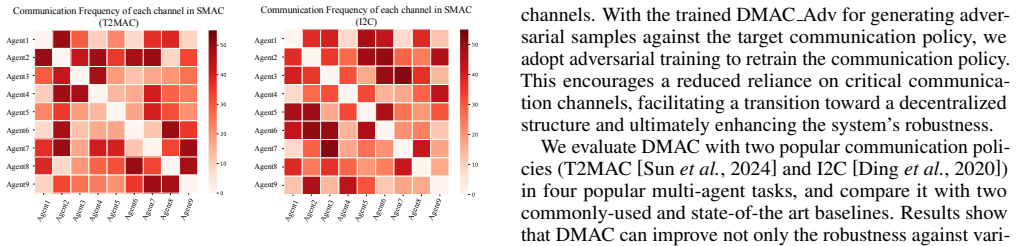
The paper's claim is that robustness of a learned communication policy can be improved not by filtering or repairing attacked messages at inference time, but by deliberately attacking the policy during training. An adversary trained with a dual-objective reward, maximizing the drop in team reward while minimizing the number of masked channels, generates adversarial samples that close the currently critical channels. Retraining the communication policy on these samples forces it to fall back on alternative channels, shifting its usage pattern from a concentrated, hub-like structure to a decentralized one. The paper reports that this shift is what makes the policy resilient: under learned adaptive and heuristic message attacks, the win rate of policies trained with DMAC roughly doubles compared with the AME and R-MACRL defenses, while the standard deviation of per-channel communication frequency drops by about a third to a half. DMAC is framed as a portable wrapper: the target agents' decision policy stays fixed during adversarial training, and only the communication policy is retrained, so the method can be attached to any learnable communication policy without changing the deployed decision model.
Load-bearing premise
The argument rests on the assumption that robustness against binary channel masking, the only attack form used during adversarial training, transfers to the message-perturbation attacks used in evaluation; if that transfer fails, the reported gains would not be explained by the training method.
Editorial extensions
If this is right
- DMAC improves post-attack win rates substantially for both tested communication policies; for example, T2MAC rises from 27.8% to 60.4% on SMAC under the learned adaptive attack, so teams hardened this way no longer collapse when one critical channel is damaged.
- Because DMAC is a training wrapper over the communication policy and leaves the target agents' decision policy fixed, the defense adds no inference-time computation and can be paired with any learnable communication policy.
- Under normal conditions the retrained policy remains at least as good as the original policy, with T2MAC on SMAC going from 81.2% to 83.7% win rate, so robustness is not bought by sacrificing ordinary performance.
- The reduced standard deviation of per-channel communication frequency indicates the retrained policy spreads messages more evenly, so attacking the previously dominant channel no longer removes most of the team's information flow.
Reading between the lines
- An implication the paper leaves implicit is that the same recipe could apply to communication policies with continuous-valued or directional channels, not just binary links, by training the adversary to select message dimensions to corrupt.
- A testable extension is to measure decentralization directly with graph-theoretic indices such as effective resistance or spectral gap rather than only the standard deviation of channel frequencies; if decentralization is the true causal mechanism, those indices should track the robustness gain.
- The paper's protocol trains the learned adaptive attack on the victim policy, but an adaptive adversary that re-optimizes after each DMAC update is not fully explored, so whether the defense survives repeated attacker re-optimization remains open.
- Because the adversary is rewarded for masking as few channels as possible, DMAC implicitly assumes the target policy has a small set of critical channels to find; in regimes where all channels matter equally, the training signal may be much weaker.
Signed reviews
Editorial analysis
A structured set of objections, weighed in public.
Referee Report
Summary. The manuscript proposes DMAC, an adversarial training method intended to improve the robustness of learned multi-agent communication policies. DMAC trains an adversary (DMAC_Adv) to identify and mask critical communication channels, then claims to retrain the target communication policy on the resulting adversarial samples so that the policy becomes less dependent on any single channel and shifts toward a decentralized communication structure. The authors evaluate DMAC on two communication policies, T2MAC and I2C, across four tasks (SMAC, Cooperative Navigation, Traffic Junction, and Predator-Prey), reporting higher win rates than AME and R-MACRL under learned adaptive and heuristic attacks, slightly improved performance in normal conditions, and reduced variance in per-channel communication frequencies.
Significance. If the mechanism were fully specified and the empirical results were reported with uncertainty quantification, DMAC would be a useful contribution: it is a training-time defense that can be combined with any learnable communication policy and adds no inference-time overhead. The adversary formulation as a MARL problem with an IGM-constrained critic is coherent, and evaluating under both learned and heuristic attacks is a sensible protocol. The authors state that source code is released, which supports reproducibility. However, the central retraining step for the communication policy is not described anywhere in the manuscript, and the empirical evidence consists of single-point win rates without seeds, error bars, or statistical tests. As a result, the strength of the claimed robustness gains cannot currently be assessed.
major comments (4)
- [§3.2, Algorithm 1] The central claim that DMAC retrains the communication policy is not supported by the presented algorithm. Algorithm 1 takes the already-trained target policy π as input and updates only the masking policy πc and the critic C (line 14), while line 11 executes the fixed policy π on masked observations. There is no update rule, loss function, alternation schedule, or set of hyperparameters for retraining CP/π anywhere in Section 3.2. The sentence stating that 'the communication policy is retrained in the process of adversarial training' is an assertion without a corresponding equation or pseudocode, and the referenced appendix is not included in the manuscript. Because a fixed policy evaluated under masks cannot change its behavior, the robustness gains in Tables 1 and 2 have no mechanism in the paper as written. Please provide the complete retraining loop for CP, including the objective, the gradient update, how adversarial samples are incorporated, and how the adversary and CP interact over training iterations.
- [§3.2 Eq. (1) and §4.1] The adversary's training objective uses binary channel masking, as defined in Eq. (1), while the evaluation attacks in Section 4.1 are message perturbations: the learned adaptive attack and the heuristic attack perturb or replace message content rather than masking whole channels. If masking-based adversarial training is supposed to confer robustness against perturbation attacks, the paper needs an explicit transfer argument or a control experiment, such as training with randomly masked channels or evaluating under masking attacks as well. Without such evidence, the reported robustness gains under perturbation attacks may not be attributable to the masking-based training procedure described in Section 3.2.
- [§4.2, Tables 1 and 2] Tables 1 and 2 report a single win-rate value per condition with no number of seeds, no standard deviation or confidence interval, and no statistical test. The headline improvements (47.9%–81.9% for T2MAC and 54.4%–99.0% for I2C under the learned adaptive attack) are therefore not statistically established. Please report mean ± standard deviation over at least five independent runs and include pairwise significance tests or effect sizes for the comparisons against AME and R-MACRL.
- [§4.2, Table 3] Table 3 reports communication-frequency statistics only for SC and PP, although the decentralization evaluation in Section 4.2 is presented as a general result for the adjusted communication policy. The claim that DMAC achieves a decentralized communication structure across all four tasks requires supporting numbers for CN and TJ as well, or an explicit statement that only two environments were analyzed in this part of the evaluation.
minor comments (5)
- [General] The manuscript repeatedly refers to an appendix ('More results can be found in the appendix', including ablation studies and additional experimental details), but the arXiv submission contains no appendix. Include the appendix or remove the references to it.
- [References] Several references are duplicated: Das et al. 2019 appears as [Das et al., 2019a] and [Das et al., 2019b], Sukhbaatar et al. 2016 appears as [Sukhbaatar et al., 2016a] and [Sukhbaatar et al., 2016b], and the Mitchell et al. 2020 citation is repeated in Section 2. Please consolidate these entries.
- [§3.2, Eq. (3)] Equation (3) uses the reciprocal of the edge weight w(u,v) after w is defined as the distance between two agents. Please clarify whether this is inverse-distance weighting, how the normalization is performed, and why distance alone is sufficient to capture interaction strength for identifying critical communication channels; an ablation or justification would be helpful.
- [§3.2, Eq. (2)] Equation (2) is ambiguous: the objective says it maximizes r̂, but the expression is written as the reciprocal of a weighted sum, with ξ preventing division by zero. Please state the exact transformation and the roles of w1, w2, and ξ, and provide their values in the experimental setup.
- [Algorithm 1] The number of masking agents N = n(n−1)/2 is defined in Section 3.2 but never used explicitly in Algorithm 1. Please clarify whether each masking agent is responsible for exactly one channel and how the pairing (i,j) is assigned in the loop over training batches.
Circularity Check
No load-bearing circularity: DMAC's robustness numbers are empirical measurements, and the only self-citation is minor and non-load-bearing; a missing CP-update specification is a correctness gap, not circularity.
full rationale
The paper's claimed robustness improvements are empirical measurements (Tables 1-3) and are not derived from the equations in Section 3.2, so there is no algebraic self-definition. DMAC_Adv's objective (Eq. 2) uses the environment reward R and mask count Rm; this is an external optimization criterion, not the reported win-rate deltas. The evaluation uses separately described learned adaptive and heuristic attacks; nothing in the paper defines those attacks as DMAC_Adv itself, so the numbers are not a renamed fit. The only self-citation, [Ma et al., 2024], is used to justify graph-based feature extraction for the adversary, and it does not contain the DMAC result; no uniqueness theorem or load-bearing premise is imported from the authors' prior work, and the cited TD-loss support [Liu et al., 2023] is external. A genuine specification gap exists: Section 3.2 asserts 'the communication policy is retrained in the process of adversarial training' and Algorithm 1 inputs only the fixed target policy π and updates only πc and C (lines 14 and 16), with no CP update rule; this is a missing-support/correctness concern, not circularity. Because the one self-citation is minor and non-load-bearing, the appropriate non-circularity score is 2 rather than 0.
Assumptions & free parameters
free parameters (3)
- w1, w2 (adversary reward weights) =
not reported
- ξ (offset in adversary reward) =
not reported
- graph embedding iterations K and edge weight normalization =
not reported
assumptions (6)
- standard math IGM principle and non-negative weight constraint in Equation 5 allow Qtot to be maximized by per-agent argmax.
- domain assumption The target agent policy π is fixed while the communication policy CP is retrained.
- domain assumption Masking a communication channel is equivalent to setting the message to null (Equation 1).
- ad hoc to paper Distance between agents is a sufficient weight for interaction strength in the graph embedding.
- domain assumption Decentralized networks are more robust to node/channel failure (decentralization theory).
- domain assumption Win rate is a comparable task-completion metric across the four environments.
Cite this review
Pith. "Pith review of Robust Multi-agent Communication Based on Decentralization-Oriented Adversarial Training." pith.science (2026). https://pith.science/paper/MQHF2NR2
@misc{pith2026250421278,
  author       = {Pith},
  title        = {Pith review of: Robust Multi-agent Communication Based on Decentralization-Oriented Adversarial Training},
  year         = {2026},
  howpublished = {\url{https://pith.science/paper/MQHF2NR2}},
  note         = {Machine review of arXiv:2504.21278}
}
read the original abstract
In typical multi-agent reinforcement learning (MARL) problems, communication is important for agents to share information and make the right decisions. However, due to the complexity of training multi-agent communication, existing methods often fall into the dilemma of local optimization, which leads to the concentration of communication in a limited number of channels and presents an unbalanced structure. Such unbalanced communication policy are vulnerable to abnormal conditions, where the damage of critical communication channels can trigger the crash of the entire system. Inspired by decentralization theory in sociology, we propose DMAC, which enhances the robustness of multi-agent communication policies by retraining them into decentralized patterns. Specifically, we train an adversary DMAC\_Adv which can dynamically identify and mask the critical communication channels, and then apply the adversarial samples generated by DMAC\_Adv to the adversarial learning of the communication policy to force the policy in exploring other potential communication schemes and transition to a decentralized structure. As a training method to improve robustness, DMAC can be fused with any learnable communication policy algorithm. The experimental results in two communication policies and four multi-agent tasks demonstrate that DMAC achieves higher improvement on robustness and performance of communication policy compared with two state-of-the-art and commonly-used baselines. Also, the results demonstrate that DMAC can achieve decentralized communication structure with acceptable communication cost.
Figures


Figures from the paper (2 more)


Reference graph
Works this paper leans on
-
[1]
Deep reinforcement learning for truck-drone delivery problem
[Bi et al., 2023] Zhiliang Bi, Xiwang Guo, Jiacun Wang, Shu- jin Qin, and Guanjun Liu. Deep reinforcement learning for truck-drone delivery problem. Drones, 7:445, 07
work page 2023
-
[3]
[Cena et al., 2013] Cecilia E. Garcia Cena, Pedro F. C´ardenas, Roque Saltar ´en Pazmi ˜no, Lisandro Puglisi, and Rafael Aracil Santonja. A cooperative multi-agent robotics system: Design and modelling. Expert Syst. Appl., 40(12):4737–4748,
work page 2013
-
[6]
Learning individually inferred communication for multi-agent cooperation
[Ding et al., 2020] Ziluo Ding, Tiejun Huang, and Zongqing Lu. Learning individually inferred communication for multi-agent cooperation. In Advances in Neural Informa- tion Processing Systems 33: Annual Conference on Neural Information Processing Systems 2020, NeurIPS 2020, De- cember 6-12, 2020, virtual,
work page 2020
-
[11]
Learning to schedule communication in multi-agent reinforcement learning
[Kim et al., 2019] Daewoo Kim, Sangwoo Moon, David Hostallero, Wan Ju Kang, Taeyoung Lee, Kyunghwan Son, and Yung Yi. Learning to schedule communication in multi-agent reinforcement learning. In 7th International Conference on Learning Representations, ICLR 2019, New Orleans, LA, USA, May 6-9,
work page 2019
-
[12]
Multi-agent game abstraction via graph attention neural network
[Liu et al., 2020] Yong Liu, Weixun Wang, Yujing Hu, Jianye Hao, Xingguo Chen, and Yang Gao. Multi-agent game abstraction via graph attention neural network. In The Thirty-Fourth AAAI Conference on Artificial Intelligence, AAAI 2020, New York, NY, USA, February 7-12, 2020 , pages 7211–7218. AAAI Press,
work page 2020
-
[13]
Na 2q: Neural attention additive model for inter- pretable multi-agent q-learning
[Liu et al., 2023] Zichuan Liu, Yuanyang Zhu, and Chunlin Chen. Na 2q: Neural attention additive model for inter- pretable multi-agent q-learning. In Andreas Krause, Emma Brunskill, Kyunghyun Cho, Barbara Engelhardt, Sivan Sabato, and Jonathan Scarlett, editors,International Confer- ence on Machine Learning, ICML 2023, 23-29 July 2023, Honolulu, Hawaii, U...
work page 2023
-
[14]
Multi-agent actor- critic for mixed cooperative-competitive environments
[Lowe et al., 2017] Ryan Lowe, Yi Wu, Aviv Tamar, Jean Harb, Pieter Abbeel, and Igor Mordatch. Multi-agent actor- critic for mixed cooperative-competitive environments. In Advances in Neural Information Processing Systems 30: Annual Conference on Neural Information Processing Sys- tems 2017, December 4-9, 2017, Long Beach, CA, USA , pages 6379–6390,
work page 2017
-
[16]
[Ma et al., 2024] Xuyan Ma, Yawen Wang, Junjie Wang, Xi- aofei Xie, Boyu Wu, Shoubin Li, Fanjiang Xu, and Qing Wang. Enhancing multi-agent system testing with diversity- guided exploration and adaptive critical state exploitation. In Maria Christakis and Michael Pradel, editors, Proceed- ings of the 33rd ACM SIGSOFT International Symposium on Software Tes...
work page 2024
Show all 35 references
-
[18]
PMAC: personalized multi-agent communication
[Meng and Tan, 2024] Xiangrui Meng and Ying Tan. PMAC: personalized multi-agent communication. In Thirty-Eighth AAAI Conference on Artificial Intelligence, AAAI 2024, February 20-27, 2024, Vancouver, Canada, pages 17505– 17513. AAAI Press,
2024
-
[19]
Gaussian process based message fil- tering for robust multi-agent cooperation in the presence of adversarial communication
[Mitchell et al., 2020] Rupert Mitchell, Jan Blumenkamp, and Amanda Prorok. Gaussian process based message fil- tering for robust multi-agent cooperation in the presence of adversarial communication. CoRR, abs/2012.00508,
2020 arXiv
-
[20]
Improving coordination in small-scale multi- agent deep reinforcement learning through memory-driven communication
[Pesce and Montana, 2020] Emanuele Pesce and Giovanni Montana. Improving coordination in small-scale multi- agent deep reinforcement learning through memory-driven communication. Mach. Learn. , 109(9-10):1727–1747,
2020
-
[21]
Deep rein- forcement learning framework for autonomous driving
[Sallab et al., 2017] Ahmad El Sallab, Mohammed Abdou, Etienne Perot, and Senthil Kumar Yogamani. Deep rein- forcement learning framework for autonomous driving. In Patrick Denny, Darnell Moore, and Buyue Zhang, editors, Autonomous Vehicles and Machines 2017, Burlingame, CA, U...
2017
-
[22]
The starcraft multi- agent challenge
[Samvelyan et al., 2019] Mikayel Samvelyan, Tabish Rashid, Christian Schroeder De Witt, Gregory Farquhar, Nantas Nardelli, Tim GJ Rudner, Chia-Man Hung, Philip HS Torr, Jakob Foerster, and Shimon Whiteson. The starcraft multi- agent challenge. arXiv preprint arXiv:1902.04043,
2019 arXiv
-
[23]
Safe, multi-agent, re- inforcement learning for autonomous driving
[Shalev-Shwartz et al., 2016] Shai Shalev-Shwartz, Shaked Shammah, and Amnon Shashua. Safe, multi-agent, re- inforcement learning for autonomous driving. CoRR, abs/1610.03295,
2016 arXiv
-
[25]
Learning when to communicate at scale in multiagent cooperative and competitive tasks
[Singh et al., 2019] Amanpreet Singh, Tushar Jain, and Sain- bayar Sukhbaatar. Learning when to communicate at scale in multiagent cooperative and competitive tasks. In 7th In- ternational Conference on Learning Representations, ICLR 2019, New Orleans, LA, USA, May 6-9, 2019 ....
2019
-
[26]
QTRAN: learning to factorize with transformation for cooperative multi-agent reinforcement learning
[Son et al., 2019] Kyunghwan Son, Daewoo Kim, Wan Ju Kang, David Hostallero, and Yung Yi. QTRAN: learning to factorize with transformation for cooperative multi-agent reinforcement learning. In Proceedings of the 36th Interna- tional Conference on Machine Learning, ICML 2019, ...
2019
-
[27]
Learning multiagent commu- nication with backpropagation
[Sukhbaatar et al., 2016a] Sainbayar Sukhbaatar, Arthur Szlam, and Rob Fergus. Learning multiagent commu- nication with backpropagation. In Advances in Neural Information Processing Systems 29: Annual Conference on Neural Information Processing Systems 2016, December 5-10, 201...
2016
-
[28]
Learning multiagent communica- tion with backpropagation
[Sukhbaatar et al., 2016b] Sainbayar Sukhbaatar, Arthur Szlam, and Rob Fergus. Learning multiagent communica- tion with backpropagation. In Advances in Neural Informa- tion Processing Systems 29: Annual Conference on Neural Information Processing Systems 2016, pages 2244–2252,
2016
-
[29]
Certifiably robust policy learning against adversarial multi-agent communication
[Sun et al., 2023] Yanchao Sun, Ruijie Zheng, Parisa Hassan- zadeh, Yongyuan Liang, Soheil Feizi, Sumitra Ganesh, and Furong Huang. Certifiably robust policy learning against adversarial multi-agent communication. In The Eleventh In- ternational Conference on Learning Represen...
2023
-
[30]
T2MAC: targeted and trusted multi-agent communication through selective engagement and evidence-driven inte- gration
[Sun et al., 2024] Chuxiong Sun, Zehua Zang, Jiabao Li, Jiangmeng Li, Xiao Xu, Rui Wang, and Changwen Zheng. T2MAC: targeted and trusted multi-agent communication through selective engagement and evidence-driven inte- gration. In Thirty-Eighth AAAI Conference on Artificial Int...
2024
-
[31]
Leibo, Karl Tuyls, and Thore Graepel
[Sunehag et al., ] Peter Sunehag, Guy Lever, Audrunas Gruslys, Wojciech Marian Czarnecki, Vin´ıcius Flores Zam- baldi, Max Jaderberg, Marc Lanctot, Nicolas Sonnerat, Joel Z. Leibo, Karl Tuyls, and Thore Graepel. Value- decomposition networks for cooperative multi-agent learn- ...
2018
-
[33]
Mis- spoke or mis-lead: Achieving robustness in multi-agent communicative reinforcement learning
[Xue et al., 2022] Wanqi Xue, Wei Qiu, Bo An, Zinovi Ra- binovich, Svetlana Obraztsova, and Chai Kiat Yeo. Mis- spoke or mis-lead: Achieving robustness in multi-agent communicative reinforcement learning. In 21st Interna- tional Conference on Autonomous Agents and Multiagent S...
2022
-
[34]
Efficient communication in multi-agent reinforcement learning via variance based control
[Zhang et al., 2019] Sai Qian Zhang, Qi Zhang, and Jieyu Lin. Efficient communication in multi-agent reinforcement learning via variance based control. In Advances in Neural Information Processing Systems 32: Annual Conference on Neural Information Processing Systems 2019, Neu...
2019
-
[35]
A survey of multi-agent deep reinforcement learning with communication
[Zhu et al., 2024] Changxi Zhu, Mehdi Dastani, and Shihan Wang. A survey of multi-agent deep reinforcement learning with communication. In Proceedings of the 23rd Interna- tional Conference on Autonomous Agents and Multiagent Systems, AAMAS 2024, Auckland, New Zealand, May 6- ...
2024
-
[2012]
Hausknecht and Peter Stone
[Hausknecht and Stone, 2015] Matthew J. Hausknecht and Peter Stone. Deep recurrent q-learning for partially ob- servable mdps. CoRR, abs/1507.06527,
2015 arXiv
-
[2013]
Tarmac: Targeted multi-agent communication
[Das et al., 2019a] Abhishek Das, Theophile Gervet, Joshua Romoff, Dhruv Batra, Devi Parikh, Mike Rabbat, and Joelle Pineau. Tarmac: Targeted multi-agent communication. In Agent1 Agent2 Agent3 Agent4 Agent5 Agent6 Agent7 Agent8 Agent9 Communication Frequency of each channel in...
2019
-
[2015]
Rethinking individual global max in cooperative multi- agent reinforcement learning
[Hong et al., 2022] Yitian Hong, Yaochu Jin, and Yang Tang. Rethinking individual global max in cooperative multi- agent reinforcement learning. In Advances in Neural Infor- mation Processing Systems 35: Annual Conference on Neu- ral Information Processing Systems 2022, NeurIP...
2022
-
[2016]
Learning structured communication for multi-agent reinforcement learning
[Sheng et al., 2023] Junjie Sheng, Xiangfeng Wang, Bo Jin, Wenhao Li, Jun Wang, Junchi Yan, Tsung-Hui Chang, and Hongyuan Zha. Learning structured communication for multi-agent reinforcement learning. In Proceedings of the 2023 International Conference on Autonomous Agents and...
2023
-
[2017]
Grey-box adver- sarial attack on communication in multi-agent reinforce- ment learning
[Ma and Li, 2023] Xiao Ma and Wu-Jun Li. Grey-box adver- sarial attack on communication in multi-agent reinforce- ment learning. In Proceedings of the 2023 International Conference on Autonomous Agents and Multiagent Systems, AAMAS 2023, London, United Kingdom, 29 May 2023 - 2...
2023
-
[2019]
Tarmac: Targeted multi-agent communication
[Das et al., 2019b] Abhishek Das, Th´eophile Gervet, Joshua Romoff, Dhruv Batra, Devi Parikh, Mike Rabbat, and Joelle Pineau. Tarmac: Targeted multi-agent communication. In Proceedings of the 36th International Conference on Machine Learning, ICML 2019, pages 1538–1546. PMLR,
2019
-
[2020]
A multi-agent reinforcement learning approach to robot soccer
[Duan et al., 2012] Yong Duan, Baoxia Cui, and Xinhe Xu. A multi-agent reinforcement learning approach to robot soccer. Artif. Intell. Rev., 38(3):193–211,
2012
-
[2021]
QPLEX: duplex dueling multi-agent q-learning
[Wang et al., 2021a] Jianhao Wang, Zhizhou Ren, Terry Liu, Yang Yu, and Chongjie Zhang. QPLEX: duplex dueling multi-agent q-learning. In 9th International Conference on Learning Representations, ICLR 2021, Virtual Event, Austria, May 3-7,
2021
-
[2022]
Graph convolutional reinforcement learn- ing
[Jiang et al., 2020] Jiechuan Jiang, Chen Dun, Tiejun Huang, and Zongqing Lu. Graph convolutional reinforcement learn- ing. In 8th International Conference on Learning Repre- sentations, ICLR 2020, Addis Ababa, Ethiopia, April 26-30,
2020
-
[2023]
Robustness of decentralized decision-making architectures in command and control systems
[Boss and Gralla, 2023] Lewis N Boss and Erica L Gralla. Robustness of decentralized decision-making architectures in command and control systems. Systems Engineering, 26(2):149–161,
2023
-
[2024]
Learning agent commu- nication under limited bandwidth by message pruning
[Mao et al., 2020] Hangyu Mao, Zhengchao Zhang, Zhen Xiao, Zhibo Gong, and Yan Ni. Learning agent commu- nication under limited bandwidth by message pruning. In The Thirty-Fourth AAAI Conference on Artificial Intelli- gence, AAAI 2020, New York, NY, USA, February 7-12, 2020, p...
2020
Reviewed August 16, 2026 · model on record in the stance chip above.
Discussion (0). Continue with ORCID to comment.