REVIEW 3 major objections 7 minor 47 references
MagicCraft: Natural Language-Driven Generation of Dynamic and Interactive 3D Objects for Commercial Metaverse Platforms
T0 review · 3 major / 7 minor · reviewed 2026-08-16 · deepseek-v4-flash
Pith's one-line read MagicCraft claims that a natural-language prompt can produce a deployable, interactive 3D object on a commercial metaverse platform in minutes, cutting creation time by a factor of 31 to 164.
desk verdict A real, well-evaluated system for AI-assisted 3D content creation whose headline speedup claim doesn't survive like-for-like comparison. read the letter →
The pith
A machine-rendered reading of the paper's core claim, the machinery that carries it, and where it could break.
The reading
What carries the argument
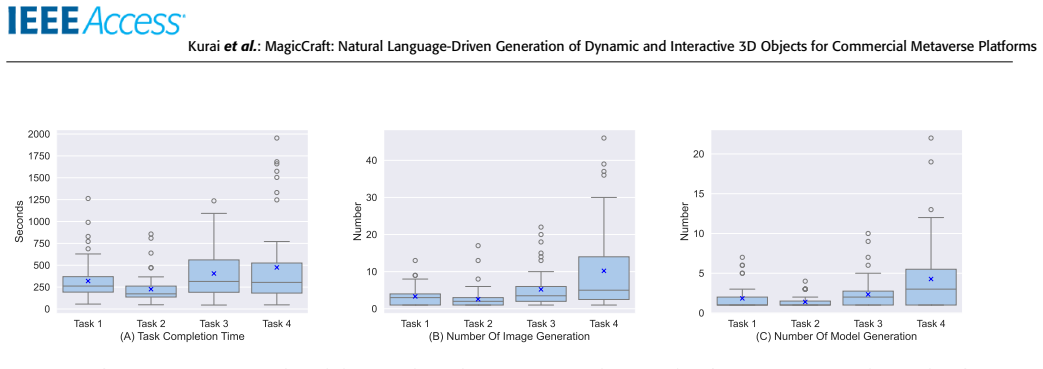
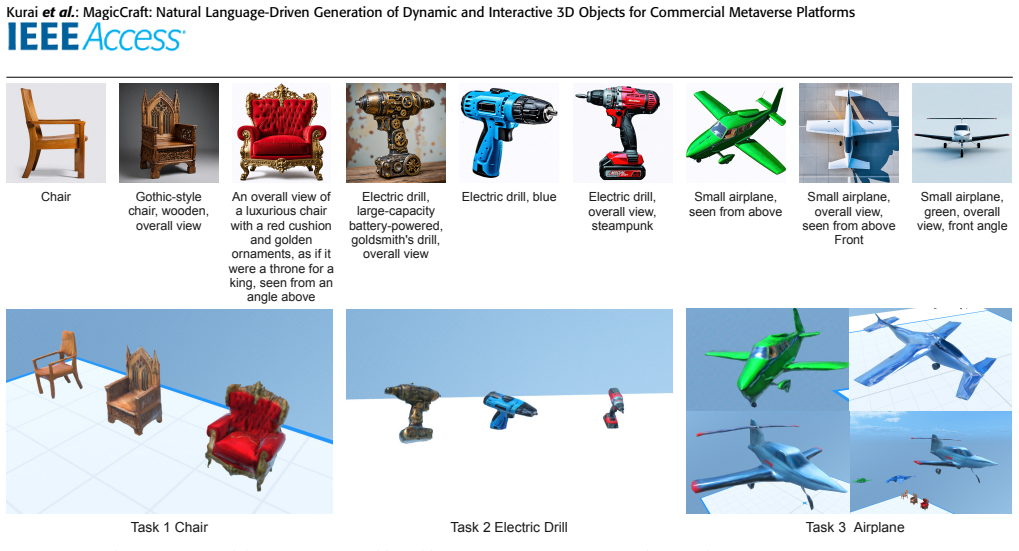
The load-bearing mechanism is the four-phase pipeline (image generation, scale-aware 3D generation, optional behavior scripting, assembly and upload) orchestrated by a web app on the Cluster platform. Its two distinctive components carry the argument: automatic scale-aware conversion, where a multimodal LLM estimates the real-world length of the longest axis and the system divides that estimate by the computational length from the GLTF bounding box to produce a scaling factor, so chairs, drills, and airplanes come out roughly the right size; and platform-injected script generation, where ClusterScript definitions are appended to the LLM prompt so the generated behaviors compile and run in the target environment. The efficiency claim itself rests on a ratio: measured user task-completion time in seconds divided by expert-estimated manual production time in hours.
What would settle it
Run a controlled time trial in which professional CG designers and novices actually create the same three objects (chair, electric drill, airplane) from the same reference images by hand, with the same quality bar MagicCraft achieved, while logging real elapsed times; if the measured expert times fall near MagicCraft users' 4 to 8 minute completion times rather than the 0.4 to 6.4 hour estimates, the reported speedup factor fails.
Extended reading notes
Core claim
MagicCraft's discovery is that the entire technical workflow of metaverse object creation—prompt interpretation, 2D visualization, 3D reconstruction, real-world scaling, interaction-point setup, behavior scripting, and platform upload—can be absorbed into an AI orchestration that the user only steers with natural language, a few dropdowns, and direct manipulation. The system generates a 2D image from an LLM-expanded prompt, converts it to a 3D model whose size is automatically corrected using a multimodal LLM's estimate of the object's real-world length divided by the GLTF bounding-box span, lets the user position a 170 cm mannequin to set sitting and grip points, produces a ClusterScript behavior from an LLM, and assembles everything into a GLB for immediate upload to Cluster. With this pipeline, 51 general users—most with zero years of 3D modeling experience—deployed usable interactive objects in four to eight minutes per task, and expert CG designers estimated equivalent manual work at 0.4 to 14.7 hours depending on object, role, and whether a base model existed. The paper therefore claims MagicCraft reduces creation time by a factor of 31 to 164, at the cost of texture resolution, mesh fidelity, and behavioral realism that experts judged suitable for prototyping rather than commercial release.
Load-bearing premise
The speedup claim assumes the expert-estimated manual creation times (0.4 to 14.7 hours, reported without variance) are a fair baseline for the same task scope and quality that MagicCraft users achieved, so if those estimates are inflated, the headline 31-164x factor collapses.
Editorial extensions
If this is right
- If the speedup holds, metaverse platforms can lower the skill barrier for user-generated content from months of 3D modeling and scripting experience to minutes of prompt writing and simple adjustments.
- The 98-100% task success rates suggest the pipeline is reliable enough for non-experts to complete the full path from prompt to deployed object, a step beyond systems that only generate static geometry.
- The quality trade-off documented by experts—low-resolution textures, distorted mechanical parts, and unreliable scripted motion—means the realistic near-term use is rapid prototyping and environmental testing, not finished commercial assets.
- Because the system is implemented on Cluster with its two native interaction primitives (rideable and grabbable), the same architecture should transfer to other platforms only after adapting scripting languages, asset pipelines, and interaction models.
- Satisfaction dropped sharply on the scripted-motion task (44.9% rating 4 or higher versus 76-82% on other tasks), indicating that LLM-generated behavior is currently the weakest link in the end-to-end pipeline.
Reading between the lines
- A controlled re-test that measures actual expert creation times on the same reference images—rather than the paper's elicited estimates—would either confirm or erode the headline 31-164x factor, since the estimates carry no variance and mix faster 'with a base model' and slower 'from scratch' scenarios.
- The scale-estimation method (LLM length estimate divided by GLTF bounding-box span) is a reusable, free calibration step that could be grafted onto any image-to-3D generator, making correct sizing a post-processing operation independent of MagicCraft.
- If behavior scripting remains the weakest stage, the field's next bottleneck is spatial reasoning in LLMs—teaching them to convert motion intent into coordinate-specific, orientation-correct transformations—rather than further improving 3D geometry quality.
- The shift of creative effort from modeling to prompting suggests that prompt difficulty and prompt literacy, not tool access, will become the main determinant of content quality in AI-assisted metaverse creation.
Signed reviews
Editorial analysis
A structured set of objections, weighed in public.
Referee Report
Summary. The paper presents MagicCraft, a system that generates functional, interactive 3D objects for the commercial metaverse platform Cluster from natural-language prompts. The system pipeline combines LLM-based prompt enhancement, text-to-image generation, image-to-3D reconstruction, automatic real-world scaling, interactive adjustment of sitting/grasping positions, and LLM-generated behavior scripts, followed by direct upload to Cluster. The authors report a public evaluation with 51 general users and interviews with 7 expert CG designers. They report high task-completion rates for the first three tasks, a mean SUS score of 71.8, and qualitative feedback indicating that non-experts could produce deployable objects. The central quantitative claim, in Section VII-A, is that MagicCraft accelerates 3D-object creation by a factor of 31 to 164 compared with traditional methods used by professional CG designers.
Significance. If the quantitative speedup claim were properly supported, this would be a substantial contribution to accessible metaverse content creation, and the paper's integrated design—deployed on a commercial platform and evaluated with both end users and domain experts—is a concrete strength. The authors provide a real system, transparent component choices, and a moderately large user study. The qualitative usability results (SUS 71.8, high completion rates for the structured tasks) and the expert feedback on prototyping value are useful in their own right. However, the headline efficiency factor rests on a comparison of non-equivalent endpoints and on subjective expert baselines, and the paper contains an internal contradiction about stage success rates. These issues are load-bearing for the paper's main claim and must be repaired.
major comments (3)
- The headline claim that MagicCraft accelerates 3D-object creation 'by a factor of 31 to 164' is not supported by like-for-like comparison. The denominator is the logged time from the user's first image generation to their first successful upload (Section V-C-1-b), which excludes pre-generation prompt formulation and has no quality gate; an upload counts as success even when the generated script did not work or the model fell short of professional quality. The numerator is the experts' estimated time to create a finished, functioning object (Section VI-A), and the paper itself states that generated objects 'may not yet meet professional standards' (Section VII-A) and are 'not yet ready for formal product deployment' (Section VI-B-1-d). In addition, the factor range mixes baselines: the 31x lower bound uses the expert-from-scratch estimate for the chair, while the 164x upper bound uses the novice-from-scratch estimate for the drill. Using the expert-with-prebuilt-model estimates in Table 1 yields factors of only 4–19x. The reported data therefore do not establish the claimed speedup; the authors should either provide a controlled, quality-adjusted comparison or explicitly rescope the claim to rapid prototyping with the smaller, documented speedup.
- The text states that 'all processing stages maintained success rates above 90%,' but Table 2 reports a Task-4 upload success rate of 71.17%. This is a direct internal contradiction. Table 1 separately reports Task-4 task success as 98%, so the paper is using at least two incompatible notions of success (per-participant task completion versus per-attempt stage success) without defining them clearly. The explanation about vertex counts and mesh reduction may be correct, but the text must correct the 'above 90%' claim and clarify the relationship between the stage-level failure rate and the claim that users successfully deployed objects.
- The expert baseline estimates are single-point subjective estimates elicited without a live control condition, without any reported variance or per-expert ranges, and without an explicit, uniform specification of the target quality bar beyond 'similar to the one shown.' Since the headline speedup factor is computed directly from these estimates, the baseline must be auditable. At minimum, report the distribution of expert estimates, specify the quality assumptions for each scenario, and state whether the estimates refer to production-ready assets or to functionally equivalent prototypes.
minor comments (7)
- [Section III-B-5] 'assemply' should be 'assembly'.
- [Section V-A-3] 'sagiall airplane' appears to be a typo for 'small airplane'.
- [Section V-C-g] 'Raw LTX' should be 'Raw TLX'.
- [Section V] The paragraph describing the alarm-clock practice task is duplicated verbatim; remove the duplicate.
- [Table 1] The header 'Performance Metrices' should be 'Performance Metrics'.
- [Section IV-a] The affiliation address contains a typo: 'Shingawa' should be 'Shinagawa'.
- [Section V-C-b] The outlier exclusion is described only as 'likely due to multitasking or external factors'; please state the operational exclusion criterion and report whether the means change when the outliers are retained.
Circularity Check
No circularity: MagicCraft's empirical evaluation is self-contained; the only self-citations are implementation references and are not load-bearing premises.
full rationale
MagicCraft is a systems and user-study paper, not a derivation, so there is no mathematical chain in which an output is definitionally identical to an input. The central 31-164x speedup claim in Section VII-A is an empirical ratio between expert-estimated manual creation times (Section VI-A) and logged MagicCraft completion times (Section V-C-1-b). The expert estimates are not fitted to, or derived from, the MagicCraft timing data; they are an independent, albeit subjective, baseline. Even if the baseline endpoints are not fully comparable, and even though the paper itself concedes in Section VII-A that generated objects 'may not yet meet professional standards for commercial applications,' that is a measurement-validity weakness, not circular reasoning. The only self-citations appear in Section I and Section IV-a, where a previous MagicCraft implementation and a prior MagicItem script-generation prompt are referenced for provenance; neither citation is used to justify a prediction or to exclude alternative approaches, and no uniqueness theorem is imported. The empirical success rates, task completion times, SUS scores, NASA-TLX scores, and expert qualitative assessments are all measured from the deployed system and stand as independent evidence for the paper's usability claims.
Assumptions & free parameters
assumptions (3)
- domain assumption Expert estimates of manual creation time are an unbiased baseline for the time-reduction claim.
- domain assumption LLM-estimated real-world size is accurate enough for automatic scaling.
- domain assumption Self-report and upload completion indicate successful object creation.
Cite this review
Pith. "Pith review of MagicCraft: Natural Language-Driven Generation of Dynamic and Interactive 3D Objects for Commercial Metaverse Platforms." pith.science (2026). https://pith.science/paper/XA56OVRG
@misc{pith2026250421332,
  author       = {Pith},
  title        = {Pith review of: MagicCraft: Natural Language-Driven Generation of Dynamic and Interactive 3D Objects for Commercial Metaverse Platforms},
  year         = {2026},
  howpublished = {\url{https://pith.science/paper/XA56OVRG}},
  note         = {Machine review of arXiv:2504.21332}
}
read the original abstract
Metaverse platforms are rapidly evolving to provide immersive spaces for user interaction and content creation. However, the generation of dynamic and interactive 3D objects remains challenging due to the need for advanced 3D modeling and programming skills. To address this challenge, we present MagicCraft, a system that generates functional 3D objects from natural language prompts for metaverse platforms. MagicCraft uses generative AI models to manage the entire content creation pipeline: converting user text descriptions into images, transforming images into 3D models, predicting object behavior, and assigning necessary attributes and scripts. It also provides an interactive interface for users to refine generated objects by adjusting features such as orientation, scale, seating positions, and grip points. Implemented on Cluster, a commercial metaverse platform, MagicCraft was evaluated by 7 expert CG designers and 51 general users. Results show that MagicCraft significantly reduces the time and skill required to create 3D objects. Users with no prior experience in 3D modeling or programming successfully created complex, interactive objects and deployed them in the metaverse. Expert feedback highlighted the system's potential to improve content creation workflows and support rapid prototyping. By integrating AI-generated content into metaverse platforms, MagicCraft makes 3D content creation more accessible.
Figures


Figures from the paper (8 more)





Reference graph
Works this paper leans on
-
[1]
VRChat Inc., ‘‘VRChat,’’ https://hello.vrchat.com/, 2024, accessed: 2024- 6-15
work page 2024
-
[2]
Roblox Corporation, ‘‘Roblox,’’ https://www.roblox.com/, 2024, accessed: 2024-6-15
work page 2024
-
[3]
Cluster, Inc., ‘‘Cluster,’’ https://cluster.mu/, 2024, accessed: 2024-6-15
work page 2024
-
[4]
R. Rombach, A. Blattmann, D. Lorenz, P . Esser, and B. Ommer, ‘‘High-resolution image synthesis with latent diffusion models,’’ in 2022 IEEE/CVF Conference on Computer Vision and Pattern Recognition (CVPR). Los Alamitos, CA, USA: IEEE Computer Society, jun 2022, pp. 10 674–10 685. [Online]. Available: https://doi.ieeecomputersociety. org/10.1109/CVPR52688...
arXiv 2022
- [5]
-
[6]
OpenAI, ‘‘Gpt-4 technical report,’’ ArXiv, vol. abs/2303.08774, 2023. [Online]. Available: https://arxiv.org/abs/2303.08774
arXiv 2023
-
[7]
D. Giunchi, N. Numan, E. Gatti, and A. Steed, ‘‘DreamCodeVR: To- wards democratizing behavior design in virtual reality with Speech-Driven programming,’’ in 2024 IEEE Conference Virtual Reality and 3D User Interfaces (VR). IEEE, Mar. 2024, pp. 579–589. 14 VOLUME 11, 2023 Kurai et al.: MagicCraft: Natural Language-Driven Generation of Dynamic and Interacti...
work page 2024
- [8]
Show all 47 references
-
[9]
——, ‘‘An implementation of magiccraft: Generating interactive 3d objects and their behaviors from text for commercial metaverse platforms,’’ in 2025 IEEE on Virtual Reality and 3D User Interfaces Abstracts and Workshops (VRW), 2025, to appear
2025
-
[10]
Solirax, ‘‘Neos,’’ https://neos.com/, 2024, accessed: 2024-6-15
2024
-
[11]
Y ellow Dog Man Studios, ‘‘Resonite,’’ https://resonite.com/, 2024, ac- cessed: 2024-6-15
2024
-
[12]
Ondrejka, ‘‘Escaping the gilded cage: User created content and building the metaverse,’’ New York Law School Law Journal , vol
C. Ondrejka, ‘‘Escaping the gilded cage: User created content and building the metaverse,’’ New York Law School Law Journal , vol. 49, 05 2004
2004
-
[13]
Blender Foundation, ‘‘Blender,’’ https://www.blender.org/, 2024, accessed: 2024-6-15
2024
-
[14]
Unity Technologies, ‘‘Unity,’’ https://unity.com/, 2024, accessed: 2024-6- 15
2024
-
[15]
Epic Games, Inc., ‘‘Unreal engine,’’ https://www.unrealengine.com/, 2024, accessed: 2024-6-15
2024
-
[16]
Y . H. Cho, S. Y . Yim, and S. Paik, ‘‘Physical and social presence in 3d virtual role-play for pre-service teachers,’’ The Internet and Higher Education , vol. 25, pp. 70–77, 2015. [Online]. Available: https://www.sciencedirect.com/science/article/pii/S1096751615000032
2015
-
[17]
M. E. Latoschik, D. Roth, D. Gall, J. Achenbach, T. Waltemate, and M. Botsch, ‘‘The effect of avatar realism in immersive social virtual realities,’’ in Proceedings of the 23rd ACM Symposium on Virtual Reality Software and Technology , ser. VRST ’17, 2017. [Online]. Available:...
2017
-
[18]
Pan and A
Y . Pan and A. Steed, ‘‘The impact of self-avatars on trust and collaboration in shared virtual environments,’’PLOS ONE, vol. 12, no. 12, pp. 1–20, Dec
-
[19]
Hindmarsh, M
J. Hindmarsh, M. Fraser, C. Heath, S. Benford, and C. Greenhalgh, ‘‘Object-focused interaction in collaborative virtual environments,’’ ACM Transactions on Computer-Human Interaction , vol. 7, no. 4, p. 477–509, dec 2000. [Online]. Available: https://doi.org/10.1145/365058.365088
-
[20]
Bowman, S
D. Bowman, S. Coquillart, B. Froehlich, M. Hirose, Y . Kitamura, K. Kiyokawa, and W. Stuerzlinger, ‘‘3d user interfaces: New directions and perspectives,’’IEEE computer graphics and applications , vol. 28, pp. 20– 36, 11 2008
2008
-
[21]
J. Tang, J. Ren, H. Zhou, Z. Liu, and G. Zeng, ‘‘Dreamgaussian: Gener- ative gaussian splatting for efficient 3d content creation,’’ arXiv preprint arXiv:2309.16653, 2023
2023 arXiv
-
[22]
Bensadoun, T
R. Bensadoun, T. Monnier, Y . Kleiman, F. Kokkinos, Y . Siddiqui, M. Kariya, O. Harosh, R. Shapovalov, B. Graham, E. Garreau, A. Karnewar, A. Cao, I. Azuri, I. Makarov, E.-T. Le, A. Toisoul, D. Novotny, O. Gafni, N. Neverova, and A. V edaldi, ‘‘Meta 3d gen,’’ 2024. [Online]. A...
2024 arXiv
-
[23]
M. Boss, Z. Huang, A. V asishta, and V . Jampani, ‘‘SF3D: Stable fast 3D mesh reconstruction with UV-unwrapping and illumination disentangle- ment,’’ arXiv [cs.CV], Aug. 2024
2024
-
[24]
C.-H. Lin, J. Gao, L. Tang, T. Takikawa, X. Zeng, X. Huang, K. Kreis, S. Fidler, M.-Y . Liu, and T.-Y . Lin, ‘‘Magic3d: High-resolution text-to-3d content creation,’’ in IEEE Conference on Computer Vision and Pattern Recognition (CVPR), 2023
2023
-
[25]
Y . Xie, T. Takikawa, S. Saito, O. Litany, S. Y an, N. Khan, F. Tombari, J. Tompkin, V . Sitzmann, and S. Sridhar, ‘‘Neural fields in visual computing and beyond,’’ Computer Graphics F orum, 2022
2022
-
[26]
Huynh-The, Q.-V
T. Huynh-The, Q.-V . Pham, X.-Q. Pham, T. T. Nguyen, Z. Han, and D.-S. Kim, ‘‘Artificial intelligence for the metaverse: A survey,’’ Engineering Applications of Artificial Intelligence , vol. 117, p. 105581,
-
[27]
Zhang, Z
M. Zhang, Z. Cai, L. Pan, F. Hong, X. Guo, L. Y ang, and Z. Liu, ‘‘Mo- tiondiffuse: Text-driven human motion generation with diffusion model,’’ arXiv preprint arXiv:2208.15001, 2022
2022 arXiv
-
[28]
De La Torre, C
F. De La Torre, C. M. Fang, H. Huang, A. Banburski-Fahey, J. Amores Fer- nandez, and J. Lanier, ‘‘LLMR: Real-time prompting of interactive worlds using large language models,’’ in Proceedings of the CHI Conference on Human Factors in Computing Systems , ser. CHI ’24, May 2024
2024
-
[29]
Pearce, B
H. Pearce, B. Ahmad, B. Tan, B. Dolan-Gavitt, and R. Karri, ‘‘Asleep at the keyboard? assessing the security of github copilot’s code contributions,’’ in Proceedings of the 43rd IEEE Symposium on Security and Privacy , 2022, pp. 754–768
2022
-
[30]
Koyama and M
Y . Koyama and M. Goto, ‘‘Bo as assistant: Using bayesian optimization for asynchronously generating design suggestions,’’ inProceedings of the 35th Annual ACM Symposium on User Interface Software and Technology , ser. UIST ’22. New Y ork, NY , USA: Association for Computing M...
-
[31]
M. Chen, J. Tworek, H. Jun, Q. Y uan, H. P . de Oliveira Pinto, J. Ka- plan, H. Edwards, Y . Burda, N. Joseph, G. Brockman, A. Ray, R. Puri, G. Krueger, M. Petrov, H. Khlaaf, G. Sastry, P . Mishkin, B. Chan, S. Gray, N. Ryder, M. Pavlov, A. Power, L. Kaiser, M. Bavarian, C. Wi...
2021
-
[32]
GitHub, Inc., ‘‘GitHub copilot,’’ https://copilot.github.com/, 2024, ac- cessed: 2024-6-15
2024
-
[33]
V aithilingam, T
P . V aithilingam, T. Zhang, and E. L. Glassman, ‘‘Expectation vs experience: Evaluating the usability of code generation tools powered by large language models,’’ in Extended Abstracts of the 2022 CHI Conference on Human Factors in Computing Systems , ser. CHI EA ’22. New Y o...
2022
-
[34]
Ahmad, S
W. Ahmad, S. Chakraborty, B. Ray, and K.-W. Chang, ‘‘Unified pre- training for program understanding and generation,’’ in Proceedings of the 2021 Conference of the North American Chapter of the Association for Computational Linguistics: Human Language Technologies, K. Toutanov...
2021
-
[35]
The Khronos ® 3D Formats Working Group, ‘‘glTF ™ 2.0 speci- fication,’’ https://registry.khronos.org/glTF/specs/2.0/glTF-2.0.html, ac- cessed: 2024-9-18
2024
-
[36]
OpenAI, ‘‘GPT-4o mini: advancing cost-efficient intelligence,’’ https:// openai.com/index/gpt-4o-mini-advancing-cost-efficient-intelligence/, ac- cessed: 2024-9-19
2024
-
[37]
A. Abid, A. Abdalla, A. Abid, D. Khan, A. Alfozan, and J. Zou, ‘‘Gradio: Hassle-free sharing and testing of ML models in the wild,’’ arXiv [cs.LG], Jun. 2019
2019
-
[38]
Merkel, ‘‘Docker: lightweight linux containers for consistent develop- ment and deployment,’’ Linux J., 2014
D. Merkel, ‘‘Docker: lightweight linux containers for consistent develop- ment and deployment,’’ Linux J., 2014
2014
-
[39]
Google Cloud, ‘‘Cloud run,’’ https://cloud.google.com/run/?hl=en, ac- cessed: 2024-9-19
2024
-
[40]
OpenAI, ‘‘Hello GPT-4o,’’ https://openai.com/index/hello-gpt-4o/, ac- cessed: 2024-9-19
2024
-
[41]
Stability AI, ‘‘Stability AI image models —,’’ https://stability.ai/ stable-image, accessed: 2024-9-19
2024
-
[42]
Brooke, ‘‘SUS: A ’quick and dirty’ usability scale,’’ in Usability Evaluation In Industry
J. Brooke, ‘‘SUS: A ’quick and dirty’ usability scale,’’ in Usability Evaluation In Industry . CRC Press, Jun. 1996, pp. 207–212. [Online]. Available: http://dx.doi.org/10.1201/9781498710411-35
1996 doi
-
[43]
[Online]
NASA, ‘‘Nasa task load index (TLX) v.1.0 manual,’’ 1986. [Online]. Avail- able: http://humansystems.arc.nasa.gov/groups/TLX/downloads/TLX.pdf VOLUME 11, 2023 15 Kurai et al.: MagicCraft: Natural Language-Driven Generation of Dynamic and Interactive 3D Objects for Commercial Me...
1986
-
[47]
in information science and technology from the University of Tokyo (20- 23)
in Japan, and his Ph.D. in information science and technology from the University of Tokyo (20- 23). He is an Assistant Professor at Nara Institute of Science and Technology (NAIST), Japan (23-). His main research interests include virtual reality (VR), cross-modal interaction...
2009
-
[2017]
Available: https://doi.org/10.1371/journal.pone.0189078
[Online]. Available: https://doi.org/10.1371/journal.pone.0189078
-
[2022]
Available: https://doi.org/10.1145/3526113.3545664
[Online]. Available: https://doi.org/10.1145/3526113.3545664
-
[2023]
Available: https://www.sciencedirect.com/science/article/ pii/S0952197622005711
[Online]. Available: https://www.sciencedirect.com/science/article/ pii/S0952197622005711
Reviewed August 16, 2026 · model on record in the stance chip above.
Discussion (0). Continue with ORCID to comment.