REVIEW 3 minor 22 references
Reflections and Drinfeld twists for set-theoretic Yang-Baxter maps
T0 review · 0 major / 3 minor · reviewed 2026-05-22 · grok-4.3
Pith's one-line read In cartesian monoidal categories every solution to the reflection equation supplies a Drinfeld twist for a Yang-Baxter equation solution.
desk verdict The paper gives a direct construction turning any reflection equation solution into a Drinfeld twist for a Yang-Baxter solution in cartesian monoidal categories, plus a set-theoretic version via structure groups and group reflections. read the letter →
The pith
A machine-rendered reading of the paper's core claim, the machinery that carries it, and where it could break.
The reading
What carries the argument
Group reflections on the braided structure group of a set-theoretic solution, defined via De Commer's notion of a braided action.
What would settle it
A concrete set-theoretic Yang-Baxter map together with a reflection on its underlying set for which the induced map on the structure group fails to be a group Drinfeld twist.
Extended reading notes
Core claim
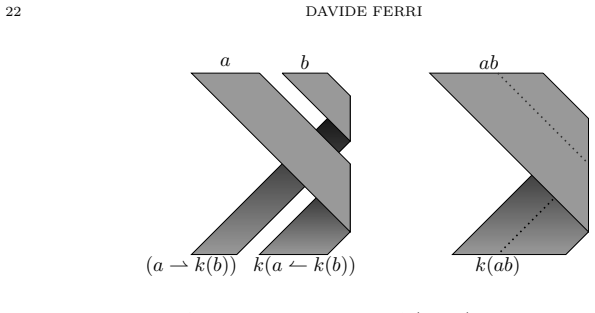
Every solution to the reflection equation in a cartesian monoidal category supplies a Drinfeld twist for a solution of the Yang-Baxter equation. In the category of sets this is realized by group reflections on the braided structure group associated to the solution, which in turn provide group Drinfeld twists; the paper characterises when a reflection on a set-theoretic solution extends to such a group reflection.
Load-bearing premise
That every set-theoretic solution comes equipped with a structure group that is a braided group in the sense of Lu-Yan-Zhu and that De Commer's braided actions can be used to define group reflections on it.
Editorial extensions
If this is right
- Two Yang-Baxter solutions related by such a Drinfeld twist induce equivalent representations of the braid group.
- Group reflections supply an explicit source of Drinfeld twists for set-theoretic solutions.
- A reflection on a set-theoretic solution (X,r) extends to a group reflection on its structure group G(X,r) precisely when certain compatibility conditions hold.
- The correspondence preserves the braided-group structure throughout the construction.
Reading between the lines
- The same mechanism may generate new families of equivalent Yang-Baxter solutions starting from known reflections.
- Similar twist constructions could be attempted in monoidal categories other than cartesian ones once suitable structure groups are available.
- The link between reflection solutions and braid-group equivalences may simplify classification problems for set-theoretic Yang-Baxter maps.
Editorial analysis
A structured set of objections, weighed in public.
Referee Report
Summary. The paper proves that in any cartesian monoidal category, every solution to the reflection equation provides a Drinfeld twist for a solution of the Yang-Baxter equation. It observes that two YBE solutions are related by a Drinfeld twist if and only if they induce equivalent braid-group representations. In the category of sets, every solution is associated with its structure group G(X,r), which is a braided group in the sense of Lu-Yan-Zhu; using De Commer's braided actions the authors define group reflections, prove that these supply group Drinfeld twists in the sense of Ghobadi, and characterize when a reflection on a set-theoretic solution (X,r) extends to a group reflection on G(X,r).
Significance. If the central claims hold, the work supplies a general, category-theoretic bridge between RE and YBE solutions via Drinfeld twists, with direct consequences for equivalence of braid-group representations. The set-theoretic specialization furnishes explicit constructions that link reflections on maps to braided-group data, extending prior notions of Lu-Yan-Zhu and De Commer in a manner that may be useful for concrete computations with set-theoretic Yang-Baxter maps. The characterization of extendable reflections is a concrete contribution that could be checked on known families of solutions.
minor comments (3)
- The statement that 'every solution to the RE provides a Drinfeld twist' would be easier to locate if the main theorem in the cartesian-monoidal-category section were numbered and cross-referenced from the abstract and introduction.
- Notation for the structure group G(X,r) and the braided action is introduced in the set-theoretic section; a brief reminder of the precise axioms from Lu-Yan-Zhu (2000) and De Commer would help readers who have not consulted those references recently.
- An explicit low-order example (e.g., a small finite set with a known reflection) illustrating the extension from a solution reflection to a group reflection would clarify the final characterization.
Simulated Author's Rebuttal
We thank the referee for the positive assessment and recommendation of minor revision. We appreciate the recognition of the category-theoretic bridge between reflection and Yang-Baxter solutions and the concrete contributions in the set-theoretic case.
Circularity Check
No significant circularity detected
full rationale
The paper establishes a general construction in cartesian monoidal categories showing that reflection equation solutions yield Drinfeld twists of Yang-Baxter equation solutions, then specializes to the set-theoretic case via structure groups. All load-bearing steps rely on externally cited independent definitions (Lu-Yan-Zhu braided groups from 2000, De Commer braided actions, Ghobadi group Drinfeld twists) rather than self-referential equations, fitted parameters renamed as predictions, or self-citation chains that reduce the central claim to its own inputs. The derivations are therefore self-contained against external benchmarks with no reduction by construction visible in the stated claims or equations.
Assumptions & free parameters
assumptions (3)
- standard math The Yang-Baxter equation and the reflection equation can be defined in any monoidal category
- domain assumption In the category of sets every solution is associated with a structure group that is a braided group in the sense of Lu, Yan, and Zhu (2000)
- domain assumption De Commer's notion of a braided action can be used to define group reflections for a braided group
Cite this review
Pith. "Pith review of Reflections and Drinfeld twists for set-theoretic Yang-Baxter maps." pith.science (2026). https://pith.science/paper/2504.21678
@misc{pith2026250421678,
  author       = {Pith},
  title        = {Pith review of: Reflections and Drinfeld twists for set-theoretic Yang-Baxter maps},
  year         = {2026},
  howpublished = {\url{https://pith.science/paper/2504.21678}},
  note         = {Machine review of arXiv:2504.21678}
}
read the original abstract
The Yang-Baxter equation (YBE) and the reflection equation (RE) both come from mathematical physics, and they can be defined in any monoidal category. For cartesian monoidal categories, we prove that every solution to the RE provides a Drinfeld twist for a solution of the YBE. As we observe, Drinfeld twists of solutions are relevant for the following reason: two solutions to the YBE (in any strict monoidal category) are related by a Drinfeld twist, if and only if they induce equivalent representations of the braid group. In the category of sets, it is known that every solution is associated with a structure group, which is a braided group in the sense of Lu, Yan, and Zhu (2000). Using De Commer's notion of a braided action, we then define group reflections for a braided group. We prove that group reflections provide group Drinfeld twists in the sense of Ghobadi. Finally, we characterise when a reflection on a solution (X,r) can be extended to a group reflection on its structure group G(X,r).
Figures


Figures from the paper (6 more)


Lean theorems connected to this paper
-
IndisputableMonolith/Foundation/RealityFromDistinction.leanreality_from_one_distinction unclear?
unclearRelation between the paper passage and the cited Recognition theorem.
For cartesian monoidal categories, we prove that every solution to the RE provides a Drinfeld twist for a solution of the YBE.
-
IndisputableMonolith/Cost/FunctionalEquation.leanwashburn_uniqueness_aczel unclear?
unclearRelation between the paper passage and the cited Recognition theorem.
We prove that group reflections provide group Drinfeld twists in the sense of Ghobadi.
What do these tags mean?
- matches
- The paper's claim is directly supported by a theorem in the formal canon.
- supports
- The theorem supports part of the paper's argument, but the paper may add assumptions or extra steps.
- extends
- The paper goes beyond the formal theorem; the theorem is a base layer rather than the whole result.
- uses
- The paper appears to rely on the theorem as machinery.
- contradicts
- The paper's claim conflicts with a theorem or certificate in the canon.
- unclear
- Pith found a possible connection, but the passage is too broad, indirect, or ambiguous to say the theorem truly supports the claim.
Reference graph
Works this paper leans on
-
[1]
Reflections to set-theoretic solutions of the yang-baxter equation
Albano, A., Mazzotta, M., and Stef anelli, P. Reflections to set-theoretic solutions of the yang-baxter equation. arXiv preprint arXiv:2405.19105 (2024)
-
[2]
Baxter, R. J. Partition function of the eight-vertex lattice model. Ann. Physics 70 (1972), 193–228
work page 1972
-
[3]
Baxter, R. J. Exactly solved models in statistical mechanics . Academic Press, Inc. [Harcourt Brace Jovanovich, Publishers], London, 1989. Reprint of th e 1982 original. REFLECTIONS AND DRINFELD TWISTS FOR SET-THEORETIC YANG–BA XTER MAPS 23
work page 1989
-
[4]
Caudrelier, V., Cramp ´e, N., and Zhang, Q. C. Set-theoretical reflection equation: classification of reflection maps. J. Phys. A 46 , 9 (2013), 095203, 12
work page 2013
-
[5]
Caudrelier, V., and Zhang, Q. C. Yang–Baxter and reflection maps from vector solitons with a boundary. Nonlinearity 27 , 6 (2014), 1081–1103
work page 2014
-
[6]
Actions of skew braces and set-theoretic solutions of the re flection equation
De Commer, K. Actions of skew braces and set-theoretic solutions of the re flection equation. Proceedings of the Edinburgh Mathematical Society 62 , 4 (2019), 1089–1113
work page 2019
-
[7]
Quandles as pre-Lie skew braces, set- theoretic Hopf algebras & universal R-matrices
Doikou, A., Rybo /suppress lowicz, B., and Stef anelli, P. Quandles as pre-Lie skew braces, set- theoretic Hopf algebras & universal R-matrices. J. Phys. A 57 , 40 (2024), Paper No. 405203, 35
work page 2024
-
[8]
Set-theoretic Yang-Baxter & reflection equations and quantum group symmetries
Doikou, A., and Smoktunowicz, A. Set-theoretic Yang-Baxter & reflection equations and quantum group symmetries. Lett. Math. Phys. 111 , 4 (2021), Paper No. 105, 40
work page 2021
Show all 22 references
-
[9]
Drinfeld, V. G. On some unsolved problems in quantum group theory. In Quantum groups (Leningrad, 1990) , vol. 1510 of Lecture Notes in Math. Springer, Berlin, 1992, pp. 1–8
1990
-
[10]
Set-theoretical solutions to the quantum Yang–Baxter equation
Etingof, P., Schedler, T., and Soloviev, A. Set-theoretical solutions to the quantum Yang–Baxter equation. Duke Math. J. 100 , 2 (1999), 169–209
1999
-
[11]
GAP – Groups, Algorithms, and Programming, Version 4.13.0 , 2024
The GAP Group . GAP – Groups, Algorithms, and Programming, Version 4.13.0 , 2024
2024
-
[12]
Garside, F. A. The braid group and other groups. Quart. J. Math. Oxford Ser. (2) 20 (1969), 235–254
1969
-
[13]
Drinfeld twists on skew braces
Ghobadi, A. Drinfeld twists on skew braces. arXiv preprint arXiv:2105.03286 (2021)
2021
-
[14]
Skew braces as remnants of co-quasitriangular Hopf algebra s in SupLat
Ghobadi, A. Skew braces as remnants of co-quasitriangular Hopf algebra s in SupLat. J. Algebra 586 (2021), 607–642
2021
-
[15]
Skew braces and the Yang–Baxter equation
Guarnieri, L., and Vendramin, L. Skew braces and the Yang–Baxter equation. Math. Comp. 86 , 307 (2017), 2519–2534
2017
-
[16]
YangBaxter package for GAP, Version 0.10.6 , 2024
Konov alov, O., and Vendramin, L. YangBaxter package for GAP, Version 0.10.6 , 2024
2024
-
[17]
P., and Mudrov, A
Kulish, P. P., and Mudrov, A. I. On twisting solutions to the Yang-Baxter equation. Czechoslovak J. Phys. 50 , 1 (2000), 115–122
2000
-
[18]
Reflection equation as a tool for studying solutions to the Yang-Baxter equation
Lebed, V., and Vendramin, L. Reflection equation as a tool for studying solutions to the Yang-Baxter equation. J. Algebra 607 (2022), 360–380
2022
-
[19]
On the set-theoretical Yang–Baxter equation
Lu, J.-H., Yan, M., and Zhu, Y.-C. On the set-theoretical Yang–Baxter equation. Duke Math. J. 104 , 1 (2000), 1–18
2000
-
[20]
Braces, radical rings, and the quantum Yang–Baxter equatio n
Rump, W. Braces, radical rings, and the quantum Yang–Baxter equatio n. J. Algebra 307 , 1 (2007), 153–170
2007
-
[21]
Combinatorial solutions to the reflection equation
Smoktunowicz, A., Vendramin, L., and Weston, R. Combinatorial solutions to the reflection equation. J. Algebra 549 (2020), 268–290
2020
-
[22]
G. Peano
Yang, C. N. Some exact results for the many-body problem in one dimensio n with repulsive delta-function interaction. Phys. Rev. Lett. 19 (1967), 1312–1315. Universit `a di Torino, Department of Mathematics “G. Peano”, via Carlo Alberto 10, 10123 Torino, Italy. Vrije Universit...
1967
Reviewed May 22, 2026 · model on record in the stance chip above.
Discussion (0). Sign in to comment.