REVIEW 2 major objections 6 minor 108 references
A Sequoia stellar candidate with very high 7Li and 9Be
T0 review · 2 major / 6 minor · reviewed 2026-08-16 · deepseek-v4-flash
Pith's one-line read BPM 3066, a metal-poor dwarf in the retrograde halo, shows a beryllium excess of 2.2 dex over the Galactic trend together with a lithium excess, and a lithium-to-beryllium ratio matching spallation predictions.
desk verdict A useful single-star report with a solid Li excess and a plausible but fragile Be measurement; deserves review if the referee pushes on the 313 nm systematics. read the letter →
The pith
A machine-rendered reading of the paper's core claim, the machinery that carries it, and where it could break.
The reading
What carries the argument
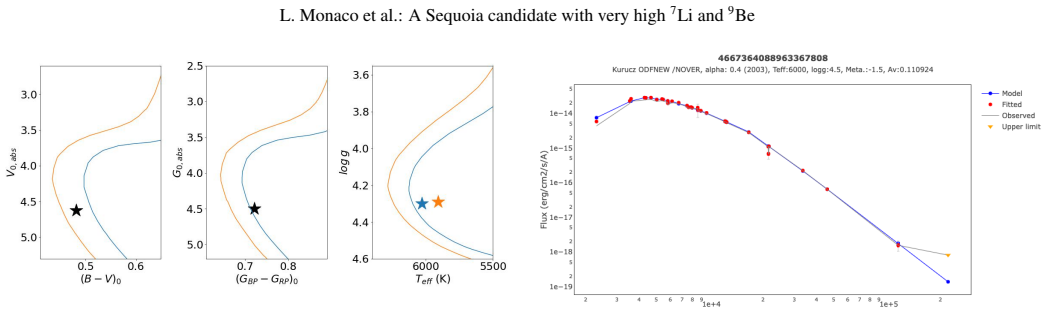
The argument is carried by abundance measurements from high-resolution optical spectra combined with a kinematic classification. Lithium is measured by fitting the $^7\mathrm{Li}$ resonance doublet at 670.78 nm and the 610.36 nm subordinate line; beryllium is measured by fitting the $^9\mathrm{Be}$ II resonance doublet at 313 nm, where the adopted abundance comes from the more isolated 313.1067 nm line and the blended 313.0422 nm feature is checked for consistency. The lithium-to-beryllium ratio then acts as the interpretive pivot: 7.9 is close to the ratio predicted for spallation, and no known stellar or nova process makes beryllium, so the paper infers a common spallation origin. The kinematic membership uses orbit integration and the so-called action diamond, a plane that separates accreted halo populations by orbital actions, to place the star in the Sequoia/Thamnos region.
What would settle it
Take a much longer, higher-signal UVES spectrum of BPM 3066 covering the 313 nm region, refit the $^9\mathrm{Be}$ doublet with an independent line list and continuum model, and compare the derived $A(\mathrm{Be})$ with 2.1; if the refit yields a value below about 1 dex, the claimed excess and the spallation interpretation collapse. A second check would be to measure beryllium from a different spectral feature or with a different synthesis code.
Extended reading notes
Core claim
The central discovery is that BPM 3066 is simultaneously overabundant in $^7\mathrm{Li}$ and $^9\mathrm{Be}$, with $A(\mathrm{Li}) = 3.0$ and $A(\mathrm{Be}) = 2.1$ at $[\mathrm{Fe/H}] \approx -1.5$. Those values sit about 0.8 dex above the lithium plateau and 2.2 dex above the beryllium-iron relation, making this the largest beryllium excess reported in a metal-poor dwarf. The ratio of the two abundances, $^7\mathrm{Li}/{}^9\mathrm{Be} = 7.9$, is close to the spallation ratio expected from hypernova ejecta in one published model, and the paper interprets the pair as products of a common spallation episode rather than of stellar nucleosynthesis. A kinematic analysis of the star's orbit places it in the retrograde halo and in the region of action space occupied by candidate Sequoia/Thamnos members, so the star connects an unusual chemical signature to an accreted galactic component.
Load-bearing premise
The whole case for the 2.2 dex beryllium overabundance rests on one beryllium line at 313.1067 nm, fit in a spectrum with signal-to-noise near 15, with a blended companion line used only as a consistency check; if the continuum placement or the adopted contaminating lines are wrong, the excess and the spallation ratio could largely disappear.
Editorial extensions
If this is right
- BPM 3066 becomes the largest known beryllium excess in a metal-poor dwarf, and its lithium-to-beryllium ratio points to spallation as the common source of both elements.
- If the hypernova interpretation is correct, the explosion would have enriched and diluted roughly 8,000 solar masses of interstellar medium, producing the measured oxygen and iron abundances while leaving some element anomalies, such as the high N, Na, Al, Sc, V, and Cu, unexplained.
- If the planet-engulfment interpretation is correct, then rocky planets enriched in lithium and beryllium by irradiation can form around a star with metallicity below [Fe/H] = -1, and their engulfment can alter the surface composition of a main-sequence star.
- The star's membership among candidate Sequoia/Thamnos stars implies that such light-element overabundances may be a chemical signature worth looking for in other stars of that accreted galaxy.
- The paper rules out nova or AGB contamination as the sole explanation, since those sources make lithium but not beryllium.
Reading between the lines
- If the beryllium measurement is later confirmed with a higher-signal spectrum and an independent treatment of the 313 nm blend, the 2.2 dex excess would establish a new class of light-element-enriched metal-poor stars; if not, the case rests on a single noisy line.
- A straightforward test of the two proposed origins would be to survey other candidate Sequoia/Thamnos members for lithium and beryllium: a hypernova origin would predict a population-level correlation between light-element excesses and [Si/O] or neutron-capture abundances, whereas engulfment would predict that such excesses are rare and uncorrelated with the host star's birth environment.
- The planet-engulfment channel has a testable analogue in white-dwarf pollution, where lithium and beryllium have been detected in accreted planetesimals; searching for similar enrichment in low-metallicity stars known to host close-in rocky planets could indicate whether such enriched material is common.
Signed reviews
Editorial analysis
A structured set of objections, weighed in public.
Referee Report
Summary. The paper reports a high-resolution UVES/VLT abundance analysis of the metal-poor dwarf BPM 3066, finding A(Li)=3.0 and A(Be)=2.1, which are respectively about 0.8 and 2.2 dex above the Spite plateau and the expected Be-Fe relation at [Fe/H]≈-1.5. The authors also derive abundances for 20 additional elements, finding enhancements in Si, Al, and the neutron-capture elements Sr, Y, Zr, and Ba. Using Gaia astrometry and radial velocities, they characterize the orbit as eccentric, strongly retrograde, and confined to the Galactic plane, and classify the star as a candidate member of the Sequoia/Thamnos accreted galaxy. They discuss two possible origins for the Li and Be overabundances: spallation in a hypernova environment and engulfment of rocky planets rich in spallated Li and Be, noting inconsistencies with the hypernova model for several elements.
Significance. If the abundance measurements are reliable, this is the largest Be excess ever observed in a metal-poor dwarf (2.2 dex above the Galactic Be-Fe relation) and the first case of a combined Li+Be overabundance in a candidate Sequoia/Thamnos member. The observed 7Li/9Be ratio of 7.9 is close to the predictions of spallation synthesis in hypernova ejecta, which would provide a rare observational constraint on light-element production processes. The paper uses a standard, well-documented abundance-analysis pipeline, derives Li from two independent lines with agreement from GALAH, and checks the Be spectral region with a manual re-reduction. The kinematic analysis is careful and makes appropriate use of the Feuillet et al. (2021) selection criteria, including a caveat about the Sequoia/Thamnos nomenclature. However, the central claim of an unprecedented Be excess rests on a single blended line at low signal-to-noise, which is the main weakness that needs to be addressed.
major comments (2)
- [Sect. 3.1, Fig. 4, Table 1] The central claim of a 2.2 dex Be excess and the resulting 7Li/9Be ratio of 7.9 rests entirely on A(Be)=2.1 derived from the single Be II 313.1067 nm line at S/N ~ 15. The paper does not test the sensitivity of this abundance to continuum placement, the adopted blend line list (V ii 313.0269, Fe ii 313.0565, Ti ii 313.0798, and weaker lines), or the oscillator strengths, and the quoted 0.20 dex uncertainty in Table 1 is not a propagated error budget. At S/N ~ 15, continuum normalization alone can shift the inferred abundance by several tenths of a dex, and a downward shift of 0.5 dex would reduce the claimed excess to about 1.7 dex and weaken the spallation-ratio argument. The authors should provide a systematics test (for example, varying the continuum placement, using an alternative line list, or fitting the 313.0422 nm blend as the primary diagnostic) and report a realistic error budget, or explicitly state the limitations that this places on the central claim.
- [Table 1] The text states that for Be 'we report the difference between the value measured from the two features,' but the actual difference is not given in the table or in the text. If the two Be II lines do not agree within the adopted 0.20 dex uncertainty, the decision to adopt the abundance from the redder line requires additional justification. Please provide the abundance derived from the 313.0422 nm feature, state the line-to-line difference, and discuss whether a single abundance can simultaneously reproduce both the isolated 313.1067 nm line and the blended 313.0422 nm region.
minor comments (6)
- [Sect. 3.1, Fig. 4 caption] The text says the Be region is blended with 'V ii and Fe i' lines, while the figure caption lists 'V ii 313.0269, Fe ii 313.0565, Ti ii 313.0798 nm'; please correct the inconsistency between Fe i and Fe ii.
- [Sect. 5.2] The phrase 'the mass swapped by the explosion' and 'the mass swapped by an HN' should read 'the mass swept up by the explosion' and 'the mass swept up by an HN' (see also the similar use in the same paragraph).
- [Sect. 4, first paragraph] There is a typo: 'Fig, 6' should be 'Fig. 6'.
- [Sect. 4] The potential name 'MWPontential2014' should be 'MWPotential2014'.
- [Sect. 3.1] The Li abundance is presented as an LTE value with no NLTE correction; since the Li i 670.78 nm line is known to be affected by NLTE in metal-poor dwarfs, a brief statement of the expected NLTE correction (or a reference for its magnitude) would strengthen the comparison with the Spite plateau.
- [Sect. 5.2] The hypernova scenario is presented in the abstract as a possible origin, but the discussion itself concludes that the required dilution mass is incompatible with the expected swept-up mass of an HN and that several observed element enhancements (N, Na, Al, Sc, V, Cu) are at odds with the HN predictions; the abstract and conclusions should either temper this scenario to a more explicitly speculative level or quantify its viability relative to the planet-engulfment alternative.
Circularity Check
No significant circularity: the Li and Be excesses are measured against external empirical baselines, and the only fitted quantity (the hypernova dilution mass) is explicitly shown to be inconsistent with expectations.
full rationale
We walked the paper's full derivation chain. The Li and Be abundances are derived from line-profile fits to the UVES spectra (Sect. 3.1), with independent supports: two Li lines agree, the GALAH Li abundance agrees to within 0.02 dex, and the Be reduction was manually rechecked. The claimed excesses are defined against external baselines: the Spite plateau for Li and the Molaro et al. (2020) Be-Fe relation for Be. Although Molaro and Cescutti are authors of both the present paper and Molaro et al. (2020), that relation is a published empirical calibration based on other stars; it does not include BPM 3066 and is not refitted here, so citing it is independent support rather than circularity. The 7Li/9Be ratio is formed from the measured abundances and compared with theoretical spallation ratios from Fields et al. (2002) and Nakamura & Shigeyama (2004); the theoretical ratio is not derived from the observed ratio. In the hypernova scenario, the dilution mass is indeed fitted to reproduce the Li and Be overabundances, but the paper does not present this as a prediction; it explicitly states that the required dilution is incompatible with the mass expected to be swept up by a hypernova and that the scenario fails for N, Na, Al, Sc, V, and Cu. The O and Fe consistency check uses published HN yields and independently measured stellar abundances. The Sequoia/Thamnos classification uses external kinematic criteria from Feuillet et al. (2021) and Gaia astrometry. No equation or claim reduces to its own input. The single-blended-line Be measurement at S/N about 15 is a real systematic vulnerability, but that is an observational and correctness concern, not a circularity concern.
Assumptions & free parameters
free parameters (2)
- Stellar atmospheric parameters (Teff, log g, microturbulence) =
Teff = 5910 K, log g = 4.29 dex, xi = 1.15 km/s
- Hypernova dilution mass =
8 x 10^3 solar masses
assumptions (5)
- domain assumption LTE, 1D model atmospheres (ATLAS9/ATLAS12) and the adopted line lists reproduce the stellar flux in the Li and Be regions.
- domain assumption The expected Li and Be at [Fe/H] = -1.5 are given by the Spite plateau and the Molaro et al. (2020) Be-Fe relation.
- domain assumption The Gaia DR3 parallax with the Lindegren zero-point correction and the MWPotential2014 galactic potential give reliable orbital integrals and Sequoia membership.
- domain assumption Hypernova spallation yields from Fields et al. (2002) and Nakamura & Shigeyama (2004) describe 7Li/9Be production.
- domain assumption BPM 3066 is an unevolved main-sequence star, so internal mixing cannot explain the Li excess.
Cite this review
Pith. "Pith review of A Sequoia stellar candidate with very high 7Li and 9Be." pith.science (2026). https://pith.science/paper/7CMZTPZ6
@misc{pith2026250421823,
  author       = {Pith},
  title        = {Pith review of: A Sequoia stellar candidate with very high 7Li and 9Be},
  year         = {2026},
  howpublished = {\url{https://pith.science/paper/7CMZTPZ6}},
  note         = {Machine review of arXiv:2504.21823}
}
read the original abstract
Aims. The metal-poor star BPM 3066 belongs to the retrograde halo and presents unexpectedly strong spectral features of lithium. To gain insight into the origin of this peculiar abundance, we investigate the chemistry and kinematic properties of this star. Methods. We performed a local thermodynamic equilibrium chemical abundance analysis of UVES/VLT high-resolution spectra of BPM 3066 using ATLAS9 and ATLAS12 model atmospheres and the MyGIsFOS code. We further characterised the orbital properties of the star by integrating its orbit and analysing its integrals of motion using the galpy code. Results. The star BPM 3066 shows an exceptional overabundance of both lithium and beryllium. The abundances are A(Li) = 3.0 and A(Be) = 2.1, which are respectively about 0.8 and 2.2 dex higher than the Li and Be abundances expected at [Fe/H] = -1.5, the metallicity of the star. The observed ratio 7Li/9Be is 7.9, which is close to that expected from a synthesis by spallation processes. Overabundances of Si, Al, and of the neutron capture elements Sr,Y, Zr, and Ba are also measured. Kinematically, BPM 3066 has an eccentric, strongly retrograde orbit, confined to a height lower than 1 kpc from the galactic plane, and it is a candidate member of the Sequoia/Thamnos accreted galaxy. Conclusions. The processes leading to the 7Li and 9Be synthesis could have occurred in the environment of a hypernova. This is supported by some abundance anomalies like the high value of Si, [Si/Fe]=1.2 and [Si/O]=1.1. However, the simultaneous high values of N, Na, Al, Sc, Ti, and Cu are at odds with the expectations from a hypernova. Alternatively, the abundances of BPM 3066 could result from the engulfing of rocky planets that were rich in spallated Li and Be. In both cases, it is remarkable that such an extreme abundance pattern has been found in a star belonging to the Sequoia/Thamnos accreted galaxy.
Figures


Figures from the paper (2 more)


Reference graph
Works this paper leans on
-
[1]
H., & Carlberg, J
Aguilera-Gómez, C., Chanamé, J., Pinsonneault, M. H., & Carlberg, J. K. 2016, ApJ, 829, 127
2016
-
[2]
Alexander, J. B. 1967, The Observatory, 87, 238
1967
-
[3]
& Plez, B
Alvarez, R. & Plez, B. 1998, A&A, 330, 1109
1998
-
[4]
M., Lind, K., Asplund, M., Barklem, P
Amarsi, A. M., Lind, K., Asplund, M., Barklem, P. S., & Collet, R. 2016, MN- RAS, 463, 1518
2016
-
[5]
F., Jeffries, R
Ashwell, J. F., Jeffries, R. D., Smalley, B., et al. 2005, MNRAS, 363, L81
2005
-
[6]
L., Nissen, P
Asplund, M., Lambert, D. L., Nissen, P. E., Primas, F., & Smith, V . V . 2006, ApJ, 644, 229 Azevedo Silva, T., Demangeon, O. D. S., Santos, N. C., et al. 2022, A&A, 666, L10 Barbá, R. H., Minniti, D., Geisler, D., et al. 2019, ApJ, 870, L24
2006
-
[7]
Barklem, P. S. 2016, Phys. Rev. A, 93, 042705
2016
-
[8]
2008, A&A, 492, 277
Bayo, A., Rodrigo, C., Barrado Y Navascués, D., et al. 2008, A&A, 492, 277
2008
Show all 108 references
-
[9]
W., Koposov, S
Belokurov, V ., Erkal, D., Evans, N. W., Koposov, S. E., & Deason, A. J. 2018, MNRAS, 478, 611
2018
-
[10]
Bensby, T., Feltzing, S., & Oey, M. S. 2014, A&A, 562, A71
2014
-
[11]
2011, MNRAS, 413, 2184
Bergemann, M. 2011, MNRAS, 413, 2184
2011
-
[12]
& Cescutti, G
Bergemann, M. & Cescutti, G. 2010, A&A, 522, A9
2010
-
[13]
M., et al
Bergemann, M., Collet, R., Amarsi, A. M., et al. 2017, ApJ, 847, 15
2017
-
[14]
2013, ApJ, 764, 115
Bergemann, M., Kudritzki, R.-P., Würl, M., et al. 2013, ApJ, 764, 115
2013
-
[15]
2012, MNRAS, 427, 27
Bergemann, M., Lind, K., Collet, R., Magic, Z., & Asplund, M. 2012, MNRAS, 427, 27
2012
-
[16]
C., & Gehren, T
Bergemann, M., Pickering, J. C., & Gehren, T. 2010, MNRAS, 401, 1334
2010
-
[17]
Boesgaard, A. M. & Novicki, M. C. 2006, ApJ, 641, 1122
2006
-
[18]
M., Rich, J
Boesgaard, A. M., Rich, J. A., Levesque, E. M., & Bowler, B. P. 2011, ApJ, 743, 140
2011
-
[19]
2024, A&A, 684, A91
Bonifacio, P., Caffau, E., Monaco, L., et al. 2024, A&A, 684, A91
2024
-
[20]
& Molaro, P
Bonifacio, P. & Molaro, P. 1997, MNRAS, 285, 847
1997
-
[21]
2021, A&A, 651, A79
Bonifacio, P., Monaco, L., Salvadori, S., et al. 2021, A&A, 651, A79
2021
-
[22]
2021, A&A, 645, A24
Borsa, F., Allart, R., Casasayas-Barris, N., et al. 2021, A&A, 645, A24
2021
-
[23]
C., et al
Bovy, J., Allende Prieto, C., Beers, T. C., et al. 2012, ApJ, 759, 131
2012
-
[24]
2012, MNRAS, 427, 127
Bressan, A., Marigo, P., Girardi, L., et al. 2012, MNRAS, 427, 127
2012
-
[25]
A., Sneden, C., Lambert, D
Brown, J. A., Sneden, C., Lambert, D. L., & Dutchover, Edward, J. 1989, ApJS, 71, 293
1989
-
[26]
A., Bizzarro, M., Latham, D
Buchhave, L. A., Bizzarro, M., Latham, D. W., et al. 2014, Nature, 509, 593
2014
-
[27]
2021, MNRAS, 506, 150
Buder, S., Sharma, S., Kos, J., et al. 2021, MNRAS, 506, 150
2021
-
[28]
2005, A&A, 441, 533
Caffau, E., Bonifacio, P., Faraggiana, R., et al. 2005, A&A, 441, 533
2005
-
[29]
2024, A&A, 691, A245
Caffau, E., Bonifacio, P., Monaco, L., et al. 2024, A&A, 691, A245
2024
-
[30]
2019, MNRAS, 487, 3162
Chavero, C., de la Reza, R., Ghezzi, L., et al. 2019, MNRAS, 487, 3162
2019
-
[31]
& Vangioni, E
Coc, A. & Vangioni, E. 2017, International Journal of Modern Physics E, 26, 1741002
2017
-
[32]
2000, in Society of Photo-Optical Instrumentation Engineers (SPIE) Conference Se- ries, V ol
Dekker, H., D’Odorico, S., Kaufer, A., Delabre, B., & Kotzlowski, H. 2000, in Society of Photo-Optical Instrumentation Engineers (SPIE) Conference Se- ries, V ol. 4008, Optical and IR Telescope Instrumentation and Detectors, ed. M. Iye & A. F. Moorwood, 534–545
2000
-
[33]
E., Desch, S
Doyle, A. E., Desch, S. J., & Young, E. D. 2021, ApJ, 907, L35
2021
-
[34]
1968, Zeitschrift fur Physik, 211, 404
Drawin, H.-W. 1968, Zeitschrift fur Physik, 211, 404
1968
-
[35]
Drawin, H. W. 1969, Zeitschrift fur Physik, 225, 483
1969
-
[36]
& Bate, M
Elsender, D. & Bate, M. R. 2021, MNRAS, 508, 5279
2021
-
[37]
2023, European Physical Journal Plus, 138, 181
Emsenhuber, A., Mordasini, C., & Burn, R. 2023, European Physical Journal Plus, 138, 181
2023
-
[38]
K., Sahlholdt, C
Feuillet, D. K., Sahlholdt, C. L., Feltzing, S., & Casagrande, L. 2021, MNRAS, 508, 1489
2021
-
[39]
D., Daigne, F., Cassé, M., & Vangioni-Flam, E
Fields, B. D., Daigne, F., Cassé, M., & Vangioni-Flam, E. 2002, ApJ, 581, 389
2002
-
[40]
2024, arXiv e-prints, arXiv:2401.01982
Fitzpatrick, M., Placco, V ., Bolton, A., et al. 2024, arXiv e-prints, arXiv:2401.01982
2024 arXiv
-
[41]
2016, MNRAS, 456, 1803 Gaia Collaboration, Vallenari, A., Brown, A
Frischknecht, U., Hirschi, R., Pignatari, M., et al. 2016, MNRAS, 456, 1803 Gaia Collaboration, Vallenari, A., Brown, A. G. A., et al. 2023, A&A, 674, A1
2016
-
[42]
Gratton, R. G. & D’Antona, F. 1989, A&A, 215, 66
1989
-
[43]
D., et al
Haywood, M., Di Matteo, P., Lehnert, M. D., et al. 2018, ApJ, 863, 113
2018
-
[44]
H., et al
Helmi, A., Babusiaux, C., Koppelman, H. H., et al. 2018, Nature, 563, 85
2018
-
[45]
A., Tremblay, P
Hollands, M. A., Tremblay, P. E., Gänsicke, B. T., et al. 2020, Nature Astronomy, 4, 663
2020
-
[46]
A., Nakamura, T., & Maeda, K
Iwamoto, K., Nomoto, K., Mazzali, P. A., Nakamura, T., & Maeda, K. 2003, in Supernovae and Gamma-Ray Bursters, ed. K. Weiler, V ol. 598, 243–281
2003
-
[47]
C., Clemens, J
Kaiser, B. C., Clemens, J. C., Blouin, S., et al. 2021, Science, 371, 168
2021
-
[48]
Y ., Snellen, I
Kesseli, A. Y ., Snellen, I. A. G., Casasayas-Barris, N., Mollière, P., & Sánchez- López, A. 2022, AJ, 163, 107
2022
-
[49]
L., Doyle, A
Klein, B. L., Doyle, A. E., Zuckerman, B., et al. 2021, ApJ, 914, 61
2021
-
[50]
Koch, A., Lind, K., & Rich, R. M. 2011, ApJ, 738, L29
2011
-
[51]
H., Helmi, A., Massari, D., Price-Whelan, A
Koppelman, H. H., Helmi, A., Massari, D., Price-Whelan, A. M., & Starkenburg, T. K. 2019, A&A, 631, L9
2019
-
[52]
Kurucz, R. L. 2005, Memorie della Societa Astronomica Italiana Supplementi, 8, 14
2005
-
[53]
W., Mazeh, T., Stefanik, R
Latham, D. W., Mazeh, T., Stefanik, R. P., et al. 1992, AJ, 104, 774
1992
-
[54]
2018, ApJ, 852, L31
Li, H., Aoki, W., Matsuno, T., et al. 2018, ApJ, 852, L31
2018
-
[55]
2022, ApJ, 931, 147
Li, H., Aoki, W., Matsuno, T., et al. 2022, ApJ, 931, 147
2022
-
[56]
Li, L. J. & Qian, S. B. 2014, MNRAS, 444, 600
2014
-
[57]
& Chieffi, A
Limongi, M. & Chieffi, A. 2018, ApJS, 237, 13
2018
-
[58]
2021, A&A, 649, A4
Lindegren, L., Bastian, U., Biermann, M., et al. 2021, A&A, 649, A4
2021
-
[59]
& Soker, N
Livio, M. & Soker, N. 1984, MNRAS, 208, 763
1984
-
[60]
Lodders, K., Palme, H., & Gail, H. P. 2009, Landolt Börnstein, 4B, 712
2009
-
[61]
2023, MNRAS, 522, 4815
Lombardo, L., Bonifacio, P., Caffau, E., et al. 2023, MNRAS, 522, 4815
2023
-
[62]
2021, A&A, 656, A155
Lombardo, L., François, P., Bonifacio, P., et al. 2021, A&A, 656, A155
2021
-
[63]
Luyten, W. J. & Dartayet, M. 1942, ApJ, 96, 55
1942
-
[64]
Malaney, R. A. & Fowler, W. A. 1989, ApJ, 345, L5
1989
-
[65]
K., Frebel, A., Ezzeddine, R., et al
Mardini, M. K., Frebel, A., Ezzeddine, R., et al. 2022, MNRAS, 517, 3993
2022
-
[66]
2017, A&A, 604, A129
Mashonkina, L., Jablonka, P., Pakhomov, Y ., Sitnova, T., & North, P. 2017, A&A, 604, A129
2017
-
[67]
J., & Przybilla, N
Mashonkina, L., Korn, A. J., & Przybilla, N. 2007, A&A, 461, 261
2007
-
[68]
& Queloz, D
Mayor, M. & Queloz, D. 1995, Nature, 378, 355
1995
-
[69]
2023, in Memorie della Societa Astronomica Italiana, V ol
Molaro, P. 2023, in Memorie della Societa Astronomica Italiana, V ol. 94, 22
2023
-
[70]
1997, A&A, 319, 593
Molaro, P., Bonifacio, P., Castelli, F., & Pasquini, L. 1997, A&A, 319, 593
1997
-
[71]
2020, MNRAS, 496, 2902
Molaro, P., Cescutti, G., & Fu, X. 2020, MNRAS, 496, 2902
2020
-
[72]
2011, A&A, 529, A90
Monaco, L., Villanova, S., Moni Bidin, C., et al. 2011, A&A, 529, A90
2011
-
[73]
C., Sozzetti, A., et al
Mortier, A., Santos, N. C., Sozzetti, A., et al. 2012, A&A, 543, A45
2012
-
[74]
C., Vasiliev, E., Iorio, G., Evans, N
Myeong, G. C., Vasiliev, E., Iorio, G., Evans, N. W., & Belokurov, V . 2019, MNRAS, 488, 1235
2019
-
[75]
P., Conroy, C., Bonaca, A., et al
Naidu, R. P., Conroy, C., Bonaca, A., et al. 2020, ApJ, 901, 48
2020
-
[76]
& Shigeyama, T
Nakamura, K. & Shigeyama, T. 2004, ApJ, 610, 888
2004
-
[77]
R., Bergemann, M., Eitner, P., & Johansen, A
Nielsen, J., Gent, M. R., Bergemann, M., Eitner, P., & Johansen, A. 2023, A&A, 678, A74
2023
-
[78]
Nissen, P. E. & Schuster, W. J. 1997, A&A, 326, 751
1997
-
[79]
2013, ARA&A, 51, 457
Nomoto, K., Kobayashi, C., & Tominaga, N. 2013, ARA&A, 51, 457
2013
-
[80]
2014, A&A, 563, A3
Pasquini, L., Koch, A., Smiljanic, R., Bonifacio, P., & Modigliani, A. 2014, A&A, 563, A3
2014
-
[81]
2012, Turbospectrum: Code for spectral synthesis, Astrophysics Source Code Library, record ascl:1205.004
Plez, B. 2012, Turbospectrum: Code for spectral synthesis, Astrophysics Source Code Library, record ascl:1205.004
2012
-
[82]
2018, adrn/pyia: v0.2
Price-Whelan, A. 2018, adrn/pyia: v0.2
2018
-
[83]
2000, A&A, 362, 666
Primas, F., Molaro, P., Bonifacio, P., & Hill, V . 2000, A&A, 362, 666
2000
-
[84]
A., & Hoyle, F
Reeves, H., Fowler, W. A., & Hoyle, F. 1970, Nature, 226, 727
1970
-
[85]
2015, A&A, 574, A116
Reffert, S., Bergmann, C., Quirrenbach, A., Trifonov, T., & Künstler, A. 2015, A&A, 574, A116
2015
-
[86]
Ryan, S. G. & Deliyannis, C. P. 1995, ApJ, 453, 819
1995
-
[87]
& Cassisi, S
Salaris, M. & Cassisi, S. 2005, Evolution of Stars and Stellar Populations
2005
-
[88]
C., García López, R
Santos, N. C., García López, R. J., Israelian, G., et al. 2002, A&A, 386, 1028
2002
-
[89]
2014, A&A, 564, A109
Sbordone, L., Caffau, E., Bonifacio, P., & Duffau, S. 2014, A&A, 564, A109
2014
-
[90]
Schlafly, E. F. & Finkbeiner, D. P. 2011, ApJ, 737, 103 Schönrich, R., Binney, J., & Dehnen, W. 2010, MNRAS, 403, 1829
2011
-
[91]
2018, MNRAS, 473, 2004
Sharma, S., Stello, D., Buder, S., et al. 2018, MNRAS, 473, 2004
2018
-
[92]
D., Martell, S
Simpson, J. D., Martell, S. L., Buder, S., et al. 2021, MNRAS, 507, 43 Skúladóttir, Á., Salvadori, S., Amarsi, A. M., et al. 2021, ApJ, 915, L30
2021
-
[93]
2009, A&A, 499, 103
Smiljanic, R., Pasquini, L., Bonifacio, P., et al. 2009, A&A, 499, 103
2009
-
[94]
2008, MNRAS, 385, L93
Smiljanic, R., Pasquini, L., Primas, F., et al. 2008, MNRAS, 385, L93
2008
-
[95]
G., & Pasquini, L
Smiljanic, R., Zych, M. G., & Pasquini, L. 2021, A&A, 646, A70
2021
-
[96]
& Spite, M
Spite, F. & Spite, M. 1982, A&A, 115, 357
1982
-
[97]
& Holweger, H
Steenbock, W. & Holweger, H. 1984, A&A, 130, 319
1984
-
[98]
2008, PASJ, 60, 1159
Suda, T., Katsuta, Y ., Yamada, S., et al. 2008, PASJ, 60, 1159
2008
-
[99]
M., Zapatero Osorio, M
Tabernero, H. M., Zapatero Osorio, M. R., Allart, R., et al. 2021, A&A, 646, A158
2021
-
[100]
F., Shi, J
Tan, K. F., Shi, J. R., & Zhao, G. 2009, MNRAS, 392, 205
2009
-
[101]
T., & Steinmetz, M
Thornton, K., Gaudlitz, M., Janka, H. T., & Steinmetz, M. 1998, ApJ, 500, 95
1998
-
[102]
1986, in Society of Photo-Optical Instrumentation Engineers (SPIE) Conference Series, V ol
Tody, D. 1986, in Society of Photo-Optical Instrumentation Engineers (SPIE) Conference Series, V ol. 627, Instrumentation in astronomy VI, ed. D. L. Crawford, 733
1986
-
[103]
1993, in Astronomical Society of the Pacific Conference Series, V ol
Tody, D. 1993, in Astronomical Society of the Pacific Conference Series, V ol. 52, Astronomical Data Analysis Software and Systems II, ed. R. J. Hanisch, R. J. V . Brissenden, & J. Barnes, 173
1993
-
[104]
& Davis, M
Tonry, J. & Davis, M. 1979, AJ, 84, 1511
1979
-
[105]
G., & Matsumoto, H
Umeda, H., Nomoto, K., Tsuru, T. G., & Matsumoto, H. 2002, ApJ, 578, 855
2002
-
[106]
2019, ApJ, 882, 174
Villanova, S., Monaco, L., Geisler, D., et al. 2019, ApJ, 882, 174
2019
-
[107]
E., Eastman, R
Woosley, S. E., Eastman, R. G., & Schmidt, B. P. 1999, ApJ, 516, 788
1999
-
[108]
T., Girard, T
Zacharias, N., Finch, C. T., Girard, T. M., et al. 2013, AJ, 145, 44 Article number, page 9 of 9
2013
Reviewed August 16, 2026 · model on record in the stance chip above.
Discussion (0). Continue with ORCID to comment.