REVIEW 3 major objections 5 minor 44 references
Emergent oscillations and chaos in non-compliant microfluidic networks
T0 review · 3 major / 5 minor · reviewed 2026-08-16 · deepseek-v4-flash
Pith's one-line read Spontaneous flow-rate oscillations and chaos emerge in rigid-walled microfluidic networks with incompressible fluid under steady driving pressures, driven by fluid inertia at moderate Reynolds numbers.
desk verdict Rigid-network oscillations and chaos are credible in 2D DNS, but the paper overreaches slightly when it drops the '2D' qualifier in the headline claim. read the letter →
The pith
A machine-rendered reading of the paper's core claim, the machinery that carries it, and where it could break.
The reading
What carries the argument
The load-bearing physical object is the pair of vortices in the connecting channel: their size $r(t)$ oscillates, alternately blocking and opening the passage past the blades and thereby modulating the flow rate $Q_3(t)$. The mathematical machinery is a proper orthogonal decomposition (POD) of the simulated velocity field—a modal expansion that keeps the two most energetic coherent structures—which reduces the incompressible Navier-Stokes equations to two coupled ODEs for the modal amplitudes $a_1(t)$, $a_2(t)$. Linearizing about the steady equilibrium yields a complex conjugate eigenvalue pair $\sigma = \sigma_r + i\sigma_i$; the onset of oscillation occurs when $\sigma_r$ crosses zero, a Hopf bifurcation. The normal form of the reduced model gives the saturated amplitude $\eta_\infty = \sqrt{-\sigma_r/\gamma_r}$ and angular frequency $\omega_\infty = (\gamma_r\sigma_i - \gamma_i\sigma_r)/\gamma_r$, hence the period $T = 2\pi/\omega_\infty$, which match DNS near the bifurcation.
What would settle it
Run a 3D DNS or a microfluidic experiment on the same H-shaped geometry with constant inlet pressures $P_1^{\rm in}=105$ Pa and $P_2^{\rm in}=70$ Pa and measure $Q_3(t)$; if the flow rate stays steady, or fails to show the period-doubling cascade and a positive largest Lyapunov exponent, the central claim is refuted for realistic devices.
Extended reading notes
Core claim
On the paper's own terms, the central discovery is that spontaneous oscillations and chaos in the flow-rate dynamics of non-compliant microfluidic networks with incompressible fluid are real, arising even under time-independent driving pressures. The mechanism is not compliance but inertia: at moderate Reynolds numbers, the inertial term in the Navier-Stokes equation combines with the blade-shaped obstacles to produce time-dependent recirculation cells whose size oscillates, modulating the flow rate through the connecting channel. A proper orthogonal decomposition of the simulated velocity field yields a two-degree-of-freedom model; linearization about the steady solution reveals a complex eigenvalue pair whose real part crosses zero at a critical inlet pressure, marking a Hopf bifurcation. The normal form of this model gives explicit formulas for the saturated amplitude and frequency, matching DNS near the bifurcation. For two identical networks in series, the same mechanism produces frequency-synchronized periodic oscillations at lower pressures and, through successive period-doubling, chaotic oscillations at higher pressures, confirmed by a positive largest Lyapunov exponent.
Load-bearing premise
The entire picture assumes a two-dimensional flow with no variation across the channel depth; if finite-depth, three-dimensional effects suppress the vortex dynamics, the predicted oscillations and chaos may not occur in real devices.
Editorial extensions
If this is right
- Oscillations occur for a wide range of inlet pressures with tunable frequencies and amplitudes, so a single rigid device can act as a microfluidic clock whose period is set by the applied pressures.
- At pressures just above onset, the saturated oscillation period and amplitude are predicted by a normal-form formula derived from two POD modes, so the reduced model gives quantitative predictions, not just qualitative agreement.
- In a two-element serial network, oscillations persist and stay frequency-synchronized for some pressures, showing that the effect survives network coupling.
- Increasing the inlet pressure in the serialized system drives a period-doubling cascade to chaos, with a positive Lyapunov exponent, establishing chaotic flow-rate dynamics in a nonturbulent, non-compliant microfluidic setting.
- Because the fluid is incompressible and the walls are rigid, the oscillations require no elastic materials and no external modulation, which simplifies fabrication of such devices.
Reading between the lines
- Beyond the paper, the same inertia-vortex mechanism suggests that networks of such elements could act as coupled nonlinear oscillators; ring or array layouts might show synchronization, phase-locking, or desynchronization, but the paper only examines serial chains.
- Another untested consequence: in the chaotic regime the flow rate carries a positive Lyapunov exponent measurable from a single channel's time series, so the device could serve as a compact physical random-number source without external actuation.
- Because the authors recommend deep channels to realize the 2D assumption, an immediate testable extension is a systematic 3D sweep over channel depth; a collapse of oscillations at finite depth would delimit the mechanism's applicability.
Signed reviews
Editorial analysis
A structured set of objections, weighed in public.
Referee Report
Summary. The paper investigates spontaneous flow-rate oscillations and chaos in microfluidic networks with rigid walls and incompressible fluid under time-independent inlet pressures. Using 2D DNS of the Navier-Stokes equations in a network with two inlets, two outlets, and blade obstacles in the connecting channel, the authors observe periodic oscillations over a range of pressures, characterize their periods and amplitudes, and develop a two-mode POD-based reduced model that reproduces the oscillations and identifies a Hopf bifurcation at a critical inlet pressure. Serializing two such networks, they report period-doubling cascades and, based on a positive largest Lyapunov exponent from DNS time series, chaotic flow-rate dynamics. The central claim is that inertia at moderate Reynolds numbers is sufficient to produce these dynamics without wall compliance or time-dependent driving.
Significance. If established, the result would extend the known RLC-analogy mechanism requiring compliance to a new inertial mechanism, with implications for microfluidic clocks, timing devices, and chaos-based applications. The paper's credible strengths are the direct DNS evidence, the explicit normal-form treatment of the Hopf bifurcation, the positive Lyapunov exponent for the serialized chaotic case, and the clear statement of the 2D assumption. The 2D nature of the evidence and the calibration of the reduced model limit the current support for the unqualified claims.
major comments (3)
- [II (Eqs. 1-2) and V] The headline claim in the abstract is stated for "microfluidic networks" without a two-dimensional qualifier, but all DNS results are obtained in two dimensions (Eqs. 1-2) with the assumption of no spanwise variation. The paper's own concluding paragraph (Section V) recommends that experiments use channel depth significantly larger than width and states that three-dimensional models are needed. In a physical finite-depth channel, no-slip top and bottom walls introduce spanwise shear and additional dissipation that could suppress the vortex-driven instability or alter the Hopf bifurcation and the chaotic regime. The mathematical existence of the 2D dynamics is not in question, but the claim of physical applicability to microfluidic networks is not supported without either a 3D simulation at a representative operating point or an experimental test. I request that the claims be qualified accordingly or that such evidence be added.
- [II, mesh description] No mesh-convergence study is reported. The mesh is described only by minimum and maximum cell sizes (9 µm² and 64 µm²), while quantitative results such as the critical pressure P1c ≈ 54 Pa (Fig. 4d), the oscillation frequencies and amplitudes in Fig. 3, and the Lyapunov exponents in Fig. 7 depend on the numerical discretization. I request a grid-refinement study at least for one periodic and one chaotic case to establish that the bifurcation boundaries and Lyapunov exponents are converged.
- [III.A-B] The reduced-model coefficients are calibrated from DNS snapshots at a single operating point (P1=80 Pa, P2=60 Pa) via Tikhonov regularization, and the same model is then used to predict the Hopf onset at P2=45 Pa (Fig. 4d-f). This assumes that the POD basis and calibrated coefficients remain valid across the pressure range, an assumption that is not tested. Consequently, the model's predictions of the Hopf boundary, frequency, and amplitude inherit the reference DNS data rather than constituting an independent validation. I request a validation case at a different operating point and a discussion of the sensitivity of the bifurcation predictions to the truncation and calibration.
minor comments (5)
- [Abstract] The word "emergespontaneously" should be "emerge spontaneously."
- [III.A, Eq. (4)] The term "cross-section" is used although the integration in Eq. (4) is over a line in the 2D setting; this should be clarified to avoid confusion with a physical channel cross-section.
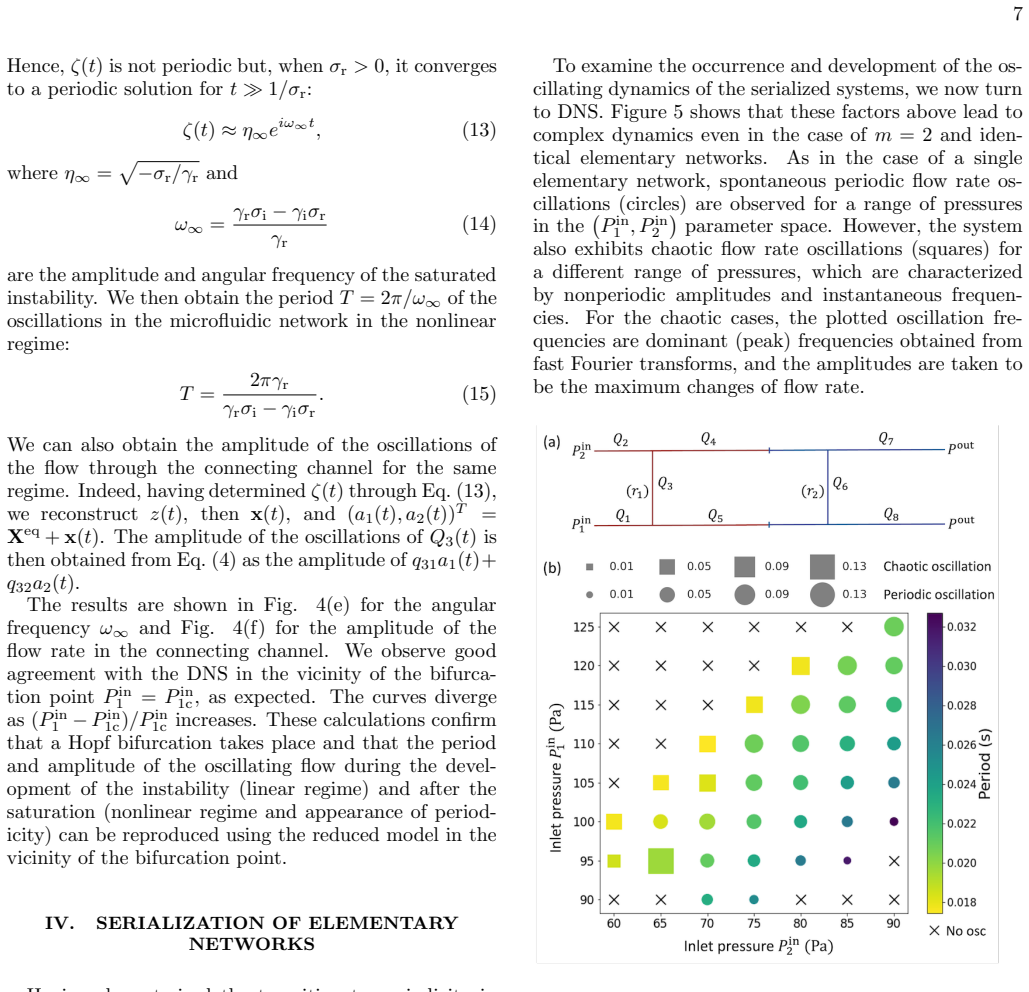
- [Figure 6 caption] The caption refers to Fig. 5(a) for notation, but Fig. 5(a) is a schematic; the labels r1 and r2 should be defined directly in the caption of Fig. 6.
- [Section III.A, Eq. (5)] The summation index q in the viscous term is inconsistent with the index s used elsewhere in the same term; this should be made uniform.
- [Section IV, Fig. 7] The description of the least-squares fit in Fig. 7(c) does not specify how the "linear portion" of the logarithmic divergence curve is selected; a quantitative criterion would improve reproducibility.
Circularity Check
No significant circularity: DNS independently establishes the phenomena; the calibrated reduced model is explicitly data-driven and is validated against DNS, not used as an independent first-principles prediction.
full rationale
The paper's central claims—spontaneous oscillations in a single element and period-doubling chaos in serialized elements—are established by direct numerical simulation of the incompressible two-dimensional Navier-Stokes equations (Eqs. 1-2) with fixed geometry and fluid parameters, with no fitted parameters entering the DNS. The reduced model of Sec. III is openly constructed from the same DNS data: the POD modes are those of the simulated fields ("The basis functions Φn are obtained using a proper orthogonal decomposition (POD) of the simulated data"), and the coefficients are either substituted from realizations of u or obtained by the calibration method of Ref. [38]. This makes the reduced model a data-driven projection of the Navier-Stokes equations, not an independent first-principles theory. However, the paper does not rest its existence claims on the model; it uses the model to characterize and reproduce Hopf bifurcations, and it compares the model outputs with independent DNS runs. The Hopf-onset prediction at P2 = 45 Pa is a nontrivial extrapolation of the ROM trained at P1 = 80 Pa, P2 = 60 Pa, and is checked against DNS rather than assumed. Self-citations to Ref. [26] and Ref. [31] supply background and motivation only, and no uniqueness theorem or prior result is invoked to force the choice of model. The two-dimensional assumption is an explicit scope limitation acknowledged in the conclusions, but acknowledging a limitation is not circular reasoning. Consequently, there is no step in which a prediction is equivalent by construction to its input.
Assumptions & free parameters
free parameters (3)
- Reduced-model coefficients (A_nℓs, B_ns, C_ns, D_n, E_n, q_jn) =
Not listed; calibrated from DNS via Tikhonov regularization
- POD mode truncation (number of modes) =
2
- Embedding dimension for Lyapunov exponent =
d=9 for P_in1=105 Pa; d=12 for the pressure range
assumptions (5)
- standard math Incompressible Navier-Stokes equations for a Newtonian fluid
- domain assumption Two-dimensional flow approximation with no spanwise variation
- standard math No-slip boundary conditions at rigid walls
- ad hoc to paper POD basis from a reference simulation remains valid across the pressure range
- ad hoc to paper Two-mode truncation captures the instability and saturation
Cite this review
Pith. "Pith review of Emergent oscillations and chaos in non-compliant microfluidic networks." pith.science (2026). https://pith.science/paper/ZU547X7J
@misc{pith2026250500068,
  author       = {Pith},
  title        = {Pith review of: Emergent oscillations and chaos in non-compliant microfluidic networks},
  year         = {2026},
  howpublished = {\url{https://pith.science/paper/ZU547X7J}},
  note         = {Machine review of arXiv:2505.00068}
}
read the original abstract
Incompressible fluids in microfluidic networks with non-rigid channels can exhibit flow rate oscillations analogous to electric current oscillations in RLC circuits. This is due to the elastic deformation of channel walls that can store and release fluid, as electric capacitors can store and release electric charges. This property is quantified through the compliance of the system, defined as the volume change relative to the pressure change. In systems with rigid walls and incompressible fluid, compliance vanishes and no oscillations can occur through this mechanism. Here, we show that not only oscillations but also chaos can emerge in the flow-rate dynamics of non-compliant microfluidic networks with incompressible fluid. Notably, these dynamics emerge spontaneously, even under time-independent driving pressures. The underlying mechanism is governed by the effect of fluid inertia, which becomes relevant at moderate Reynolds numbers observed in microfluidic systems exhibiting complex flow patterns. The results are established using a combination of direct numerical simulations and a reduced model derived from modal analysis. This approach enables us to determine the onset of oscillations, the associated bifurcations, the oscillation frequencies and amplitudes, and their dependence on the driving pressures. These findings can inspire novel studies and applications of previously unexplored oscillatory and chaotic regimes in non-compliant microfluidic systems.
Figures


Figures from the paper (4 more)



Reference graph
Works this paper leans on
-
[1]
For the entire network, we only control the static pressures at the two inlets, P in 1 and P in 2 , which are con- strained to be time independent; the outlets are assumed to experience a common constant pressureP out, which is set to zero. This boundary condition is consistent with pressure-driven flow microfluidics in applications where the system inlet...
-
[2]
G. M. Whitesides, The origins and the future of microflu- idics, Nature 442, 368 (2006)
work page 2006
-
[3]
E. K. Sackmann, A. L. Fulton, and D. J. Beebe, The present and future role of microfluidics in biomedical re- search, Nature 507, 181 (2014)
work page 2014
- [4]
-
[5]
C. Lou, H. Yang, Y. Hou, H. Huang, J. Qiu, C. Wang, Y. Sang, H. Liu, and L. Han, Microfluidic platforms for real-time in situ monitoring of biomarkers for cellular processes, Adv. Mater. 36, 2307051 (2024)
work page 2024
- [6]
- [7]
-
[8]
G. Xin, W. Zhu, Y. Deng, J. Cheng, L. T. Zhang, A. J. Chung, S. De, and J. Lian, Microfluidics-enabled orienta- tion and microstructure control of macroscopic graphene- fibres, Nat. Nanotechnol. 14, 168 (2019)
work page 2019
Show all 44 references
-
[9]
R. Dong, Y. Liu, L. Mou, J. Deng, and X. Jiang, Microfluidics-based biomaterials and biodevices, Adv. Mater. 31, 1805033 (2019)
2019
-
[10]
Liu and X
Y. Liu and X. Jiang, Why microfluidics? Merits and trends in chemical synthesis, Lab on a Chip 17, 3960 (2017)
2017
-
[11]
Yager, T
P. Yager, T. Edwards, E. Fu, K. Helton, K. Nelson, M. R. Tam, and B. H. Weigl, Microfluidic diagnostic tech- nologies for global public health, Nature 442, 412 (2006)
2006
-
[12]
C. M. Pandey, S. Augustine, S. Kumar, S. Kumar, S. Nara, S. Srivastava, and B. D. Malhotra, Microflu- idics based point-of-care diagnostics, Biotechnol. J. 13, 1700047 (2018)
2018
-
[13]
D. B. Weibel, M. Kruithof, S. Potenta, S. K. Sia, A. Lee, and G. M. Whitesides, Torque-actuated valves for microfluidics, Anal. Chem. 77, 4726 (2005)
2005
-
[14]
Abate and D
A. Abate and D. Weitz, Single-layer membrane valves for elastomeric microfluidic devices, Appl. Phys. Lett. 92, 243509 (2008)
2008
-
[15]
H. Xia, J. Wu, J. Zheng, J. Zhang, and Z. Wang, Nonlin- ear microfluidics: Device physics, functions, and applica- tions, Lab on a Chip 21, 1241 (2021)
2021
-
[16]
Leach, H
J. Leach, H. Mushfique, R. di Leonardo, M. Padgett, and J. Cooper, An optically driven pump for microfluidics, Lab on a Chip 6, 735 (2006)
2006
-
[17]
Zhang, S
W. Zhang, S. Lin, C. Wang, J. Hu, C. Li, Z. Zhuang, Y. Zhou, R. A. Mathies, and C. J. Yang, PMMA/PDMS valves and pumps for disposable microfluidics, Lab on a Chip 9, 3088 (2009)
2009
-
[18]
D. C. Leslie, C. J. Easley, E. Seker, J. M. Karlinsey, M. Utz, M. R. Begley, and J. P. Landers, Frequency- specific flow control in microfluidic circuits with passive elastomeric features, Nat. Phys. 5, 231 (2009)
2009
-
[19]
W. H. Grover, R. H. Ivester, E. C. Jensen, and R. A. Mathies, Development and multiplexed control of latch- ing pneumatic valves using microfluidic logical struc- tures, Lab on a Chip 6, 623 (2006)
2006
-
[20]
E. C. Jensen, W. H. Grover, and R. A. Mathies, Microp- neumatic digital logic structures for integrated microde- vice computation and control, J. Microelectromechanical Syst. 16, 1378 (2007)
2007
-
[21]
P. N. Duncan, T. V. Nguyen, and E. E. Hui, Pneumatic oscillator circuits for timing and control of integrated microfluidics, Proc. Natl. Acad. Sci. USA 110, 18104 (2013)
2013
-
[22]
Bruus, Theoretical Microfluidics, Vol
H. Bruus, Theoretical Microfluidics, Vol. 18 (Oxford Uni- versity Press, 2007)
2007
-
[23]
A Ahamed, M
Md. A Ahamed, M. Hasan, Md. E. Kabir, and Z. Zhang, Microfluidic hydraulic oscillators: A comprehensive re- view of emerging biochemical and biomedical applica- tions, Anal. Chim. Acta 1350, 343793 (2025)
2025
-
[24]
Ruiz-Garc´ ıa and E
M. Ruiz-Garc´ ıa and E. Katifori, Topologically controlled emergent dynamics in flow networks, arXiv preprint arXiv:2001.01811 (2020)
2020 arXiv
-
[25]
Ruiz-Garc´ ıa and E
M. Ruiz-Garc´ ıa and E. Katifori, Emergent dynamics in excitable flow systems, Phys. Rev. E 103, 062301 (2021)
2021
-
[26]
I. C. Christov, Soft hydraulics: From newtonian to com- plex fluid flows through compliant conduits, J. Phys. Condens. Matter 34, 063001 (2021)
2021
-
[27]
D. J. Case, J.-R. Angilella, and A. E. Motter, Sponta- neous oscillations and negative-conductance transitions in microfluidic networks, Sci. Adv. 6, eaay6761 (2020)
2020
-
[28]
Anbari, H.T
A. Anbari, H.T. Chien, S.S. Datta, W. Deng, D.A. Weitz and J. Fan, Microfluidic model porous media: Fabrica- tion and applications, Small 14, 1703575 (2018). 11
2018
-
[29]
W. Wang, J. Zhang, and C. Xu, Oscillating feedback micromixer: A short review, Chem. Eng. Process 201, 109812 (2024)
2024
-
[30]
Xie and C
T. Xie and C. Xu, Numerical and experimental investiga- tions of chaotic mixing behavior in an oscillating feedback micromixer, Chem. Eng. Sci. 171, 303 (2017)
2017
-
[31]
Mart´ ınez-Calvo, M
A. Mart´ ınez-Calvo, M. D. Biviano, A. H. Christensen, E. Katifori, K. H. Jensen, and M. Ruiz-Garc´ ıa, The fluidic memristor as a collective phenomenon in elastohydrody- namic networks, Nat. Commun. 15, 3121 (2024)
2024
-
[32]
D. J. Case, Y. Liu, I. Z. Kiss, J.-R. Angilella, and A. E. Motter, Braess’s paradox and programmable behaviour in microfluidic networks, Nature 574, 647 (2019)
2019
-
[33]
Battat, D
S. Battat, D. A. Weitz, and G. M. Whitesides, Nonlin- ear phenomena in microfluidics, Chem. Rev. 122, 6921 (2022)
2022
-
[34]
J. L. Lumley, The structure of inhomogeneous turbu- lent flows, in Atmospheric Turbulence and Radio Wave Propagation (Eds. A. M. Yaglom and V. I. Tatarski), pp.166–178 (Nauka, 1967)
1967
-
[35]
Berkooz, P
G. Berkooz, P. Holmes, and J. L. Lumley, The proper or- thogonal decomposition in the analysis of turbulent flows, Annu. Rev. Fluid Mech. 25, 539 (1993)
1993
-
[36]
J. Wang, V. G. Rodgers, P. Brisk, and W. H. Grover, In- stantaneous simulation of fluids and particles in complex microfluidic devices, PLoS One 12, e0189429 (2017)
2017
-
[37]
H. Yang, S. H. Hong, G. Wang, and Y. Wang, Multifi- delity reduced-order model for GPU-enabled microfluidic concentration gradient design, Eng. Comput. 39, 2869 (2023)
2023
-
[38]
Sirovich, Turbulence and the dynamics of coherent structures
L. Sirovich, Turbulence and the dynamics of coherent structures. I. coherent structures, Quart. Appl. Math.45, 561 (1987)
1987
-
[39]
Cordier, B
L. Cordier, B. A. El Majd, and J. Favier, Calibration of POD reduced-order models using Tikhonov regulariza- tion, Int. J. Numer. Methods Fluids. 63, 269 (2010)
2010
-
[40]
Y. A. Kuznetsov, Elements of Applied Bifurcation Theory (Springer, New York, 2004)
2004
-
[41]
Kantz, A robust method to estimate the maximal Lya- punov exponent of a time series, Phys
H. Kantz, A robust method to estimate the maximal Lya- punov exponent of a time series, Phys. Lett. A 185, 77 (1994)
1994
-
[42]
M. B. Kennel, R. Brown, and H. D. Abarbanel, Deter- mining embedding dimension for phase-space reconstruc- tion using a geometrical construction, Phys. Rev. A 45, 3403 (1992)
1992
-
[43]
A. Ooi, L. Chan, D. Aljubaili, C. Mamon, J.S. Leontini, A. Skvortsov, P. Mathupriya, and H. Hasini, Some new characteristics of the confined flow over circular cylinders at low Reynolds numbers, Int. J. Heat Fluid Flow 86, 108741 (2020)
2020
-
[44]
J. M. Ottino and S. Wiggins, Designing optimal mi- cromixers, Science 305, 485 (2004)
2004
Reviewed August 16, 2026 · model on record in the stance chip above.
Discussion (0). Continue with ORCID to comment.