REVIEW 4 major objections 5 minor 2 cited by
Multiple generation star formation in Cepheus Flare
T0 review · 4 major / 5 minor · reviewed 2026-08-16 · deepseek-v4-flash
Pith's one-line read The Cepheus Flare region formed stars in four distinct bursts.
desk verdict A useful expanded membership catalog for ASCC 127, but the four-episode star formation history rests on isochrone ages whose systematic uncertainties are comparable to the inter-episode gaps. read the letter →
The pith
A machine-rendered reading of the paper's core claim, the machinery that carries it, and where it could break.
The reading
What carries the argument
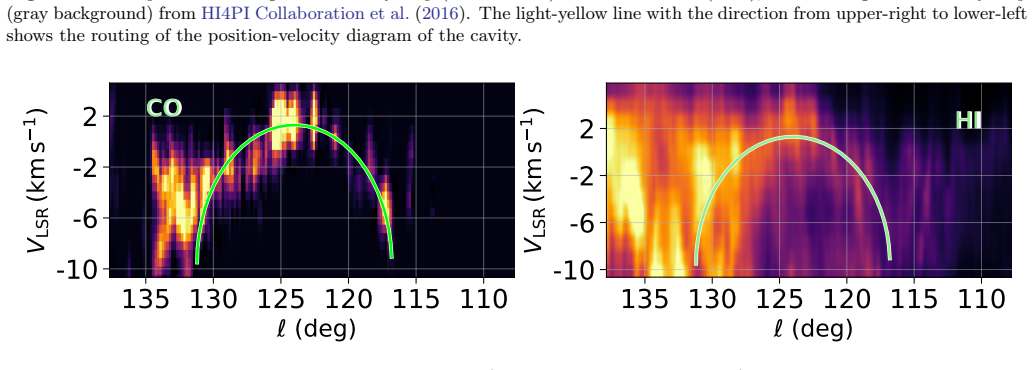
The argument rests on four linked tools. Friends-of-Friends clustering (via the ROCKSTAR code) in Gaia DR3 five-dimensional phase space (position on sky, parallax, and proper motion) expands ASCC 127 to 3,971 members; K-means then divides them into Groups 1-5. Ages come from fitting empirical color-corrected PARSEC 1.2S isochrones to dereddened color-magnitude diagrams, a correction needed because the model's low-mass main sequence is too blue. Backward orbit integrations with the MWPotential2014 model in galpy trace each group to its presumed formation site and time, connecting the age sequence to spatial positions. Finally, three-dimensional dust extinction maps plus CO and HI surveys reveal the cavity and its expansion, and a simple kinetic-energy estimate ties the cavity's $\sim 10^{50}$ erg to supernova-scale feedback. The empirical color-correction functions are the load-bearing piece for the age ladder, since without them the group ages shift by 5-6 Myr.
What would settle it
Measure independent ages for a sample of ASCC 127 members spanning all five groups using a method anchored to absolute ages, such as lithium depletion boundary fitting for M dwarfs or spectroscopic surface-gravity ages for pre-main-sequence stars. If the resulting ages for Groups 2, 3, 4, and 5 overlap within their 1-sigma uncertainties, the four-episode sequence and the feedback-triggering narrative collapse; conversely, if the 32 Myr versus 15 Myr split persists, the paper's picture is confirmed. A second check targets the cavity: high-resolution CO observations should show a clear expanding shell with a kinematic center coinciding with the older groups; absence of such a shell would weaken the feedback interpretation.
Extended reading notes
Core claim
The paper's central claim is that ASCC 127, previously treated as a single young moving group, is actually a composite of five subgroups (Groups 1-5) with best-fit isochrone ages of 32, 22, 15, 15, and 20 Myr, and that these subgroups together with the local young stellar objects (~7 Myr) record four distinct star formation episodes in the Cepheus Flare region. Backward orbit integrations place the subgroups within about 100 pc of one another at their formation times, and the oldest group formed while the others had not yet appeared. The paper further claims that a large cavity seen in dust, CO, and HI maps is an expanding structure produced by feedback from these earlier generations, and that the Loop III and Cepheus Flare Shell features are consistent with supernova-driven energy input. In the author's telling, the spatial age gradient — older groups outside, younger YSOs along an arc inside the cavity — is direct evidence that feedback from massive stars in earlier generations compressed the interstellar medium and triggered the later ones.
Load-bearing premise
The entire four-episode sequence depends on the assumption that the photometric ages from color-corrected PARSEC isochrones faithfully separate Groups 1-5 and the YSOs into distinct epochs; the age differences between groups (5-13 Myr) are comparable to the paper's own color-correction shift (5-6 Myr) and to the uncertainty of its rough 50 Myr field-star cut.
Editorial extensions
If this is right
- ASCC 127's membership is roughly double the previous census, and its internal structure includes two newly identified subgroups, so any future study of this moving group must account for five kinematically distinct components.
- If the age sequence is real, the Cepheus Flare YSO population at ~7 Myr is a fourth generation, and its spatial position along the arc of Group 4 indicates star formation propagating along a compressed filament.
- The cavity's expansion time of 3-5 Myr and energy of $\sim 10^{50}$ erg imply at least one supernova from a roughly 9-solar-mass star in the older groups, consistent with the presence of Loop III and the Cepheus Flare Shell.
- The traceback places Groups 2-5 within 60-100 pc of each other at formation, meaning the region's star formation was concentrated in a compact volume and then dispersed to the present configuration.
- The method — combining Gaia membership, isochrone ages, orbit traceback, and ISM maps — can be applied to other nearby young associations to test whether multi-episode, feedback-triggered histories are common.
Reading between the lines
- A natural test the paper leaves implicit: independent age indicators such as lithium depletion or rotation-based gyrochronology for a few dozen members of Groups 2-5 would separate systematic isochrone error from the true age spread; if those ages converge, the four-episode sequence stands, and if they overlap, it collapses.
- The age gap between the 15 Myr Groups 3/4 and the ~7 Myr YSOs nearly matches the cavity's 3-5 Myr expansion time plus a free-fall time, so the current episode may still be ongoing and the cavity itself may host the next generation — a prediction that future submillimeter observations of dense cores inside the cavity could check.
- Because the color correction shifts ages by 5-6 Myr while the quoted inter-group age differences are 5-13 Myr, the sequence's robustness hinges on the correction being accurate at the low-mass end; applying the same correction to a coeval benchmark cluster would directly bound this systematic.
Signed reviews
Editorial analysis
A structured set of objections, weighed in public.
Referee Report
Summary. The paper re-derives the membership of the young moving group ASCC 127 from Gaia DR3, expanding it to 3,971 stars with a Friends-of-Friends algorithm and then splitting the sample into five subgroups (Groups 1–5) by K-means clustering. Ages are obtained by fitting color-corrected PARSEC 1.2S isochrones to dereddened Gaia CMDs, yielding 32, 22, 15, 15, and 20 Myr for Groups 1–5. The subgroups are compared with the known YSO population of the Cepheus Flare region, and a dust/CO/HI cavity is identified. The authors interpret the combined age ladder (32, ~20, 15, ~7 Myr) as four sequential star formation episodes, with feedback from older generations shaping the surrounding ISM and triggering later generations. The paper also presents backward orbit integrations of the five groups to support the spatial relationships among the episodes.
Significance. If the age ladder and the membership decontamination are reliable, the paper would provide a useful expanded census of ASCC 127 and a plausible case for sequential, feedback-driven star formation in the Cepheus Flare. The authors deserve credit for releasing the full membership table in machine-readable form, for applying an externally calibrated empirical color correction rather than an ad hoc one, and for combining Gaia astrometry with dust, CO, and HI data. The spatial association of the groups with Cepheus Flare clouds and the expanding cavity are interesting observational findings in their own right. However, the central multi-episode claim depends on age differences of only 5–13 Myr, and the paper's own systematic-age diagnostics (corrected vs uncorrected ages, YSO ages) cast doubt on whether those differences are currently resolved.
major comments (4)
- [§3.4, Table 2, footnote] The four-episode chronology rests on age differences of 5–13 Myr, but the paper's own comparison of corrected and uncorrected PARSEC ages shows a systematic shift of about 5–6 Myr (26→32, 17→22, 10→15, 10→15, 14→20 Myr). The quoted bootstrap uncertainties (1–4 Myr) measure only resampling scatter and do not include the Wang et al. (2025) empirical correction calibration, the fixed solar metallicity, STILISM extinction errors, or the 'rather rough' 50 Myr field-star cut admitted in §3.2. A systematic shift of only ~5 Myr would merge the 20 and 15 Myr episodes. The authors should quantify this systematic error budget and show that the episode spacing survives it.
- [§4.2, Figure 9] The 7 Myr 'episode' is not secure. The same isochrone-fitting procedure returns ~7 Myr for YSOs that Szilágyi et al. (2021) dated at 1–5 Myr, which suggests a systematic offset at the young end. Moreover, §4.2 splits Group 4 into YSOs at 7 Myr and other members at 19 Myr, while Table 2 lists a single 15 Myr age for Group 4; one episode is therefore already a blend. The authors need to reconcile these numbers and to validate the young-age scale with an independent clock before adding 7 Myr as a separate generation.
- [§4.2, cavity energetics] The supernova interpretation of the cavity is not supported by the paper's own stellar lifetimes. With a 9 M⊙ lifetime of ~31 Myr, a 9 M⊙ star formed in a 15–22 Myr old group has not yet exploded; Group 1 (32 Myr) would contain at most ~3 M⊙ stars. The text first states that Groups 2–5 can provide less than 10^49 erg of wind energy before their supernova explosions and then concludes that a ~10^50 erg cavity was likely produced by a supernova in these groups. The authors should either identify a specific massive member with sufficient remaining or lapsed lifetime, or soften the supernova claim to a hypothesis that is consistent with the group ages.
- [§3.2–§3.3] The membership selection may bias the age ladder. The 50 Myr isochrone cut is described as 'rather rough,' and an additional 169 stars are removed from Group 3 post hoc using the tangential-velocity distribution. Because the same photometry is later used to fit ages, a selection that preferentially keeps or removes young-looking stars can change the derived age sequence. The authors should quantify how the derived ages of Groups 1–5 shift under reasonable variations of the field-star cuts (e.g., 40 Myr versus 60 Myr) and under the Pang et al. (2022) membership.
minor comments (5)
- [Table 2 caption] There is a typo in the table caption: 'medain radial velocity' should be 'median radial velocity.'
- [§3.2 footnotes] The footnote reads 'the local standrd of rest' rather than 'the local standard of rest'; please fix this typo.
- [§4.1] The text says Groups 2 and 5 formed approximately 17 Myr after Group 1, but Table 2 gives age differences of 10–12 Myr between these groups; please clarify or correct this inconsistency.
- [§4.1] The paragraph describing the orbit uncertainty repeats the sentence 'We then derive the median orbit from the sampled trajectories and use the 1σ standard deviation...' twice; one copy should be removed.
- [§4.2 vs Table 2] The age reported for Group 4 is 15 Myr in Table 2 but 19 Myr for its non-YSO members in §4.2; these values should be reconciled in the text.
Circularity Check
No significant circularity: the episodic ages are externally calibrated isochrone fits, and the traceback uses those ages rather than producing them.
full rationale
The claimed derivation chain is not circular. Membership and subgrouping (Sections 3.1-3.3) are performed in kinematic and distance space using FoF and K-means without feeding photometric ages into the grouping, so the age ladder is an output rather than a selection input. The age estimates in Section 3.4 use PARSEC 1.2S isochrones with empirical color corrections taken from Wang et al. (2025); that cited calibration is external to this paper, being derived from fits to the Hyades, Pleiades, and Praesepe benchmark clusters, so adopting it is independent support rather than a self-referential loop even though authors overlap. The 'four distinct age groups' (32, 20, 15, and 7 Myr) are a restatement of the fitted group ages and the re-fitted YSO age; the paper presents them as inferred evidence, not as an independent prediction forced by construction. The backward orbit integrations simply propagate these fitted ages and observed kinematics through MWPotential2014; they do not generate the ages from the orbits. The paper's own caution that the 50 Myr field-star cut is 'rather rough' and the 5-6 Myr color-correction shifts are systematic-uncertainty concerns, not evidence that any quantity was defined in terms of the conclusion. No equation sets a fitted parameter equal to a claimed prediction, and no load-bearing uniqueness theorem is imported from the authors' prior work. Score 0.
Assumptions & free parameters
free parameters (4)
- Empirical color correction functions for PARSEC 1.2S isochrones =
Not re-fitted; adopted from Wang et al. (2025)
- Number of subgroups K =
5
- Adopted distance for cavity gas mass =
300 pc
- Cavity expansion velocity V_exp =
~10 km/s
assumptions (5)
- domain assumption The Wang et al. (2025) color correction, calibrated on Hyades, Pleiades, and Praesepe, is transferable to ASCC 127 and Cepheus Flare YSOs.
- ad hoc to paper The 50 Myr isochrone cleanly separates ASCC 127 members from field stars in the dereddened color-magnitude diagram.
- domain assumption The parent molecular clouds had initial kinematics similar to those of the young groups at their formation times.
- standard math MWPotential2014 is an adequate Galactic potential for 32 Myr backward orbit integrations.
- domain assumption The Friends-of-Friends grouping in 5D phase space with radial velocities set to zero recovers the true kinematic structure of ASCC 127.
Cite this review
Pith. "Pith review of Multiple generation star formation in Cepheus Flare." pith.science (2026). https://pith.science/paper/3MCDL5C2
@misc{pith2026250500407,
  author       = {Pith},
  title        = {Pith review of: Multiple generation star formation in Cepheus Flare},
  year         = {2026},
  howpublished = {\url{https://pith.science/paper/3MCDL5C2}},
  note         = {Machine review of arXiv:2505.00407}
}
read the original abstract
We present an analysis of the young stellar moving group ASCC 127 using Gaia DR3 data, significantly expanding its membership to 3,971 stars -- double the number identified in previous studies. Using kinematic and distance criteria, ASCC 127 is divided into five subgroups (Groups 1-5) with ages spanning from 15 to 32 Myr. Groups 1-5 are spatially linked to the Cepheus Flare star-forming region, revealing potential evidence of four sequential star formation episodes at approximately 32 Myr, 20 Myr, 15 Myr, and 7 Myr. Through dust and gas mapping, we identify a spatial cavity extending several tens of parsecs, which may have resulted from feedback processes such as supernovae associated with earlier generations of stars in the region. This structure, along with the larger Loop III feature, indicates that feedback from massive stars likely influenced the interstellar medium (ISM). By integrating young stellar populations with ISM studies, we provide a detailed picture of the feedback-driven star formation history in the Cepheus Flare region.
Figures


Figures from the paper (7 more)


Forward citations
Cited by 2 Pith papers
-
CO Structures with Narrow Lines in Nearby Quiescent Regions
A systematic MWISP survey finds 57 narrow-line CO structures, mostly nearby diffuse 'veil clouds' with subsonic turbulence, likely shaped by the Local Bubble and ion-neutral friction.
-
CU-JADE: A Method for Traversing Extinction Jumps along the Line of Sight
CU-JADE applies cumulative-sum change-point detection to stellar distance-extinction data to locate multiple dust layers, yielding new molecular cloud distances and an all-sky 3D extinction map extending to 4 kpc.
Reference graph
Works this paper leans on
-
[1]
, " * write output.state after.block = add.period write newline
ENTRY address archivePrefix author booktitle chapter doi edition editor eprint howpublished institution journal key month number organization pages publisher school series title misctitle type volume year version url label extra.label sort.label short.list INTEGERS output.state before.all mid.sentence after.sentence after.block FUNCTION init.state.consts ...
-
[2]
write newline
" write newline "" before.all 'output.state := FUNCTION format.url url empty "" new.block "" url * "" * if FUNCTION format.eprint eprint empty "" archivePrefix empty "" archivePrefix "arXiv" = new.block " " eprint * " " * new.block " " eprint * " " * if if if FUNCTION format.doi doi empty "" " " doi * " " * if FUNCTION format.pid doi empty eprint empty ""...
-
[3]
thebibliography [1] 20pt REFERENCES 6pt =0pt 10pt plus 3pt =0pt =0pt =1pt plus 1pt =0pt =0pt -12pt =13pt plus 1pt =20pt =13pt plus 1pt \@M =10000 =-1.0em =0pt =0pt 0pt =0pt =1.0em @enumiv\@empty 10000 10000 `\.\@m \@noitemerr \@latex@warning Empty `thebibliography' environment \@ifnextchar \@reference \@latexerr Missing key on reference command Each refer...
arXiv 2020
-
[4]
Astropy Collaboration , Robitaille , T. P., Tollerud , E. J., et al. 2013, , 558, A33, 10.1051/0004-6361/201322068
-
[5]
Astropy Collaboration , Price-Whelan , A. M., Sip o cz , B. M., et al. 2018, , 156, 123, 10.3847/1538-3881/aabc4f
-
[6]
Bailer-Jones , C. A. L., Rybizki , J., Fouesneau , M., Demleitner , M., & Andrae , R. 2021, , 161, 147, 10.3847/1538-3881/abd806
-
[7]
Behroozi , P. S., Wechsler , R. H., & Wu , H.-Y. 2013, , 762, 109, 10.1088/0004-637X/762/2/109
-
[8]
Bell , C. P. M., Mamajek , E. E., & Naylor , T. 2015, , 454, 593, 10.1093/mnras/stv1981
Show all 65 references
-
[9]
Berkhuijsen , E. M. 1973, , 24, 143
1973
-
[10]
2015, , 216, 29, 10.1088/0067-0049/216/2/29
Bovy , J. 2015, , 216, 29, 10.1088/0067-0049/216/2/29
2015 doi
-
[11]
2012, , 427, 127, 10.1111/j.1365-2966.2012.21948.x
Bressan , A., Marigo , P., Girardi , L., et al. 2012, , 427, 127, 10.1111/j.1365-2966.2012.21948.x
2012
-
[12]
2023, , 522, 1288, 10.1093/mnras/stad608
Brice \ n o-Morales , G., & Chanam \'e , J. 2023, , 522, 1288, 10.1093/mnras/stad608
2023 doi
-
[13]
L., Elyajouri , M., & Monreal-Ibero , A
Capitanio , L., Lallement , R., Vergely , J. L., Elyajouri , M., & Monreal-Ibero , A. 2017, , 606, A65, 10.1051/0004-6361/201730831
2017 doi
-
[14]
Castellani , V., Degl'Innocenti , S., & Prada Moroni , P. G. 2001, , 320, 66, 10.1046/j.1365-8711.2001.03958.x
2001
-
[15]
2019, , 632, A105, 10.1051/0004-6361/201936612
Chen , Y., Girardi , L., Fu , X., et al. 2019, , 632, A105, 10.1051/0004-6361/201936612
2019 doi
-
[16]
M., Hartmann , D., & Thaddeus , P
Dame , T. M., Hartmann , D., & Thaddeus , P. 2001, , 547, 792, 10.1086/318388
2001 doi
-
[17]
2024, , 685, A82, 10.1051/0004-6361/202347628
Edenhofer , G., Zucker , C., Frank , P., et al. 2024, , 685, A82, 10.1051/0004-6361/202347628
2024 doi
-
[18]
L., & Luhman , K
Esplin , T. L., & Luhman , K. L. 2022, , 163, 64, 10.3847/1538-3881/ac3e64
2022 doi
-
[19]
P., Offner , S
Farias , J. P., Offner , S. S. R., Grudi \'c , M. Y., Guszejnov , D., & Rosen , A. L. 2024, , 527, 6732, 10.1093/mnras/stad3609
2024 doi
-
[20]
A., Mackey , J., Grassitelli , L., Romano-D \' az , E., & Porciani , C
Fichtner , Y. A., Mackey , J., Grassitelli , L., Romano-D \' az , E., & Porciani , C. 2024, , 690, A72, 10.1051/0004-6361/202449638
2024 doi
- [21]
-
[22]
Y., Guszejnov , D., Hopkins , P
Grudi \'c , M. Y., Guszejnov , D., Hopkins , P. F., Offner , S. S. R., & Faucher-Gigu \`e re , C.-A. 2021 a , , 506, 2199, 10.1093/mnras/stab1347
2021 doi
-
[23]
Y., Guszejnov , D., Offner , S
Grudi \'c , M. Y., Guszejnov , D., Offner , S. S. R., et al. 2022, , 512, 216, 10.1093/mnras/stac526
2022 doi
-
[24]
Y., Kruijssen , J
Grudi \'c , M. Y., Kruijssen , J. M. D., Faucher-Gigu \`e re , C.-A., et al. 2021 b , , 506, 3239, 10.1093/mnras/stab1894
2021 doi
-
[25]
Guszejnov , D., Markey , C., Offner , S. S. R., et al. 2022, , 515, 167, 10.1093/mnras/stac1737
2022 doi
-
[26]
2016, , 594, A116, 10.1051/0004-6361/201629178
HI4PI Collaboration , Ben Bekhti , N., Fl \"o er , L., et al. 2016, , 594, A116, 10.1051/0004-6361/201629178
2016 doi
-
[27]
Hunter , J. D. 2007, Computing in Science and Engineering, 9, 90, 10.1109/MCSE.2007.55
2007 doi
- [28]
-
[29]
Kalberla , P. M. W., & Haud , U. 2015, , 578, A78, 10.1051/0004-6361/201525859
2015 doi
-
[30]
Kalberla , P. M. W., McClure-Griffiths , N. M., Pisano , D. J., et al. 2010, , 521, A17, 10.1051/0004-6361/200913979
2010 doi
- [31]
-
[32]
Kerp , J., Winkel , B., Ben Bekhti , N., Fl \"o er , L., & Kalberla , P. M. W. 2011, Astronomische Nachrichten, 332, 637, 10.1002/asna.201011548
2011 doi
-
[33]
C., & Skinner , M
Kim , J.-G., Kim , W.-T., Ostriker , E. C., & Skinner , M. A. 2017, , 851, 93, 10.3847/1538-4357/aa9b80
2017 doi
-
[34]
2019, , 158, 122, 10.3847/1538-3881/ab339a
Kounkel , M., & Covey , K. 2019, , 158, 122, 10.3847/1538-3881/ab339a
2019 doi
-
[35]
2001, in Astronomische Gesellschaft Meeting Abstracts, Vol
Kroupa , P. 2001, in Astronomische Gesellschaft Meeting Abstracts, Vol. 18, Astronomische Gesellschaft Meeting Abstracts, P78
2001
-
[36]
2007, in IAU Symposium, Vol
Kun , M. 2007, in IAU Symposium, Vol. 237, Triggered Star Formation in a Turbulent ISM, ed. B. G. Elmegreen & J. Palous , 119--123
2007
-
[37]
J., Mamajek , E
Kun , M., Balog , Z., Kenyon , S. J., Mamajek , E. E., & Gutermuth , R. A. 2009, , 185, 451, 10.1088/0067-0049/185/2/451
2009 doi
-
[38]
T., & Balog , Z
Kun , M., Kiss , Z. T., & Balog , Z. 2008, in Handbook of Star Forming Regions, Volume I, ed. B. Reipurth , Vol. 4, 136
2008
-
[39]
L., Valette , B., et al
Lallement , R., Vergely , J. L., Valette , B., et al. 2014, , 561, A91, 10.1051/0004-6361/201322032
2014 doi
-
[40]
2018, , 616, A132, 10.1051/0004-6361/201832832
Lallement , R., Capitanio , L., Ruiz-Dern , L., et al. 2018, , 616, A132, 10.1051/0004-6361/201832832
2018 doi
-
[41]
B., & Starrfield , S
Larson , R. B., & Starrfield , S. 1971, , 13, 190
1971
-
[42]
2020, , 901, 49, 10.3847/1538-4357/abaef3
Li , L., Shao , Z., Li , Z.-Z., et al. 2020, , 901, 49, 10.3847/1538-4357/abaef3
2020 doi
-
[43]
2019, , 245, 32, 10.3847/1538-4365/ab530a
Liu , L., & Pang , X. 2019, , 245, 32, 10.3847/1538-4365/ab530a
2019 doi
-
[44]
M., Pisano , D
McClure-Griffiths , N. M., Pisano , D. J., Calabretta , M. R., et al. 2009, , 181, 398, 10.1088/0067-0049/181/2/398
2009 doi
-
[45]
1987, , 317, 190, 10.1086/165267
McCray , R., & Kafatos , M. 1987, , 317, 190, 10.1086/165267
1987 doi
-
[46]
Miret-Roig , N., Galli , P. A. B., Olivares , J., et al. 2022, , 667, A163, 10.1051/0004-6361/202244709
2022 doi
-
[47]
A., Meschin , P
Olano , C. A., Meschin , P. I., & Niemela , V. S. 2006, , 369, 867, 10.1111/j.1365-2966.2006.10343.x
2006
-
[48]
2022, , 931, 156, 10.3847/1538-4357/ac674e
Pang , X., Tang , S.-Y., Li , Y., et al. 2022, , 931, 156, 10.3847/1538-4357/ac674e
2022 doi
-
[49]
E., Alves , J., et al
Ratzenb \"o ck , S., Gro schedl , J. E., Alves , J., et al. 2023, , 678, A71, 10.1051/0004-6361/202346901
2023 doi
-
[50]
J., Menten , K
Reid , M. J., Menten , K. M., Brunthaler , A., et al. 2019, , 885, 131, 10.3847/1538-4357/ab4a11
2019 doi
-
[51]
2024, , 534, 2566, 10.1093/mnras/stae2157
S \'a nchez-Sanju \'a n , S., Hern \'a ndez , J., P \'e rez-Villegas , \'A ., et al. 2024, , 534, 2566, 10.1093/mnras/stae2157
2024 doi
-
[52]
Schinnerer , E., & Leroy , A. K. 2024, , 62, 369, 10.1146/annurev-astro-071221-052651
2024 doi
-
[53]
2010, , 403, 1829, 10.1111/j.1365-2966.2010.16253.x
Sch \"o nrich , R., Binney , J., & Dehnen , W. 2010, , 403, 1829, 10.1111/j.1365-2966.2010.16253.x
2010
-
[54]
Spoelstra , T. A. T. 1973, , 24, 149
1973
-
[55]
2021, , 505, 5164, 10.1093/mnras/stab1496
Szil \'a gyi , M., Kun , M., & \'A brah \'a m , P. 2021, , 505, 5164, 10.1093/mnras/stab1496
2021 doi
-
[56]
Taylor , M. B. 2005, in Astronomical Society of the Pacific Conference Series, Vol. 347, Astronomical Data Analysis Software and Systems XIV, ed. P. Shopbell , M. Britton , & R. Ebert , 29
2005
-
[57]
2017, PhD thesis, University of Groningen
Tian, H. 2017, PhD thesis, University of Groningen
2017
-
[58]
C., & Varoquaux , G
van der Walt , S., Colbert , S. C., & Varoquaux , G. 2011, Computing in Science and Engineering, 13, 22, 10.1109/MCSE.2011.37
2011 doi
-
[59]
2025, , 979, 92, 10.3847/1538-4357/ad960a
Wang , F., Fang , M., Fu , X., et al. 2025, , 979, 92, 10.3847/1538-4357/ad960a
2025 doi
-
[60]
2016, , 585, A41, 10.1051/0004-6361/201527007
Winkel , B., Kerp , J., Fl \"o er , L., et al. 2016, , 585, A41, 10.1051/0004-6361/201527007
2016 doi
-
[61]
2022, Research in Astronomy and Astrophysics, 22, 085017, 10.1088/1674-4527/ac784e
Xia , J., Tang , N., Zhi , Q., et al. 2022, Research in Astronomy and Astrophysics, 22, 085017, 10.1088/1674-4527/ac784e
2022 doi
-
[62]
Zari , E., Brown , A. G. A., & de Zeeuw , P. T. 2019, , 628, A123, 10.1051/0004-6361/201935781
2019 doi
-
[63]
J., Liu , Y., Fang , M., & Kuhn , M
Zhou , X., Herczeg , G. J., Liu , Y., Fang , M., & Kuhn , M. 2022, , 933, 77, 10.3847/1538-4357/ac704d
2022 doi
-
[64]
2024, , 966, 202, 10.3847/1538-4357/ad3552
Zhuang , Z., Su , Y., Zhang , S., et al. 2024, , 966, 202, 10.3847/1538-4357/ad3552
2024 doi
-
[65]
2023, in Astronomical Society of the Pacific Conference Series, Vol
Zucker , C., Alves , J., Goodman , A., Meingast , S., & Galli , P. 2023, in Astronomical Society of the Pacific Conference Series, Vol. 534, Protostars and Planets VII, ed. S. Inutsuka , Y. Aikawa , T. Muto , K. Tomida , & M. Tamura , 43
2023
Reviewed August 16, 2026 · model on record in the stance chip above.
Discussion (0). Continue with ORCID to comment.