REVIEW 3 major objections 5 minor 143 references
Audio Personas: Augmenting Social Perception via Body-Anchored Audio Cues
T0 review · 3 major / 5 minor · reviewed 2026-08-16 · deepseek-v4-flash
Pith's one-line read A person's body-anchored audio cues—their audio persona—change how strangers rate their attractiveness, likability, and threat, and the paper shows that anchoring sound to the body, not just playing it nearby, is what makes the cue stick…
desk verdict A genuinely new concept and a carefully run preregistered study, but the claim that body-anchoring specifically drives the effect is weaker than the abstract suggests because the control condition also varies whether the sound moves. read the letter →
The pith
A machine-rendered reading of the paper's core claim, the machinery that carries it, and where it could break.
The reading
What carries the argument
The load-bearing mechanism is body anchoring: an audio source whose spatial position tracks the wearer's body in real time, so the sound moves when the person moves and stays within the wearer's social space. The proof-of-concept uses head-worn trackers, a game engine for 3D audio rendering with distance-based volume rolloff, and a multi-listener audio streaming pipeline so each user both broadcasts a persona and hears others'. This spatial coincidence between sound and person is what, under multisensory cue integration, makes the sound bind to the person rather than the environment.
What would settle it
Run the same 64-person study with a third control condition in which the research assistant carries a sound source, such as a handheld speaker, that moves with them but is visibly not part of their body; if participants incorporate the sound into impressions at the same rate as the audio-persona condition, body attachment itself is not what drives the effect.
Extended reading notes
Core claim
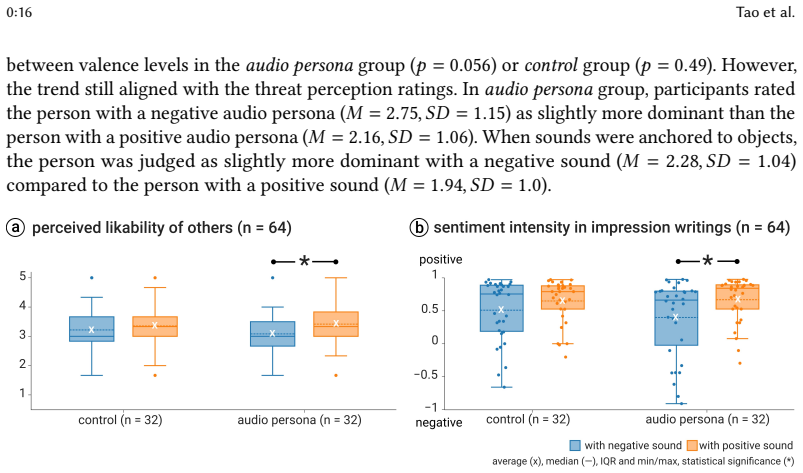
The central claim is that body-anchored audio cues—audio personas—change how strangers form impressions of a person in face-to-face interaction. The paper argues that spatially anchoring a sound to the body aligns the auditory cue with the person, making the sound available information about that person, whereas the same sound anchored to an object stays background. The supporting evidence is that 62.5% of participants in the audio-persona condition included the sound in impression drawings or writings, versus 18.75% in the object-anchored control, and that positive audio personas produced significantly higher social attraction, higher likability, and lower perceived threat than negative audio personas within the audio-persona group. The valence effects replicated as non-significant trends in the control group, which the paper reads as evidence that body anchoring strengthens, rather than creates, the effect.
Load-bearing premise
In the comparison that supports body anchoring, the body-anchored sound moves with the research assistant while the object-anchored sound stays fixed in the room, so the measured effect could come from the sound's movement or novelty rather than from being attached to the body.
Editorial extensions
If this is right
- People can deliberately craft a sonic first impression, adding a dynamic layer to clothing and makeup that can change with mood or context.
- The contrast between 62.5% incorporation of body-anchored sounds versus 18.75% for object-anchored sounds indicates that body anchoring itself drives the absorption of the cue into impressions.
- The valence findings mean audio personas can work as an implicit signal—buzzing or hurricane sounds read as threatening, brook or forest sounds read as warm—without the wearer saying a word.
- The prototype shows that the core technical ingredients—head tracking, spatialized audio with distance rolloff, and multi-user audio streaming—are sufficient to deliver body-anchored personas in a lab setting.
- Designer feedback points to public and semi-public spaces as the natural context, suggesting early deployments should target encounters among strangers rather than private gatherings.
Reading between the lines
- A cleaner test of body anchoring would replace the object-anchored control with a moving sound source carried by the research assistant; if incorporation rates stay high, motion rather than body attachment would be doing the work.
- Because valence effects reached significance only in the body-anchored group, audio personas may matter most in multi-person settings, where an object-anchored sound cannot be attributed to any one person; the paper did not test that case.
- The null behavioral results suggest the shift may be confined to explicit ratings rather than approach or avoidance; a social-distance or implicit-association measure could reveal whether the effect reaches behavior.
- A shared vocabulary problem follows: if audio personas rely on valence associations, widespread use needs something like an emoji library of sounds, since the same sound can read as positive to one person and negative to another.
Signed reviews
Editorial analysis
A structured set of objections, weighed in public.
Referee Report
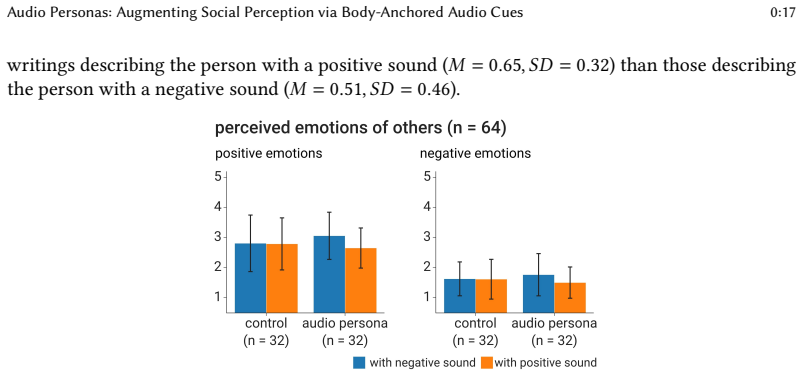
Summary. The paper introduces the concept of 'Audio Personas'—body-anchored sounds rendered in audio augmented reality—and evaluates it through a proof-of-concept system and two empirical studies. Study #1 (n = 64, preregistered, mixed-factorial) compares an audio-persona condition (sounds anchored to research assistants) with an object-anchored control condition (sounds anchored to fixed speakers), crossing positive/negative audio valence within participants. The primary findings are that participants in the persona group were more likely to include sound in their impression drawings/writings (H1), and that within the persona group, positive personas increased social attraction, likability, and reduced perceived threat relative to negative personas (H2). The anchoring-by-valence interaction was not significant on any self-report measure, and no effects were found on perceived emotional states or behavioral measures. Study #2 (n = 8 audio designers) explores use cases and design patterns, reporting that audio personas are preferred in public and semi-public-private spaces for impression management and state signaling. The central claim is that audio personas can shape social perception and that body-anchoring is a key design feature for this effect.
Significance. If the claims hold, this paper opens a novel design space for augmenting face-to-face social interactions through body-anchored audio, connecting audio AR with impression management. The work has tangible strengths: the study is preregistered, uses a controlled mixed-factorial design with counterbalancing, and combines self-report, behavioral, and open-ended drawing/writing measures. The proof-of-concept system is a concrete technical contribution, and the design study provides convergent qualitative insights. However, the strongest causal claim—that body-anchoring, specifically, enables the effect—is undercut by a confound in the H1 contrast and by the absence of a significant anchoring-by-valence interaction on the self-report measures. The paper contributes a useful exploratory prototype and a set of findings that are promising but not conclusive regarding the role of body-anchoring per se. For the field, the concept itself is interesting enough to warrant further investigation, but the current evidence does not fully support the abstract's strong framing.
major comments (3)
- [§4.1.1, §4.13]
- [§4.10, §6.1] This comment covers the overinterpretation of non-significant interaction and exploratory pairwise tests.
- [§4.2.3]
minor comments (5)
- [§4.5.1]
- [§4.1.2]
- [§4.9]
- [§6.1]
- [§1]
Circularity Check
No circularity: the paper's claims are empirical preregistered results whose outcomes are measured independently of the manipulations; no derivation reduces to its own inputs.
full rationale
This is an empirical HCI paper with two user studies and no mathematical derivation, fitted parameters, or model-based predictions. The central claim is that body-anchored audio cues ('audio personas') influence social perception. The independent variables are audio anchoring (body-anchored vs object-anchored) and audio valence (positive vs negative), and the dependent variables are impression drawings/writings, Likert-scale social attraction, likability, threat, perceived emotions, seat choice, and interpersonal distance. None of these outcomes is defined in terms of the independent variable by construction; a participant's rating of social attraction is not the same measurement event as the valence of the sound they heard. The preregistered hypotheses (Section 4.6) are directional empirical predictions, and the confirmatory statistics (e.g., social attraction p=0.002, threat p=0.008, likability p=0.03 in the audio persona group) are measured contrasts rather than restatements of the manipulation. The paper does not fit any parameter to data and then predict a closely related quantity; it does not invoke a uniqueness theorem; and it does not smuggle in an ansatz via citation. The authors do cite their own prior work (e.g., Bailenson et al. 2004 on transformed social interaction; Fauville et al. 2022 on impression formation from video-conference screenshots), but those citations are contextual and not load-bearing: the empirical validity of the current claims rests on the preregistered in-lab study reported here, not on those earlier papers. The paper's own limitation section (Section 6.3) explicitly acknowledges that the object-anchored control is one possible baseline and that future work should compare against no-audio or non-spatialized sound. That is a validity limitation, not circularity: even if the body-anchoring contrast is confounded with sound movement, the outcome measures are still independent of the manipulation by construction. Under the specified review standards, the appropriate finding is no significant circularity.
Assumptions & free parameters
assumptions (3)
- domain assumption Sounds selected from IADS-2/IADS-E with given valence ratings are effective positive and negative stimuli in a social context.
- domain assumption A headphone-based system with VIVE trackers and Unity spatialization adequately simulates body-anchored audio for in-lab social interaction.
- domain assumption Self-report Likert scales and impression drawings/writings capture the intended social perception constructs (likability, threat, attraction, emotions).
invented entities (1)
-
Audio Persona (body-anchored audio cue)
independent evidence
Cite this review
Pith. "Pith review of Audio Personas: Augmenting Social Perception via Body-Anchored Audio Cues." pith.science (2026). https://pith.science/paper/KEK33S3C
@misc{pith2026250500956,
  author       = {Pith},
  title        = {Pith review of: Audio Personas: Augmenting Social Perception via Body-Anchored Audio Cues},
  year         = {2026},
  howpublished = {\url{https://pith.science/paper/KEK33S3C}},
  note         = {Machine review of arXiv:2505.00956}
}
read the original abstract
We introduce Audio Personas, enabling users to "decorate" themselves with body-anchored sounds in audio augmented reality. Like outfits, makeup, and fragrances, audio personas offer an alternative yet dynamic channel to augment face-to-face interactions. For instance, one can set their audio persona as rain sounds to reflect a bad mood, bee sounds to establish personal boundaries, or a playful "woosh" sound to mimic passing by someone like a breeze. To instantiate the concept, we implemented a headphone-based prototype with multi-user tracking and audio streaming. Our preregistered in-lab study with 64 participants showed that audio personas influenced how participants formed impressions. Individuals with positive audio personas were rated as more socially attractive, more likable, and less threatening than those with negative audio personas. Our study with audio designers revealed that audio personas were preferred in public and semi-public-private spaces for managing social impressions (e.g., personality) and signaling current states (e.g., emotions).
Figures


Figures from the paper (12 more)




Reference graph
Works this paper leans on
-
[1]
Audio Stream
2024. Audio Stream. https://assetstore.unity.com/packages/tools/audio/audiostream-pcm-audio-for-unity-65411
2024
-
[2]
Half-Life
2024. Half-Life. https://www.half-life.com/en/home/
2024
-
[3]
HTC VIVE
2024. HTC VIVE. https://www.vive.com/
2024
-
[4]
Meta Horizon
2024. Meta Horizon. https://horizon.meta.com
2024
-
[5]
Meta XR Audio SDK
2024. Meta XR Audio SDK. https://assetstore.unity.com/packages/tools/integration/meta-xr-audio-sdk-264557
2024
-
[6]
Multi Audio Listener
2024. Multi Audio Listener. https://github.com/GaelVanhalst/MultiAudioListener
2024
-
[7]
RootMotion Final IK
2024. RootMotion Final IK. https://assetstore.unity.com/packages/tools/animation/final-ik-14290
2024
-
[8]
Second Life
2024. Second Life. https://secondlife.com
2024
Show all 143 references
-
[9]
2024. VR Chat. https://hello.vrchat.com
2024
-
[10]
Parastoo Abtahi, Mar Gonzalez-Franco, Eyal Ofek, and Anthony Steed. 2019. I’m a giant: Walking in large virtual environments at high speed gains. InProceedings of the 2019 CHI Conference on Human Factors in Computing Systems. 1–13
2019
-
[11]
Sun Joo Ahn, Joshua Bostick, Elise Ogle, Kristine L Nowak, Kara T McGillicuddy, and Jeremy N Bailenson. 2016. Experiencing nature: Embodying animals in immersive virtual environments increases inclusion of nature in self and involvement with nature.Journal of Computer-Mediated...
2016
-
[12]
Jeremy N Bailenson, Andrew C Beall, Jack Loomis, Jim Blascovich, and Matthew Turk. 2004. Transformed social interaction: Decoupling representation from behavior and form in collaborative virtual environments.Presence: Teleoperators & Virtual Environments13, 4 (2004), 428–441
2004
-
[13]
Francesco Barbieri, Jose Camacho-Collados, Luis Espinosa Anke, and Leonardo Neves. 2020. TweetEval: Unified Benchmark and Comparative Evaluation for Tweet Classification. InFindings of the Association for Computational Linguistics: EMNLP 2020. Association for Computational Lin...
2020 doi
-
[14]
BiLL Bahng Boyer. 2014. Urban echoes: The boombox and sonic mobility in the 1980s.The Oxford Handbook of Mobile Music Studies, Volume 11 (2014), 399
2014
-
[15]
MM Bradley and PJ Lang. 2007. The international affective digitized sounds: affective ratings of sounds and instruction manual (Technical Report No. B-3). University of Florida.NIMH Center for the Study of Emotion and Attention, Gainesville, FL30 (2007)
2007
-
[16]
I See by Your Outfit That You Are a Cowboy
Katherine B Branstetter. 1975. " I See by Your Outfit That You Are a Cowboy": Attire as a Marker of Ethnic, Social, and Personal Identity. (1975)
1975
-
[17]
Virginia Braun and Victoria Clarke. 2006. Using thematic analysis in psychology.Qualitative research in psychology 3, 2 (2006), 77–101
2006
-
[18]
Oğuz’Oz’ Buruk, Çağlar Genç, İhsan Ozan Yıldırım, Mehmet Cengiz Onbaşlı, and Oğuzhan Özcan. 2021. Snowflakes: a prototyping tool for computational jewelry. InProceedings of the 2021 CHI Conference on Human Factors in Computing Systems. 1–15
2021
-
[19]
Hyeon Jeong Byeon, Seungjin Ha, and Uran Oh. 2023. Avocus: A voice customization system for online personas. In Extended Abstracts of the 2023 CHI Conference on Human Factors in Computing Systems. 1–6
2023
-
[20]
Alessandro Carlini, Camille Bordeau, and Maxime Ambard. 2024. Auditory localization: a comprehensive practical review.Frontiers in Psychology15 (2024), 1408073
2024
-
[21]
Naomi C Carroll and Andrew W Young. 2005. Priming of emotion recognition.The Quarterly Journal of Experimental Psychology Section A58, 7 (2005), 1173–1197
2005
-
[22]
2024.Exploring augmented reality solutions to facilitate co-located engagement
Biswapriyo Chakrabarty. 2024.Exploring augmented reality solutions to facilitate co-located engagement. Ph. D. Dissertation. University of British Columbia
2024
-
[23]
Yi Fei Cheng, Laurie Heller, Stacey Cho, and David Lindlbauer. 2024. First or Third-Person Hearing? A Controlled Evaluation of Auditory Perspective on Embodiment and Sound Localization Performance(ISMAR ’24). IEEE. 0:30 Tao et al
2024
-
[24]
Isabelle D Cherney, Clair S Seiwert, Tara M Dickey, and Judith D Flichtbeil. 2006. Children’s drawings: A mirror to their minds.Educational psychology26, 1 (2006), 127–142
2006
-
[25]
Minsoo Choi, Alexandros Koilias, Matias Volonte, Dominic Kao, and Christos Mousas. 2023. Exploring the Appearance and Voice Mismatch of Virtual Characters. In2023 IEEE International Symposium on Mixed and Augmented Reality Adjunct (ISMAR-Adjunct). IEEE, 555–560
2023
-
[26]
Tae Rang Choi and Yongjun Sung. 2018. Instagram versus Snapchat: Self-expression and privacy concern on social media.Telematics and informatics35, 8 (2018), 2289–2298
2018
-
[27]
Yongsoon Choi. 2017. Designing Wearable Electronic Spectacle for Enhancing Social Impressions Emitting Sound and Smell.International Journal of Multimedia and Ubiquitous Engineering12, 4 (2017), 95–108
2017
-
[28]
Yongsoon Choi, Adrian David Cheok, Xavier Roman, The Anh Nguyen, Kenichi Sugimoto, and Veronica Halupka
-
[29]
Ashley Colley, Minna Pakanen, Saara Koskinen, Kirsi Mikkonen, and Jonna Häkkilä. 2016. Smart handbag as a wearable public display-exploring concepts and user perceptions. InProceedings of the 7th Augmented Human International Conference 2016. 1–8
2016
-
[30]
Jean Costa, Alexander T Adams, Malte F Jung, François Guimbretière, and Tanzeem Choudhury. 2016. EmotionCheck: leveraging bodily signals and false feedback to regulate our emotions. InProceedings of the 2016 ACM international joint conference on pervasive and ubiquitous comput...
2016
-
[31]
Ilja Croijmans, Daniel Beetsma, Henk Aarts, Ilse Gortemaker, and Monique Smeets. 2021. The role of fragrance and self-esteem in perception of body odors and impressions of others.PloS one16, 11 (2021), e0258773
2021
-
[32]
Amar D’Adamo, Marte Roel Lesur, Laia Turmo Vidal, Mohammad Mahdi Dehshibi, Daniel De La Prida, Joaquín R Diaz-Durán, Luis Antonio Azpicueta-Ruiz, Aleksander Väljamäe, and Ana Tajadura-Jiménez. 2024. SoniWeight Shoes: Investigating Effects and Personalization of a Wearable Soun...
2024
-
[33]
Deborah Davis and William T Perkowitz. 1979. Consequences of responsiveness in dyadic interaction: Effects of probability of response and proportion of content-related responses on interpersonal attraction.Journal of Personality and Social Psychology37, 4 (1979), 534
1979
-
[34]
I don’t Want to Wear a Screen
Laura Devendorf, Joanne Lo, Noura Howell, Jung Lin Lee, Nan-Wei Gong, M Emre Karagozler, Shiho Fukuhara, Ivan Poupyrev, Eric Paulos, and Kimiko Ryokai. 2016. " I don’t Want to Wear a Screen" Probing Perceptions of and Possibilities for Dynamic Displays on Clothing. InProceedin...
2016
-
[35]
Christine Dierk, Molly Jane Pearce Nicholas, and Eric Paulos. 2018. AlterWear: battery-free wearable displays for opportunistic interactions. InProceedings of the 2018 CHI Conference on Human Factors in Computing Systems. 1–11
2018
-
[36]
Jennica Falk and Staffan Björk. 1999. The BubbleBadge: a wearable public display. InChi’99 extended abstracts on human factors in computing systems. 318–319
1999
-
[37]
Géraldine Fauville, Anna CM Queiroz, Mufan Luo, Jeffrey Hancock, and Jeremy N Bailenson. 2022. Impression formation from video conference screenshots: The role of gaze, camera distance, and angle. (2022)
2022
-
[38]
Ann Marie Fiore. 1993. Multisensory integration of visual, tactile, and olfactory aesthetic cues of appearance.Clothing and Textiles Research Journal11, 2 (1993), 45–52
1993
-
[39]
Emma Frid, Roberto Bresin, Paolo Alborno, and Ludvig Elblaus. 2016. Interactive sonification of spontaneous movement of children—cross-modal mapping and the perception of body movement qualities through sound.Frontiers in neuroscience10 (2016), 521
2016
-
[40]
Jerry Bryan Fuller, Tim Barnett, Kim Hester, Clint Relyea, and Len Frey. 2007. An exploratory examination of voice behavior from an impression management perspective.Journal of Managerial Issues(2007), 134–151
2007
-
[41]
Enrico Furfaro, Frederic Bevilacqua, Nadia Berthouze, and Ana Tajadura-Jimenez. 2015. Sonification of virtual and real surface tapping: evaluation of behavior changes, surface perception and emotional indices.IEEE MultiMedia (2015)
2015
-
[42]
Anna Fuste and Chris Schmandt. 2018. ARTextiles for Promoting Social Interactions Around Personal Interests. InExtended Abstracts of the 2018 CHI Conference on Human Factors in Computing Systems (CHI ’18). ACM. https: //doi.org/10.1145/3170427.3188589
2018
-
[43]
Erving Goffman et al. 2002. The presentation of self in everyday life. 1959.Garden City, NY259 (2002)
2002
-
[44]
2018.IceBreakware: designing wearable technologies for spatial awareness and social interactions
Amos Golan. 2018.IceBreakware: designing wearable technologies for spatial awareness and social interactions. Ph. D. Dissertation. Massachusetts Institute of Technology
2018
-
[45]
Alba Gomez-Andres, Jennifer Grau-Sánchez, Esther Duarte, Antoni Rodriguez-Fornells, and Ana Tajadura-Jiménez
-
[46]
2007.Self-expression
Mitchell S Green. 2007.Self-expression. OUP Oxford. Audio Personas: Augmenting Social Perception via Body-Anchored Audio Cues 0:31
2007
-
[47]
Siqi Guo, Minsoo Choi, Dominic Kao, and Christos Mousas. 2024. Collaborating with my Doppelgänger: The Effects of Self-similar Appearance and Voice of a Virtual Character during a Jigsaw Puzzle Co-solving Task.Proceedings of the ACM on Computer Graphics and Interactive Techniq...
2024
-
[48]
Tom Gurion and Nori Jacoby. 2013. Audio-only augmented reality system for social interaction. InHCI International 2013-Posters’ Extended Abstracts: International Conference, HCI International 2013, Las Vegas, NV, USA, July 21-26, 2013, Proceedings, Part I 15. Springer, 322–326
2013
-
[49]
Jonna Häkkilä, Ashley Colley, Paula Roinesalo, and Jani Väyrynen. 2017. Clothing integrated augmented reality markers. InProceedings of the 16th International Conference on Mobile and Ubiquitous Multimedia. 113–121
2017
-
[50]
Edward T Hall. 1963. A system for the notation of proxemic behavior.American anthropologist65, 5 (1963), 1003–1026
1963
-
[51]
Edward T Hall. 1966. The hidden dimension.Garden City(1966)
1966
-
[52]
Waldie E Hanser, Ruth E Mark, Wobbe P Zijlstra, and Ad JJM Vingerhoets. 2015. The effects of background music on the evaluation of crying faces.Psychology of Music43, 1 (2015), 75–85
2015
-
[53]
Leslie A Hayduk. 1983. Personal space: Where we now stand.Psychological bulletin94, 2 (1983), 293
1983
-
[54]
Seoyeon Hong, Mi R Jahng, Namyeon Lee, and Kevin R Wise. 2020. Do you filter who you are?: Excessive self- presentation, social cues, and user evaluations of Instagram selfies.Computers in Human Behavior104 (2020), 106159
2020
-
[55]
Noura Howell, Laura Devendorf, Rundong Tian, Tomás Vega Galvez, Nan-Wei Gong, Ivan Poupyrev, Eric Paulos, and Kimiko Ryokai. 2016. Biosignals as social cues: Ambiguity and emotional interpretation in social displays of skin conductance. InProceedings of the 2016 ACM Conference...
2016
-
[56]
Clayton Hutto and Eric Gilbert. 2014. Vader: A parsimonious rule-based model for sentiment analysis of social media text. InProceedings of the international AAAI conference on web and social media, Vol. 8. 216–225
2014
-
[57]
Daniel Andre Ignacio, David R Gerkens, Erick Ryan Aguinaldo, Dina Arch, and Ruben Barajas. 2021. Music-like stimuli affect the emotional processing of words and facial expressions.Psychology of Music49, 3 (2021), 479–497
2021
-
[58]
Ana Javornik, Ben Marder, Jennifer Brannon Barhorst, Graeme McLean, Yvonne Rogers, Paul Marshall, and Luk Warlop. 2022. ‘What lies behind the filter?’Uncovering the motivations for using augmented reality (AR) face filters on social media and their effect on well-being.Compute...
2022
-
[59]
Janet G Johnson, Tommy Sharkey, Iramuali Cynthia Butarbutar, Danica Xiong, Ruijie Huang, Lauren Sy, and Nadir Weibel. 2023. UnMapped: Leveraging Experts’ Situated Experiences to Ease Remote Guidance in Collaborative Mixed Reality. InProceedings of the 2023 CHI Conference on Hu...
2023
-
[60]
2014.Two essays on analytical psychology
Carl Gustav Jung. 2014.Two essays on analytical psychology. Routledge
2014
-
[61]
Patrik N Juslin and Daniel Västfjäll. 2008. Emotional responses to music: The need to consider underlying mechanisms. Behavioral and brain sciences31, 5 (2008), 559–575
2008
-
[62]
Randy W Kamphaus and Karen L Pleiss. 1991. Draw-a-Person techniques: Tests in search of a construct.Journal of School Psychology29, 4 (1991), 395–401
1991
-
[63]
Viirj Kan, Katsuya Fujii, Judith Amores, Chang Long Zhu Jin, Pattie Maes, and Hiroshi Ishii. 2015. Social textiles: Social affordances and icebreaking interactions through wearable social messaging. InProceedings of the Ninth International Conference on Tangible, Embedded, and...
2015
-
[64]
Dominic Kao, Rabindra Ratan, Christos Mousas, Amogh Joshi, and Edward F Melcer. 2022. Audio matters too: How audial avatar customization enhances visual avatar customization. InProceedings of the 2022 CHI Conference on Human Factors in Computing Systems. 1–27
2022
-
[65]
Elif Kutay Karaçor. 2016. Public vs. private: The evaluation of different space types in terms of publicness dimension. European Journal of Sustainable Development5, 3 (2016), 51–51
2016
-
[66]
Jahanvash Karim, Robert Weisz, and Shafiq Ur Rehman. 2011. International positive and negative affect schedule short-form (I-PANAS-SF): Testing for factorial invariance across cultures.Procedia-Social and Behavioral Sciences15 (2011), 2016–2022
2011
-
[67]
Benjamin Kenwright. 2020. There’s more to sound than meets the ear: Sound in interactive environments.IEEE Computer Graphics and Applications40, 4 (2020), 62–70
2020
-
[68]
Angelika C Kern and Wolfgang Ellermeier. 2020. Audio in VR: Effects of a soundscape and movement-triggered step sounds on presence.Frontiers in Robotics and AI7 (2020), 20
2020
-
[69]
Konstantina Kilteni, Raphaela Groten, and Mel Slater. 2012. The sense of embodiment in virtual reality.Presence: Teleoperators and Virtual Environments21, 4 (2012), 373–387
2012
-
[70]
Hayeon Kim and In-Kwon Lee. 2022. Studying the effects of congruence of auditory and visual stimuli on virtual reality experiences.IEEE Transactions on Visualization and Computer Graphics28, 5 (2022), 2080–2090
2022
-
[71]
Hayeon Kim, Jinhyung Park, and In-Kwon Lee. 2023. ” To Be or Not to Be Me?”: Exploration of Self-Similar Effects ofAvatars on Social Virtual Reality Experiences.IEEE Transactions on Visualization and Computer Graphics(2023)
2023
-
[72]
Jeanine Kirchner-Krath, Manuel Schmidt-Kraepelin, Sofia Schöbel, Mathias Ullrich, Ali Sunyaev, and Harald FO Von Korflesch. 2024. Outplay Your Weaker Self: A Mixed-Methods Study on Gamification to Overcome Procrastination 0:32 Tao et al. in Academia. InProceedings of the CHI C...
2024
-
[73]
Martin Kocur, Florian Habler, Valentin Schwind, Paweł W Woźniak, Christian Wolff, and Niels Henze. 2021. Physio- logical and perceptual responses to athletic avatars while cycling in virtual reality. InProceedings of the 2021 CHI conference on human factors in computing systems. 1–18
2021
-
[74]
Nikita Menon KP, Eldy S Lazaro Vasquez, Hannah Curran, Sasha De Koninck, and Laura Devendorf. 2023. Weaving Augmented Reality Markers. InAdjunct Proceedings of the 2023 ACM International Joint Conference on Pervasive and Ubiquitous Computing & the 2023 ACM International Sympos...
2023
-
[75]
Andrey Krekhov, Sebastian Cmentowski, and Jens Krüger. 2019. The illusion of animal body ownership and its potential for virtual reality games. In2019 IEEE Conference on Games (CoG). IEEE, 1–8
2019
-
[76]
2009.Ice breakers: Short activities to encourage social interaction
Bonnie J Krueger. 2009.Ice breakers: Short activities to encourage social interaction. Lorenz Educational Press
2009
-
[77]
Jens Lange, Marc W Heerdink, and Gerben A Van Kleef. 2022. Reading emotions, reading people: Emotion perception and inferences drawn from perceived emotions.Current opinion in psychology43 (2022), 85–90
2022
-
[78]
Paul J Laurienti, Robert A Kraft, Joseph A Maldjian, Jonathan H Burdette, and Mark T Wallace. 2004. Semantic congruence is a critical factor in multisensory behavioral performance.Experimental brain research158 (2004), 405–414
2004
-
[79]
Mark R Leary and Robin M Kowalski. 1990. Impression management: A literature review and two-component model. Psychological bulletin107, 1 (1990), 34
1990
-
[80]
Sharron J Lennon and Leslie L Davis. 1989. Clothing and human behavior from a social cognitive framework Part I: Theoretical perspectives.Clothing and Textiles Research Journal7, 4 (1989), 41–48
1989
-
[81]
Joanne Leong, Pat Pataranutaporn, Yaoli Mao, Florian Perteneder, Ehsan Hoque, Janet M Baker, and Pattie Maes
-
[82]
Judith Ley-Flores, Laia Turmo Vidal, Elena Márquez Segura, Aneesha Singh, Frederic Bevilacqua, Francisco Cuadrado, Joaquín Roberto Díaz Durán, Omar Valdiviezo-Hernández, Milagrosa Sánchez-Martin, and Ana Tajadura-Jiménez
-
[83]
Benjamin J Li and Hui Min Lee. 2023. Filters uncovered: Investigating the impact of AR face filters and self-view on videoconference fatigue and affect.Telematics and Informatics Reports11 (2023), 100088
2023
-
[84]
Mats Liljedahl. 2011. Sound for fantasy and freedom. InGame sound technology and player interaction: Concepts and developments. IGI Global, 22–43
2011
-
[85]
Scott D Lipscombc. 2013. Playing with sound: The role of music and sound effects in gaming.The Psychology of Music in Multimedia(2013), 289
2013
-
[86]
Bruce" Liu, Vladimir Kirilyuk, Xiuxiu Yuan, Alex Olwal, Peggy Chi, Xiang
Xingyu" Bruce" Liu, Vladimir Kirilyuk, Xiuxiu Yuan, Alex Olwal, Peggy Chi, Xiang" Anthony" Chen, and Ruofei Du
-
[87]
W John Livesley and Dennis Basil Bromley. 1973. Person perception in childhood and adolescence. (1973)
1973
-
[88]
Nidhya Logeswaran and Joydeep Bhattacharya. 2009. Crossmodal transfer of emotion by music.Neuroscience letters 455, 2 (2009), 129–133
2009
-
[89]
Angella Mackey, Ron Wakkary, Stephan Wensveen, Annika Hupfeld, and Oscar Tomico. 2020. Alternative Presents for Dynamic Fabric. InProceedings of the 2020 ACM Designing Interactive Systems Conference (DIS ’20). ACM. https: //doi.org/10.1145/3357236.3395447
2020
-
[90]
Rosa Mikeal Martey and Mia Consalvo. 2011. Performing the looking-glass self: Avatar appearance and group identity in Second Life.Popular Communication9, 3 (2011), 165–180
2011
-
[91]
Massimiliano Masullo, Luigi Maffei, Tina Iachini, Mariachiara Rapuano, Federico Cioffi, Gennaro Ruggiero, and Francesco Ruotolo. 2021. A questionnaire investigating the emotional salience of sounds.Applied Acoustics182 (2021), 108281
2021
-
[92]
James L May and Phyllis Ann Hamilton. 1980. Effects of musically evoked affect on women’s interpersonal attraction toward and perceptual judgments of physical attractiveness of men.Motivation and Emotion4 (1980), 217–228
1980
-
[93]
David McGookin and Stephen Brewster. 2012. PULSE: the design and evaluation of an auditory display to provide a social vibe. InProceedings of the SIGCHI Conference on Human Factors in Computing Systems. 1263–1272
2012
-
[94]
David McGookin, Stephen Brewster, and Pablo Priego. 2009. Audio bubbles: Employing non-speech audio to support tourist wayfinding. InHaptic and Audio Interaction Design: 4th International Conference, HAID 2009 Dresden, Germany, September 10-11, 2009 Proceedings 4. Springer, 41–50
2009
-
[95]
Kimberly A Miller. 1997. Dress: Private and secret self-expression.Clothing and Textiles Research Journal15, 4 (1997), 223–234
1997
-
[96]
Florian Mueller and Matthew Karau. 2002. Transparent hearing. InCHI’02 extended abstracts on Human Factors in Computing Systems. 730–731. Audio Personas: Augmenting Social Perception via Body-Anchored Audio Cues 0:33
2002
-
[97]
Elizabeth D Mynatt, Maribeth Back, Roy Want, Michael Baer, and Jason B Ellis. 1998. Designing audio aura. In Proceedings of the SIGCHI conference on Human factors in computing systems. 566–573
1998
-
[98]
Lennart E Nacke, Mark N Grimshaw, and Craig A Lindley. 2010. More than a feeling: Measurement of sonic user experience and psychophysiology in a first-person shooter game.Interacting with computers22, 5 (2010), 336–343
2010
-
[99]
Bryan C Pijanowski, Almo Farina, Stuart H Gage, Sarah L Dumyahn, and Bernie L Krause. 2011. What is soundscape ecology? An introduction and overview of an emerging new science.Landscape ecology26 (2011), 1213–1232
2011
-
[100]
Inka Rantala, Ashley Colley, and Jonna Häkkilä. 2018. Smart Jewelry: Augmenting Traditional Wearable Self- Expression Displays. InProceedings of the 7th ACM International Symposium on Pervasive Displays (PerDis ’18). ACM. https://doi.org/10.1145/3205873.3205891
2018
-
[101]
Juan Sebastian Rios, Daniel John Ketterer, and Donghee Yvette Wohn. 2018. How Users Choose a Face Lens on Snapchat. InCompanion of the 2018 ACM Conference on Computer Supported Cooperative Work and Social Computing (CSCW ’18). ACM. https://doi.org/10.1145/3272973.3274087
2018
-
[102]
Paula Roinesalo, Juho Rantakari, Lasse Virtanen, and Jonna Häkkilä. 2016. Clothes integrated visual markers as self-expression tool. InProceedings of the 18th International Conference on Human-Computer Interaction with Mobile Devices and Services Adjunct (MobileHCI ’16). ACM. ...
2016
-
[103]
2000.Here&There: an augmented reality system of linked audio
Joseph Michael Rozier. 2000.Here&There: an augmented reality system of linked audio. Ph. D. Dissertation. Mas- sachusetts Institute of Technology
2000
-
[104]
Ulrike Schultze and Matthew Michael Leahy. 2009. The avatar-self relationship: Enacting presence in second life. (2009)
2009
-
[105]
Cristina Segalin, Fabio Celli, Luca Polonio, Michal Kosinski, David Stillwell, Nicu Sebe, Marco Cristani, and Bruno Lepri. 2017. What your Facebook profile picture reveals about your personality. InProceedings of the 25th ACM international conference on Multimedia. 460–468
2017
-
[106]
Adeeba Siddiqui. 2021. Social media and its role in amplifying a certain idea of beauty.Infotheca—Journal for Digital Humanities21, 1 (2021), 73–85
2021
-
[107]
Andra Siibak. 2009. Constructing the self through the photo selection-visual impression management on social networking websites.Cyberpsychology: Journal of psychosocial research on cyberspace3, 1 (2009), 1
2009
-
[108]
Marjan Sikora, Mladen Russo, Jurica Ðerek, and Ante Jurčević. 2018. Soundscape of an archaeological site recreated with audio augmented reality.ACM Transactions on Multimedia Computing, Communications, and Applications (TOMM)14, 3 (2018), 1–22
2018
-
[109]
Aneesha Singh, Marusa Hrobat, Suxin Gui, Nadia Bianchi-Berthouze, Judith Ley-Flores, Frederic Bevilacqua, Joaquin R Diaz Duran, Elena MÁrquez Segura, and Ana Tajadura-Jiménez. 2024. Pushed by Sound: Effects of Sound and Movement Direction on Body Perception, Experience Quality...
2024
-
[110]
Charles Spence. 2013. Just how important is spatial coincidence to multisensory integration? Evaluating the spatial rule.Annals of the New York Academy of Sciences1296, 1 (2013), 31–49
2013
-
[111]
Dominik Storek, Jan Stuchlik, and Frantisek Rund. 2015. Modifications of the surrounding auditory space by augmented reality audio: Introduction towarped acoustic reality. (2015)
2015
-
[112]
Abu Yousuf Swapan, Joo Hwa Bay, and Dora Marinova. 2019. Importance of the residential front yard for social sustainability: Comparing sense of community levels in semi-private-public open spaces.Journal of Green Building 14, 2 (2019), 177–202
2019
-
[113]
Ana Tajadura and Daniel Västfjäll. 2008. Auditory-induced emotion-A neglected channel for communication in HCI. Emotion in HCI(2008), 81
2008
-
[114]
Ana Tajadura-Jiménez, Maria Basia, Ophelia Deroy, Merle Fairhurst, Nicolai Marquardt, and Nadia Bianchi-Berthouze
-
[115]
Ana Tajadura-Jiménez, Galini Pantelidou, Pawel Rebacz, Daniel Västfjäll, and Manos Tsakiris. 2011. I-space: the effects of emotional valence and source of music on interpersonal distance.PloS one6, 10 (2011), e26083
2011
-
[116]
Ana Tajadura-Jiménez, Manos Tsakiris, Torsten Marquardt, and Nadia Bianchi-Berthouze. 2015. Action sounds update the mental representation of arm dimension: contributions of kinaesthesia and agency.Frontiers in psychology 6 (2015), 689
2015
-
[117]
Ana Tajadura-Jiménez, Aleksander Väljamäe, Frédéric Bevilacqua, and Nadia Bianchi-Berthouze. 2018. Principles for Designing Body-Centered Auditory Feedback.The Wiley handbook of human computer interaction1 (2018), 371–403
2018
-
[118]
Henri Tajfel. 1974. Social identity and intergroup behaviour.Social science information13, 2 (1974), 65–93
1974
-
[119]
Leila Takayama and Clifford Nass. 2010. Throwing voices: The psychological impact of the spatial height of projected voices. InProceedings of the 2010 ACM conference on Computer supported cooperative work. 91–94
2010
-
[120]
Alexander Todorov, Ron Dotsch, Jenny M Porter, Nikolaas N Oosterhof, and Virginia B Falvello. 2013. Validation of data-driven computational models of social perception of faces.Emotion13, 4 (2013), 724. 0:34 Tao et al
2013
-
[121]
Leandro Miletto Tonetto, Cristiano Porto Klanovicz, and Charles Spence. 2014. Modifying action sounds influences people’s emotional responses and bodily sensations.i-Perception5, 3 (2014), 153–163
2014
-
[122]
2011.Life on the Screen
Sherry Turkle. 2011.Life on the Screen. Simon and Schuster
2011
-
[123]
Laia Turmo Vidal, José Manuel Vega-Cebrián, María Concepción Valdez Gastelum, Elena Márquez Segura, Judith Ley-Flores, Joaquin R Diaz Duran, and Ana Tajadura-Jiménez. 2024. Body Sensations as Design Material: An Approach to Design Sensory Technology for Altering Body Perceptio...
2024
-
[124]
Mikko Viinikainen, Jari Kätsyri, and Mikko Sams. 2012. Representation of perceived sound valence in the human brain.Human brain mapping33, 10 (2012), 2295–2305
2012
-
[125]
Yanan Wang, Shijian Luo, Yujia Lu, Hebo Gong, Yexing Zhou, Shuai Liu, and Preben Hansen. 2017. AnimSkin: Fabri- cating Epidermis with Interactive, Functional and Aesthetic Color Animation. InProceedings of the 2017 Conference on Designing Interactive Systems (DIS ’17). ACM. ht...
2017
-
[126]
Hiroki Watanabe and Tsutomu Terada. 2020. Manipulatable auditory perception in wearable computing. InProceedings of the Augmented Humans International Conference. 1–12
2020
-
[127]
Mark Weiser and John Seely Brown. 1996. Designing calm technology.PowerGrid Journal1, 1 (1996), 75–85
1996
-
[128]
Andrea Stevenson Won, Jeremy Bailenson, Jimmy Lee, and Jaron Lanier. 2015. Homuncular flexibility in virtual reality.Journal of Computer-Mediated Communication20, 3 (2015), 241–259
2015
-
[129]
Jane E Workman and Kim KP Johnson. 1991. The role of cosmetics in impression formation.Clothing and Textiles Research Journal10, 1 (1991), 63–67
1991
-
[130]
Jing Yang, Amit Barde, and Mark Billinghurst. 2022. Audio augmented reality: A systematic review of technologies, applications, and future research directions.journal of the audio engineering society70, 10 (2022), 788–809
2022
-
[131]
Jing Yang, Yves Frank, and Gábor Sörös. 2019. Hearing is believing: synthesizing spatial audio from everyday objects to users. InProceedings of the 10th Augmented Human International Conference 2019. 1–9
2019
-
[132]
Jing Yang, Prasanth Sasikumar, Huidong Bai, Amit Barde, Gábor Sörös, and Mark Billinghurst. 2020. The effects of spatial auditory and visual cues on mixed reality remote collaboration.Journal on Multimodal User Interfaces14, 4 (2020), 337–352
2020
-
[133]
Wanlu Yang, Kai Makita, Takashi Nakao, Noriaki Kanayama, Maro G Machizawa, Takafumi Sasaoka, Ayako Sugata, Ryota Kobayashi, Ryosuke Hiramoto, Shigeto Yamawaki, et al . 2018. Affective auditory stimulus database: An expanded version of the International Affective Digitized Soun...
2018
-
[134]
Nick Yee and Jeremy Bailenson. 2007. The Proteus effect: The effect of transformed self-representation on behavior. Human communication research33, 3 (2007), 271–290
2007
-
[135]
Jamil Zaki. 2013. Cue integration: A common framework for social cognition and physical perception.Perspectives on Psychological Science8, 3 (2013), 296–312
2013
-
[136]
Marcel Zentner, Didier Grandjean, and Klaus R Scherer. 2008. Emotions evoked by the sound of music: characterization, classification, and measurement.Emotion8, 4 (2008), 494
2008
-
[137]
Yiran Zhao, Yujie Tao, Grace Le, Rui Maki, Alexander Adams, Pedro Lopes, and Tanzeem Choudhury. 2023. Affective Touch as Immediate and Passive Wearable Intervention.Proceedings of the ACM on Interactive, Mobile, Wearable and Ubiquitous Technologies6, 4 (2023), 1–23
2023
-
[2011]
In Proceedings of the 8th international conference on advances in computer entertainment technology
Sound perfume: designing a wearable sound and fragrance media for face-to-face interpersonal interaction. In Proceedings of the 8th international conference on advances in computer entertainment technology. 1–8
-
[2015]
InProceedings of the 33rd annual ACM conference on human factors in computing systems
As light as your footsteps: altering walking sounds to change perceived body weight, emotional state and gait. InProceedings of the 33rd annual ACM conference on human factors in computing systems. 2943–2952
-
[2020]
Enriching footsteps sounds in gait rehabilitation in chronic stroke patients: a pilot study.Annals of the New York Academy of Sciences1467, 1 (2020), 48–59
2020
-
[2021]
Inextended abstracts of the 2021 CHI conference on Human Factors in Computing Systems
Exploring the use of real-time camera filters on embodiment and creativity. Inextended abstracts of the 2021 CHI conference on Human Factors in Computing Systems. 1–7
2021
-
[2023]
InProceedings of the 2023 CHI Conference on Human Factors in Computing Systems
Visual captions: augmenting verbal communication with on-the-fly visuals. InProceedings of the 2023 CHI Conference on Human Factors in Computing Systems. 1–20
2023
-
[2024]
Co-Designing Sensory Feedback for Wearables to Support Physical Activity through Body Sensations.Proceed- ings of the ACM on Interactive, Mobile, Wearable and Ubiquitous Technologies8, 1 (2024), 1–31
2024
Reviewed August 16, 2026 · model on record in the stance chip above.
Discussion (0). Continue with ORCID to comment.