REVIEW 3 major objections 5 minor 62 references
Controlling the effect of quantum fluctuations in a driven nonlinear parametric oscillator
T0 review · 3 major / 5 minor · reviewed 2026-08-16 · deepseek-v4-flash
Pith's one-line read A high-frequency auxiliary drive can externally control the primary subharmonic resonance of a quantum nonlinear parametric oscillator, lowering the critical fluctuation threshold and suppressing large oscillations.
desk verdict A plausible Kapitza-type control idea for a quantum parametric oscillator, undermined by an uncontrolled averaging step in the derivation of the effective variance equation and a self-referential numerical check. read the letter →
The pith
A machine-rendered reading of the paper's core claim, the machinery that carries it, and where it could break.
The reading
What carries the argument
The load-bearing machinery is the critical-fluctuation threshold $V_{0c}$ together with the fast-oscillation average that moves it. The fast part of the position is $\psi_1=-g\cos(\Omega t)/\Omega^2$, giving $\langle\psi_1^2\rangle_f=g^2/(2\Omega^4)$; this enters the effective frequency $\omega_r^2=\omega_0^2+3\lambda\langle\psi_1^2\rangle_f$. The moment hierarchy is closed at the level of the variance by setting skewness $S=0$ and the fourth-moment condition $K_1=3V^2$, and a slow-flow amplitude-phase reduction near the primary subharmonic resonance converts the closed equations into five coupled amplitude equations whose nontrivial fixed point yields Eq. (25).
What would settle it
Solve the full quantum Hamiltonian $\hat H_T$ of Eq. (6) numerically for the parameters of Fig. 7 and compare the mean $\langle X(t)\rangle$ and variance $V(t)$ with the truncated effective equations over a range of $g$: if the high-to-low amplitude transition occurs at a $g$ significantly different from the $V_{0c}(g)$ prediction, or if the wave packet develops visible skewness before the transition, the Gaussian closure is the reason.
Extended reading notes
Core claim
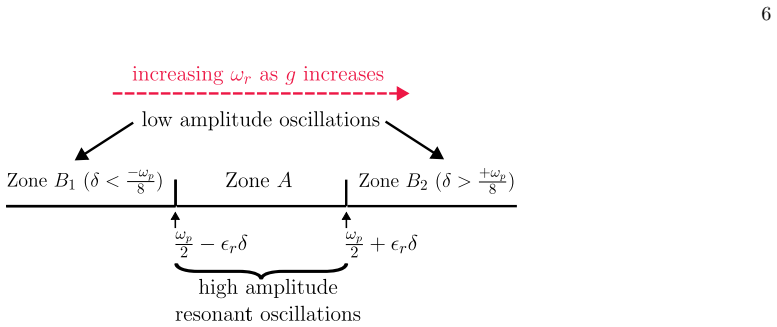
On the paper's own terms, the discovery is that a high-frequency linear drive $G(t)=-g\cos\Omega t$ with $\Omega\gg\omega_0,\omega_p$ does not merely add a perturbing wiggle: after fast-scale averaging it renormalizes the oscillator. The effective natural frequency becomes $\omega_r^2=\omega_0^2+3\lambda g^2/(2\Omega^4)$, the effective parametric strength becomes $\epsilon_r=\epsilon\omega_0^2/\omega_r^2$, and the drive disappears from the slow equations except through these renormalized parameters. Near the primary subharmonic resonance ($\omega_p\approx 2\omega_0$), the boundary of the unstable zone is set by a critical value of the position variance $$V_{0c}=\frac{\omega_p\epsilon}{3\$\lambda$}\frac{\$omega_0^{2}$}{\$omega_0^{2}$+\frac{3\$\lambda$ $g^{2}$}{2\$\Omega$^4}}\left(\frac{\omega_p}{8}-\delta\right),$$ with $\delta$ the detuning. For $V_0<V_{0c}$ the resonant large-amplitude solution is a saddle; for $V_0>V_{0c}$ that solution ceases to exist and motion becomes low-amplitude. Because the denominator grows with $g$, increasing the fast-drive strength lowers $V_{0c}$, shrinking the unstable zone and suppressing the amplitude of both $\langle X\rangle$ and $V$; the paper shows this both in the slow-flow amplitude equations and in direct numerical integration of the effective equations.
Load-bearing premise
The control law's load-bearing premise is that the quantum state remains Gaussian throughout the resonance zone, so skewness $S$ and the fourth-moment condition $K_1=3V^2$ can be imposed; if higher moments feed back into the variance before the transition, the predicted $V_{0c}(g,\Omega)$ will not describe the actual quantum oscillator.
Editorial extensions
If this is right
- For a fixed initial fluctuation level $V_0$, increasing the fast-drive strength $g$ lowers the threshold $V_{0c}$, so the system can be pushed from the unstable resonance zone into low-amplitude periodic motion without retuning the parametric pump.
- The mapping to an effective undriven oscillator with parameters $\omega_r$ and $\epsilon_r$ means the high-frequency drive acts as a single knob that renormalizes both the natural frequency and the parametric strength of the truncated quantum dynamics.
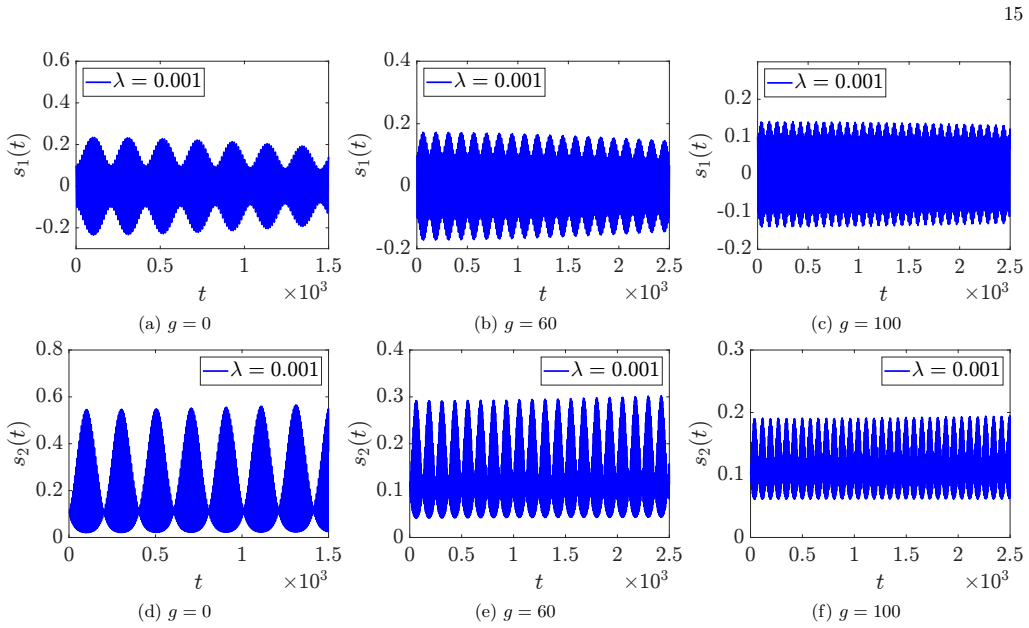
- Outside the resonance zone, the drive stretches the slow amplitude-modulation period: for the paper's parameter set the period grows from about 305 to 774 as $g$ goes from 0 to 400, because $\epsilon_r$ drops.
- In the resonance zone the drive adds a contribution to the squared oscillation amplitude proportional to $g^2/\Omega^4$ that is not enhanced by $1/\lambda$, so even a weakly nonlinear oscillator can have its resonant amplitude suppressed by strong fast driving.
- The quenching effect of $g$ is strongest for weak nonlinearity; as $\lambda$ grows, the critical $g$ needed to leave the resonance zone becomes smaller but the overall suppression of $\langle X\rangle$ becomes less complete.
Reading between the lines
- A testable extension beyond the paper is an exact simulation of the full quantum Hamiltonian for the parameters of Fig. 7: matching the predicted $V_{0c}(g)$ transition would confirm the Gaussian closure, while a discrepancy would show precisely where skewness or kurtosis feedback matters.
- Because the renormalization depends only on the combination $g/\Omega^2$, a design rule implicit in Eq. (25) is that lowering the fast-drive frequency while keeping it far above $\omega_0$ is equivalent to raising its amplitude; the paper does not state this pairing as a design principle.
- The same averaging mechanism should apply to higher subharmonic resonances, with $\omega_p/8-\delta$ replaced by the corresponding zone edge; the paper deliberately stops at the primary resonance, so this remains an unproven but natural extension.
- Adding a thermal bath would likely shift and smear the sharp threshold $V_{0c}$; since dissipation is excluded, an experimentally meaningful prediction is that the control effect survives only when bath-induced variance stays below the renormalized threshold.
Signed reviews
Editorial analysis
A structured set of objections, weighed in public.
Referee Report
Summary. The manuscript studies the Hamiltonian (6), a quantum nonlinear parametric oscillator with a quartic nonlinearity and an additional high-frequency drive G(t)X. The authors derive Ehrenfest-style equations for the first two moments of position, close the hierarchy by setting skewness S=0 and kurtosis K1=3V^2, and then apply Blekhman time-scale separation to obtain effective equations (12) for the slow variables s1 and s2. A Krylov-Bogoliubov analysis of these effective equations yields the flow equations (17)-(21) and a critical variance V0c in Eq. (25) that decreases with the high-frequency drive amplitude g and frequency Omega. The paper interprets this as external control of the quantum-fluctuation-driven instability and presents numerical solutions of the effective equations (12) and of the flow equations in Sec. V for the resonance zone and for the two off-resonance zones B1 and B2. The central claim is that V0c(g,Omega) can be externally tuned and that the amplitude of <X> is suppressed for g>0.
Significance. If the derivation were rigorous, the paper would provide a genuinely useful and testable prediction: an explicit, parameter-free formula (25) for the dependence of the instability threshold on the high-frequency drive, with no fitted constants. The extension of Blekhman averaging to a coupled system of moment equations is also of methodological interest. The authors are transparent about the Gaussian closure and about the absence of dissipation, and they provide detailed flow equations and a broad numerical survey. However, the value of these contributions is conditional on the validity of the Blekhman reduction, which is the main point of concern below.
major comments (3)
- [Appendix B, Eq. (B10)] The derivation of the effective equations is not controlled. The fast-variable equation (B10) contains the explicitly time-growing terms -(6 lambda g^2 / Omega^3) z t sin(2 Omega t) and 8 lambda z^2 t. The text dismisses them because lambda is small, but for the parameters used in Sec. V (lambda=0.001, g=200, Omega=5) the coefficient lambda g^2 / Omega^3 is 0.32, so the discarded terms are O(1) after t approximately 3, while the simulations run to t approximately 10^3 to 10^4. Moreover, the linearized solution psi2 = -(a0/delta) sin(delta t + eta) with delta = sqrt(6 lambda g^2 / Omega^4) is not fast: delta is much smaller than Omega, so its average over one period 2 pi / Omega is not zero, violating the constraint <psi2>_f = 0 that underlies Eq. (B7). Because Eq. (12), and hence Eq. (25), are obtained from this averaging, the central g-dependence of V0c is not supported by a controlled derivation or by an independent check.
- [Sec. V, numerical validation] All numerical evidence in Sec. V is obtained by integrating the effective equations (12) and the flow equations (17)-(21) alone; the pre-averaged truncated hierarchy (10) is never solved, and no direct quantum simulation is reported. Thus the numerics demonstrate the behavior of the averaged model but cannot detect a failure of the Blekhman reduction that produces Eq. (25). The authors acknowledge in Sec. VI that direct quantum simulation is needed to test the validity of the truncation, yet the abstract states that the theoretical predictions are 'validated through numerical simulations.' At minimum, the authors should integrate Eq. (10) with the same parameters and compare the envelope and variance to the effective equations, or provide an independent error estimate for the averaging.
- [Sec. II.A, Eq. (10), and Sec. VI] The Gaussian closure S=0, K1=3V^2 is imposed before the resonance analysis and assumed to hold throughout the dynamics. In the resonance zone the flow equations show V0(t) growing to O(10) with strongly aperiodic motion (Fig. 4), so the moment hierarchy is not in a regime where Gaussianity is evident. The paper does not quantify the feedback of skewness and excess kurtosis on V, even though Sec. VI explicitly lists their omission as a limitation. Since the critical threshold V0c in Eqs. (24)-(25) is defined by the fixed point of the variance equation under this closure, the central control law is contingent on an assumption that is untested in precisely the regime of interest. A consistency check closing the hierarchy at the next order, or a numerical comparison with a hierarchy that retains S and K1, would be needed to support the claim.
minor comments (5)
- [Sec. VI] The name 'Bleckhman' should be 'Blekhman'.
- [Sec. II, after Eq. (8)] The notation K1 is used for the fourth central moment even though K_n was defined for n>3; this is confusing and should be relabeled, for example as K4.
- [Appendix A, Eq. (A1)] The Hamiltonian in Eq. (A1) is written with F(t)=1+epsilon cos Omega t, whereas the main text defines F(t)=1+epsilon cos omega_p t and reserves Omega for the high-frequency drive; this discrepancy should be corrected.
- [Sec. III] The sentence 'the influence of the FFT has subsumed' appears to be a typo for 'HFS'.
- [Fig. 7] The axis labels render as '6=0:001' instead of 'lambda=0.001'; the figure should be regenerated.
Circularity Check
No circularity: Eq. (25) is derived from the averaged flow equations by algebra, with no fitted parameter renamed as a prediction; the numerics solve the same effective equations, a validation limitation the paper acknowledges, not a circular reduction.
full rationale
The central control law V0c(g) in Eq. (25) follows by setting B^2=0 in the fixed point Eq. (22), using the closed-form expressions epsilon_r = epsilon*omega0^2/(omega0^2+3*lambda*g^2/(2*Omega^4)) and omega_r^2 = omega0^2 + 3*lambda*<psi1^2>_f = omega0^2 + 3*lambda*g^2/(2*Omega^4). No parameter is fitted to Eq. (25) or to the numerical data; the flow equations (17)-(21) are derived from the effective equations (12), and Eq. (25) is an analytic consequence of their fixed-point structure. The numerical section integrates Eq. (12) directly, so it checks the KBM slow-flow reduction against the same effective model; it does not independently validate the moment closure S=0, K1=3V^2 or the Blekhman averaging. The paper itself notes in Sec. VI that the hierarchy "may be improved by deferring the closure at higher ordered correlators" and that direct quantum simulation is needed to test validity, which is an honest limitation rather than circularity. The self-citations [44-47] are only examples of Blekhman averaging in the literature and are not load-bearing; the truncation follows the external Ref. [39]. The Appendix B step of dropping secular terms and treating psi2 as fast although delta << Omega is a potential technical error, but it does not make the derived result equivalent to its own input; it is an uncontrolled approximation, not a circular reduction. Therefore no circular step is established.
Assumptions & free parameters
assumptions (4)
- domain assumption The moment hierarchy is closed by setting skewness S=0 and kurtosis K1=3V^2, preserving a Gaussian state.
- domain assumption The Blekhman inertial approximation: the fast components satisfy ddot(psi_j) >> dot(psi_j) >> psi_j, so psi_1 is approximately -g cos(Omega t)/Omega^2 and psi_2 is treated as small or slow.
- domain assumption The system is closed and dissipationless; coupling to a thermal bath is excluded.
- domain assumption Small detuning and weak parametric strength: |Delta| << omega_0 and {epsilon, lambda <X^2>} << omega_0^2.
Cite this review
Pith. "Pith review of Controlling the effect of quantum fluctuations in a driven nonlinear parametric oscillator." pith.science (2026). https://pith.science/paper/2XVSWEAH
@misc{pith2026250501373,
  author       = {Pith},
  title        = {Pith review of: Controlling the effect of quantum fluctuations in a driven nonlinear parametric oscillator},
  year         = {2026},
  howpublished = {\url{https://pith.science/paper/2XVSWEAH}},
  note         = {Machine review of arXiv:2505.01373}
}
read the original abstract
This study investigates the interplay between a high-frequency external forcing and the intrinsic dynamics of a quantum nonlinear parametric oscillator. To analyze this system, classical equations of motion of the averages of quantum operators are derived and solved by employing suitable truncation schemes and the Blekhman perturbation method. It is observed that quantum fluctuations and oscillation amplitudes within the parametric resonance zone can be modulated through the fast external periodic forcing. Moreover, the influence of the strength of driving on the overall system dynamics is systematically explored. Finally, the theoretical predictions are validated through numerical simulations, establishing the reliability of the developed framework.
Figures


Figures from the paper (7 more)


Reference graph
Works this paper leans on
-
[39]
Peano, New Journal of Physics 16, 015011 (2014)
V. Peano, New Journal of Physics 16, 015011 (2014)
work page 2014
-
[1]
effective description of the original dynamics
In the light of such advances, one can ask the following questions: (a) What is the role of quantum fluctuations in a nonlinear parametric oscillator driven by a high-frequency signal, specifically around the instability zones? (b) What theoretical methods are suitable to probe such quantum dynamics when the driving is at time scales much faster than any ...
-
[2]
+ 3λ(s1 +ψ1)(s2 +ψ2) =g cos(Ωt). (B1) Taking the average of the above equation, while considering that the slow component remains nearly constant over the fast time scale, the following is obtained as ¨s1 +⟨ ¨ψ1⟩ +ω2 0F (t)(s1 +⟨ψ1⟩) +λ(s3 1 + 3s2 1⟨ψ1⟩ + 3s1⟨ψ2 1⟩ +⟨ψ3 1⟩) + 3λ(s1 +⟨ψ1⟩)(s2 +⟨ψ2⟩) =⟨g cos(Ωt)⟩ (B2) By subtracting Eq. (B2) from Eq. (B1), ...
-
[3]
Consequently, the effective slow motion of the fluctuation is obtained as ...s 2 + 4ω2 rFr(t) ˙s2 =−2ω2 r ˙Fr(t)s2− 12λs2 1 ˙s2− 18λ ˙s2s2− 12λs2 ˙s1s1, (B13) Eqs. (B5) and (B13) make up Eq. (12) in the main text
-
[4]
D. Jordan and P. Smith, Nonlinear Ordinary Differential Equations: An Introduction to Dynamical Systems , Oxford applied and engineering mathematics (Oxford University Press, 1999)
work page 1999
-
[5]
S. H. Strogatz, Nonlinear dynamics and chaos: with applications to physics, biology, chemistry, and engineering (Chapman and Hall/CRC, 2024)
2024
-
[6]
H. G. Schuster, Reviews of Nonlinear Dynamics and Complexity (Wiley Online Library, 2008)
work page 2008
-
[7]
J. F. Rhoads, S. W. Shaw, and K. L. Turner, Journal of Dynamic Systems, Measurement, and Control 132, 034001 (2010), https://asmedigitalcollection.asme.org/dynamicsystems/article-pdf/132/3/034001/5653925/034001 1.pdf
work page 2010
Show all 62 references
-
[8]
M. R. Paul and M. C. Cross, Phys. Rev. Lett. 92, 235501 (2004)
2004
-
[9]
L. G. Villanueva, R. B. Karabalin, M. H. Matheny, E. Kenig, M. C. Cross, and M. L. Roukes, Nano letters 11, 5054 (2011)
2011
-
[10]
Ebrahim-Zadeh and M
M. Ebrahim-Zadeh and M. Dunn, Handbook of optics 4, 2201 (2000)
2000
-
[11]
T. Hao, Q. Cen, S. Guan, W. Li, Y. Dai, N. Zhu, and M. Li, Light: Science & Applications 9, 102 (2020)
2020
-
[12]
M. T. Caccamo and S. Magaz` u, Scientific Reports13, 22984 (2023)
2023
-
[13]
Magaz` u and M
S. Magaz` u and M. T. Caccamo, Scientific Reports14, 24657 (2024)
2024
-
[14]
Paul, Rev
W. Paul, Rev. Mod. Phys. 62, 531 (1990)
1990
-
[15]
L. S. Brown, Phys. Rev. Lett. 66, 527 (1991)
1991
-
[16]
J. I. Cirac and P. Zoller, Phys. Rev. Lett. 74, 4091 (1995)
1995
-
[17]
J. I. Cirac and P. Zoller, Nature 404, 579 (2000)
2000
-
[18]
Bachtold, J
A. Bachtold, J. Moser, and M. I. Dykman, Rev. Mod. Phys. 94, 045005 (2022)
2022
-
[19]
I. Katz, A. Retzker, R. Straub, and R. Lifshitz, Phys. Rev. Lett. 99, 040404 (2007)
2007
-
[20]
Regal, J
C. Regal, J. Teufel, and K. Lehnert, Nature Physics 4, 555 (2008)
2008
-
[21]
Chang, K
D. Chang, K. Ni, O. Painter, and H. Kimble, New Journal of Physics 14, 045002 (2012)
2012
-
[22]
A. H. Safavi-Naeini, J. Chan, J. T. Hill, T. P. M. Alegre, A. Krause, and O. Painter, Phys. Rev. Lett. 108, 033602 (2012)
2012
-
[23]
Teklu, A
B. Teklu, A. Ferraro, M. Paternostro, and M. G. Paris, EPJ Quantum Technology 2, 1 (2015). 19
2015
-
[24]
R. D. Delaney, A. P. Reed, R. W. Andrews, and K. W. Lehnert, Phys. Rev. Lett. 123, 183603 (2019)
2019
-
[25]
K. L. Turner, S. A. Miller, P. G. Hartwell, N. C. MacDonald, S. H. Strogatz, and S. G. Adams, Nature 396, 149 (1998)
1998
-
[26]
R. S. Zounes and R. H. Rand, International Journal of Non-Linear Mechanics 37, 43 (2002)
2002
-
[27]
B. E. DeMartini, H. E. Butterfield, J. Moehlis, and K. L. Turner, Journal of Microelectromechanical Systems 16, 1314 (2007)
2007
-
[28]
Kovacic and M
I. Kovacic and M. J. Brennan, The Duffing equation: nonlinear oscillators and their behaviour (John Wiley & Sons, 2011)
2011
-
[29]
Q. Wang, Y. Yang, and X. Zhang, Chaos, Solitons & Fractals 137, 109832 (2020)
2020
-
[30]
J. Yang, S. Rajasekar, and M. A. Sanju´ an, Physics Reports 1067, 1 (2024)
2024
-
[31]
Wiggins, Physics Letters A 124, 138 (1987)
S. Wiggins, Physics Letters A 124, 138 (1987)
1987
-
[32]
R. J. Cook, D. G. Shankland, and A. L. Wells, Phys. Rev. A 31, 564 (1985)
1985
-
[33]
H¨ anggi and C
P. H¨ anggi and C. Zerbe, inAIP Conference Proceedings, Vol. 285 (American Institute of Physics, 1993) pp. 481–486
1993
-
[34]
Zerbe and P
C. Zerbe and P. H¨ anggi, Phys. Rev. E52, 1533 (1995)
1995
-
[35]
Dykman, M
M. Dykman, M. Marthaler, and V. Peano, Physical Review A—Atomic, Molecular, and Optical Physics 83, 052115 (2011)
2011
-
[36]
Zhang and M
Y. Zhang and M. Dykman, Physical Review A 95, 053841 (2017)
2017
-
[37]
Z. Lin, Y. Nakamura, and M. Dykman, Physical Review E 92, 022105 (2015)
2015
-
[38]
Marthaler and M
M. Marthaler and M. Dykman, Physical Review A—Atomic, Molecular, and Optical Physics 76, 010102 (2007)
2007
- [40]
-
[41]
D. K. Boneß, W. Belzig, and M. I. Dykman, arXiv preprint arXiv:2501.07562 (2025)
2025 arXiv
-
[42]
Sarkar and J
P. Sarkar and J. K. Bhattacharjee, Physical Review E 102, 052204 (2020)
2020
-
[43]
L. E. Ballentine, Y. Yang, and J. P. Zibin, Phys. Rev. A 50, 2854 (1994)
1994
-
[44]
Ballentine and S
L. Ballentine and S. McRae, Physical Review A 58, 1799 (1998)
1998
-
[45]
L. E. Ballentine, Phys. Rev. A 65, 062110 (2002)
2002
-
[46]
I. I. Blekhman, Vibrational mechanics: nonlinear dynamic effects, general approach, applications (World Scientific, 2000)
2000
-
[47]
S. Roy, D. Das, and D. Banerjee, The European Physical Journal B 93, 1 (2020)
2020
-
[48]
S. Roy, D. Das, and D. Banerjee, International Journal of Non-Linear Mechanics 135, 103771 (2021)
2021
-
[49]
S. Roy, D. Das, and D. Banerjee, arXiv preprint arXiv:2205.08091 (2022)
2022 arXiv
-
[50]
S. Roy, A. Ray, and A. R. Chowdhury, Chaos, Solitons & Fractals 174, 113857 (2023)
2023
-
[51]
Ullner, A
E. Ullner, A. Zaikin, J. Garcıa-Ojalvo, R. Bascones, and J. Kurths, Physics Letters A 312, 348 (2003)
2003
-
[52]
A. A. Zaikin, L. L´ opez, J. Baltan´ as, J. Kurths, and M. A. F. Sanjuan, Physical Review E 66, 011106 (2002)
2002
-
[53]
Olusola, O
O. Olusola, O. Shomotun, U. Vincent, and P. McClintock, Physical Review E 101, 052216 (2020)
2020
-
[54]
Pal and J
A. Pal and J. K. Bhattacharjee, Physics Open 6, 100047 (2021)
2021
-
[55]
Rajasekar, K
S. Rajasekar, K. Abirami, and M. A. F. Sanjuan, Chaos: An Interdisciplinary Journal of Nonlinear Science 21 (2011)
2011
-
[56]
Chizhevsky, E
V. Chizhevsky, E. Smeu, and G. Giacomelli, Physical review letters 91, 220602 (2003)
2003
-
[57]
Sarkar, D
P. Sarkar, D. Banerjee, S. Paul, and D. S. Ray, Phys. Rev. E 106, 024203 (2022)
2022
-
[58]
Biswas and J
S. Biswas and J. K. Bhattacharjee, Nonlinear Dynamics 96, 737 (2019)
2019
-
[59]
Biswas, P
S. Biswas, P. Chowdhury, and J. K. Bhattacharjee, Communications in Nonlinear Science and Numerical Simulation 93, 105537 (2021)
2021
-
[60]
Sarkar, R
P. Sarkar, R. Chattopadhyay, and J. K. Bhattacharjee, Physical Review E 110, 034207 (2024)
2024
-
[61]
Marthaler and M
M. Marthaler and M. Dykman, Physical Review A—Atomic, Molecular, and Optical Physics 73, 042108 (2006)
2006
-
[62]
J. M. Horowitz and T. R. Gingrich, Nature Physics 16, 15 (2020)
2020
Reviewed August 16, 2026 · model on record in the stance chip above.
Discussion (0). Continue with ORCID to comment.