REVIEW 3 major objections 6 minor 93 references
An extremely metal-poor Lyman $\alpha$ emitter candidate at $z=6$ revealed through absorption spectroscopy
T0 review · 3 major / 6 minor · reviewed 2026-08-16 · deepseek-v4-flash
Pith's one-line read A z=6 Lyman-alpha emitter may be the most metal-poor galaxy yet seen.
desk verdict A careful, well-presented candidate: absorption-based [Z/H]<-3 for a proximate LAE at z=6, but the limit inherits an unquantified N_HI that makes the 'extremely metal-poor' claim a placeholder until confirmation. read the letter →
The pith
A machine-rendered reading of the paper's core claim, the machinery that carries it, and where it could break.
The reading
What carries the argument
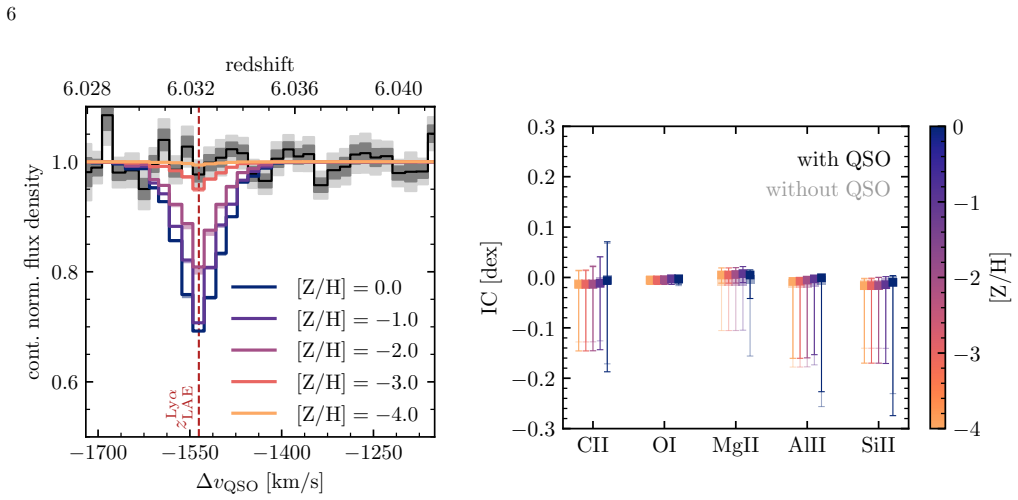
The argument rides on three linked pieces. First is the LAE itself: a compact Ly-$\alpha$ line detected in the MUSE data cube at $z_{\rm LAE}=6.0323$, spatially offset 29 pkpc from the quasar, whose redshift fixes where an associated absorber would sit. Second is the Voigt-profile damping-wing model of the quasar's Ly-$\alpha$ transmission, which at that redshift requires a sub-DLA (a neutral-hydrogen column between $\log N_{\rm HI}/{\rm cm}^{-2}\sim19$ and $20.3$, optically thick to Ly-$\alpha$ but not fully self-shielding) with $\log N_{\rm HI}/{\rm cm}^{-2}\approx19.7$ and $b\lesssim50$ km/s. Third is the metallicity measurement: low-ionization absorption regions in the continuum-normalized quasar spectrum are stacked, and forward-modeled Voigt profiles with solar abundance ratios and photoionization ionization corrections show that the absence of absorption at the LAE redshift pushes the metallicity below $[Z/H] < -3$.
What would settle it
A spectrum with roughly double the current exposure time and higher resolution that reaches a 3-$\sigma$ sensitivity below $[Z/H]=-3$ for Si II 1260 at $z=6.0323$ would settle the claim: detection of those lines would raise the metallicity limit, while a resolved damping-wing profile with an independently fitted column density very different from $10^{19.7}$ cm$^{-2}$ would break the association. A JWST spectrum of the LAE itself that measures emission-line metallicities or reveals a different redshift for the continuum source would also test the identification.
Extended reading notes
Core claim
The central claim is that the damping-wing-like profile in the spectrum of quasar PSO J158-14 is produced by a proximate sub-damped Lyman-$\alpha$ absorption system at the redshift of a newly identified Lyman-$\alpha$ emitter, rather than by a large neutral fraction in the intergalactic medium. The Ly-$\alpha$ line from the foreground source at $z_{\rm LAE}=6.0323$ sits at the outer edge of the quasar's proximity zone, and modeling the absorption as a single Voigt component at that redshift yields $\log N_{\rm HI}/{\rm cm}^{-2}\approx19.7$ for a broadening parameter $b=5$ km/s, a value typical of low-metallicity absorbers. The deep co-added spectrum shows no low-ionization metal absorption (Si II, C II, O I, Al II, Mg II) at the LAE redshift, and stacking those line regions with inverse-variance weighting gives an upper limit $[Z/H] < -3$ after applying photoionization-based ionization corrections of $\lesssim0.3$ dex. The paper therefore identifies this system as an extremely metal-poor galaxy candidate whose circumgalactic gas may be essentially unenriched, and notes that the absorber truncates the quasar's proximity zone, so quasar lifetimes inferred from that zone are underestimated.
Load-bearing premise
The result rests on the assumption that the damping-wing-like shape in the quasar spectrum is caused by a single foreground sub-DLA at the LAE's redshift with column density $\log N_{\rm HI}/{\rm cm}^{-2}\approx19.7$, not by a neutral IGM patch, continuum mis-normalization, or another absorber; the $[Z/H]$ limit scales directly with that assumed column density, for which no uncertainty is quoted.
Editorial extensions
If this is right
- If confirmed at higher resolution, this becomes the most metal-poor absorption-selected system known at $z\sim6$, with a metallicity below one-thousandth of the solar value.
- The quasar's Ly-alpha damping wing would be explained by the foreground absorber, removing the need to invoke a large neutral IGM patch along this sightline.
- Because the absorber truncates the quasar's proximity zone, quasar lifetimes inferred from the size of that zone for PSO J158-14 are underestimates.
- This is the lowest absorption-based metallicity limit yet reported for a high-redshift galaxy candidate, lower than emission-line-based limits such as $[O/H]<-2.4$ for other metal-poor systems, although emission and absorption probe different gas phases.
- Deeper, higher-resolution spectroscopy of the quasar could detect the weak metal lines predicted at $[Z/H]\sim-3$ and directly test the association of the absorption with the LAE.
Reading between the lines
- This detection suggests a search strategy that absorption-line surveys have been missing: locate LAEs at the edges of quasar proximity zones in deep integral-field data, then target the quasars for metallicity stacking; metal-selected surveys would systematically skip such pristine systems.
- If the LAE's gas is genuinely this metal-poor, its Ly-alpha emission could be powered by very young stars or by fluorescence from the quasar; observations with JWST targeting the LAE itself could look for Population III signatures such as strong He II emission, which the current data do not cover.
- The sightline at 29 pkpc likely probes the galaxy's circumgalactic medium rather than its star-forming body, so the galaxy's overall stellar metallicity could be higher than $[Z/H]<-3$; the paper's own caution about emission-versus-absorption phase differences points the same way.
- A natural test would be to apply the same MUSE-plus-stacking method to other $z\sim6$ quasars with unexplained damping wings, to estimate how often such metal-poor proximate absorbers masquerade as neutral IGM patches.
Signed reviews
Editorial analysis
A structured set of objections, weighed in public.
Referee Report
Summary. This paper reports the discovery of a Lyα emitter (LAE) candidate at z=6.0323 in MUSE observations of the quasar PSO J158-14 at z_QSO=6.0685, at a projected separation of about 29 pkpc. The authors argue that this LAE is associated with a proximate sub-DLA with log N_HI ~ 19.7 that produces the quasar's damping-wing-like Lyα transmission profile. Using 10.2 hours of co-added Magellan/FIRE and VLT/X-Shooter spectroscopy, they stack low-ionization absorption lines at the LAE redshift, detect no absorption, and after applying CLOUDY ionization corrections derive a metallicity limit of [Z/H] < -3. They conclude that this is an extremely metal-poor galaxy candidate that may host signatures of Population III stars, and note that the quasar's proximity zone may be truncated by the absorber.
Significance. If confirmed, this would be a notable result: an absorption-based metallicity limit below [Z/H] = -3 at z ~ 6, deeper than current emission-line-based metal-poor galaxy constraints at high redshift, and a rare case where a MUSE-detected LAE is plausibly associated with a proximate absorber. The analysis is transparent in several respects: the co-added spectra are made public, the stacking procedure is clearly described, foreground absorption systems are masked, and the CLOUDY grid includes the quasar radiation field. The principal weakness is that the headline metallicity limit inherits a direct, unquantified dependence on the H I column density derived from the damping-wing fit, and the statistical confidence level of the limit is not stated. These issues are fixable but load-bearing for the central claim.
major comments (3)
- [Sec. 2.1 and Eq. (1)] The H I column density log N_HI = 19.7 is presented as a single-value Voigt-profile fit to the damping wing, with no quoted uncertainty, no fit statistic, and no marginalization over continuum normalization errors or a residual neutral IGM contribution. Because Eq. (1) translates log N_HI directly into [Z/H], a 0.5 dex lower column (for example log N_HI = 19.2, which appears compatible with the observed profile given the noise and the IGM degeneracy) would shift the metallicity limit to [Z/H] < -2.5, which would no longer meet the 'extremely metal-poor' threshold of -3. Please provide a posterior or delta-chi-squared grid over N_HI that marginalizes over continuum and IGM parameters, and quote the resulting column-density range.
- [Sec. 2.1] The absorber is assumed to be at the Lyα centroid redshift z_LAE = 6.0323, but Lyα emission centroids are often offset from the systemic velocity by hundreds of km/s, and the absorption system's systemic redshift is not independently measured. If the true absorber redshift differs from the assumed value, the stacked metal-line search in Fig. 4 is diluted and the non-detection may not constrain gas associated with the LAE. Please quantify the allowed velocity offset, for example by scanning the stack over a range of redshifts or by using an additional redshift tracer.
- [Sec. 2.2 and Fig. 4] The upper limit [Z/H] < -3 is stated without a confidence level. The description that no absorption is seen 'beyond the noise level' does not specify whether this is a 1, 2, or 3 sigma limit, and the limit does not appear to include systematic errors from continuum normalization or from the uncertainty in N_HI. Please state the confidence level and provide the full error budget, including the propagation of the N_HI uncertainty into the final limit.
minor comments (6)
- [Abstract] The abstract says '>10 hour medium-resolution spectrum' while the body quotes 10.2 hours; please make the numbers consistent.
- [Eq. (1)] The notation log(N_Z/N_HI)_sun is ambiguous because the left-hand side refers to a specific ion column density N_Zi while the solar reference is per element; please define the ionization state and element explicitly and clarify the meaning of [Z/H] as a total metal-to-hydrogen ratio.
- [Sec. 2.1] The statement that the inferred N_HI is insensitive to b for b < 50 km/s is not demonstrated; a short description of how N_HI changes with b, or a small fit grid, would strengthen the claim.
- [Fig. 1 caption] The blue Voigt profile mentioned in the text is not explicitly labeled in the figure caption; please add a label so the reader can identify it.
- [Sec. 3] The statement that the quasar lifetime estimate is underestimated is speculative and is not quantitatively supported by the data presented here; please soften or support this claim.
- [Sec. 2.1] The <0.2% probability of an IGM neutral patch is cited from Satyavolu et al. (2023), but this is a model-dependent estimate; please note that this prior does not automatically cover all continuum mis-normalization or small-scale IGM fluctuations.
Circularity Check
No significant circularity found: the [Z/H]<−3 limit rests on an independent metal-line non-detection, with the H I column as a standard fitted input rather than a re-labeled prediction.
full rationale
The derivation of the central claim is self-contained in the sense relevant to circularity. The reported metallicity limit has two independent inputs: (i) the H I column density log N_HI/cm^-2 ≈ 19.7 from a Voigt/damping-wing fit to the quasar's Lyα transmission profile, and (ii) the non-detection of low-ionization metal absorption in a 10.2-hour stacked spectrum. Equation (1) is a forward-modeling abundance conversion, not a tautology: given N_HI and solar abundance ratios, the absence of metal lines sets an upper limit on [Z/H], and the paper never uses [Z/H] to infer N_HI nor uses the metal non-detection to identify the LAE. The LAE itself is identified from independent MUSE emission-line data and HST non-detections, with its redshift matching the assumed absorber position. There are self-citations in the argument—notably Satyavolu et al. 2023 for the <0.2% probability of an IGM neutral patch and Durovčíková et al. 2020 for continuum fitting—but these are not load-bearing in a circular way: the cited probability is a simulation-based external result with stated assumptions, and the central metal-line non-detection is a new observable presented in this paper. The paper also explicitly flags that high-resolution spectroscopy is required to confirm the weak metal lines and that direct LAE spectroscopy is needed to confirm the metallicity. The main caveat is systematic rather than circular: log N_HI has no quoted uncertainty, and because Eq. (1) is linear in log N_HI, a lower true column would weaken the [Z/H] limit. That is a robustness concern, not a reduction of the result to its own inputs.
Assumptions & free parameters
free parameters (2)
- H I column density log N_HI =
19.7 (dex)
- Doppler broadening parameter b =
5 km/s
assumptions (4)
- domain assumption The detected single emission line is Ly-alpha at z = 6.0323
- domain assumption The absorber is physically located at the LAE redshift and at a projected distance of 29 pkpc
- domain assumption Solar abundance pattern for converting metal column density limits to [Z/H]
- domain assumption CLOUDY photoionization models with HM12 UV background, CMB, cosmic rays, and quasar radiation describe the absorber ionization state
Cite this review
Pith. "Pith review of An extremely metal-poor Lyman $\alpha$ emitter candidate at $z=6$ revealed through absorption spectroscopy." pith.science (2026). https://pith.science/paper/I35LAKIF
@misc{pith2026250501499,
  author       = {Pith},
  title        = {Pith review of: An extremely metal-poor Lyman $\alpha$ emitter candidate at $z=6$ revealed through absorption spectroscopy},
  year         = {2026},
  howpublished = {\url{https://pith.science/paper/I35LAKIF}},
  note         = {Machine review of arXiv:2505.01499}
}
abstract
We report the discovery of a Lyman $\alpha$ emitter (LAE) candidate in the immediate foreground of the quasar PSO J158-14 at $z_{\rm QSO}=6.0685$ at a projected distance $\sim29\ {\rm pkpc}$ that is associated with an extremely metal-poor absorption system. This system was found in archival observations of the quasar field with the Very Large Telescope/Multi-Unit Spectroscopic Explorer (VLT/MUSE) and was previously missed in searches of absorption systems using quasar absorption line spectroscopy as it imparts no detectable metal absorption lines on the background quasar spectrum. The detected Ly$\alpha$ emission line at a redshift of $z_{\rm LAE}=6.0323$ is well aligned with the outer edge of the quasar's proximity zone and can plausibly cause its observed damping wing if it is associated with a proximate sub-damped Ly$\alpha$ absorption system with a column density of $\log {N_{\rm HI} / {\rm cm}^{-2}} \approx 19.7$. A $>10$ hour medium-resolution spectrum of the quasar observed with the Magellan/Folded-port InfraRed Echellette (FIRE) and VLT/X-Shooter spectrographs reveals a metallicity constraint of ${\rm [Z/H]} < -3$. Such low metallicity makes this system an extremely metal-poor galaxy candidate and provides an exciting site to study possible signatures of Population III stars.
Figures


Figures from the paper (1 more)
Reference graph
Works this paper leans on
-
[1]
, " * write output.state after.block = add.period write newline
ENTRY address archivePrefix author booktitle chapter doi edition editor eprint howpublished institution journal key month number organization pages publisher school series title misctitle type volume year version url label extra.label sort.label short.list INTEGERS output.state before.all mid.sentence after.sentence after.block FUNCTION init.state.consts ...
-
[2]
write newline
" write newline "" before.all 'output.state := FUNCTION format.url url empty "" new.block "" url * "" * if FUNCTION format.eprint eprint empty "" archivePrefix empty "" archivePrefix "arXiv" = new.block " " eprint * " " * new.block " " eprint * " " * if if if FUNCTION format.doi doi empty "" " " doi * " " * if FUNCTION format.pid doi empty eprint empty ur...
-
[3]
؋ v6ɠ S|k |Dܔi ڈ #wS'?X C( x- t^ލa /YxɂS ';GĆ G@gK O N H N H N ȝ ߏ4dS X +H\
thebibliography [1] 20pt to REFERENCES 6pt =0pt -12pt 10pt plus 3pt =0pt =0pt =1pt plus 1pt =0pt =0pt -12pt =13pt plus 1pt =20pt =13pt plus 1pt \@M =10000 =-1.0em =0pt =0pt 0pt =0pt =1.0em @enumiv\@empty 10000 10000 `\.\@m \@noitemerr \@latex@warning Empty `thebibliography' environment \@ifnextchar \@reference \@latexerr Missing key on reference command E...
arXiv 2020
-
[4]
Abel, T., Bryan, G. L., & Norman, M. L. 2002, Science, 295, 93, 10.1126/science.295.5552.93
-
[5]
Asplund, M., Grevesse, N., Sauval, A. J., & Scott, P. 2009, Annual Review of Astronomy and Astrophysics, 47, 481, 10.1146/annurev.astro.46.060407.145222
arXiv 2009
-
[6]
2010, in Ground-based and Airborne Instrumentation for Astronomy III , Vol
Bacon, R., Accardo, M., Adjali, L., et al. 2010, in Ground-based and Airborne Instrumentation for Astronomy III , Vol. 7735 (SPIE), 131--139, 10.1117/12.856027
-
[7]
2019, The Astrophysical Journal, 885, 59, 10.3847/1538-4357/ab4129
Bañados, E., Rauch, M., Decarli, R., et al. 2019, The Astrophysical Journal, 885, 59, 10.3847/1538-4357/ab4129
-
[8]
Becker, G. D., Bolton, J. S., Zhu, Y., & Hashemi, S. 2024, Monthly Notices of the Royal Astronomical Society, 533, 1525, 10.1093/mnras/stae1918
Show all 93 references
-
[9]
D., Sargent, W
Becker, G. D., Sargent, W. L. W., Rauch, M., & Calverley, A. P. 2011, The Astrophysical Journal, 735, 93, 10.1088/0004-637X/735/2/93
2011 doi
-
[10]
D., Pettini, M., Rafelski, M., et al
Becker, G. D., Pettini, M., Rafelski, M., et al. 2019, The Astrophysical Journal, 883, 163, 10.3847/1538-4357/ab3eb5
2019 doi
-
[11]
C., & Christlieb, N
Beers, T. C., & Christlieb, N. 2005, Annual Review of Astronomy and Astrophysics, 43, 531, 10.1146/annurev.astro.42.053102.134057
2005
-
[12]
Berg, T. A. M., Fumagalli, M., D'Odorico, V., et al. 2021, Monthly Notices of the Royal Astronomical Society, 502, 4009, 10.1093/mnras/stab184
2021 doi
-
[13]
Bosman, S. E. I., Fan, X., Jiang, L., et al. 2018, Monthly Notices of the Royal Astronomical Society, 10.1093/mnras/sty1344
2018 doi
-
[14]
Bosman, S. E. I., Davies, F. B., Becker, G. D., et al. 2022, Monthly Notices of the Royal Astronomical Society, 514, 55, 10.1093/mnras/stac1046
2022 doi
-
[15]
2017, Memorie della Societa Astronomica Italiana, 88, 671
Bromm, V. 2017, Memorie della Societa Astronomica Italiana, 88, 671. https://ui.adsabs.harvard.edu/abs/2017MmSAI..88..671B
2017
-
[16]
J., Katz, H., Witten, C., et al
Cameron, A. J., Katz, H., Witten, C., et al. 2024, Monthly Notices of the Royal Astronomical Society, 534, 523, 10.1093/mnras/stae1547
2024 doi
-
[17]
2000, The Astrophysical Journal, 542, L75, 10.1086/312937
Cen, R., & Haiman, Z. 2000, The Astrophysical Journal, 542, L75, 10.1086/312937
2000 doi
-
[18]
2023, Revista Mexicana de Astronomia y Astrofisica, 59, 327, 10.22201/ia.01851101p.2023.59.02.12
Chatzikos, M., Bianchi, S., Camilloni, F., et al. 2023, Revista Mexicana de Astronomia y Astrofisica, 59, 327, 10.22201/ia.01851101p.2023.59.02.12
2023 doi
-
[19]
C., Shanks, T., et al
Chehade, B., Carnall, A. C., Shanks, T., et al. 2018, Monthly Notices of the Royal Astronomical Society, 478, 1649, 10.1093/mnras/sty690
2018 doi
-
[20]
C., Rudie, G
Cooke, R., Pettini, M., Steidel, C. C., Rudie, G. C., & Nissen, P. E. 2011, Monthly Notices of the Royal Astronomical Society, 417, 1534, 10.1111/j.1365-2966.2011.19365.x
2011
- [21]
- [22]
-
[23]
L., Ryan-Weber, E., D'Odorico, V., et al
Davies, R. L., Ryan-Weber, E., D'Odorico, V., et al. 2023 b , Monthly Notices of the Royal Astronomical Society, 521, 289, 10.1093/mnras/stac3662
2023 doi
-
[24]
2018, Astronomy & Astrophysics, Volume 613, id.L2, NUMPAGES 4 /NUMPAGES pp., 613, L2, 10.1051/0004-6361/201833034
De Cia, A. 2018, Astronomy & Astrophysics, Volume 613, id.L2, NUMPAGES 4 /NUMPAGES pp., 613, L2, 10.1051/0004-6361/201833034
2018 doi
-
[25]
2018, The Astrophysical Journal, 863, L29, 10.3847/2041-8213/aad7b7
D'Odorico, V., Feruglio, C., Ferrara, A., et al. 2018, The Astrophysical Journal, 863, L29, 10.3847/2041-8213/aad7b7
2018 doi
-
[26]
D., et al
D'Odorico, V., Banados, E., Becker, G. D., et al. 2023, Monthly Notices of the Royal Astronomical Society, 523, 1399, 10.1093/mnras/stad1468
2023 doi
-
[27]
2022, Monthly Notices of the Royal Astronomical Society, 512, 2389, 10.1093/mnras/stac545
D’Odorico, V., Finlator, K., Cristiani, S., et al. 2022, Monthly Notices of the Royal Astronomical Society, 512, 2389, 10.1093/mnras/stac545
2022 doi
-
[28]
B., & Hennawi, J
Eilers, A.-C., Davies, F. B., & Hennawi, J. F. 2018, The Astrophysical Journal, 864, 53, 10.3847/1538-4357/aad4fd
2018 doi
-
[29]
F., Decarli, R., et al
Eilers, A.-C., Hennawi, J. F., Decarli, R., et al. 2020, The Astrophysical Journal, 900, 37, 10.3847/1538-4357/aba52e
2020 doi
-
[30]
Fan, X., Bañados, E., & Simcoe, R. A. 2023, Annual Review of Astronomy and Astrophysics, 61, 373, 10.1146/annurev-astro-052920-102455
2023 doi
-
[31]
A., Becker, R
Fan, X., Strauss, M. A., Becker, R. H., et al. 2006, The Astronomical Journal, 132, 117, 10.1086/504836
2006 doi
-
[32]
P., Venemans, B
Farina, E. P., Venemans, B. P., Decarli, R., et al. 2017, The Astrophysical Journal, 848, 78, 10.3847/1538-4357/aa8df4
2017 doi
-
[33]
J., Korista, K
Ferland, G. J., Korista, K. T., Verner, D. A., et al. 1998, Publications of the Astronomical Society of the Pacific, 110, 761, 10.1086/316190
1998 doi
-
[34]
Frebel, A., & Norris, J. E. 2015, Annual Review of Astronomy and Astrophysics, 53, 631, 10.1146/annurev-astro-082214-122423
2015 doi
- [35]
-
[36]
M., & Prochaska, J
Fumagalli, M., O'Meara, J. M., & Prochaska, J. X. 2011, Science, 334, 1245, 10.1126/science.1213581
2011 doi
-
[37]
2016, Monthly Notices of the Royal Astronomical Society, 455, 4100, 10.1093/mnras/stv2616
---. 2016, Monthly Notices of the Royal Astronomical Society, 455, 4100, 10.1093/mnras/stv2616
2016 doi
-
[38]
E., & Peterson, B
Gunn, J. E., & Peterson, B. A. 1965, The Astrophysical Journal, 142, 1633, 10.1086/148444
1965 doi
-
[39]
2012, The Astrophysical Journal, 746, 125, 10.1088/0004-637X/746/2/125
Haardt, F., & Madau, P. 2012, The Astrophysical Journal, 746, 125, 10.1088/0004-637X/746/2/125
2012 doi
-
[40]
2001, The Physics of Galaxy Formation, 222, 101
Haiman, Z., & Cen, R. 2001, The Physics of Galaxy Formation, 222, 101. https://ui.adsabs.harvard.edu/abs/2001ASPC..222..101H/abstract
2001
-
[41]
2024, The Astrophysical Journal, 966, 80, 10.3847/1538-4357/ad307b
Hamanowicz, A., Tchernyshyov, K., Roman-Duval, J., et al. 2024, The Astrophysical Journal, 966, 80, 10.3847/1538-4357/ad307b
2024 doi
-
[42]
J., Runnholm, A., Gronke, M., & Scarlata, C
Hayes, M. J., Runnholm, A., Gronke, M., & Scarlata, C. 2021, The Astrophysical Journal, 908, 36, 10.3847/1538-4357/abd246
2021 doi
-
[43]
E., Brammer, G
Heintz, K. E., Brammer, G. B., Watson, D., et al. 2025, Astronomy and Astrophysics, 693, A60, 10.1051/0004-6361/202450243
2025 doi
-
[44]
L., et al
Hernandez, S., Aloisi, A., James, B. L., et al. 2021, The Astrophysical Journal, 908, 226, 10.3847/1538-4357/abd6c4
2021 doi
-
[45]
Hirano, S., Hosokawa, T., Yoshida, N., Omukai, K., & Yorke, H. W. 2015, Monthly Notices of the Royal Astronomical Society, 448, 568, 10.1093/mnras/stv044
2015 doi
-
[46]
L., Aloisi, A., Heckman, T., Sohn, S
James, B. L., Aloisi, A., Heckman, T., Sohn, S. T., & Wolfe, M. A. 2014, The Astrophysical Journal, 795, 109, 10.1088/0004-637X/795/2/109
2014 doi
-
[47]
L., & Aykutalp, A
Johnson, J. L., & Aykutalp, A. 2019, The Astrophysical Journal, 879, 18, 10.3847/1538-4357/ab223e
2019 doi
-
[48]
S., Devriendt, J., & Slyz, A
Katz, H., Kimm, T., Ellis, R. S., Devriendt, J., & Slyz, A. 2023, Monthly Notices of the Royal Astronomical Society, 524, 351, 10.1093/mnras/stad1903
2023 doi
- [49]
-
[50]
S., & Glover, S
Klessen, R. S., & Glover, S. C. O. 2023, Annual Review of Astronomy and Astrophysics, 61, 65, 10.1146/annurev-astro-071221-053453
2023 doi
-
[51]
Ledoux, C., Petitjean, P., Fynbo, J. P. U., Møller, P., & Srianand, R. 2006, Astronomy & Astrophysics, 457, 71, 10.1051/0004-6361:20054242
2006 doi
-
[52]
2014, Annual Review of Astronomy and Astrophysics, 52, 415, 10.1146/annurev-astro-081811-125615
Madau, P., & Dickinson, M. 2014, Annual Review of Astronomy and Astrophysics, 52, 415, 10.1146/annurev-astro-081811-125615
2014 doi
-
[53]
Madau, P., & Rees, M. J. 2000, The Astrophysical Journal, 542, L69, 10.1086/312934
2000 doi
-
[54]
2024, Astronomy & Astrophysics, 687, A67, 10.1051/0004-6361/202347087
Maiolino, R., Übler, H., Perna, M., et al. 2024, Astronomy & Astrophysics, 687, A67, 10.1051/0004-6361/202347087
2024 doi
-
[55]
2017, Monthly Notices of the Royal Astronomical Society, 472, 772, 10.1093/mnras/stx2061
Matthee, J., Sobral, D., Darvish, B., et al. 2017, Monthly Notices of the Royal Astronomical Society, 472, 772, 10.1093/mnras/stx2061
2017 doi
-
[56]
1998, The Astrophysical Journal, 501, 15, 10.1086/305799
Miralda-Escudé, J. 1998, The Astrophysical Journal, 501, 15, 10.1086/305799
1998 doi
- [58]
-
[59]
2022, Monthly Notices of the Royal Astronomical Society, 513, 5134, 10.1093/mnras/stac1242
Nakajima, K., & Maiolino, R. 2022, Monthly Notices of the Royal Astronomical Society, 513, 5134, 10.1093/mnras/stac1242
2022 doi
-
[60]
2020, Astronomy & Astrophysics, 641, A6, 10.1051/0004-6361/201833910
Planck Collaboration , Aghanim, N., Akrami, Y., et al. 2020, Astronomy & Astrophysics, 641, A6, 10.1051/0004-6361/201833910
2020 doi
-
[61]
X., Hennawi, J
Prochaska, J. X., Hennawi, J. F., Westfall, K. B., et al. 2020, Journal of Open Source Software, 5, 2308, 10.21105/joss.02308
2020 doi
-
[62]
X., Hennawi , J., Cooke , R., et al
Prochaska , J. X., Hennawi , J., Cooke , R., et al. 2020, pypeit/PypeIt: Release 1.0.0 , v1.0.0, Zenodo, 10.5281/zenodo.3743493
2020 doi
-
[63]
V., Pettini, M., Madau, P., & Zych, B
Ryan-Weber, E. V., Pettini, M., Madau, P., & Zych, B. J. 2009, Monthly Notices of the Royal Astronomical Society, 395, 1476, 10.1111/j.1365-2966.2009.14618.x
2009
-
[64]
2023, The Astrophysical Journal, 948, 35, 10.3847/1538-4357/acc39f
Saccardi, A., Salvadori, S., D'Odorico, V., et al. 2023, The Astrophysical Journal, 948, 35, 10.3847/1538-4357/acc39f
2023 doi
-
[65]
2012, Monthly Notices of the Royal Astronomical Society: Letters, 421, L29, 10.1111/j.1745-3933.2011.01200.x
Salvadori, S., & Ferrara, A. 2012, Monthly Notices of the Royal Astronomical Society: Letters, 421, L29, 10.1111/j.1745-3933.2011.01200.x
2012
-
[66]
2023, Monthly Notices of the Royal Astronomical Society, 522, 4918, 10.1093/mnras/stad1326
Satyavolu, S., Eilers, A.-C., Kulkarni, G., et al. 2023, Monthly Notices of the Royal Astronomical Society, 522, 4918, 10.1093/mnras/stad1326
2023 doi
- [67]
-
[68]
Schauer, A. T. P., Drory, N., & Bromm, V. 2020, The Astrophysical Journal, 904, 145, 10.3847/1538-4357/abbc0b
2020 doi
-
[69]
Schauer, A. T. P., Glover, S. C. O., Klessen, R. S., & Ceverino, D. 2019, Monthly Notices of the Royal Astronomical Society, 484, 3510, 10.1093/mnras/stz013
2019 doi
-
[70]
2003, The Astrophysical Journal, 596, 768, 10.1086/378044
Schaye, J., Aguirre, A., Kim, T.-S., et al. 2003, The Astrophysical Journal, 596, 768, 10.1086/378044
2003 doi
-
[71]
P., Bañados, E., et al
Schindler, J.-T., Farina, E. P., Bañados, E., et al. 2020, The Astrophysical Journal, 905, 51, 10.3847/1538-4357/abc2d7
2020 doi
- [72]
-
[73]
A., Sargent, W
Simcoe, R. A., Sargent, W. L. W., & Rauch, M. 2002, The Astrophysical Journal, 578, 737, 10.1086/342620
2002 doi
-
[74]
A., Sullivan, P
Simcoe, R. A., Sullivan, P. W., Cooksey, K. L., et al. 2012, Nature, 492, 79, 10.1038/nature11612
2012 doi
-
[75]
A., Burgasser, A
Simcoe, R. A., Burgasser, A. J., Schechter, P. L., et al. 2013, Publications of the Astronomical Society of the Pacific, 125, 270, 10.1086/670241
2013 doi
-
[76]
2024, Astronomy & Astrophysics, Volume 687, id.A314, NUMPAGES 44 /NUMPAGES pp., 687, A314, 10.1051/0004-6361/202349062
Sodini, A., D'Odorico, V., Salvadori, S., et al. 2024, Astronomy & Astrophysics, Volume 687, id.A314, NUMPAGES 44 /NUMPAGES pp., 687, A314, 10.1051/0004-6361/202349062
2024 doi
-
[77]
Spina, B., Bosman, S. E. I., Davies, F. B., Gaikwad, P., & Zhu, Y. 2024, Astronomy and Astrophysics, 688, L26, 10.1051/0004-6361/202450798
2024 doi
-
[78]
2007, Monthly Notices of the Royal Astronomical Society, 382, 945, 10.1111/j.1365-2966.2007.12215.x
Tornatore, L., Ferrara, A., & Schneider, R. 2007, Monthly Notices of the Royal Astronomical Society, 382, 945, 10.1111/j.1365-2966.2007.12215.x
2007
-
[79]
D., & Cupani, G
Vanni, I., Salvadori, S., D'Odorico, V., Becker, G. D., & Cupani, G. 2024, The Astrophysical Journal, 967, L22, 10.3847/2041-8213/ad46fa
2024 doi
-
[80]
2023, Astronomy & Astrophysics, 678, A173, 10.1051/0004-6361/202346981
Vanzella, E., Loiacono, F., Bergamini, P., et al. 2023, Astronomy & Astrophysics, 678, A173, 10.1051/0004-6361/202346981
2023 doi
-
[81]
2011, Astronomy & Astrophysics, 536, A105, 10.1051/0004-6361/201117752
Vernet, J., Dekker, H., D’Odorico, S., et al. 2011, Astronomy & Astrophysics, 536, A105, 10.1051/0004-6361/201117752
2011 doi
-
[82]
Viegas, S. M. 1995, Monthly Notices of the Royal Astronomical Society, 276, 268, 10.1093/mnras/276.1.268
1995 doi
-
[83]
2018, The Astrophysical Journal, Volume 868, Issue 2, article id
Vladilo, G., Gioannini, L., Matteucci, F., & Palla, M. 2018, The Astrophysical Journal, Volume 868, Issue 2, article id. 127, NUMPAGES 13 /NUMPAGES pp. (2018)., 868, 127, 10.3847/1538-4357/aae8dc
2018 doi
-
[84]
B., Yang, J., et al
Wang, F., Davies, F. B., Yang, J., et al. 2020, The Astrophysical Journal, 896, 23, 10.3847/1538-4357/ab8c45
2020 doi
-
[85]
M., Streicher, O., Urrutia, T., et al
Weilbacher, P. M., Streicher, O., Urrutia, T., et al. 2012, 8451, 84510B, 10.1117/12.925114
2012 doi
- [86]
-
[87]
2023, Monthly Notices of the Royal Astronomical Society, 525, 527, 10.1093/mnras/stad2181
Welsh, L., Cooke, R., Fumagalli, M., & Pettini, M. 2023, Monthly Notices of the Royal Astronomical Society, 525, 527, 10.1093/mnras/stad2181
2023 doi
-
[88]
Welsh, L., Cooke, R., Fumagalli, M., Pettini, M., & Rudie, G. C. 2024, Astronomy and Astrophysics, 691, A285, 10.1051/0004-6361/202451147
2024 doi
- [89]
-
[90]
2020, The Astrophysical Journal, 904, 26, 10.3847/1538-4357/abbc1b
Yang, J., Wang, F., Fan, X., et al. 2020, The Astrophysical Journal, 904, 26, 10.3847/1538-4357/abbc1b
2020 doi
-
[91]
A., et al
Yue, M., Eilers, A.-C., Simcoe, R. A., et al. 2023, The Astrophysical Journal, 950, 105, 10.3847/1538-4357/accf20
2023 doi
-
[92]
D., Bosman, S
Zhu, Y., Becker, G. D., Bosman, S. E. I., et al. 2024, Monthly Notices of the Royal Astronomical Society, 533, L49, 10.1093/mnrasl/slae061
2024 doi
-
[93]
Ďurovčíková, D., Katz, H., Bosman, S. E. I., et al. 2020, Monthly Notices of the Royal Astronomical Society, 493, 4256, 10.1093/mnras/staa505
2020 doi
-
[94]
2024, The Astrophysical Journal, 969, 162, 10.3847/1538-4357/ad4888
Ďurovčíková, D., Eilers, A.-C., Chen, H., et al. 2024, The Astrophysical Journal, 969, 162, 10.3847/1538-4357/ad4888
2024 doi
Reviewed August 16, 2026 · model on record in the stance chip above.
Discussion (0). Continue with ORCID to comment.