REVIEW 4 major objections 5 minor 47 references
Data-Driven Structural State Estimation via Multi-Fidelity Gaussian Process Models
T0 review · 4 major / 5 minor · reviewed 2026-08-16 · deepseek-v4-flash
Pith's one-line read Simulated guided-wave data can replace costly experiments in structural damage estimation when fused through a two-level Gaussian process.
desk verdict A solid applied demonstration that multi-fidelity GPRM helps when experimental data are scarce, but the second test case's 'simulated' data are calibrated on the same experiments, so that part of the evidence is weaker than it looks. read the letter →
The pith
A machine-rendered reading of the paper's core claim, the machinery that carries it, and where it could break.
The reading
What carries the argument
The load-bearing object is the two-level auto-regressive co-kriging identity $f_2(x)=\rho f_1(x)+\delta(x)$, in which the experimental mapping $f_2$ is written as a scaled version of the simulated mapping $f_1$ plus a Gaussian-process discrepancy term $\delta$. This turns the problem of fusing experiment and simulation into one joint Gaussian process with a squared-exponential kernel, a cross-correlation parameter $\rho$, and a variance lower-bound constraint that keeps predicted uncertainty no smaller than the scatter in the experimental data. The same Gaussian process posterior then supplies both the mean damage-state estimate and the acquisition function values (L2 loss, max variance, upper confidence bound, expected improvement) used for active learning.
What would settle it
Take a dataset where the experimental DI trend is known at many states and the simulated DI deviates from it by a bias that changes sign along the state axis. Train the multi-fidelity model on two experimental states plus simulated points located only inside the sign-change region, and check whether test RMSE on the held-out experimental states stays below the standard-Gaussian-process baseline; if it does not, the constant-scaling premise is the cause.
Extended reading notes
Core claim
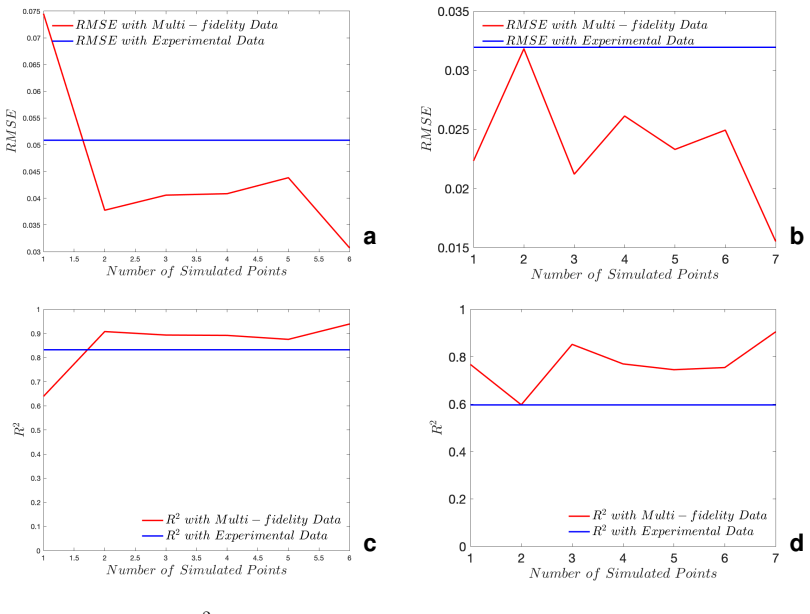
The central claim is that auto-regressive co-kriging, applied to damage indices extracted from guided waves, lets a small set of experimental DI values (as few as two or three states) be augmented with simulated DI values to produce mean predictions and confidence bounds that follow the experimental trend better than a standard Gaussian process using only the experimental points. In the fixed-high-fidelity task, adding simulated points to a fixed experimental set lowers RMSE and raises $R^2$ once enough points are included, although the first added points can initially increase error. In the constant-total-states task, replacing experimental states with simulated states degrades accuracy more slowly than removing the experimental data outright. In the load case, combining the multi-fidelity model with active learning gives faster and more stable RMSE convergence than randomly selected simulated points, and can outperform a standard Gaussian process trained on more experimental states.
Load-bearing premise
The load-bearing assumption is that the difference between simulated and experimental damage indices is a fixed scaling factor plus a stable discrepancy; if the simulation's bias changes across damage states, the extra simulated points can pull the estimate away from the real trend—the paper itself reports RMSE rising before it falls.
Editorial extensions
If this is right
- Simulated guided-wave data can substitute for a large fraction of experimental states: in the load test, models with two experimental sets plus simulated points beat a standard Gaussian process with three or four experimental sets.
- The multi-fidelity model can be used to fill data-sparse regions of the damage-state axis, where experiments are impractical or prohibitively costly.
- An optimal amount of low-fidelity data exists: RMSE first rises and then falls as simulated points are added, so a sweep of added points can identify the best low-fidelity budget.
- Active-learning acquisition functions, especially upper confidence bound and expected improvement, make convergence faster and less dependent on the random order of data addition.
Reading between the lines
- The same co-kriging structure should transfer to other damage-sensitive features, such as spectral or time-frequency features, as long as the simulation-to-experiment relationship is approximately affine; a head-to-head comparison of DI types under identical experimental budgets would test this.
- The reported initial RMSE rise suggests a practical diagnostic: monitoring the derivative of RMSE with respect to added simulated points could let an operator stop augmentation before simulation bias dominates the estimate.
- Because the paper applies a hard variance lower bound, a fully Bayesian treatment that treats the bound as a prior on noise levels would reveal how much of the gain comes from the constraint versus the multi-fidelity fusion itself.
- For deployment on real structures, the main unknown is whether the cross-correlation parameter learned on one sensor path or coupon generalizes to another; a cross-validation across sensor paths would settle that.
Signed reviews
Editorial analysis
A structured set of objections, weighed in public.
Referee Report
Summary. The paper applies multi-fidelity Gaussian process regression (MF-GPRM), based on the autoregressive co-kriging model of Kennedy and O'Hagan, to damage state estimation in two aluminum plate test cases. Damage indices (DIs) extracted from experimental guided-wave signals are treated as high-fidelity data, and DIs from FEM simulations (test case 1) or a physics-based load-compensation model (test case 2) as low-fidelity data. The authors compare MF-GPRM with standard GPRM trained on the same experimental data, reporting lower RMSE and higher R^2 for MF-GPRM across several tasks, and additionally investigate active-learning acquisition rules for selecting simulated data points. The central claim is that multi-fidelity fusion of cheap simulated data with a small experimental set improves probabilistic damage-state estimation.
Significance. If the claims hold, the paper offers a practical route to reducing experimental data collection costs in guided-wave SHM by incorporating lower-fidelity simulated data into a probabilistic regression framework. The main strengths are the use of two different data-source types (FEM and physics-based reconstruction), the integration of active learning with multiple acquisition criteria, and the availability of a first test case that relies on an independent FEM simulation. However, the second test case's low-fidelity data are not independent of the experimental data, which substantially weakens the generalizability claim. Overall, the paper is an incremental but potentially useful application of an established method rather than a methodological breakthrough.
major comments (4)
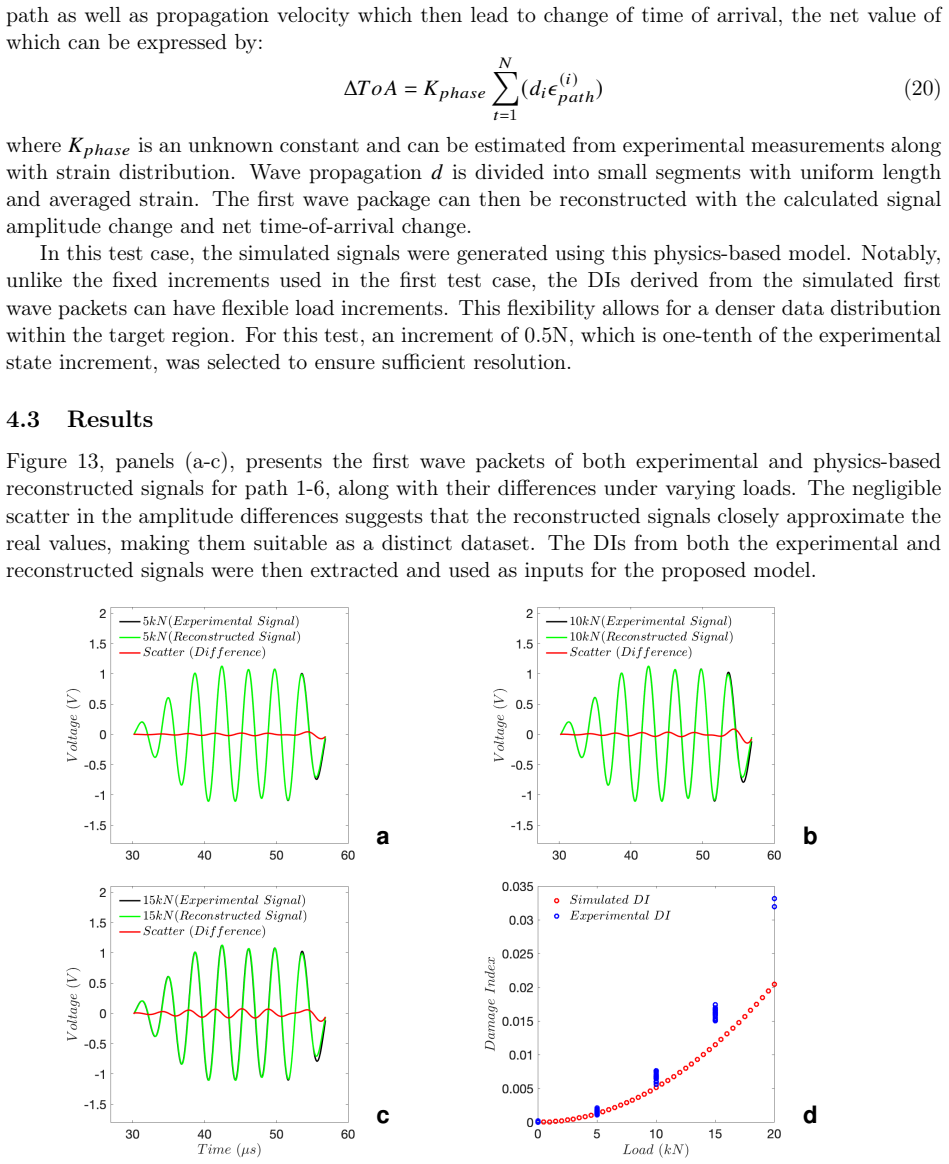
- [Sec. 4.2, Sec. 4.3] The low-fidelity dataset in the second test case is not an independent simulation source. The constants A, B in Eq. (19) and K_phase in Eq. (20) are computed from experimental signals collected at the five loads 0, 5, 10, 15, 20 kN, and the simulated signals are then generated at 0.5 kN increments. The simulated DIs are therefore effectively a dense interpolation of the same experimental response, rather than predictions from an independently calibrated physics model. As a result, the large RMSE/R^2 gains in Figs. 14 and 15 and the numbers in Table 4 cannot be interpreted as evidence that inexpensive independent simulations can substitute for experiments; at most they demonstrate that a physics-based interpolation of the experimental response can be exploited. This compromises the universal-superiority conclusion in Sec. 5. The authors should either redo the second test case with a genuinely independent simulation (e.g., an FEM model of the loaded plate) or explicitly reframe the test case as physics-based data augmentation and correspondingly limit the claims in the abstract and conclusion.
- [Sec. 3.3.1, Appendix A.2] The variance lower-bound constraint is a free parameter whose value appears to be selected based on the results. Section 3.3.1 states that "three times the largest variance of the experimental data was chosen as the lower constraint" for sigma_1^2 and sigma_2^2, while Appendix A.2 shows outputs for multipliers 1, 5, 10, and 15 but gives no criterion for choosing 3. The sensitivity of the main RMSE/R^2 comparisons to this multiplier is not reported. Because the uncertainty bounds are a central claimed advantage of the method, the choice should be justified by a principled rule such as cross-validation, or a sensitivity analysis over the multiplier range should be reported for at least the main comparisons.
- [Sec. 3.3, Figs. 8 and 11] The experimental training sets are formed by randomly drawing 15 of 20 realizations, but no repeated-split statistics are reported. RMSE and R^2 values are presented for a single split per configuration, so the observed differences between standard GPRM and multi-fidelity GPRM may be within the sampling variability of the experimental realizations. The authors should repeat the random splitting (e.g., 10 or more seeds) and report mean and standard error of the performance metrics to support the claim that the improvements are statistically meaningful.
- [Sec. 2.1.1, Eq. (2)] The model assumes a single state-independent correlation coefficient rho between the low- and high-fidelity maps, and the paper acknowledges that "the actual value can change at different locations" without providing any diagnostic for this assumption. The empirical observation in Sec. 3.3.1 and Fig. 8 that RMSE initially increases when simulated points are added could be a symptom of rho being misestimated in some regions of the state domain. Please provide evidence for the adequacy of the constant-rho assumption, for example by estimating rho over a moving window of the damage-state domain or by comparing against a model with a spatially varying rho; at minimum, report the fitted values of rho for the studied paths and discuss whether they are consistent across the domain.
minor comments (5)
- [Sec. 3.3.1, Fig. 7(d)] The text states that RMSE decreased from 0.032593 to 0.030838, "approximately halving the original value from GPRM," but this is a reduction of about 5%, not a halving. Please correct the description to reflect the actual magnitude of the improvement.
- [Appendix A.2, Figs. A.4 and A.5] The captions for these figures list panel labels incorrectly, repeating "(a)" and "(b)" instead of "(a)" through "(d)". Please correct the panel designations so that the text and figures are unambiguous.
- [Sec. 4.2] The text says "an increment of 0.5N, which is one-tenth of the experimental state increment"; since the experimental increments are in kN, this should be "0.5 kN."
- [Sec. 3.3.1, Sec. 4] There are several typos: "the experimental dat" should be "the experimental data" in Sec. 3.3.1, and "demonstrat" should be "demonstrate" in the introductory paragraph of Sec. 4. Please proofread the final text.
- [Sec. 4.3.3, Fig. 17(b)] The active-learning RMSE curves appear to be single-run results, whereas the random-selection comparison uses 10 seeds. If the active-learning criteria were not repeated across multiple trials, please state this explicitly and discuss the potential variability of the active-learning results.
Circularity Check
Test case 2's 'simulated' DIs come from a load-compensation model calibrated on the same experimental load states, so those multi-fidelity gains are partly forced; test case 1's FEM data keeps the claim partially independent.
-
fitted input called prediction
[Section 4.2 (Physics-based Load Compensation Model), used in Sections 4.3.1 and 4.3.2]
""Five static loads—0, 5, 10, 15, and 20 kN—were applied to produce the experimental signals." ... "A and B are unknown model constants which can be calculated from experimental signals collected at various loading conditions." ... "K_phase is an unknown constant and can be estimated from experimental measurements along with strain distribution." ... "In this test case, the simulated signals were generated using this physics-based model. ... For this test, an increment of 0.5N, which is one-tenth of the experimental state increment, was selected to ensure sufficient resolution.""
By the paper's own description, the constants A, B, and K_phase of the load-compensation model are fit to experimental signals from the same five load states (0, 5, 10, 15, 20 kN) that constitute the high-fidelity dataset. The simulated DIs at 0.5 kN increments are then produced from this calibrated model and fed into the multi-fidelity GPRM as the low-fidelity source. In Task 1 (Sec. 4.3.1), the experimental training sets are 0 and 20 kN (or 0, 10, 20 kN), and the added 'simulated' points at 5, 10, and 15 kN are generated by a model that has already seen experimental signals at exactly those states.
full rationale
The multi-fidelity Gaussian process formulation in Section 2.1 is a standard auto-regressive co-kriging model trained by marginal likelihood maximization; there is no circularity in the mathematics itself, and test case 1 uses independent FEM simulations, so the approach is not inherently circular. The identified circularity is confined to test case 2: the physics-based load-compensation model used as the low-fidelity data source is calibrated on experimental signals from the same load states, so adding its outputs as 'simulated' points in Tasks 1–3 partially re-injects the high-fidelity data that the comparison is supposed to save. This makes the test case 2 numerical gains (e.g., RMSE decreasing from about 0.0075 to 0.0025 in Section 4.3.1) overstate the value of independent simulations. Because one full validation test case relies on this leakage while the other is independent, the circularity is partial rather than total; a score of 6 reflects 'one or more predictions reduce by construction, partial circularity.'
Assumptions & free parameters
free parameters (4)
- Variance lower-bound multiplier c =
3
- UCB lambda =
not reported
- EI xi =
not reported
- DI choice =
RMSD
assumptions (5)
- domain assumption f2(x) = rho f1(x) + delta(x) with constant rho
- domain assumption Damage index varies smoothly with damage state
- domain assumption Simulated data is a valid lower-fidelity source
- standard math Linear combination of Gaussian processes is Gaussian
- ad hoc to paper Prediction variance lower bound sigma_*^2 >= sigma_2^2
Cite this review
Pith. "Pith review of Data-Driven Structural State Estimation via Multi-Fidelity Gaussian Process Models." pith.science (2026). https://pith.science/paper/X2FGEU6K
@misc{pith2026250501666,
  author       = {Pith},
  title        = {Pith review of: Data-Driven Structural State Estimation via Multi-Fidelity Gaussian Process Models},
  year         = {2026},
  howpublished = {\url{https://pith.science/paper/X2FGEU6K}},
  note         = {Machine review of arXiv:2505.01666}
}
read the original abstract
Guided wave-based techniques have been used extensively in Structural Health Monitoring (SHM). Models using guided waves can provide information from both time and frequency domains to make themselves accurate and robust. Probabilistic SHM models, which have the ability to account for uncertainties, are developed when decision confidence intervals are of interest. Most active-sensing guided-wave methods rely on the assumption that a large dataset can be collected, making them impractical when data collection is constrained by time or environmental factors. Meanwhile, although simulation results may lack the accuracy of real-world data, they are easier to obtain. In this context, models that integrate data from multiple sources have the potential to combine the accuracy of experimental data with the convenience of simulated data, without requiring large and potentially costly experimental datasets. The goal of this work is to introduce and assess a probabilistic multi-fidelity Gaussian process regression framework for damage state estimation via the use of both experimental and simulated guided waves. The main differences from previous works include the integration of damage-sensitive features (damage indices, DIs) extracted from both experimental and numerical sources, as well as the use of a relatively small amount of real-world data. The proposed model was validated by two test cases where multiple data sources exist. For each test case, experimental data were collected from a piezoelectric sensor network attached to an aluminum plate with various structural conditions, while simulated data were generated using either multiphysics finite element model (FEM) or physics-based signal reconstruction approaches under the same conditions.
Figures


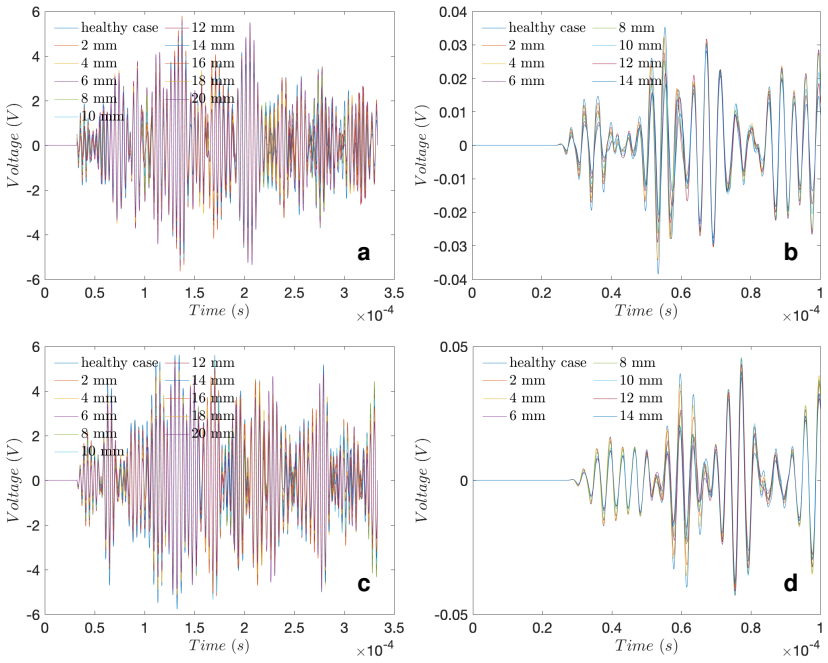
Figures from the paper (15 more)






Reference graph
Works this paper leans on
-
[1]
An introduction to structural health monitoring,
Farrar, C. R. and Worden, K., “An introduction to structural health monitoring,”Philosoph- ical Transactions of the Royal Society A: Mathematical, Physical and Engineering Sciences, Vol. 365, No. 1851, 2007, pp. 303–315
work page 2007
-
[2]
Structural health monitoring techniques for aircraft composite structures,
Diamanti, K. and Soutis, C., “Structural health monitoring techniques for aircraft composite structures,” Progress in Aerospace Sciences, Vol. 46, No. 8, 2010, pp. 342–352. 24
work page 2010
-
[3]
State-of-the-art technologies for UAV inspections,
Jordan, S., Moore, J., Hovet, S., Box, J., Perry, J., Kirsche, K., Lewis, D., and Tse, Z. T. H., “State-of-the-art technologies for UAV inspections,”IET Radar, Sonar & Navigation, Vol. 12, No. 2, 2018, pp. 151–164
work page 2018
-
[4]
Life-cyclereliability-basedoptimizationofcivilandaerospace structures,
Frangopol, D.M.andMaute, K., “Life-cyclereliability-basedoptimizationofcivilandaerospace structures,” Structure and Infrastructure Engineering, Vol. 81, No. 1, 2003, pp. 397–410
work page 2003
-
[5]
Structural health monitoring: Closing the gap between research and industrial deployment,
Cawley, P., “Structural health monitoring: Closing the gap between research and industrial deployment,” Structural Health Monitoring, Vol. 17, No. 5, 2018, pp. 1225–1244
work page 2018
-
[6]
Amer, A. and Kopsaftopoulos, F. P., “Probabilistic active sensing acousto-ultrasound SHM based on non-parametric stochastic representations,”Proceedings of the Vertical Flight Society 75th Annual Forum & Technology Display, Philadelphia, PA, USA, May 2019
work page 2019
-
[7]
Amer, A. and Kopsaftopoulos, F. P., “Towards Unified Probabilistic Rotorcraft Damage De- tection and Quantification via Non-parametric Time Series and Gaussian Process Regression Models,” Proceedings of the Vertical Flight Society 76th Annual Forum & Technology Display, Virginia Beach, VA, USA, October 2020
work page 2020
-
[8]
Janapati, V., Kopsaftopoulos, F., Li, F., Lee, S., and Chang, F.-K., “Damage detection sen- sitivity characterization of acousto-ultrasound-based structural health monitoring techniques,” StructurRasmussen-Williams06 al Health Monitoring, Vol. 15, No. 2, 2016, pp. 143–161
work page 2016
Show all 47 references
-
[9]
A probabilistic crack size quantification method using in-situ Lamb wave test and Bayesian updating,
Yang, J., He, J., Guan, X., Wang, D., Chen, H., Zhang, W., and Liu, Y., “A probabilistic crack size quantification method using in-situ Lamb wave test and Bayesian updating,”Mechanical Systems and Signal Processing, Vol. 78, 2016, pp. 118–133
2016
-
[10]
A Lamb wave based fatigue crack length estimation method using finite element simulations,
He, J., Ran, Y., Liu, B., Yang, J., and Guan, X., “A Lamb wave based fatigue crack length estimation method using finite element simulations,”The 9th International Symposium on NDT in Aerospace, Xiamen, China, Xiamen, China, November 2017
2017
-
[11]
Monitoring of fatigue crack propagation by damage index of ultrasonic guided waves calculated by various acoustic features,
Jin, H., Yan, J., Li, W., and Qing, X., “Monitoring of fatigue crack propagation by damage index of ultrasonic guided waves calculated by various acoustic features,”Applied Sciences, Vol. 9, 2019, pp. 4254
2019
-
[12]
Active interface debonding detection of a concrete- filled steel tube with piezoelectric technologies using wavelet packet analysis,
Xu, B., Zhang, T., Song, G., and Gu, H., “Active interface debonding detection of a concrete- filled steel tube with piezoelectric technologies using wavelet packet analysis,”Mechanical Sys- tems and Signal Processing, Vol. 36, 2013, pp. 7–17
2013
-
[13]
Piezoelectric Wafer Active Sensors for Structural Health Monitoring of Com- posite Structures Using Tuned Guided Waves,
Giurgiutiu, V., “Piezoelectric Wafer Active Sensors for Structural Health Monitoring of Com- posite Structures Using Tuned Guided Waves,”Journal of Engineering Materials and Technol- ogy, Vol. 133, No. 4, 2011, pp. 041012
2011
-
[14]
Multimodal structural health monitoring based on active and passive sensing,
Nasrollahi, A., Deng, W., Ma, Z., and Rizzo, P., “Multimodal structural health monitoring based on active and passive sensing,” Structural Health Monitoring, Vol. 17, No. 2, 2018, pp. 395–409
2018
-
[15]
Monitoring fatigue crack growth in narrow structural components using Lamb wave technique,
Lim, S. I., Cui, L., Liu, Y., and Soh, C. K., “Monitoring fatigue crack growth in narrow structural components using Lamb wave technique,” Proc. SPIE 7981, Sensors and Smart Structures Technologies for Civil, Mechanical, and Aerospace Systems, San Diego, CA, USA, April 2011. 25
2011
-
[16]
Comparative study of deterioration of com- posite due to moisture using strain, electro-mechanical impedence, and guided waves,
Soman, R., Malinowski, P., and Ostachowicz, W., “Comparative study of deterioration of com- posite due to moisture using strain, electro-mechanical impedence, and guided waves,”Proc. SPIE 10600, Health Monitoring of Structural and Biological Systems XII, Denver, CO, USA, March 2018
2018
-
[17]
In-situ acousto-ultrasonic monitoring of crack propagation in AL2024 alloy,
Vanniamparambil, P., Bartoli, I., Hazeli, K., Caudra, J., Schwartz, E., Saralaya, R., and Kontsos, A., “In-situ acousto-ultrasonic monitoring of crack propagation in AL2024 alloy,” Proc. SPIE 8348, Health Monitoring of Structural and Biological Systems, San Diego, CA, USA, April 2012
2012
-
[18]
Uncertainty quantification of guided waves propagation for active sensing structural health monitoring,
Ahmed, S. and Kopsaftopoulos, F., “Uncertainty quantification of guided waves propagation for active sensing structural health monitoring,”Proceedings of the vertical flight society 75th annual forum & technology display, Philadelphia, PA, USA, 2019, pp. 13–16
2019
-
[19]
A stochastic global identification framework for aerospace structures operating under varying flight states,
Kopsaftopoulos, F., Nardari, R., Li, Y.-H., and Chang, F.-K., “A stochastic global identification framework for aerospace structures operating under varying flight states,”Mechanical Systems and Signal Processing, Vol. 98, 2018, pp. 425–447
2018
-
[20]
Support-vector networks,
Cortes, C. and Vapnik, V., “Support-vector networks,”Machine learning, Vol. 20, No. 3, 1995, pp. 273–297
1995
-
[21]
Cristianini, N., Shawe-Taylor, J., et al.,An introduction to support vector machines and other kernel-based learning methods, Cambridge university press, 2000
2000
-
[22]
Physics-constrained deep learn- ing for high-dimensional surrogate modeling and uncertainty quantification without labeled data,
Zhu, Y., Zabaras, N., Koutsourelakis, P.-S., and Perdikaris, P., “Physics-constrained deep learn- ing for high-dimensional surrogate modeling and uncertainty quantification without labeled data,” Journal of Computational Physics, Vol. 394, 2019, pp. 56–81
2019
-
[23]
Deep UQ: Learning deep neural network surrogate models for high dimensional uncertainty quantification,
Tripathy, R. K. and Bilionis, I., “Deep UQ: Learning deep neural network surrogate models for high dimensional uncertainty quantification,”Journal of computational physics, Vol. 375, 2018, pp. 565–588
2018
-
[24]
Machine learning approach to model order reduction of nonlinear systems via autoencoder and lstm networks,
Simpson, T., Dervilis, N., and Chatzi, E., “Machine learning approach to model order reduction of nonlinear systems via autoencoder and lstm networks,”arXiv preprint arXiv:2109.11213, 2021
2021 arXiv
-
[25]
Convolutional neural network and long short-term memory based reduced order surrogate for minimal turbulent channel flow,
Nakamura, T., Fukami, K., Hasegawa, K., Nabae, Y., and Fukagata, K., “Convolutional neural network and long short-term memory based reduced order surrogate for minimal turbulent channel flow,”Physics of Fluids, Vol. 33, No. 2, 2021, pp. 025116
2021
-
[26]
Numerical Gaussian processes for time- dependentandnonlinearpartialdifferentialequations,
Raissi, M., Perdikaris, P., and Karniadakis, G. E., “Numerical Gaussian processes for time- dependentandnonlinearpartialdifferentialequations,” SIAM Journal on Scientific Computing, Vol. 40, No. 1, 2018, pp. A172–A198
2018
-
[27]
Uncertainty propagation using infinite mixture of gaus- sian processes and variational bayesian inference,
Chen, P., Zabaras, N., and Bilionis, I., “Uncertainty propagation using infinite mixture of gaus- sian processes and variational bayesian inference,”Journal of computational physics, Vol. 284, 2015, pp. 291–333
2015
-
[28]
Multi-output separable Gaussian pro- cess: Towards an efficient, fully Bayesian paradigm for uncertainty quantification,
Bilionis, I., Zabaras, N., Konomi, B. A., and Lin, G., “Multi-output separable Gaussian pro- cess: Towards an efficient, fully Bayesian paradigm for uncertainty quantification,”Journal of Computational Physics, Vol. 241, 2013, pp. 212–239. 26
2013
-
[29]
Gaussian processes in machine learning,
Rasmussen, C. E., “Gaussian processes in machine learning,”Summer school on machine learn- ing, Springer, 2003, pp. 63–71
2003
-
[30]
Statistical Time Series Meth- ods for Multicopter Fault Detection and Identification,
Dutta, A., McKay, M., Kopsaftopoulos, F., and Gandhi, F., “Statistical Time Series Meth- ods for Multicopter Fault Detection and Identification,”Vertical Flight Society International Powered Lift Conference, San Jose, CA, AHS, Jan 2020
2020
-
[31]
Aircraft parametric structural load monitoring using gaussian process regression,
Fuentes, R., Cross, E., Halfpenny, A., Worden, K., and Barthorpe, R. J., “Aircraft parametric structural load monitoring using gaussian process regression,”EWSHM-7th European workshop on structural health monitoring, 2014
2014
-
[32]
Probabilistic Damage Quantificationvia the Integration of Non-parametric Time-series and Gaussian Process Regression Models,
Amer, A. and Kopsaftopoulos, F. P., “Probabilistic Damage Quantificationvia the Integration of Non-parametric Time-series and Gaussian Process Regression Models,”Proceedings of the 12th International Workshop on Structural Health Monitoring (IWSHM 2019), Palo Alto, CA, USA, Se...
2019
-
[33]
An information theoretic approach to use high-fidelity codes to calibrate low-fidelity codes,
Lewis, A., Smith, R., Williams, B., and Figueroa, V., “An information theoretic approach to use high-fidelity codes to calibrate low-fidelity codes,”Journal of Computational Physics, Vol. 324, 2016, pp. 24–43
2016
-
[34]
Multi-fidelity optimization via surrogate modelling,
Forrester, A. I., Sóbester, A., and Keane, A. J., “Multi-fidelity optimization via surrogate modelling,” Proceedings of the royal society a: mathematical, physical and engineering sciences, Vol. 463, No. 2088, 2007, pp. 3251–3269
2007
-
[35]
Recursive co-kriging model for design of computer experiments with multiple levels of fidelity,
Le Gratiet, L. and Garnier, J., “Recursive co-kriging model for design of computer experiments with multiple levels of fidelity,”International Journal for Uncertainty Quantification, Vol. 4, No. 5, 2014
2014
-
[36]
Multi-fidelity modelling via recursive co-kriging and Gaussian–Markov random fields,
Perdikaris, P., Venturi, D., Royset, J. O., and Karniadakis, G. E., “Multi-fidelity modelling via recursive co-kriging and Gaussian–Markov random fields,”Proceedings of the Royal Society A: Mathematical, Physical and Engineering Sciences, Vol. 471, No. 2179, 2015, pp. 20150018
2015
-
[37]
Com- bining experimental data and computer simulations, with an application to flyer plate experi- ments,
Gattiker, J., Higdon, D., Keller-McNulty, S., McKay, M., Moore, L., and Williams, B., “Com- bining experimental data and computer simulations, with an application to flyer plate experi- ments,” Bayesian Analysis, Vol. 1, No. 4, 2006, pp. 765–792
2006
-
[38]
Computer model calibration using high-dimensional output,
Higdon, D., Gattiker, J., Williams, B., and Rightley, M., “Computer model calibration using high-dimensional output,” Journal of the American Statistical Association, Vol. 103, No. 482, 2008, pp. 570–583
2008
-
[39]
Deep multi-fidelity Gaussian processes,
Raissi, M. and Karniadakis, G., “Deep multi-fidelity Gaussian processes,” arXiv preprint arXiv:1604.07484, 2016
2016 arXiv
-
[40]
Inferring solutions of differential equations using noisy multi-fidelity data,
Raissi, M., Perdikaris, P., and Karniadakis, G. E., “Inferring solutions of differential equations using noisy multi-fidelity data,”Journal of Computational Physics, Vol. 335, 2017, pp. 736–746
2017
-
[41]
Machine learning of linear differential equa- tionsusingGaussianprocesses,
Raissi, M., Perdikaris, P., and Karniadakis, G. E., “Machine learning of linear differential equa- tionsusingGaussianprocesses,” Journal of Computational Physics, Vol.348, 2017, pp.683–693
2017
-
[42]
Multi-fidelity Bayesian neural networks: Al- gorithms and applications,
Meng, X., Babaee, H., and Karniadakis, G. E., “Multi-fidelity Bayesian neural networks: Al- gorithms and applications,”Journal of Computational Physics, Vol. 438, 2021, pp. 110361. 27
2021
-
[43]
A deep neural network, multi-fidelity surrogate model approach for Bayesian model updating in shm,
Torzoni, M., Manzoni, A., and Mariani, S., “A deep neural network, multi-fidelity surrogate model approach for Bayesian model updating in shm,”European Workshop on Structural Health Monitoring, Springer, 2023, pp. 1076–1086
2023
-
[44]
Damage State Estimation via Multi-fidelity Gaussian Process Regression Models for Active-Sensing Structure Health Monitoring,
Fan, Y. and Kopsaftopoulos, F., “Damage State Estimation via Multi-fidelity Gaussian Process Regression Models for Active-Sensing Structure Health Monitoring,”European Workshop on Structural Health Monitoring, Springer, 2023, pp. 267–276
2023
-
[45]
Loadmonitoringandcompensationstrategiesforguided- waves based structural health monitoring using piezoelectric transducers,
Roy, S., Ladpli, P., andChang, F.-K., “Loadmonitoringandcompensationstrategiesforguided- waves based structural health monitoring using piezoelectric transducers,”Journal of Sound and Vibration, Vol. 351, 2015, pp. 206–220
2015
-
[46]
A novel physics-based temperature compensation model for structural health monitoring using ultrasonic guided waves,
Roy, S., Lonkar, K., Janapati, V., and Chang, F.-K., “A novel physics-based temperature compensation model for structural health monitoring using ultrasonic guided waves,”Structural Health Monitoring, Vol. 13, No. 3, 2014, pp. 321–342
2014
-
[47]
GaussianProcessRegressionforActiveSensingProbabilistic Structural Health Monitoring: Experimental Assessment Across Multiple Damage and Loading Scenarios,
Amer, A.andKopsaftopoulos, F., “GaussianProcessRegressionforActiveSensingProbabilistic Structural Health Monitoring: Experimental Assessment Across Multiple Damage and Loading Scenarios,” arXiv preprint arXiv:2106.14841, 2021. 28 Appendices A First Test Case A.1 Task1 a b c d ...
2021 arXiv
Reviewed August 16, 2026 · model on record in the stance chip above.
Discussion (0). Continue with ORCID to comment.