REVIEW 4 major objections 5 minor 40 references
Brain-Inspired Quantum Neural Architectures for Pattern Recognition: Integrating QSNN and QLSTM
T0 review · 4 major / 5 minor · reviewed 2026-08-16 · deepseek-v4-flash
Pith's one-line read A two-stage hybrid of quantum spiking and quantum recurrent networks outperforms six classical and quantum baselines on credit-card fraud detection.
desk verdict Plausible hybrid architecture, but the headline superiority claim is not supported by an uncontrolled benchmark with no significance tests and no code. read the letter →
The pith
A machine-rendered reading of the paper's core claim, the machinery that carries it, and where it could break.
The reading
What carries the argument
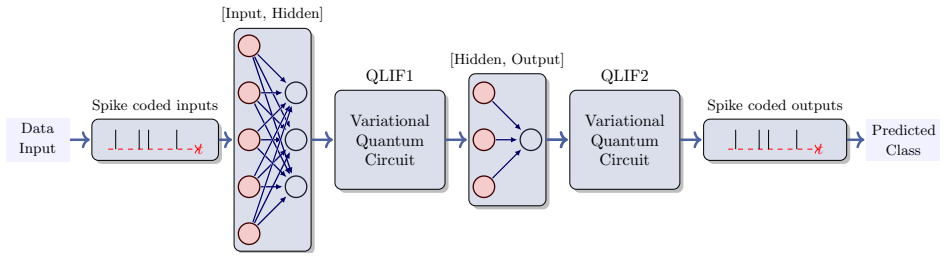
The central object is the two-stage QSNN-QLSTM pipeline. A Quantum Spiking Neural Network—a spiking network whose leaky integrate-and-fire neurons have their membrane potential initialized by a variational quantum circuit, trained with surrogate gradients that replace the non-differentiable spike decision with a smooth approximation in the backward pass—forms the first stage and is pre-trained alone. A Quantum Long Short-Term Memory module, in which the forget, input, update, and output gates are each variational quantum circuits, forms the second stage. The training protocol has three phases: pre-train the QSNN; propagate data through the frozen QSNN into a fresh QLSTM for a single pass; then co-train both with two optimizers at different learning rates. This staged protocol is what the paper argues lets the model learn new patterns without erasing prior knowledge, and the variational circuits are what make the model quantum.
What would settle it
Run the same seven models on the same credit-card fraud data under identical data budgets, optimizer families where possible, and a fixed early-stopping rule, evaluating by nested cross-validation on the training folds; if QSNN-QLSTM does not rank first in F1, AUC, or recall across the ten seeds, the paper's central superiority claim collapses.
Extended reading notes
Core claim
On the paper's own terms, the central discovery is that the novel QSNN-QLSTM model consistently surpasses the other compared models in F1 score, AUC, and recall on the credit-card fraud dataset, while using 774 trainable parameters (against 43,457 for the classical LSTM), training on 1,390 samples instead of 5,390, and converging in 40 iterations instead of 700 for the ANN. The authors attribute this to a division of labor: the QSNN stage filters noisy and infrequent events and strengthens spatiotemporally correlated signals, while the QLSTM stage captures and memorizes correlated patterns, transforming short-term into long-term storage. The paper also reports that the hybrid model is second only to the SNN in precision. In the authors' reading, this supports the broader conclusion that quantum brain-inspired models can detect patterns that classical and simpler quantum models miss.
Load-bearing premise
The central claim rests on the assumption that the experimental settings—quantum models trained on 1,390 samples and classical on 5,390, with different optimizers, batch sizes, and iteration counts—were chosen fairly and not tuned to the test set, so the reported wins reflect the architecture rather than the configuration.
Editorial extensions
If this is right
- If the superiority claim is right, hybrid quantum spiking-plus-recurrent models are a viable alternative to classical networks for imbalanced tabular anomaly detection.
- The three-phase training recipe provides a concrete template for adding a recurrent memory stage to a pre-trained spiking network without catastrophic forgetting.
- The reported data efficiency suggests quantum models could be used where labeled examples are scarce, reducing reliance on synthetic data augmentation.
- The iteration count of 40 versus 700 implies that, absent simulation overhead, the hybrid model would train far faster in wall-clock time on quantum hardware.
- The parameter-count ordering reported (QNN below QSNN below ANN below QSNN-QLSTM below SNN below QLSTM below LSTM) indicates that hybrid quantum models can stay lightweight despite combining two architectures.
Reading between the lines
- An ablation study that removes either the QSNN or the QLSTM stage would isolate whether the gains come from the spiking front end, the recurrent memory, or simply the extra trainable parameters.
- A paired statistical test over the paper's ten random seeds would show whether the reported F1 and AUC gaps exceed run-to-run variability; the paper does not report such a test.
- The same two-stage design could be tried on other imbalanced tabular benchmarks with different fraud ratios and feature counts, which would reveal whether the advantage is specific to this dataset.
- Because all quantum models here run on simulators, the reported margins are not yet evidence about performance on noisy quantum hardware; that is an inference, not a claim the paper makes.
Signed reviews
Editorial analysis
A structured set of objections, weighed in public.
Referee Report
Summary. The manuscript proposes a hybrid quantum spiking neural network (QSNN) combined with a quantum long short-term memory (QLSTM) model for credit card fraud detection, and compares it with classical ANN, LSTM, SNN and quantum QNN, QLSTM, QSNN baselines on the standard Kaggle dataset. The authors report 10-run F1, AUC, recall, and precision results, and claim that QSNN-QLSTM consistently outperforms the other models while using fewer parameters, less training data, and fewer iterations. The paper also describes a three-phase training pipeline (pre-training QSNN, single-pass QLSTM training, then joint co-training) and discusses the limitations of quantum simulators.
Significance. The conceptual combination of a spiking quantum front-end and a recurrent quantum memory is a plausible research direction, and the paper's emphasis on data efficiency for quantum models is timely. However, the central empirical claim is not established because the comparison is uncontrolled: training set sizes, optimizers, batch sizes, iteration counts, and validation splits differ across models, and hyperparameters were tuned per model without a stated protocol or any significance testing. If the claim were substantiated with a matched experimental design and statistical analysis, the architecture would be a useful contribution to quantum machine learning and anomaly detection; as presented, the evidence is insufficient. The paper also provides no code or data release, which limits reproducibility.
major comments (4)
- [§4.2, Tables 1-2] The comparison is uncontrolled. Quantum models were trained on 1,390 samples (390 fraud + 1,000 non-fraud) whereas classical models used 5,390 samples (390 fraud + 5,000 non-fraud), with different optimizers (SGD, Adam, RMSprop), batch sizes (64-256), iteration counts (40-700), and validation splits of different absolute sizes. The paper states that hyperparameters, optimizers, and iteration counts were 'conducted experimentally through multiple trials to achieve the best performance for each model,' but it never specifies the data used in those trials or a protocol that prevents the test set from influencing the choices. The reported advantage of QSNN-QLSTM may therefore be an artifact of per-model tuning rather than an architectural property.
- [§4.3, Figs. 11-14] Results are reported only as 10-run boxplots, without statistical significance tests, confidence intervals, or paired comparisons. Because the test set contains only 101 fraud positives, the observed differences in F1, recall, and AUC among the top models could be produced by a handful of changed predictions and may lie within sampling noise. The claim that QSNN-QLSTM 'consistently surpasses other models' is also contradicted by Fig. 14, in which SNN attains the highest precision and QSNN-QLSTM is a close second.
- [§4.2, QSNN-QLSTM parameter list] The architecture description for QSNN-QLSTM is internally inconsistent: the parameter list includes a linear layer of size 10×2+2 after the QLIF1 cell, yet the following QLSTM preprocessing layer is given as 10×20+20, implying a 10-dimensional input to the QLSTM. It is unclear whether the evaluated model matches the described graph, and the manuscript provides no code to resolve the ambiguity.
- [§4.2–§4.3] The claim that quantum models 'require fewer iterations' is tautological given the experimental design, because the iteration count for each model was intentionally set to the point at which that model converged. With per-model stopping criteria, the number of iterations is not an independent advantage, and no runtimes or convergence thresholds are reported to make the comparison meaningful.
minor comments (5)
- [Keywords and Figure 14 caption] The manuscript contains numerous typographical errors and misspellings, e.g., 'Annomaly Detection' in the keywords, 'Presicion' in the Fig. 14 caption, 'clasification', 'hiperbolic', and 'subsenquently'; these should be corrected.
- [§2.1, Eq. (14)] Equation (14) presents the chain rule with brace notation that is garbled in the PDF; the intended expression should be reformatted so that the surrogate gradient substitution is readable.
- [§4.1] The dataset is described as having 30 features including 28 PCA-transformed features and the transaction amount, which sums to 29; the standard Kaggle credit card dataset also includes a 'Time' feature. Please clarify the exact feature set used.
- [References] References [11] and [37] appear to duplicate the same source (the snnTorch / training SNNs paper) in different venues; these should be unified.
- [Fig. 15] Figure 15 uses different y-axis scales across panels, so the visual claim of 'consistent progression' and 'variance decreases' is not supported; provide comparable axes or quantitative convergence statistics.
Circularity Check
No significant circularity: the reported QSNN-QLSTM advantage is an empirical comparison, not a derivation that reduces to its own inputs.
full rationale
The paper's central assertion, that QSNN-QLSTM 'consistently surpasses other models' on F1, AUC, and recall, is presented as an experimental outcome (Sections 4.3 and 5) supported by boxplots and learning curves. No equation or construction in the paper defines this advantage in terms of the model's inputs, and no fitted parameter is renamed as a prediction. Section 4.2 does state that hyperparameters, optimizers, and iteration counts were 'conducted experimentally through multiple trials to achieve the best performance for each model.' That is a limitation of experimental control and statistical inference, not circularity: the reported test metrics are not the same quantity as the tuning choices, and the superiority is not forced by those choices. The unequal training-set sizes (1,390 quantum vs. 5,390 classical samples), the absence of significance tests, and the unreleased code are validity concerns, not reductions by construction. The only overlapping-author citation, [6], is used in the introduction as background evidence that QNNs can outperform classical models in reinforcement learning; it is not load-bearing for the architecture or for the fraud-detection comparison. No uniqueness theorem or ansatz is imported from prior work by the same authors. Accordingly, the circularity score is 0.
Assumptions & free parameters
free parameters (5)
- Per-model training set sizes =
Quantum: 390 fraud + 1,000 non-fraud; classical: 390 fraud + 5,000 non-fraud
- Per-model iteration counts =
ANN 700, LSTM/SNN 350, QNN 70, QLSTM 100, QSNN 80, QSNN-QLSTM 40
- Per-model optimizers, learning rates, batch sizes =
ANN SGD 1e-2/128; LSTM Adam 1e-3/128; SNN Adam 1e-3/64; QNN RMSprop 1e-2/256; QLSTM Adam 1e-2/256; QSNN SGD 1e-3/64…
- Quantum circuit hyperparameters =
5 qubits; QLSTM 4 VQC blocks with 3 layers; QSNN 1-2 QLIF cells with 10 hidden neurons
- Spiking time steps =
25
assumptions (5)
- domain assumption The snnTorch and PennyLane library implementations (surrogate gradient, LIF dynamics, state-vector simulation, automatic differentiation) are correct as used.
- domain assumption The Kaggle credit card fraud labels and features are accurate and representative for fraud detection.
- domain assumption Amplitude encoding of 30 normalized features into 5 qubits preserves the information needed for classification.
- domain assumption The standard LSTM equations in Section 2.2 and the VQC replacement for each gate in QLSTM are equivalent to a learnable recurrent model.
- ad hoc to paper Hyperparameters were chosen without consulting the test set.
Cite this review
Pith. "Pith review of Brain-Inspired Quantum Neural Architectures for Pattern Recognition: Integrating QSNN and QLSTM." pith.science (2026). https://pith.science/paper/5JJLORGQ
@misc{pith2026250501735,
  author       = {Pith},
  title        = {Pith review of: Brain-Inspired Quantum Neural Architectures for Pattern Recognition: Integrating QSNN and QLSTM},
  year         = {2026},
  howpublished = {\url{https://pith.science/paper/5JJLORGQ}},
  note         = {Machine review of arXiv:2505.01735}
}
read the original abstract
Recent advances in the fields of deep learning and quantum computing have paved the way for innovative developments in artificial intelligence. In this manuscript, we leverage these cutting-edge technologies to introduce a novel model that emulates the intricate functioning of the human brain, designed specifically for the detection of anomalies such as fraud in credit card transactions. Leveraging the synergies of Quantum Spiking Neural Networks (QSNN) and Quantum Long Short-Term Memory (QLSTM) architectures, our approach is developed in two distinct stages, closely mirroring the information processing mechanisms found in the brain's sensory and memory systems. In the initial stage, similar to the brain's hypothalamus, we extract low-level information from the data, emulating sensory data processing patterns. In the subsequent stage, resembling the hippocampus, we process this information at a higher level, capturing and memorizing correlated patterns. We will compare this model with other quantum models such as Quantum Neural Networks among others and their corresponding classical models.
Figures


Figures from the paper (12 more)




Reference graph
Works this paper leans on
-
[1]
When brain-inspired ai meets agi
Lin Zhao, Lu Zhang, Zihao Wu, Yuzhong Chen, Haixing Dai, Xiaowei Yu, Zhengliang Liu, Tuo Zhang, Xintao Hu, Xi Jiang, Xiang Li, Dajiang Zhu, Dinggang Shen, and Tianming Liu. When brain-inspired ai meets agi. Meta-Radiology, 1(1):100005, 2023
work page 2023
-
[2]
Maria Schuld, Alex Bocharov, Krysta M. Svore, and Nathan Wiebe. Circuit-centric quantum classifiers.Phys. Rev. A, 101:032308, 2020
work page 2020
-
[3]
Nathan Wiebe, Ashish Kapoor, and Krysta M. Svore. Quantum nearest-neighbor algorithms for machine learning. Quantum Information and Computation, 15:318–358, 2015
work page 2015
-
[4]
Anguita, Sandro Ridella, Fabio Rivieccio, and Rodolfo Zunino
D. Anguita, Sandro Ridella, Fabio Rivieccio, and Rodolfo Zunino. Quantum optimization for training support vector machines.Neural networks, 16:763–770, 2003
work page 2003
-
[5]
Quantum speed-up for unsupervised learning.Machine Learning, 90:261–287, 2013
Esma Aïmeur, Gilles Brassard, and Sébastien Gambs. Quantum speed-up for unsupervised learning.Machine Learning, 90:261–287, 2013. 19
work page 2013
-
[6]
On the use of quantum reinforcement learning in energy-efficiency scenarios.Energies, 15, 2022
Eva Andrés, Manuel Pegalajar Cuéllar, and Gabriel Navarro. On the use of quantum reinforcement learning in energy-efficiency scenarios.Energies, 15, 2022
work page 2022
-
[7]
Earl K. Miller and Jonathan D. Cohen. An integrative theory of prefrontal cortex function.Annual Review of Neuroscience, 24(1):167–202, March 2001
work page 2001
-
[8]
R.C. Atkinson and R.M. Shiffrin. Human memory: A proposed system and its control processes. In Kenneth W. SpenceandJanetTaylorSpence,editors, HumanMemory: AProposedSystemanditsControlProcesses. ,volume2 of Psychology of Learning and Motivation, pages 89–195. Academic Press, 1968
work page 1968
Show all 40 references
-
[9]
Oxford university press, 2007
Per Andersen.The hippocampus book. Oxford university press, 2007
2007
-
[10]
Hippocampus, space, and memory.Behavioral and Brain sciences, 2(3):313–322, 1979
David S Olton, James T Becker, and Gail E Handelmann. Hippocampus, space, and memory.Behavioral and Brain sciences, 2(3):313–322, 1979
1979
-
[11]
Eshraghian, Max Ward, Emre Neftci, Xinxin Wang, Gregor Lenz, Girish Dwivedi, Mohammed Bennamoun, Doo Seok Jeong, and Wei D
Jason K. Eshraghian, Max Ward, Emre Neftci, Xinxin Wang, Gregor Lenz, Girish Dwivedi, Mohammed Bennamoun, Doo Seok Jeong, and Wei D. Lu. Training spiking neural networks using lessons from deep learning, 2021
2021
-
[12]
LearningphraserepresentationsusingRNNencoder–decoderforstatisticalmachinetranslation
KyunghyunCho,BartvanMerriënboer,CaglarGulcehre,DzmitryBahdanau,FethiBougares,HolgerSchwenk,and YoshuaBengio. LearningphraserepresentationsusingRNNencoder–decoderforstatisticalmachinetranslation. In Alessandro Moschitti, Bo Pang, and Walter Daelemans, editors,Proceedings of the...
2014
-
[13]
Hebb.The Organization of Behavior: A Neuropsychological Theory
D.O. Hebb.The Organization of Behavior: A Neuropsychological Theory. Taylor & Francis, 2005
2005
-
[14]
Deep learning in spiking neural networks.Neural Networks, 111:47–63, 2019
Amirhossein Tavanaei, Masoud Ghodrati, Saeed Reza Kheradpisheh, Timothée Masquelier, and Anthony Maida. Deep learning in spiking neural networks.Neural Networks, 111:47–63, 2019
2019
-
[15]
Lobo, Javier Del Ser, Albert Bifet, and Nikola Kasabov
Jesus L. Lobo, Javier Del Ser, Albert Bifet, and Nikola Kasabov. Spiking neural networks and online learning: An overview and perspectives.Neural Networks, 121:88–100, 2020
2020
-
[16]
Recherches quantitatives sur l’excitation electrique des nerfs.J
LM Lapicque. Recherches quantitatives sur l’excitation electrique des nerfs.J. Physiol. Paris., 9:620–635, 1907
1907
-
[17]
Memory-inspired spiking hyperdimensional network for robust online learning.Scientific Reports, 12(1):7641, May 2022
ZhuowenZou,HalehAlimohamadi,AliZakeri,FarhadImani,YeseongKim,M.HassanNajafi,andMohsenImani. Memory-inspired spiking hyperdimensional network for robust online learning.Scientific Reports, 12(1):7641, May 2022
2022
-
[18]
Brain-inspiredspikingneuralnetworksfordecoding and understanding muscle activity and kinematics from electroencephalography signals during hand movements
KaushalyaKumarasinghe,NikolaKasabov,andDeniseTaylor. Brain-inspiredspikingneuralnetworksfordecoding and understanding muscle activity and kinematics from electroencephalography signals during hand movements. Scientific Reports, 11(1):2486, Jan 2021
2021
-
[19]
Andrea Banino, Caswell Barry, Benigno Uria, Charles Blundell, Timothy Lillicrap, Piotr Mirowski, Alexander Pritzel, Martin J. Chadwick, Thomas Degris, Joseph Modayil, Greg Wayne, Hubert Soyer, Fabio Viola, Brian Zhang, Ross Goroshin, Neil Rabinowitz, Razvan Pascanu, Charlie Be...
2018
-
[20]
Bengio, P
Y. Bengio, P. Simard, and P. Frasconi. Learning long-term dependencies with gradient descent is difficult.IEEE Transactions on Neural Networks, 5:157–166, 1994
1994
-
[21]
A novel connectionist system for unconstrained handwriting recognition.IEEE Transactions on Pattern Analysis and Machine Intelligence, 31:855–868, 2009
Alex Graves, Marcus Liwicki, Santiago Fernández, Roman Bertolami, Horst Bunke, and Jürgen Schmidhuber. A novel connectionist system for unconstrained handwriting recognition.IEEE Transactions on Pattern Analysis and Machine Intelligence, 31:855–868, 2009
2009
-
[22]
Alex Graves and Jürgen Schmidhuber. Framewise phoneme classification with bidirectional lstm and other neural network architectures.Neural networks : the official journal of the International Neural Network Society, 18:602–610, 2005
2005
-
[23]
Lstm can solve hard long time lag problems.Advances in Neural Information Processing Systems, 9:473–479, 1996
Sepp Hochreiter and Jürgen Schmidhuber. Lstm can solve hard long time lag problems.Advances in Neural Information Processing Systems, 9:473–479, 1996
1996
-
[24]
Maida, and Ashok Kumar
Anthony Triche, Anthony S. Maida, and Ashok Kumar. Exploration in neo-hebbian reinforcement learning: Computational approaches to the exploration–exploitation balance with bio-inspired neural networks.Neural Networks, 151:16–33, 2022
2022
-
[25]
A variational algorithm for quantum neural networks
Antonio Macaluso, Luca Clissa, Stefano Lodi, and Claudio Sartori. A variational algorithm for quantum neural networks. InComputational Science – ICCS 2020, pages 591–604. Springer International Publishing, 2020
2020
-
[26]
Parameterized quantum circuits as machine learning models.Quantum Science and Technology, 4(4):043001, nov 2019
Marcello Benedetti, Erika Lloyd, Stefan Sack, and Mattia Fiorentini. Parameterized quantum circuits as machine learning models.Quantum Science and Technology, 4(4):043001, nov 2019. 20
2019
-
[27]
Qdnn: deepneuralnetworkswithquantumlayers
ChenZhaoandXiao-ShanGao. Qdnn: deepneuralnetworkswithquantumlayers. QuantumMachineIntelligence , 3:15, 2021
2021
-
[28]
Recent advances for quantum neural networks in generative learning.IEEE Transactions on Pattern Analysis and Machine Intelligence, 45(10):12321–12340, 2023
JinkaiTian,XiaoyuSun,YuxuanDu,ShanshanZhao,QingLiu,KainingZhang,WeiYi,WanrongHuang,Chaoyue Wang, Xingyao Wu, Min-Hsiu Hsieh, Tongliang Liu, Wenjing Yang, and Dacheng Tao. Recent advances for quantum neural networks in generative learning.IEEE Transactions on Pattern Analysis a...
2023
-
[29]
Quantum self-attention neural networks for text classification
Guangxi Li, Xuanqiang Zhao, and Xin Wang. Quantum self-attention neural networks for text classification. Science China Information Sciences, 67(4):142501, 2024
2024
-
[30]
Elsevier, 2014
Peter Wittek.Quantum Machine Learning: What Quantum Computing means to data mining. Elsevier, 2014
2014
-
[31]
Expanding data encoding patterns for quantum algorithms
Manuela Weigold, Johanna Barzen, Frank Leymann, and Marie Salm. Expanding data encoding patterns for quantum algorithms. In2021 IEEE 18th International Conference on Software Architecture Companion (ICSA-C), pages 95–101, 2021
2021
-
[32]
Michael McCloskey and Neal J. Cohen. Catastrophic interference in connectionist networks: The sequential learning problem. In Gordon H. Bower, editor,Catastrophic Interference in Connectionist Networks: The Sequential Learning Problem, volume 24 ofPsychology of Learning and Mo...
1989
-
[33]
Continual learning through synaptic intelligence
Friedemann Zenke, Ben Poole, and Surya Ganguli. Continual learning through synaptic intelligence. In Doina Precup and Yee Whye Teh, editors,Proceedings of the 34th International Conference on Machine Learning, volume 70 ofProceedings of Machine Learning Research, pages 3987–39...
2017
-
[34]
Progressive neural networks.CoRR, abs/1606.04671, 2016
AndreiA.Rusu,NeilC.Rabinowitz,GuillaumeDesjardins,HubertSoyer,JamesKirkpatrick,KorayKavukcuoglu, Razvan Pascanu, and Raia Hadsell. Progressive neural networks.CoRR, abs/1606.04671, 2016
2016 arXiv
-
[35]
Continuallearningwithdeepgenerativereplay
HanulShin,JungKwonLee,JaehongKim,andJiwonKim. Continuallearningwithdeepgenerativereplay. CoRR, abs/1705.08690, 2017
2017 arXiv
-
[36]
Overcoming catastrophic forgetting in neural networks.CoRR, abs/1612.00796, 2016
JamesKirkpatrick,RazvanPascanu,NeilC.Rabinowitz,JoelVeness,GuillaumeDesjardins,AndreiA.Rusu,Kieran Milan, John Quan, Tiago Ramalho, Agnieszka Grabska-Barwinska, Demis Hassabis, Claudia Clopath, Dharshan Kumaran, and Raia Hadsell. Overcoming catastrophic forgetting in neural ne...
2016 arXiv
-
[37]
Training spiking neural networks using lessons from deep learning.Proceedings of the IEEE, 111(9):1016–1054, 2023
JasonKEshraghian,MaxWard,EmreNeftci,XinxinWang,GregorLenz,GirishDwivedi,MohammedBennamoun, Doo Seok Jeong, and Wei D Lu. Training spiking neural networks using lessons from deep learning.Proceedings of the IEEE, 111(9):1016–1054, 2023
2023
-
[38]
A survey on concept drift adaptation.ACM computing surveys (CSUR), 46(4):1–37, 2014
João Gama, Indr˙e Žliobait˙e, Albert Bifet, Mykola Pechenizkiy, and Abdelhamid Bouchachia. A survey on concept drift adaptation.ACM computing surveys (CSUR), 46(4):1–37, 2014
2014
-
[39]
Ensemble learning for data stream analysis: A survey.Information Fusion, 37:132–156, 2017
Bartosz Krawczyk, Leandro L Minku, João Gama, Jerzy Stefanowski, and Michał Woźniak. Ensemble learning for data stream analysis: A survey.Information Fusion, 37:132–156, 2017
2017
-
[40]
Incremental on-line learning: A review and comparison of state of the art algorithms.Neurocomputing, 275:1261–1274, 2018
Viktor Losing, Barbara Hammer, and Heiko Wersing. Incremental on-line learning: A review and comparison of state of the art algorithms.Neurocomputing, 275:1261–1274, 2018. 21
2018
Reviewed August 16, 2026 · model on record in the stance chip above.
Discussion (0). Continue with ORCID to comment.