REVIEW 3 major objections 4 minor 16 references
Real-Time, Single-Ear, Wearable ECG Reconstruction, R-Peak Detection, and HR/HRV Monitoring
T0 review · 3 major / 4 minor · reviewed 2026-08-16 · deepseek-v4-flash
Pith's one-line read A single-ear, dry-electrode wearable can reconstruct an ECG, detect R-peaks, and estimate HR/HRV in real time on an ultra-low-power chip, using only 36.7 µJ per inference.
desk verdict A credible embedded-systems step toward single-ear HR/HRV monitoring, but the headline accuracy numbers are inflated by test-set threshold tuning and a median-based correction that hides real HRV; the engineering deserves a referee, the evaluation needs rework. read the letter →
The pith
A machine-rendered reading of the paper's core claim, the machinery that carries it, and where it could break.
The reading
What carries the argument
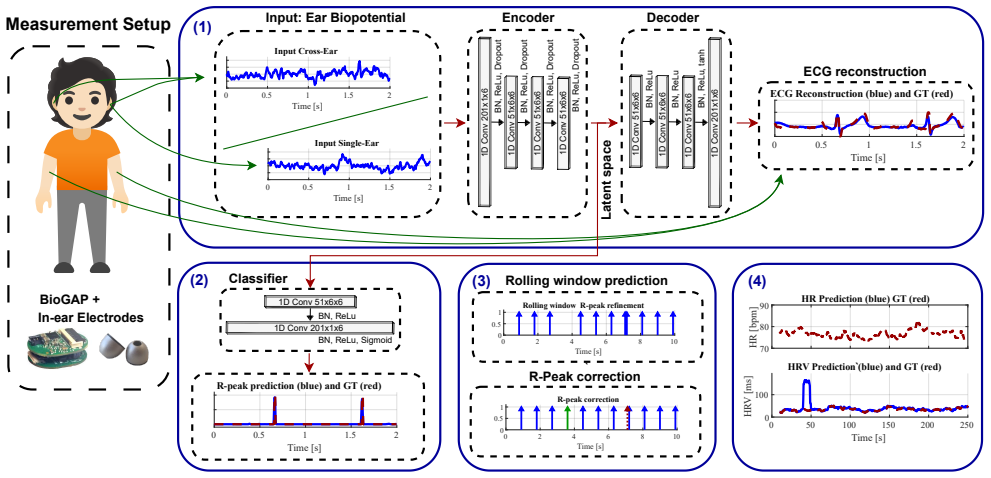
The load-bearing mechanism is the DeepMF-mini network plus its postprocessing pipeline. DeepMF-mini is a 1D convolutional autoencoder (roughly 10k parameters) whose encoder is frozen after training and paired with a classifier made of transpose convolutions; it learns a latent-space representation shared between the noisy ear biopotential and the clean arm-ECG, and the classifier outputs R-peak probabilities. The rolling-window refinement evaluates each 2-second window multiple times with a 0.4 s shift, discards the least-reliable last segment, and takes element-wise maxima over the overlap, so peaks near window edges get a second chance. Finally, Algorithm 1 corrects the predicted peak sequence by adjusting to the running median of RR intervals, which is what makes the reported HRV numbers possible from noisy single-ear signals.
What would settle it
Record ear-ECG and simultaneous arm-ECG from, say, twenty subjects during rest, walking, and a protocol that induces premature ventricular contractions; compute RMSSD from the corrected peaks and compare with the arm-ECG ground truth. If the correction algorithm removes or inserts beats outside isolated missed/duplicate cases, the single-ear HRV error will climb substantially above the reported 91.57 ms as the arrhythmia or motion burden increases.
Extended reading notes
Core claim
The paper's central claim is that a compact convolutional network called DeepMF-mini, a roughly 75× smaller variant of the DeepMF architecture, can be trained once on ear biopotentials and then detect R-peaks in real time for new users without recalibration. The model is a two-stage design: an encoder-decoder first maps the ear signal to a latent representation that reconstructs the arm-measured Lead I ECG; the decoder is then replaced by a peak classifier trained on the same latent space. A rolling-window postprocessor merges overlapping predictions to catch peaks near window boundaries, and a correction algorithm that uses the running median of RR intervals removes duplicates and inserts missed beats. With all processing on the wearable, the paper reports an R-peak F1-score of 0.95 for cross-ear and 0.82 for single-ear input, HR errors of 0.49 bpm and 5.91 bpm, and HRV errors of 25.82 ms and 91.57 ms, respectively, at 36.7 µJ per inference.
Load-bearing premise
The R-peak correction step assumes that missed or duplicate detections are isolated events, so that deleting or inserting a beat according to the running median of RR intervals does not erase genuine beat-to-beat variability; if real arrhythmic or motion-induced intervals occur, the correction would bias the HRV measurement toward regularity and the reported accuracy would be optimistic.
Editorial extensions
If this is right
- Consumer earbuds using this design could track HR and HRV continuously for about 36 hours on a 75 mAh battery, since the whole system draws about 7.6 mW.
- Cross-ear R-peak detection (F1 = 0.95) is achieved with 75× fewer parameters than the reference DeepMF model, freeing memory and compute for audio processing on the same chip.
- The single-ear configuration reduces hardware complexity (no wiring across the head) and still reaches HR errors around 5.91 bpm, suitable for trend monitoring rather than clinical-grade beat annotation.
- The quantized 10 kB model runs in 1.47 ms per inference at the energy-efficient operating point, so it occupies only a small fraction of the duty cycle.
- Because the model is trained with leave-one-subject-out, a new user would not need a personal calibration session before the device starts reporting HR/HRV.
Reading between the lines
- The paper's HRV numbers depend on Algorithm 1, which assumes missed or duplicate beats are isolated and true intervals are near whole-number multiples of the running median; if real arrhythmias or motion artifacts produce genuine short-long-short patterns, this correction would bias HRV toward regularity, so the 25.82 ms error may not hold on ambulatory or arrhythmic data.
- The single-ear input's main weakness is the attenuated, less consistent T-wave and post-QRS signal; adding a second sensing modality already present in earbuds (e.g., PPG or an accelerometer for motion rejection) could plausibly close most of the 91.57 ms HRV gap without a major energy cost.
- The same latent-space pipeline could be retargeted to estimate other cardiac intervals, such as QT or PR, if the ECG reconstruction quality improves; the paper already shows the reconstruction approximates the arm ECG waveform.
- The 36.7 µJ per inference figure suggests an always-on heartbeat detector leaves ample power headroom for audio streaming on the same earbud, which is the practical path to making cardiac monitoring a background feature.
Signed reviews
Editorial analysis
A structured set of objections, weighed in public.
Referee Report
Summary. The paper presents DeepMF-mini, a lightweight convolutional autoencoder and R-peak classifier derived from the DeepMF architecture, integrated into BioGAP, an ultra-low-power wearable biosignal platform. The authors collect simultaneous arm-ECG and in-ear biopotential data from four healthy subjects in rest conditions and evaluate leave-one-subject-out (LOSO) R-peak detection, ECG reconstruction, and HR/HRV estimation for both single-ear and cross-ear configurations. They report a single-ear F1-score of 0.82, a cross-ear F1-score of 0.95, HR mean errors of 5.91 bpm (single-ear) and 0.49 bpm (cross-ear), HRV mean errors of 91.57 ms and 25.82 ms respectively, and an on-device inference energy of 36.7 uJ/inference with an estimated 36 h battery life. The main claims are that a subject-independent, fully wearable single-ear system can perform real-time HR/HRV monitoring at accuracy comparable to state-of-the-art cross-ear approaches.
Significance. If the reported accuracy holds under a properly unbiased evaluation, this is a useful step toward practical hearable-based cardiovascular monitoring: dry in-ear electrodes, a 10k-parameter model, on-device inference at 36.7 uJ per inference, and a concrete embedded deployment are all meaningful engineering contributions. The manuscript also ships code and data (github.com/pulp-bio/DeepMF-mini), which is a strength for reproducibility. The cross-ear HR error of 0.49 bpm and the sub-40 uJ inference energy are attractive headline numbers. However, the current evidence base is narrow: four male subjects, rest-only recordings, no confidence intervals, and an evaluation protocol that tunes the detection threshold on the test subjects. These issues directly affect the load-bearing 'subject-independent robust extraction' claim and need to be addressed before the quantitative claims can be taken at face value.
major comments (3)
- [Section III-G] The detection threshold is selected on the evaluation set: 'the threshold maximizing the F1-score was selected for rolling output inference across all subjects.' Because the evaluation is LOSO with only four subjects and no separate validation split is described, this is equivalent to tuning a hyperparameter on the test data. This biases the reported F1-score and all downstream HR/HRV errors upward, undermining the subject-independent claim. Please use nested LOSO (or a subject-disjoint validation split) and report metrics for the threshold chosen without access to test labels.
- [Section III-E, Algorithm 1] All reported HRV errors (25.82 ms cross-ear, 91.57 ms single-ear) are computed after applying Algorithm 1, which inserts or removes beats by rounding the ratio of each RR interval to the running median. This correction assumes that missed or duplicate detections are isolated and that the underlying true RR intervals are close to integer multiples of a median interval. On a four-subject, rest-only dataset with no arrhythmic or motion-corrupted intervals, the correction is not stress-tested, and it could suppress genuine beat-to-beat variability if such intervals occur. Please report both raw and corrected HR/HRV errors and validate the correction on data containing artifacts or known ectopic beats.
- [Section III-A and Section IV-C] The subject-independent claim rests on LOSO evaluation over only four healthy male subjects, all recorded at rest, with no confidence intervals or per-subject breakdowns. With n=4, a single subject can dominate the cross-ear HR error of 0.49 bpm, and the absence of variability measures makes it impossible to assess whether the reported accuracy is stable. Please provide per-subject results, confidence intervals, and preferably an independent test cohort or an explicit statistical statement of the precision of the reported errors.
minor comments (4)
- [Section I] The contributions list contains a typo: 'achieves SoA performance for HV and HVR' should presumably read 'HR and HRV'; elsewhere the paper correctly uses 'HRV'.
- [Table II] The reported DeepMF precision/recall values are inconsistent between the text (Section II: '95%/92%') and Table II ('91.2% / 94.9%'). Please reconcile these numbers.
- [Section IV-D and Table I] The relationship between the reported 36.7 uJ per inference, the 400 ms update interval, and the total system power of 7.6 mW is not derived; please state which components contribute to the 7.6 mW and how the 36 h battery estimate is obtained.
- [Section III-A] The dataset description reports mean age as '31.0 ± 5.1 years' with a decimal point; '31 ± 5 years' would be more natural, and the number of female participants (zero) should be stated explicitly as a limitation.
Circularity Check
Test-set threshold selection makes the reported subject-independent F1 and HR/HRV errors partly in-sample optima.
-
fitted input called prediction
[Section III-G (Accuracy evaluation), used for the results in Section IV-C]
"To minimize subject bias in the LOSO evaluation, the threshold maximizing the F1-score was selected for rolling output inference across all subjects."
The threshold is a free decision parameter chosen by maximizing F1 on the same LOSO test outputs that are later reported. No validation split is described, so 'across all subjects' covers every test fold. Consequently the reported F1 scores (0.82 single-ear, 0.95 cross-ear) and the downstream HR/HRV mean errors (0.49 bpm, 25.82 ms) are in-sample evaluations at the selected threshold, not out-of-sample subject-independent predictions. The subject-independent claim is therefore supported by a parameter fitted to the target labels, making the headline quantitative results partially forced by construction.
full rationale
The model-training derivation is otherwise self-contained: the encoder-decoder maps ear biopotentials to simultaneously recorded arm-ECG traces, the classifier is trained on binary R-peak labels derived from the arm-ECG, and the LOSO splits keep subjects disjoint. Algorithm 1 is a deterministic postprocessor using only predicted peak intervals and a running median; it is not circular because it does not use ground-truth labels, though its integer-multiple-of-median assumption can bias HRV toward regularity in arrhythmic or motion-corrupted data (a correctness risk, not circularity). The self-citations to BioGAP [14] and GAPSES [5] are platform/hardware references and are not load-bearing for the algorithmic claims. The single circular element is the test-set threshold selection in Section III-G. Because the F1-maximizing threshold is chosen on all LOSO test subjects and then the same subjects are used to report F1 and HR/HRV errors, the headline numbers are partly in-sample. This does not make the whole model equivalent to its inputs, but it materially compromises the 'subject-independent' quantitative claims.
Assumptions & free parameters
free parameters (3)
- F1-maximizing detection threshold =
not reported
- R-peak label generation thresholds =
min peak height 0.7, min inter-peak distance 80 samples
- Rolling window and correction hyperparameters =
2 s window, 0.4 s shift, 0.4 s end discard, 10 s HR/HRV window, minimum 4 peaks
assumptions (4)
- domain assumption In-ear and mastoid dry-electrode biopotentials contain ECG-related signal with sufficient SNR for R-peak detection.
- domain assumption Four healthy male volunteers at rest are representative enough for a 'user-generic' subject-independent model.
- ad hoc to paper Median-RR correction (Algorithm 1) fixes only spurious missed or extra peaks and preserves true physiological RR variability.
- standard math Standard signal processing (notch and bandpass filtering, z-score normalization) preserves R-peak timing relative to ground truth.
Cite this review
Pith. "Pith review of Real-Time, Single-Ear, Wearable ECG Reconstruction, R-Peak Detection, and HR/HRV Monitoring." pith.science (2026). https://pith.science/paper/SP4X73FC
@misc{pith2026250501738,
  author       = {Pith},
  title        = {Pith review of: Real-Time, Single-Ear, Wearable ECG Reconstruction, R-Peak Detection, and HR/HRV Monitoring},
  year         = {2026},
  howpublished = {\url{https://pith.science/paper/SP4X73FC}},
  note         = {Machine review of arXiv:2505.01738}
}
read the original abstract
Biosignal monitoring, in particular heart activity through heart rate (HR) and heart rate variability (HRV) tracking, is vital in enabling continuous, non-invasive tracking of physiological and cognitive states. Recent studies have explored compact, head-worn devices for HR and HRV monitoring to improve usability and reduce stigma. However, this approach is challenged by the current reliance on wet electrodes, which limits usability, the weakness of ear-derived signals, making HR/HRV extraction more complex, and the incompatibility of current algorithms for embedded deployment. This work introduces a single-ear wearable system for real-time ECG (Electrocardiogram) parameter estimation, which directly runs on BioGAP, an energy-efficient device for biosignal acquisition and processing. By combining SoA in-ear electrode technology, an optimized DeepMF algorithm, and BioGAP, our proposed subject-independent approach allows for robust extraction of HR/HRV parameters directly on the device with just 36.7 uJ/inference at comparable performance with respect to the current state-of-the-art architecture, achieving 0.49 bpm and 25.82 ms for HR/HRV mean errors, respectively and an estimated battery life of 36h with a total system power consumption of 7.6 mW. Clinical relevance: The ability to reconstruct ECG signals and extract HR and HRV paves the way for continuous, unobtrusive cardiovascular monitoring with head-worn devices. In particular, the integration of cardiovascular measurements in everyday-use devices (such as earbuds) has potential in continuous at-home monitoring to enable early detection of cardiovascular irregularities.
Figures


Figures from the paper (3 more)


Reference graph
Works this paper leans on
-
[1]
Wearables and the medical revolution,
J. Dunn et al., “Wearables and the medical revolution,” Personalized medicine, vol. 15, no. 5, pp. 429–448, 2018
work page 2018
-
[2]
Advances in biosignal sensing and signal process- ing methods with wearable devices,
J. Matthews et al., “Advances in biosignal sensing and signal process- ing methods with wearable devices,” Analysis & Sensing, vol. 3, no. 2, p. e202200062, 2023
work page 2023
-
[3]
A comprehensive accuracy assessment of samsung smartwatch heart rate and heart rate variability,
F. Sarhaddi et al., “A comprehensive accuracy assessment of samsung smartwatch heart rate and heart rate variability,” PloS one , vol. 17, no. 12, p. e0268361, 2022
work page 2022
-
[4]
SoftPulse Products: Innovative Solutions for Wearable Sensors,
Datwyler Group, “SoftPulse Products: Innovative Solutions for Wearable Sensors,” https://datwyler.com/company/innovation/ softpulse/products, 2025, accessed: 2025-01-25
work page 2025
-
[5]
S. Frey et al. , “Gapses: Versatile smart glasses for comfortable and fully-dry acquisition and parallel ultra-low-power processing of eeg and eog,” IEEE TBioCAS, pp. 1–11, 2024
work page 2024
-
[6]
Hearables: feasibility of recording cardiac rhythms from head and in-ear locations,
W. von Rosenberg et al., “Hearables: feasibility of recording cardiac rhythms from head and in-ear locations,” Royal Society open science , vol. 4, no. 11, pp. 171 214–171 214, 2017
work page 2017
-
[7]
Hearables: Feasibility and validation of in-ear electrocardiogram,
G. Hammour et al. , “Hearables: Feasibility and validation of in-ear electrocardiogram,” in IEEE EMBC, 2019, pp. 5777–5780
work page 2019
-
[8]
The deep-match framework: R-peak detection in ear-ecg,
H. J. Davies et al., “The deep-match framework: R-peak detection in ear-ecg,” IEEE TBioCAS, vol. 71, no. 7, pp. 2014–2021, 2024
work page 2014
Show all 16 references
-
[9]
A wireless system for eeg acquisition and processing in an earbud form factor with 600 hours battery lifetime,
M. Guermandi et al. , “A wireless system for eeg acquisition and processing in an earbud form factor with 600 hours battery lifetime,” in Proc. IEEE EMBC , 2022, pp. 3139–3145
2022
-
[10]
Hearables: feasibility of recording cardiac rhythms from single in-ear locations,
M. Yarici et al., “Hearables: feasibility of recording cardiac rhythms from single in-ear locations,” Royal Society open science , vol. 11, no. 1, pp. 221 620–17, 2024
2024
-
[11]
Enabling r-peak detection in wearable ecg: Combining matched filtering and hilbert transform,
T. Chanwimalueang et al., “Enabling r-peak detection in wearable ecg: Combining matched filtering and hilbert transform,” in IEEE DSP . IEEE, 2015, pp. 134–138
2015
-
[12]
Hearables: Heart rate variability from ear electrocar- diogram and ear photoplethysmogram (ear-ecg and ear-ppg),
H. Tian et al., “Hearables: Heart rate variability from ear electrocar- diogram and ear photoplethysmogram (ear-ecg and ear-ppg),” in IEEE EMBC, vol. 2023. United States: IEEE, 2023, pp. 1–5
2023
-
[13]
In-ear ecg signal enhancement with denoising convolutional autoencoders,
E. Occhipinti et al. , “In-ear ecg signal enhancement with denoising convolutional autoencoders,” 2024. [Online]. Available: https://arxiv. org/abs/2409.05891
2024 arXiv
-
[14]
Biogap: a 10-core fp-capable ultra-low power iot processor, with medical-grade afe and ble connectivity for wearable biosignal processing,
S. Frey et al. , “Biogap: a 10-core fp-capable ultra-low power iot processor, with medical-grade afe and ble connectivity for wearable biosignal processing,” IEEE COINS, 2023
2023
-
[15]
Nntool: Neural network tool for gap proces- sors,
G. Technologies, “Nntool: Neural network tool for gap proces- sors,” https://greenwaves-technologies.com/tools-and-software/, ac- cessed: 2024-05-24
2024
-
[16]
Hearables: In-Ear Multimodal Data Fusion for Robust Heart Rate Estimation,
M. ˙Zyli´nski et al. , “Hearables: In-Ear Multimodal Data Fusion for Robust Heart Rate Estimation,” BioMedInformatics, vol. 4, no. 2, pp. 911–920, Apr. 2024
2024
Reviewed August 16, 2026 · model on record in the stance chip above.
Discussion (0). Continue with ORCID to comment.