REVIEW 3 major objections 5 minor 43 references
Harnessing the Power of LLMs, Informers and Decision Transformers for Intent-driven RAN Management in 6G
T0 review · 3 major / 5 minor · reviewed 2026-08-16 · deepseek-v4-flash
Pith's one-line read An end-to-end generative AI pipeline—fine-tuned LLM, predictive validator, and goal-aware decision transformer—claims to automate intent-driven radio access network management in 6G.
desk verdict A plausible end-to-end intent-driven RAN framework with a new HDTGA architecture, but the headline 'at least 19.3%' throughput gain is contradicted by the paper's own per-baseline results (9.5% vs. vanilla DT), and the intent-validation accuracy is circular. read the letter →
The pith
A machine-rendered reading of the paper's core claim, the machinery that carries it, and where it could break.
The reading
What carries the argument
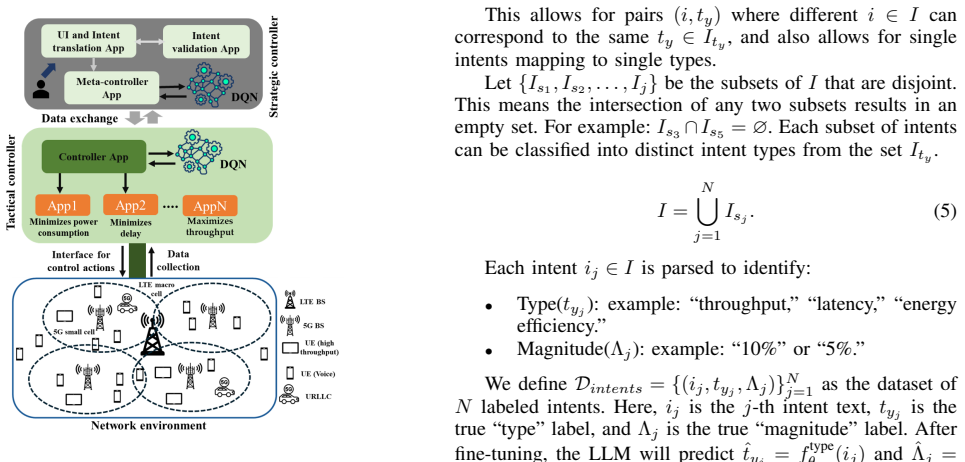
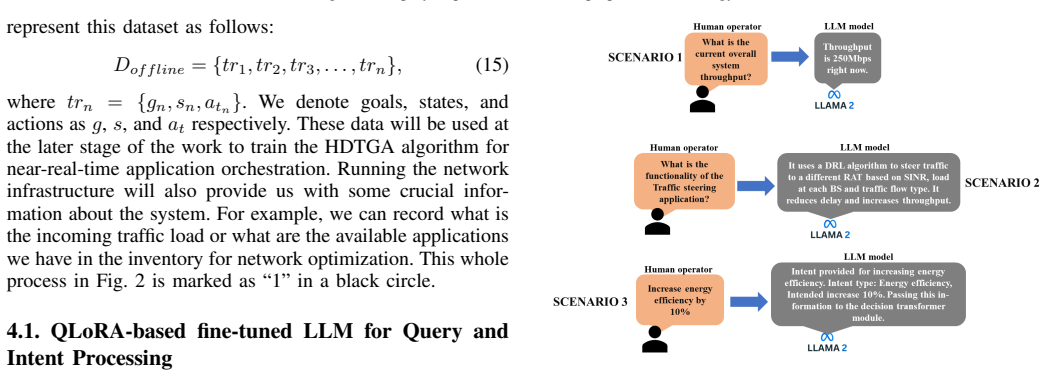
The load-bearing object is HDTGA, a two-level transformer architecture where a meta-transformer $\pi^{\text{meta}}_\phi$ predicts an important past action $a_{t-\beta}$ that previously achieved the current goal, partially or fully, and a control transformer $\pi^{\text{control}}_\theta$ then produces the actual application-selection action $a_t$ conditioned on recent states, the intent-derived goal $g_t$, and that remembered action. This replaces the returns-to-go that ordinary Decision Transformers require, so no external task-specific reward schedule has to be specified. The surrounding machinery consists of QLoRA (4-bit quantization plus low-rank adapters) for memory-efficient LLM fine-tuning, a RAG module for retrieving current network data, and the Informer's ProbSparse self-attention for long-sequence forecasting of the three validation KPIs.
What would settle it
Inspect the h-DQN trajectories and count state-action-goal triples with zero empirical support; if any high-reward action for a goal is missing, Theorem 1's premise fails. A sharper test: delete the best known action for one goal from $D_{\text{offline}}$, retrain HDTGA, and measure whether the value drops beyond the claimed $\epsilon$ bound.
Extended reading notes
Core claim
The central discovery, stated by the authors, is that intent-driven management decomposes into three trainable stages, each improving on its baseline. In the reported experiments, the fine-tuned LLM reaches BERTScore 0.92 versus 0.86 for the base model; the Informer forecaster achieves MAE 16.1 for traffic load versus 64.9 for a decoder-only transformer and 70.5 for LSTM; the validation layer correctly labels 88% of intents; and HDTGA increases throughput by 9.5%, 23.2%, and 25.2% respectively against vanilla Decision Transformer, HRL with validation, and HRL without validation, with corresponding delay reductions of 30.4%, 53.5%, and 61.5% and energy-efficiency gains of 41.1%, 46.7%, and 77.4%. The paper also claims an $\epsilon$-optimality theorem for HDTGA, with the proof leaning on an offline-data coverage condition.
Load-bearing premise
The load-bearing premise is that the offline dataset $D_{\text{offline}}$ has already observed every state-action-goal triple with non-zero probability, so HDTGA can learn the optimal mapping; if that coverage fails, low training loss does not guarantee near-optimal performance.
Editorial extensions
If this is right
- Operators could submit intents as free text and receive an automatically vetted configuration, removing manual SLA mapping.
- Because validation uses forecasted rather than current KPIs, intents that would degrade performance at peak load are rejected before they reach the radio access network.
- The goal-aware hierarchy needs no hand-tuned returns-to-go, so a policy trained on one set of goals can be repurposed for new target metrics by changing the goal input.
- Lower action-inference time than the baselines makes near-real-time orchestration feasible for delay-sensitive applications.
- The reported smoother KPI curves with validation imply fewer quality-of-service violation events during intent execution.
Reading between the lines
- The abstract's 'at least 19.3%' throughput wording is an average of the per-baseline gains of 9.5%, 23.2%, and 25.2%, so it should not be read as a guaranteed lower bound.
- The same offline trajectories could be replayed through standard offline-RL evaluation to test whether HDTGA's advantage comes from the architecture itself or simply from using a different policy class on data produced by the hierarchical DQN.
- Goal-aware recall of a past useful action may transfer to other sequential decision problems where a sparse goal is easier to specify than a dense reward, but that transfer is untested in the paper.
- The validation layer's 88% accuracy depends on the threshold-selection heuristic and the simulated traffic mixes, so deployment would likely require re-learning those thresholds per site.
Signed reviews
Editorial analysis
A structured set of objections, weighed in public.
Referee Report
Summary. The paper proposes an end-to-end intent-driven RAN management framework for 5G/6G built from three GenAI components: a QLoRA-fine-tuned LLM with a RAG module for intent processing, an Informer-based time-series predictor for proactive intent validation, and a hierarchical decision transformer with goal awareness (HDTGA) for network-application orchestration. Simulation results are reported for an OFDM multi-RAT deployment with 60 users, including gains in BERTScore, semantic similarity, intent-validation accuracy, throughput, delay, and energy efficiency. The central advertised claim is that HDTGA improves throughput by 'at least 19.3%' while reducing delay by 48.5% and boosting energy efficiency by 54.9% over baselines.
Significance. If the reported results were accurate, the framework would be a useful integration of several modern GenAI techniques into a single intent-driven management loop, addressing a real need in 6G network automation. The simulation setup is detailed, the three-step architecture is clearly described, and the comparison against vanilla decision transformers and hierarchical RL baselines is a sensible evaluation design. The paper should be credited for assembling these components and for reporting per-baseline gains that show consistent improvement in delay and energy efficiency. However, the significance is substantially weakened by the internal inconsistency of the headline performance claims, the circularity of the intent-validation evaluation, and an unproven optimality theorem.
major comments (3)
- [Abstract, §1, §5.2.3, Fig. 11a] The headline claim that HDTGA 'increases throughput at least by 19.3%' (Abstract and Conclusions) is contradicted by the paper's own per-baseline results in Fig. 11a and §5.2.3: throughput gains over vanilla DT, HRL with intent validation, and HRL without intent validation are 9.5%, 23.2%, and 25.2%, respectively. The minimum gain is 9.5%, so 19.3% cannot be a lower bound; it is the arithmetic average of the three gains. The Introduction's '19.4%' adds a further inconsistency. This is a load-bearing error in the primary quantitative contribution; please rephrase the claim as an average or provide a worst-case analysis/confidence interval that actually supports a lower bound.
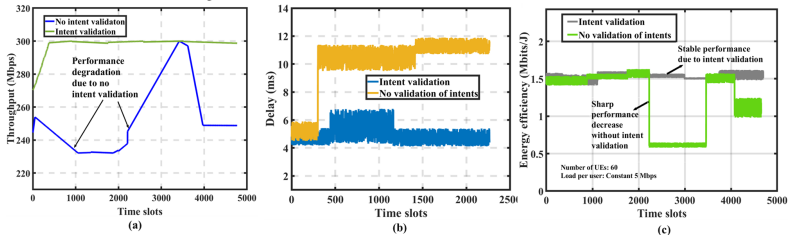
- [§4.2, Table 2, Algorithms 2–3, Fig. 9] The 88% intent-validation accuracy is not a predictive accuracy measure. The thresholds in Algorithm 2 and the lookup table (Table 2) are constructed from QoS drift calculations on the simulation data, and Algorithm 3 validates an intent by matching it against this same table. The evaluation in Fig. 9 is therefore performed on the very intents and network states used to build the validator, with no train/test split, temporal holdout, or cross-validation. The reported '88% accuracy' reflects memorization of the construction data rather than the ability to rule out performance-degrading intents preemptively. Please evaluate on a held-out set of intents/network states, or explicitly reframe the result as in-sample performance of a rule-based validator.
- [Theorem 1 and Appendix A] The optimality guarantee in Theorem 1 is not established by the proof in Appendix A. The proof assumes (i) sufficient coverage of the offline dataset Doffline, (ii) transformer universal approximation, and (iii) that training minimizes the empirical loss to an acceptable level; these assumptions are neither verified for the h-DQN-generated dataset nor stated in the theorem. The proof also uses an undefined δ in the final bound ε = 2δRmax/(1−γ)^2, while the preceding argument concerns Γ, so the bound is not well-formed. Since the offline coverage condition is known to be difficult to satisfy in offline RL and is load-bearing for any near-optimality claim, either provide evidence of coverage (e.g., state-action-goal visitation counts or a distributional analysis) or revise the theorem to state the conditional result under explicitly listed, verifiable assumptions.
minor comments (5)
- [§5.2.1] The sentence 'This increase from 0.86 to 0.89' compares a BERTScore value with a METEOR value and should read 'This increase from 0.83 to 0.89' for METEOR.
- [Table 3] The DRL learning rate of 0.5 appears unusually high and may be a typo; please verify and clarify whether this is the learning rate for the network applications' DQNs.
- [§5.2.2] The MAE values (70.5, 64.9, 16.1) should be accompanied by units, the prediction horizon, and the test-set size to be interpretable.
- [Figures 6–12] Figures 6–12 show point values without error bars or multiple-seed statistics; report the number of random seeds and variance to support the comparative claims.
- [References] The bibliography contains duplicate entries for the RAG reference (references [12] and [24]) and for the traffic steering/h-DQN works; consolidate them.
Circularity Check
Intent-validation '88% accuracy' is a lookup-table self-check built from and evaluated on the same QoS-drift data; the rest of the framework is independent empirical work.
-
fitted input called prediction
[Section 4.2 (Algorithm 2, Table 2), Algorithm 3, Section 5.2.2 (Fig. 9)]
"Next, intents are executed for multiple combinations of the defined thresholds in Sth based on the predicted values of packet loss, load, and power consumption. We calculate the QoS drifts while executing such intents. We form the following look-up table (Table 2): ... Based on the lookup table, we either validate or invalidate intents in a supervised manner. ... Only 12 out of 100 intents were incorrectly validated, achieving 88% accuracy."
The validation decision is literally a lookup in Tlookup, and Tlookup is constructed from the same quantity used as the ground truth: QoS drift observed when intents are executed in simulation. Table 2 records, for each intent type and threshold-based network state, whether executing that intent produced Qdrift>0. Algorithm 3 then marks an intent Invalid exactly when the matching table entry has Qdrift>0. The reported 88% accuracy is measured on the same intents and network states used to build the table, with no described train/test split: Fig. 9 plots 'a subset of intents' against 'corresponding QoS drifts' and counts mismatches.
full rationale
The one clear circular step is the intent-validation accuracy claim. The lookup table used to validate intents is formed by executing intents and measuring QoS drifts, and the 88% accuracy is evaluated against QoS drifts over the same intents/states without an explicit held-out split, so the 'prediction' reduces to a self-check of the table's construction. I do not find comparable circularity in the other components. The QLoRA LLM fine-tuning is evaluated against the base LLaMA model using standard external metrics (BERTScore, METEOR, semantic similarity). The Informer forecasting is compared to LSTM and GPT-2 DOT using MAE on the time-series residuals; that is a self-contained benchmark. The HDTGA orchestration is trained on h-DQN-generated offline trajectories and compared against vanilla DT and two HRL baselines in simulation on throughput, delay, and energy efficiency, which is an independent empirical comparison rather than a derivation from its own outputs. The self-citations ([8], [9], [26], [27]) are background pointers or data-collection references, not load-bearing uniqueness arguments. Theorem 1 is conditional on coverage and model-capacity assumptions and is therefore weak or nearly vacuous, but it is not circular in the sense of a result being equivalent to its inputs. The abstract's 'at least 19.3%' throughput claim conflicts with the per-baseline 9.5% gain in Fig. 11a, but that is an internal numerical inconsistency, not a circularity, and is not counted in this score. Because one advertised prediction reduces by construction while the central LLM, forecasting, and orchestration results retain independent content, the appropriate score is 6.
Assumptions & free parameters
free parameters (6)
- Validation thresholds Hload, Lload, Hloss, Lloss, Hpc, Lpc =
Not reported (chosen via Algorithm 2)
- KPI significance thresholds zeta_a, zeta_b =
Not reported (percentile-based)
- Utility weights g1, g2 =
Not reported
- QoS penalty parameter varrho =
Not reported
- Scaling factor sf in goal deviation =
Not reported
- Q-value alignment weight =
0.5
assumptions (5)
- ad hoc to paper Transformer universal approximation: a transformer with sufficient capacity can approximate the optimal policy arbitrarily well.
- domain assumption Lipschitz continuity of state transitions and reward function.
- domain assumption Offline dataset coverage of state-action-goal space.
- domain assumption The simulation environment (OFDM, CDL channels, traffic models, RAN applications) is a faithful proxy for real 5G/6G networks.
- domain assumption The QoS drift and lookup table correctly encode ground-truth performance degradation for intent validation.
Cite this review
Pith. "Pith review of Harnessing the Power of LLMs, Informers and Decision Transformers for Intent-driven RAN Management in 6G." pith.science (2026). https://pith.science/paper/FXVGGHO5
@misc{pith2026250501841,
  author       = {Pith},
  title        = {Pith review of: Harnessing the Power of LLMs, Informers and Decision Transformers for Intent-driven RAN Management in 6G},
  year         = {2026},
  howpublished = {\url{https://pith.science/paper/FXVGGHO5}},
  note         = {Machine review of arXiv:2505.01841}
}
read the original abstract
Intent-driven network management is critical for managing the complexity of 5G and 6G networks. It enables adaptive, on-demand management of the network based on the objectives of the network operators. In this paper, we propose an innovative three-step framework for intent-driven network management based on Generative AI (GenAI) algorithms. First, we fine-tune a Large Language Model (LLM) on a custom dataset using a Quantized Low-Rank Adapter (QLoRA) to enable memory-efficient intent processing within limited computational resources. A Retrieval Augmented Generation (RAG) module is included to support dynamic decision-making. Second, we utilize a transformer architecture for time series forecasting to predict key parameters, such as power consumption, traffic load, and packet drop rate, to facilitate intent validation proactively. Lastly, we introduce a Hierarchical Decision Transformer with Goal Awareness (HDTGA) to optimize the selection and orchestration of network applications and hence, optimize the network. Our intent guidance and processing approach improves BERTScore by 6% and the semantic similarity score by 9% compared to the base LLM model. Again, the proposed predictive intent validation approach can successfully rule out the performance-degrading intents with an average of 88% accuracy. Finally, compared to the baselines, the proposed HDTGA algorithm increases throughput at least by 19.3%, reduces delay by 48.5%, and boosts energy efficiency by 54.9%.
Figures

Figures from the paper (9 more)




Reference graph
Works this paper leans on
-
[1]
Management and Orchestration; Intent Driven Man- agement Services for Mobile Networks,
3GPP, “Management and Orchestration; Intent Driven Man- agement Services for Mobile Networks,” ETSI, Technical Specification TS 28.312, March 2022, release 17. [Online]. Available: https://www.etsi.org/deliver/etsi ts/128300 128399/128312/ 17.00.01 60/ts 128312v170001p.pdf
work page 2022
-
[2]
D. M. Manias, A. Chouman, and A. Shami, “Towards Intent-Based Network Management: Large Language Models for Intent Extraction in 5G Core Networks,” in 20th DRCN, 2024, pp. 1–6
work page 2024
-
[3]
SMART Intent-Driven Network Management,
C. Yang, X. Mi, Y . Ouyang, R. Dong, J. Guo, and M. Guizani, “SMART Intent-Driven Network Management,” IEEE Commun. Mag- azine, vol. 61, no. 1, pp. 106–112, 2023
work page 2023
-
[4]
LLM-Based Policy Generation for Intent-Based Management of Applications,
K. Dzeparoska, J. Lin, A. Tizghadam, and A. Leon-Garcia, “LLM-Based Policy Generation for Intent-Based Management of Applications,” in 19th IEEE CNSM , 2023, pp. 1–7
work page 2023
-
[5]
NLP Powered Intent Based Network Management for Private 5G Networks,
J. Mcnamara et al., “NLP Powered Intent Based Network Management for Private 5G Networks,” IEEE Access , vol. 11, pp. 36 642–36 657, 2023
work page 2023
-
[6]
Network Meets ChatGPT: Intent Autonomous Man- agement, Control and Operation,
J. Wang et al ., “Network Meets ChatGPT: Intent Autonomous Man- agement, Control and Operation,” Journal of Commun. and Inf. Netw. , vol. 8, no. 3, pp. 239–255, 2023
work page 2023
-
[7]
M. Polese, L. Bonati, S. D’Oro, S. Basagni, and T. Melodia, “ColO- RAN: Developing Machine Learning-Based xApps for Open RAN Closed-Loop Control on Programmable Experimental Platforms,” IEEE Trans. on Mobile Comput. , vol. 22, no. 10, pp. 5787–5800, 2023
work page 2023
-
[8]
M. A. Habib et al., “Intent-driven Intelligent Control and Orchestration in O-RAN Via Hierarchical Reinforcement Learning,” in IEEE 20th MASS, 2023, pp. 55–61
work page 2023
Show all 43 references
-
[9]
LLM-Based Intent Processing and Network Optimization Using Attention-Based Hierarchical Reinforcement Learning,
——, “LLM-Based Intent Processing and Network Optimization Using Attention-Based Hierarchical Reinforcement Learning,” 2024. [Online]. Available: https://arxiv.org/abs/2406.06059
2024 arXiv
-
[10]
Attention Is All You Need,
A. Vaswani et al ., “Attention Is All You Need,” CoRR, vol. abs/1706.03762, 2017. [Online]. Available: http://arxiv.org/abs/1706. 03762
2017 arXiv
-
[11]
QLoRA: Efficient Finetuning of Quantized LLMs,
T. Dettmers, A. Pagnoni, A. Holtzman, and L. Zettlemoyer, “QLoRA: Efficient Finetuning of Quantized LLMs,” 2023. [Online]. Available: https://arxiv.org/abs/2305.14314
2023 arXiv
-
[13]
Informer: Beyond Efficient Transformer for Long Sequence Time-Series Forecasting,
H. Zhou et al ., “Informer: Beyond Efficient Transformer for Long Sequence Time-Series Forecasting,” 2021. [Online]. Available: https://arxiv.org/abs/2012.07436
2021 arXiv
-
[14]
Decision Transformer: Reinforcement Learning via Sequence Modeling,
L. Chen et al ., “Decision Transformer: Reinforcement Learning via Sequence Modeling,” 2021. [Online]. Available: https://arxiv.org/abs/ 2106.01345
2021 arXiv
-
[15]
FeUdal Networks for Hierarchical Reinforcement Learning,
A. S. Vezhnevets et al ., “FeUdal Networks for Hierarchical Reinforcement Learning,” CoRR, vol. abs/1703.01161, 2017. [Online]. Available: http://arxiv.org/abs/1703.01161
2017 arXiv
-
[16]
Intent Assurance using LLMs guided by Intent Drift,
K. Dzeparoska, A. Tizghadam, and A. Leon-Garcia, “Intent Assurance using LLMs guided by Intent Drift,” inNOMS 2024-2024 IEEE Network Operations and Management Symposium , 2024, pp. 1–7
2024
-
[17]
OrchestRAN: Orches- trating Network Intelligence in the Open RAN,
S. D’Oro, L. Bonati, M. Polese, and T. Melodia, “OrchestRAN: Orches- trating Network Intelligence in the Open RAN,” IEEE Trans. on Mobile Comput., vol. 23, no. 7, pp. 7952–7968, 2024
2024
-
[18]
Op- timizing Energy Saving for Wireless Networks Via Offline Decision Transformer,
Y . T. Xu, D. Wu, M. Jenkin, S. Jang, X. Liu, and G. Dudek, “Op- timizing Energy Saving for Wireless Networks Via Offline Decision Transformer,” in ICC 2024, 2024, pp. 409–414
2024
-
[19]
Decision Transformers for Wireless Communications: A New Paradigm of Resource Management,
J. Zhang et al., “Decision Transformers for Wireless Communications: A New Paradigm of Resource Management,” 2024. [Online]. Available: https://arxiv.org/abs/2404.05199
2024 arXiv
-
[20]
Study on channel model for frequencies from 0.5 to 100 ghz,
3rd Generation Partnership Project (3GPP), “Study on channel model for frequencies from 0.5 to 100 ghz,” 3GPP, Technical Report TR 38.901, Jan 2020, available at: https://www.3gpp.org/ftp/Specs/archive/ 38 series/38.901/
2020
-
[21]
Deep Learning Predictive Band Switching in Wireless Networks,
F. B. Mismar, A. Alammouri, A. Alkhateeb, J. G. Andrews, and B. L. Evans, “Deep Learning Predictive Band Switching in Wireless Networks,” IEEE Trans. Wireless Commun, vol. 20, no. 1, pp. 96–109, 2021
2021
-
[22]
Hierarchical Deep Reinforcement Learning: Integrating Temporal Ab- straction and Intrinsic Motivation,
T. D. Kulkarni, K. Narasimhan, A. Saeedi, and J. B. Tenenbaum, “Hierarchical Deep Reinforcement Learning: Integrating Temporal Ab- straction and Intrinsic Motivation,” CoRR, vol. abs/1604.06057, 2016
2016 arXiv
-
[23]
LoRA: Low-Rank Adaptation of Large Language Models,
E. J. Hu et al ., “LoRA: Low-Rank Adaptation of Large Language Models,” 2021. [Online]. Available: https://arxiv.org/abs/2106.09685
2021 arXiv
-
[24]
Retrieval-Augmented Generation for Knowledge- Intensive NLP Tasks,
P. Lewis et al ., “Retrieval-Augmented Generation for Knowledge- Intensive NLP Tasks,” 2021. [Online]. Available: https://arxiv.org/abs/ 2005.11401
2021 arXiv
-
[25]
LLaMA: Open and Efficient Foundation Language Models,
H. Touvron et al., “LLaMA: Open and Efficient Foundation Language Models,” arXiv preprint arXiv:2302.13971 , 2023
2023 arXiv
-
[26]
Transformer-Based Wireless Traffic Prediction and Network Optimization in O-RAN,
M. A. Habib et al., “Transformer-Based Wireless Traffic Prediction and Network Optimization in O-RAN,” arXiv preprint arXiv:2403.10808 , Mar. 2024
2024 arXiv
-
[27]
Traffic Steering for 5G Multi-RAT Deployments Using Deep Reinforcement Learning,
——, “Traffic Steering for 5G Multi-RAT Deployments Using Deep Reinforcement Learning,” in IEEE 20th CCNC , 2023, pp. 164–169
2023
-
[28]
Cooperative Hierarchical Deep Reinforcement Learning Based Joint Sleep and Power Control in RIS-Aided Energy-Efficient RAN,
H. Zhou, M. Elsayed, M. Bavand, R. Gaigalas, S. Furr, and M. Erol- Kantarci, “Cooperative Hierarchical Deep Reinforcement Learning Based Joint Sleep and Power Control in RIS-Aided Energy-Efficient RAN,” IEEE Trans. on Cogn. Commun. Netw. , pp. 1–1, 2024
2024
-
[29]
Team Learning-Based Resource Allocation for Open Radio Access Network (O-RAN),
H. Zhang, H. Zhou, and M. Erol-Kantarci, “Team Learning-Based Resource Allocation for Open Radio Access Network (O-RAN),” in ICC 2022, 2022, pp. 4938–4943
2022
-
[30]
Deep Reinforcement Learning for 5G Networks: Joint Beamforming, Power Control, and Interference Coordination,
F. B. Mismar, B. L. Evans, and A. Alkhateeb, “Deep Reinforcement Learning for 5G Networks: Joint Beamforming, Power Control, and Interference Coordination,” IEEE Trans. Commun. , vol. 68, no. 3, pp. 1581–1592, 2020
2020
-
[31]
Handover Decision Making for Dense HetNets: A Reinforcement Learning Approach,
Y . Song, S. H. Lim, and S.-W. Jeon, “Handover Decision Making for Dense HetNets: A Reinforcement Learning Approach,” IEEE Access , vol. 11, pp. 24 737–24 751, 2023
2023
-
[32]
A Survey on 5G Usage Scenarios and Traffic Models,
J. Navarro-Ortiz, P. Romero-Diaz, S. Sendra, P. Ameigeiras, J. J. Ramos- Munoz, and J. M. Lopez-Soler, “A Survey on 5G Usage Scenarios and Traffic Models,” IEEE Commun. Surveys Tuts , vol. 22, no. 2, pp. 905– 929, 2020
2020
-
[33]
Which Statistical Distribution Best Characterizes Modern Cellular Traffic and What Factors Could Predict Its Spatiotemporal Variability?
S. Bothe, H. N. Qureshi, and A. Imran, “Which Statistical Distribution Best Characterizes Modern Cellular Traffic and What Factors Could Predict Its Spatiotemporal Variability?” IEEE Commun. Lett. , vol. 23, no. 5, pp. 810–813, 2019
2019
-
[34]
AI-Enabled Radio Resource Allo- cation in 5G for URLLC and eMBB Users,
M. Elsayed and M. Erol-Kantarci, “AI-Enabled Radio Resource Allo- cation in 5G for URLLC and eMBB Users,” in 2019 IEEE 2nd 5GWF , 2019, pp. 590–595
2019
-
[35]
Dahlman, S
E. Dahlman, S. Parkvall, and J. Skold, 4G, LTE-Advanced Pro and The Road to 5G, Third Edition , 3rd ed. USA: Academic Press, Inc., 2016
2016
-
[36]
Millimeter Wave Mobile Communications for 5G Cellular: It Will Work!
T. S. Rappaport et al ., “Millimeter Wave Mobile Communications for 5G Cellular: It Will Work!” IEEE Access, vol. 1, pp. 335–349, 2013
2013
-
[37]
BERTScore: Evaluating Text Generation with BERT,
T. Zhang, V . Kishore, F. Wu, K. Q. Weinberger, and Y . Artzi, “BERTScore: Evaluating Text Generation with BERT,” CoRR, vol. abs/1904.09675, 2019. [Online]. Available: http://arxiv.org/abs/1904. 09675
1904 arXiv
-
[38]
Meteor: An Automatic Metric for MT Evaluation with High Levels of Correlation with Human Judgments,
A. Lavie and A. Agarwal, “Meteor: An Automatic Metric for MT Evaluation with High Levels of Correlation with Human Judgments,” in Proceedings of the Second Workshop on Statistical Machine Translation, ser. StatMT ’07. USA: Association for Computational Linguistics, 2007, p. 228–231
2007
-
[39]
BERT: Pre-training of Deep Bidirectional Transformers for Language Understanding,
J. Devlin, M. Chang, K. Lee, and K. Toutanova, “BERT: Pre-training of Deep Bidirectional Transformers for Language Understanding,” CoRR, vol. abs/1810.04805, 2018. [Online]. Available: http://arxiv.org/ abs/1810.04805
2018 arXiv
-
[40]
Mobile Traffic Prediction from Raw Data Using LSTM Networks,
H. D. Trinh, L. Giupponi, and P. Dini, “Mobile Traffic Prediction from Raw Data Using LSTM Networks,” in IEEE 29th PIMRC , 2018, pp. 1827–1832
2018
-
[41]
Language Models are Unsupervised Multitask Learners,
A. Radford, J. Wu, R. Child, D. Luan, D. Amodei, and I. Sutskever, “Language Models are Unsupervised Multitask Learners,” 2019, openAI technical report. [Online]. Avail- able: https://cdn.openai.com/better-language-models/language models are unsupervised multitask learners.pdf...
2019
-
[42]
The reward function R(s,a,g ) is bounded: |R(s,a,g )|≤ Rmax
-
[43]
The state transition probabilities and reward function satisfy the Lipschitz condition with respect to a suit- able metric
-
[44]
Increase throughput by 10%,
The offline dataset Doffline covers the state-action-goal space sufficiently, ensuring that all state-action-goal triples have been observed with non-zero probability. We will prove the theorem by leveraging the properties of sequence modeling in the HDTGA architecture and its...
Reviewed August 16, 2026 · model on record in the stance chip above.
Discussion (0). Continue with ORCID to comment.