REVIEW 4 major objections 4 minor 108 references
Location of a Sample of GeV and Optical Outbursts in the Jets of Blazars
T0 review · 4 major / 4 minor · reviewed 2026-08-16 · deepseek-v4-flash
Pith's one-line read All 47 blazar outbursts arise beyond the broad line region
desk verdict Useful sample extension of the flare-ratio method, but the "all cases beyond BLR" claim overreaches because the EC-only approach is applied to a BL Lac whose inferred 14–15 pc zone lies far beyond the torus, where SSC must dominate. read the letter →
The pith
A machine-rendered reading of the paper's core claim, the machinery that carries it, and where it could break.
The reading
What carries the argument
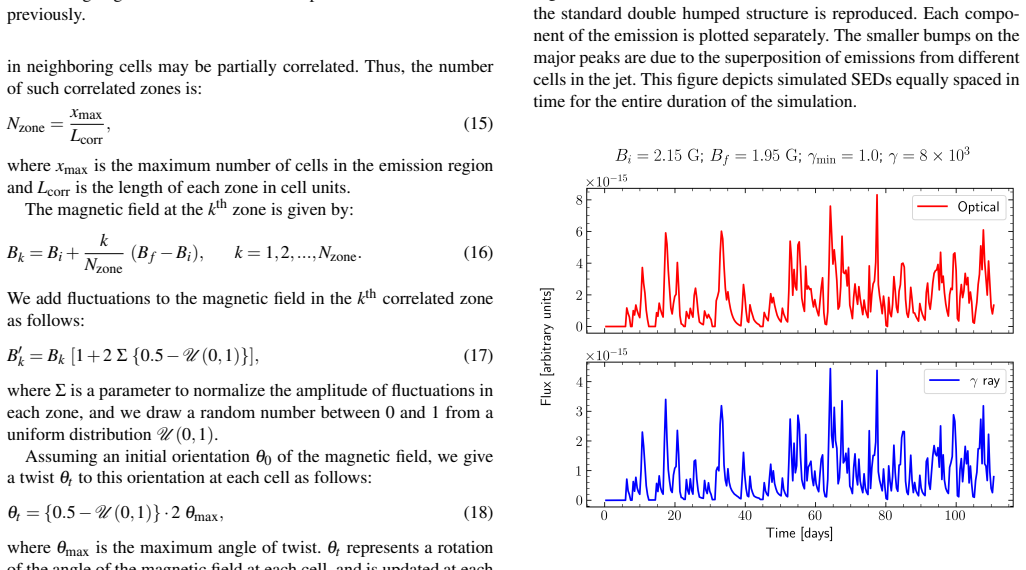
The load-bearing object is the gamma-to-optical energy dissipation ratio of a flare pair, $R_{\gamma/{\rm opt}}$. Observed light curves in the R band and in 0.1–100 GeV are decomposed into double-exponential flares; flares whose peaks fall within 20 days are paired, and the ratio of their integrated energies is computed. The same decomposition is applied to light curves produced by a cylindrical, multi-cell jet simulation in which the optical emission is synchrotron radiation and the GeV emission is external Compton scattering. The seed photon energy densities from the broad line region and dusty torus are described by Eqs. 13–14, which fall off with distance as $[1+(r/R)]^{-\beta}$; this makes $R_{\gamma/{\rm opt}}$ a monotonic, distance-dependent ruler. The BLR and torus distances themselves are set by the reverberation-mapping scaling relations $R_{\rm BLR}=0.1\,L_{D,46}^{0.5}\,\mathrm{pc}$ and $R_{\rm torus}=2.5\,L_{D,46}^{0.5}\,\mathrm{pc}$, so matching observed to simulated ratios yields a distance in parsecs and a position relative to the BLR and torus.
What would settle it
A single well-measured contemporaneous GeV/optical flare pair in an LSP blazar whose energy ratio matches the simulated ratio at or inside the BLR radius—of order $10^2$–$10^3$ for the fiducial parameters—would place that emission inside the BLR and contradict the claim that all such outbursts lie beyond it.
Extended reading notes
Core claim
The paper's central discovery is that every one of the 47 contemporaneous GeV/optical flare pairs examined in ten low-synchrotron-peaked blazars originates outside the broad line region (BLR), with most emission zones between the BLR and the dusty torus and a minority beyond the torus. The distance is not measured directly but inferred from the gamma-to-optical energy ratio: the simulated ratio falls as the emission zone moves downstream, because the external-Compton seed photon field from the BLR and torus weakens with distance, so each observed ratio maps to a distance. Representative results include PKS 0208-512 at roughly 0.5–1 pc, 3C 454.3 at 0.8–2 pc, and PKS 1510-089 and PKS 2142-75 beyond the torus, the latter out to about 15 pc. For the well-studied 2013–2014 outburst of 3C 279, the method separates two flares in distance and reproduces the two-zone conclusion of earlier VLBI-based work, one flare between the BLR and torus and the other beyond the torus. The paper also reports that short-timescale flares follow the model expectation: in flat-spectrum radio quasars the GeV-to-optical ratio decreases when short flares are included, while in BL Lac objects it does not change, matching an EC-dominated gamma-ray mechanism in the former and an SSC-coupled mechanism in the latter.
Load-bearing premise
The conclusion stands on the assumption that the simulated gamma-to-optical energy ratio as a function of emission-region distance is a faithful mapping for every source, which requires each flare's GeV emission to be external-Compton-dominated and the adopted magnetic field, disk luminosity, jet Lorentz factor, and BLR/torus geometry to be correct.
Editorial extensions
If this is right
- If the conclusion is right, the torus, not the broad line region, supplies the seed photons for most luminous GeV flares in these blazars, so SED models that require BLR seed photons to make strong gamma-ray flares are disfavored for this class.
- Jet parameters inferred from GeV/optical variability, such as magnetic field strength and Doppler factor, describe the jet at distances of a few parsecs from the black hole rather than within 0.1 pc.
- The GeV/optical ratio can serve as a relative distance indicator for multiple flares in one source: in 3C 279, two contemporaneous flares from the same epoch are placed at different distances, matching results from radio-jet monitoring.
- Short-timescale variability in FSRQs and BL Lacs should behave differently: FSRQs should show a lower GeV-to-optical ratio when short flares are included, while BL Lacs should not, because their GeV emission tracks the magnetic field through the SSC process.
- This method can be extended to larger samples using public Fermi-LAT and optical monitoring data, allowing systematic comparison with radio-jet and SED-based location estimates.
Reading between the lines
- A testable extension would be to apply the same ratio method to high-synchrotron-peaked blazars, where the GeV emission is SSC-dominated; the predicted distance-ruler would be much flatter, so the method should fail there, providing a check on the model assumptions.
- If the all-beyond-BLR result holds, one might expect GeV spectra of these flares to show little or no BLR-related absorption or cut-off features; searching Fermi spectra of the same flare epochs for such signatures would test the location independently.
- The inference depends on each source's disk luminosity and jet parameters from the literature; a coordinated re-analysis that fits those parameters simultaneously with the same data could sharpen the distances and test whether the scatter among sources is real or a parameter artifact.
Signed reviews
Editorial analysis
A structured set of objections, weighed in public.
Referee Report
Summary. The paper applies the Barat et al. (2022) method to locate the GeV/optical emission region in 47 contemporaneous outburst pairs across 10 LSP blazars. Flares are decomposed from Fermi-LAT 0.1-100 GeV and SMARTS R-band light curves, and the ratio of the energy dissipated in each GeV and optical flare pair is compared with ratios extracted from simulated light curves generated by a cylindrical jet model that includes synchrotron, SSC, and EC scattering of BLR and torus seed photons. The authors infer that all 47 pairs originate beyond the BLR, generally between the BLR and the dusty torus, with a few beyond the torus. They also compare individual flaring epochs, most notably the 2013-14 flares of 3C 279, with results from the literature, and report consistency in most cases for which data are available.
Significance. If the inference is robust, the paper provides a uniform, relatively large-sample confirmation that GeV/optical flares in LSP blazars occur outside the BLR, in line with VLBI-based and Compton-dominance studies, and it strengthens the case for torus seed photons in GeV production. The paper's strengths are its use of public Fermi-LAT and SMARTS data, its uniform analysis of 47 flare pairs, and its attempt to validate the method against epoch-specific literature results. However, the central claim is only as strong as the model assumption of EC-dominated GeV emission and the parameter-dependent simulated calibration; at present the supporting evidence is incomplete.
major comments (4)
- [Section 2, Section 4.3, Table 8, Eq. (14)] The assumption that each flare's 0.1-100 GeV emission is EC-dominated is not verified per flare, and the sample includes PKS 2142-75, which is classified as a BL Lac object in Table 8. For this source Table 5 gives inferred distances of about 14-15 pc, while the torus is at 4.26 pc; at r = 15 pc the torus seed photon density in Eq. (14) is suppressed by [1 + (15/4.26)]^-4 ≈ 2.4 × 10^-3 relative to its peak, and the BLR contribution is negligible. The GeV emission in this regime must therefore be substantially SSC, whose ratio to synchrotron does not depend on distance in the same way as EC, so the distance inference is no longer unique. The manuscript does not compute the SSC fraction per flare or exclude SSC-dominated events, so the statement that the location is beyond the BLR for all cases is not established for these events. The authors should either quantify the SSC/EC fraction for each flare, restrict the sample to events for which EC dominance can be demonstrated, or soften the 'all cases' claim.
- [Section 4.1, Eqs. (23)-(24), Fig. 6] The observed ratios R_flare-3 and R_flare-5 are given in units of ph cm^-2 s^-1 mJy^-1, while the simulated ratios in Fig. 6 are dimensionless energy ratios. Comparing these numbers directly is dimensionally inconsistent: the photon-flux-to-energy-flux conversion for the gamma-ray band and the mJy-to-energy-flux-density conversion for the optical band must be applied before the comparison. As written, the quantitative agreement with Rani et al. (2018) is not supported by the analysis.
- [Section 3.1, Table 5] The inferred distances are not accompanied by propagated uncertainties. The observed and simulated ratios carry error bars, but there is no formal mapping from the ratio uncertainties to the distance estimates. For PKS 1244-255, observed ratios such as 0.54 ± 1.88 and 0.35 ± 6.90 are consistent with a very broad range of distances, and the text acknowledges that one flare pair is difficult to constrain. The abstract's unqualified claim that the location is beyond the BLR for all 47 cases is stronger than the table entries support.
- [Section 5, Table 4] The sensitivity discussion states that varying L_D by a factor of 10 moves the inferred emission zone by about 2.5 pc and can change its location relative to the BLR and torus. Since the L_D and Γ values in Table 4 are taken from literature SED fits without quoted uncertainties, the robustness of the 'beyond BLR' conclusion across all 47 pairs is not demonstrated. A per-source parameter exploration, or at least a conservative uncertainty band on r that accounts for the literature parameters, is needed to support the universal claim.
minor comments (4)
- [Table 1, Abstract] Table 1 lists 11 objects while the text and abstract say 10 blazars; please clarify whether 3C 279 is one of the 10 or an additional source used only for the comparison in Section 4.1.
- [Section 3.2.1] The turbulence parameters L_corr, σ, Σ, and θ_max are said to be chosen by qualitative comparison with observed light curves, but no values are given anywhere in the paper. This prevents reproduction of the simulated light curves; the values should be reported even if a more detailed model description is deferred to a future paper.
- [Section 5 versus Section 4.3] Section 5 says the method applies only to LSP blazars for which the 0.1-100 GeV emission is dominated by the EC process, yet Section 4.3 and Table 8 classify PKS 2142-75 as a BL Lac object and include it in the main sample; please reconcile the classification or justify that this source is an LSP BL Lac with EC-dominated GeV emission.
- [General] There are numerous typographical and spelling errors, e.g., 'assumtion', 'emisison', 'dissiptaion', 'magentic', 'outbrusts', and the section title 'Shoter-Timescale Flares'; the manuscript needs a careful proofreading pass.
Circularity Check
No significant circularity: observed flare ratios are independent, the forward simulation is specified in-paper, and external benchmarks support the method.
full rationale
The derivation chain is not circular. The observed GeV-to-optical energy ratios are measured from independent Fermi-LAT and SMARTS light curves (Sections 2, 3.1), and the distance-to-ratio mapping is produced by a forward jet-emission simulation (Eqs. 1–22) with parameters taken from external SED studies (Paliya et al. 2017; Ghisellini et al. 2010), not fitted to the observed flare ratios. The BLR/torus seed-photon profiles (Eqs. 13–14) are standard literature forms (Hayashida et al. 2012), and the “beyond BLR” conclusion is an inverted prediction of that simulation, not an identity. The method's provenance is a self-citation (Barat et al. 2022), but the present paper re-specifies the model equations and validates against external epoch-specific results (3C 279 vs. Rani et al. 2018; 3C 454.3 vs. Acharyya et al. 2021; PKS 1510-089 vs. H.E.S.S.), so the citation is not load-bearing. The manuscript's own caveats concern model validity rather than circularity: Section 4.3 classifies some sample objects (PKS 2142-75, PKS 1244-255 in Table 8) as BL Lacs whose GeV emission is SSC, which conflicts with the EC-dominance assumption used for all LSP blazars in Section 3.2; and Eqs. 23–24 quote 3C 279 flare ratios in mixed units. These are correctness risks for individual inferences, but they do not make the observed ratio equal to the simulated ratio by construction, nor do they reduce the central claim to a fitted parameter.
Assumptions & free parameters
free parameters (4)
- Turbulence parameters (L_corr, sigma, Sigma, theta_max) =
not specified
- Gaussian smoothing width =
10 days
- Flare-pair window =
20 days
- Flare decomposition stopping threshold =
10% of highest flare
assumptions (6)
- domain assumption The 0.1-100 GeV emission in LSP blazars is dominated by external Compton scattering of BLR and torus seed photons.
- domain assumption The R-band optical emission is synchrotron radiation from the same electron population that produces the GeV emission.
- domain assumption The BLR and torus seed photon energy densities follow Eqs. 13-14 with E_BLR = 0.1 and E_torus = 0.01.
- domain assumption The BLR and torus radii scale with disk luminosity as R_BLR = 0.1 L_D,46^0.5 pc and R_torus = 2.5 L_D,46^0.5 pc (Eqs. 21-22).
- domain assumption Each flare can be modeled as a double exponential function (Eq. 1).
- domain assumption Optical and GeV flares with peaks within 20 days are produced by the same physical event.
Cite this review
Pith. "Pith review of Location of a Sample of GeV and Optical Outbursts in the Jets of Blazars." pith.science (2026). https://pith.science/paper/IBWGXL54
@misc{pith2026250503010,
  author       = {Pith},
  title        = {Pith review of: Location of a Sample of GeV and Optical Outbursts in the Jets of Blazars},
  year         = {2026},
  howpublished = {\url{https://pith.science/paper/IBWGXL54}},
  note         = {Machine review of arXiv:2505.03010}
}
abstract
The exact location of the $\gamma$-ray emitting region in blazar jets has long been a matter of debate. However, the location has important implications about the emission processes, geometric and physical parameters of the jet, as well as the nature of interaction of the jet with the interstellar and intergalactic medium. Diverse conclusions have been drawn by various authors based on a variety of methods applied to different data sets of many blazars, e.g., the location is less than 0.1 pc from the central engine within the broad line region (BLR) or a few or tens of pc downstream beyond the dusty torus or at some intermediate distance. Here we use a method, established in a previous work, in which the location of the GeV/optical emission is determined using the ratio of energy dissipated during contemporaneous outbursts at those wave bands. We apply it to a total of 47 multi-wavelength outbursts in 10 blazars. We find that the location of the GeV/optical emission is beyond the BLR for all cases. This result is consistent with other studies, in which the location has been determined for a large sample of blazars. We compare the location determined by our method for several GeV outbursts of multiple blazars to that obtained by other authors using different methods. We find that our results are consistent in such one-to-one comparison in most cases, for which the required data were available.
Figures


Figures from the paper (4 more)


Reference graph
Works this paper leans on
-
[1]
write newline
" write newline "" before.all 'output.state := FUNCTION fin.entry write newline FUNCTION new.block output.state before.all = 'skip after.block 'output.state := if FUNCTION new.sentence output.state after.block = 'skip output.state before.all = 'skip after.sentence 'output.state := if if FUNCTION not #0 #1 if FUNCTION and 'skip pop #0 if FUNCTION or pop #1...
-
[2]
Abdo A. A., et al., 2010, @doi [The Astrophysical Journal] 10.1088/0004-637X/722/1/520 , https://ui.adsabs.harvard.edu/abs/2010ApJ...722..520A 722, 520
-
[3]
Abdollahi S., et al., 2020, @doi [The Astrophysical Journal Supplement Series] 10.3847/1538-4365/ab6bcb , 247, 33
-
[4]
Abdollahi S., et al., 2022, @doi [ ] 10.3847/1538-4365/ac6751 , https://ui.adsabs.harvard.edu/abs/2022ApJS..260...53A 260, 53
-
[5]
Acciari V. A., et al., 2022, @doi [Monthly Notices of the Royal Astronomical Society] 10.1093/mnras/stab3454 , https://ui.adsabs.harvard.edu/abs/2022MNRAS.510.2344A 510, 2344
-
[6]
Acharyya A., Chadwick P. M., Brown A. M., 2021, @doi [Monthly Notices of the Royal Astronomical Society] 10.1093/mnras/staa3483 , https://ui.adsabs.harvard.edu/abs/2021MNRAS.500.5297A 500, 5297
-
[7]
Ackermann M., et al., 2016, @doi [The Astrophysical Journal] 10.3847/2041-8205/824/2/L20 , https://ui.adsabs.harvard.edu/abs/2016ApJ...824L..20A 824, L20
-
[8]
Agarwal S., Shukla A., Mannheim K., Vaidya B., Banerjee B., 2024, @doi [The Astrophysical Journal] 10.3847/2041-8213/ad4994 , https://ui.adsabs.harvard.edu/abs/2024ApJ...968L...1A 968, L1
Show all 108 references
-
[9]
Agudo I., et al., 2011, @doi [The Astrophysical Journal] 10.1088/2041-8205/726/1/L13 , https://ui.adsabs.harvard.edu/abs/2011ApJ...726L..13A 726, L13
2011 doi
-
[10]
L., 2018, @doi [Astronomy and Astrophysics] 10.1051/0004-6361/201833005 , https://ui.adsabs.harvard.edu/abs/2018A&A...616A..63A 616, A63
Arsioli B., Chang Y. L., 2018, @doi [Astronomy and Astrophysics] 10.1051/0004-6361/201833005 , https://ui.adsabs.harvard.edu/abs/2018A&A...616A..63A 616, A63
2018 doi
-
[11]
B., et al., 2009, @doi [The Astrophysical Journal] 10.1088/0004-637X/697/2/1071 , https://ui.adsabs.harvard.edu/abs/2009ApJ...697.1071A 697, 1071
Atwood W. B., et al., 2009, @doi [The Astrophysical Journal] 10.1088/0004-637X/697/2/1071 , https://ui.adsabs.harvard.edu/abs/2009ApJ...697.1071A 697, 1071
2009 doi
-
[12]
Barat S., Chatterjee R., Mitra K., 2022, @doi [Monthly Notices of the Royal Astronomical Society] 10.1093/mnras/stac1852 , https://ui.adsabs.harvard.edu/abs/2022MNRAS.515.1655B 515, 1655
2022 doi
-
[13]
C., et al., 2013, @doi [The Astrophysical Journal] 10.1088/0004-637X/767/2/149 , https://ui.adsabs.harvard.edu/abs/2013ApJ...767..149B 767, 149
Bentz M. C., et al., 2013, @doi [The Astrophysical Journal] 10.1088/0004-637X/767/2/149 , https://ui.adsabs.harvard.edu/abs/2013ApJ...767..149B 767, 149
2013 doi
-
[14]
D., Rees M
Blandford R. D., Rees M. J., 1978, @doi [Physica Scripta] 10.1088/0031-8949/17/3/020 , https://ui.adsabs.harvard.edu/abs/1978PhyS...17..265B 17, 265
1978 doi
-
[15]
Blandford R., Meier D., Readhead A., 2019, @doi [Annual Review of Astronomy and Astrophysics] 10.1146/annurev-astro-081817-051948 , https://ui.adsabs.harvard.edu/abs/2019ARA&A..57..467B 57, 467
2019 doi
-
[16]
M., 2000, @doi [The Astrophysical Journal] 10.1086/317791 , https://ui.adsabs.harvard.edu/abs/2000ApJ...545..107B 545, 107
B a \.z ejowski M., Sikora M., Moderski R., Madejski G. M., 2000, @doi [The Astrophysical Journal] 10.1086/317791 , https://ui.adsabs.harvard.edu/abs/2000ApJ...545..107B 545, 107
2000 doi
-
[17]
Bonning E., et al., 2012, @doi [The Astrophysical Journal] 10.1088/0004-637X/756/1/13 , https://ui.adsabs.harvard.edu/abs/2012ApJ...756...13B 756, 13
2012 doi
-
[18]
Bottacini E., B \"o ttcher M., Pian E., Collmar W., 2016, @doi [The Astrophysical Journal] 10.3847/0004-637X/832/1/17 , https://ui.adsabs.harvard.edu/abs/2016ApJ...832...17B 832, 17
2016 doi
-
[19]
B \"o ttcher M., 2007, @doi [Astrophysics and Space Science] 10.1007/s10509-007-9404-0 , https://ui.adsabs.harvard.edu/abs/2007Ap&SS.309...95B 309, 95
2007 doi
-
[20]
D., 2010, @doi [The Astrophysical Journal] 10.1088/0004-637X/711/1/445 , https://ui.adsabs.harvard.edu/abs/2010ApJ...711..445B 711, 445
B \"o ttcher M., Dermer C. D., 2010, @doi [The Astrophysical Journal] 10.1088/0004-637X/711/1/445 , https://ui.adsabs.harvard.edu/abs/2010ApJ...711..445B 711, 445
2010 doi
-
[21]
B \"o ttcher M., Els P., 2016, @doi [The Astrophysical Journal] 10.3847/0004-637X/821/2/102 , https://ui.adsabs.harvard.edu/abs/2016ApJ...821..102B 821, 102
2016 doi
-
[22]
N., Lebofsky M
Bregman J. N., Lebofsky M. J., Aller M. F., Rieke G. H., Aller H. D., Hodge P. E., Glassgold A. E., Huggins P. J., 1981, @doi [Nature] 10.1038/293714a0 , https://ui.adsabs.harvard.edu/abs/1981Natur.293..714B 293, 714
1981 doi
-
[23]
M., 2013, @doi [Monthly Notices of the Royal Astronomical Society] 10.1093/mnras/stt218 , https://ui.adsabs.harvard.edu/abs/2013MNRAS.431..824B 431, 824
Brown A. M., 2013, @doi [Monthly Notices of the Royal Astronomical Society] 10.1093/mnras/stt218 , https://ui.adsabs.harvard.edu/abs/2013MNRAS.431..824B 431, 824
2013 doi
-
[24]
M., Rosenberg F
Burbidge E. M., Rosenberg F. D., 1965, @doi [The Astrophysical Journal] 10.1086/148458 , https://ui.adsabs.harvard.edu/abs/1965ApJ...142.1673B 142, 1673
1965 doi
-
[25]
N., et al., 2005, @doi [Space Science Reviews] 10.1007/s11214-005-5097-2 , https://ui.adsabs.harvard.edu/abs/2005SSRv..120..165B 120, 165
Burrows D. N., et al., 2005, @doi [Space Science Reviews] 10.1007/s11214-005-5097-2 , https://ui.adsabs.harvard.edu/abs/2005SSRv..120..165B 120, 165
2005 doi
-
[26]
Cao G., Wang J.-C., 2013, @doi [Monthly Notices of the Royal Astronomical Society] 10.1093/mnras/stt1723 , https://ui.adsabs.harvard.edu/abs/2013MNRAS.436.2170C 436, 2170
2013 doi
-
[27]
Castignani G., et al., 2017, @doi [Astronomy and Astrophysics] 10.1051/0004-6361/201629775 , https://ui.adsabs.harvard.edu/abs/2017A&A...601A..30C 601, A30
2017 doi
-
[28]
B., 2023, @doi [The Astrophysical Journal] 10.3847/1538-4357/acc575 , https://ui.adsabs.harvard.edu/abs/2023ApJ...948....2C 948, 2
Chase O., McBride F., Gokus A., Lucchini M., Zhang H., Ojha R., Fox D. B., 2023, @doi [The Astrophysical Journal] 10.3847/1538-4357/acc575 , https://ui.adsabs.harvard.edu/abs/2023ApJ...948....2C 948, 2
2023 doi
-
[29]
Chatterjee R., et al., 2012, @doi [The Astrophysical Journal] 10.1088/0004-637X/749/2/191 , https://ui.adsabs.harvard.edu/abs/2012ApJ...749..191C 749, 191
2012 doi
-
[30]
Chiang J., B \"o ttcher M., 2002, @doi [The Astrophysical Journal] 10.1086/324294 , https://ui.adsabs.harvard.edu/abs/2002ApJ...564...92C 564, 92
2002 doi
-
[31]
Chidiac C., et al., 2016, @doi [Astronomy and Astrophysics] 10.1051/0004-6361/201628347 , https://ui.adsabs.harvard.edu/abs/2016A&A...590A..61C 590, A61
2016 doi
-
[32]
T., Brown A
Coogan R. T., Brown A. M., Chadwick P. M., 2016, @doi [Monthly Notices of the Royal Astronomical Society] 10.1093/mnras/stw199 , https://ui.adsabs.harvard.edu/abs/2016MNRAS.458..354C 458, 354
2016 doi
-
[33]
Costamante L., Cutini S., Tosti G., Antolini E., Tramacere A., 2018, @doi [Monthly Notices of the Royal Astronomical Society] 10.1093/mnras/sty887 , https://ui.adsabs.harvard.edu/abs/2018MNRAS.477.4749C 477, 4749
2018 doi
-
[34]
K., Mondal S
Das A. K., Mondal S. K., Prince R., 2023, @doi [Monthly Notices of the Royal Astronomical Society] 10.1093/mnras/stad702 , https://ui.adsabs.harvard.edu/abs/2023MNRAS.521.3451D 521, 3451
2023 doi
-
[35]
D., Schlickeiser R., 1993, @doi [The Astrophysical Journal] 10.1086/173251 , https://ui.adsabs.harvard.edu/abs/1993ApJ...416..458D 416, 458
Dermer C. D., Schlickeiser R., 1993, @doi [The Astrophysical Journal] 10.1086/173251 , https://ui.adsabs.harvard.edu/abs/1993ApJ...416..458D 416, 458
1993 doi
-
[36]
J., 2003, @doi [Astroparticle Physics] 10.1016/S0927-6505(02)00155-X , https://ui.adsabs.harvard.edu/abs/2003APh....18..377D 18, 377
Donea A.-C., Protheroe R. J., 2003, @doi [Astroparticle Physics] 10.1016/S0927-6505(02)00155-X , https://ui.adsabs.harvard.edu/abs/2003APh....18..377D 18, 377
2003 doi
-
[37]
T., McCann K., 2015, @doi [The Astrophysical Journal] 10.1088/0004-637X/809/2/164 , https://ui.adsabs.harvard.edu/abs/2015ApJ...809..164D 809, 164
Dotson A., Georganopoulos M., Meyer E. T., McCann K., 2015, @doi [The Astrophysical Journal] 10.1088/0004-637X/809/2/164 , https://ui.adsabs.harvard.edu/abs/2015ApJ...809..164D 809, 164
2015 doi
-
[38]
S., et al., 2013, @doi [The Astrophysical Journal] 10.1088/0004-637X/779/2/174 , https://ui.adsabs.harvard.edu/abs/2013ApJ...779..174D 779, 174
Dutka M. S., et al., 2013, @doi [The Astrophysical Journal] 10.1088/0004-637X/779/2/174 , https://ui.adsabs.harvard.edu/abs/2013ApJ...779..174D 779, 174
2013 doi
-
[39]
S., et al., 2017, @doi [The Astrophysical Journal] 10.3847/1538-4357/835/2/182 , https://ui.adsabs.harvard.edu/abs/2017ApJ...835..182D 835, 182
Dutka M. S., et al., 2017, @doi [The Astrophysical Journal] 10.3847/1538-4357/835/2/182 , https://ui.adsabs.harvard.edu/abs/2017ApJ...835..182D 835, 182
2017 doi
-
[40]
Ghisellini G., Celotti A., Fossati G., Maraschi L., Comastri A., 1998, @doi [Monthly Notices of the Royal Astronomical Society] 10.1046/j.1365-8711.1998.02032.x , https://ui.adsabs.harvard.edu/abs/1998MNRAS.301..451G 301, 451
1998
-
[41]
Ghisellini G., Tavecchio F., Chiaberge M., 2005, @doi [Astronomy and Astrophysics] 10.1051/0004-6361:20041404 , https://ui.adsabs.harvard.edu/abs/2005A&A...432..401G 432, 401
2005 doi
-
[42]
Ghisellini G., Tavecchio F., Foschini L., Ghirlanda G., Maraschi L., Celotti A., 2010, @doi [Monthly Notices of the Royal Astronomical Society] 10.1111/j.1365-2966.2009.15898.x , https://ui.adsabs.harvard.edu/abs/2010MNRAS.402..497G 402, 497
2010
-
[43]
Giroletti M., et al., 2004, @doi [The Astrophysical Journal] 10.1086/379663 , https://ui.adsabs.harvard.edu/abs/2004ApJ...600..127G 600, 127
2004 doi
-
[44]
A., Peck A
Gurwell M. A., Peck A. B., Hostler S. R., Darrah M. R., Katz C. A., 2007, in Baker A. J., Glenn J., Harris A. I., Mangum J. G., Yun M. S., eds, Astronomical Society of the Pacific Conference Series Vol. 375, From Z-Machines to ALMA: (Sub)Millimeter Spectroscopy of Galaxies. p. 234
2007
-
[45]
H. E. S. S. Collaboration et al., 2013, @doi [Astronomy and Astrophysics] 10.1051/0004-6361/201321135 , https://ui.adsabs.harvard.edu/abs/2013A&A...554A.107H 554, A107
2013 doi
-
[46]
H. E. S. S. Collaboration et al., 2019, @doi [Astronomy and Astrophysics] 10.1051/0004-6361/201935704 , https://ui.adsabs.harvard.edu/abs/2019A&A...627A.159H 627, A159
2019 doi
-
[47]
Hada K., et al., 2012, @doi [The Astrophysical Journal] 10.1088/0004-637X/760/1/52 , https://ui.adsabs.harvard.edu/abs/2012ApJ...760...52H 760, 52
2012 doi
-
[48]
Harvey A. L. W., Georganopoulos M., Meyer E. T., 2020, @doi [Nature Communications] 10.1038/s41467-020-19296-6 , https://ui.adsabs.harvard.edu/abs/2020NatCo..11.5475H 11, 5475
2020 doi
-
[49]
Hayashida M., et al., 2012, @doi [The Astrophysical Journal] 10.1088/0004-637X/754/2/114 , https://ui.adsabs.harvard.edu/abs/2012ApJ...754..114H 754, 114
2012 doi
-
[50]
Hayashida M., et al., 2015, @doi [The Astrophysical Journal] 10.1088/0004-637X/807/1/79 , https://ui.adsabs.harvard.edu/abs/2015ApJ...807...79H 807, 79
2015 doi
-
[51]
Hovatta T., Lindfors E., 2019, @doi [New Astronomy Reviews] 10.1016/j.newar.2020.101541 , https://ui.adsabs.harvard.edu/abs/2019NewAR..8701541H 87, 101541
2019
-
[52]
a hteenm \
Hovatta T., Valtaoja E., Tornikoski M., L \"a hteenm \"a ki A., 2009, @doi [Astronomy and Astrophysics] 10.1051/0004-6361:200811150 , https://ui.adsabs.harvard.edu/abs/2009A&A...494..527H 494, 527
2009 doi
-
[53]
D., Neugebauer G., 1988, @doi [The Astronomical Journal] 10.1086/114638 , https://ui.adsabs.harvard.edu/abs/1988AJ.....95..307I 95, 307
Impey C. D., Neugebauer G., 1988, @doi [The Astronomical Journal] 10.1086/114638 , https://ui.adsabs.harvard.edu/abs/1988AJ.....95..307I 95, 307
1988 doi
-
[54]
C., et al., 2015, @doi [The Astrophysical Journal] 10.1088/0004-637X/804/1/7 , https://ui.adsabs.harvard.edu/abs/2015ApJ...804....7I 804, 7
Isler J. C., et al., 2015, @doi [The Astrophysical Journal] 10.1088/0004-637X/804/1/7 , https://ui.adsabs.harvard.edu/abs/2015ApJ...804....7I 804, 7
2015 doi
-
[55]
G., et al., 2013, @doi [The Astrophysical Journal] 10.1088/0004-637X/773/2/147 , https://ui.adsabs.harvard.edu/abs/2013ApJ...773..147J 773, 147
Jorstad S. G., et al., 2013, @doi [The Astrophysical Journal] 10.1088/0004-637X/773/2/147 , https://ui.adsabs.harvard.edu/abs/2013ApJ...773..147J 773, 147
2013 doi
-
[56]
G., et al., 2017, @doi [The Astrophysical Journal] 10.3847/1538-4357/aa8407 , https://ui.adsabs.harvard.edu/abs/2017ApJ...846...98J 846, 98
Jorstad S. G., et al., 2017, @doi [The Astrophysical Journal] 10.3847/1538-4357/aa8407 , https://ui.adsabs.harvard.edu/abs/2017ApJ...846...98J 846, 98
2017 doi
-
[57]
P., B \"o ttcher M., 2014, @doi [The Astrophysical Journal] 10.1088/0004-637X/785/2/132 , https://ui.adsabs.harvard.edu/abs/2014ApJ...785..132J 785, 132
Joshi M., Marscher A. P., B \"o ttcher M., 2014, @doi [The Astrophysical Journal] 10.1088/0004-637X/785/2/132 , https://ui.adsabs.harvard.edu/abs/2014ApJ...785..132J 785, 132
2014 doi
-
[58]
Kang S.-J., Zheng Y.-G., Wu Q., Chen L., Yin Y., 2021, @doi [Monthly Notices of the Royal Astronomical Society] 10.1093/mnras/stab489 , https://ui.adsabs.harvard.edu/abs/2021MNRAS.502.5875K 502, 5875
2021 doi
-
[59]
Khatoon R., Prince R., Shah Z., Sahayanathan S., Gogoi R., 2022, @doi [Monthly Notices of the Royal Astronomical Society] 10.1093/mnras/stac892 , https://ui.adsabs.harvard.edu/abs/2022MNRAS.513..611K 513, 611
2022 doi
-
[60]
G., Pushkarev A
Kramarenko I. G., Pushkarev A. B., Kovalev Y. Y., Lister M. L., Hovatta T., Savolainen T., 2022, @doi [Monthly Notices of the Royal Astronomical Society] 10.1093/mnras/stab3358 , https://ui.adsabs.harvard.edu/abs/2022MNRAS.510..469K 510, 469
2022 doi
-
[61]
Kundu A., Chatterjee R., Mitra K., Mondal S., 2022, @doi [Monthly Notices of the Royal Astronomical Society] 10.1093/mnras/stab3750 , https://ui.adsabs.harvard.edu/abs/2022MNRAS.510.3688K 510, 3688
2022 doi
-
[62]
W., Filippenko A
Liodakis I., Romani R. W., Filippenko A. V., Kocevski D., Zheng W., 2019, @doi [The Astrophysical Journal] 10.3847/1538-4357/ab26b7 , https://ui.adsabs.harvard.edu/abs/2019ApJ...880...32L 880, 32
2019 doi
-
[63]
M., Kovalev Y
Lisakov M. M., Kovalev Y. Y., Savolainen T., Hovatta T., Kutkin A. M., 2017, @doi [Monthly Notices of the Royal Astronomical Society] 10.1093/mnras/stx710 , https://ui.adsabs.harvard.edu/abs/2017MNRAS.468.4478L 468, 4478
2017 doi
-
[64]
T., Bai J
Liu H. T., Bai J. M., 2006, @doi [The Astrophysical Journal] 10.1086/509097 , https://ui.adsabs.harvard.edu/abs/2006ApJ...653.1089L 653, 1089
2006 doi
-
[65]
T., Bai J
Liu H. T., Bai J. M., Feng H. C., Li S. K., 2015, @doi [Monthly Notices of the Royal Astronomical Society] 10.1093/mnras/stv601 , https://ui.adsabs.harvard.edu/abs/2015MNRAS.450..494L 450, 494
2015 doi
-
[66]
MAGIC Collaboration et al., 2018, @doi [Monthly Notices of the Royal Astronomical Society] 10.1093/mnras/sty1753 , https://ui.adsabs.harvard.edu/abs/2018MNRAS.480..879M 480, 879
2018 doi
-
[67]
R., Jorstad S
MacDonald N. R., Jorstad S. G., Marscher A. P., 2017, @doi [The Astrophysical Journal] 10.3847/1538-4357/aa92c8 , https://ui.adsabs.harvard.edu/abs/2017ApJ...850...87M 850, 87
2017 doi
-
[68]
M., Bailyn C
Majumder A., Mitra K., Chatterjee R., Urry C. M., Bailyn C. D., Nandi P., 2019, @doi [Monthly Notices of the Royal Astronomical Society] 10.1093/mnras/stz2557 , https://ui.adsabs.harvard.edu/abs/2019MNRAS.490..124M 490, 124
2019 doi
-
[69]
Malzac J., 2012, in 39th COSPAR Scientific Assembly. p. 1168
2012
- [70]
-
[71]
Maraschi L., Ghisellini G., Celotti A., 1992, @doi [The Astrophysical Journal] 10.1086/186531 , https://ui.adsabs.harvard.edu/abs/1992ApJ...397L...5M 397, L5
1992 doi
-
[72]
P., 1998, in Zensus J
Marscher A. P., 1998, in Zensus J. A., Taylor G. B., Wrobel J. M., eds, Astronomical Society of the Pacific Conference Series Vol. 144, IAU Colloq. 164: Radio Emission from Galactic and Extragalactic Compact Sources. p. 25
1998
-
[73]
P., 2014, @doi [The Astrophysical Journal] 10.1088/0004-637X/780/1/87 , https://ui.adsabs.harvard.edu/abs/2014ApJ...780...87M 780, 87
Marscher A. P., 2014, @doi [The Astrophysical Journal] 10.1088/0004-637X/780/1/87 , https://ui.adsabs.harvard.edu/abs/2014ApJ...780...87M 780, 87
2014 doi
-
[74]
Marscher A., 2016, @doi [Galaxies] 10.3390/galaxies4040037 , https://ui.adsabs.harvard.edu/abs/2016Galax...4...37M 4, 37
2016 doi
-
[75]
P., et al., 2008, @doi [Nature] 10.1038/nature06895 , https://ui.adsabs.harvard.edu/abs/2008Natur.452..966M 452, 966
Marscher A. P., et al., 2008, @doi [Nature] 10.1038/nature06895 , https://ui.adsabs.harvard.edu/abs/2008Natur.452..966M 452, 966
2008 doi
-
[76]
P., et al., 2010, @doi [The Astrophysical Journal] 10.1088/2041-8205/710/2/L126 , https://ui.adsabs.harvard.edu/abs/2010ApJ...710L.126M 710, L126
Marscher A. P., et al., 2010, @doi [The Astrophysical Journal] 10.1088/2041-8205/710/2/L126 , https://ui.adsabs.harvard.edu/abs/2010ApJ...710L.126M 710, L126
2010 doi
-
[77]
a hteenm \
Marscher A., Jorstad S. G., Larionov V. M., Aller M. F., L \"a hteenm \"a ki A., 2011, @doi [Journal of Astrophysics and Astronomy] 10.1007/s12036-011-9013-8 , https://ui.adsabs.harvard.edu/abs/2011JApA...32..233M 32, 233
2011 doi
-
[78]
R., et al., 1996, @doi [The Astrophysical Journal] 10.1086/177068 , https://ui.adsabs.harvard.edu/abs/1996ApJ...461..396M 461, 396
Mattox J. R., et al., 1996, @doi [The Astrophysical Journal] 10.1086/177068 , https://ui.adsabs.harvard.edu/abs/1996ApJ...461..396M 461, 396
1996 doi
-
[79]
D., Blandford R
Meyer M., Scargle J. D., Blandford R. D., 2019, @doi [ ] 10.3847/1538-4357/ab1651 , https://ui.adsabs.harvard.edu/abs/2019ApJ...877...39M 877, 39
2019 doi
-
[80]
J., 2001, @doi [Astroparticle Physics] 10.1016/S0927-6505(00)00141-9 , https://ui.adsabs.harvard.edu/abs/2001APh....15..121M 15, 121
M \"u cke A., Protheroe R. J., 2001, @doi [Astroparticle Physics] 10.1016/S0927-6505(00)00141-9 , https://ui.adsabs.harvard.edu/abs/2001APh....15..121M 15, 121
2001 doi
-
[81]
J., Engel R., Rachen J
M \"u cke A., Protheroe R. J., Engel R., Rachen J. P., Stanev T., 2003, @doi [Astroparticle Physics] 10.1016/S0927-6505(02)00185-8 , https://ui.adsabs.harvard.edu/abs/2003APh....18..593M 18, 593
2003 doi
-
[82]
V., Wagner A
Mukherjee D., Bicknell G. V., Wagner A. Y., 2021, @doi [Astronomische Nachrichten] 10.1002/asna.20210061 , https://ui.adsabs.harvard.edu/abs/2021AN....342.1140M 342, 1140
2021 doi
-
[83]
C., Sikora M., 2014, @doi [The Astrophysical Journal] 10.1088/0004-637X/789/2/161 , https://ui.adsabs.harvard.edu/abs/2014ApJ...789..161N 789, 161
Nalewajko K., Begelman M. C., Sikora M., 2014, @doi [The Astrophysical Journal] 10.1088/0004-637X/789/2/161 , https://ui.adsabs.harvard.edu/abs/2014ApJ...789..161N 789, 161
2014 doi
-
[84]
Pacciani L., et al., 2010, @doi [The Astrophysical Journal] 10.1088/2041-8205/716/2/L170 , https://ui.adsabs.harvard.edu/abs/2010ApJ...716L.170P 716, L170
2010 doi
-
[85]
Pacciani L., Tavecchio F., Donnarumma I., Stamerra A., Carrasco L., Recillas E., Porras A., Uemura M., 2014, @doi [The Astrophysical Journal] 10.1088/0004-637X/790/1/45 , https://ui.adsabs.harvard.edu/abs/2014ApJ...790...45P 790, 45
2014 doi
-
[86]
Padovani P., Giommi P., 1995, @doi [Monthly Notices of the Royal Astronomical Society] 10.1093/mnras/277.4.1477 , https://ui.adsabs.harvard.edu/abs/1995MNRAS.277.1477P 277, 1477
1995 doi
-
[87]
S., Sahayanathan S., Stalin C
Paliya V. S., Sahayanathan S., Stalin C. S., 2015, @doi [The Astrophysical Journal] 10.1088/0004-637X/803/1/15 , https://ui.adsabs.harvard.edu/abs/2015ApJ...803...15P 803, 15
2015 doi
-
[88]
S., Marcotulli L., Ajello M., Joshi M., Sahayanathan S., Rao A
Paliya V. S., Marcotulli L., Ajello M., Joshi M., Sahayanathan S., Rao A. R., Hartmann D., 2017, @doi [The Astrophysical Journal] 10.3847/1538-4357/aa98e1 , https://ui.adsabs.harvard.edu/abs/2017ApJ...851...33P 851, 33
2017 doi
-
[89]
S., Marcotulli L., Ajello M., Joshi M., Sahayanathan S., Rao A
Paliya V. S., Marcotulli L., Ajello M., Joshi M., Sahayanathan S., Rao A. R., Hartmann D., 2018, VizieR Online Data Catalog: Multi-wavelength analysis of CGRaBS blazars (Paliya+, 2017) , VizieR On-line Data Catalog: J/ApJ/851/33. Originally published in: 2017ApJ...851...33P, @...
2018 doi
-
[90]
M., et al., 2018, @doi [Monthly Notices of the Royal Astronomical Society] 10.1093/mnras/sty1497 , https://ui.adsabs.harvard.edu/abs/2018MNRAS.479.2037P 479, 2037
Pati \ n o- \'A lvarez V. M., et al., 2018, @doi [Monthly Notices of the Royal Astronomical Society] 10.1093/mnras/sty1497 , https://ui.adsabs.harvard.edu/abs/2018MNRAS.479.2037P 479, 2037
2018 doi
-
[91]
Poutanen J., Stern B., 2010, @doi [The Astrophysical Journal] 10.1088/2041-8205/717/2/L118 , https://ui.adsabs.harvard.edu/abs/2010ApJ...717L.118P 717, L118
2010 doi
-
[92]
Prince R., Gupta N., Nalewajko K., 2019, @doi [The Astrophysical Journal] 10.3847/1538-4357/ab3afa , https://ui.adsabs.harvard.edu/abs/2019ApJ...883..137P 883, 137
2019 doi
-
[93]
P., Fuhrmann L., Zensus J
Rani B., Lott B., Krichbaum T. P., Fuhrmann L., Zensus J. A., 2013, @doi [Astronomy and Astrophysics] 10.1051/0004-6361/201321440 , https://ui.adsabs.harvard.edu/abs/2013A&A...557A..71R 557, A71
2013 doi
-
[94]
P., Marscher A
Rani B., Krichbaum T. P., Marscher A. P., Jorstad S. G., Hodgson J. A., Fuhrmann L., Zensus J. A., 2014, @doi [Astronomy and Astrophysics] 10.1051/0004-6361/201424796 , https://ui.adsabs.harvard.edu/abs/2014A&A...571L...2R 571, L2
2014 doi
-
[95]
Rani B., et al., 2018, @doi [The Astrophysical Journal] 10.3847/1538-4357/aab785 , https://ui.adsabs.harvard.edu/abs/2018ApJ...858...80R 858, 80
2018 doi
-
[96]
Roming P. W. A., et al., 2005, @doi [Space Science Reviews] 10.1007/s11214-005-5095-4 , https://ui.adsabs.harvard.edu/abs/2005SSRv..120...95R 120, 95
2005 doi
-
[97]
R., Sarkar A., Chatterjee A., Chitnis V
Roy A., Patel S. R., Sarkar A., Chatterjee A., Chitnis V. R., 2021, @doi [Monthly Notices of the Royal Astronomical Society] 10.1093/mnras/stab975 , https://ui.adsabs.harvard.edu/abs/2021MNRAS.504.1103R 504, 1103
2021 doi
-
[98]
T., Takahashi T., Madejski G., D'Ammando F., 2013, @doi [The Astrophysical Journal] 10.1088/2041-8205/766/1/L11 , https://ui.adsabs.harvard.edu/abs/2013ApJ...766L..11S 766, L11
Saito S., Stawarz ., Tanaka Y. T., Takahashi T., Madejski G., D'Ammando F., 2013, @doi [The Astrophysical Journal] 10.1088/2041-8205/766/1/L11 , https://ui.adsabs.harvard.edu/abs/2013ApJ...766L..11S 766, L11
2013 doi
-
[99]
C., Rees M
Sikora M., Begelman M. C., Rees M. J., 1994, @doi [The Astrophysical Journal] 10.1086/173633 , https://ui.adsabs.harvard.edu/abs/1994ApJ...421..153S 421, 153
1994 doi
-
[100]
G., Vestrand W
Stacy J. G., Vestrand W. T., Sreekumar P., 2003, @doi [The Astrophysical Journal] 10.1086/377632 , https://ui.adsabs.harvard.edu/abs/2003ApJ...598..216S 598, 216
2003 doi
-
[101]
Tavecchio F., Mazin D., 2009, @doi [Monthly Notices of the Royal Astronomical Society] 10.1111/j.1745-3933.2008.00584.x , https://ui.adsabs.harvard.edu/abs/2009MNRAS.392L..40T 392, L40
2009
-
[102]
Troitskiy I., et al., 2016, @doi [Galaxies] 10.3390/galaxies4040072 , https://ui.adsabs.harvard.edu/abs/2016Galax...4...72T 4, 72
2016 doi
-
[103]
M., Mushotzky R
Urry C. M., Mushotzky R. F., 1982, @doi [The Astrophysical Journal] 10.1086/159607 , https://ui.adsabs.harvard.edu/abs/1982ApJ...253...38U 253, 38
1982 doi
-
[104]
M., Padovani P., 1995, @doi [Publications of the Astronomical Society of the Pacific] 10.1086/133630 , https://ui.adsabs.harvard.edu/abs/1995PASP..107..803U 107, 803
Urry C. M., Padovani P., 1995, @doi [Publications of the Astronomical Society of the Pacific] 10.1086/133630 , https://ui.adsabs.harvard.edu/abs/1995PASP..107..803U 107, 803
1995 doi
-
[105]
a hteenm \
Valtaoja E., L \"a hteenm \"a ki A., Ter \"a sranta H., Lainela M., 1999, @doi [The Astrophysical Journal Supplement Series] 10.1086/313170 , https://ui.adsabs.harvard.edu/abs/1999ApJS..120...95V 120, 95
1999 doi
-
[106]
Wendel C., Shukla A., Mannheim K., 2021, @doi [The Astrophysical Journal] 10.3847/1538-4357/ac0a6e , https://ui.adsabs.harvard.edu/abs/2021ApJ...917...32W 917, 32
2021 doi
-
[107]
pp 54--63 ( @eprint arXiv 1204.5552 ), @doi 10.1142/S2010194513011070
Zhang J., Zhang S.-N., Liang E.-W., 2013, in International Journal of Modern Physics Conference Series. pp 54--63 ( @eprint arXiv 1204.5552 ), @doi 10.1142/S2010194513011070
2013 arXiv
-
[108]
Zhang B.-K., Jin M., Zhao X.-Y., Zhang L., Dai B.-Z., 2021, @doi [Research in Astronomy and Astrophysics] 10.1088/1674-4527/21/8/186 , https://ui.adsabs.harvard.edu/abs/2021RAA....21..186Z 21, 186
2021 doi
Reviewed August 16, 2026 · model on record in the stance chip above.
Discussion (0). Continue with ORCID to comment.