REVIEW 4 major objections 6 minor 42 references
FAST Reveals the Extended HI Halo and Accretion Signatures of NGC2683
T0 review · 4 major / 6 minor · reviewed 2026-08-15 · deepseek-v4-flash
Pith's one-line read Using high-sensitivity FAST observations, this paper claims that the edge-on galaxy NGC 2683 has a neutral hydrogen halo four times taller than earlier VLA maps did, holding about 300 million solar masses of gas.
desk verdict Genuinely new FAST data reveal a much more extended HI distribution around NGC 2683, but the halo mass and the 'halo not flare' conclusion outrun the quantitative evidence. read the letter →
The pith
A machine-rendered reading of the paper's core claim, the machinery that carries it, and where it could break.
The reading
What carries the argument
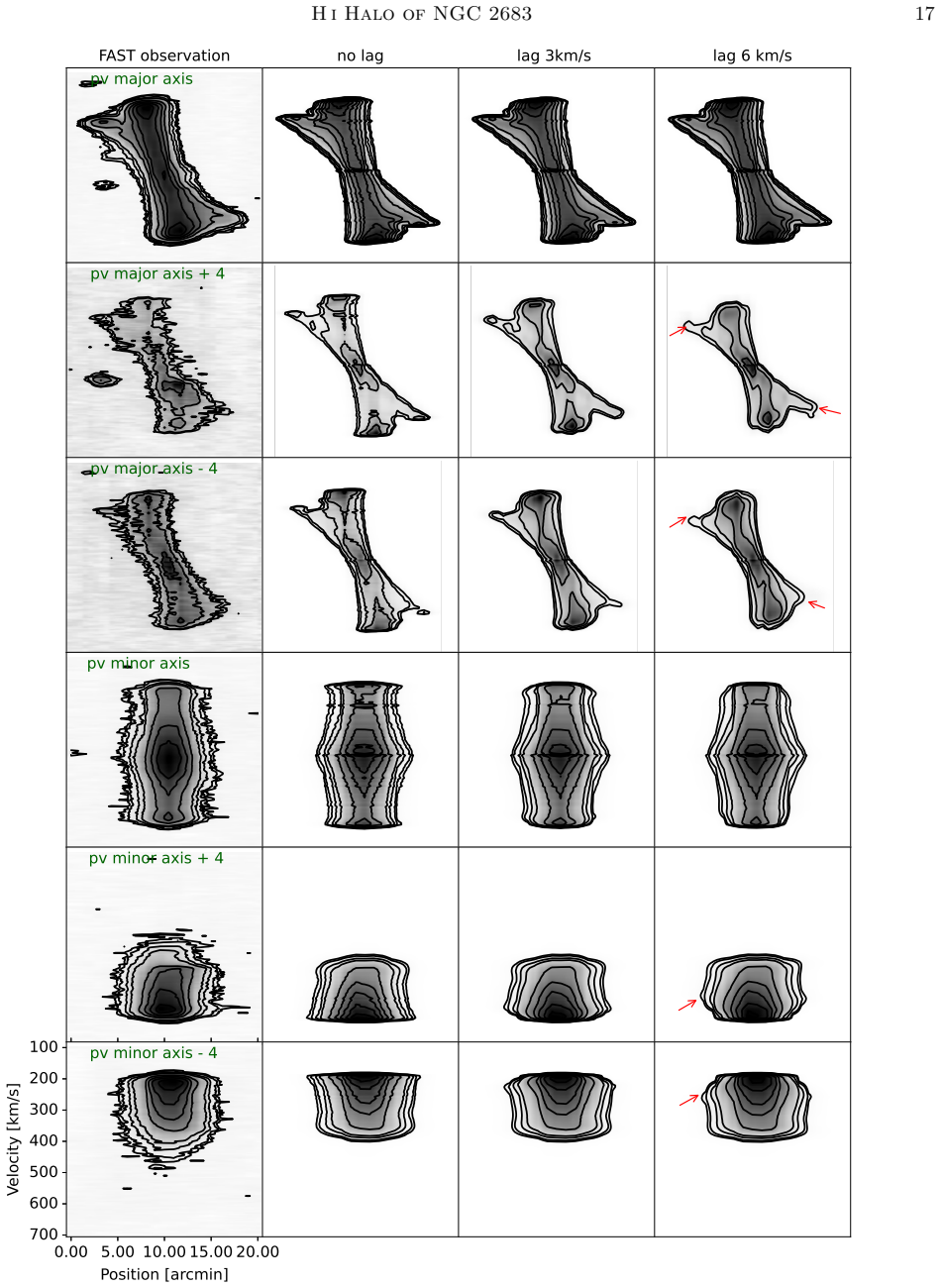
The central comparison is between FAST total-power data and VLA interferometric data reprocessed, tapered, and smoothed to a matched $3.1'$ beam. Because FAST measures total power, it retains the short-spacing information that the VLA misses, and its $5\sigma$ column-density sensitivity of $3.7\times10^{18}\,\mathrm{cm^{-2}}$ is roughly four times deeper than the reprocessed VLA limit. The model machinery is the earlier tilted thin-disk, flare, warp, and outer-ring model, augmented by an empirical vertical halo profile $\rho_{\rm halo}=\chi\rho_{\rm disk}\,\sinh(z/z_0)/\cosh^2(z/z_0)$, with scale heights fitted as a power law in radius from the VLA data and $\chi=0.1$ set by matching the model flux to FAST. The decisive evidence is the set of residual channel maps and vertical flux profiles: the flare-only model cannot fill the vertical extent that FAST sees, while the flare-plus-halo model leaves residuals of order $0.5\times10^{19}\,\mathrm{cm^{-2}}$.
What would settle it
Reprocess the FAST maps with an independent stray-radiation and baseline correction, or re-observe with an interferometric array that has complete short-spacing coverage, and check whether the vertical excess at column densities near $3\times10^{19}\,\mathrm{cm^{-2}}$ persists. If the excess vanishes or is traced to sidelobes or Galactic HI confusion, the halo claim would collapse; if the short-spacing-complete map recovers the full $112.1\,\mathrm{Jy\,km\,s^{-1}}$ flux with only a flaring disk, no halo would be needed.
Extended reading notes
Core claim
The paper claims that NGC 2683 hosts an extended neutral hydrogen halo that earlier VLA observations did not reveal. FAST detects HI emission out to about 18.7 arcminutes perpendicular to the disk, roughly four times the vertical extent of the reprocessed VLA map, at a total flux $F_{\rm HI}=112.1\,\mathrm{Jy\,km\,s^{-1}}$, corresponding to $M_{\rm HI}=2.32\times10^9\,M_\odot$. Reproducing the FAST channel maps requires adding a halo component with the empirical vertical profile $\rho_{\rm halo}\propto \rho_{\rm disk}\,\sinh(z/z_0)/\cosh^2(z/z_0)$ to a flaring disk model; the flare-only model leaves large systematic residuals. The inferred halo mass is $3\times10^8\,M_\odot$, about 13% of the total HI mass, and the authors conclude that external gas accretion from dwarf companions and high-velocity clouds, rather than a galactic fountain, is the likely origin of this halo.
Load-bearing premise
The vertical excess seen by FAST consists of real, diffuse neutral hydrogen attached to NGC 2683, not artifacts of single-dish calibration, baseline subtraction, stray radiation, or Galactic HI confusion.
Editorial extensions
If this is right
- The total HI mass of NGC 2683 is about 10% larger than the earlier VLA-based estimate, so interferometric surveys can miss a substantial diffuse component.
- A flaring disk alone cannot reproduce the vertical extent; realistic models of this galaxy must include an extraplanar HI halo.
- The proximity and velocity structure of dw3? relative to the HI tail of KK 69 indicate that a dwarf companion is currently donating gas to NGC 2683.
- Complex B appears to be in the process of being accreted, making infalling high-velocity clouds a plausible continuing supply for the halo.
- Roughly 13% of the galaxy's atomic hydrogen resides outside the thin disk, pointing to external gas accretion rather than star formation as the mechanism building the reservoir.
Reading between the lines
- Editorial inference: if the same FAST-versus-VLA comparison were applied to other edge-on galaxies, some previous interpretations of vertical HI extent as purely flaring disks might need revisiting, because missing short spacings could hide similar halos.
- Editorial inference: the HI tail connecting KK 69 to dw3? may be a directly observable cold-accretion stream; mapping it at higher angular resolution and measuring its kinematics could put the accretion rate onto NGC 2683 on a quantitative footing.
- Editorial inference: a straightforward testable extension is to apply the same mask-and-compare halo-mass estimate to a small sample of isolated edge-on spirals, to see whether a roughly 10-15% halo fraction is generic or specific to this interacting group.
Signed reviews
Editorial analysis
A structured set of objections, weighed in public.
Referee Report
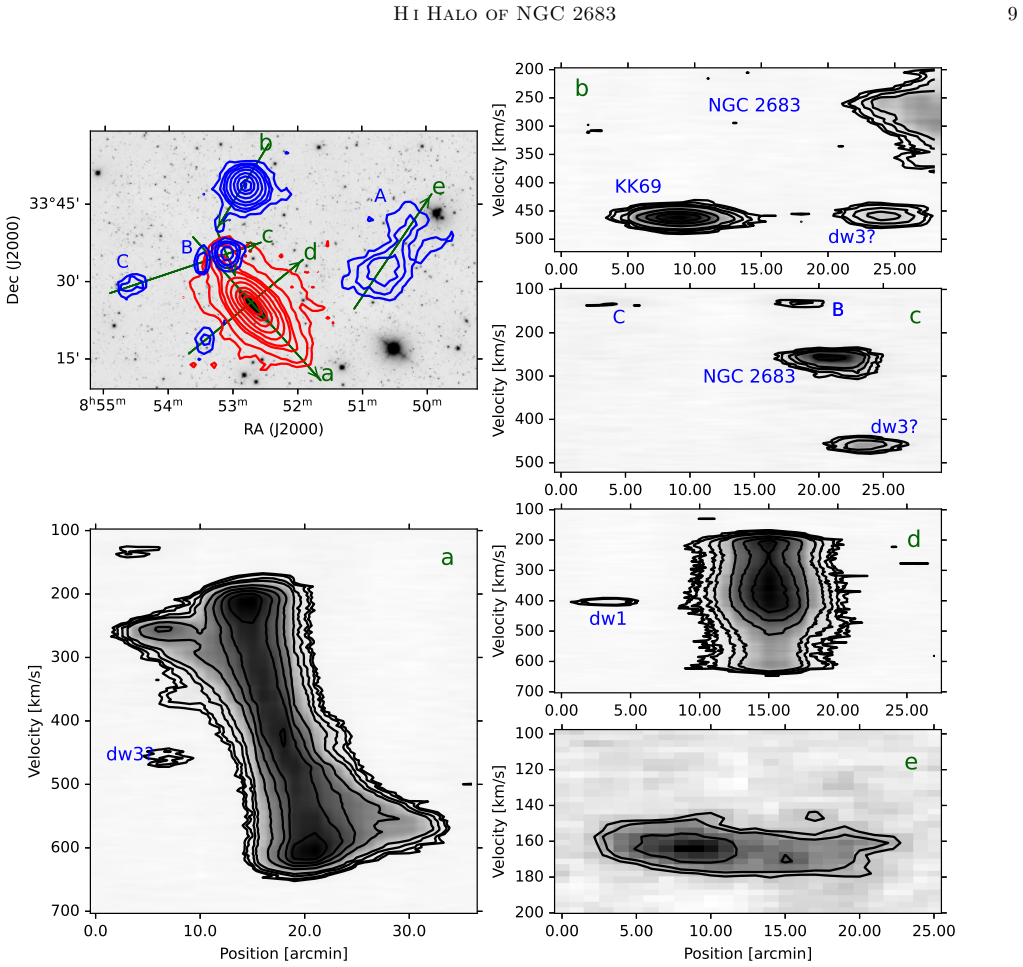
Summary. The paper presents FAST 19-beam HI observations of the edge-on galaxy NGC 2683 and its surroundings. Compared with the VLA data of Vollmer et al. (2016), the FAST maps reach about four times larger vertical extent and a slightly higher total flux (112.1 Jy km/s, M_HI = 2.32e9 Msun). The authors also report the detection of the dwarf galaxies KK69, dw1, and dw3?, and three compact high-velocity complexes A, B, and C. Interpreting the diffuse vertical excess as an HI halo, they add a halo component to the Vollmer et al. flare model, with normalization chi = 0.1 tuned to the FAST data, and claim the halo model matches the FAST data better than the pure flare model. The derived halo mass is about 3e8 Msun, roughly 13% of the total HI mass, which they attribute to external gas accretion from the dwarf companions and HVCs.
Significance. If the extended faint HI distribution around NGC 2683 is real, the paper provides a rare single-dish detection of a candidate neutral gas halo in an edge-on spiral, with a mass fraction comparable to HALOGAS extraplanar gas fractions. The detection of the dwarf galaxy dw3? and the HI tail of KK69, along with the three velocity complexes, adds useful information on gas accretion in a low-mass group. The paper also demonstrates the sensitivity of FAST for faint extended HI emission, which is a constructive result. The direct reprocessing of the VLA data to a matched beam is a step in the right direction. However, as explained in the major comments, the central 'halo not flare' conclusion and the quoted halo mass rest on model normalization, subtraction, and masking choices that are not yet quantitatively tested.
major comments (4)
- [Sec. 4.2, Figs. 8, 10, 11] The comparison between the V-model-flare and V-model+halo is not a fair test of the presence of a halo. The halo model is normalized to the FAST data via the parameter chi, which is explicitly 'derived from the comparison of the flux obtained from the model with the FAST observations' (chi = 0.1), whereas the V-model-flare is the original Vollmer et al. model not renormalized to FAST. A model fitted to the data is naturally expected to yield smaller residuals. To support the 'halo not flare' claim, the authors should either fix chi a priori (e.g., from the expected halo mass fraction or from fitting the halo model simultaneously to both VLA and FAST data) or present a comparison where both models are normalized in the same way.
- [Sec. 3, Fig. 3] The central evidence for the extended halo is the FAST minus VLA excess map, but the paper provides no quantitative uncertainty analysis or null tests for this subtraction. The few negative regions are dismissed as 'likely attributable to pointing uncertainties' without a quantitative estimate of the magnitude of the pointing offset (the pointing accuracy is ~12 arcsec against a 2.9' beam) or of the effect of baseline subtraction and stray radiation. Single-dish baseline errors and residual negative bowls from the VLA's missing short spacings can produce broad, faint positive residuals at the level of ~3e19 cm-2 claimed here. The authors should quantify these systematic effects, e.g., by jackknifing the data, by comparing two independent halves of the FAST observations, or by injecting and recovering a model disk into the FAST data to show that the excess is not an artifact.
- [Sec. 4.2, halo mass and scale-height fit] The halo mass of 3e8 Msun is derived by masking the FAST data with a model cube built from the VLA-based disk+flare model, using an arbitrary threshold of twice the rms noise. This mass therefore inherits the model's vertical structure; if the flare law is even slightly misestimated, the mask will misclassify disk or flare emission as halo, or vice versa. In addition, the scale-height power law used in the halo model is fitted to VLA data (Figure 9) that, by the authors' own statement, do not show the extended halo, creating a circularity: the halo's vertical structure is derived from the same data that supposedly lack the halo. The paper gives no error bars, no variation of the threshold, and no test of the sensitivity of the derived mass to the assumed disk/flare subtraction. A direct measurement of the halo column density and a proper propagation of uncertainties are needed.
- [Sec. 3, Fig. 2 and vertical extent statement] The claim that FAST detects HI about four times farther than the VLA in the vertical direction is not an apples-to-apples comparison. The two data sets have very different sensitivities: the reprocessed VLA has 5-sigma column-density sensitivity of 1.4e19 cm-2, while FAST reaches 3.7e18 cm-2. A more sensitive observation will naturally detect more extended faint emission. The paper should either match the sensitivity and then compare the extent, or model what vertical extent the VLA would have detected if the same extended HI distribution were present. Without this, the factor-of-four extent is not a robust property of the galaxy.
minor comments (6)
- [Sec. 1] "We not only detected the H i distribution of three dwarf galaxies" is ungrammatical; it should read "We not only detected the H i distribution of three dwarf galaxies, but also discovered three HI complexes."
- [Sec. 2] The sentence "The antenna temperature was convert to flux density" is a typo, should be "was converted".
- [Sec. 2, Table 1] The 5-sigma column-density sensitivity for NGC 2683 is listed as 3.7e18 cm-2, while in Sec. 3 it is also quoted as 5-sigma = 3.7e18 cm-2; please ensure the factor-5 convention is consistent throughout the text and table.
- [Fig. 4 caption] The contour list in the caption of Figure 4 is long and appears to include values not visible in the panel; consider trimming the description or referencing the velocity ranges in the text.
- [Sec. 4.2] The symbol 'chi' should be defined as a dimensionless normalization factor in the text before Eq. (1). Also, 'we adopted chi = 0.1' would benefit from an explicit statement of the range of chi that gives a reasonable fit, if explored.
- [Sec. 5] In conclusion (2), 'We also determined the mass of the three complex clouds by assuming them as the HVCs' is awkward; 'by assuming them to be HVCs' would be clearer.
Circularity Check
One fitted normalization enters the model-consistency argument, but the halo mass is a separate masked measurement; no full circularity.
-
fitted input called prediction
[Section 4.2, 'H i halo' (Eq. 8 discussion and Figure 10)]
"The parameter χ is derived from the comparison of the flux obtained from the model with the FAST observations, for which we adopted χ = 0.1. ... The column density of the excess H i is predominantly distributed around∼ 0.5× 1019 cm−2, indicating that the V-model+halo model is generally consistent with the FAST observations."
The halo component is normalized by fitting χ to the FAST flux level, and the same fitted model is then subtracted from the FAST data to produce the residual map whose smallness is quoted as evidence that the halo model is consistent. The overall flux-level agreement is therefore enforced by construction rather than predicted. The circularity is partial: the spatial profiles, channel-map extents, and the separate masked measurement of the 3e8 Msun halo mass are not set by the single fitted normalization χ, so the central halo claim retains independent content.
full rationale
The paper's central observation is an independent comparison between FAST and reprocessed VLA data: FAST sees more vertically extended HI, and the excess column densities cluster around 3e19 cm^-2. The halo is then modeled by adding a component from Eq. 8 of Vollmer et al. (2016), with scale heights derived from VLA data and a normalization χ adopted from a comparison with FAST fluxes. This is a transparent model fit rather than a hidden prediction. The reported halo mass of 3e8 Msun (about 13% of total HI) is not obtained from the fitted χ; it is derived by applying a mask built from the disk+flare model cube to the FAST data, following the external HALOGAS methodology of Marasco et al. (2019). Thus the mass is a direct masked measurement of the residual emission, not a quantity forced by the fitted normalization. There is some reliance on the self-cited Vollmer et al. (2016) flare model as the baseline, but the flare model is compared directly against FAST channel maps, providing an independent check. The main weakness is statistical rather than circular: the FAST-VLA excess map lacks quantitative null tests for baseline errors, stray radiation, pointing offsets, and missing short spacings. That concern belongs to correctness risk, not to a derivation that reduces to its own inputs.
Assumptions & free parameters
free parameters (3)
- Halo density normalization chi =
0.1
- Halo scale-height power-law parameters =
not stated numerically (fit shown in Figure 9)
- EPG mask threshold =
2 times the FAST rms noise
assumptions (4)
- domain assumption FAST flux calibration and the 16 K/Jy gain conversion are accurate.
- domain assumption The reprocessed, uv-tapered VLA data faithfully represents the compact disk component, so the FAST-VLA difference is diffuse extended emission.
- domain assumption Equation 8 from Vollmer et al. (2016) is an appropriate empirical vertical density law for NGC 2683's halo.
- domain assumption The flare model from Vollmer et al. (2016) is a correct starting description of the disk outside the halo.
Cite this review
Pith. "Pith review of FAST Reveals the Extended HI Halo and Accretion Signatures of NGC2683." pith.science (2026). https://pith.science/paper/IWHZXVMF
@misc{pith2026250503158,
  author       = {Pith},
  title        = {Pith review of: FAST Reveals the Extended HI Halo and Accretion Signatures of NGC2683},
  year         = {2026},
  howpublished = {\url{https://pith.science/paper/IWHZXVMF}},
  note         = {Machine review of arXiv:2505.03158}
}
abstract
We present the results of our recent HI observations conducted on the edge-on galaxy NGC2683 using the Five-hundred-meter Aperture Spherical radio Telescope (FAST). In comparison to previous observations made by the VLA, FAST has detected a more extensive distribution of HI. Particularly noteworthy is that the detections made by FAST extend approximately four times farther than those of the VLA in the vertical direction from the galactic plane. The total HI flux measured for NGC2683 amounts to $F_{\rm HI} = 112.1\,\rm{Jy\,km\,s^{-1}}$ (equivalent to a total HI mass of $M_{\rm HI} = 2.32 \times 10^9\,{\rm M_\odot}$), which is slightly higher than that detected by VLA. FAST has also identified three dwarf galaxies in close proximity to NGC2683, namely KK69, NGC2683dw1 (hereafter dw1), and NGC2683dw3$?$ (hereafter dw3$?$). dw3$?$ is situated within the extended HI distribution of NGC2683 in projection and lies near the tail of KK69 extending towards NGC2683. These observations suggest that dw3$?$ is likely a result of the accretion process from NGC2683 to KK69. Furthermore, FAST has detected three high-velocity clouds (HVCs), with complex B potentially undergoing accretion with NGC2683. Based on the model from Vollmer et al. 2016 and incorporating the HI halo component, we found that the model with the added HI halo aligns more closely with our FAST observations in NGC2683. The estimated mass of this HI halo is $3 \times 10^8\,{\rm M_\odot}$, constituting approximately 13% of the total HI mass of the galaxy. We suggest that the origination of this HI halo is more likely attributed to external gas accretion.
Figures


Figures from the paper (9 more)




Reference graph
Works this paper leans on
-
[1]
, " * write output.state after.block = add.period write newline
ENTRY address archivePrefix author booktitle chapter doi edition editor eprint howpublished institution journal key month number organization pages publisher school series title misctitle type volume year version url label extra.label sort.label short.list INTEGERS output.state before.all mid.sentence after.sentence after.block FUNCTION init.state.consts ...
-
[2]
write newline
" write newline "" before.all 'output.state := FUNCTION format.url url empty "" new.block "" url * "" * if FUNCTION format.eprint eprint empty "" archivePrefix empty "" archivePrefix "arXiv" = new.block " " eprint * " " * new.block " " eprint * " " * if if if FUNCTION format.doi doi empty "" " " doi * " " * if FUNCTION format.pid doi empty eprint empty ur...
-
[3]
P2B92E@c CB `֟G
thebibliography [1] 20pt to REFERENCES 6pt =0pt -12pt 10pt plus 3pt =0pt =0pt =1pt plus 1pt =0pt =0pt -12pt =13pt plus 1pt =20pt =13pt plus 1pt \@M =10000 =-1.0em =0pt =0pt 0pt =0pt =1.0em @enumiv\@empty 10000 10000 `\.\@m \@noitemerr \@latex@warning Empty `thebibliography' environment \@ifnextchar \@reference \@latexerr Missing key on reference command E...
2021
-
[4]
A., Giovanelli, R., & Haynes, M
Adams, E. A., Giovanelli, R., & Haynes, M. P. 2013, The Astrophysical Journal, 768, 77
work page 2013
-
[5]
2015, Analyst, 140, 250
Baek, S.-J., Park, A., Ahn, Y.-J., & Choo, J. 2015, Analyst, 140, 250
2015
-
[6]
1975, Astronomy and Astrophysics, vol
Barbon, R., & Capaccioli, M. 1975, Astronomy and Astrophysics, vol. 42, no. 2, Aug. 1975, p. 221-228. Research supported by the Consiglio Nazionale delle Ricerche., 42, 221
work page 1975
-
[7]
N., Karachentsev, I., Sharina, M., & Kaisin, S
Begum, A., Chengalur, J. N., Karachentsev, I., Sharina, M., & Kaisin, S. 2008, Monthly Notices of the Royal Astronomical Society, 386, 1667
work page 2008
-
[8]
1994, Astronomy and Astrophysics Suppl., Vol
Broeils, A., & Van Woerden, H. 1994, Astronomy and Astrophysics Suppl., Vol. 107, p. 129-176 (1994), 107, 129
work page 1994
Show all 42 references
-
[9]
G., Greene, J
Carlsten, S. G., Greene, J. E., Beaton, R. L., Danieli, S., & Greco, J. P. 2022, The Astrophysical Journal, 933, 47
2022
-
[10]
1991, Astronomical Journal (ISSN 0004-6256), vol
Casertano, S., & Van Gorkom, J. 1991, Astronomical Journal (ISSN 0004-6256), vol. 101, April 1991, p. 1231-1241. Research supported by ZWO and Rijksuniversiteit Groningen., 101, 1231
1991
-
[11]
2023, Monthly Notices of the Royal Astronomical Society, 521, 4009
Crosby, E., Jerjen, H., M \"u ller, O., et al. 2023, Monthly Notices of the Royal Astronomical Society, 521, 4009
2023
-
[12]
K., Zagursky, M
de Naray, R. K., Zagursky, M. J., & McGaugh, S. S. 2009, The Astronomical Journal, 138, 1082
2009
-
[13]
J., Lang, D., et al
Dey, A., Schlegel, D. J., Lang, D., et al. 2019, The Astronomical Journal, 157, 168
2019
-
[14]
M., & Lockman, F
Dickey, J. M., & Lockman, F. J. 1990, IN: Annual review of astronomy and astrophysics. Vol. 28 (A91-28201 10-90). Palo Alto, CA, Annual Reviews, Inc., 1990, p. 215-261., 28, 215
1990
-
[15]
2006, Monthly Notices of the Royal Astronomical Society, 366, 449
Fraternali, F., & Binney, J. 2006, Monthly Notices of the Royal Astronomical Society, 366, 449
2006
-
[16]
2002, The Astronomical Journal, 123, 3124
Fraternali, F., van Moorsel, G., Sancisi, R., & Oosterloo, T. 2002, The Astronomical Journal, 123, 3124
2002
-
[17]
G., Corsini, E., Cappellari, M., et al
Funes, J. G., Corsini, E., Cappellari, M., et al. 2002, Astronomy & Astrophysics, 388, 50
2002
-
[18]
2013, Astronomy & Astrophysics, 554, A125
Gentile, G., J \'o zsa, G., Serra, P., et al. 2013, Astronomy & Astrophysics, 554, A125
2013
-
[19]
1985, Astronomical Journal (ISSN 0004-6256), vol
Harris, H., Hesser, J., Bothun, G., Hanes, D., & Harris, W. 1985, Astronomical Journal (ISSN 0004-6256), vol. 90, Dec. 1985, p. 2495-2498., 90, 2495
1985
-
[20]
P., Hogg, D
Haynes, M. P., Hogg, D. E., Maddalena, R. J., Roberts, M. S., & van Zee, L. 1998, The Astronomical Journal, 115, 62
1998
-
[21]
2003, Astronomy & Astrophysics, 401, 483
Huchtmeier, W., Karachentsev, I., & Karachentseva, V. 2003, Astronomy & Astrophysics, 401, 483
2003
-
[22]
2016, Astronomy & Astrophysics, 588, A89
Javanmardi, B., Martinez-Delgado, D., Kroupa, P., et al. 2016, Astronomy & Astrophysics, 588, A89
2016
-
[23]
2019, Science China Physics, Mechanics & Astronomy, 62, 1
Jiang, P., Yue, Y., Gan, H., et al. 2019, Science China Physics, Mechanics & Astronomy, 62, 1
2019
-
[24]
2020, Research in Astronomy and Astrophysics, 20, 064
Jiang, P., Tang, N.-Y., Hou, L.-G., et al. 2020, Research in Astronomy and Astrophysics, 20, 064
2020
-
[25]
2024, arXiv preprint arXiv:2401.17364
Jing, Y., Wang, J., Xu, C., et al. 2024, arXiv preprint arXiv:2401.17364
2024 arXiv
-
[26]
M., & Kerp, J
Kalberla, P. M., & Kerp, J. 2009, Annual review of astronomy and Astrophysics, 47, 27
2009
-
[27]
2015 a , Astrophysical Bulletin, 70, 379
Karachentsev, I., Riepe, P., Zilch, T., et al. 2015 a , Astrophysical Bulletin, 70, 379
2015
-
[28]
D., Tully, R
Karachentsev, I. D., Tully, R. B., Makarova, L. N., Makarov, D. I., & Rizzi, L. 2015 b , The Astrophysical Journal, 805, 144
2015
-
[29]
1998, Astronomy and Astrophysics Supplement Series, 127, 409
Karachentseva, V., & Karachentsev, I. 1998, Astronomy and Astrophysics Supplement Series, 127, 409
1998
-
[30]
2019, Astronomy & Astrophysics, 631, A50
Marasco, A., Fraternali, F., Heald, G., et al. 2019, Astronomy & Astrophysics, 631, A50
2019
-
[31]
2011, International Journal of Modern Physics D, 20, 989
Nan, R., Li, D., Jin, C., et al. 2011, International Journal of Modern Physics D, 20, 989
2011
-
[32]
2007, The Astronomical Journal, 134, 1019
Oosterloo, T., Fraternali, F., & Sancisi, R. 2007, The Astronomical Journal, 134, 1019
2007
-
[33]
N., Forbes, D
Proctor, R. N., Forbes, D. A., Brodie, J. P., & Strader, J. 2008, Monthly Notices of the Royal Astronomical Society, 385, 1709
2008
-
[34]
2012, Annual Review of Astronomy and Astrophysics, 50, 491
Putman, M., Peek, J., & Joung, M. 2012, Annual Review of Astronomy and Astrophysics, 50, 491
2012
-
[35]
2008, The Astronomy and Astrophysics Review, 15, 189
Sancisi, R., Fraternali, F., Oosterloo, T., & Van Der Hulst, T. 2008, The Astronomy and Astrophysics Review, 15, 189
2008
-
[36]
S., Patra, N
Saponara, J., Koribalski, B. S., Patra, N. N., & Benaglia, P. 2020, Astrophysics and Space Science, 365, 1
2020
-
[37]
2016, Astronomy & Astrophysics, 586, A98
Vollmer, B., Nehlig, F., & Ibata, R. 2016, Astronomy & Astrophysics, 586, A98
2016
-
[38]
1997, Annual Review of Astronomy and Astrophysics, 35, 217
Wakker, B., & van Woerden, H. 1997, Annual Review of Astronomy and Astrophysics, 35, 217
1997
-
[39]
2015, The Astronomical Journal, 150, 81
Wiegert, T., Irwin, J., Miskolczi, A., et al. 2015, The Astronomical Journal, 150, 81
2015
-
[40]
2021, The Astrophysical Journal, 922, 53
Xu, J.-L., Zhang, C.-P., Yu, N., et al. 2021, The Astrophysical Journal, 922, 53
2021
-
[41]
2023, Monthly Notices of the Royal Astronomical Society, 521, 2719
Yu, H., Zhu, M., Xu, J.-L., et al. 2023, Monthly Notices of the Royal Astronomical Society, 521, 2719
2023
-
[42]
2022, Monthly Notices of the Royal Astronomical Society, 513, 1329
Zheng, Y., Wang, J., Irwin, J., et al. 2022, Monthly Notices of the Royal Astronomical Society, 513, 1329
2022
Reviewed August 15, 2026 · model on record in the stance chip above.
Discussion (0). Continue with ORCID to comment.