REVIEW 2 major objections 6 minor 110 references
Evidence for universal gas depletion in a sample of 41 luminous Type 1 quasars at z $\sim$ 2
T0 review · 2 major / 6 minor · reviewed 2026-08-15 · deepseek-v4-flash
Pith's one-line read Luminous unobscured quasars at z~2 are gas-poor: gas fractions of 0.02-0.32 lie below inactive galaxies and obscured quasars, marking an evolutionary shift from gas-rich obscured to gas-poor unobscured hosts.
desk verdict Useful new CO sample, honest sensitivity analysis, but 'universal depletion' leans on a single geometric assumption only three sources justify. read the letter →
The pith
A machine-rendered reading of the paper's core claim, the machinery that carries it, and where it could break.
The reading
What carries the argument
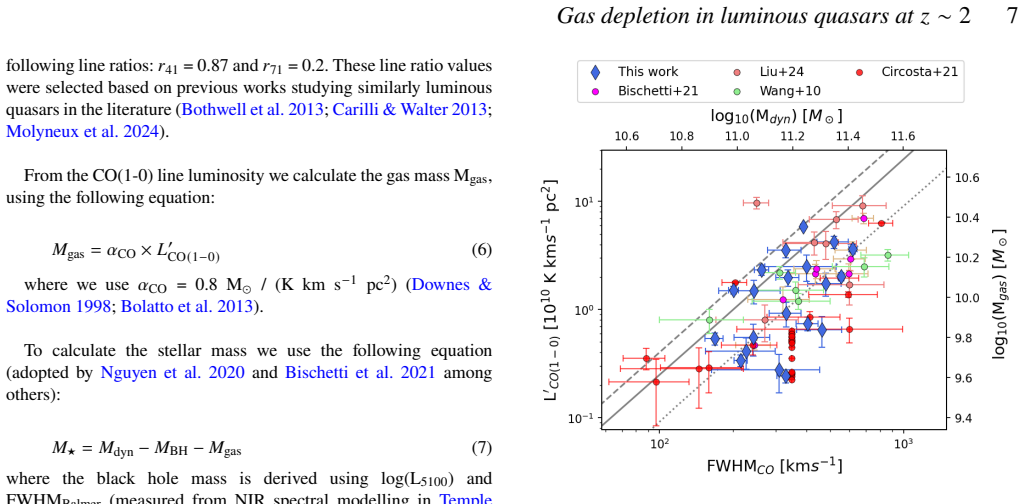
The load-bearing machinery is the chain from CO line measurements to gas fractions. A CO(3–2) luminosity is converted to CO(1–0) using fixed line ratios ($r_{31}=0.97$, $r_{41}=0.87$, $r_{71}=0.20$) and then to molecular gas mass with $\alpha_{\rm CO}=0.8\ M_\odot\,({\rm K\,km\,s^{-1}\,pc^2})^{-1}$; dynamical masses come from the CO line width through a rotating-disk model, $M_{\rm dyn} = 1.16\times 10^5 \times 0.75 \times \mathrm{FWHM_{CO}} \times \sin(i)^2 \times r_{\rm kpc}$, with inclination $i=30^\circ$ and radius $r=5\ {\rm kpc}$ assumed for every target; stellar masses are the remainder $M_\star = M_{\rm dyn} - M_{\rm BH} - M_{\rm gas}$, so the gas fraction is $M_{\rm gas}/M_\star$. Because only three targets are spatially resolved, the single assumed radius is what carries the depletion contrast.
What would settle it
Resolve the CO emission in a representative subset of about a dozen of these quasars at sub-kiloparsec resolution and measure the actual radii and orientations; if the median radius is close to $2\,\mathrm{kpc}$ rather than $5\,\mathrm{kpc}$, the dynamical-mass equation raises the median $\log_{10} f_{\rm gas}$ from $-1.22$ to $-0.76$, largely erasing the claimed depletion relative to the star-forming main sequence. Alternatively, measure stellar masses independently from rest-frame optical or near-infrared SED fitting and recompute the gas fractions directly.
Extended reading notes
Core claim
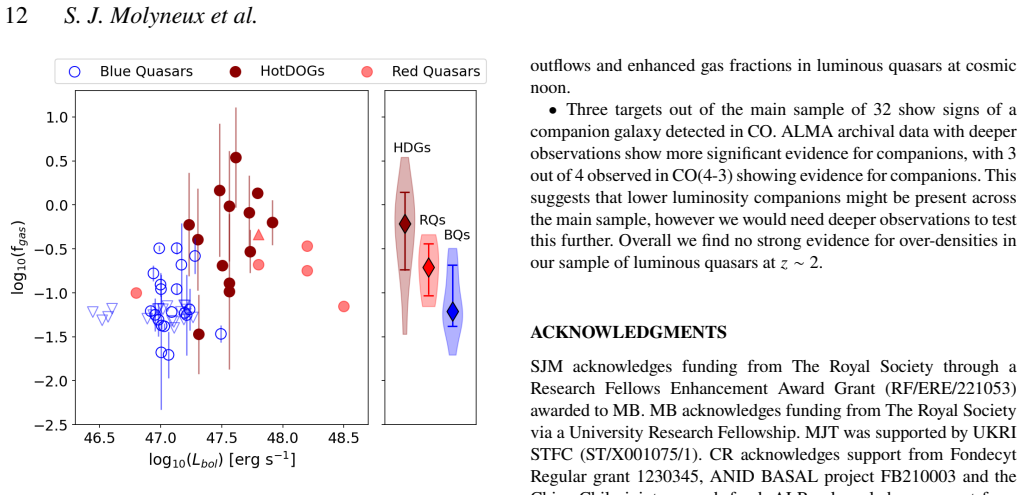
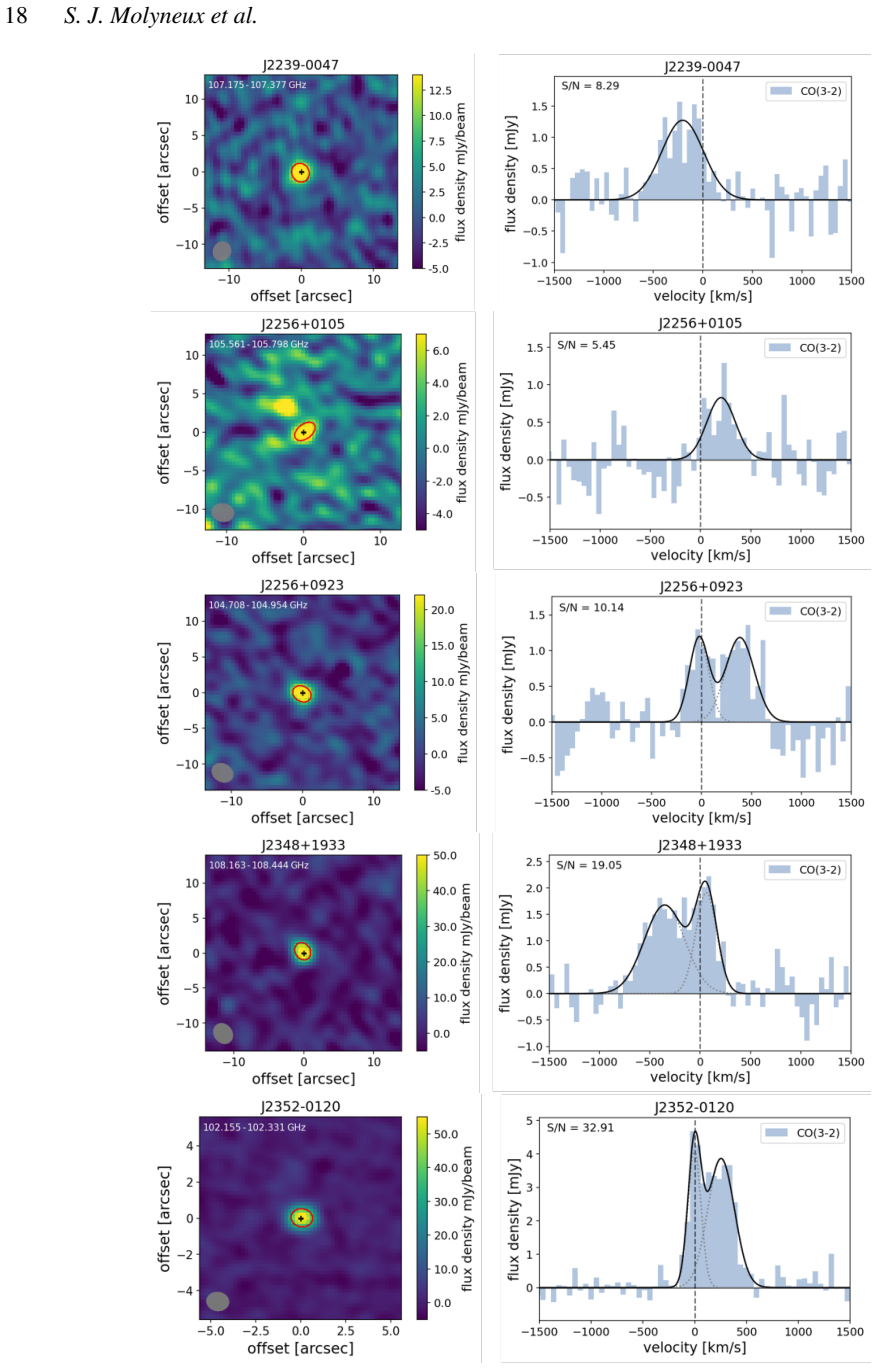
The central claim is that luminous, unobscured (Type 1) quasars at $z\sim 2$ have depleted molecular gas reservoirs. In the 20 of 41 targets with CO detections the median gas mass is $8.0 \pm 1.5 \times 10^9\,M_\odot$, the median dynamical mass is $1.4 \pm 0.9 \times 10^{11}\,M_\odot$, and the gas fractions $M_{\rm gas}/M_\star$ range from $0.02$ to $0.32$ with median $0.06 \pm 0.09$. These values sit below both inactive main-sequence galaxies at the same redshift and obscured quasar populations (red quasars and hot dust-obscured galaxies) at comparable luminosity. The authors interpret the ordering obscured/gas-rich $\rightarrow$ unobscured/gas-poor as an evolutionary trend: the same luminous phase that evacuates nuclear dust and gas leaves a gas-poor host. They also present tentative evidence that quasars with stronger disk winds (C IV blueshifts above $1000\ \mathrm{km\,s^{-1}}$ and weak He II) have somewhat higher gas fractions, and they find no strong sign that these quasars live in extremely dense environments.
Load-bearing premise
The entire depletion signal rests on assuming every quasar's molecular gas sits in a rotating disk of radius $5\,\mathrm{kpc}$ inclined at 30 degrees; if the true sizes are closer to $2\,\mathrm{kpc}$, the paper's own calculation shifts the median gas fraction upward by about half a decade and the gap to star-forming galaxies narrows considerably.
Editorial extensions
If this is right
- If the depletion is real, the most luminous unobscured quasars at $z\sim2$ are not sites of ongoing vigorous star formation but hosts whose molecular fuel has been largely consumed or expelled.
- Gas fractions rise with obscuration across comparable luminous samples, so the molecular reservoir shrinks as the quasar sheds its dusty cocoon; the ordering is consistent with a gas-rich obscured phase preceding the unobscured phase.
- Quasars with the strongest broad-line winds (C IV blueshift above $1000\ \mathrm{km\,s^{-1}}$) tend toward higher gas fractions, suggesting that disk winds are more easily launched when some cold gas remains rather than in fully depleted hosts.
- Only about 15 percent of the sample shows CO-bright companions at the achieved sensitivity, so luminous quasars at this epoch do not appear to require extreme overdensities; deeper observations could still uncover fainter companions.
Reading between the lines
- A direct extension the authors leave implicit: if the gas-poor unobscured phase is the end state, the same targets should show recently removed gas — for example broad molecular outflows or excess ionised gas — at a rate that scales with how far below the main sequence each object sits; stacking the non-detections for broad wings, which the paper begins to do, is a cheap test.
- The tentative C IV/gas-fraction link could be sharpened by testing whether gas fraction correlates more tightly with Eddington ratio or with wind velocity, using the same sample's measured black-hole masses and $L/L_{\rm Edd}$ values.
- Because stellar masses are here derived rather than measured, the cleanest independent check is rest-frame optical or near-infrared SED fitting for a subsample; higher stellar masses would make the depletion stronger, while lower stellar masses would weaken it.
Signed reviews
Editorial analysis
A structured set of objections, weighed in public.
Referee Report
Summary. This paper presents ALMA CO observations of 41 luminous unobscured quasars at z∼2 from SDSS, comprising a main sample of 32 sources observed in CO(3-2) plus 9 archival sources observed in CO(3-2), CO(4-3), or CO(7-6). The authors measure CO luminosities, derive gas masses using fixed conversion factors (α_CO = 0.8, r31 = 0.97, r41 = 0.87, r71 = 0.2), and compute dynamical masses from CO line widths under the assumption of ordered rotation with a fixed radius r = 5 kpc and inclination i = 30° for all sources (Eq. 3). Stellar masses are then obtained as M★ = M_dyn − M_BH − M_gas (Eq. 7), so gas fractions (Eq. 8) depend directly on the assumed geometry. The central finding is that these quasars have low gas fractions, median ∼0.06, 'generally lower than both inactive galaxies and obscured quasars at similar redshifts', which the authors attribute to an evolutionary trend from gas-rich obscured quasars to gas-poor unobscured quasars. They also report a tentative correlation with C IV blueshift / He II EW and identify a few CO-detected companions. A sensitivity analysis in Section 4.1 shows that changing the radius to 2 kpc raises the median log10 f_gas from −1.22 to −0.76 (median f_gas ≈ 0.17) and that implausible values (r31 ≈ 0.1 or α_CO ≈ 11) would be required to erase the deficit entirely.
Significance. If the result holds, it is an important piece of evidence for AGN-driven gas depletion in the most luminous quasars at cosmic noon, a regime where simulations currently do not predict depleted reservoirs. The paper's strengths are its relatively large and uniformly selected sample, the homogeneous ALMA processing, the explicit sensitivity analysis in Section 4.1 (which correctly identifies the magnitude of the geometric prior), and the connection drawn between BLR/NLR outflow indicators and the molecular ISM. The paper also includes upper limits for non-detections and makes the reduced data available on request. These features make the work potentially valuable to the AGN feedback community, provided the central geometric assumption is either better justified or the conclusions are appropriately caveated.
major comments (2)
- [3.3 (Eq. 3) and 4.1] The central claim of universal gas depletion rests on a single assumed CO-emitting radius r = 5 kpc and inclination i = 30° for every source, although only three objects are spatially resolved (sizes 0.53–0.65 arcsec ≈ 5 kpc). Because the stellar mass is not independently measured but is defined by M★ = M_dyn − M_BH − M_gas (Eq. 7), the assumed radius propagates directly into every gas fraction. The paper's own test in Section 4.1 shows that adopting r = 2 kpc changes the median log10 f_gas from −1.22 to −0.76, i.e., the median f_gas rises from ≈0.06 to ≈0.17, reducing the contrast with star-forming galaxies by roughly a factor of three. At smaller radii or larger inclinations (the sin^2(i) dependence in Eq. 3 is significant) the gap could close further. Since only a single discrete sensitivity check is reported rather than a marginalisation over physically plausible (r, i), the 'universal' conclusion is conditional on an unverified geometric prior. I ask the authors to (a) adopt resolved sizes where available and marginalise over plausible radius and inclination distributions, or (b) substantially soften the wording in the abstract and conclusions, quantifying how the significance of the deficit changes with r and i.
- [4.1, Fig. 7, Table 2] The comparison that justifies the statement that gas fractions are 'generally lower than both inactive galaxies and obscured quasars' mixes literature samples with widely different α_CO and line-ratio conventions (Table 2: α_CO ranges from 0.8 to 3.6 for Perna+18, is 3.6 for Circosta+21, and 0.66–15.22 for Sanders+23 SFGs). Since f_gas scales linearly with the assumed α_CO (Eq. 6), the apparent deficit relative to star-forming galaxies could partly reflect these convention differences rather than an intrinsic physical depletion. The sensitivity test in Section 4.1 (r31 ≈ 0.1 or α_CO ≈ 11 would erase the deficit) is reassuring, but it applies only to the authors' own measurements, not to the comparison samples. I recommend that the authors recompute all literature gas fractions with a common set of conversion factors (as already done for the obscured quasars in Fig. 8) or explicitly quantify how the deficit depends on adopting plausible alternative α_CO and line ratios for the comparison samples.
minor comments (6)
- [Abstract] The abstract uses 'CIV' but the main text uses 'Civ'; please standardise the notation for the C IV line.
- [3.3 (Eq. 3)] Eq. (3) as printed appears dimensionally inconsistent (FWHM appears without a square, and sin^2(i) appears in the numerator); please verify the expression against Wang et al. (2013) and Bischetti et al. (2021), and specify the units of each term.
- [4.1] The sentence 'Molecular gas at 5kpc has been identified but as outflows and not part of the mainbulkrotation' is incomplete and unclear; please rephrase to state whether such 5 kpc gas is associated with rotation or with outflows, and cite the relevant literature.
- [Table 3] For non-detections the gas fraction column lists values such as '<0.05', but the caption does not explicitly state that these are 3σ upper limits computed with the assumed median line width; please clarify the caption.
- [Fig. 7] The grey line for main-sequence star-forming galaxies from Tacconi et al. (2020) should be accompanied by a statement of the stellar mass and the α_CO / line-ratio assumptions used to place it on the plot.
- [3.7] There is a typo: 'J1606+16735' should be 'J1606+1735' as listed in Table 3; also check 'J0052+0104' versus 'J0052+0140' for consistency.
Circularity Check
No circular derivation: gas masses and dynamical masses come from independent ALMA measurements plus external conversion factors; the acknowledged self-reference in Eq. 7 and the assumed 5 kpc radius are limitations, not built-in predictions.
full rationale
The central claim of low gas fractions rests on ALMA CO detections. Gas masses are derived from L'_CO using external alpha_CO = 0.8 (Downes & Solomon 1998; Bolatto et al. 2013) and literature line ratios r31 = 0.97, r41 = 0.87, r71 = 0.2; none of these is fitted to the present sample. Dynamical masses come from measured CO FWHM and an assumed ordered-rotation geometry (Eq. 3), and stellar masses are defined as the residual Mdyn - MBH - Mgas (Eq. 7). The paper explicitly flags that fgas then depends on the gas-mass assumptions, and Section 4.1 presents a sensitivity test showing that adopting r = 2 kpc changes the median log10(fgas) from -1.22 to -0.76; this is an acknowledged conditional assumption, not a result forced by construction. The evolutionary interpretation comparing obscured and unobscured quasars is a literature comparison rather than a self-derived prediction. Self-citations to Rankine et al. (2020), Temple et al. (2023), and Molyneux et al. (2024) provide sample selection, spectral products, and line-ratio priors, but none is load-bearing in the sense of substituting for the new ALMA measurements or invoking a uniqueness theorem. No step reduces a claimed prediction to its own input by construction, so no circular step is listed.
Assumptions & free parameters
free parameters (5)
- CO-emitting radius r =
5 kpc (assumed for all targets; only 3 resolved with 0.53-0.65 arcsec)
- Inclination i =
30 degrees
- alpha_CO =
0.8 Msun/(K km/s pc^2)
- CO line ratios r31, r41, r71 =
0.97, 0.87, 0.20
- FWHM for non-detections =
Median FWHM of detections (~170-620 km/s)
assumptions (5)
- domain assumption CO-emitting gas is in ordered circular rotation
- domain assumption Dark matter fraction is negligible within the CO-emitting radius
- domain assumption CO luminosity traces the bulk molecular gas reservoir
- domain assumption Literature line ratios and alpha_CO apply to these luminous quasars
- domain assumption Stellar mass equals Mdyn - MBH - Mgas
Cite this review
Pith. "Pith review of Evidence for universal gas depletion in a sample of 41 luminous Type 1 quasars at z $\sim$ 2." pith.science (2026). https://pith.science/paper/GROTC75V
@misc{pith2026250503884,
  author       = {Pith},
  title        = {Pith review of: Evidence for universal gas depletion in a sample of 41 luminous Type 1 quasars at z $\sim$ 2},
  year         = {2026},
  howpublished = {\url{https://pith.science/paper/GROTC75V}},
  note         = {Machine review of arXiv:2505.03884}
}
abstract
We present ALMA CO observations of the molecular gas in a sample of 41 luminous unobscured quasars at z $\sim$ 2 from the Sloan Digital Sky Survey. 32 targets comprise the main sample observed in CO(3-2) and 9 targets have archival ALMA data of CO(3-2), CO(4-3) and CO(7-6). All quasars have rest-UV to optical spectra tracing ionised gas in the broad line region (e.g. CIV) and the narrow line region (e.g. [OIII]) and they cover the full range of outflow properties in the SDSS quasar population at these redshifts. 15 out of the 32 quasars in the main sample are detected in CO(3-2) and five out of the nine archival quasars are also detected in CO. The median gas mass for all 20 CO detected quasars is 8.0 $\pm$ 1.5 $\times$ 10$^9$ M$_{\odot}$ with a median M$_{dyn}$ of 1.4 $\pm$ 0.9 $\times$ 10$^{11}$ M$_{\odot}$. We find gas fractions in the range 0.02 - 0.32, which are generally lower than both inactive galaxies and obscured quasars at similar redshifts. We suggest an evolutionary trend in gas fractions of quasar host galaxies from obscured and gas rich to unobscured and gas poor. We note a tentative correlation between the gas fractions and the broad-line region properties with quasars showing high CIV blueshifts, indicating stronger broad-line region winds, having higher gas fractions. Six of the quasars corresponding to 15% of the sample also show evidence for at least one companion galaxy detected in CO at the same redshift.
Figures


Figures from the paper (12 more)






Reference graph
Works this paper leans on
-
[1]
write newline
" write newline "" before.all 'output.state := FUNCTION fin.entry write newline FUNCTION new.block output.state before.all = 'skip after.block 'output.state := if FUNCTION new.sentence output.state after.block = 'skip output.state before.all = 'skip after.sentence 'output.state := if if FUNCTION not #0 #1 if FUNCTION and 'skip pop #0 if FUNCTION or pop #1...
-
[2]
Ahmadi A., Hacar A., 2023, ALminer: ALMA archive mining and visualization toolkit , Astrophysics Source Code Library, record ascl:2306.025 ( @eprint ascl 2306.025 )
2023
-
[3]
Assef R. J., et al., 2020, @doi [ ] 10.3847/1538-4357/ab9814 , https://ui.adsabs.harvard.edu/abs/2020ApJ...897..112A 897, 112
-
[4]
Banerji M., McMahon R. G., Hewett P. C., Alaghband-Zadeh S., Gonzalez-Solares E., Venemans B. P., Hawthorn M. J., 2012, @doi [ ] 10.1111/j.1365-2966.2012.22099.x , https://ui.adsabs.harvard.edu/abs/2012MNRAS.427.2275B 427, 2275
arXiv 2012
-
[5]
Banerji M., Alaghband-Zadeh S., Hewett P. C., McMahon R. G., 2015, @doi [ ] 10.1093/mnras/stu2649 , https://ui.adsabs.harvard.edu/abs/2015MNRAS.447.3368B 447, 3368
-
[6]
L., Jones G., Wagg J., McMahon R
Banerji M., Carilli C. L., Jones G., Wagg J., McMahon R. G., Hewett P. C., Alaghband-Zadeh S., Feruglio C., 2017, @doi [ ] 10.1093/mnras/stw3019 , https://ui.adsabs.harvard.edu/abs/2017MNRAS.465.4390B 465, 4390
-
[7]
Banerji M., Jones G. C., Wagg J., Carilli C. L., Bisbas T. G., Hewett P. C., 2018, @doi [ ] 10.1093/mnras/sty1443 , https://ui.adsabs.harvard.edu/abs/2018MNRAS.479.1154B 479, 1154
-
[8]
Banerji M., Jones G. C., Carniani S., DeGraf C., Wagg J., 2021, @doi [ ] 10.1093/mnras/stab852 , https://ui.adsabs.harvard.edu/abs/2021MNRAS.503.5583B 503, 5583
Show all 110 references
-
[9]
Baskin A., Laor A., Hamann F., 2013, @doi [ ] 10.1093/mnras/stt582 , https://ui.adsabs.harvard.edu/abs/2013MNRAS.432.1525B 432, 1525
2013 doi
-
[10]
Baskin A., Laor A., Hamann F., 2015, @doi [ ] 10.1093/mnras/stv406 , https://ui.adsabs.harvard.edu/abs/2015MNRAS.449.1593B 449, 1593
2015 doi
- [11]
-
[12]
Bischetti M., et al., 2019, @doi [ ] 10.1051/0004-6361/201935524 , https://ui.adsabs.harvard.edu/abs/2019A&A...628A.118B 628, A118
2019 doi
-
[13]
Bischetti M., et al., 2021, @doi [ ] 10.1051/0004-6361/202039057 , https://ui.adsabs.harvard.edu/abs/2021A&A...645A..33B 645, A33
2021 doi
-
[14]
D., Wolfire M., Leroy A
Bolatto A. D., Wolfire M., Leroy A. K., 2013, @doi [ ] 10.1146/annurev-astro-082812-140944 , https://ui.adsabs.harvard.edu/abs/2013ARA&A..51..207B 51, 207
2013 doi
-
[15]
Bongiorno A., et al., 2014, @doi [ ] 10.1093/mnras/stu1248 , https://ui.adsabs.harvard.edu/abs/2014MNRAS.443.2077B 443, 2077
2014 doi
-
[16]
S., et al., 2013, @doi [ ] 10.1093/mnras/sts562 , https://ui.adsabs.harvard.edu/abs/2013MNRAS.429.3047B 429, 3047
Bothwell M. S., et al., 2013, @doi [ ] 10.1093/mnras/sts562 , https://ui.adsabs.harvard.edu/abs/2013MNRAS.429.3047B 429, 3047
2013 doi
-
[17]
Brusa M., et al., 2015, @doi [ ] 10.1051/0004-6361/201425491 , https://ui.adsabs.harvard.edu/abs/2015A&A...578A..11B 578, A11
2015 doi
-
[18]
Brusa M., et al., 2018, @doi [ ] 10.1051/0004-6361/201731641 , https://ui.adsabs.harvard.edu/abs/2018A&A...612A..29B 612, A29
2018 doi
-
[19]
Calistro Rivera G., et al., 2021, @doi [ ] 10.1051/0004-6361/202040214 , https://ui.adsabs.harvard.edu/abs/2021A&A...649A.102C 649, A102
2021 doi
-
[20]
L., Walter F., 2013, @doi [ ] 10.1146/annurev-astro-082812-140953 , https://ui.adsabs.harvard.edu/abs/2013ARA&A..51..105C 51, 105
Carilli C. L., Walter F., 2013, @doi [ ] 10.1146/annurev-astro-082812-140953 , https://ui.adsabs.harvard.edu/abs/2013ARA&A..51..105C 51, 105
2013 doi
-
[21]
Carniani S., et al., 2015, @doi [ ] 10.1051/0004-6361/201526557 , https://ui.adsabs.harvard.edu/abs/2015A&A...580A.102C 580, A102
2015 doi
-
[22]
Cicone C., Feruglio C., Maiolino R., Fiore F., Piconcelli E., Menci N., Aussel H., Sturm E., 2012, @doi [ ] 10.1051/0004-6361/201218793 , https://ui.adsabs.harvard.edu/abs/2012A&A...543A..99C 543, A99
2012 doi
-
[23]
Circosta C., et al., 2018, @doi [ ] 10.1051/0004-6361/201833520 , https://ui.adsabs.harvard.edu/abs/2018A&A...620A..82C 620, A82
2018 doi
-
[24]
Circosta C., et al., 2021, @doi [ ] 10.1051/0004-6361/202039270 , https://ui.adsabs.harvard.edu/abs/2021A&A...646A..96C 646, A96
2021 doi
-
[25]
C., Banerji M., Richards G
Coatman L., Hewett P. C., Banerji M., Richards G. T., Hennawi J. F., Prochaska J. X., 2019, @doi [ ] 10.1093/mnras/stz1167 , https://ui.adsabs.harvard.edu/abs/2019MNRAS.486.5335C 486, 5335
2019 doi
-
[26]
Concas A., et al., 2022, @doi [ ] 10.1093/mnras/stac1026 , https://ui.adsabs.harvard.edu/abs/2022MNRAS.513.2535C 513, 2535
2022 doi
-
[27]
G., 2018a, @doi [ ] 10.1093/mnras/stx2598 , https://ui.adsabs.harvard.edu/abs/2018MNRAS.473.4197C 473, 4197
Costa T., Rosdahl J., Sijacki D., Haehnelt M. G., 2018a, @doi [ ] 10.1093/mnras/stx2598 , https://ui.adsabs.harvard.edu/abs/2018MNRAS.473.4197C 473, 4197
-
[28]
G., 2018b, @doi [ ] 10.1093/mnras/sty1514 , https://ui.adsabs.harvard.edu/abs/2018MNRAS.479.2079C 479, 2079
Costa T., Rosdahl J., Sijacki D., Haehnelt M. G., 2018b, @doi [ ] 10.1093/mnras/sty1514 , https://ui.adsabs.harvard.edu/abs/2018MNRAS.479.2079C 479, 2079
-
[29]
Cresci G., Maiolino R., 2018, @doi [Nature Astronomy] 10.1038/s41550-018-0404-5 , https://ui.adsabs.harvard.edu/abs/2018NatAs...2..179C 2, 179
2018 doi
-
[30]
Cresci G., et al., 2015, @doi [ ] 10.1088/0004-637X/799/1/82 , https://ui.adsabs.harvard.edu/abs/2015ApJ...799...82C 799, 82
2015 doi
-
[31]
D'Amato Q., et al., 2020, @doi [ ] 10.1051/0004-6361/201936175 , https://ui.adsabs.harvard.edu/abs/2020A&A...636A..37D 636, A37
2020 doi
-
[32]
De Rosa G., et al., 2014, @doi [ ] 10.1088/0004-637X/790/2/145 , https://ui.adsabs.harvard.edu/abs/2014ApJ...790..145D 790, 145
2014 doi
-
[33]
Decarli R., et al., 2017, @doi [ ] 10.1038/nature22358 , https://ui.adsabs.harvard.edu/abs/2017Natur.545..457D 545, 457
2017 doi
-
[34]
D \' az-Santos T., et al., 2018, @doi [Science] 10.1126/science.aap7605 , https://ui.adsabs.harvard.edu/abs/2018Sci...362.1034D 362, 1034
2018 doi
-
[35]
M., 1998, @doi [ ] 10.1086/306339 , https://ui.adsabs.harvard.edu/abs/1998ApJ...507..615D 507, 615
Downes D., Solomon P. M., 1998, @doi [ ] 10.1086/306339 , https://ui.adsabs.harvard.edu/abs/1998ApJ...507..615D 507, 615
1998 doi
-
[36]
K., Steidel C
Erb D. K., Steidel C. C., Shapley A. E., Pettini M., Reddy N. A., Adelberger K. L., 2006, @doi [ ] 10.1086/504891 , https://ui.adsabs.harvard.edu/abs/2006ApJ...646..107E 646, 107
2006 doi
-
[37]
C., 2012, @doi [ ] 10.1146/annurev-astro-081811-125521 , https://ui.adsabs.harvard.edu/abs/2012ARA&A..50..455F 50, 455
Fabian A. C., 2012, @doi [ ] 10.1146/annurev-astro-081811-125521 , https://ui.adsabs.harvard.edu/abs/2012ARA&A..50..455F 50, 455
2012 doi
-
[38]
Feruglio C., et al., 2014, @doi [ ] 10.1051/0004-6361/201423719 , https://ui.adsabs.harvard.edu/abs/2014A&A...565A..91F 565, A91
2014 doi
-
[39]
Feruglio C., et al., 2015, @doi [ ] 10.1051/0004-6361/201526020 , https://ui.adsabs.harvard.edu/abs/2015A&A...583A..99F 583, A99
2015 doi
-
[40]
Feruglio C., et al., 2018, @doi [ ] 10.1051/0004-6361/201833174 , https://ui.adsabs.harvard.edu/abs/2018A&A...619A..39F 619, A39
2018 doi
-
[41]
Fiore F., et al., 2017, @doi [ ] 10.1051/0004-6361/201629478 , https://ui.adsabs.harvard.edu/abs/2017A&A...601A.143F 601, A143
2017 doi
-
[42]
K., Lagos C
Fogasy J., Knudsen K. K., Lagos C. D. P., Drouart G., Gonzalez-Perez V., 2017, @doi [ ] 10.1051/0004-6361/201628173 , https://ui.adsabs.harvard.edu/abs/2017A&A...597A.123F 597, A123
2017 doi
-
[43]
K., Drouart G., Lagos C
Fogasy J., Knudsen K. K., Drouart G., Lagos C. D. P., Fan L., 2020, @doi [ ] 10.1093/mnras/staa472 , https://ui.adsabs.harvard.edu/abs/2020MNRAS.493.3744F 493, 3744
2020 doi
-
[44]
M., Alexander D
Harrison C. M., Alexander D. M., Mullaney J. R., Swinbank A. M., 2014, @doi [ ] 10.1093/mnras/stu515 , https://ui.adsabs.harvard.edu/abs/2014MNRAS.441.3306H 441, 3306
2014 doi
-
[45]
C ., 2023, @doi [ ] 10.3847/1538-4365/acd783 , https://ui.adsabs.harvard.edu/abs/2023ApJS..267...19I 267, 19
Ili \'c D., Raki \'c N., Popovi \'c L. C ., 2023, @doi [ ] 10.3847/1538-4365/acd783 , https://ui.adsabs.harvard.edu/abs/2023ApJS..267...19I 267, 19
2023 doi
-
[46]
J., et al., 2008, @doi [ ] 10.1111/j.1365-2966.2008.13811.x , https://ui.adsabs.harvard.edu/abs/2008MNRAS.390.1117I 390, 1117
Ivison R. J., et al., 2008, @doi [ ] 10.1111/j.1365-2966.2008.13811.x , https://ui.adsabs.harvard.edu/abs/2008MNRAS.390.1117I 390, 1117
2008
-
[47]
E., et al., 2020, @doi [ ] 10.1093/mnras/staa2196 , https://ui.adsabs.harvard.edu/abs/2020MNRAS.498.1560J 498, 1560
Jarvis M. E., et al., 2020, @doi [ ] 10.1093/mnras/staa2196 , https://ui.adsabs.harvard.edu/abs/2020MNRAS.498.1560J 498, 1560
2020 doi
-
[48]
Kakkad D., et al., 2020, @doi [ ] 10.1051/0004-6361/202038551 , https://ui.adsabs.harvard.edu/abs/2020A&A...642A.147K 642, A147
2020 doi
-
[49]
Kashikawa N., et al., 2015, @doi [ ] 10.1088/0004-637X/798/1/28 , https://ui.adsabs.harvard.edu/abs/2015ApJ...798...28K 798, 28
2015 doi
-
[50]
E., Lacy M., Lonsdale C
Kimball A. E., Lacy M., Lonsdale C. J., Macquart J. P., 2015, @doi [ ] 10.1093/mnras/stv1160 , https://ui.adsabs.harvard.edu/abs/2015MNRAS.452...88K 452, 88
2015 doi
-
[51]
C., 2013, @doi [ ] 10.1146/annurev-astro-082708-101811 , https://ui.adsabs.harvard.edu/abs/2013ARA&A..51..511K 51, 511
Kormendy J., Ho L. C., 2013, @doi [ ] 10.1146/annurev-astro-082708-101811 , https://ui.adsabs.harvard.edu/abs/2013ARA&A..51..511K 51, 511
2013 doi
-
[52]
J., et al., 2021, @doi [ ] 10.3847/1538-4365/abcbfe , https://ui.adsabs.harvard.edu/abs/2021ApJS..252...29K 252, 29
Koss M. J., et al., 2021, @doi [ ] 10.3847/1538-4365/abcbfe , https://ui.adsabs.harvard.edu/abs/2021ApJS..252...29K 252, 29
2021 doi
-
[53]
S., et al., 2024, @doi [ ] 10.1051/0004-6361/202449566 , https://ui.adsabs.harvard.edu/abs/2024A&A...689A.331L 689, A331
Lambert T. S., et al., 2024, @doi [ ] 10.1051/0004-6361/202449566 , https://ui.adsabs.harvard.edu/abs/2024A&A...689A.331L 689, A331
2024 doi
-
[54]
Lamperti I., et al., 2020, @doi [ ] 10.3847/1538-4357/ab6221 , https://ui.adsabs.harvard.edu/abs/2020ApJ...889..103L 889, 103
2020 doi
-
[55]
B., Banerji M., Fabian A
Lansbury G. B., Banerji M., Fabian A. C., Temple M. J., 2020, @doi [ ] 10.1093/mnras/staa1220 , https://ui.adsabs.harvard.edu/abs/2020MNRAS.495.2652L 495, 2652
2020 doi
-
[56]
M., Moore J
Leighly K. M., Moore J. R., 2004, @doi [ ] 10.1086/422088 , https://ui.adsabs.harvard.edu/abs/2004ApJ...611..107L 611, 107
2004 doi
-
[57]
Li J., et al., 2023, @doi [ ] 10.3847/1538-4357/accbbd , https://ui.adsabs.harvard.edu/abs/2023ApJ...950..180L 950, 180
2023 doi
-
[58]
Liu F.-Y., et al., 2024, @doi [ ] 10.3847/1538-4357/ad24fe , https://ui.adsabs.harvard.edu/abs/2024ApJ...964..136L 964, 136
2024 doi
-
[59]
L., et al., 2023, @doi [ ] 10.1093/mnras/stad540 , https://ui.adsabs.harvard.edu/abs/2023MNRAS.521.2134L 521, 2134
Longinotti A. L., et al., 2023, @doi [ ] 10.1093/mnras/stad540 , https://ui.adsabs.harvard.edu/abs/2023MNRAS.521.2134L 521, 2134
2023 doi
-
[60]
M., et al., 2021, @doi [ ] 10.3847/1538-4365/abc705 , https://ui.adsabs.harvard.edu/abs/2021ApJS..252...15M 252, 15
Matthews B. M., et al., 2021, @doi [ ] 10.3847/1538-4365/abc705 , https://ui.adsabs.harvard.edu/abs/2021ApJS..252...15M 252, 15
2021 doi
-
[61]
F., Ostriker E
McKee C. F., Ostriker E. C., 2007, @doi [ ] 10.1146/annurev.astro.45.051806.110602 , https://ui.adsabs.harvard.edu/abs/2007ARA&A..45..565M 45, 565
2007 arXiv
-
[62]
J., Harrison C
Molyneux S. J., Harrison C. M., Jarvis M. E., 2019, @doi [ ] 10.1051/0004-6361/201936408 , https://ui.adsabs.harvard.edu/abs/2019A&A...631A.132M 631, A132
2019 doi
-
[63]
J., et al., 2024, @doi [ ] 10.1093/mnras/stad3133 , https://ui.adsabs.harvard.edu/abs/2024MNRAS.527.4420M 527, 4420
Molyneux S. J., et al., 2024, @doi [ ] 10.1093/mnras/stad3133 , https://ui.adsabs.harvard.edu/abs/2024MNRAS.527.4420M 527, 4420
2024 doi
-
[64]
J., et al., 2011, @doi [ ] 10.1038/nature10159 , https://ui.adsabs.harvard.edu/abs/2011Natur.474..616M 474, 616
Mortlock D. J., et al., 2011, @doi [ ] 10.1038/nature10159 , https://ui.adsabs.harvard.edu/abs/2011Natur.474..616M 474, 616
2011 doi
-
[65]
A., Boquien M., Burgarella D., 2021, @doi [ ] 10.1051/0004-6361/202141273 , https://ui.adsabs.harvard.edu/abs/2021A&A...653A..70M 653, A70
Mountrichas G., Buat V., Georgantopoulos I., Yang G., Masoura V. A., Boquien M., Burgarella D., 2021, @doi [ ] 10.1051/0004-6361/202141273 , https://ui.adsabs.harvard.edu/abs/2021A&A...653A..70M 653, A70
2021 doi
-
[66]
R., Alexander D
Mullaney J. R., Alexander D. M., Fine S., Goulding A. D., Harrison C. M., Hickox R. C., 2013, @doi [ ] 10.1093/mnras/stt751 , https://ui.adsabs.harvard.edu/abs/2013MNRAS.433..622M 433, 622
2013 doi
-
[67]
Neeleman M., et al., 2019, @doi [ ] 10.3847/1538-4357/ab2ed3 , https://ui.adsabs.harvard.edu/abs/2019ApJ...882...10N 882, 10
2019 doi
-
[68]
Netzer H., 2019, @doi [ ] 10.1093/mnras/stz2016 , https://ui.adsabs.harvard.edu/abs/2019MNRAS.488.5185N 488, 5185
2019 doi
-
[69]
H., Lira P., Trakhtenbrot B., Netzer H., Cicone C., Maiolino R., Shemmer O., 2020, @doi [ ] 10.3847/1538-4357/ab8bd3 , https://ui.adsabs.harvard.edu/abs/2020ApJ...895...74N 895, 74
Nguyen N. H., Lira P., Trakhtenbrot B., Netzer H., Cicone C., Maiolino R., Shemmer O., 2020, @doi [ ] 10.3847/1538-4357/ab8bd3 , https://ui.adsabs.harvard.edu/abs/2020ApJ...895...74N 895, 74
2020 doi
-
[70]
P \^a ris I., et al., 2018, @doi [ ] 10.1051/0004-6361/201732445 , https://ui.adsabs.harvard.edu/abs/2018A&A...613A..51P 613, A51
2018 doi
-
[71]
Pensabene A., Carniani S., Perna M., Cresci G., Decarli R., Maiolino R., Marconi A., 2020, @doi [ ] 10.1051/0004-6361/201936634 , https://ui.adsabs.harvard.edu/abs/2020A&A...637A..84P 637, A84
2020 doi
-
[72]
Pensabene A., et al., 2021, @doi [ ] 10.1051/0004-6361/202039696 , https://ui.adsabs.harvard.edu/abs/2021A&A...652A..66P 652, A66
2021 doi
-
[73]
Perna M., et al., 2018, @doi [ ] 10.1051/0004-6361/201833040 , https://ui.adsabs.harvard.edu/abs/2018A&A...619A..90P 619, A90
2018 doi
-
[74]
M., Bluck A
Piotrowska J. M., Bluck A. F. L., Maiolino R., Peng Y., 2022, @doi [ ] 10.1093/mnras/stab3673 , https://ui.adsabs.harvard.edu/abs/2022MNRAS.512.1052P 512, 1052
2022 doi
-
[75]
L., Hewett P
Rankine A. L., Hewett P. C., Banerji M., Richards G. T., 2020, @doi [ ] 10.1093/mnras/staa130 , https://ui.adsabs.harvard.edu/abs/2020MNRAS.492.4553R 492, 4553
2020 doi
-
[76]
Ricci C., et al., 2017, @doi [ ] 10.3847/1538-4357/835/1/105 , https://ui.adsabs.harvard.edu/abs/2017ApJ...835..105R 835, 105
2017 doi
-
[77]
T., et al., 2011, @doi [ ] 10.1088/0004-6256/141/5/167 , https://ui.adsabs.harvard.edu/abs/2011AJ....141..167R 141, 167
Richards G. T., et al., 2011, @doi [ ] 10.1088/0004-6256/141/5/167 , https://ui.adsabs.harvard.edu/abs/2011AJ....141..167R 141, 167
2011 doi
-
[78]
B., Richards G
Rivera A. B., Richards G. T., Gallagher S. C., McCaffrey T. V., Rankine A. L., Hewett P. C., Shemmer O., 2022, @doi [ ] 10.3847/1538-4357/ac6a5d , https://ui.adsabs.harvard.edu/abs/2022ApJ...931..154R 931, 154
2022 doi
-
[79]
Saintonge A., et al., 2017, @doi [ ] 10.3847/1538-4365/aa97e0 , https://ui.adsabs.harvard.edu/abs/2017ApJS..233...22S 233, 22
2017 doi
-
[80]
Salom \'e P., Gu \'e lin M., Downes D., Cox P., Guilloteau S., Omont A., Gavazzi R., Neri R., 2012, @doi [ ] 10.1051/0004-6361/201219955 , https://ui.adsabs.harvard.edu/abs/2012A&A...545A..57S 545, A57
2012 doi
-
[81]
L., et al., 2023, @doi [ ] 10.3847/1538-4357/aca46f , https://ui.adsabs.harvard.edu/abs/2023ApJ...942...24S 942, 24
Sanders R. L., et al., 2023, @doi [ ] 10.3847/1538-4357/aca46f , https://ui.adsabs.harvard.edu/abs/2023ApJ...942...24S 942, 24
2023 doi
-
[82]
Scholtz J., et al., 2020, @doi [ ] 10.1093/mnras/staa030 , https://ui.adsabs.harvard.edu/abs/2020MNRAS.492.3194S 492, 3194
2020 doi
-
[83]
C., Bauer F
Shangguan J., Ho L. C., Bauer F. E., Wang R., Treister E., 2020, @doi [ ] 10.3847/1538-4357/aba8a1 , https://ui.adsabs.harvard.edu/abs/2020ApJ...899..112S 899, 112
2020 doi
-
[84]
Shen Y., et al., 2024, @doi [ ] 10.3847/1538-4365/ad3936 , https://ui.adsabs.harvard.edu/abs/2024ApJS..272...26S 272, 26
2024 doi
-
[85]
M., Vanden Bout P
Solomon P. M., Vanden Bout P. A., 2005, @doi [ ] 10.1146/annurev.astro.43.051804.102221 , https://ui.adsabs.harvard.edu/abs/2005ARA&A..43..677S 43, 677
2005 arXiv
-
[86]
R., Arrigoni Battaia F., 2022, @doi [ ] 10.1093/mnrasl/slac102 , https://ui.adsabs.harvard.edu/abs/2022MNRAS.517L..11S 517, L11
Stacey H. R., Arrigoni Battaia F., 2022, @doi [ ] 10.1093/mnrasl/slac102 , https://ui.adsabs.harvard.edu/abs/2022MNRAS.517L..11S 517, L11
2022 doi
-
[87]
R., Costa T., McKean J
Stacey H. R., Costa T., McKean J. P., Sharon C. E., Calistro Rivera G., Glikman E., van der Werf P. P., 2022, @doi [ ] 10.1093/mnras/stac2765 , https://ui.adsabs.harvard.edu/abs/2022MNRAS.517.3377S 517, 3377
2022 doi
-
[88]
C., Temple M
Stepney M., Banerji M., Hewett P. C., Temple M. J., Rankine A. L., Matthews J. H., Richards G. T., 2023, @doi [ ] 10.1093/mnras/stad2060 , https://ui.adsabs.harvard.edu/abs/2023MNRAS.524.5497S 524, 5497
2023 doi
-
[89]
C., Temple M
Stepney M., Banerji M., Tang S., Hewett P. C., Temple M. J., Wethers C. F., Puglisi A., Molyneux S. J., 2024, @doi [ ] 10.1093/mnras/stae1970 , https://ui.adsabs.harvard.edu/abs/2024MNRAS.533.2948S 533, 2948
2024 doi
-
[90]
K., Chen G., Zhang H.-X., 2024, @doi [ ] 10.3847/1538-4357/ad22e3 , https://ui.adsabs.harvard.edu/abs/2024ApJ...964...95S 964, 95
Sun W., Fan L., Han Y., Knudsen K. K., Chen G., Zhang H.-X., 2024, @doi [ ] 10.3847/1538-4357/ad22e3 , https://ui.adsabs.harvard.edu/abs/2024ApJ...964...95S 964, 95
2024 doi
-
[91]
J., Genzel R., Sternberg A., 2020, @doi [ ] 10.1146/annurev-astro-082812-141034 , https://ui.adsabs.harvard.edu/abs/2020ARA&A..58..157T 58, 157
Tacconi L. J., Genzel R., Sternberg A., 2020, @doi [ ] 10.1146/annurev-astro-082812-141034 , https://ui.adsabs.harvard.edu/abs/2020ARA&A..58..157T 58, 157
2020 doi
-
[92]
J., Banerji M., Hewett P
Temple M. J., Banerji M., Hewett P. C., Coatman L., Maddox N., Peroux C., 2019, @doi [ ] 10.1093/mnras/stz1420 , https://ui.adsabs.harvard.edu/abs/2019MNRAS.487.2594T 487, 2594
2019 doi
-
[93]
J., et al., 2023, @doi [ ] 10.1093/mnras/stad1448 , https://ui.adsabs.harvard.edu/abs/2023MNRAS.523..646T 523, 646
Temple M. J., et al., 2023, @doi [ ] 10.1093/mnras/stad1448 , https://ui.adsabs.harvard.edu/abs/2023MNRAS.523..646T 523, 646
2023 doi
-
[94]
J., et al., 2024, @doi [ ] 10.1093/mnras/stae1524 , https://ui.adsabs.harvard.edu/abs/2024MNRAS.532..424T 532, 424
Temple M. J., et al., 2024, @doi [ ] 10.1093/mnras/stae1524 , https://ui.adsabs.harvard.edu/abs/2024MNRAS.532..424T 532, 424
2024 doi
-
[95]
Trakhtenbrot B., Lira P., Netzer H., Cicone C., Maiolino R., Shemmer O., 2017, @doi [ ] 10.3847/1538-4357/836/1/8 , https://ui.adsabs.harvard.edu/abs/2017ApJ...836....8T 836, 8
2017 doi
-
[96]
A., Armus L., Murray N., Walth G., 2021, @doi [ ] 10.3847/1538-4357/ac2b9e , https://ui.adsabs.harvard.edu/abs/2021ApJ...923...59V 923, 59
Vayner A., Zakamska N., Wright S. A., Armus L., Murray N., Walth G., 2021, @doi [ ] 10.3847/1538-4357/ac2b9e , https://ui.adsabs.harvard.edu/abs/2021ApJ...923...59V 923, 59
2021 doi
-
[97]
P., Walter F., Zschaechner L., Decarli R., De Rosa G., Findlay J
Venemans B. P., Walter F., Zschaechner L., Decarli R., De Rosa G., Findlay J. R., McMahon R. G., Sutherland W. J., 2016, @doi [ ] 10.3847/0004-637X/816/1/37 , https://ui.adsabs.harvard.edu/abs/2016ApJ...816...37V 816, 37
2016 doi
-
[98]
P., et al., 2017, @doi [ ] 10.3847/1538-4357/aa62ac , https://ui.adsabs.harvard.edu/abs/2017ApJ...837..146V 837, 146
Venemans B. P., et al., 2017, @doi [ ] 10.3847/1538-4357/aa62ac , https://ui.adsabs.harvard.edu/abs/2017ApJ...837..146V 837, 146
2017 doi
-
[99]
Vietri G., et al., 2018, @doi [ ] 10.1051/0004-6361/201732335 , https://ui.adsabs.harvard.edu/abs/2018A&A...617A..81V 617, A81
2018 doi
-
[100]
Vietri G., et al., 2020, @doi [ ] 10.1051/0004-6361/202039136 , https://ui.adsabs.harvard.edu/abs/2020A&A...644A.175V 644, A175
2020 doi
-
[101]
Vito F., et al., 2014, @doi [ ] 10.1093/mnras/stu637 , https://ui.adsabs.harvard.edu/abs/2014MNRAS.441.1059V 441, 1059
2014 doi
-
[102]
Vito F., et al., 2018, @doi [ ] 10.1093/mnras/stx3120 , https://ui.adsabs.harvard.edu/abs/2018MNRAS.474.4528V 474, 4528
2018 doi
-
[103]
Wang R., et al., 2010, @doi [ ] 10.1088/0004-637X/714/1/699 , https://ui.adsabs.harvard.edu/abs/2010ApJ...714..699W 714, 699
2010 doi
-
[104]
Wang R., et al., 2013, @doi [ ] 10.1088/0004-637X/773/1/44 , https://ui.adsabs.harvard.edu/abs/2013ApJ...773...44W 773, 44
2013 doi
-
[105]
R., Harrison C
Ward S. R., Harrison C. M., Costa T., Mainieri V., 2022, @doi [ ] 10.1093/mnras/stac1219 , https://ui.adsabs.harvard.edu/abs/2022MNRAS.514.2936W 514, 2936
2022 doi
-
[106]
J., Omont A., Bergeron J., 2013, @doi [ ] 10.1088/0004-637X/770/1/13 , https://ui.adsabs.harvard.edu/abs/2013ApJ...770...13W 770, 13
Willott C. J., Omont A., Bergeron J., 2013, @doi [ ] 10.1088/0004-637X/770/1/13 , https://ui.adsabs.harvard.edu/abs/2013ApJ...770...13W 770, 13
2013 doi
-
[107]
J., Bergeron J., Omont A., 2015, @doi [ ] 10.1088/0004-637X/801/2/123 , https://ui.adsabs.harvard.edu/abs/2015ApJ...801..123W 801, 123
Willott C. J., Bergeron J., Omont A., 2015, @doi [ ] 10.1088/0004-637X/801/2/123 , https://ui.adsabs.harvard.edu/abs/2015ApJ...801..123W 801, 123
2015 doi
-
[108]
J., Bergeron J., Omont A., 2017, @doi [ ] 10.3847/1538-4357/aa921b , https://ui.adsabs.harvard.edu/abs/2017ApJ...850..108W 850, 108
Willott C. J., Bergeron J., Omont A., 2017, @doi [ ] 10.3847/1538-4357/aa921b , https://ui.adsabs.harvard.edu/abs/2017ApJ...850..108W 850, 108
2017 doi
-
[109]
Wylezalek D., et al., 2022, @doi [ ] 10.3847/2041-8213/ac98c3 , https://ui.adsabs.harvard.edu/abs/2022ApJ...940L...7W 940, L7
2022 doi
- [110]
Reviewed August 15, 2026 · model on record in the stance chip above.
Discussion (0). Continue with ORCID to comment.