REVIEW 3 major objections 4 minor 81 references
The Isaac Newton Telescope Monitoring Survey of Local Group Dwarf Galaxies. VII. Long-Period Variable Stars in the Nearest Starburst Dwarf Galaxy, IC 10
T0 review · 3 major / 4 minor · reviewed 2026-08-15 · deepseek-v4-flash
Pith's one-line read Nine epochs of optical monitoring identify 536 long-period variable star candidates in IC 10, the nearest starburst dwarf galaxy, and recover every long-period variable that Gaia DR3 confirmed there.
desk verdict Useful new LPV catalog for IC10, but the recovery statistics that back the headline claims are internally inconsistent and need to be fixed before the completeness numbers can be trusted. read the letter →
The pith
A machine-rendered reading of the paper's core claim, the machinery that carries it, and where it could break.
The reading
What carries the argument
The load-bearing machinery is the Stetson variability index $L$, defined by $L = J \times (K/0.798) \times (\sum_i w_i / w_{\mathrm{all}})$, where the Welch-Stetson index $J$ accumulates weight-signed products of normalized magnitude residuals from paired $i$-band/$V$-band epochs, $K$ is a kurtosis-type shape statistic ($K=0.9$ for a sinusoid), and the weight ratio scales each star by how many epochs actually detected it. The decision threshold is set empirically: for each $i$-band magnitude bin the negative wing of the $L$ histogram is mirrored onto the positive side, a Gaussian is fitted to represent the non-variable population, and the threshold $L=1.05$ is chosen so that at least 90% of the real distribution lies above that Gaussian, implying roughly 10% contamination. Candidates must additionally pass an amplitude cut of 0.2 mag in $i$, a minimum of six measurements spaced at least 30 days apart (following Javadi et al. 2011a), and a non-negative extinction-corrected color $(V-i)_0 > 0$. This chain, index computation, mirrored-Gaussian threshold, amplitude and epoch cuts, and Gaia-based foreground removal, is what takes the 53,579 measured stars down to the 536 claimed LPV candidates.
What would settle it
Rerun the exact same pipeline on the same photometry but with each star's measurement epochs randomly permuted in time: this preserves every noise property of the data while destroying any true variability signal, and the fraction of stars that still pass $L>1.05$, the 0.2-mag amplitude cut, and the epoch cut is a direct measurement of the false-positive rate, which should come out near the claimed 10%. If it comes out much higher, the 536-star catalog and the recovery fractions against Spitzer, HST, and Gaia are inflated. A complementary check is to take a sample of the 536 candidates and measure their periods with an independent, longer-baseline monitoring program: genuine LPVs should show coherent long-period pulsation in phase with the $i$-band amplitudes reported here.
Extended reading notes
Core claim
The paper's central claim is that targeted optical monitoring of IC 10, nine epochs between June 2015 and October 2017 in the Sloan $i$-band and Harris $V$-band reduced with PSF-fitting photometry and the Stetson variability indices $J$, $K$, and $L$, yields 536 LPV candidates, the most extensive optical catalog of evolved, pulsating, dust-producing stars in the nearest starburst galaxy. The sample is selected by the threshold $L > 1.05$ set through a mirrored-Gaussian fit to the $L$-index histogram, an $i$-band amplitude above 0.2 mag, at least six usable epochs, and removal of foreground stars identified from Gaia parallaxes and proper motions. The authors present completeness as the test of the method: the catalog recovers roughly 73% of the DUSTiNGS/Spitzer sources in the field, about 43% of the Spitzer variables, about 70% of the Hubble Catalog of Variables sources, about 75% of the CFHT carbon stars, and all of the LPVs that Gaia DR3 confirmed in IC 10. The paper also argues that the standard SFD98 reddening map fails for this galaxy, overestimating extinction and smearing the color-magnitude diagram, and that a constant reddening of $E(B-V)=0.78$ mag with a distance modulus of $\mu=24.51$ mag from Sanna et al. (2008) is the correct extinction prescription, so the catalog magnitudes are corrected that way.
Load-bearing premise
The whole candidate list rests on one statistical assumption: that mirroring the negative part of the $L$-index histogram and fitting a Gaussian to it correctly represents the non-variable population, so that the cut $L>1.05$ really isolates variables with about 10% contamination; if the photometric noise is non-Gaussian, or the mirroring distorts the shape of the non-variable distribution, then the numbers 536 and 380, and all the recovery fractions built on them, change.
Editorial extensions
If this is right
- The 536-star catalog becomes the population baseline for deriving IC 10's star formation history from the luminosity distribution of asymptotic giant branch stars and red supergiants, the stated next step of the survey series.
- The recovery statistics quantify the optical blind spot in dusty starbursts: roughly 60% of the extremely dusty AGB variables seen by Spitzer are missed in the optical, most of them in the crowded, dust-rich center of the galaxy.
- Because every Gaia-confirmed LPV in the galaxy appears in the candidate list, the catalog can be treated as magnitude-complete at the bright end, and the public data release lets other groups test variability and star-formation claims without new observing campaigns.
- The demonstration that the SFD98 dust map overestimates extinction toward IC 10 shifts the recommended extinction treatment for this galaxy to a constant $E(B-V)=0.78$ mag, which affects any distance or luminosity estimate derived from its stars.
Reading between the lines
- My inference, not the paper's: the true LPV population of IC 10 is probably larger than 536, because the survey itself misses roughly 60% of the extremely dusty AGB variables that Spitzer sees; a completeness-corrected count, rather than the raw number, should be used in any star-formation or dust-budget calculation built on this catalog.
- My inference: the mirrored-Gaussian threshold procedure is a portable recipe for sparse-epoch surveys; applying it to fields with independently known variability content, or to Monte Carlo noise realizations, would calibrate the 10% contamination figure and test whether $L=1.05$ remains the right cut for other galaxies in the same monitoring program.
- My inference: a period-luminosity follow-up on a longer time baseline would turn these candidates into distance anchors; because published distance moduli for IC 10 spread from roughly 22 to 25 mag, a PL-calibrated distance using these LPVs could help settle the galaxy's distance controversy.
Signed reviews
Editorial analysis
A structured set of objections, weighed in public.
Referee Report
Summary. This paper presents an optical monitoring survey of the starburst dwarf galaxy IC10 using the Isaac Newton Telescope Wide Field Camera, producing a photometric catalog of 53,579 stars in CCD4 (0.07 deg^2) and identifying 536 long-period variable (LPV) candidates, of which 380 lie within two half-light radii. The authors describe their PSF photometry, variability selection based on Stetson J/K/L indices, extinction corrections, and foreground decontamination using Gaia DR3 and TRILEGAL. They validate the catalog by cross-matching with Pan-STARRS, Spitzer/DUSTiNGS, HST/HCV, CFHT carbon stars, and Gaia DR3 LPVs, and they claim recovery fractions such as ~73% of Spitzer sources, 43% of Spitzer variables, 40% of extremely dusty AGB stars, and ~70% of HST variables. The catalog is to be released at CDS. The central claim is that this is the most comprehensive optical LPV candidate catalog of IC10 with a validated detection method.
Significance. If the claimed recovery statistics are correct, this is a valuable contribution: it is the deepest optical LPV census of IC10 to date, it reuses and documents a mature photometric pipeline, it provides a public catalog that will enable star-formation history and dust-production studies, and it demonstrates cross-survey consistency against Spitzer, HST, Gaia, and CFHT data. The paper includes careful completeness simulations and foreground modeling, and the data release is a concrete public asset. However, the significance is currently undermined by internal numerical inconsistencies in the very statistics that are used to validate the detection method, so the headline claims cannot be accepted as written.
major comments (3)
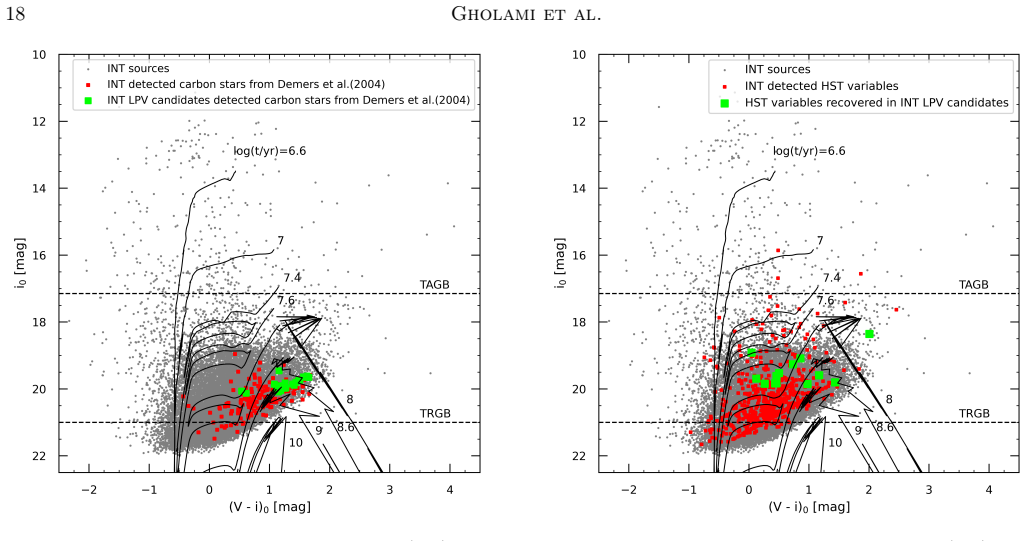
- [Abstract and Section 5.2.1] The recovery statistics against Spitzer are internally inconsistent. Section 5.2.1 states that among the 257 variables identified with Spitzer, the authors recovered 110 stars in their catalog, and that Boyer et al. found 235 x-AGB and 22 less dusty AGB variable candidates, of which 11 x-AGB and 7 less dusty AGB candidates were recovered among the INT variables in CCD4. These two statements imply 18 recovered Spitzer variables, not 110. The abstract's claims that the survey 'identified 43% of the variable stars found with Spitzer' (110/257) and 'retrieved 40% of the extremely dusty AGB stars' are not supported by the per-class counts as written: 11/235 is 4.7%, and 7/22 is 32%, not the ~68% stated in the text. The authors must recompute these numbers, state the exact denominators for each percentage, and clarify whether the 110 count refers to Spitzer sources recovered as catalog objects (not necessarily as variables) or to variables. Because these percentages are the primary evidence for the validated detection method, this discrepancy must be resolved before the paper can be accepted.
- [Section 5.2.3 and Figure 21 caption] The HST/HCV cross-match results differ between the text and the figure caption. The text says the authors recovered 669 SFVCs and 'identified 22 of our variables among the HCV variables, of which 13 are LPV candidates,' while the Figure 21 caption says '34 of our variables were recovered from the HCV, of which 17 are considered LPV candidates.' These are different numbers for the same quantity, and the discrepancy is not explained. Since the abstract's ~70% HST recovery claim depends on the correct count, the authors must reconcile the text and caption and report a single consistent set of HST recovery statistics.
- [Section 4, Figure 7] The derivation of the L-index threshold rests on the assumption that the mirrored negative side of the L histogram represents the non-variable population and that a Gaussian fit to it isolates variables. The text states that a threshold of L = 1.05 is chosen 'at which at least 90% of the stellar distribution is above the Gaussian fit' and that '~10% of these might be non-variable.' This wording is ambiguous: if 90% of the distribution is above the fit, the contamination fraction is not obviously 10%. The authors should state explicitly how the 10% contamination estimate is obtained from the Gaussian fit and whether the threshold was validated with the artificial-star injections. This point is central because the 536 LPV candidates and all derived completeness fractions depend on this threshold.
minor comments (4)
- [Abstract and Section 4.3] The abstract states that the authors 'found all the confirmed LPVs that Gaia DR3 detected in IC10 among our identified LPVs,' but Section 4.3 says that Rimoldini et al. identified 20 LPV candidates and the authors found all of them except one that lies outside the CCD4 area. The abstract should be qualified to state that all Gaia LPVs inside the survey footprint were recovered, or that the four spectroscopically/otherwise confirmed LPVs (Lebzelter et al.) were recovered.
- [Section 5.2.1] The sentence 'Our results are consistent with the study by Boyer et al. (2015a,b)' is not supported by the preceding numbers, which show an order-of-magnitude discrepancy between recovered and total x-AGB variables. Please rephrase or provide a quantitative comparison.
- [Section 5.2.1] The phrase 'recovering approximately 73% of DUSTiNGS sources within the 2rh area in our catalog' is unclear about the denominator: it should state whether the 73% refers to all DUSTiNGS sources in 2rh, all in CCD4, or all in the full DUSTiNGS footprint, and it should give the matching radius used for cross-identification.
- [Section 3.1 and Table 3] The catalog description mentions that stars with an asterisk are marked due to quality of astrometric solution, but the text does not explain how the astrometric solution quality was assessed or how many stars are affected. A brief explanation would help users of the public catalog.
Circularity Check
No circularity found: variability selection is threshold-based and the catalog is validated against independent external catalogs; the inconsistent recovery statistics are a correctness concern, not a circularity.
full rationale
The derivation chain—PSF photometry, Stetson J/K/L variability indices, the L=1.05 threshold from a mirror-Gaussian fit to the survey's own L histogram, the amplitude rule A=2*sigma/0.707, the six-measurement minimum, foreground rejection via trilegal and Gaia DR3, and cross-matching to Pan-STARRS, Spitzer, HST, CFHT, and Gaia DR3—does not reduce to its own inputs. The L threshold is a selection criterion calibrated on the survey's noise distribution, not a quantity the paper then claims to predict; the catalog's success is measured against external, independently published catalogs. The cited prior methods (Stetson 1996; Welch and Stetson 1993; Javadi et al. 2011a) supply standard variability statistics and a sampling rule; they do not encode the target result (the 536 LPV candidates or the recovery fractions). Self-citations to the authors' earlier LG survey papers are programmatic rather than load-bearing. I therefore find no circular step. Separately, as a correctness-not-circularity flag: Section 5.2.1's recovery statistics are internally inconsistent (257 Spitzer variables; 110 recovered versus 7+11 recovered; the claimed 40% x-AGB recovery versus 11/235; the roughly 68% less dusty AGB figure versus 7/22; and HST counts differing between the text and Fig. 21), so the abstract's validation percentages should be recomputed before they are relied upon.
Assumptions & free parameters
free parameters (4)
- L variability index threshold =
1.05
- Minimum i-band amplitude for LPV candidacy =
0.20 mag
- Minimum number of measurements for amplitude reliability =
6
- Gaussian fit confidence level for L threshold =
90%
assumptions (7)
- domain assumption Distance modulus of IC10 is mu = 24.51 +/- 0.08 mag (distance 0.81 Mpc) from Sanna et al. (2008).
- domain assumption Constant reddening E(B-V) = 0.78 +/- 0.06 mag applies to all stars in IC10.
- domain assumption IC10 metallicity is [Fe/H] = -1.28 dex (Z = 0.0008).
- standard math The extinction law follows Cardelli et al. (1989) with R_V = 3.1.
- domain assumption Variable sources with dereddened color (V-i)_0 < 0 are not LPVs.
- standard math Stetson variability indices J, K, L, as implemented in the newtrial routine, reliably separate variable from non-variable sources given the sampling.
- domain assumption The TRILEGAL model and Gaia astrometry adequately describe foreground contamination toward IC10.
Cite this review
Pith. "Pith review of The Isaac Newton Telescope Monitoring Survey of Local Group Dwarf Galaxies. VII. Long-Period Variable Stars in the Nearest Starburst Dwarf Galaxy, IC 10." pith.science (2026). https://pith.science/paper/2CAGEDSN
@misc{pith2026250503972,
  author       = {Pith},
  title        = {Pith review of: The Isaac Newton Telescope Monitoring Survey of Local Group Dwarf Galaxies. VII. Long-Period Variable Stars in the Nearest Starburst Dwarf Galaxy, IC 10},
  year         = {2026},
  howpublished = {\url{https://pith.science/paper/2CAGEDSN}},
  note         = {Machine review of arXiv:2505.03972}
}
abstract
To identify long-period variable (LPV) stars in IC10 - the nearest starburst galaxy of the Local Group (LG) - we conducted an optical monitoring survey using the 2.5-m Isaac Newton Telescope (INT) with the wide-field camera (WFC) in the i-band and V-band from 2015 to 2017. We created a photometric catalog for 53,579 stars within the area of CCD4 of WFC ($\sim$ 0.07 deg$^2$ corresponding to 13.5 kpc$^2$ at the distance of IC10), of which we classified 536 and 380 stars as long-period variable candidates (LPVs), mostly asymptotic giant branch stars (AGBs) and red supergiants (RSGs), within CCD4 and two half-light radii of IC10, respectively. By comparing our output catalog to the catalogs from Pan-STARRS, Spitzer Space Telescope, Hubble Space Telescope (HST), and carbon stars from the Canada-France-Hawai'i Telescope (CFHT) survey, we determined the success of our detection method. We recovered $\sim$ 73% of Spitzer's sources in our catalog and demonstrated that our survey successfully identified 43% of the variable stars found with Spitzer, and also retrieved 40% of the extremely dusty AGB stars among the Spitzer variables. In addition, we successfully identified $\sim$ 70% of HST variables in our catalog. Furthermore, we found all the confirmed LPVs that Gaia DR3 detected in IC10 among our identified LPVs. This paper is the first in a series on IC10, presenting the variable star survey methodology and the photometric catalog, available to the public through the Centre de Donn\'ees Astronomiques de Strasbourg.
Figures


Figures from the paper (18 more)




Reference graph
Works this paper leans on
-
[1]
T., et al., 2023, ApJ, 948, 63
Abdollahi, H., Javadi, A., Mirtorabi, M. T., et al., 2023, ApJ, 948, 63
2023
-
[2]
Bonanos, A. Z., Yang, M., Sokolovsky, K. V., et al., 2019, A&A, 630, A92
work page 2019
-
[3]
Borissova, J., Georgiev, L., Rosado, M., et al., 2000, A&A, 363, 130
work page 2000
-
[4]
Bressan, A., Marigo, P., Girardi, L., et al., 2012, MNRAS, 427, 127
work page 2012
-
[5]
Britavskiy, N. E., Bonanos, A. Z., Herrero, A., et al., 2019, A&A, 631, A95
work page 2019
-
[6]
L., Srinivasan, S., Riebel, D., et al., 2012, ApJ, 748, 40
Boyer, M. L., Srinivasan, S., Riebel, D., et al., 2012, ApJ, 748, 40
work page 2012
-
[7]
Boyer, M. L., Skillman, E. D., van Loon, J. Th., et al., 2009, ApJ, 697, 1993
work page 2009
- [8]
Show all 81 references
-
[9]
K., Karakas, A
Fishlock, C. K., Karakas, A. I., Lugaro, M., Yong, D., 2014, ApJ, 797, 44
2014
-
[10]
Karakas, A. I. & Lattanzio, J. C., 2014, PASA, 31, e030
2014
-
[11]
Cristallo, S., Straniero, O., Piersanti, L., & Gobrecht, D., 2015, ApJS, 219, 40
2015
-
[12]
A., Clayton, G
Cardelli, J. A., Clayton, G. C., & Mathis, J. S. 1989, ApJ, 345, 245
1989
-
[13]
C., Magnier, E
Chambers, K. C., Magnier, E. A., Metcalfe, N., et al., 2016, arXiv e-prints, arXiv:1612.05560
2016 arXiv
-
[14]
Chen, Y., Bressan, A., Girardi, L., et al., 2015, MNRAS, 452, 1068
2015
-
[15]
A., Murray, N., et al., 2022, ApJ, 929, 74
Cosens, M., Wright, S. A., Murray, N., et al., 2022, ApJ, 929, 74
2022
-
[16]
J., 2003, A&A, 404, 483 Dell’Agli, F., Di Criscienzo, M., Ventura, P., et al., 2018, MNRAS, 479, 5035 20 Gholami et al
Smartt, S. J., 2003, A&A, 404, 483 Dell’Agli, F., Di Criscienzo, M., Ventura, P., et al., 2018, MNRAS, 479, 5035 20 Gholami et al
2003
-
[17]
& Ables, H., 1965, PASP, 77, 272 de Vaucouleurs, G., 1978, ApJ, 224, 710
Demers, S., Battinelli, P., & Letarte, B., 2004, A&A, 424, 125 de Vaucouleurs, G. & Ables, H., 1965, PASP, 77, 272 de Vaucouleurs, G., 1978, ApJ, 224, 710
2004
-
[18]
P., et al., 2005, AN, 326, 432 Gaia Collaboration, Brown, A
Erben, T., Schirmer, M., Dietrich, J. P., et al., 2005, AN, 326, 432 Gaia Collaboration, Brown, A. G. A., Vallenari, A., et al., 2021, A&A, 649, A1 García-Gil, A., Muñoz-Tuñón, C., & Varela, A. M., 2010, PASP, 122, 1109
2005
-
[19]
Irwin, Mike, 2015, MNRAS, 454, 1000
2015
-
[20]
Th., et al., 2019, IAUS, 344–70
Gholami, M., Javadi, A., van Loon, J. Th., et al., 2019, IAUS, 344–70
2019
-
[21]
Th., et al., 2023, Proceedings IAU Symposium No
Gholami, M., Javadi, A., van Loon, J. Th., et al., 2023, Proceedings IAU Symposium No. 373
2023
-
[22]
Costa, L., 2005, A&A, 436, 895
2005
-
[23]
R., Boyer, M
Goldman, S. R., Boyer, M. L., McQuinn, K. B. W., et al., 2019, ApJ, 877, 49
2019
-
[24]
R., van Loon, J
Goldman, S. R., van Loon, J. Th., Zijlstra, Albert A., et al., 2017, MNRAS, 465, 403 Gonçalves, D. R., Magrini, L., Martins, L. P., Teodorescu, A. M., Quireza, C., 2012, MNRAS, 419, 854
2017
-
[25]
Habing, H. J. & Olofsson, H., 2003, Asymptotic Giant Branch stars (New York: Springer) Hamedani Golshan, R., Javadi, A., van Loon, J. Th.,
2003
-
[26]
Khosroshahi, H., Saremi, E., 2017, MNRAS, 466, 1764
2017
-
[27]
A., Javadi, A., van Loon, J
Hashemi, S. A., Javadi, A., van Loon, J. Th., 2018, MNRAS, 483, 4751
2018
-
[28]
& Olofsson H., 2018, A&ARv, 26, 1
Herwig, I., 2005, ARA&A, 43, 435 Höfner, S. & Olofsson H., 2018, A&ARv, 26, 1
2005
-
[29]
A., 2001, ApJ, 559, 225
Hunter, D. A., 2001, ApJ, 559, 225
2001
-
[30]
Th., Khosroshahi, H
Javadi, A., van Loon J. Th., Khosroshahi, H. G., Mirtorabi, M. T., 2013, MNRAS, 432, 2824
2013
-
[31]
Th., et al., 2015, MNRAS, 447, 3973
Javadi, A., Saberi, M., van Loon, J. Th., et al., 2015, MNRAS, 447, 3973
2015
-
[32]
Th., Khosroshahi, H
Javadi, A., van Loon, J. Th., Khosroshahi, H. G., et al., 2017, MNRAS, 464, 2103
2017
-
[33]
P., 2003, AJ, 125, 525
Huchra, J. P., 2003, AJ, 125, 525
2003
-
[34]
K., Ammon, K., 2006, A&A, 460, 339
Jordi, K., Grebel, E. K., Ammon, K., 2006, A&A, 460, 339
2006
-
[35]
Kim, M., Kim, E., Hwang, N., et al., 2009, ApJ, 703, 816
2009
-
[36]
McQuinn, K. B. W., Boyer, M. L., Mitchell, M. B., et al., 2017, ApJ, 834, 78
2017
-
[37]
Lebzelter, T., Mowlavi, N., Lecoeur-Taibi, I., et al., 2023, A&A, 674, A15
2023
-
[38]
Leroy, A., Bolatto, A., Walter, F., & Blitz, L., 2006, ApJ, 643, 825
2006
-
[39]
M., 2010, ASPC, 425, 103 Levesque E
Levesque, E. M., 2010, ASPC, 425, 103 Levesque E. M., Massey, P., Olsen, K. A. G., et al., 2005, ApJ, 628, 973
2010
-
[40]
& Lee, M
Lim, S. & Lee, M. G., 2015, ApJ, 804, 123 McDonald I., Zijlstra A. A., 2016, ApJ Letters, 823, 5
2015
-
[41]
Madore, B. F. & Freedman, W. L., 1995, AJ, 109, 1645 Maíz Apellániz, J., Evans, C. J., Barbá, R. H., et al., 2014, A&A, 564, A63
1995
-
[42]
Marigo, P., Girardi, L., Bressan, A., et al., 2008, A&A, 482, 883
2008
-
[43]
2017, ApJ, 835
Marigo, P., Girardi, L., Bressan, A., et al. 2017, ApJ, 835
2017
-
[44]
L., 2013, MNRAS, 434, 488
Marigo, P., Bressan, A., Nanni, A., Girardi, L., Pumo, M. L., 2013, MNRAS, 434, 488
2013
-
[45]
& Armandroff, T
Massey, P. & Armandroff, T. E., 1995, AJ, 109, 2470
1995
-
[46]
L., 1998, ARA&A, 36, 435
Mateo, M. L., 1998, ARA&A, 36, 435
1998
-
[47]
W., 2012, AJ, 144, 36
McConnachie, A. W., 2012, AJ, 144, 36
2012
-
[48]
E., 1994, ApJ, 422, 1580
Navabi, M., Saremi, E., Javadi, A., et al., 2021, ApJ, 910, 127 O’Donnell, J. E., 1994, ApJ, 422, 1580
2021
-
[49]
Parto, T., Dehghani, S., Javadi, A., et al., 2023, ApJ, 942, 33
2023
-
[50]
J., Jurcevicí, J
Pierce, M. J., Jurcevicí, J. S., & Crabtree, D., 2000, MNRAS, 313, 271
2000
-
[51]
Ren, Y., Jiang, B., Yang, M., et al., 2021, ApJ, 923, 232
2021
-
[52]
G., van Loon, J
Rezaeikhah, S., Javadi, A., Khosroshahi, H. G., van Loon, J. Th., 2014, MNRAS, 445, 2214
2014
-
[53]
G., Bullejos, A., Borissova, J., et al., 2001, A&A, 370, 34
Richer, M. G., Bullejos, A., Borissova, J., et al., 2001, A&A, 370, 34
2001
-
[54]
Riebel, D., Srinivasan, S., Sargent, B., Meixner, M., 2012, ApJ, 753, 71 Lorenzo Rimoldini, Berry Holl, Panagiotis Gavras, et al., 2023, A&A, 674, A14
2012
-
[55]
G., Krist, J., Danielson, G
Saha, A., Hessel, J. G., Krist, J., Danielson, G. E., 1996, AJ, 111, 197
1996
-
[56]
F., Freedman, W
Sakai, S., Madore, B. F., Freedman, W. L., 1999, ApJ, 511, 671
1999
-
[57]
B., et al., 2008, ApJ, 688, L69
Sanna, N., Bono, G., Stetson, P. B., et al., 2008, ApJ, 688, L69
2008
-
[58]
Th., et al., 2017, in J
Saremi, E., Javadi, A., van Loon, J. Th., et al., 2017, in J. Phys. Conf. Ser, Vol. 869, 01206
2017
-
[59]
Th., et al
Saremi, E., Javadi, A., van Loon, J. Th., et al. 2020, ApJ, 894, 135 LONG-PERIOD V ARIABLE STARS IN IC 10 21
2020
-
[60]
Saremi, E., Javadi, A., Navabi, M., et al., 2021, ApJ, 923, 164
2021
-
[61]
J., Finkbeiner, D
Schlegel, D. J., Finkbeiner, D. P., & Davis, M., 1998, ApJ, 500, 525
1998
-
[62]
B., 1987, PASP, 99, 191
Stetson, P. B., 1987, PASP, 99, 191
1987
-
[63]
B., 1990, ASPC, 102, 932
Stetson, P. B., 1990, ASPC, 102, 932
1990
-
[64]
B., 1993, IAU Colloq
Stetson, P. B., 1993, IAU Colloq. 136, Stellar Photometry–Current Techniques and Future Developments, ed. C. J. Butler & I. Elliot (Cambridge: Cambridge Univ. Press), 291
1993
-
[65]
B., 1994, PASP, 106, 250 Stetson P
Stetson, P. B., 1994, PASP, 106, 250 Stetson P. B., 1996, PASP, 108, 851
1994
-
[66]
A., Archer, I., 2017, MNRAS, 472, 4618
Tehrani, K., Crowther, P. A., Archer, I., 2017, MNRAS, 472, 4618
2017
-
[67]
Tikhonov, N. A. & Galazutdinova, O. A., 2010, Astron. Letters, 35, 11, 748
2010
-
[68]
M., Sanyal, D., et al., 2015, A&A, 581, A110
Tramper, F., Straal, S. M., Sanyal, D., et al., 2015, A&A, 581, A110
2015
-
[69]
D., Sheehy, C
Vacca, W. D., Sheehy, C. D., Graham, J. R., 2007, ApJ, 662, 272
2007
-
[70]
L., Richer, M
Vaduvescu, O., McCall, M. L., Richer, M. G., 2007, AJ, 134, 604 van der Marel, R. P., Fardal, M. A., Sohn, S. T., et al., 2019, AJ, 872, 24 van Loon, J. Th., Cohen, M., Oliveira, J. M., et al., 2008, A&A, 487, 1055
2007
-
[71]
& Chen, X., 2019, ApJ, 877, 116
Wang, S. & Chen, X., 2019, ApJ, 877, 116
2019
-
[72]
R., Dolphin, A
Weisz, D. R., Dolphin, A. E., Skillman, E. D., et al., 2014, ApJ, 789, 23
2014
-
[73]
Welch, D. L. & Stetson, P. B., 1993, AJ, 105, 1813
1993
-
[74]
A., Feast, M
Whitelock, P. A., Feast, M. W., van Loon, J. Th., Zijlstra, A. A., 2003, MNRAS, 342, 86
2003
-
[75]
D., Welch, D
Wilson, C. D., Welch, D. L., Reid, I. N., Saha, A., Hoessel, J., 1996, AJ, 111, 1106
1996
-
[76]
R., Whiteoak, J
Wood, P. R., Whiteoak, J. B., Hughes, S. M. G.,et al., 1992, ApJ, 397, 552
1992
-
[77]
R., 1998, A&A, 338, 592
Wood, P. R., 1998, A&A, 338, 592
1998
-
[78]
& Skillman, E
Yang, H. & Skillman, E. D., 1993, AJ, 106, 1448
1993
-
[79]
& Jiang, B
Yang, M. & Jiang, B. W., 2012, ApJ, 754, 22
2012
-
[80]
Yin, J., Magrini, L., Matteucci, F., et al., 2010, A&A, 520, A55
2010
-
[81]
A., Loup, C., Waters, L
Zijlstra, A. A., Loup, C., Waters, L. B. F. M., et al., 1996, MNRAS, 279, 32 22 Gholami et al. APPENDIX A. SUPPLEMENTARY MATERIAL As mentioned in Sec. 4.1, we identified 536 LPV candidates within the area of CCD4 of the WFC on the INT telescope. Here, we present the light–curv...
1996
Reviewed August 15, 2026 · model on record in the stance chip above.
Discussion (0). Continue with ORCID to comment.