REVIEW 4 major objections 5 minor 34 references
Spatio-temporal Monte Carlo modeling of loading and decay dynamics in an optical dipole trap
T0 review · 4 major / 5 minor · reviewed 2026-08-15 · deepseek-v4-flash
Pith's one-line read The paper argues that a two-stage Monte Carlo model reproduces measured 87Rb optical-dipole-trap atom-number curves and identifies radiative escape as the dominant two-body loss during loading while MOT light is present.
desk verdict Useful and novel ODT modeling framework, but the central prediction claim is undercut by fitting to the same data and by non-reproducible semi-classical estimates. read the letter →
The pith
A machine-rendered reading of the paper's core claim, the machinery that carries it, and where it could break.
The reading
What carries the argument
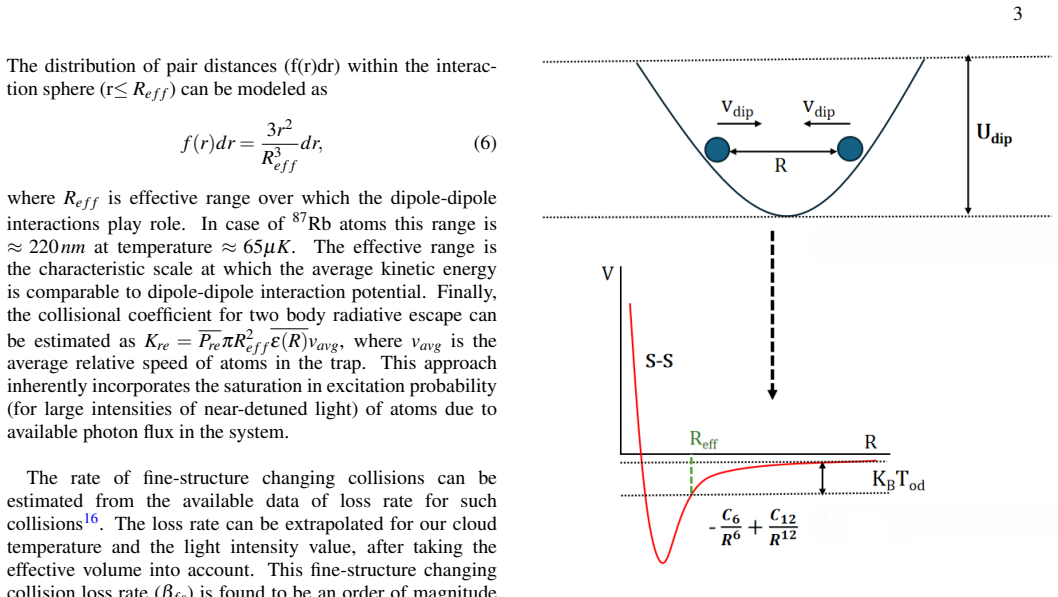
The central object is the two-stage Monte Carlo simulation. The spatial stage samples atom-pair distances and pair kinetic energies from the thermal cloud distribution, with pair energy following a gamma distribution and pair separations scaling as $r^2$ within an effective range $R_{\mathrm{eff}}\approx220$ nm, and computes the radiative-escape probability $P_{\mathrm{re}}$ from the light-assisted collision model, including AC Stark shifts and trap-depth-dependent excitation distances. The same spatial sampling evaluates the elastic evaporative coefficient $\beta_{\mathrm{dec}}$ from the $s$-wave scattering length. The temporal stage steps the atom number in small time increments $\Delta t$, choosing among loading, one-body background loss, single-atom-loss two-body events, and dual-atom-loss two-body events by relative probability, then fixes the final parameters by minimizing point-by-point absolute error against the experimental data.
What would settle it
Time-resolved absorption imaging during loading and decay would falsify the fixed-cloud premise if it showed the cloud heating or expanding; separately, measuring the two-body loss coefficient at several MOT-beam intensities during loading would test the prediction that radiative escape exceeds fine-structure and hyperfine-changing losses by roughly an order of magnitude.
Extended reading notes
Core claim
The paper argues on its own terms that the spatio-temporal Monte Carlo scheme, with loss parameters estimated from semiclassical theory, gives a close estimation of the experimentally observed atom-number evolution in the ODT. During loading, when near-resonant MOT beams illuminate the trap, the computed two-body losses are dominated by radiative escape, with an estimated coefficient around $4.6\times10^{-3}\,\mathrm{s}^{-1}$ versus about $2\times10^{-4}\,\mathrm{s}^{-1}$ for fine-structure-changing and $1.9\times10^{-4}\,\mathrm{s}^{-1}$ for hyperfine-changing collisions; the temporal MC fit to the loading data yields $\beta_{\mathrm{MC}} = 7.6\times10^{-3}\,\mathrm{s}^{-1}$. With the MOT beams off, elastic evaporative momentum-transfer collisions dominate, and the fitted two-body coefficient $\beta = (1.8\pm0.4)\times10^{-4}\,\mathrm{s}^{-1}$ matches the semiclassical estimate of $1.6\times10^{-4}\,\mathrm{s}^{-1}$. The MC evolution reproduces the decay data with a point-by-point error of 10%, versus 18% for a conventional differential-equation fit, and the loading curve with 18% versus 19%.
Load-bearing premise
The load-bearing premise is that the cloud's temperature and effective volume stay fixed throughout loading and decay, so every extracted loss coefficient inherits the constant-volume and temperature-proportional-to-trap-depth approximations.
Editorial extensions
If this is right
- The fitted two-body coefficient in loading ($\beta_{\mathrm{MC}} = 7.6\times10^{-3}\,\mathrm{s}^{-1}$) matches the semiclassical estimate built on radiative escape, so the identified dominant channel can be checked by independent two-body loss measurements.
- The Monte Carlo evolution reproduces the measured decay curve with about half the error of a differential-equation fit (10% versus 18%), suggesting the stochastic treatment captures the two-body loss statistics better than averaged rate equations.
- The same two-stage procedure can be run at other beam waists, trap depths, MOT densities, and temperatures, producing predicted loading and decay curves from the same physical inputs.
- The method extends Monte Carlo modeling to traps with roughly $10^5$ atoms, a regime previously treated mainly with differential-equation fitting rather than event-level simulation.
Reading between the lines
- A testable extension the authors do not pursue is time-resolved thermometry during loading and decay: if the cloud heats or expands, the fixed effective volume and temperature-proportional-to-trap-depth assumptions would need to be relaxed, and the fitted two-body coefficients would partly absorb that effect.
- The order-of-magnitude dominance of radiative escape rests on the chosen effective interaction range ($R_{\mathrm{eff}}\approx220$ nm) and the core and escape radii; a sensitivity scan over these inputs would show whether the ordering is robust.
- Applied to other alkali species by substituting their scattering lengths and light-assisted collision parameters, the same scheme could isolate the elastic channel more cleanly in systems where radiative escape is weaker.
Signed reviews
Editorial analysis
A structured set of objections, weighed in public.
Referee Report
Summary. The manuscript develops a spatio-temporal Monte Carlo (MC) framework for modeling the loading and decay dynamics of a large-atom-number (≈10^4–10^5) 87Rb optical dipole trap (ODT). The authors combine a spatial MC procedure with semi-classical Gallagher–Pritchard and elastic-collision models to estimate intra-trap two-body loss coefficients (radiative-escape, fine-structure changing, hyperfine changing, and elastic evaporative), and then use a temporal MC scheme to simulate the atom-number evolution. The model is compared with experimental loading and decay data for a 12.9 µm single-beam ODT. The paper claims (i) that the radiative-escape process dominates two-body loss during loading in the presence of MOT beams, surpassing fine-structure and hyperfine changing losses by nearly an order of magnitude, and (ii) that elastic momentum-transfer collisions dominate the two-body loss during dark decay. The fitted MC parameters are reported as R_load = 6.7×10^6 s^-1, γ = 0.2 s^-1, β_MC = 7.6×10^-3 s^-1 for loading, and γ = (0.4±0.15) s^-1, β = (1.8±0.4)×10^-4 s^-1 for decay.
Significance. If the validation were sound, the paper would offer a useful simulation framework for ODTs with large atom numbers, a regime in which the earlier MC treatments focused on microtraps with few atoms. The explicit spatial averaging of collision probabilities and the direct comparison with differential-equation fits are positive features. The paper also provides a clear experimental data set and makes the fitted parameters available. However, the central validation is compromised by numerical inconsistencies in the decay-channel estimate and by a normalization error in the pair-energy distribution; these issues directly affect the two main physical conclusions. The contribution remains potentially valuable as a modeling approach, but the specific claims of agreement between semi-classical estimates and fitted coefficients require correction.
major comments (4)
- [Eq. (9) and Sec. IV.B] The quoted elastic decay coefficient β_dec = 1.6×10^-4 s^-1 is not reproducible from the stated inputs. Using σ_el = 8πa_s^2 with a_s = 5.3 nm, v_r from T = 65 μK, V_eff = 2.6×10^-7 cm^3, and the central value η ≈ 1.2 gives β_dec ≈ 5×10^-5 s^-1; a spatial average over the Gaussian density profile (weighting the loss rate by n^2, i.e., by exp(-2η)) gives an even lower value, roughly 3×10^-5 s^-1. This is a factor of 3–5 below the quoted 1.6×10^-4 s^-1. Consequently, the claimed agreement with the fitted β = (1.8±0.4)×10^-4 s^-1 and the conclusion that elastic collisions dominate the dark decay are not supported by the manuscript as written. The authors should provide the detailed evaluation used to obtain 1.6×10^-4 s^-1, including the spatial-averaging procedure, or correct the estimate.
- [Eq. (5) and Sec. II.A] The pair kinetic energy distribution f(E)dE = [1/(6(k_B T)^3)] E^2 exp(-E/k_B T) dE integrates to 1/3, not 1; the correct normalization for the gamma distribution with shape 3 is 1/(2(k_B T)^3). This affects the sampling of pair energies in the radiative-escape estimates unless a compensating normalization factor is used elsewhere. Since the radiative-escape loss coefficient Kre is a central input to the loading-phase conclusions, the authors should correct the equation and verify that the reported values (β_re ≈ 4.6×10^-3 s^-1 and the bracketing estimates 5×10^-3 and 8.4×10^-3 s^-1) remain unchanged after this correction.
- [Sec. II.B and Abstract] The abstract states that the temporal MC method 'based on estimated parameters from spatial MC' gives a close estimation of the experimental evolution, but Sec. II.B explicitly states that 'the final parameters are obtained by minimizing the point by point absolute error from the actual data.' Thus the MC curves in Fig. 9 are fits, not forward predictions. The independent validation is therefore limited to comparing the fitted coefficients (R_load, γ, β, β') with the semi-classical estimates. For the decay channel this comparison is invalidated by the numerical issue in Eq. (9) noted above. The framing of the results as predictions based on estimated parameters should be revised to reflect the fitting procedure.
- [Sec. IV.A and Eq. (8)] The assumption of a constant cloud volume V_eff = 2.6×10^-7 cm^3 across all trap depths, together with a temperature 'roughly proportional to the trap depth,' is not tested. Since V_eff for a harmonic Gaussian trap scales as (T/ω_r^2) ω_z^-1, and both frequencies scale with the square root of trap depth, the combination V_eff ∝ T^3/2 / U^3/2 would remain constant only if T ∝ U exactly; the paper does not demonstrate this. More importantly, the sensitivity of Kre and β_dec to this assumption is not quantified. The authors should provide a sensitivity analysis or justify the constancy of V_eff.
minor comments (5)
- [Fig. 2 caption] The caption mentions a time step '≈ 20 ns' but the text does not specify the value of Δt used in the temporal MC or the criterion ensuring that the sum of probabilities in Eqs. (10)–(13) remains below unity. Please state Δt and the verification.
- [Eq. (5)] The phrase 'gamma distribution' should be capitalized as 'Gamma distribution' and the normalization should be checked as noted in the major comments.
- [Sec. I and Sec. IV.B] In the Abstract and Sec. IV.B, the statement that radiative escape 'surpasses' fine-structure and hyperfine changing losses 'by nearly an order of magnitude' is inconsistent with the quoted values (4.6×10^-3 versus 2×10^-4 and 1.9×10^-4 s^-1), which differ by a factor of about 23. Please rephrase or correct the numbers.
- [Sec. II.A] The term 'dual atom inelastic collision probability' in the paragraph following Eq. (2) is unclear; it likely means 'two-atom inelastic collision probability.' Please clarify.
- [Sec. III] The sentence 'The single MOT beam intensity at the position of dipole trap center is around 17 mW/cm^2' appears without an explicit connection to the loading-phase modeling; clarify whether this intensity is used in the GP-model estimates.
Circularity Check
The claimed 'close estimation' of the atom-number evolution is an in-sample MC fit, not a forward prediction; only the semi-classical coefficient comparison carries independent weight.
-
fitted input called prediction
[Abstract; Section II.B ('Temporal evolution'); Section IV.B ('Optical dipole trap loading and decay')]
"The temporal MC method based on estimated parameters from spatial MC, gives a close estimation of the experimentally observed atom-number evolution in ODT. ... The data generated from MC run is compared with the experimental data and the final parameters are obtained by minimizing the point by point absolute error from the actual data."
The 'close estimation' of the atom-number evolution is not a forward prediction. The final MC parameters (Rload, gamma, beta_MC in loading; gamma, beta in decay) are obtained by minimizing the point-by-point absolute error against the same experimental N(t) data that the abstract claims the model reproduces. At the optimized parameters, the MC trajectory is statistically forced to approximate the data, so the 'close estimation' claim is partly by construction.
full rationale
The derivation chain contains one genuine circular step: the temporal MC 'close estimation' of the loading and decay curves is an in-sample fit, because the final simulation parameters are explicitly obtained by minimizing the point-by-point absolute error against the same experimental data the abstract says the model reproduces. This matches the fitted-input-called-prediction pattern. However, the paper's physical conclusions (radiative-escape dominance during loading, elastic momentum-transfer dominance during dark decay) rest on separately computed semi-classical coefficients (Kre, beta'_decay) that are not fitted to the data; they are compared with the fitted beta values. That comparison is independent content and not circular. No load-bearing self-citation chain is present: the cited works by the same group (refs. 19 and 29) concern AC-Stark imaging and MOT preparation, and are not used to justify the loss models. The suspicious pair-energy distribution in Eq. 5 (which does not normalize to unity) and the reproducibility of Eq. 9 are arithmetic/modeling concerns, not circularity, and are therefore not scored here. Overall, the central 'prediction' claim is partly circular, while the channel-dominance conclusions retain independent semi-classical support; score 5.
Assumptions & free parameters
free parameters (7)
- Cloud temperature TOD =
about 50-65 uK, assumed proportional to trap depth
- Effective volume Veff =
2.6e-7 cm^3 (Eq. 8, ar = 6 um, az = 436 um)
- Background loss rate gamma =
0.25 s^-1 initial; 0.2 s^-1 (loading fit), 0.4 +/- 0.15 s^-1 (decay fit)
- Loading rate Rl =
about 10^6 s^-1 estimate; 6.7e6 s^-1 fitted
- Two-body inelastic loss beta (loading) =
4.6e-3 to 8e-3 s^-1 model range; 7.6e-3 s^-1 fitted
- Elastic two-body loss beta' (decay) =
1.6e-4 s^-1 model; 1.8 +/- 0.4e-4 s^-1 fitted
- Effective interaction range Reff =
about 220 nm at 65 uK
assumptions (7)
- domain assumption Gallagher-Pritchard pair-distribution model (Eqs. 1-4) is valid for the ODT geometry
- domain assumption Cloud temperature and volume remain constant during loading and decay
- ad hoc to paper Temperature is roughly proportional to trap depth
- domain assumption Non-hydrodynamic regime so two-body loss scales as N^2
- domain assumption Low-energy s-wave cross-section sigma_el = 8*pi*as^2 with as about 5.3 nm, energy independent
- domain assumption During decay the atoms sit in the dark F=1 state with no Zeeman splitting, suppressing hyperfine- and spin-changing collisions
- ad hoc to paper Temporal MC event-selection with fixed Delta t remains valid, i.e. the sum of event probabilities in Eqs. 10-13 stays below unity
Cite this review
Pith. "Pith review of Spatio-temporal Monte Carlo modeling of loading and decay dynamics in an optical dipole trap." pith.science (2026). https://pith.science/paper/ZSGHS5NE
@misc{pith2026250504134,
  author       = {Pith},
  title        = {Pith review of: Spatio-temporal Monte Carlo modeling of loading and decay dynamics in an optical dipole trap},
  year         = {2026},
  howpublished = {\url{https://pith.science/paper/ZSGHS5NE}},
  note         = {Machine review of arXiv:2505.04134}
}
abstract
Here, we present our studies on intra-trap dynamics of an optical dipole trap (ODT) loaded from a Magneto-optical trap (MOT) of $^{87}$Rb atoms. A spatio-temporal Monte Carlo (MC) simulation approach has been employed in conjunction with the semi-classical theory based calculations for estimation of various intra-trap two-body loss parameters in the ODT. The temporal MC method based on estimated parameters from spatial MC, gives a close estimation of the experimentally observed atom-number evolution in ODT. We also find that, the decay rate of atoms in an ODT is dominated by momentum-transfer elastic collisions in the absence of MOT beams. However, in presence of MOT beams, the radiative escape process is the dominant two-body loss mechanism in the trap, which surpasses the fine-structure changing and hyperfine changing collisional losses by nearly an order of magnitude.
Figures


Figures from the paper (5 more)


Reference graph
Works this paper leans on
-
[1]
author author H. Zhai ,\ @noop title Ultracold Atomic Physics \ ( publisher Cambridge University Press ,\ year 2021 ) NoStop
work page 2021
-
[2]
author author J. García-Ripoll , author P. Zoller , \ and\ author J. Cirac ,\ title title Quantum information processing with cold atoms and trapped ions , \ 10.1088/0953-4075/38/9/008 journal journal Journal of Physics B: Atomic, Molecular and Optical Physics \ volume 38 ,\ pages S567 ( year 2005 ) NoStop
-
[3]
author author M. D. \ Barrett , author J. A. \ Sauer , \ and\ author M. S. \ Chapman ,\ title title All-optical formation of an atomic bose-einstein condensate , \ 10.1103/PhysRevLett.87.010404 journal journal Phys. Rev. Lett. \ volume 87 ,\ pages 010404 ( year 2001 ) NoStop
-
[4]
author author R. Grimm , author M. Weidemüller , \ and\ author Y. B. \ Ovchinnikov ,\ title title Optical dipole traps for neutral atoms , \ \ ( publisher Academic Press ,\ year 2000 )\ pp.\ pages 95--170 NoStop
work page 2000
-
[5]
author author S. J. M. \ Kuppens , author K. L. \ Corwin , author K. W. \ Miller , author T. E. \ Chupp , \ and\ author C. E. \ Wieman ,\ title title Loading an optical dipole trap , \ 10.1103/PhysRevA.62.013406 journal journal Phys. Rev. A \ volume 62 ,\ pages 013406 ( year 2000 ) NoStop
-
[6]
author author T. Gr \"u nzweig , author A. Hilliard , author M. McGovern , \ and\ author M. F. \ Andersen ,\ title title Near-deterministic preparation of a single atom in an optical microtrap , \ 10.1038/nphys1778 journal journal Nature Physics \ volume 6 ,\ pages 951--954 ( year 2010 ) NoStop
-
[7]
author author A. Fuhrmanek , author R. Bourgain , author Y. R. P. \ Sortais , \ and\ author A. Browaeys ,\ title title Light-assisted collisions between a few cold atoms in a microscopic dipole trap , \ 10.1103/PhysRevA.85.062708 journal journal Phys. Rev. A \ volume 85 ,\ pages 062708 ( year 2012 ) NoStop
-
[8]
author author J. D. \ Miller , author R. A. \ Cline , \ and\ author D. J. \ Heinzen ,\ title title Far-off-resonance optical trapping of atoms , \ 10.1103/PhysRevA.47.R4567 journal journal Phys. Rev. A \ volume 47 ,\ pages R4567--R4570 ( year 1993 ) NoStop
Show all 34 references
-
[9]
author author K. M. \ O'Hara , author S. R. \ Granade , author M. E. \ Gehm , \ and\ author J. E. \ Thomas ,\ title title Loading dynamics of co _ 2 laser traps , \ 10.1103/PhysRevA.63.043403 journal journal Phys. Rev. A \ volume 63 ,\ pages 043403 ( year 2001 ) NoStop
-
[10]
author author P. S. \ Julienne \ and\ author J. Vigu\'e ,\ title title Cold collisions of ground- and excited-state alkali-metal atoms , \ 10.1103/PhysRevA.44.4464 journal journal Phys. Rev. A \ volume 44 ,\ pages 4464--4485 ( year 1991 ) NoStop
-
[11]
Ueberholz , author S
author author B. Ueberholz , author S. Kuhr , author D. Frese , author D. Meschede , \ and\ author V. Gomer ,\ title title Counting cold collisions , \ 10.1088/0953-4075/33/4/105 journal journal Journal of Physics B: Atomic, Molecular and Optical Physics \ volume 33 ,\ pages L...
-
[12]
Piilo , author K.-A
author author J. Piilo , author K.-A. \ Suominen , \ and\ author K. Berg-Sørensen ,\ title title Cold collisions between atoms in optical lattices , \ 10.1088/0953-4075/34/7/105 journal journal Journal of Physics B: Atomic, Molecular and Optical Physics \ volume 34 ,\ pages L2...
-
[13]
author author S. D. \ Gensemer , author P. L. \ Gould , author P. J. \ Leo , author E. Tiesinga , \ and\ author C. J. \ Williams ,\ title title Ultracold ^ 87 R b ground-state hyperfine-changing collisions in the presence and absence of laser light , \ 10.1103/PhysRevA.62.0307...
-
[14]
Arora , author M
author author B. Arora , author M. S. \ Safronova , \ and\ author C. W. \ Clark ,\ title title Magic wavelengths for the np - ns transitions in alkali-metal atoms , \ 10.1103/PhysRevA.76.052509 journal journal Phys. Rev. A \ volume 76 ,\ pages 052509 ( year 2007 ) NoStop
-
[15]
Schlosser , author G
author author N. Schlosser , author G. Reymond , \ and\ author P. Grangier ,\ title title Collisional blockade in microscopic optical dipole traps , \ 10.1103/PhysRevLett.89.023005 journal journal Phys. Rev. Lett. \ volume 89 ,\ pages 023005 ( year 2002 ) NoStop
-
[16]
author author P. S. \ Julienne , author S. H. . \ Pan , author H. R. \ Thorsheim , \ and\ author J. Weiner ,\ title title Theory of collision‐induced optical trap loss , \ 10.1063/1.37325 journal journal AIP Conference Proceedings \ volume 172 ,\ pages 308--310 ( year 1988 ) NoStop
-
[17]
Gallagher \ and\ author D
author author A. Gallagher \ and\ author D. E. \ Pritchard ,\ title title Exoergic collisions of cold Na* - Na , \ 10.1103/PhysRevLett.63.957 journal journal Phys. Rev. Lett. \ volume 63 ,\ pages 957--960 ( year 1989 ) NoStop
1989 doi
-
[18]
author author M. G. \ Peters , author D. Hoffmann , author J. D. \ Tobiason , \ and\ author T. Walker ,\ title title Laser-induced ultracold R b(5 S _ 1/2 )+ R b(5 P _ 1/2 ) collisions , \ 10.1103/PhysRevA.50.R906 journal journal Phys. Rev. A \ volume 50 ,\ pages R906--R909 ( ...
-
[19]
Bhardwaj , author S
author author K. Bhardwaj , author S. P. \ Ram , author S. Singh , author V. B. \ Tiwari , \ and\ author S. R. \ Mishra ,\ title title Absorption imaging of trapped atoms in presence of ac-stark shift , \ @noop journal journal Physica Scripta \ volume 96 ,\ pages 015405 ( year...
2020
-
[20]
\ Shih \ and\ author M
author author C.-Y. \ Shih \ and\ author M. S. \ Chapman ,\ title title Nondestructive light-shift measurements of single atoms in optical dipole traps , \ 10.1103/PhysRevA.87.063408 journal journal Phys. Rev. A \ volume 87 ,\ pages 063408 ( year 2013 ) NoStop
-
[21]
author author E. I. \ Dashevskaya , author A. Voronin , \ and\ author E. E. \ Nikitin ,\ title title Theory of excitation transfer in collisions between alkali atoms. i. identical partners , \ https://api.semanticscholar.org/CorpusID:123174275 journal journal Canadian Journal ...
1969
-
[22]
author author D. M. \ Harber , author H. J. \ Lewandowski , author J. M. \ McGuirk , \ and\ author E. A. \ Cornell ,\ title title Effect of cold collisions on spin coherence and resonance shifts in a magnetically trapped ultracold gas , \ 10.1103/PhysRevA.66.053616 journal jou...
-
[23]
author author E. G. M. \ van Kempen , author S. J. J. M. F. \ Kokkelmans , author D. J. \ Heinzen , \ and\ author B. J. \ Verhaar ,\ title title Interisotope determination of ultracold rubidium interactions from three high-precision experiments , \ 10.1103/PhysRevLett.88.09320...
-
[24]
Ketterle \ and\ author N
author author W. Ketterle \ and\ author N. V. \ Druten ,\ title title Evaporative cooling of trapped atoms , \ \ ( publisher Academic Press ,\ year 1996 )\ pp.\ pages 181--236 NoStop
1996
-
[25]
\ Wang , author C
author author Z.-B. \ Wang , author C. Gu , author X.-X. \ Hu , author Y.-T. \ Zhang , author J.-Z. \ Zhang , author G. Li , author X.-D. \ He , author X.-B. \ Zou , author C.-H. \ Dong , author G.-C. \ Guo , \ and\ author C.-L. \ Zou ,\ title title Controllable atomic collisi...
-
[26]
author author Y. H. \ Fung \ and\ author M. F. \ Andersen ,\ title title Efficient collisional blockade loading of a single atom into a tight microtrap , \ 10.1088/1367-2630/17/7/073011 journal journal New Journal of Physics \ volume 17 ,\ pages 073011 ( year 2015 ) NoStop
-
[27]
author author R. A. \ Stewart , author P. Shen , author J. L. \ Booth , \ and\ author K. W. \ Madison ,\ title title Measurement of R b- R b van der waals coefficient via quantum diffractive universality , \ 10.1103/PhysRevA.106.052812 journal journal Phys. Rev. A \ volume 106...
-
[28]
author author A. M. \ Steane , author M. Chowdhury , \ and\ author C. J. \ Foot ,\ title title Radiation force in the magneto-optical trap , \ 10.1364/JOSAB.9.002142 journal journal J. Opt. Soc. Am. B \ volume 9 ,\ pages 2142--2158 ( year 1992 ) NoStop
-
[29]
Bhardwaj , author S
author author K. Bhardwaj , author S. Sarkar , author S. P. \ Ram , author V. B. \ Tiwari , \ and\ author S. R. \ Mishra ,\ title title A method for loading magneto-optical trap in an ultrahigh vacuum environment , \ 10.1063/5.0106398 journal journal AIP Advances \ volume 13 ,...
-
[30]
merlin.mbs aapmrev4-1.bst 2010-07-25 4.21a (PWD, AO, DPC) hacked
FUNCTION id.bst "merlin.mbs aapmrev4-1.bst 2010-07-25 4.21a (PWD, AO, DPC) hacked" ENTRY address archive archivePrefix author bookaddress booktitle chapter collaboration doi edition editor eid eprint howpublished institution isbn issn journal key language month note number org...
2010
-
[31]
merlin.mbs aipauth4-1.bst 2010-07-25 4.21a (PWD, AO, DPC) hacked
FUNCTION id.bst "merlin.mbs aipauth4-1.bst 2010-07-25 4.21a (PWD, AO, DPC) hacked" ENTRY address archive archivePrefix author bookaddress booktitle chapter collaboration doi edition editor eid eprint howpublished institution isbn issn journal key language month note number org...
2010
-
[32]
merlin.mbs aipnum4-1.bst 2010-07-25 4.21a (PWD, AO, DPC) hacked
FUNCTION id.bst "merlin.mbs aipnum4-1.bst 2010-07-25 4.21a (PWD, AO, DPC) hacked" ENTRY address archive archivePrefix author bookaddress booktitle chapter collaboration doi edition editor eid eprint howpublished institution isbn issn journal key language month note number orga...
2010
-
[33]
merlin.mbs apsrev4-1.bst 2010-07-25 4.21a (PWD, AO, DPC) hacked
FUNCTION id.bst "merlin.mbs apsrev4-1.bst 2010-07-25 4.21a (PWD, AO, DPC) hacked" ENTRY address archive archivePrefix author bookaddress booktitle chapter collaboration doi edition editor eid eprint howpublished institution isbn issn journal key language month note number orga...
2010
-
[34]
merlin.mbs apsrmp4-1.bst 2010-07-25 4.21a (PWD, AO, DPC) hacked
FUNCTION id.bst "merlin.mbs apsrmp4-1.bst 2010-07-25 4.21a (PWD, AO, DPC) hacked" ENTRY address archive archivePrefix author bookaddress booktitle chapter collaboration doi edition editor eid eprint howpublished institution isbn issn journal key language month note number orga...
2010
Reviewed August 15, 2026 · model on record in the stance chip above.
Discussion (0). Continue with ORCID to comment.