REVIEW 4 major objections 4 minor 1 cited by
Leptohadronic Multimessenger Modeling of Two High-redshift (z $>$ 1) Neutrino Emission Blazar Candidates
T0 review · 4 major / 4 minor · reviewed 2026-08-15 · deepseek-v4-flash
Pith's one-line read The paper argues that GB6 J2113+1121 and NVSS J171822+423948 are efficient PeV neutrino emitters, with cascade synchrotron radiation dominating their X-ray and GeV emission.
desk verdict A transparent, standard leptohadronic model applied to two new z>1 FSRQ–neutrino correlations; the 2%/0.8% detection probabilities are scenario-dependent because the BLR-location assumption carries the whole neutrino efficiency claim. read the letter →
The pith
A machine-rendered reading of the paper's core claim, the machinery that carries it, and where it could break.
The reading
What carries the argument
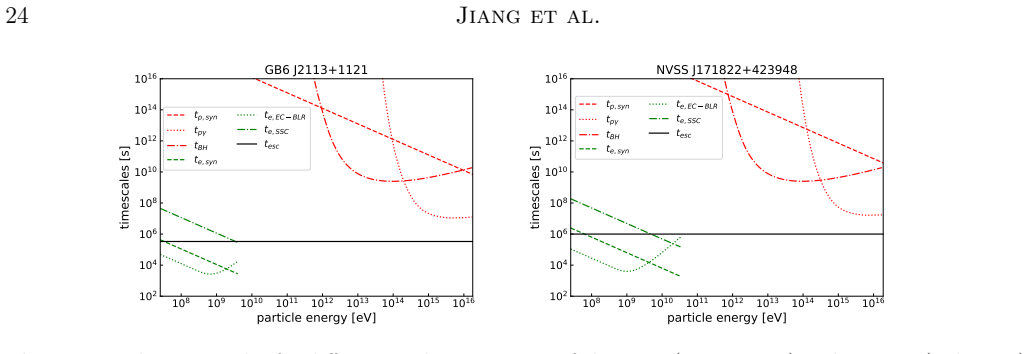
The central object is the one-zone leptohadronic emission region: a spherical blob of radius $R \sim 1$-$3\times10^{16}$ cm with magnetic field $B \sim 6$ G and $2.5$ G, moving with Doppler factor $\delta \sim 30$ and $20$, and filled with co-accelerated electron and proton distributions. The argument is carried by $p\gamma$ pion production on BLR photons, whose energy density in the jet frame is boosted as $u_{\rm BLR} = \Gamma^2 L'_{\rm BLR}/(4\pi (r'_{\rm BLR})^2 c [1+(r'_{\rm in}/r'_{\rm BLR})^3])$. Hadronic cascades are computed iteratively: $\pi^0$-decay gamma rays and high-energy pair synchrotron photons annihilate on soft photons to produce successive generations of electron-positron pairs, and the synchrotron radiation of those pairs is what dominates the X-ray band. The $p\gamma$ efficiency $f_{p\gamma} \approx t_{\rm dyn}/t_{p\gamma}$ converts proton luminosity into neutrino luminosity through $\epsilon_\nu L_{\epsilon_\nu} \approx (3/8) f_{p\gamma} \epsilon_p L_{\epsilon_p}$, and the BLR photon field is what raises this efficiency to the level the paper calls 'efficient' PeV neutrino emission.
What would settle it
Take a pointed X-ray observation of NVSS J171822+423948 during a gamma-ray flare: the model predicts a cascade-dominated X-ray component peaking near 0.5 keV with a flux tied to the hadronic luminosity, whereas a purely leptonic interpretation would give a different spectral shape and normalization. A spectrum showing primary-electron synchrotron or SSC dominance instead of cascade synchrotron, or radio-core or variability evidence placing the emission region beyond the BLR, would falsify the central claim.
Extended reading notes
Core claim
Under the assumption that the emission region sits at the BLR boundary ($r'_{\rm in} \approx r'_{\rm BLR}$, about 0.1 pc for GB6 J2113+1121 and 0.2 pc for NVSS J171822+423948), the BLR photon field acts as the dominant target for $p\gamma$ interactions. The model reproduces the observed spectral energy distribution with proton injection luminosities about two orders of magnitude above electron injection, neutrino spectra peaking near 2-3 PeV in the observer frame, and single-muon-neutrino detection probabilities of about 2% and 0.8% over the roughly 1-2 year gamma-ray flares. The central discovery is that electromagnetic cascades from pion decay and Bethe-Heitler pairs, radiated as synchrotron emission by the secondary pairs, dominate the X-ray band (around 0.5-1 keV) and contribute significantly above about 5 GeV, while BLR photons absorb gamma rays above roughly 5-10 GeV. The paper concludes that for these sources the X-ray flux is a better neutrino tracer than the gamma-ray flux.
Load-bearing premise
The load-bearing premise is that the emission region sits at the boundary of the broad-line region, about 0.1-0.2 pc from the black hole, so BLR photons are the main target for proton-photon collisions; if the same flares instead originated outside the BLR, the paper's own comparison shows the neutrino production efficiency dropping by orders of magnitude and the claim that these are efficient PeV neutrino emitters collapsing.
Editorial extensions
If this is right
- If the modeling is right, both sources are efficient PeV neutrino emitters, and their per-flare single-muon-neutrino detection probabilities are about 2% and 0.8%, low mainly because of their high redshifts.
- X-rays, not gamma rays, are the most promising electromagnetic messenger for these two sources: hadronic cascade synchrotron dominates the X-ray band while BLR absorption suppresses gamma rays above about 5-10 GeV.
- IceCube should accumulate further neutrino alerts from flat-spectrum radio quasars at redshifts greater than 1 during flaring states, with neutrino spectra peaking near 2-3 PeV.
- A spectral break in the gamma-ray spectrum at a few GeV can be used as a marker that a flaring FSRQ is in a neutrino-productive (BLR-near) environment.
- The required jet powers exceed the Eddington luminosities by factors of about 4-10 during the flares, implying that temporary super-Eddington jet power may be an ingredient for IceCube neutrino production.
Reading between the lines
- One extension the paper leaves implicit is that quasi-simultaneous X-ray pointed observations of gamma-ray-alerted FSRQs would be an efficient way to select neutrino flares, because the cascade-dominated X-ray flux directly limits the expected neutrino flux.
- A testable consequence of the BLR-absorption picture is that gamma-ray-selected samples may systematically miss neutrino emitters; a search for IceCube neutrinos from X-ray-selected, gamma-faint high-redshift FSRQs would probe this selection bias.
- The same BLR-boundary assumption could be applied to other luminous FSRQs with measured disk luminosities to produce a ranked list of neutrino candidates, a ranking that stacking IceCube alerts on X-ray-selected flares could falsify.
- If super-Eddington high-redshift FSRQ jets are common in the early universe, the cumulative contribution of such sources to the diffuse IceCube neutrino flux could be larger than the small per-source detection probabilities suggest; stacking analyses of flaring redshifts-greater-than-1 FSRQs would test this.
Signed reviews
Editorial analysis
A structured set of objections, weighed in public.
Referee Report
Summary. The paper applies a one-zone leptohadronic model with a BLR external photon field to two high-redshift FSRQs, GB6 J2113+1121 and NVSS J171822+423948, which have been temporally and spatially associated with IceCube neutrino events. From by-eye SED fits during their gamma-ray flares, the authors derive neutrino spectra, IceCube single-muon detection probabilities of about 2% and 0.8%, baryon loading factors of a few hundred, and all-flavor neutrino-to-gamma luminosity ratios Y_nu_gamma ~ 0.5-0.7. They conclude that the sources are efficient PeV neutrino emitters and that hadronic cascade synchrotron emission dominates the X-ray and GeV bands. The paper also compares these sources with other neutrino candidate blazars and discusses how the location of the emission region relative to the BLR affects neutrino production efficiency.
Significance. If the emission region is indeed at the BLR boundary, the paper provides a concrete multimessenger interpretation for two distant FSRQ-neutrino associations and makes a falsifiable prediction that X-rays, rather than gamma-rays, are the better electromagnetic tracer of neutrino output. The modeling is transparent: the authors explicitly state that the fit is by eye, that the multi-band data are not simultaneous, that the NVSS X-ray luminosity is assumed rather than measured, and that the BLR-location assumption is not uniquely required by variability. These candor and the use of a standard, well-documented leptohadronic framework are strengths. The quantitative conclusions are nevertheless scenario-dependent because the neutrino normalization is set by the free proton luminosity and because the central claim hinges on the placement of the emission region at r'_in ~ r'_BLR.
major comments (4)
- [Section 4, Section 2.3, Table 1, Figure 6] The assumption r'_in ~ r'_BLR is load-bearing for the central claim. The authors note in Section 4 that short-term variability alone does not prove this location and that other FSRQs (PKS B1424-418, PKS 1502+106) are argued to emit beyond the BLR. Figure 6 shows that if the blob is outside the BLR, fp_gamma drops by orders of magnitude over the relevant proton energies; with the same proton luminosity, the neutrino fluxes, the 2% and 0.8% detection probabilities, and the cascade-dominated X-ray/GeV components would all drop correspondingly. A quantitative refit with r'_in outside the BLR, or at least a likelihood-based comparison of allowed locations, is needed before the conclusion that these sources are efficient PeV neutrino emitters can be considered robust.
- [Section 2.3, Table 1] The fitting procedure is by-eye, with nine free parameters adjusted without a likelihood function and without reported uncertainties. The text itself states that the data are not simultaneous, 'which weakens the use of a steady-state solution.' Consequently, the quoted detection probabilities are point estimates whose statistical meaning is unclear. The authors should provide a sensitivity scan or alternative fits showing how P_Det and the cascade contributions vary within a plausible parameter range; as it stands, the abstract's phrase 'strongly suggests' is not commensurate with the fitting procedure.
- [Section 3, Table 1, Figure 4] For NVSS J171822+423948 there is no X-ray data, and the model instead assumes L_X ~ 2x10^46 erg/s. Since the text states that the X-ray flux 'strictly constrains the pair cascades emission, thereby limiting the neutrino flux,' the 0.8% detection probability is partly an input assumption rather than an output prediction. The authors should show how the neutrino flux and detection probability depend on the assumed X-ray luminosity or on the X-ray upper limit shown in Figure 4; otherwise the quoted number is not a robust prediction for this source.
- [Section 2.3, Section 3, Eq. (27)] The neutrino normalization is set by Lp,inj, which is a free parameter that the authors tune to 'maximize the neutrino flux while explaining the electromagnetic spectrum.' The resulting Y_nu_gamma ~ 0.5-0.7 and the detection probabilities are therefore scenario-maximized outputs of a tuned model, not parameter-free predictions. The paper should explicitly label them as such and soften the abstract's claim that the investigation 'strongly suggests these sources are efficient PeV neutrino emitters.'
minor comments (4)
- [Section 3] The text gives the energy of IceCube-201221A as 0.174 TeV, but the same event is described elsewhere as ~0.2 PeV; this appears to be a typo and should read 0.174 PeV.
- [Figure 8 caption] The caption lists 'GB6 J2113+1121' twice in the legend; presumably one entry should be 'NVSS J171822+423948.'
- [Section 2.3, item 5] The text says 'we consider eta = 103' where the intended value is eta = 10^3; this should be typeset consistently as 10^3 in the text and in the discussion of Eq. (22).
- [Equation (23)] The notation in Eq. (23) mixes the integration variable epsilon_nu^obs_mu with the differential d epsilon_nu^obs_mu; using a single symbol for the energy and the differential would improve readability.
Circularity Check
The quoted neutrino detection probabilities are outputs of a deliberately neutrino-maximized fit, not independent predictions; the 'efficient PeV emitter' claim is partly circular.
-
fitted input called prediction
[Section 2.3 (Parameter Constraints) and Section 3, Eqs. (23)-(24)]
"Our goal is not to obtain the best model parameters by fitting the data through minimizing the likelihood function, but rather to maximize the neutrino flux while explaining the electromagnetic spectrum (SED). Therefore, we choose to ”fit by eye,” manually adjusting certain parameters to match the modeling results with the electromagnetic SED, while ensuring a reasonable model, and obtain the neutrino flux."
The neutrino flux that enters Eqs. (23)-(24) is set by Lp,inj, one of the nine free parameters, which the paper explicitly adjusts to 'maximize the neutrino flux' rather than to optimize the SED fit. Since the neutrino luminosity is proportional to the injected proton luminosity (Eq. 27 and the normalization of Eq. 16), the resulting 2% and 0.8% IceCube detection probabilities, and the abstract's conclusion that these sources are 'efficient PeV neutrino emitters', are re-expressions of the chosen proton normalization and the assumed BLR target density, not parameter-free predictions. For NVSS, the X-ray constraint that limits the cascade and hence the neutrino flux is itself assumed (L_X ≈ 2×10^46 erg/s) rather than measured, further weakening the independence of the quoted numbers.
-
fitted input called prediction
[Section 2.3, item 5 (acceleration efficiency η)]
"Additionally, in modeling the neutrino emission from FSRQs, Palladino et al. (2019) suggested that a low acceleration efficiency of η = 10^3 would result in neutrinos with a maximum energy of ∼ 10 PeV in the AGN frame, which aligns with the maximum energy of the observed astrophysical neutrinos. Consequently, we consider η = 10^3, where protons cannot be effectively accelerated."
The maximum proton energy γp,max, which sets the neutrino spectral cutoff and peak, is chosen by adopting η = 10^3 specifically so that the resulting neutrino energies align with IceCube's observed range and avoid a sup-PeV peak. The later statement that the modeled νμ flux peaks at ~2-3 PeV, inside IceCube's sensitivity window, is therefore partly an echo of this input choice rather than an independent spectral prediction. This is a second fitted input presented as a model finding.
full rationale
The paper's core neutrino predictions are partially circular, but not fully. The one-zone leptohadronic machinery, pγ cross sections, BLR photon treatment, and IceCube effective-area integral are standard and give the model real physical content; the GB6 X-ray data do constrain the cascade and therefore limit the proton luminosity. However, the paper explicitly states that it maximizes the neutrino flux rather than best-fitting the SED, and the quoted detection probabilities are computed from the resulting neutrino flux. Because the neutrino luminosity in the model is proportional to the free proton injection luminosity, the 2% and 0.8% values, and the 'efficient PeV neutrino emitter' conclusion, are in significant part restatements of the chosen Lp,inj and the assumed BLR target photon density. The acceleration efficiency η=10^3 is likewise chosen to make the neutrino peak fall in IceCube's band. The placement of the emission region at r_in ≈ r_BLR is load-bearing for the high pγ efficiency, but that is a scenario assumption rather than a circular step: the paper itself acknowledges that short-term variability alone does not prove the location and that some FSRQs emit beyond the BLR, and Figure 6's drop in fpγ is a physical consequence, not an identity. Self-citations to Liao et al. (2022) and Jiang et al. (2024) supply observational inputs such as disk luminosities, black hole masses, and the 2.2σ correlations; these are externally anchored observations and do not, on their own, constitute circularity. Overall, the central 'prediction' is a tuned upper-end model output, so the circularity score is moderate: 5 out of 10.
Assumptions & free parameters
free parameters (12)
- R (blob radius) =
1e16 cm (GB6); 3e16 cm (NVSS)
- B (magnetic field) =
6 G (GB6); 2.5 G (NVSS)
- delta (Doppler factor) =
30 (GB6); 20 (NVSS)
- Le,inj (electron injection luminosity) =
9.8e41 erg/s (GB6); 7.8e42 erg/s (NVSS)
- gamma_e,break =
1e3 (GB6); 2e3 (NVSS)
- gamma_e,max =
7.8e3 (GB6); 6.5e4 (NVSS)
- n_e,1 =
1.2 (GB6); 1.6 (NVSS)
- n_e,2 =
3.9 (both)
- Lp,inj (proton injection luminosity) =
1.4e44 erg/s (GB6); 8.9e43 erg/s (NVSS)
- NVSS X-ray luminosity (assumed) =
~2e46 erg/s
- gamma_e,min =
50 (both)
- eta (proton acceleration efficiency) =
1e3
assumptions (6)
- domain assumption One-zone leptohadronic emission model: a single spherical blob with co-accelerated electrons and protons producing EM and neutrino emission via synchrotron, SSC, EC, p-gamma, and Bethe-Heitler processes with EM cascades.
- domain assumption Emission region located at the BLR boundary (r'_in ~ r'_BLR, 0.1 pc and 0.2 pc), so BLR photons dominate EC losses and serve as the p-gamma target.
- domain assumption BLR radiation approximated as a single-temperature blackbody peaking at ~2e15 Gamma Hz, neglecting emission lines.
- ad hoc to paper Proton injection index n_p = 2 and low acceleration efficiency eta = 1e3, so gamma_p,max ~ 2e7 and the neutrino spectrum peaks in the IceCube band.
- domain assumption Neutrino emission duration equals the 1-2 year gamma-ray flare duration through continuous blob formation in a stationary zone.
- domain assumption Proton synchrotron, pp interactions, and accretion-disk and dust-torus external fields are neglected.
Cite this review
Pith. "Pith review of Leptohadronic Multimessenger Modeling of Two High-redshift (z $>$ 1) Neutrino Emission Blazar Candidates." pith.science (2026). https://pith.science/paper/U5UWDRU2
@misc{pith2026250504160,
  author       = {Pith},
  title        = {Pith review of: Leptohadronic Multimessenger Modeling of Two High-redshift (z $>$ 1) Neutrino Emission Blazar Candidates},
  year         = {2026},
  howpublished = {\url{https://pith.science/paper/U5UWDRU2}},
  note         = {Machine review of arXiv:2505.04160}
}
abstract
The blazars are one of the leading candidate sources of high-energy neutrinos. Recently, two blazars have been found to be temporally and spatially correlated with some IceCube high-energy neutrino events. The two blazars, GB6 J2113+1121 and NVSS J171822+423948, are Flat Spectrum Radio Quasars (FSRQs) with redshifts greater than unity. In particular, NVSS J171822+423948 has a redshift of 2.7, which provides an important probe for studying the radiation processes of jets from active galactic nuclei in the early universe. To better understand the physical origin of the IceCube neutrinos, we adopt the one-zone leptohadronic model to fit the multimessenger emission of GB6 J2113+1121 and NVSS J171822+423948 during their $\gamma$-ray flaring periods and then calculate the high-energy neutrino detection probability. The chance of detecting a single muon neutrino from these two sources is found to be $\sim 2\%$ and $0.8\%$, respectively. Although such detection rates are not high mainly because of their high redshifts, our investigation strongly suggests that these sources are efficient PeV neutrino emitters. Our results also indicate that electromagnetic cascades produced by hadronic processes contribute significantly to X-ray and $\gamma$-ray emissions. However, high-energy $\gamma$-rays can be severely absorbed by the soft photon field from the broad-line region (BLR), which weakens the correlation between $\gamma$-rays and neutrinos, while suggesting a stronger connection between X-rays and neutrinos. We predict that IceCube will continue to detect neutrinos from FSRQs with redshifts greater than 1 in the future.
Figures


Figures from the paper (9 more)


Forward citations
Cited by 1 Pith paper
-
Cosmic Clues from Amaterasu: Blazar-Driven Ultrahigh-Energy Cosmic Rays?
A leptohadronic jet model of PKS 1717+177 can accommodate the 244 EeV Amaterasu event as a proton, but only with an assumed Lorentz invariance violation and a surprisingly strong extragalactic magnetic field.
Reference graph
Works this paper leans on
-
[1]
G., Abraham , K., Ackermann , M., et al
Aartsen , M. G., Abraham , K., Ackermann , M., et al. 2015 a , , 115, 081102, 10.1103/PhysRevLett.115.081102
-
[2]
G., Ackermann , M., Adams , J., et al
Aartsen , M. G., Ackermann , M., Adams , J., et al. 2015 b , Astroparticle Physics, 66, 39, 10.1016/j.astropartphys.2015.01.001
-
[3]
G., Abraham , K., Ackermann , M., et al
Aartsen , M. G., Abraham , K., Ackermann , M., et al. 2016, , 833, 3, 10.3847/0004-637X/833/1/3
-
[4]
2017, , 835, 45, 10.3847/1538-4357/835/1/45
---. 2017, , 835, 45, 10.3847/1538-4357/835/1/45
-
[5]
G., Ackermann , M., Adams , J., et al
Aartsen , M. G., Ackermann , M., Adams , J., et al. 2018 a , Advances in Space Research, 62, 2902, 10.1016/j.asr.2017.05.030
-
[6]
2018 b , , 98, 062003, 10.1103/PhysRevD.98.062003
---. 2018 b , , 98, 062003, 10.1103/PhysRevD.98.062003
-
[7]
2023, , 269, 25, 10.3847/1538-4365/acfa95
Abbasi , R., Ackermann , M., Adams , J., et al. 2023, , 269, 25, 10.3847/1538-4365/acfa95
-
[8]
A., Ackermann , M., Agudo , I., et al
Abdo , A. A., Ackermann , M., Agudo , I., et al. 2010, , 716, 30, 10.1088/0004-637X/716/1/30
Show all 128 references
-
[9]
M., & Brown , A
Acharyya , A., Chadwick , P. M., & Brown , A. M. 2021, , 500, 5297, 10.1093/mnras/staa3483
2021 doi
-
[10]
2017, , 837, L5, 10.3847/2041-8213/aa5fff
Ackermann , M., Ajello , M., Baldini , L., et al. 2017, , 837, L5, 10.3847/2041-8213/aa5fff
2017 doi
-
[11]
Aharonian , F. A. 2000, , 5, 377, 10.1016/S1384-1076(00)00039-7
2000 doi
-
[12]
2015, Reports on Progress in Physics, 78, 126901, 10.1088/0034-4885/78/12/126901
Ahlers , M., & Halzen , F. 2015, Reports on Progress in Physics, 78, 126901, 10.1088/0034-4885/78/12/126901
2015 doi
-
[13]
2022, , 263, 24, 10.3847/1538-4365/ac9523
Ajello , M., Baldini , L., Ballet , J., et al. 2022, , 263, 24, 10.3847/1538-4365/ac9523
2022 doi
-
[14]
A., Arcaro , C., et al
Ansoldi , S., Antonelli , L. A., Arcaro , C., et al. 2018, , 863, L10, 10.3847/2041-8213/aad083
2018 doi
-
[15]
P., Tollerud , E
Astropy Collaboration , Robitaille , T. P., Tollerud , E. J., et al. 2013, , 558, A33, 10.1051/0004-6361/201322068
2013 doi
- [16]
-
[17]
2020, , 101, 063024, 10.1103/PhysRevD.101.063024
Banik , P., Bhadra , A., Pandey , M., & Majumdar , D. 2020, , 101, 063024, 10.1103/PhysRevD.101.063024
2020 doi
-
[18]
2019, , 57, 467, 10.1146/annurev-astro-081817-051948
Blandford , R., Meier , D., & Readhead , A. 2019, , 57, 467, 10.1146/annurev-astro-081817-051948
2019 doi
- [19]
-
[20]
R., & Gould , R
Blumenthal , G. R., & Gould , R. J. 1970, Reviews of Modern Physics, 42, 237, 10.1103/RevModPhys.42.237
1970 doi
-
[21]
2013, , 768, 54, 10.1088/0004-637X/768/1/54
B \"o ttcher , M., Reimer , A., Sweeney , K., & Prakash , A. 2013, , 768, 54, 10.1088/0004-637X/768/1/54
2013 doi
-
[22]
2015, Nature Communications, 6, 6783, 10.1038/ncomms7783
Bustamante , M., Baerwald , P., Murase , K., & Winter , W. 2015, Nature Communications, 6, 6783, 10.1038/ncomms7783
2015 doi
-
[23]
2019, , 483, L12, 10.1093/mnrasl/sly210
Cerruti , M., Zech , A., Boisson , C., et al. 2019, , 483, L12, 10.1093/mnrasl/sly210
2019 doi
-
[24]
2015, , 448, 910, 10.1093/mnras/stu2691
Cerruti , M., Zech , A., Boisson , C., & Inoue , S. 2015, , 448, 910, 10.1093/mnras/stu2691
2015 doi
- [25]
-
[26]
J., Zdziarski , A
Chodorowski , M. J., Zdziarski , A. A., & Sikora , M. 1992, , 400, 181, 10.1086/171984
1992 doi
-
[27]
R., Marshall , J
Cleary , K., Lawrence , C. R., Marshall , J. A., Hao , L., & Meier , D. 2007, , 660, 117, 10.1086/511969
2007 doi
-
[28]
S., & Blandford , R
Coppi , P. S., & Blandford , R. D. 1990, , 245, 453, 10.1093/mnras/245.3.453
1990 doi
-
[29]
2018, , 477, 4749, 10.1093/mnras/sty887
Costamante , L., Cutini , S., Tosti , G., Antolini , E., & Tramacere , A. 2018, , 477, 4749, 10.1093/mnras/sty887
2018 doi
-
[30]
D., & Menon , G
Dermer , C. D., & Menon , G. 2009, High Energy Radiation from Black Holes: Gamma Rays, Cosmic Rays, and Neutrinos (Unknown Publisher)
2009
-
[31]
D., Murase , K., & Inoue , Y
Dermer , C. D., Murase , K., & Inoue , Y. 2014, Journal of High Energy Astrophysics, 3, 29, 10.1016/j.jheap.2014.09.001
2014 doi
-
[32]
J., & Reimer , A
Dimitrakoudis , S., Mastichiadis , A., Protheroe , R. J., & Reimer , A. 2012, , 546, A120, 10.1051/0004-6361/201219770
2012 doi
-
[33]
R., Rosario , D
Dom \' nguez , A., Primack , J. R., Rosario , D. J., et al. 2011, , 410, 2556, 10.1111/j.1365-2966.2010.17631.x
2011
-
[34]
C., Walker , S
Fabian , A. C., Walker , S. A., Celotti , A., et al. 2014, , 442, L81, 10.1093/mnrasl/slu065
2014 doi
-
[35]
2014, , 22, 73, 10.1007/s00159-014-0073-z
Falomo , R., Pian , E., & Treves , A. 2014, , 22, 73, 10.1007/s00159-014-0073-z
2014 doi
-
[36]
2023, , 958, L2, 10.3847/2041-8213/ad0644
Fichet de Clairfontaine , G., Buson , S., Pfeiffer , L., et al. 2023, , 958, L2, 10.3847/2041-8213/ad0644
2023 doi
-
[37]
D., Dermer , C
Finke , J. D., Dermer , C. D., & B \"o ttcher , M. 2008, , 686, 181, 10.1086/590900
2008 doi
-
[38]
B., & Chaffee , Jr., F
Foltz , C. B., & Chaffee , Jr., F. H. 1987, , 93, 529, 10.1086/114334
1987 doi
-
[39]
2020, , 893, 162, 10.3847/1538-4357/ab8307
Franckowiak , A., Garrappa , S., Paliya , V., et al. 2020, , 893, 162, 10.3847/1538-4357/ab8307
2020 doi
-
[40]
2019, Nature Astronomy, 3, 88, 10.1038/s41550-018-0610-1
Gao , S., Fedynitch , A., Winter , W., & Pohl , M. 2019, Nature Astronomy, 3, 88, 10.1038/s41550-018-0610-1
2019 doi
-
[41]
2017, , 843, 109, 10.3847/1538-4357/aa7754
Gao , S., Pohl , M., & Winter , W. 2017, , 843, 109, 10.3847/1538-4357/aa7754
2017 doi
-
[42]
C., Sinapius , J., & Fermi-LAT Collaboration
Garrappa , S., Buson , S., Cheung , C. C., Sinapius , J., & Fermi-LAT Collaboration . 2022, GRB Coordinates Network, 31653, 1
2022
-
[43]
2019, , 880, 103, 10.3847/1538-4357/ab2ada
Garrappa , S., Buson , S., Franckowiak , A., et al. 2019, , 880, 103, 10.3847/1538-4357/ab2ada
2019 doi
-
[44]
2022, , 509, 2102, 10.1093/mnras/stab2688
Gasparyan , S., B \'e gu \'e , D., & Sahakyan , N. 2022, , 509, 2102, 10.1093/mnras/stab2688
2022 doi
-
[45]
1998, , 301, 451, 10.1046/j.1365-8711.1998.02032.x
Ghisellini , G., Celotti , A., Fossati , G., Maraschi , L., & Comastri , A. 1998, , 301, 451, 10.1046/j.1365-8711.1998.02032.x
1998
-
[46]
1996, , 280, 67, 10.1093/mnras/280.1.67
Ghisellini , G., & Madau , P. 1996, , 280, 67, 10.1093/mnras/280.1.67
1996 doi
-
[47]
2009, , 396, L105, 10.1111/j.1745-3933.2009.00673.x
Ghisellini , G., Maraschi , L., & Tavecchio , F. 2009, , 396, L105, 10.1111/j.1745-3933.2009.00673.x
2009
-
[48]
2017, , 469, 255, 10.1093/mnras/stx806
Ghisellini , G., Righi , C., Costamante , L., & Tavecchio , F. 2017, , 469, 255, 10.1093/mnras/stx806
2017 doi
-
[50]
2010, , 402, 497, 10.1111/j.1365-2966.2009.15898.x
Ghisellini , G., Tavecchio , F., Foschini , L., et al. 2010, , 402, 497, 10.1111/j.1365-2966.2009.15898.x
2010
-
[51]
2014, , 515, 376, 10.1038/nature13856
Ghisellini , G., Tavecchio , F., Maraschi , L., Celotti , A., & Sbarrato , T. 2014, , 515, 376, 10.1038/nature13856
2014 doi
-
[52]
2020 a , , 497, 865, 10.1093/mnras/staa2082
Giommi , P., Glauch , T., Padovani , P., et al. 2020 a , , 497, 865, 10.1093/mnras/staa2082
2020 doi
-
[53]
2020 b , , 640, L4, 10.1051/0004-6361/202038423
Giommi , P., Padovani , P., Oikonomou , F., et al. 2020 b , , 640, L4, 10.1051/0004-6361/202038423
2020 doi
-
[54]
2024, , 974, 38, 10.3847/1538-4357/ad6a4e
Gokus , A., B \"o ttcher , M., Errando , M., et al. 2024, , 974, 38, 10.3847/1538-4357/ad6a4e
2024 doi
-
[55]
2005, Astroparticle Physics, 23, 537, 10.1016/j.astropartphys.2005.03.007
Halzen , F., & Hooper , D. 2005, Astroparticle Physics, 23, 537, 10.1016/j.astropartphys.2005.03.007
2005 doi
- [56]
-
[57]
M., Nalewajko , K., et al
Hayashida , M., Madejski , G. M., Nalewajko , K., et al. 2012, , 754, 114, 10.1088/0004-637X/754/2/114
2012 doi
-
[58]
Hunter, J. D. 2007, Computing in science & engineering, 9, 90
2007
-
[59]
2013, Science, 342, 1242856, 10.1126/science.1242856
IceCube Collaboration . 2013, Science, 342, 1242856, 10.1126/science.1242856
2013 doi
- [60]
-
[61]
2018 a , Science, 361, eaat1378, 10.1126/science.aat1378
---. 2018 a , Science, 361, eaat1378, 10.1126/science.aat1378
2018 doi
-
[62]
2018 b , Science, 361, 147, 10.1126/science.aat2890
---. 2018 b , Science, 361, 147, 10.1126/science.aat2890
2018 doi
-
[63]
2022, Science, 378, 538, 10.1126/science.abg3395
IceCube Collaboration , Abbasi , R., Ackermann , M., et al. 2022, Science, 378, 538, 10.1126/science.abg3395
2022 doi
-
[64]
2023, Science, 380, 1338, 10.1126/science.adc9818
Icecube Collaboration , Abbasi , R., Ackermann , M., et al. 2023, Science, 380, 1338, 10.1126/science.adc9818
2023 doi
-
[65]
1996, , 463, 555, 10.1086/177270
Inoue , S., & Takahara , F. 1996, , 463, 555, 10.1086/177270
1996 doi
-
[66]
2023, , 953, L12, 10.3847/2041-8213/acebe3
Jiang , N., Zhou , Z., Zhu , J., Wang , Y., & Wang , T. 2023, , 953, L12, 10.3847/2041-8213/acebe3
2023 doi
-
[67]
2024, , 965, L2, 10.3847/2041-8213/ad36b9
Jiang , X., Liao , N.-H., Wang , Y.-B., et al. 2024, , 965, L2, 10.3847/2041-8213/ad36b9
2024 doi
-
[68]
2016, Nature Physics, 12, 807, 10.1038/nphys3715
Kadler , M., Krau , F., Mannheim , K., et al. 2016, Nature Physics, 12, 807, 10.1038/nphys3715
2016 doi
-
[69]
2018, , 864, 84, 10.3847/1538-4357/aad59a
Keivani , A., Murase , K., Petropoulou , M., et al. 2018, , 864, 84, 10.3847/1538-4357/aad59a
2018 doi
-
[70]
R., & Aharonian , F
Kelner , S. R., & Aharonian , F. A. 2008, , 78, 034013, 10.1103/PhysRevD.78.034013
2008 doi
- [71]
-
[72]
B., et al
Kun , E., Bartos , I., Tjus , J. B., et al. 2021, , 911, L18, 10.3847/2041-8213/abf1ec
2021 doi
-
[73]
2018, , 853, 159, 10.3847/1538-4357/aaa3fb
Li , S., Xia , Z.-Q., Liang , Y.-F., Liao , N.-H., & Fan , Y.-Z. 2018, , 853, 159, 10.3847/1538-4357/aaa3fb
2018 doi
-
[74]
2019, , 879, L9, 10.3847/2041-8213/ab2893
Liao , N.-H., Dou , L.-M., Jiang , N., et al. 2019, , 879, L9, 10.3847/2041-8213/ab2893
2019 doi
-
[75]
2018, , 865, L17, 10.3847/2041-8213/aae20d
Liao , N.-H., Li , S., & Fan , Y.-Z. 2018, , 865, L17, 10.3847/2041-8213/aae20d
2018 doi
-
[76]
2022, , 932, L25, 10.3847/2041-8213/ac756f
Liao , N.-H., Sheng , Z.-F., Jiang , N., et al. 2022, , 932, L25, 10.3847/2041-8213/ac756f
2022 doi
-
[77]
2019, , 99, 063008, 10.1103/PhysRevD.99.063008
Liu , R.-Y., Wang , K., Xue , R., et al. 2019, , 99, 063008, 10.1103/PhysRevD.99.063008
2019 doi
-
[78]
2006, , 2006, 003, 10.1088/1475-7516/2006/05/003
Loeb , A., & Waxman , E. 2006, , 2006, 003, 10.1088/1475-7516/2006/05/003
2006 doi
-
[79]
G., & Sikora , M
Madejski , G. G., & Sikora , M. 2016, , 54, 725, 10.1146/annurev-astro-081913-040044
2016 doi
- [80]
-
[81]
Mastichiadis , A., & Kirk , J. G. 1995, , 295, 613
1995
-
[82]
D., & Blandford , R
Meyer , M., Scargle , J. D., & Blandford , R. D. 2019, , 877, 39, 10.3847/1538-4357/ab1651
2019 doi
-
[83]
P., Protheroe , R
M \"u cke , A., Engel , R., Rachen , J. P., Protheroe , R. J., & Stanev , T. 2000, Computer Physics Communications, 124, 290, 10.1016/S0010-4655(99)00446-4
2000 doi
-
[84]
M \"u cke , A., & Protheroe , R. J. 2001, Astroparticle Physics, 15, 121, 10.1016/S0927-6505(00)00141-9
2001 doi
-
[85]
J., Engel , R., Rachen , J
M \"u cke , A., Protheroe , R. J., Engel , R., Rachen , J. P., & Stanev , T. 2003, Astroparticle Physics, 18, 593, 10.1016/S0927-6505(02)00185-8
2003 doi
-
[86]
D., Takami , H., & Migliori , G
Murase , K., Dermer , C. D., Takami , H., & Migliori , G. 2012, , 749, 63, 10.1088/0004-637X/749/1/63
2012 doi
-
[87]
2016, , 116, 071101, 10.1103/PhysRevLett.116.071101
Murase , K., Guetta , D., & Ahlers , M. 2016, , 116, 071101, 10.1103/PhysRevLett.116.071101
2016 doi
-
[88]
2008, , 689, L105, 10.1086/595882
Murase , K., Inoue , S., & Nagataki , S. 2008, , 689, L105, 10.1086/595882
2008 doi
-
[89]
Murase , K., Inoue , Y., & Dermer , C. D. 2014, , 90, 023007, 10.1103/PhysRevD.90.023007
2014 doi
-
[90]
2018, , 865, 124, 10.3847/1538-4357/aada00
Murase , K., Oikonomou , F., & Petropoulou , M. 2018, , 865, 124, 10.3847/1538-4357/aada00
2018 doi
-
[91]
2016, , 94, 103006, 10.1103/PhysRevD.94.103006
Murase , K., & Waxman , E. 2016, , 94, 103006, 10.1103/PhysRevD.94.103006
2016 doi
-
[92]
2019, , 489, 4347, 10.1093/mnras/stz2246
Oikonomou , F., Murase , K., Padovani , P., Resconi , E., & M \'e sz \'a ros , P. 2019, , 489, 4347, 10.1093/mnras/stz2246
2019 doi
-
[93]
2021, , 2021, 082, 10.1088/1475-7516/2021/10/082
Oikonomou , F., Petropoulou , M., Murase , K., et al. 2021, , 2021, 082, 10.1088/1475-7516/2021/10/082
2021 doi
-
[94]
1995, , 444, 567, 10.1086/175631
Padovani , P., & Giommi , P. 1995, , 444, 567, 10.1086/175631
1995 doi
-
[95]
2019, , 484, L104, 10.1093/mnrasl/slz011
Padovani , P., Oikonomou , F., Petropoulou , M., Giommi , P., & Resconi , E. 2019, , 484, L104, 10.1093/mnrasl/slz011
2019 doi
-
[96]
2014, , 443, 474, 10.1093/mnras/stu1166
Padovani , P., & Resconi , E. 2014, , 443, 474, 10.1093/mnras/stu1166
2014 doi
-
[97]
2018, , 854, L32, 10.3847/2041-8213/aaad5e
Paiano , S., Falomo , R., Treves , A., & Scarpa , R. 2018, , 854, L32, 10.3847/2041-8213/aaad5e
2018 doi
-
[98]
S., Ajello , M., Ojha , R., et al
Paliya , V. S., Ajello , M., Ojha , R., et al. 2019, , 871, 211, 10.3847/1538-4357/aafa10
2019 doi
-
[99]
2019, , 871, 41, 10.3847/1538-4357/aaf507
Palladino , A., Rodrigues , X., Gao , S., & Winter , W. 2019, , 871, 41, 10.3847/1538-4357/aaf507
2019 doi
-
[100]
2016, Astroparticle Physics, 80, 115, 10.1016/j.astropartphys.2016.04.001
Petropoulou , M., Coenders , S., & Dimitrakoudis , S. 2016, Astroparticle Physics, 80, 115, 10.1016/j.astropartphys.2016.04.001
2016 doi
-
[101]
2015, , 448, 2412, 10.1093/mnras/stv179
Petropoulou , M., Dimitrakoudis , S., Padovani , P., Mastichiadis , A., & Resconi , E. 2015, , 448, 2412, 10.1093/mnras/stv179
2015 doi
-
[102]
2015, , 447, 36, 10.1093/mnras/stu2364
Petropoulou , M., & Mastichiadis , A. 2015, , 447, 36, 10.1093/mnras/stu2364
2015 doi
-
[103]
2020, , 899, 113, 10.3847/1538-4357/aba8a0
Petropoulou , M., Oikonomou , F., Mastichiadis , A., et al. 2020, , 899, 113, 10.3847/1538-4357/aba8a0
2020 doi
-
[104]
Planck Collaboration , Ade , P. A. R., Aghanim , N., et al. 2014, , 571, A16, 10.1051/0004-6361/201321591
2014 doi
-
[105]
2020, Zenodo
Reback, J., McKinney, W., Van Den Bossche, J., et al. 2020, Zenodo
2020
-
[106]
2022, , 128, 221101, 10.1103/PhysRevLett.128.221101
Reusch , S., Stein , R., Kowalski , M., et al. 2022, , 128, 221101, 10.1103/PhysRevLett.128.221101
2022 doi
-
[107]
M., Medina , M
Reynoso , M. M., Medina , M. C., & Romero , G. E. 2011, , 531, A30, 10.1051/0004-6361/201014998
2011 doi
-
[108]
M., Bosch-Ramon , V., & Duffy , P
Rieger , F. M., Bosch-Ramon , V., & Duffy , P. 2007, , 309, 119, 10.1007/s10509-007-9466-z
2007 doi
-
[109]
2024, , 977, 42, 10.3847/1538-4357/ad8dce
Robinson , J., & B \"o ttcher , M. 2024, , 977, 42, 10.3847/1538-4357/ad8dce
2024 doi
-
[110]
2018, , 854, 54, 10.3847/1538-4357/aaa7ee
Rodrigues , X., Fedynitch , A., Gao , S., Boncioli , D., & Winter , W. 2018, , 854, 54, 10.3847/1538-4357/aaa7ee
2018 doi
-
[111]
S., Garrappa , S., et al
Rodrigues , X., Paliya , V. S., Garrappa , S., et al. 2024, , 681, A119, 10.1051/0004-6361/202347540
2024 doi
-
[112]
2023, , 519, 1396, 10.1093/mnras/stac3607
Sahakyan , N., Giommi , P., Padovani , P., et al. 2023, , 519, 1396, 10.1093/mnras/stac3607
2023 doi
-
[113]
2015, , 446, 2483, 10.1093/mnras/stu2269
Sbarrato , T., Ghisellini , G., Tagliaferri , G., et al. 2015, , 446, 2483, 10.1093/mnras/stu2269
2015 doi
-
[114]
2002, , 382, 829, 10.1051/0004-6361:20011670
Schuster , C., Pohl , M., & Schlickeiser , R. 2002, , 382, 829, 10.1051/0004-6361:20011670
2002 doi
-
[115]
S., Romani , R
Shaw , M. S., Romani , R. W., Cotter , G., et al. 2012, , 748, 49, 10.1088/0004-637X/748/1/49
2012 doi
-
[116]
C., & Rees , M
Sikora , M., Begelman , M. C., & Rees , M. J. 1994, , 421, 153, 10.1086/173633
1994 doi
-
[117]
Sikora , M., Stawarz , ., Moderski , R., Nalewajko , K., & Madejski , G. M. 2009, , 704, 38, 10.1088/0004-637X/704/1/38
2009 doi
-
[118]
I., Petropoulou , M., Vasilopoulos , G., & Mastichiadis , A
Stathopoulos , S. I., Petropoulou , M., Vasilopoulos , G., & Mastichiadis , A. 2024, , 683, A225, 10.1051/0004-6361/202347277
2024 doi
-
[119]
Stecker , F. W. 1968, , 21, 1016, 10.1103/PhysRevLett.21.1016
1968 doi
-
[120]
2011, , 534, A86, 10.1051/0004-6361/201117204
Tavecchio , F., Becerra-Gonzalez , J., Ghisellini , G., et al. 2011, , 534, A86, 10.1051/0004-6361/201117204
2011 doi
-
[121]
2008, , 386, 945, 10.1111/j.1365-2966.2008.13072.x
Tavecchio , F., & Ghisellini , G. 2008, , 386, 945, 10.1111/j.1365-2966.2008.13072.x
2008
-
[122]
E., et al
Virtanen , P., Gommers , R., Oliphant , T. E., et al. 2020, Nature Methods, 17, 261, 10.1038/s41592-019-0686-2
2020 doi
-
[123]
2021, Research in Astronomy and Astrophysics, 21, 305, 10.1088/1674-4527/21/12/305
Wang , Z.-R., & Xue , R. 2021, Research in Astronomy and Astrophysics, 21, 305, 10.1088/1674-4527/21/12/305
2021 doi
-
[124]
1995, , 75, 386, 10.1103/PhysRevLett.75.386
Waxman , E. 1995, , 75, 386, 10.1103/PhysRevLett.75.386
1995 doi
-
[125]
1997, , 78, 2292, 10.1103/PhysRevLett.78.2292
Waxman , E., & Bahcall , J. 1997, , 78, 2292, 10.1103/PhysRevLett.78.2292
1997 doi
-
[126]
2019, , 886, 23, 10.3847/1538-4357/ab4b44
Xue , R., Liu , R.-Y., Petropoulou , M., et al. 2019, , 886, 23, 10.3847/1538-4357/ab4b44
2019 doi
-
[127]
2021, , 906, 51, 10.3847/1538-4357/abc886
Xue , R., Liu , R.-Y., Wang , Z.-R., Ding , N., & Wang , X.-Y. 2021, , 906, 51, 10.3847/1538-4357/abc886
2021 doi
-
[128]
C., & Li , W.-J
Xue , R., Wang , Z.-R., Joshi , J. C., & Li , W.-J. 2024, , 971, 146, 10.3847/1538-4357/ad5fe9
2024 doi
-
[129]
2020, , 890, 25, 10.3847/1538-4357/ab65ea
Yuan , C., Murase , K., & M \'e sz \'a ros , P. 2020, , 890, 25, 10.3847/1538-4357/ab65ea
2020 doi
Reviewed August 15, 2026 · model on record in the stance chip above.
Discussion (0). Continue with ORCID to comment.