REVIEW 4 major objections 6 minor 78 references
The ALMA-ATOMS Survey: Exploring Protostellar Outflows in HC$_3$N
T0 review · 4 major / 6 minor · reviewed 2026-08-15 · deepseek-v4-flash
Pith's one-line read A dense-gas molecule usually used for cores, HC3N, also works as an outflow tracer and catches the low-velocity gas that SiO misses.
desk verdict The HC3N outflow catalog is a genuinely useful new sample, but the headline claim that HC3N beats SiO at low velocities rests on a non-significant KS test and an untested masking assumption. read the letter →
The pith
A machine-rendered reading of the paper's core claim, the machinery that carries it, and where it could break.
The reading
What carries the argument
The machinery has three parts. First, the velocity range of the ambient cloud is defined by a single Gaussian fit to the optically thin H13CO+ (J=1–0) line toward each dust core; HC3N emission outside $V_{\rm LSR} \pm {\rm FWHM}$ is treated as outflow wing emission. Second, outflow candidates are screened through moment-0/1/2 maps and position–velocity diagrams that must show elongated structure and a Hubble-law wedge. Third, HC3N column densities are computed pixel-by-pixel in LTE with $T_{\rm ex}=50$ K and a fixed HC3N/H2 abundance of $5\times10^{-9}$, from which masses, momenta, energies, dynamical times, and mechanical luminosities are derived for each lobe. The comparison with SiO outflows relies on the same ATOMS fields and includes Kolmogorov–Smirnov tests on lobe position angle, extent, and terminal velocity.
What would settle it
Take the 45 HC3N outflow hosts and inspect the H13CO+ (J=1–0) spectra for non-Gaussian wings or asymmetries; if any host shows outflow wings in H13CO+ within the adopted VLSR ± FWHM, then the claimed low-velocity HC3N component is partly an artifact of choosing too wide a cloud window.
Extended reading notes
Core claim
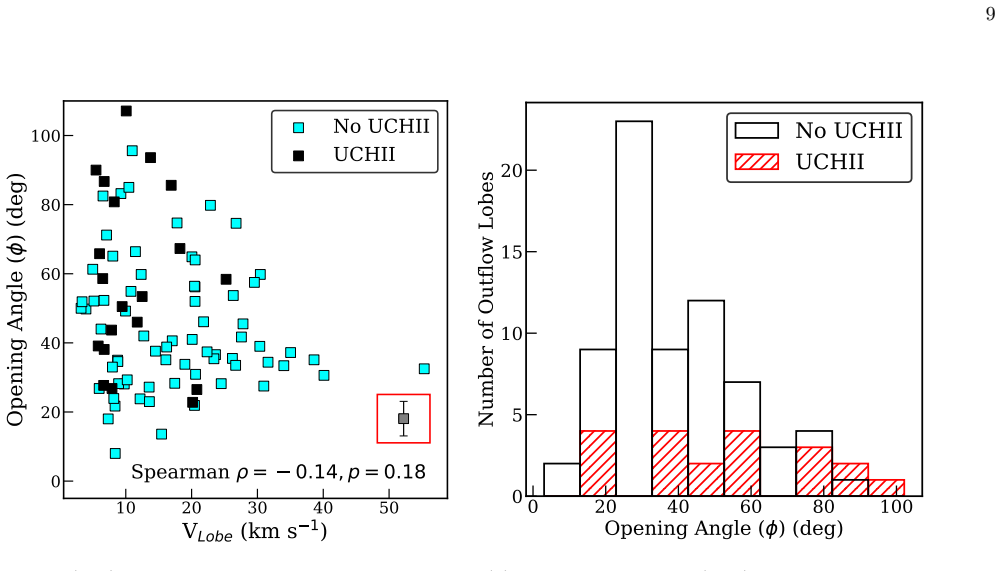
The central claim is that HC3N (J=11–10) emission can be used as a reliable complementary tracer of protostellar outflows in high-mass star-forming regions, with an advantage for the low-velocity components that carry much of the outflow mass and energy. In the ALMA-ATOMS sample of 146 clumps, the authors identify 45 outflow candidates (31 confirmed, 14 probable), derive their physical parameters from LTE, optically thin column densities, and compare them with SiO (J=2–1) outflows. The HC3N outflow lobes show nearly the same orientation, extent, and terminal-velocity distribution as SiO lobes, but a slightly larger fraction of HC3N lobes is found at low velocities; ten sources even show separate fast narrow and slow wide components in position-velocity diagrams. The derived outflow mass, momentum, and energy correlate moderately (Spearman ρ ≈ 0.4–0.6) with clump mass and bolometric luminosity, but show no correlation with the $L_{\rm bol}/M_{\rm clump}$ evolutionary-stage proxy. The authors conclude that HC3N can detect outflows at all evolutionary stages and is an unbiased tracer that complements SiO and other traditional outflow tracers.
Load-bearing premise
The cloud velocity window is fixed by a single Gaussian fit to H13CO+ (J=1–0), and all HC3N inside VLSR ± FWHM is excluded as cloud emission; if H13CO+ itself carries outflow wings, the window is too wide and the very slow outflow gas that the paper claims to detect is the first thing cut away.
Editorial extensions
If this is right
- Outflow surveys that include HC3N (J=11–10) can recover a larger share of the slow, massive gas that dominates outflow energetics.
- HC3N can be used alongside SiO to separate slow wide-angle outflow components from fast collimated jets in the same source.
- Because HC3N outflow detection does not correlate with clump evolutionary stage, surveys can use it to find outflows across a wide range of massive clumps without preselection.
- Outflow mass, momentum, and energy scale with clump mass and luminosity, so HC3N-derived parameters can feed empirical calibrations of outflow feedback in high-mass star formation.
- The 45-outflow catalog provides a new sample for follow-up in other tracers and for estimating outflow-driven feedback in the ATOMS clumps.
Reading between the lines
- If HC3N indeed traces slow outflow components that SiO misses, combining the two tracers should raise the total measured outflow mass and momentum per source compared to SiO-only estimates; this is testable by re-deriving outflow parameters with combined masks.
- The lack of correlation with evolutionary stage may reflect that HC3N is produced in shocks from grain-surface sputtering across a broad range of conditions; a chemical model prediction would be that HC3N abundance jumps by an order of magnitude in C-shocks regardless of protostellar age.
- Because HC3N is rarer and more confined than CO, HC3N outflow surveys at moderate resolution could complement CO-based surveys in crowded or heavily contaminated regions, provided sensitivity is sufficient (the paper notes its own detection rate is sensitivity-limited).
- The ten sources with both fast narrow and slow wide components suggest a two-wind geometry; high-angular-resolution follow-up of these ten could test whether the two components trace the jet and the entrained outflow as distinct kinematic structures.
Signed reviews
Editorial analysis
A structured set of objections, weighed in public.
Referee Report
Summary. This paper presents a systematic search for molecular outflows in the HC3N (J=11-10) line toward 146 massive star-forming clumps from the ALMA-ATOMS survey. The authors identify 45 outflows (44 bipolar, 1 explosive) using wing emission outside a VLSR±FWHM interval set by a Gaussian fit to H13CO+ (J=1-0), with confirmation from moment maps and position-velocity diagrams. They derive outflow masses, momenta, energies, dynamical times, and related quantities under LTE, optically thin, and constant abundance assumptions, and compare the resulting catalog against an SiO (J=2-1) outflow catalog from the same survey. The paper argues that HC3N is a useful complementary outflow tracer, particularly for detecting low-velocity outflow components, and that outflow detection does not correlate with clump evolutionary stage.
Significance. If the central claims hold, this would be the first large-sample demonstration that HC3N can serve as an outflow tracer in massive star-forming regions, complementing SiO and CO by tracing slower, less contaminated gas. The paper provides a substantial catalog (Table 2) with derived parameters and identifies 10 sources with separate fast-jet and slow-wide components, which is of interest to models of jet- and wind-driven outflows. The analysis is systematic and uses public survey data, with clear figures and a reproducible methodology. However, the headline claim that HC3N is 'slightly better' at detecting low-velocity components rests on a Kolmogorov-Smirnov test that does not reach statistical significance (p=0.225), and the main comparison relies on an unpublished SiO catalog. The outflow parameter derivation also carries a large systematic uncertainty from the assumed HC3N/H2 abundance (spanning about a factor of 280 between literature values), which is acknowledged but not propagated. The paper's value is primarily as a catalog; its interpretive claims currently outrun the statistical evidence.
major comments (4)
- [§3.1, §3.4] The outflow definition uses a single Gaussian fit to H13CO+ (J=1-0) to set VLSR±FWHM as the 'cloud component' and removes all HC3N emission within that range. The paper states that H13CO+ 'typically does not have contribution from outflowing material' but provides no diagnostic test of this assumption. If H13CO+ itself has non-Gaussian wings in shocked regions, the excluded interval is overestimated, and the slowest HC3N wing channels are discarded, which would bias the terminal velocities high and directly undermine the paper's specific claim that HC3N recovers low-velocity outflow components. Since the central claim of the paper depends on this masking choice, a quantitative test is needed; for example, comparing the H13CO+ profiles against single-Gaussian models in the outflow regions, or re-deriving outflow properties with an alternative cloud-velocity definition.
- [§4.2.2, Figure 9] The claim that HC3N traces lower-velocity components than SiO is supported by a KS test on the vlobe distributions with p=0.225, which does not reject the null hypothesis that the two samples are drawn from the same distribution at any conventional significance level. The cumulative fraction plot in Figure 9 (right) shows a visual offset, but the stated test does not establish a statistically significant difference. The authors should either apply a more sensitive test (e.g., a two-sample Anderson-Darling test or a comparison of the full velocity distributions with the masks taken into account) or, if the data support it, moderate the claim to 'no statistically significant difference, with a possible trend at low velocities'.
- [§4.1, Equations (10)-(15)] The derived outflow masses, momenta, and energies assume a single [HC3N/H2] abundance of 5×10^-9, while the cited literature values range from 1.4×10^-8 (Mendoza et al. 2018) to 5.1×10^-11 (Taniguchi et al. 2018b), a factor of about 280. This systematic uncertainty is not propagated into the catalog values in Table 2 or into the correlation analyses. Because the abundance factor is roughly constant across sources, the Spearman correlations with clump mass and luminosity may be insensitive to it, but the absolute values (and the direct comparison with Towner et al. 2024 in Figure 5) are not. The paper should at least provide a quantitative statement of how the assumed abundance and Tex affect the reported ranges in Table 1 and the slopes in Equations (10)-(15).
- [§4.2.2] The comparison with SiO outflows relies on a 'Baug et al. (private communication)' catalog that is not publicly available and is not described beyond the number of detected outflows (153). This makes the central comparison non-reproducible for other researchers. The SiO catalog should be published or otherwise made accessible, or the authors should re-run the comparison using a publicly available SiO outflow sample. At minimum, the paper must state the detection threshold and masking procedure used for the SiO catalog so that differences in sensitivity do not drive the reported comparison.
minor comments (6)
- [§3.3] There is a typo: 'adpoted' should be 'adopted' in the sentence preceding Equation (1).
- [Table 2] The formatting of Table 2 is dense and some entries are unclear (e.g., the superscript 'a' marks and the missing PA values for the explosive outflow lobes). Please clarify the meaning of blank cells and ensure the table is readable in the published version.
- [§4.2.1] The wording 'the KS-test do not provide enough evidence to claim the similarity' is imprecise; for p=0.087 the test does not reject the null hypothesis of identical distributions, so one should say 'no significant difference was detected' rather than 'a moderate difference is present'.
- [§3.1] The paper describes the explosive outflow in IRAS 15520-5234 as one outflow but Table 2 lists seven components O1-O7. Please clarify whether these are seven lobes of one explosive outflow or seven separately identified outflows, and how the opening angle and PV analysis treat them.
- [§3.4] The text says 'we assumed a mean inclination angle, θ, of 53.7°' and uses it to correct parameters with powers of sinθ and cosθ; please state explicitly that the quoted vlobe values in Table 2 are the observed (not inclination-corrected) terminal velocities, since the comparison in Figure 9 appears to use these values.
- [Throughout] The notation 'HC 3N' and 'HC3N' is used inconsistently. Please use a single convention throughout the text, tables, and figures.
Circularity Check
No circular derivation: outflow parameters are measured from observed HC3N wing emission with literature-based abundance and temperature, not fitted to the claimed correlations; the unpublished same-group SiO benchmark is a verification caveat, not a circular step.
full rationale
The paper's derivation chain is not circular. Outflow identification (Sec. 3.1) starts from HC3N emission outside the VLSR±FWHM interval set by a Gaussian fit to H13CO+; the cloud velocity is an input, and the HC3N wings are independent observed data, so the low-velocity outflow claim is not equivalent to the input by construction. The outflow column density and parameters (Secs. 3.3–3.4) use fixed literature inputs—Tex = 50 K, [HC3N/H2] = 5e-9, mean inclination 53.7°, and standard LTE equations—rather than values fitted to the correlations later presented. The moderate correlations of Mout, Pout, and Eout with clump mass and luminosity (Sec. 4.1) are post-hoc empirical relationships, not used to define or select the outflows, so there is no fitted-input-called-prediction. The evolutionary-stage non-correlation claim is a null statistical result, not a self-fulfilling construction. The only notable dependence is the comparison with the SiO outflow catalog, which is an unpublished private communication from Baug et al., a coauthor group; this limits independent verification of the comparative low-velocity claim but does not make the HC3N derivation reduce to its own inputs. The paper itself acknowledges in Sec. 3.4 that 'low-velocity outflowing gas always mixes with the cloud component,' and the H13CO+ contamination concern raised in Sec. 3.1 is a real assumption/limitation, but it is a correctness risk, not a circularity. Overall, no specific equation is shown to be equivalent to its inputs, and the central outflow catalog is empirically derived.
Assumptions & free parameters
free parameters (3)
- [HC3N/H2] relative abundance =
5e-9 (mean of 1.4e-8, 5.1e-11, 5e-10)
- Excitation temperature Tex =
50 K
- Mean inclination angle theta =
53.7 degrees
assumptions (5)
- domain assumption HC3N emission is optically thin and in LTE, so column density follows Eq. 1.
- domain assumption H13CO+ (J=1-0) traces only the quiescent cloud velocity and has no outflow contribution; a single Gaussian fit defines Vlsr and cloud FWHM.
- domain assumption Outflow candidates are validated by visual inspection of moment maps and PV diagrams, with 'Hubble law' velocity structure as outflow signature.
- domain assumption Clump masses and bolometric luminosities from Liu et al. (2020) are reliable.
- domain assumption Lbol/Mclump is a valid proxy for evolutionary stage of massive clumps.
Cite this review
Pith. "Pith review of The ALMA-ATOMS Survey: Exploring Protostellar Outflows in HC$_3$N." pith.science (2026). https://pith.science/paper/7QDGLT2H
@misc{pith2026250504164,
  author       = {Pith},
  title        = {Pith review of: The ALMA-ATOMS Survey: Exploring Protostellar Outflows in HC$_3$N},
  year         = {2026},
  howpublished = {\url{https://pith.science/paper/7QDGLT2H}},
  note         = {Machine review of arXiv:2505.04164}
}
abstract
We present the first systematic study of bipolar outflows using HC$_3$N as a tracer in a sample of 146 massive star-forming regions from ALMA-ATOMS survey. Protostellar outflows arise at the initial stage of star formation as a consequence of active accretion. In general, these outflows play a pivotal role in regulating the star formation processes by injecting energetic material in the parent molecular clouds. In such process, lower velocity components of outflows contain a significant portion of the energy. However, extraction of those component is difficult as the corresponding gas is often mixed with that of the ambient cloud. In our sample, we identified 44 bipolar outflows and one explosive outflow in HC$_3$N (J=11--10). The host clumps of these outflows are found to be at different evolutionary stages, suggesting that outflows in HC$_3$N are detectable in different stages of star formation. Also, the non-correlation of HC$_3$N outflows with clump evolutionary stages suggests that HC$_3$N is an unbiased tracer of outflows. Analyses revealed that HC$_3$N performs slightly better in detecting low-velocity components of outflows than traditionally employed tracers like SiO. The derived outflow parameters (i.e outflow mass, momentum, and energy) show moderate correlations with clump mass and luminosity. Our analysis of outflow opening angles and position-velocity diagrams across the outflow lobes show that, HC$_3$N is not only a good tracer of low-velocity outflows, but can also detect high-velocity collimated outflows. Overall, this study indicates that HC$_3$N can be used as a complementary outflow tracer along with the traditionally known outflow tracers, particularly in the detection of the low-velocity components of outflows.
Figures


Figures from the paper (6 more)


Reference graph
Works this paper leans on
-
[1]
, " * write output.state after.block = add.period write newline
ENTRY address archivePrefix author booktitle chapter doi edition editor eprint howpublished institution journal key month number organization pages publisher school series title misctitle type volume year version url label extra.label sort.label short.list INTEGERS output.state before.all mid.sentence after.sentence after.block FUNCTION init.state.consts ...
-
[2]
write newline
" write newline "" before.all 'output.state := FUNCTION format.url url empty "" new.block "" url * "" * if FUNCTION format.eprint eprint empty "" archivePrefix empty "" archivePrefix "arXiv" = new.block " " eprint * " " * new.block " " eprint * " " * if if if FUNCTION format.doi doi empty "" " " doi * " " * if FUNCTION format.pid doi empty eprint empty ur...
-
[3]
K6 hKY]V䱃A oRf/P`QvSɼ &_ļz]Gu _lNެCh RP b[ puIS' ׯ O ݓN2m#' ^J&<jS# y <M jaF E
thebibliography [1] 20pt to REFERENCES 6pt =0pt -12pt 10pt plus 3pt =0pt =0pt =1pt plus 1pt =0pt =0pt -12pt =13pt plus 1pt =20pt =13pt plus 1pt \@M =10000 =-1.0em =0pt =0pt 0pt =0pt =1.0em @enumiv\@empty 10000 10000 `\.\@m \@noitemerr \@latex@warning Empty `thebibliography' environment \@ifnextchar \@reference \@latexerr Missing key on reference command E...
arXiv 2021
-
[4]
Arce, H. G., Borkin, M. A., Goodman, A. A., Pineda, J. E., & Halle, M. W. 2010, The Astrophysical Journal, 715, 1170, 10.1088/0004-637X/715/2/1170
-
[5]
Arce, H. G., & Goodman, A. A. 2001, The Astrophysical Journal, 551, L171, 10.1086/320031
-
[6]
Arce , H. G., & Sargent , A. I. 2006, , 646, 1070, 10.1086/505104
doi:10.1086/505104 2006
-
[7]
G., Shepherd , D., Gueth , F., et al
Arce , H. G., Shepherd , D., Gueth , F., et al. 2007, in Protostars and Planets V, ed. B. Reipurth , D. Jewitt , & K. Keil , 245, 10.48550/arXiv.astro-ph/0603071
-
[8]
Astropy Collaboration , Robitaille , T. P., Tollerud , E. J., et al. 2013, , 558, A33, 10.1051/0004-6361/201322068
Show all 78 references
-
[9]
1996, Annual Review of Astronomy and Astrophysics, 34, 111, https://doi.org/10.1146/annurev.astro.34.1.111
Bachiller, R. 1996, Annual Review of Astronomy and Astrophysics, 34, 111, https://doi.org/10.1146/annurev.astro.34.1.111
1996 doi
-
[10]
Bachiller, R., & Gutiérrez, M. P. 1997, The Astrophysical Journal, 487, L93, 10.1086/310877
1997 doi
-
[11]
2016, , 54, 491, 10.1146/annurev-astro-081915-023341
Bally , J. 2016, , 54, 491, 10.1146/annurev-astro-081915-023341
2016 doi
-
[12]
2020, , 890, 44, 10.3847/1538-4357/ab66b6
Baug , T., Wang , K., Liu , T., et al. 2020, , 890, 44, 10.3847/1538-4357/ab66b6
2020 doi
-
[13]
2021, Monthly Notices of the Royal Astronomical Society, 507, 4316, 10.1093/mnras/stab1902
Baug, T., Wang, K., Liu, T., et al. 2021, Monthly Notices of the Royal Astronomical Society, 507, 4316, 10.1093/mnras/stab1902
2021 doi
-
[14]
T., Gueth, F., Guilloteau, S., & Dutrey, A
Beltrán, M. T., Gueth, F., Guilloteau, S., & Dutrey, A. 2004, A&A, 416, 631, 10.1051/0004-6361:20034123
2004 doi
-
[15]
2013, Monthly Notices of the Royal Astronomical Society, 436, 179, 10.1093/mnras/stt1559
Benedettini, M., Viti, S., Codella, C., et al. 2013, Monthly Notices of the Royal Astronomical Society, 436, 179, 10.1093/mnras/stt1559
2013 doi
-
[16]
A., Snell , R
Bergin , E. A., Snell , R. L., & Goldsmith , P. F. 1996, , 460, 343, 10.1086/176974
1996 doi
-
[17]
J., Frank, A., Blackman, E
Carroll, J. J., Frank, A., Blackman, E. G., Cunningham, A. J., & Quillen, A. C. 2009, The Astrophysical Journal, 695, 1376, 10.1088/0004-637X/695/2/1376
2009 doi
-
[18]
F., Millar, T
Chapman, J. F., Millar, T. J., Wardle, M., Burton, M. G., & Walsh, A. J. 2009, Monthly Notices of the Royal Astronomical Society, 394, 221
2009
-
[19]
A., Charnley, S
Cordiner, M. A., Charnley, S. B., Wirström, E. S., & Smith, R. G. 2012, The Astrophysical Journal, 744, 131, 10.1088/0004-637X/744/2/131
2012 doi
-
[20]
M., Arce, H
Dunham, M. M., Arce, H. G., Mardones, D., et al. 2014, The Astrophysical Journal, 783, 29, 10.1088/0004-637X/783/1/29
2014 doi
-
[21]
2024, , 167, 72, 10.3847/1538-3881/ad152b
Dutta , S., Lee , C.-F., Johnstone , D., et al. 2024, , 167, 72, 10.3847/1538-3881/ad152b
2024 doi
-
[22]
1997, The Astrophysical Journal, 489, 113, 10.1086/304782
Fukuzawa, K., & Osamura, Y. 1997, The Astrophysical Journal, 489, 113, 10.1086/304782
1997 doi
-
[23]
P., Hayashi , M., Gatley , I., Hasegawa , T., & Kaifu , N
Garden , R. P., Hayashi , M., Gatley , I., Hasegawa , T., & Kaifu , N. 1991, , 374, 540, 10.1086/170143
1991 doi
-
[24]
2019, radio-astro-tools/spectral-cube: v0.4.4 , v0.4.4, Zenodo, 10.5281/zenodo.2573901
Ginsburg , A., Koch , E., Robitaille , T., et al. 2019, radio-astro-tools/spectral-cube: v0.4.4 , v0.4.4, Zenodo, 10.5281/zenodo.2573901
2019 doi
-
[25]
, Merello, M
Guerra-Varas, N. , Merello, M. , Bronfman, L. , et al. 2023, A&A, 677, A148, 10.1051/0004-6361/202245522
2023 doi
-
[26]
A., & Baug, T
Guzmán Ccolque, E., Fernández-López, M., Zapata, L. A., & Baug, T. 2022, The Astrophysical Journal, 937, 51, 10.3847/1538-4357/ac8c35
2022 doi
-
[27]
E., Herbst, E., & Garrod, R
Hassel, G. E., Herbst, E., & Garrod, R. T. 2008, The Astrophysical Journal, 681, 1385, 10.1086/588185
2008 doi
-
[28]
A., & Ladd , E
Hatchell , J., Fuller , G. A., & Ladd , E. F. 1999, , 344, 687
1999
-
[29]
2021, The Astrophysical Journal Supplement Series, 253, 2, 10.3847/1538-4365/abd0fb
He, Y.-X., Henkel, C., Zhou, J.-J., et al. 2021, The Astrophysical Journal Supplement Series, 253, 2, 10.3847/1538-4365/abd0fb
2021 doi
-
[30]
2019, The Astrophysical Journal, 880, 138, 10.3847/1538-4357/ab1f8f
Holdship, J., Viti, S., Codella, C., et al. 2019, The Astrophysical Journal, 880, 138, 10.3847/1538-4357/ab1f8f
2019 doi
-
[31]
M., et al
Izumi, N., Sanhueza, P., Koch, P. M., et al. 2024, The Astrophysical Journal, 963, 163, 10.3847/1538-4357/ad18c6
2024 doi
- [32]
-
[33]
G., Stone , J
Lee , C.-F., Mundy , L. G., Stone , J. M., & Ostriker , E. C. 2002, , 576, 294, 10.1086/341540
2002 doi
-
[34]
2020, , 903, 119, 10.3847/1538-4357/abb81f
Li , S., Sanhueza , P., Zhang , Q., et al. 2020, , 903, 119, 10.3847/1538-4357/abb81f
2020 doi
-
[35]
2025, The Astrophysical Journal, 979, 17, 10.3847/1538-4357/ad9275
Liu, C.-F., Shang, H., Johnstone, D., et al. 2025, The Astrophysical Journal, 979, 17, 10.3847/1538-4357/ad9275
2025 doi
-
[36]
J., et al
Liu, H.-L., Liu, T., Evans II, N. J., et al. 2021, Monthly Notices of the Royal Astronomical Society, 505, 2801
2021
-
[37]
2022, Monthly Notices of the Royal Astronomical Society, 511, 4480
Liu, H.-L., Tej, A., Liu, T., et al. 2022, Monthly Notices of the Royal Astronomical Society, 511, 4480
2022
-
[38]
J., Kim , K.-T., et al
Liu , T., Evans , N. J., Kim , K.-T., et al. 2020, , 496, 2790, 10.1093/mnras/staa1577
2020 doi
-
[39]
2021, The Astrophysical Journal, 909, 177, 10.3847/1538-4357/abde3c
Lu, X., Li, S., Ginsburg, A., et al. 2021, The Astrophysical Journal, 909, 177, 10.3847/1538-4357/abde3c
2021 doi
-
[40]
López-Sepulcre , A., Codella , C., Cesaroni , R., Marcelino , N., & Walmsley , C. M. 2009, A&A, 499, 811, 10.1051/0004-6361/200912051
2009 doi
-
[41]
Machida, M. N. 2014, The Astrophysical Journal Letters, 796, L17, 10.1088/2041-8205/796/1/L17
2014 doi
-
[42]
T., Moore, T
Maud, L. T., Moore, T. J. T., Lumsden, S. L., et al. 2015, Monthly Notices of the Royal Astronomical Society, 453, 645, 10.1093/mnras/stv1635
2015 doi
-
[43]
P., Waters , B., Schiebel , D., Young , W., & Golap , K
McMullin , J. P., Waters , B., Schiebel , D., Young , W., & Golap , K. 2007, in Astronomical Society of the Pacific Conference Series, Vol. 376, Astronomical Data Analysis Software and Systems XVI, ed. R. A. Shaw , F. Hill , & D. J. Bell , 127
2007
- [44]
-
[45]
2018, , 475, 5501, 10.1093/mnras/sty180
Mendoza , E., Lefloch , B., Ceccarelli , C., et al. 2018, , 475, 5501, 10.1093/mnras/sty180
2018 doi
-
[46]
P., et al
Molinari, S., Baldeschi, A., Robitaille, T. P., et al. 2019, Monthly Notices of the Royal Astronomical Society, 486, 4508, 10.1093/mnras/stz900
2019 doi
-
[47]
, Pezzuto, S
Molinari, S. , Pezzuto, S. , Cesaroni, R. , et al. 2008, A&A, 481, 345, 10.1051/0004-6361:20078661
2008 doi
-
[48]
2021, , 923, 147, 10.3847/1538-4357/ac2365
Morii , K., Sanhueza , P., Nakamura , F., et al. 2021, , 923, 147, 10.3847/1538-4357/ac2365
2021 doi
-
[49]
E., Palmer , P., & Zuckerman , B
Morris , M., Turner , B. E., Palmer , P., & Zuckerman , B. 1976, , 205, 82, 10.1086/154252
1976 doi
-
[50]
M \"u ller , H. S. P., Thorwirth , S., Roth , D. A., & Winnewisser , G. 2001, , 370, L49, 10.1051/0004-6361:20010367
2001 doi
-
[51]
2007, The Astrophysical Journal, 662, 395, 10.1086/517515
Nakamura, F., & Li, Z.-Y. 2007, The Astrophysical Journal, 662, 395, 10.1086/517515
2007 doi
-
[52]
2017, Monthly Notices of the Royal Astronomical Society, 467, 2723, 10.1093/mnras/stx004
Palau, A., Walsh, C., Sánchez-Monge, A., et al. 2017, Monthly Notices of the Royal Astronomical Society, 467, 2723, 10.1093/mnras/stx004
2017 doi
-
[53]
Pelletier , G., & Pudritz , R. E. 1992, , 394, 117, 10.1086/171565
1992 doi
- [54]
-
[55]
2012, APLpy: Astronomical Plotting Library in Python , Astrophysics Source Code Library
Robitaille , T., & Bressert , E. 2012, APLpy: Astronomical Plotting Library in Python , Astrophysics Source Code Library. 1208.017
2012
-
[56]
M., Foster , J
Sanhueza , P., Jackson , J. M., Foster , J. B., et al. 2012, , 756, 60, 10.1088/0004-637X/756/1/60
2012 doi
-
[57]
2009, , 61, 1055, 10.1093/pasj/61.5.1055
Shimajiri , Y., Takahashi , S., Takakuwa , S., Saito , M., & Kawabe , R. 2009, , 61, 1055, 10.1093/pasj/61.5.1055
2009 doi
-
[58]
Shirley, Y. L. 2015, Publications of the Astronomical Society of the Pacific, 127, 299, 10.1086/680342
2015 doi
-
[59]
1994, , 429, 781, 10.1086/174363
Shu , F., Najita , J., Ostriker , E., et al. 1994, , 429, 781, 10.1086/174363
1994 doi
-
[60]
2000, SAOImage DS9: A utility for displaying astronomical images in the X11 window environment , Astrophysics Source Code Library, record ascl:0003.002
Smithsonian Astrophysical Observatory . 2000, SAOImage DS9: A utility for displaying astronomical images in the X11 window environment , Astrophysics Source Code Library, record ascl:0003.002
2000
-
[61]
L., Loren , R
Snell , R. L., Loren , R. B., & Plambeck , R. L. 1980, , 239, L17, 10.1086/183283
1980 doi
-
[62]
, Bachiller, R
Tafalla, M. , Bachiller, R. , Lefloch, B. , et al. 2015, A&A, 573, L2, 10.1051/0004-6361/201425255
2015 doi
-
[63]
Tang, X. D. , Henkel, C. , Menten, K. M. , et al. 2018, A&A, 609, A16, 10.1051/0004-6361/201731849
2018 doi
-
[64]
2019b, The Astrophysical Journal, 881, 57, 10.3847/1538-4357/ab2d9e
Taniguchi, K., Herbst, E., Caselli, P., et al. 2019b, The Astrophysical Journal, 881, 57, 10.3847/1538-4357/ab2d9e
-
[65]
2018 a , , 866, 32, 10.3847/1538-4357/aadd0c
Taniguchi , K., Miyamoto , Y., Saito , M., et al. 2018 a , , 866, 32, 10.3847/1538-4357/aadd0c
2018 doi
-
[66]
K., & Minamidani , T
Taniguchi , K., Saito , M., Sridharan , T. K., & Minamidani , T. 2018 b , , 854, 133, 10.3847/1538-4357/aaa66f
2018 doi
- [67]
-
[68]
2017, The Astrophysical Journal, 844, 68, 10.3847/1538-4357/aa7899
Taniguchi, K., Saito, M., Hirota, T., et al. 2017, The Astrophysical Journal, 844, 68, 10.3847/1538-4357/aa7899
2017 doi
-
[69]
M., Patel , N
Torrelles , J. M., Patel , N. A., Curiel , S., et al. 2011, , 410, 627, 10.1111/j.1365-2966.2010.17483.x
2011
-
[70]
Towner , A. P. M., Ginsburg , A., Dell'Ova , P., et al. 2024, , 960, 48, 10.3847/1538-4357/ad0786
2024 doi
-
[71]
A., van Dishoeck , E
van Kempen , T. A., van Dishoeck , E. F., Hogerheijde , M. R., & G \"u sten , R. 2009, , 508, 259, 10.1051/0004-6361/200811099
2009 doi
-
[72]
Velusamy , T., & Langer , W. D. 1998, , 392, 685, 10.1038/33624
1998 doi
-
[73]
2011, The Astrophysical Journal, 735, 64, 10.1088/0004-637X/735/1/64
Wang, K., Zhang, Q., Wu, Y., & Zhang, H. 2011, The Astrophysical Journal, 735, 64, 10.1088/0004-637X/735/1/64
2011 doi
-
[74]
X., Zhang , J
Wang , Y. X., Zhang , J. S., Yan , Y. T., et al. 2022, , 663, A177, 10.1051/0004-6361/202142450
2022 doi
-
[75]
2023, The Astrophysical Journal, 949, 89, 10.3847/1538-4357/acc83f
Xie, J., Li, J., Wang, J., et al. 2023, The Astrophysical Journal, 949, 89, 10.3847/1538-4357/acc83f
2023 doi
-
[76]
2019, Monthly Notices of the Royal Astronomical Society, 489, 4497, 10.1093/mnras/stz2431
Yu, N., Wang, J.-J., & Xu, J.-L. 2019, Monthly Notices of the Royal Astronomical Society, 489, 4497, 10.1093/mnras/stz2431
2019 doi
-
[77]
I., Dewangan, L
Zinchenko, I. I., Dewangan, L. K., Baug, T., Ojha, D. K., & Bhadari, N. K. 2021, Monthly Notices of the Royal Astronomical Society: Letters, 506, L45, 10.1093/mnrasl/slab070
2021 doi
-
[78]
I., Liu , S.-Y., Su , Y.-N., Wang , K.-S., & Wang , Y
Zinchenko , I. I., Liu , S.-Y., Su , Y.-N., Wang , K.-S., & Wang , Y. 2020, , 889, 43, 10.3847/1538-4357/ab5c18
2020 doi
Reviewed August 15, 2026 · model on record in the stance chip above.
Discussion (0). Continue with ORCID to comment.