Micro-macro population dynamics models of benthic algae with long-memory decay and generic growth
Pith reviewed 2026-05-22 16:37 UTC · model grok-4.3
The pith
Superposing spin processes with heterogeneous rates models the long-memory algebraic decay in benthic algae and generates generic growth.
A machine-rendered reading of the paper's core claim, the machinery that carries it, and where it could break.
Core claim
The continuum limit of superposed spin processes with heterogeneous rates captures the long-memory decay and generates generic growth for the algae population.
What carries the argument
Spin processes, defined as continuous-time jump processes transitioning between states 0 and 1, superposed with heterogeneous rates to produce the macroscopic dynamics.
If this is right
- The model reproduces the algebraic decay rate seen in experiments.
- Computational simulations show rate-induced tipping phenomena.
- The framework provides a computationally tractable way to interpret and predict long-term algae dynamics.
- It is relevant for river-engineering applications involving biofilm management.
Where Pith is reading between the lines
- This modeling approach could extend to other ecological systems exhibiting long-memory behaviors without needing system-specific parameters.
- Future work might test whether the heterogeneous rates can be derived from physical properties of sediment transport rather than chosen to fit data.
- Connecting this to other stochastic models could reveal if similar superpositions explain long-memory in non-biological contexts like material fatigue or financial time series.
Load-bearing premise
That superposing spin processes with heterogeneous rates alone is enough to match the experimentally observed long-memory decay without extra mechanisms or tuning to the specific algae data.
What would settle it
If measurements of algae population decay over time do not show the algebraic rate predicted by the superposed heterogeneous spin processes, or if the growth does not match the generic form in the continuum limit.
Figures




read the original abstract
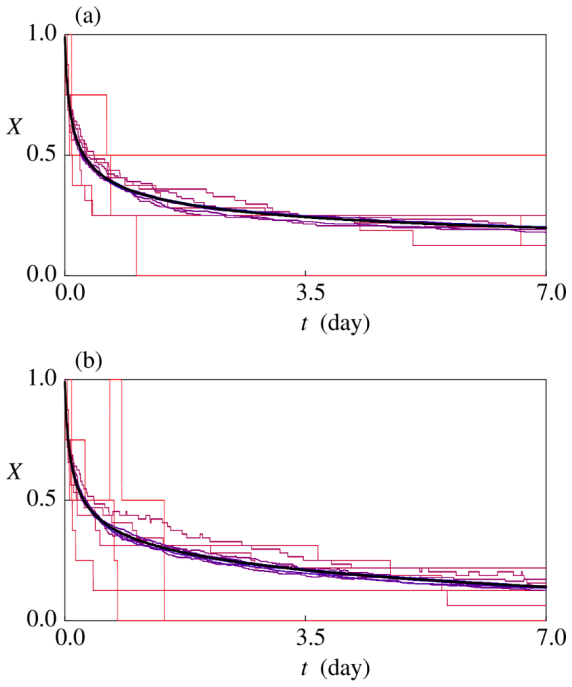
Benthic algae as a primary producer in riverine ecosystems develop biofilms on the riverbed. Their population dynamics involve growth and decay processes, the former owing to the balance between biological proliferation and mortality, while the latter to mechanical abrasion because of the transport of sediment particles. Contrary to the assumptions of previous studies, the decay has experimentally been found to exhibit long-memory behavior, where the population decreases at an algebraic rate. However, the origin and mathematical theory of this phenomenon remain unresolved. The objective of this study is to introduce a novel mathematical model employing spin processes to describe microscopic biofilm dynamics. A spin process is a continuous-time jump process transitioning between states 0 and 1, and the continuum limit of these processes captures the long-memory decay and generates generic growth. The proposed framework leverages heterogeneous spin rates, achieved by appropriately superposing spin processes with distinct rates, to reproduce the long-memory decay. Computational simulations demonstrate the behavior of the model, particularly emphasizing rate-induced tipping phenomena. This mathematical model provides a computationally tractable interpretation of benthic algae dynamics and their long-term prediction, relevant to river-engineering applications.
Editorial analysis
A structured set of objections, weighed in public.
Referee Report
Summary. The manuscript introduces a micro-macro model for benthic algae biofilm dynamics on riverbeds. Microscopic dynamics are represented by spin processes (continuous-time Markov chains on {0,1}) whose heterogeneous rates are superposed; the claimed continuum limit of this superposition reproduces the experimentally observed algebraic long-memory decay while also permitting generic growth. Simulations are used to illustrate rate-induced tipping phenomena, with the framework positioned as computationally tractable for long-term river-engineering predictions.
Significance. If the continuum limit is rigorously derived from the microscopic spin rules without circular insertion of the target decay law, the construction would supply a concrete mechanistic route from individual attachment/abrasion events to macroscopic power-law memory, a feature absent from standard exponential-decay models. The simulation component already demonstrates practical utility for exploring tipping; reproducible code or explicit parameter-free derivations would further strengthen the contribution.
major comments (2)
- [Abstract / §2] Abstract and §2 (model construction): the statement that 'appropriately superposing spin processes with distinct rates' yields long-memory algebraic decay is load-bearing for the central claim. A finite collection of distinct rates produces a finite sum of exponentials whose long-time asymptotics remain exponential (dominated by the smallest rate). Algebraic decay ∼ t^{-α} requires a continuous measure μ(dr) whose density behaves as r^{α-1} near r=0. The manuscript must either (i) derive this specific singular measure from the mechanics of sediment abrasion and algal attachment or (ii) explicitly acknowledge that the distribution is chosen to match the observed decay, thereby clarifying that the long-memory is inserted by construction rather than obtained as a limit.
- [§3] §3 (continuum limit): no derivation steps, error estimates, or convergence theorem are referenced in the abstract or visible model section. The claim that the superposition 'captures the long-memory decay' therefore lacks the technical justification needed to support the micro-to-macro passage. An explicit statement of the scaling regime, the form of the generator, and the passage to the integro-differential or fractional equation is required.
minor comments (2)
- [Simulations section] The computational simulations of rate-induced tipping are a constructive element; however, the manuscript should report the precise numerical scheme, the number of realizations, and any quantitative comparison against the experimental decay curves cited in the introduction.
- [Notation] Notation for the spin rates and the superposition measure should be introduced once and used consistently; currently the abstract employs informal phrasing ('appropriately superposing') that should be replaced by a precise mathematical definition.
Simulated Author's Rebuttal
We thank the referee for the careful reading and constructive comments on our manuscript. The points raised regarding the justification for algebraic decay and the details of the continuum limit are well taken. We respond to each major comment below and indicate the revisions planned for the next version.
read point-by-point responses
-
Referee: [Abstract / §2] Abstract and §2 (model construction): the statement that 'appropriately superposing spin processes with distinct rates' yields long-memory algebraic decay is load-bearing for the central claim. A finite collection of distinct rates produces a finite sum of exponentials whose long-time asymptotics remain exponential (dominated by the smallest rate). Algebraic decay ∼ t^{-α} requires a continuous measure μ(dr) whose density behaves as r^{α-1} near r=0. The manuscript must either (i) derive this specific singular measure from the mechanics of sediment abrasion and algal attachment or (ii) explicitly acknowledge that the distribution is chosen to match the observed decay, thereby clarifying that the long-memory is inserted by construction rather than obtained as a limit.
Authors: We agree that a finite superposition of distinct rates yields only a sum of exponentials with exponential asymptotics. Our construction uses a continuous superposition over a measure μ(dr) whose density is singular as r^{α-1} near r=0, which produces the algebraic decay. This choice is motivated by the physical heterogeneity of attachment and abrasion rates across the riverbed, but the manuscript does not derive the precise form of μ from first-principles sediment mechanics. In the revision we will modify the abstract and §2 to state explicitly that the long-memory is obtained by selecting an appropriate continuous distribution of rates (rather than from finite superposition) and will clarify that this distribution is chosen to reproduce the experimentally observed decay while remaining consistent with the heterogeneous environment. revision: yes
-
Referee: [§3] §3 (continuum limit): no derivation steps, error estimates, or convergence theorem are referenced in the abstract or visible model section. The claim that the superposition 'captures the long-memory decay' therefore lacks the technical justification needed to support the micro-to-macro passage. An explicit statement of the scaling regime, the form of the generator, and the passage to the integro-differential or fractional equation is required.
Authors: We appreciate this observation. The current version presents the continuum limit at a modeling level. In the revised manuscript we will expand §3 (or add an appendix) with an explicit derivation: we will specify the scaling regime in which the number of heterogeneous spin processes tends to infinity with the rate distribution μ, write the infinitesimal generator of the superposed process, and show the passage to the limiting integro-differential equation whose decay term is equivalent to a fractional derivative. We will also cite relevant mean-field convergence results for heterogeneous Markov processes and include a brief discussion of error estimates. This will provide the required technical justification for the micro-to-macro limit. revision: yes
Circularity Check
Long-memory decay reproduced by tailored superposition of rates rather than emergent without tuning
specific steps
-
fitted input called prediction
[Abstract]
"The proposed framework leverages heterogeneous spin rates, achieved by appropriately superposing spin processes with distinct rates, to reproduce the long-memory decay."
The adverb 'appropriately' indicates that the distribution of rates is selected to produce the observed algebraic decay. A finite collection of distinct rates yields only a sum of exponentials (asymptotically exponential), so achieving t^{-α} requires a continuous measure with specific singularity at zero; this measure is therefore inserted by construction to match the target rather than derived from the microscopic spin mechanics.
full rationale
The central modeling step selects heterogeneous rates via 'appropriate' superposition to match the target algebraic decay. While the continuum limit of spin processes is a standard mathematical construction with independent content, the specific choice of rate measure to obtain power-law behavior reduces the claimed 'capture' of long-memory to an input selection. No load-bearing self-citation or self-definition of the target quantity itself is present, keeping the circularity moderate and non-total. The micro-macro framework retains some independent mathematical structure beyond the fit.
Axiom & Free-Parameter Ledger
free parameters (1)
- heterogeneous spin rates
axioms (1)
- domain assumption Continuum limit of superposed continuous-time jump processes between states 0 and 1 exists and yields algebraic decay.
invented entities (1)
-
spin process for microscopic biofilm dynamics
no independent evidence
Lean theorems connected to this paper
-
IndisputableMonolith/Cost/FunctionalEquation.leanwashburn_uniqueness_aczel unclear?
unclearRelation between the paper passage and the cited Recognition theorem.
the continuum limit of these processes captures the long-memory decay ... by appropriately superposing spin processes with distinct rates
What do these tags mean?
- matches
- The paper's claim is directly supported by a theorem in the formal canon.
- supports
- The theorem supports part of the paper's argument, but the paper may add assumptions or extra steps.
- extends
- The paper goes beyond the formal theorem; the theorem is a base layer rather than the whole result.
- uses
- The paper appears to rely on the theorem as machinery.
- contradicts
- The paper's claim conflicts with a theorem or certificate in the canon.
- unclear
- Pith found a possible connection, but the passage is too broad, indirect, or ambiguous to say the theorem truly supports the claim.
Reference graph
Works this paper leans on
-
[1]
Aklilu, T., Sahilu, G., Ambelu, A., & Mehari, B. (2025). Positive matrix factorization in distinguishing water pollution sources in upper Awash river basin, Ethiopia. Water Science, 39(1), 123-137. https://doi.org/10.1080/23570008.2025.2464348
-
[2]
Insulaire, F., Lamouroux, N., Barillier, A., Paillex, A., Capra, H., Cattaneo, F., & Gouraud, V . (2024). Characterizing the effects of morphological microstructures and hydropeaks on fish stranding in rivers. River Research and Applications, 40(5), 834-849. https://doi.org/10.1002/rra.4277
-
[3]
Wine, M. L. (2024). Irrigation water use driving desiccation of Earth’s endorheic lakes and seas. Australasian Journal of Water Resources, 28(1), 74-85. https://doi.org/10.1080/13241583.2022.2141333
-
[4]
Finnsson, H., Chambers, C., & Guðbergsson, G. (2025). Invasive species management: The case of pink salmon in Iceland. Marine Policy, 173, 106539. https://doi.org/10.1016/j.marpol.2024.106539
-
[5]
Zhao, Y ., Zhang, Y ., Guo, J., Wang, J., & Li, Y . (2023). Shifts in periphyton research themes over the past three decades. Environmental Science and Pollution Research, 30(3), 5281-5295. https://doi.org/10.1007/s11356-022-24251-7
-
[6]
X., Li, J., Liu, Y ., & Tong, Z
Kang, C. X., Li, J., Liu, Y ., & Tong, Z. (2022). Effects of high nitrogen concentration and low water level on the growth of the submerged macrophyte V allisneria spinulosa. Journal of Freshwater Ecology, 37(1), 161 -172. https://doi.org/10.1080/02705060.2022.2030817
-
[7]
Sajid, M., Misra, A. K., & Almohaimeed, A. S. (2024). Modeling the role of fish population in mitigating algal bloom. Electronic Research Archive, 32(10). https://doi.org/10.3934/era.2024269
-
[8]
Tedeschi, A. C., & Chow -Fraser, P. (2021). Periphytic algal biomass as a bioindicator of phosphorus concentrations in agricultural headwater streams of southern Ontario. Journal of Great Lakes Research, 47(6), 1702 -1709. https://doi.org/10.1016/j.jglr.2021.08.018
-
[9]
Daniel, S. E., Burlakova, L. E., Karatayev, A. Y ., & Denecke, L. E. (2025). Invasion dynamics of New Zealand mud snail (Potamopyrgus antipodarum) in the Laurentian Great Lakes. Hydrobiologia, 852, 2049-2064. https://doi.org/10.1007/s10750- 024-05522-5
-
[10]
Su, Y ., Ma, J., Wu, Z., Guan, B., & Li, K. (2024). Comparison of zooplankton assimilation of different carbon sources and fatty acids in a eutrophic lake and its restored basins. Journal of Environmental Management, 372, 123355. https://doi.org/10.1016/j.jenvman.2024.123355
-
[11]
Saravia, L. A., Momo, F., & Lissin, L. D. B. (1998). Modelling periphyton dynamics in running water. Ecological Modelling, 114(1), 35-47. https://doi.org/10.1016/S0304-3800(98)00113-6
-
[12]
Momo, F. R. (1995). A new model for periphyton growth in running waters. Hydrobiologia, 299, 215 -218. https://doi.org/10.1007/BF00767328
-
[13]
Farahdiba, A. U., Hidayah, E. N., Asmar, G. A., & Myint, Y . W. (2020). Growth and removal of nitrogen and phosphorus by a macroalgae Cladophora glomerata under different nitrate concentrations. Nature Environment and Pollution Technology, 19(2), 809-813. https://doi.org/10.46488/NEPT.2020.v19i02.038
-
[14]
Schmidt, T. S., Konrad, C. P., Miller, J. L., Whitlock, S. D., & Stricker, C. A. (2019). Benthic algal (periphyton) growth ra tes in response to nitrogen and phosphorus: parameter estimation for water quality models. JAWRA Journal of the American Water Resources Association, 55(6), 1479-1491. https://doi.org/10.1111/1752-1688.12797
-
[15]
Hondzo, M., & Wang, H. (2002). Effects of turbulence on growth and metabolism of periphyton in a laboratory flume. Water Resources Research, 38(12), 13_1-13_9. https://doi.org/10.1029/2002WR001409
-
[16]
Huang, W., Wu, L., Wang, Z., Yano, S., Li, J., Hao, G., & Zhang, J. (2021). Modeling periphyton biomass in a flow -reduced river based on a least squares support vector machines model: implications for managing the risk of nuisance periphyton. Journal of Cleaner Production, 286, 124884. https://doi.org/10.1016/j.jclepro.2020.124884
-
[17]
V ., Larrañaga, A., von Schiller, D., & Elosegi, A
Pérez-Calpe, A. V ., Larrañaga, A., von Schiller, D., & Elosegi, A. (2021). Interactive effects of discharge reduction and fine sediments on stream biofilm metabolism. PloS one, 16(2), e0246719. https://doi.org/10.1371/journal.pone.0246719
-
[18]
Higgins, S. N., Hecky, R. E., & Guildford, S. J. (2008). The collapse of benthic macroalgal blooms in response to self-shading. Freshwater Biology, 53(12), 2557-2572. https://doi.org/10.1111/j.1365-2427.2008.02084.x
-
[19]
Pitawala, S., Scales, P. J., & Martin, G. J. O. (2025). A new modeling approach for predicting the growth of filamentous algae in outdoor algae -based wastewater treatment systems . Biotechnology and Bioengineering. Online published. https://doi.org/10.1002/bit.28941
-
[20]
Bækkelie, K. A. E., Schneider, S. C., Hagman, C. H. C, & Petrin, Z. (2017). Effects of flow events and nutrient addition on stream periphyton and macroinvertebrates: an experimental study using flumes. Knowledge & Management of Aquatic Ecosystems, (418), 47. https://doi.org/10.1051/kmae/2017041
-
[21]
P., Aznarez, C., Jeppesen, E., Baattrup -Pedersen, A., & Meerhoff, M
Calvo, C., Pacheco, J. P., Aznarez, C., Jeppesen, E., Baattrup -Pedersen, A., & Meerhoff, M. (2022). Flow pulses shape periphyton differently according to local light and nutrient conditions in experimental lowland streams. Freshwater Biology, 67(7), 1272-1286. https://doi.org/10.1111/fwb.13916
-
[22]
Lima, B. A. D., Modkovski, T. A., Chaves, J. R. D., Peixoto, L. O. M., Medeiros, S. T., Baer, G. H., Fernandes, C. V . S., & Azevedo, J. C. R. D. (2025). The influence of hydrological variables on river biofilms: a review of relationships and environmental implications. RBRH, 30, e11. https://doi.org/10.1590/2318-0331.302520240083
-
[23]
Albi, G., Chignola, R., & Ferrarese, F. (2022). Efficient ensemble stochastic algorithms for agent -based models with spatial predator–prey dynamics. Mathematics and Computers in Simulation, 199, 317 -340. https://doi.org/10.1016/j.matcom.2022.03.019
-
[24]
Zhang, C. (2021). Pattern formation with jump discontinuity in a macroalgae -herbivore model with strong Allee effect in macroalgae. Journal of Mathematical Analysis and Applications, 504(1), 125371. https://doi.org/10.1016/j.jmaa.2021.125371
-
[25]
Zhang, C., Lu, J., Liu, M., & Zhang, H. (2025 a). Stable patterns with jump -discontinuity for a phytoplankton –zooplankton system with both Allee and fear effect. Physica D: Nonlinear Phenomena, 472, 134481. https://doi.org/10.1016/j.physd.2024.134481
-
[26]
Zhang, K., Hong, X., Han, Y ., & Wang, B. (2025b). Combined effects of information dissemination and resource allocation on spatial spreading of the epidemic. Applied Mathematical Modelling, 137, 115672. https://doi.org/10.1016/j.apm.2024.115672
-
[27]
Hoyle, J. T., Kilroy, C., Hicks, D. M., & Brown, L. (2017). The influence of sediment mobility and channel geomorphology on periphyton abundance. Freshwater Biology, 62(2), 258-273. https://doi.org/10.1111/fwb.12865 39
-
[28]
Luce, J. J., Steele, R., & Lapointe, M. F. (2010). A physically based statistical model of sand abrasion effects on periphyto n biomass. Ecological Modelling, 221(2), 353-361. https://doi.org/10.1016/j.ecolmodel.2009.09.018
-
[29]
Haddadchi, A., Kuczynski, A., Hoyle, J. T., Kilroy, C., Booker, D. J., & Hicks, M. (2020). Periphyton removal flows determined by sediment entrainment thresholds. Ecological Modelling, 434, 109263. https://doi.org/10.1016/j.ecolmodel.2020.109263
-
[30]
Boulêtreau, S., Izagirre, O., Garabétian, F., Sauvage, S., Elosegi, A., & Sánchez‐Pérez, J. M. (2008). Identification of a minimal adequate model to describe the biomass dynamics of river epilithon. River Research and Applications, 24(1), 36 -53. https://doi.org/10.1002/rra.1046
-
[31]
Fovet, O., Belaud, G., Litrico, X., Charpentier, S., Bertrand, C., Dauta, A., & Hugodot, C. (2010). Modelling periphyton in irrigation canals. Ecological Modelling, 221(8), 1153-1161. https://doi.org/10.1016/j.ecolmodel.2010.01.002
-
[32]
Graba, M., Kettab, A., Sauvage, S., & Sanchez-Pérez, J. M. (2012). On modeling chronic detachment of periphyton in artificial rough, open channel flow. Desalination and Water Treatment, 41(1-3), 79-87. https://doi.org/10.1080/19443994.2012.664681
-
[33]
Kazama, S., & Watanabe, K. (2018). Estimation of periphyton dynamics in a temperate catchment using a distributed nutrient- runoff model. Ecological Modelling, 367, 1-9. https://doi.org/10.1016/j.ecolmodel.2017.11.006
-
[34]
Yoshioka, H., Yoshioka, Y ., & Hamagami, K. (2024). Subexponential memory of water environmental variables through the superstatistics. Proceedings of the ISCIE International Symposium on Stochastic Systems Theory and its Applications, V ol. 2024, pp. 37-42. https://doi.org/10.5687/sss.2024.37
-
[35]
Yoshioka, H., & Hamagami, K. (2024). Marcus’s formulation of stochastic algae population dynamics subject to power -type abrasion. International Journal of Dynamics and Control, 12(11), 3987-3999. https://doi.org/10.1007/s40435-024-01461-0
-
[36]
Dolman, L. A., V owles, A. S., & Kemp, P. S. (2024). Chalk stream restoration: Physical and ecological responses to gravel augmentation. PloS one, 19(11), e0313876. https://doi.org/10.1371/journal.pone.0313876
-
[37]
Luis, S., Brown, R., Sellheim, K., & Merz, J. (2024). A spatially explicit drift foraging model quantifies salmon rearing habitat enhancement. Journal of Ecohydraulics, Online published. https://doi.org/10.1080/24705357.2024.2426787
-
[38]
Eliazar, I. I., & Shlesinger, M. F. (2013). Fractional motions. Physics Reports, 527(2), 101 -129. https://doi.org/10.1016/j.physrep.2013.01.004
- [39]
-
[40]
Capasso, V ., & Bakstein, D. (2021). An Introduction to Continuous-Time Stochastic Processes. Birkhäuser, Cham
work page 2021
-
[41]
Klenke, A. (2020). Probability Theory. Springer, Cham
work page 2020
-
[42]
Dynamic fibrils in H-alpha and C IV
Saravia, L. A., Giorgi, A., & Momo, F. (2012). Multifractal growth in periphyton communities. Oikos, 121(11), 1810 -1820. https://doi.org/10.1111/j.1600-0706.2011.20423.x
work page internal anchor Pith review Pith/arXiv arXiv doi:10.1111/j.1600-0706.2011.20423.x 2012
-
[43]
DeNicola, D. M., McNair, J. N., & Suh, J. (2021). A stochastic model of epilithic algal succession and patch dynamics in streams. Ecosphere, 12(7), e03566. https://doi.org/10.1002/ecs2.3566
-
[44]
Mansourvar, Z., & Asadi, M. (2023). On the estimation of hazard rate in mixed populations with its application. Communications in Statistics-Theory and Methods, 52(21), 7564-7575. https://doi.org/10.1080/03610926.2022.2048858
-
[45]
Kerioui, M., Bertrand, J., Bruno, R., Mercier, F., Guedj, J., & Desmée, S. (2022). Modelling the association between biomarkers and clinical outcome: An introduction to nonlinear joint models. British Journal of Clinical Pharmacology, 88(4), 1452 -1463. https://doi.org/10.1111/bcp.15200
-
[46]
Christiansen, M. C. (2021). On the calculation of prospective and retrospective reserves in non -Markov models. European Actuarial Journal, 11(2), 441-462. https://doi.org/10.1007/s13385-021-00277-y
-
[47]
Lee, J., & Zhou, C. (2021). Binary funding impacts in derivative valuation. Mathematical Finance, 31(1), 242 -278. https://doi.org/10.1111/mafi.12287
-
[48]
Martin, J., & Villeneuve, S. (2023). Risk -sharing and optimal contracts with large exogenous risks. Decisions in Economics and Finance, 46(1), 1-43. https://doi.org/10.1007/s10203-023-00386-1
-
[49]
Faizanbasha, A., & Rizwan, U. (2024). Optimal age replacement time for coherent systems under Geometric Point Process. Computers & Industrial Engineering, 190, 110047. https://doi.org/10.1016/j.cie.2024.110047
-
[50]
Achim, P., & Knoepfle, J. (2024). Relational enforcement. Theoretical Economics, 19(2), 823 -863. https://doi.org/10.3982/TE5183
-
[51]
Herdegen, M., & Herrmann, S. (2016). Single jump processes and strict local martingales. Stochastic Processes and Their Applications, 126(2), 337-359. https://doi.org/10.1016/j.spa.2015.09.003
-
[52]
Gushchin, A. A. (2020). Single jump filtrations and local martingales. Modern Stochastics: Theory and Applications, 7(2), 135-
work page 2020
-
[53]
https://doi.org/10.15559/20-VMSTA153
-
[54]
Feudel, U. (2023). Rate-induced tipping in ecosystems and climate: the role of unstable states, basin boundaries and transient dynamics. Nonlinear Processes in Geophysics, 30, 481-502. https://doi.org/10.5194/npg-30-481-2023
-
[55]
Ritchie, P. D. L., Alkhayuon, H., Cox, P. M., & Wieczorek, S. (2023). Rate -induced tipping in natural and human systems. Earth System Dynamics, 14(3), 669-683. https://doi.org/10.5194/esd-14-669-2023
-
[56]
Abbas, M., Giannino, F., Iuorio, A., Ahmad, Z., & Calabró, F. (2025). PDE models for vegetation biomass and autotoxicity. Mathematics and Computers in Simulation, 228, 386-401. https://doi.org/10.1016/j.matcom.2024.07.004
-
[57]
B., V ezza, P., & Camporeale, C
Latella, M., Bertagni, M. B., V ezza, P., & Camporeale, C. (2020). An integrated methodology to study riparian vegetation dynamics: From field data to impact modeling. Journal of Advances in Modeling Earth Systems, 12(8), e2020MS002094. https://doi.org/10.1029/2020MS002094
-
[58]
Tsubaki, R., Kawahara, Y ., & Mizuguchi, Y . (2024). Impact assessment of flushing flow from a dam to invasive aquatic plant egeria densa in a gravel-bed river. KSCE Journal of Civil Engineering, 28(3), 1062-1074. https://doi.org/10.1007/s12205-024- 1465-x
-
[59]
V esipa, R., Camporeale, C., & Ridolfi, L. (2016). Recovery times of riparian vegetation. Water Resources Research, 52(4), 2934-2950. https://doi.org/10.1002/2015WR018490
-
[60]
Cunico, I., Bertoldi, W., Caponi, F., Dijkstra, H. A., & Siviglia, A. (2024). River ecomorphodynamic models exhibit features of nonlinear dynamics and chaos. Geophysical Research Letters, 51(11), e2023GL107951. https://doi.org/10.1029/2023GL107951
-
[61]
Hamagami, K., Yoshioka, H., & Ito, J. (2024 a). Effect of bed forms on the detachment of benthic algae by the sediment transportation. Journal of Water and Environment Technology, 22(4), 159-167. https://doi.org/10.2965/jwet.23-127 40
-
[62]
Hamagami, K., Ito, J., Yoshioka, H., & Usuda, S. (2024b). effect of riverbed configuration on detachment of benthic algae by sediment transportation. Journal of Rainwater Catchment Systems, 30 (1), 7-13
-
[63]
Yoshioka, H. (2024). Modeling stationary, periodic, and long memory processes by superposed jump-driven processes, Chaos, Solitons & Fractals, 188, 115357. https://doi.org/10.1016/j.chaos.2024.115357
-
[64]
Sun, Y . (2006). The exact law of large numbers via Fubini extension and characterization of insurable risks. Journal of Economic Theory, 126(1), 31-69. https://doi.org/10.1016/j.jet.2004.10.005
-
[65]
Duffie, D., & Sun, Y . (2012). The exact law of large numbers for independent random matching. Journal of Economic Theory, 147(3), 1105-1139. https://doi.org/10.1016/j.jet.2012.01.003
-
[66]
Magnus, R. (2023). Essential Ordinary Differential Equations. Springer, Cham
work page 2023
-
[67]
Bansaye, V ., & Méléard, S. (2015). Stochastic models for structured populations. Springer, Berlin
work page 2015
-
[68]
Hein, Y ., & Jafarpour, F. (2024). Asymptotic decoupling of population growth rate and cell size distribution. Physical Review Research, 6(4), 043006. https://doi.org/10.1103/PhysRevResearch.6.043006
-
[69]
Nieto, C., V argas-Garcia, C., & Pedraza, J. M. (2021). Continuous rate modeling of bacterial stochastic size dynamics. Physical Review E, 104(4), 044415. https://doi.org/10.1103/PhysRevE.104.044415
-
[70]
Calvo, R., Muñoz, M. A., & Galla, T. (2025). Navigating uncertainty: Risk -averse versus risk-prone strategies in populations facing demographic and environmental stochasticity. Physical Review E, 111(2), 024118. https://doi.org/10.1103/PhysRevE.111.024118
-
[71]
Kravitzch, E., Hayel, Y ., V arma, V . S., & Berthet, A. O. (2023). Analysis of a continuous-time adaptive voter model. Physical Review E, 107(5), 054307. https://doi.org/10.1103/PhysRevE.107.054307
-
[72]
S., V azquez, F., San Miguel, M., & Galla, T
Ramirez, L. S., V azquez, F., San Miguel, M., & Galla, T. (2024). Ordering dynamics of nonlinear voter models. Physical Review E, 109(3), 034307. https://doi.org/10.1103/PhysRevE.109.034307
-
[73]
Ayi, N., & Duteil, N.P. (2024). Large -population limits of non -exchangeable particle systems. In: Carrillo, J.A., Tadmor, E. (eds) Active Particles, V olume 4. Modeling and Simulation in Science, Engineering and Technology. Birkhäuser, Cham. https://doi.org/10.1007/978-3-031-73423-6_3
-
[74]
Chapra, S. C., Flynn, K. F., & Rutherford, J. C. (2014). Parsimonious model for assessing nutrient impacts on periphyton - dominated streams. Journal of Environmental Engineering, 140(6), 04014014. https://doi.org/10.1061/(ASCE)EE.1943- 7870.0000834
-
[75]
Lavaud, R., Filgueira, R., Nadeau, A., Steeves, L., & Guyondet, T. (2020). A dynamic energy budget model for the macroalga Ulva lactuca. Ecological Modelling, 418, 108922. https://doi.org/10.1016/j.ecolmodel.2019.108922
-
[76]
P., Calvo, C., Aznarez, C., Barrios, M., Meerhoff, M., Jeppesen, E., & Baattrup -Pedersen, A
Pacheco, J. P., Calvo, C., Aznarez, C., Barrios, M., Meerhoff, M., Jeppesen, E., & Baattrup -Pedersen, A. (2022). Periphyton biomass and life-form responses to a gradient of discharge in contrasting light and nutrients scenarios in experimental lowland streams. Science of the Total Environment, 806, 150505. https://doi.org/10.1016/j.scitotenv.2021.150505
-
[77]
Ritchie, P., & Sieber, J. (2017). Probability of noise -and rate -induced tipping. Physical Review E, 95(5), 052209. https://doi.org/10.1103/PhysRevE.95.052209
-
[78]
Slyman, K., & Jones, C. K. (2023). Rate and noise-induced tipping working in concert. Chaos: An Interdisciplinary Journal of Nonlinear Science, 33(1). https://doi.org/10.1063/5.0129341
-
[79]
Akuria, M., & Sinha, R. (2025). Spatiotemporal morphodynamics of an ephemeral Himalayan River impacted by sand mining: A process -response framework. Science of The Total Environment, 964, 178526. https://doi.org/10.1016/j.scitotenv.2025.178526
-
[80]
Bulteau, T., Vázquez-Tarrío, D., Batalla, R. J., & Piégay, H. (2024). A multi -site and hypothesis -driven approach to identify controls on the bedload transport regime of an anthropised gravel -bed river. Earth Surface Processes and Landforms, 49(12), 3913-3933. https://doi.org/10.1002/esp.5945
discussion (0)
Sign in with ORCID, Apple, or X to comment. Anyone can read and Pith papers without signing in.