REVIEW 5 minor 102 references
A targeted search for binary white dwarf pulsars using Gaia and WISE
T0 review · 0 major / 5 minor · reviewed 2026-08-15 · deepseek-v4-flash
Pith's one-line read A targeted search using Gaia and WISE data finds that binary white dwarf pulsars like AR Sco are rare: among 56 selected candidates, only one new member of the class, J191213.72-441045.1, was identified.
desk verdict A careful, sample-scoped search for AR Sco analogs that finds exactly one new pulsar (already reported) and a useful contaminant census; selection completeness is unquantified but honestly acknowledged. read the letter →
The pith
A machine-rendered reading of the paper's core claim, the machinery that carries it, and where it could break.
The reading
What carries the argument
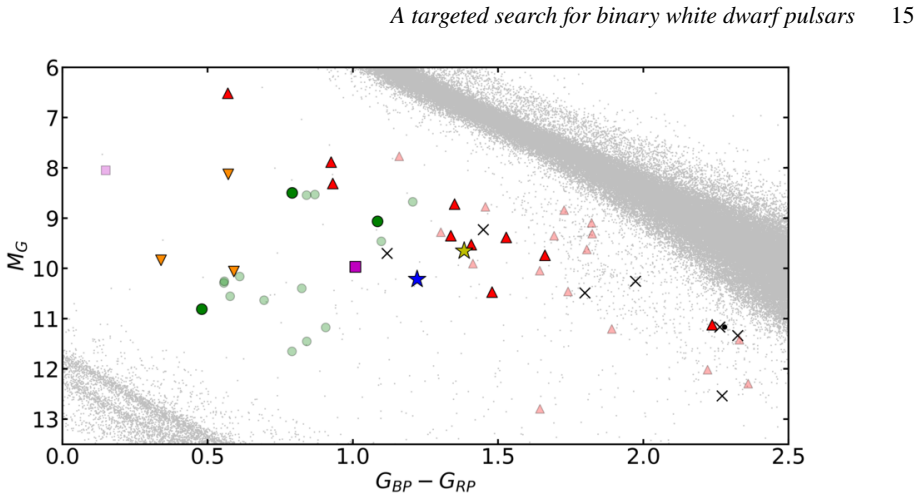
The load-bearing selection mechanism is the AR Sco proxy: a position in the Gaia colour-magnitude diagram (brightness versus colour) between the main sequence and the white-dwarf cooling track, a WISE variability flag (a catalogue digit indicating infrared variability) of at least 7, and a WISE W1-W2 colour (3.4 micron minus 4.6 micron magnitude) greater than 0.5. These cuts separate the 56 candidates from the general Gaia and WISE populations and carry the argument because they are calibrated on a single prototype. The classification step then rests on archival time-series photometry, high-speed photometry, and optical spectroscopy, which assign the 26 newly characterised systems to known classes and reveal whether any show the few-minute pulsing that defines the white dwarf pulsar phenomenon.
What would settle it
Redo the search keeping the Gaia colour-magnitude selection but dropping the W1-W2 greater than 0.5 cut and lowering the WISE variability flag threshold to 5 or below, then classify the larger sample; if additional AR Sco analogues appear, the reported null conclusion is an artifact of the infrared cuts.
Extended reading notes
Core claim
The central claim is that binary white dwarf pulsars of the AR Sco type are scarce. Using a selection built from AR Sco's observed properties - lying between the main sequence and the white-dwarf cooling track in the Gaia colour-magnitude diagram, showing infrared variability with a WISE variability flag of at least 7, and having W1-W2 colour greater than 0.5 - the paper identifies 56 candidates. Among the 26 previously uncharacterised systems, follow-up classified ten as young stellar objects, three as polars, one as an intermediate polar, and three as likely non-magnetic cataclysmic variables; seven showed no detectable optical variability. One object, J191213.72-441045.1, is confirmed as a second binary white dwarf pulsar and is described in detail in a companion paper. The paper concludes that aside from this one new system, nothing in the sample behaves like AR Sco.
Load-bearing premise
The load-bearing assumption is that the WISE selection cuts derived from AR Sco alone - a variability flag of at least 7 and W1-W2 greater than 0.5 - capture all or most genuine binary white dwarf pulsars; a member of the class with weaker infrared variability or with W1-W2 below 0.5 would be absent from the sample, and the reported null result would be an artifact of the cuts.
Editorial extensions
If this is right
- The class of binary white dwarf pulsars is, at best, extremely sparse: only one new member, J191213.72-441045.1, emerges from 56 purpose-selected candidates.
- The AR Sco selection criteria do work in the sense of finding an AR Sco analogue, but they are heavily contaminated: ten young stellar objects and seven cataclysmic variables were recovered among the 26 uncharacterised systems.
- Three newly classified polars and one intermediate polar add to the known magnetic cataclysmic variable population, with the intermediate polar J0452+3017 having the shortest known orbital period of its class.
- The fact that J1912-4410 sits close to AR Sco in the colour-magnitude diagram, while the other systems lie nearer the main sequence or white-dwarf track, suggests that only a narrow range of stellar and orbital parameters triggers the pulsed radio emission.
- Future searches should focus on the narrow AR Sco region and relax or remove the infrared criteria, since infrared variability mainly picks up young stellar objects rather than white dwarf pulsars.
Reading between the lines
- If the crystallisation-dynamo model needs binary white dwarf pulsars as a short-lived link between intermediate polars and polars, the rarity implied here may mean the phase is brief or that only a small subset of IPs pass through it; a population-synthesis calculation along that model's lines could be checked against this null result.
- The heavy contamination by young stellar objects suggests that a radio-based or X-ray-based search could complement the infrared selection; many radio transients are now known to host white dwarf binaries, so transient radio surveys may be a testable way to enlarge the class.
- Because the W1-W2 and variability cuts are derived from one object, systems in which the companion dilutes the infrared excess or the magnetic interaction is weaker could be missed; a re-run of the same Gaia colour-magnitude selection without the WISE colour and variability cuts would test how many AR Sco analogues hide just outside the cuts.
Signed reviews
Editorial analysis
A structured set of objections, weighed in public.
Referee Report
Summary. The paper reports a targeted search for binary white dwarf pulsars similar to AR Sco. Using Gaia eDR3 colour-magnitude and quality cuts (Eqs. 1-10) followed by WISE infrared variability and colour cuts (Section 2.2), the authors select 56 candidates, 30 of which are already known as polars, intermediate polars, or young stellar objects. The remaining 26 previously uncharacterised systems are followed up with archival TESS, ZTF, ATLAS, and CRTS photometry, ULTRACAM/ULTRASPEC high-speed photometry, and spectroscopy from XSHOOTER, OSIRIS, INT/IDS, FLOYDS, and SOAR. The follow-up classifies ten objects as YSOs, three as new polars, one as an intermediate polar, and three as likely non-magnetic CVs; seven systems remain unclassified, and one was not followed up because of blending. The single new binary white dwarf pulsar, J1912-4410, was already reported in a separate publication. The paper concludes that no other systems in the selected sample have characteristics akin to AR Sco.
Significance. If the result holds, the paper provides a useful observational constraint on the rarity of binary white dwarf pulsars and sharpens the motivation for future, less biased searches. The follow-up is unusually thorough: archival time series from four independent surveys are combined with high-speed photometry and multi-telescope spectroscopy, and periods are cross-checked between datasets. The newly classified systems are individually valuable, including a candidate shortest-period intermediate polar, new polars, and period-gap CVs. The main caveat is that the selection criteria were tuned to the single known object AR Sco, so the null result is a sample-scoped upper limit rather than a direct measurement of the space density of such systems; the paper mostly states this correctly, but one or two sentences could make the scope of the null result even more explicit.
minor comments (5)
- [Section 2.2 / Abstract] The WISE thresholds (variability flag digit >= 7 and W1-W2 > 0.5) are explicitly tuned to AR Sco and discard 788 variable candidates, so the abstract's statement 'we find no other systems whose characteristics are akin to AR Sco' should be tied to the selection, for example by adding 'among the 56 candidates satisfying our AR-Sco-tuned criteria'.
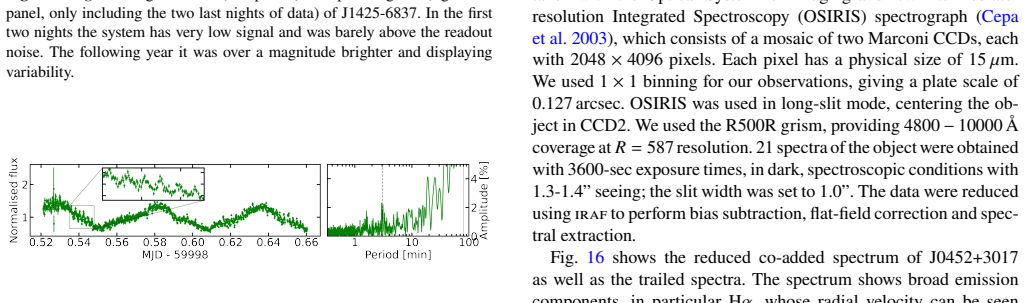
- [Section 4.2.2] The text says that 21 spectra of J0452+3017 were obtained with 3600-sec exposure times in a 2.5-hour observing block; this is internally inconsistent (21 x 3600 s is about 21 hours), so either the exposure time or the number of spectra needs to be corrected.
- [Eqs. (9)-(10)] The quantity M'_G is used in the selection but is only defined in prose; please define it explicitly in the equation block, including the zero-point parallax correction used.
- [Section 5.5 / Table 4] For the seven systems with no optical variability, the conclusion that they are not binary white dwarf pulsars would be strengthened by stating the detection limits, because the ULTRACAM/ULTRASPEC runs vary in length from about 16 to 184 minutes and could miss longer-period or low-amplitude pulsed signals.
- [Appendix A] The entry for Gaia DR2 1956566510538468224 reports an orbital period of '2.002757(38)± hours'; the symbol is misplaced and should read '2.002757(38) h' or '2.002757 ± 0.000038 h'.
Circularity Check
No significant circularity: the search is intentionally tuned to AR Sco, but the null result is a scoped observational classification supported by independent follow-up data.
full rationale
The paper's selection criteria are explicitly anchored to AR Sco, e.g. 'The limits were tailored to recover AR Sco' (Section 2.1) and 'AR Sco ... motivated the selection W1−W2 > 0.5' (Section 2.2). This makes the search deliberately biased, but it does not make the paper's claim circular. The headline result is a scoped observational statement about the 56 candidates, not a derivation of a general physical absence from the fitted cuts. The classifications of the 26 previously uncharacterised systems rest on independent spectroscopy (XSHOOTER, OSIRIS, IDS, FLOYDS, Goodman) and high-speed photometry (ULTRACAM/ULTRASPEC), plus archival TESS, ZTF, ATLAS and CRTS light curves. The one discovered pulsar, J1912-4410, is reported in separately published works (Pelisoli et al. 2023; Schwope et al. 2023b) with independent optical, radio and X-ray detections, so the relevant self-citations are external observational evidence rather than a self-supporting argument. The paper also acknowledges the obvious completeness limitation: 'Future searches might benefit from focussing on this region and relaxing or removing infrared criteria' (Section 6). That is a selection-effect caveat, not a circular reduction of the null result to the selection. No fitted parameter is repackaged as a prediction, and no equation reduces to its own input.
Assumptions & free parameters
free parameters (4)
- WISE W1-W2 color cut =
> 0.5
- WISE variability flag threshold =
>= 7
- Gaia CMD boundary coefficients (Eqs. 9-10) =
M_G' < 5.25 + 7*((BP-RP)+0.45)^2/5; M_G' > 4.45 - 5.15*(1-exp(0.35*(BP-RP)))
- Parallax and flux quality cuts (Eqs. 3-5) =
parallax/error > 10; F_BP/error > 9; F_RP/error > 9
assumptions (5)
- domain assumption The selection criteria derived from AR Sco are adequate to recover AR Sco-like binary white dwarf pulsars.
- domain assumption WISE variability flags and W1-W2 excess trace non-thermal emission or other pulsar-relevant properties in white dwarf binaries.
- domain assumption No AR Sco-like pulsar would lack optical variability over the observed baselines.
- domain assumption Published classifications for the 30 previously known candidates are correct.
- domain assumption Spectral classification templates for YSOs and CVs are reliable for the newly observed objects.
Cite this review
Pith. "Pith review of A targeted search for binary white dwarf pulsars using Gaia and WISE." pith.science (2026). https://pith.science/paper/6QYYFJ22
@misc{pith2026250504693,
  author       = {Pith},
  title        = {Pith review of: A targeted search for binary white dwarf pulsars using Gaia and WISE},
  year         = {2026},
  howpublished = {\url{https://pith.science/paper/6QYYFJ22}},
  note         = {Machine review of arXiv:2505.04693}
}
read the original abstract
After its discovery in 2016, the white dwarf binary AR Scorpii (AR Sco) remained for several years the only white dwarf system to show pulsed radio emission associated with a fast-spinning white dwarf. The evolutionary origin and the emission mechanism for AR Sco are not completely understood, with different models proposed. Testing and improving these models requires observational input. Here we report the results of a targeted search for other binary white dwarf pulsars like AR Sco. Using data from Gaia and WISE, we identified 56 candidate systems with similar properties to AR Sco, of which 26 were previously uncharacterised. These were subject to spectroscopic and photometric follow-up observations. Aside from one new binary white dwarf pulsar found, J191213.72-441045.1, which was reported in a separate work, we find no other systems whose characteristics are akin to AR Sco. The newly characterised systems are primarily young stellar objects (with 10 found) or cataclysmic variables (7 identifications), with the remaining being either blended or non-variable on short timescales.
Figures


Figures from the paper (16 more)




Reference graph
Works this paper leans on
-
[1]
Barrett P., Dieck C., Beasley A. J., Mason P. A., Singh K. P., 2020, @doi [Advances in Space Research] 10.1016/j.asr.2020.04.007 , https://ui.adsabs.harvard.edu/abs/2020AdSpR..66.1226B 66, 1226
-
[2]
Barwig H., Ritter H., Barnbantner O., 1994, , https://ui.adsabs.harvard.edu/abs/1994A&A...288..204B 288, 204
1994
-
[3]
Bellm E. C., et al., 2019, @doi [ ] 10.1088/1538-3873/aaecbe , https://ui.adsabs.harvard.edu/abs/2019PASP..131a8002B 131, 018002
-
[4]
Bera P., Bhattacharya D., 2018, @doi [ ] 10.1093/mnras/stx2720 , https://ui.adsabs.harvard.edu/abs/2018MNRAS.474.1629B 474, 1629
-
[5]
Bernardini F., de Martino D., Mukai K., Falanga M., 2014, @doi [ ] 10.1093/mnras/stu1819 , https://ui.adsabs.harvard.edu/abs/2014MNRAS.445.1403B 445, 1403
-
[6]
Bonnet-Bidaud J. M., et al., 2020, @doi [ ] 10.1051/0004-6361/201935741 , https://ui.adsabs.harvard.edu/abs/2020A&A...633A.145B 633, A145
-
[7]
Bookbinder J. A., Lamb D. Q., 1987, @doi [ ] 10.1086/185072 , https://ui.adsabs.harvard.edu/abs/1987ApJ...323L.131B 323, L131
doi:10.1086/185072 1987
-
[8]
Brice \ n o C., et al., 2019, @doi [ ] 10.3847/1538-3881/aaf79b , https://ui.adsabs.harvard.edu/abs/2019AJ....157...85B 157, 85
Show all 102 references
-
[9]
C \'a novas H., et al., 2019, @doi [ ] 10.1051/0004-6361/201935321 , https://ui.adsabs.harvard.edu/abs/2019A&A...626A..80C 626, A80
2019 doi
-
[10]
Cantat-Gaudin T., et al., 2018, @doi [ ] 10.1051/0004-6361/201833476 , https://ui.adsabs.harvard.edu/abs/2018A&A...618A..93C 618, A93
2018 doi
-
[11]
Cantat-Gaudin T., et al., 2020, @doi [ ] 10.1051/0004-6361/202038192 , https://ui.adsabs.harvard.edu/abs/2020A&A...640A...1C 640, A1
2020 doi
-
[12]
Cepa J., et al., 2003, in Iye M., Moorwood A. F. M., eds, Society of Photo-Optical Instrumentation Engineers (SPIE) Conference Series Vol. 4841, Instrument Design and Performance for Optical/Infrared Ground-based Telescopes. pp 1739--1749, @doi 10.1117/12.460913
2003 doi
-
[13]
L., K \"o rding E
Coppejans D. L., K \"o rding E. G., Miller-Jones J. C. A., Rupen M. P., Knigge C., Sivakoff G. R., Groot P. J., 2015, @doi [ ] 10.1093/mnras/stv1225 , https://ui.adsabs.harvard.edu/abs/2015MNRAS.451.3801C 451, 3801
2015 doi
-
[14]
Cropper M., 1990, @doi [ ] 10.1007/BF00177799 , https://ui.adsabs.harvard.edu/abs/1990SSRv...54..195C 54, 195
1990 doi
-
[15]
M., et al., 2021, VizieR Online Data Catalog, https://ui.adsabs.harvard.edu/abs/2014yCat.2328....0C p
Cutri R. M., et al., 2021, VizieR Online Data Catalog, https://ui.adsabs.harvard.edu/abs/2014yCat.2328....0C p. II/328
2021
-
[16]
S., et al., 2007, @doi [ ] 10.1111/j.1365-2966.2007.11881.x , https://ui.adsabs.harvard.edu/abs/2007MNRAS.378..825D 378, 825
Dhillon V. S., et al., 2007, @doi [ ] 10.1111/j.1365-2966.2007.11881.x , https://ui.adsabs.harvard.edu/abs/2007MNRAS.378..825D 378, 825
2007
-
[17]
S., et al., 2014, @doi [ ] 10.1093/mnras/stu1660 , https://ui.adsabs.harvard.edu/abs/2014MNRAS.444.4009D 444, 4009
Dhillon V. S., et al., 2014, @doi [ ] 10.1093/mnras/stu1660 , https://ui.adsabs.harvard.edu/abs/2014MNRAS.444.4009D 444, 4009
2014 doi
-
[18]
J., et al., 2009, @doi [ ] 10.1088/0004-637X/696/1/870 , https://ui.adsabs.harvard.edu/abs/2009ApJ...696..870D 696, 870
Drake A. J., et al., 2009, @doi [ ] 10.1088/0004-637X/696/1/870 , https://ui.adsabs.harvard.edu/abs/2009ApJ...696..870D 696, 870
2009 doi
-
[19]
J., et al., 2017, @doi [ ] 10.1093/mnras/stx1085 , https://ui.adsabs.harvard.edu/abs/2017MNRAS.469.3688D 469, 3688
Drake A. J., et al., 2017, @doi [ ] 10.1093/mnras/stx1085 , https://ui.adsabs.harvard.edu/abs/2017MNRAS.469.3688D 469, 3688
2017 doi
-
[20]
D., et al., 2019, @doi [ ] 10.1088/1538-3873/ab291c , https://ui.adsabs.harvard.edu/abs/2019PASP..131i4502F 131, 094502
Feinstein A. D., et al., 2019, @doi [ ] 10.1088/1538-3873/ab291c , https://ui.adsabs.harvard.edu/abs/2019PASP..131i4502F 131, 094502
2019 doi
-
[21]
T., Bailey J., Hough J
Ferrario L., Wickramasinghe D. T., Bailey J., Hough J. H., Tuohy I. R., 1992, @doi [ ] 10.1093/mnras/256.2.252 , https://ui.adsabs.harvard.edu/abs/1992MNRAS.256..252F 256, 252
1992 doi
-
[22]
Ferrario L., Wickramasinghe D., Bailey J., Buckley D., 1995, @doi [ ] 10.1093/mnras/273.1.17 , https://ui.adsabs.harvard.edu/abs/1995MNRAS.273...17F 273, 17
1995 doi
- [23]
-
[24]
Gagn \'e J., et al., 2015, @doi [ ] 10.1088/0067-0049/219/2/33 , https://ui.adsabs.harvard.edu/abs/2015ApJS..219...33G 219, 33
2015 doi
-
[25]
M., Littlefield C., Potter S
Gaibor Y., Garnavich P. M., Littlefield C., Potter S. B., Buckley D. A. H., 2020, @doi [ ] 10.1093/mnras/staa1901 , https://ui.adsabs.harvard.edu/abs/2020MNRAS.496.4849G 496, 4849
2020 doi
-
[26]
Geng J.-J., Zhang B., Huang Y.-F., 2016, @doi [ ] 10.3847/2041-8205/831/1/L10 , https://ui.adsabs.harvard.edu/abs/2016ApJ...831L..10G 831, L10
2016 doi
-
[27]
P., et al., 2019, @doi [ ] 10.1093/mnras/sty3016 , https://ui.adsabs.harvard.edu/abs/2019MNRAS.482.4570G 482, 4570
Gentile Fusillo N. P., et al., 2019, @doi [ ] 10.1093/mnras/sty3016 , https://ui.adsabs.harvard.edu/abs/2019MNRAS.482.4570G 482, 4570
2019 doi
-
[28]
P., et al., 2021, @doi [ ] 10.1093/mnras/stab2672 , https://ui.adsabs.harvard.edu/abs/2021MNRAS.508.3877G 508, 3877
Gentile Fusillo N. P., et al., 2021, @doi [ ] 10.1093/mnras/stab2672 , https://ui.adsabs.harvard.edu/abs/2021MNRAS.508.3877G 508, 3877
2021 doi
-
[29]
Ginzburg S., Fuller J., Kawka A., Caiazzo I., 2022, @doi [ ] 10.1093/mnras/stac1363 , https://ui.adsabs.harvard.edu/abs/2022MNRAS.514.4111G 514, 4111
2022 doi
-
[30]
A., et al., 2020, @doi [Research Notes of the American Astronomical Society] 10.3847/2515-5172/abbe23 , https://ui.adsabs.harvard.edu/abs/2020RNAAS...4..175G 4, 175
Gordon Y. A., et al., 2020, @doi [Research Notes of the American Astronomical Society] 10.3847/2515-5172/abbe23 , https://ui.adsabs.harvard.edu/abs/2020RNAAS...4..175G 4, 175
2020 doi
-
[31]
A., et al., 2021, @doi [ ] 10.3847/1538-4365/ac05c0 , https://ui.adsabs.harvard.edu/abs/2021ApJS..255...30G 255, 30
Gordon Y. A., et al., 2021, @doi [ ] 10.3847/1538-4365/ac05c0 , https://ui.adsabs.harvard.edu/abs/2021ApJS..255...30G 255, 30
2021 doi
-
[32]
E., et al., 2019, @doi [ ] 10.1051/0004-6361/201832577 , https://ui.adsabs.harvard.edu/abs/2019A&A...622A.149G 622, A149
Gro schedl J. E., et al., 2019, @doi [ ] 10.1051/0004-6361/201832577 , https://ui.adsabs.harvard.edu/abs/2019A&A...622A.149G 622, A149
2019 doi
-
[33]
P., Thorstensen J
Halpern J. P., Thorstensen J. R., 2015, @doi [ ] 10.1088/0004-6256/150/6/170 , https://ui.adsabs.harvard.edu/abs/2015AJ....150..170H 150, 170
2015 doi
-
[34]
M., 2020, @doi [Advances in Space Research] 10.1016/j.asr.2019.10.022 , https://ui.adsabs.harvard.edu/abs/2020AdSpR..66.1004H 66, 1004
Hameury J. M., 2020, @doi [Advances in Space Research] 10.1016/j.asr.2019.10.022 , https://ui.adsabs.harvard.edu/abs/2020AdSpR..66.1004H 66, 1004
2020 doi
-
[35]
L., Rebull L
Harvey P., Mer \' n B., Huard T. L., Rebull L. M., Chapman N., Evans Neal J. I., Myers P. C., 2007, @doi [ ] 10.1086/518646 , https://ui.adsabs.harvard.edu/abs/2007ApJ...663.1149H 663, 1149
2007 doi
-
[36]
H., 1960, @doi [ ] 10.1086/190050 , https://ui.adsabs.harvard.edu/abs/1960ApJS....4..337H 4, 337
Herbig G. H., 1960, @doi [ ] 10.1086/190050 , https://ui.adsabs.harvard.edu/abs/1960ApJS....4..337H 4, 337
1960 doi
-
[37]
Hurley-Walker N., et al., 2024, @doi [ ] 10.3847/2041-8213/ad890e , https://ui.adsabs.harvard.edu/abs/2024ApJ...976L..21H 976, L21
2024 doi
-
[38]
Inight K., et al., 2023, @doi [ ] 10.1093/mnras/stad2018 , https://ui.adsabs.harvard.edu/abs/2023MNRAS.524.4867I 524, 4867
2023 doi
-
[39]
Isern J., Garc \' a-Berro E., K \"u lebi B., Lor \'e n-Aguilar P., 2017, @doi [ ] 10.3847/2041-8213/aa5eae , https://ui.adsabs.harvard.edu/abs/2017ApJ...836L..28I 836, L28
2017 doi
-
[40]
C., Rawat N., Raj A., Wang W., Singh H
Joshi A., Pandey J. C., Rawat N., Raj A., Wang W., Singh H. P., 2022, @doi [ ] 10.3847/1538-3881/ac6026 , https://ui.adsabs.harvard.edu/abs/2022AJ....163..221J 163, 221
2022 doi
-
[41]
R., 1989, @doi [ ] 10.1093/mnras/241.3.365 , https://ui.adsabs.harvard.edu/abs/1989MNRAS.241..365K 241, 365
King A. R., 1989, @doi [ ] 10.1093/mnras/241.3.365 , https://ui.adsabs.harvard.edu/abs/1989MNRAS.241..365K 241, 365
1989 doi
-
[42]
E., 1982, , https://ui.adsabs.harvard.edu/abs/1982A&A...114L...4K 114, L4
Kuijpers J., Pringle J. E., 1982, , https://ui.adsabs.harvard.edu/abs/1982A&A...114L...4K 114, L4
1982
-
[43]
J., Mamajek E
Kun M., Balog Z., Kenyon S. J., Mamajek E. E., Gutermuth R. A., 2009, @doi [ ] 10.1088/0067-0049/185/2/451 , https://ui.adsabs.harvard.edu/abs/2009ApJS..185..451K 185, 451
2009 doi
-
[44]
Lindegren L., et al., 2021, @doi [ ] 10.1051/0004-6361/202039653 , https://ui.adsabs.harvard.edu/abs/2021A&A...649A...4L 649, A4
2021 doi
-
[45]
L., Esplin T
Luhman K. L., Esplin T. L., 2020, @doi [ ] 10.3847/1538-3881/ab9599 , https://ui.adsabs.harvard.edu/abs/2020AJ....160...44L 160, 44
2020 doi
-
[46]
L., Herrmann K
Luhman K. L., Herrmann K. A., Mamajek E. E., Esplin T. L., Pecaut M. J., 2018, @doi [ ] 10.3847/1538-3881/aacc6d , https://ui.adsabs.harvard.edu/abs/2018AJ....156...76L 156, 76
2018 doi
-
[47]
R., Lawson W
Lyo A. R., Lawson W. A., Bessell M. S., 2008, @doi [ ] 10.1111/j.1365-2966.2008.13688.x , https://ui.adsabs.harvard.edu/abs/2008MNRAS.389.1461L 389, 1461
2008
-
[48]
Mainzer A., et al., 2011, @doi [ ] 10.1088/0004-637X/731/1/53 , https://ui.adsabs.harvard.edu/abs/2011ApJ...731...53M 731, 53
2011 doi
-
[49]
R., 1989, @doi [ ] 10.1086/132570 , https://ui.adsabs.harvard.edu/abs/1989PASP..101.1032M 101, 1032
Marsh T. R., 1989, @doi [ ] 10.1086/132570 , https://ui.adsabs.harvard.edu/abs/1989PASP..101.1032M 101, 1032
1989 doi
-
[50]
R., et al., 2016, @doi [ ] 10.1038/nature18620 , https://ui.adsabs.harvard.edu/abs/2016Natur.537..374M 537, 374
Marsh T. R., et al., 2016, @doi [ ] 10.1038/nature18620 , https://ui.adsabs.harvard.edu/abs/2016Natur.537..374M 537, 374
2016 doi
-
[51]
Marton G., et al., 2019, @doi [ ] 10.1093/mnras/stz1301 , https://ui.adsabs.harvard.edu/abs/2019MNRAS.487.2522M 487, 2522
2019 doi
-
[52]
O., Middleditch J., Cordova F
Mason K. O., Middleditch J., Cordova F. A., Jensen K. A., Reichert G., Murdin P. G., Clark D., Bowyer S., 1983, @doi [ ] 10.1086/160627 , https://ui.adsabs.harvard.edu/abs/1983ApJ...264..575M 264, 575
1983 doi
-
[53]
B., Szkody P., 2007, @doi [ ] 10.1051/0004-6361:20065354 , https://ui.adsabs.harvard.edu/abs/2007A&A...467..277M 467, 277
Mason E., Wickramasinghe D., Howell S. B., Szkody P., 2007, @doi [ ] 10.1051/0004-6361:20065354 , https://ui.adsabs.harvard.edu/abs/2007A&A...467..277M 467, 277
2007 doi
-
[54]
Mouchet M., et al., 2017, @doi [ ] 10.1051/0004-6361/201630166 , https://ui.adsabs.harvard.edu/abs/2017A&A...600A..53M 600, A53
2017 doi
-
[55]
Oliveira I., et al., 2009, @doi [ ] 10.1088/0004-637X/691/1/672 , https://ui.adsabs.harvard.edu/abs/2009ApJ...691..672O 691, 672
2009 doi
-
[56]
F., et al., 2020, @doi [ ] 10.1093/mnras/staa764 , https://ui.adsabs.harvard.edu/abs/2020MNRAS.494.3799P 494, 3799
Pala A. F., et al., 2020, @doi [ ] 10.1093/mnras/staa764 , https://ui.adsabs.harvard.edu/abs/2020MNRAS.494.3799P 494, 3799
2020 doi
-
[57]
Patterson J., 1994, @doi [ ] 10.1086/133375 , https://ui.adsabs.harvard.edu/abs/1994PASP..106..209P 106, 209
1994 doi
-
[58]
A., 1981, @doi [ ] 10.1086/158837 , https://ui.adsabs.harvard.edu/abs/1981ApJ...245..618P 245, 618
Patterson J., Williams G., Hiltner W. A., 1981, @doi [ ] 10.1086/158837 , https://ui.adsabs.harvard.edu/abs/1981ApJ...245..618P 245, 618
1981 doi
-
[59]
Pelisoli I., Vos J., 2019, @doi [ ] 10.1093/mnras/stz1876 , https://ui.adsabs.harvard.edu/abs/2019MNRAS.488.2892P 488, 2892
2019 doi
-
[60]
Pelisoli I., et al., 2022, @doi [ ] 10.1093/mnras/stac2391 , https://ui.adsabs.harvard.edu/abs/2022MNRAS.516.5052P 516, 5052
2022 doi
-
[61]
Pelisoli I., et al., 2023, @doi [Nature Astronomy] 10.1038/s41550-023-01995-x , https://ui.adsabs.harvard.edu/abs/2023NatAs...7..931P 7, 931
2023 doi
-
[62]
Pelisoli I., et al., 2024a, @doi [ ] 10.1093/mnras/stad3442 , https://ui.adsabs.harvard.edu/abs/2024MNRAS.527.3826P 527, 3826
-
[63]
Pelisoli I., et al., 2024b, @doi [ ] 10.1093/mnras/stae1275 , https://ui.adsabs.harvard.edu/abs/2024MNRAS.531.1805P 531, 1805
-
[64]
L., Chandra V., Hill M
Petrosky E., Hwang H.-C., Zakamska N. L., Chandra V., Hill M. J., 2021, @doi [ ] 10.1093/mnras/stab592 , https://ui.adsabs.harvard.edu/abs/2021MNRAS.503.3975P 503, 3975
2021 doi
-
[65]
Pettersson B., Armond T., Reipurth B., 2014, @doi [ ] 10.1051/0004-6361/201423594 , https://ui.adsabs.harvard.edu/abs/2014A&A...570A..30P 570, A30
2014 doi
-
[66]
B., Buckley D
Potter S. B., Buckley D. A. H., 2018, @doi [ ] 10.1093/mnras/sty2407 , https://ui.adsabs.harvard.edu/abs/2018MNRAS.481.2384P 481, 2384
2018 doi
-
[67]
B., et al., 2010, @doi [MNRAS] 10.1111/j.1365-2966.2009.15944.x , https://ui.adsabs.harvard.edu/abs/2010MNRAS.402.1161P 402, 1161
Potter S. B., et al., 2010, @doi [MNRAS] 10.1111/j.1365-2966.2009.15944.x , https://ui.adsabs.harvard.edu/abs/2010MNRAS.402.1161P 402, 1161
2010
-
[68]
L., et al., 2021, @doi [ ] 10.1093/mnras/stab498 , https://ui.adsabs.harvard.edu/abs/2021MNRAS.503.3692P 503, 3692
Pretorius M. L., et al., 2021, @doi [ ] 10.1093/mnras/stab498 , https://ui.adsabs.harvard.edu/abs/2021MNRAS.503.3692P 503, 3692
2021 doi
-
[69]
D., Thomas H
Reinsch K., Burwitz V., Beuermann K., Schwope A. D., Thomas H. C., 1994, , https://ui.adsabs.harvard.edu/abs/1994A&A...291L..27R 291, L27
1994
-
[70]
A., Stroozas B
Remillard R. A., Stroozas B. A., Tapia S., Silber A., 1991, @doi [ ] 10.1086/170546 , https://ui.adsabs.harvard.edu/abs/1991ApJ...379..715R 379, 715
1991 doi
-
[71]
R., et al., 2015, @doi [Journal of Astronomical Telescopes, Instruments, and Systems] 10.1117/1.JATIS.1.1.014003 , https://ui.adsabs.harvard.edu/abs/2015JATIS...1a4003R 1, 014003
Ricker G. R., et al., 2015, @doi [Journal of Astronomical Telescopes, Instruments, and Systems] 10.1117/1.JATIS.1.1.014003 , https://ui.adsabs.harvard.edu/abs/2015JATIS...1a4003R 1, 014003
2015 doi
-
[72]
E., Heinke C
Ridder M. E., Heinke C. O., Sivakoff G. R., Hughes A. K., 2023, @doi [ ] 10.1093/mnras/stad038 , https://ui.adsabs.harvard.edu/abs/2023MNRAS.519.5922R 519, 5922
2023 doi
- [73]
-
[74]
Satyvaldiev V., 1971, Astronomicheskij Tsirkulyar, https://ui.adsabs.harvard.edu/abs/1971ATsir.633....7S 633, 7
1971
-
[75]
R., Belloni D., G \"a nsicke B
Schreiber M. R., Belloni D., G \"a nsicke B. T., Parsons S. G., Zorotovic M., 2021, @doi [Nature Astronomy] 10.1038/s41550-021-01346-8 , https://ui.adsabs.harvard.edu/abs/2021NatAs...5..648S 5, 648
2021 doi
-
[76]
R., Belloni D., Schwope A
Schreiber M. R., Belloni D., Schwope A. D., 2024, @doi [ ] 10.1051/0004-6361/202348807 , https://ui.adsabs.harvard.edu/abs/2024A&A...682L...7S 682, L7
2024 doi
-
[77]
D., Mengel S., 1997, @doi [Astronomische Nachrichten] 10.1002/asna.2113180104 , https://ui.adsabs.harvard.edu/abs/1997AN....318...25S 318, 25
Schwope A. D., Mengel S., 1997, @doi [Astronomische Nachrichten] 10.1002/asna.2113180104 , https://ui.adsabs.harvard.edu/abs/1997AN....318...25S 318, 25
1997 doi
-
[78]
D., Thinius B., 2012, @doi [Astronomische Nachrichten] 10.1002/asna.201211716 , https://ui.adsabs.harvard.edu/abs/2012AN....333..717S 333, 717
Schwope A. D., Thinius B., 2012, @doi [Astronomische Nachrichten] 10.1002/asna.201211716 , https://ui.adsabs.harvard.edu/abs/2012AN....333..717S 333, 717
2012 doi
-
[79]
Schwope A., Buckley D. A. H., Malyali A., Potter S., K \"o nig O., Arcodia R., Gromadzki M., Rau A., 2022, @doi [ ] 10.1051/0004-6361/202141653 , https://ui.adsabs.harvard.edu/abs/2022A&A...661A..43S 661, A43
2022 doi
-
[80]
R., Buckley D., Munday J., Pelisoli I., 2023a, In prep
Schwope I., Marsh T. R., Buckley D., Munday J., Pelisoli I., 2023a, In prep
-
[81]
Schwope A., Marsh T. R., Standke A., Pelisoli I., Potter S., Buckley D., Munday J., Dhillon V., 2023b, @doi [ ] 10.1051/0004-6361/202346589 , https://ui.adsabs.harvard.edu/abs/2023A&A...674L...9S 674, L9
-
[82]
D., Remillard R
Silber A. D., Remillard R. A., Horne K., Bradt H. V., 1994, @doi [ ] 10.1086/173945 , https://ui.adsabs.harvard.edu/abs/1994ApJ...424..955S 424, 955
1994 doi
-
[83]
Spina L., et al., 2021, @doi [ ] 10.1093/mnras/stab471 , https://ui.adsabs.harvard.edu/abs/2021MNRAS.503.3279S 503, 3279
2021 doi
-
[84]
R., Marsh T
Stanway E. R., Marsh T. R., Chote P., G \"a nsicke B. T., Steeghs D., Wheatley P. J., 2018, @doi [ ] 10.1051/0004-6361/201732380 , https://ui.adsabs.harvard.edu/abs/2018A&A...611A..66S 611, A66
2018 doi
-
[85]
A., Littlefield C., Garnavich P., Wood C., Hambsch F.-J., Myers G., 2018, @doi [ ] 10.3847/1538-3881/aad5dd , https://ui.adsabs.harvard.edu/abs/2018AJ....156..150S 156, 150
Stiller R. A., Littlefield C., Garnavich P., Wood C., Hambsch F.-J., Myers G., 2018, @doi [ ] 10.3847/1538-3881/aad5dd , https://ui.adsabs.harvard.edu/abs/2018AJ....156..150S 156, 150
2018 doi
-
[86]
P., Lin L
Takata J., Hu C. P., Lin L. C. C., Tam P. H. T., Pal P. S., Hui C. Y., Kong A. K. H., Cheng K. S., 2018, @doi [ ] 10.3847/1538-4357/aaa23d , https://ui.adsabs.harvard.edu/abs/2018ApJ...853..106T 853, 106
2018 doi
-
[87]
Tapia S., 1977, , https://ui.adsabs.harvard.edu/abs/1977IAUC.3054....1T 3054, 1
1977
-
[88]
R., Halpern J
Thorstensen J. R., Halpern J. P., 2009, The Astronomer's Telegram, https://ui.adsabs.harvard.edu/abs/2009ATel.2177....1T 2177, 1
2009
-
[89]
R., L \'e pine S., Shara M., 2006, @doi [ ] 10.1086/507956 , https://ui.adsabs.harvard.edu/abs/2006PASP..118.1238T 118, 1238
Thorstensen J. R., L \'e pine S., Shara M., 2006, @doi [ ] 10.1086/507956 , https://ui.adsabs.harvard.edu/abs/2006PASP..118.1238T 118, 1238
2006 doi
-
[90]
R., Alper E
Thorstensen J. R., Alper E. H., Weil K. E., 2016, @doi [ ] 10.3847/1538-3881/152/6/226 , https://ui.adsabs.harvard.edu/abs/2016AJ....152..226T 152, 226
2016 doi
-
[91]
R., Motsoaledi M., Woudt P
Thorstensen J. R., Motsoaledi M., Woudt P. A., Buckley D. A. H., Warner B., 2020, @doi [ ] 10.3847/1538-3881/ab9d1b , https://ui.adsabs.harvard.edu/abs/2020AJ....160...70T 160, 70
2020 doi
-
[92]
L., et al., 2018, @doi [ ] 10.1088/1538-3873/aabadf , https://ui.adsabs.harvard.edu/abs/2018PASP..130f4505T 130, 064505
Tonry J. L., et al., 2018, @doi [ ] 10.1088/1538-3873/aabadf , https://ui.adsabs.harvard.edu/abs/2018PASP..130f4505T 130, 064505
2018 doi
- [93]
-
[94]
T., Ivezi \'c Z ., 2015, @doi [ ] 10.1088/0004-637X/812/1/18 , https://ui.adsabs.harvard.edu/abs/2015ApJ...812...18V 812, 18
VanderPlas J. T., Ivezi \'c Z ., 2015, @doi [ ] 10.1088/0004-637X/812/1/18 , https://ui.adsabs.harvard.edu/abs/2015ApJ...812...18V 812, 18
2015 doi
-
[95]
Vanderplas J., 2015, gatspy: General tools for Astronomical Time Series in Python , @doi 10.5281/zenodo.14833 , https://doi.org/10.5281/zenodo.14833
2015 doi
-
[96]
Visvanathan N., Pickles A., 1982, @doi [ ] 10.1038/298041a0 , https://ui.adsabs.harvard.edu/abs/1982Natur.298...41V 298, 41
1982 doi
-
[97]
F., 1987, Soviet Astronomy Letters, https://ui.adsabs.harvard.edu/abs/1987SvAL...13..250V 13, 250
Voikhanskaya N. F., 1987, Soviet Astronomy Letters, https://ui.adsabs.harvard.edu/abs/1987SvAL...13..250V 13, 250
1987
-
[98]
F., 1965, Commmunications of the Konkoly Observatory Hungary, https://ui.adsabs.harvard.edu/abs/1965CoKon..57....1W 57, 1
Walker M. F., 1965, Commmunications of the Konkoly Observatory Hungary, https://ui.adsabs.harvard.edu/abs/1965CoKon..57....1W 57, 1
1965
-
[99]
J., Lakeland B
Wilson A. J., Lakeland B. S., Wilson T. J., Naylor T., 2023, @doi [ ] 10.1093/mnras/stad301 , https://ui.adsabs.harvard.edu/abs/2023MNRAS.521..354W 521, 354
2023 doi
-
[100]
L., et al., 2010, @doi [ ] 10.1088/0004-6256/140/6/1868 , https://ui.adsabs.harvard.edu/abs/2010AJ....140.1868W 140, 1868
Wright E. L., et al., 2010, @doi [ ] 10.1088/0004-6256/140/6/1868 , https://ui.adsabs.harvard.edu/abs/2010AJ....140.1868W 140, 1868
2010 doi
-
[101]
arXiv:2408.11536
de Ruiter I., et al., 2024, @doi [arXiv e-prints] 10.48550/arXiv.2408.11536 , https://ui.adsabs.harvard.edu/abs/2024arXiv240811536D p. arXiv:2408.11536
2024 doi
-
[102]
C., et al., 2011, @doi [ ] 10.1088/0004-6256/142/2/60 , https://ui.adsabs.harvard.edu/abs/2011AJ....142...60V 142, 60
van Eyken J. C., et al., 2011, @doi [ ] 10.1088/0004-6256/142/2/60 , https://ui.adsabs.harvard.edu/abs/2011AJ....142...60V 142, 60
2011 doi
Reviewed August 15, 2026 · model on record in the stance chip above.
Discussion (0). Continue with ORCID to comment.