REVIEW 3 major objections 6 minor 46 references
Turbulence and Transport in Spectrally Accelerated full-f Gyrokinetic Simulations
T0 review · 3 major / 6 minor · reviewed 2026-08-15 · deepseek-v4-flash
Pith's one-line read Spectral full-f gyrokinetic simulations reproduce TEM-driven edge turbulence and separatrix power to within 10% of experiment.
desk verdict A solid numerical-consistency study of the spectral full-f GENE-X scheme against grid-based TEM turbulence; the physical validation is not yet independent and the abstract oversells the Psep match. read the letter →
The pith
A machine-rendered reading of the paper's core claim, the machinery that carries it, and where it could break.
The reading
What carries the argument
The machinery is a global spectral discretization of velocity space: the gyrocenter distribution function is expanded in scaled Hermite polynomials in parallel velocity and Laguerre polynomials in magnetic moment, so that the gyrokinetic Vlasov equation becomes evolution equations for the spectral coefficients, which are velocity moments. Truncation plus a diagonal damping term closes the system, and the quasineutrality, Ampère, and Ohm equations are written directly in terms of moments. This reduces the velocity-space degrees of freedom by about an order of magnitude while retaining enough kinetic structure for TEMs.
What would settle it
Run the spectral simulation at resolutions above (16,8) and a grid-based reference at resolutions above (80,60); if the separatrix power moves away from the experimental 120 kW by more than the statistical uncertainty, the convergence claim fails. Alternatively, measure the density-fluctuation frequency spectrum in TCV-X21 directly: the paper predicts a strongly electron-diamagnetic-propagating band near 0.5 MHz at kyρs ≈ 0.4, so its absence would contradict the TEM interpretation.
Extended reading notes
Core claim
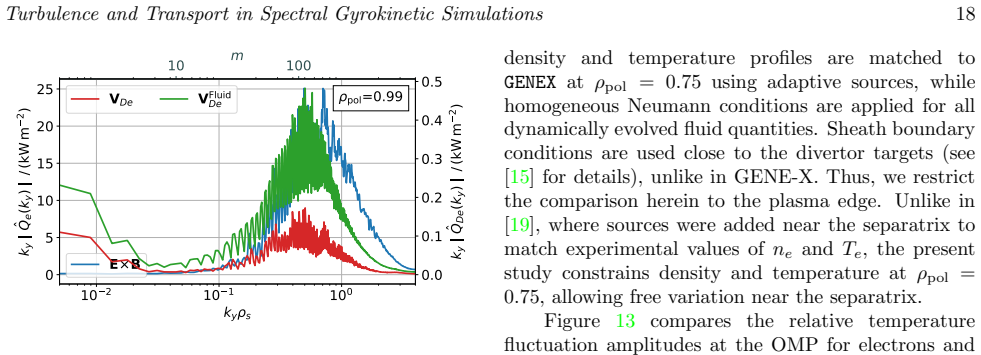
The central claim is that a spectral full-f gyrokinetic formulation in velocity space is not just a cheap surrogate for profiles: it faithfully reproduces the TEM-driven turbulent state. For spectral resolutions (4,2), (8,4), and (16,8), the fluctuation spectra, mode propagation in the electron diamagnetic direction, phase shifts between density and temperature fluctuations and the potential, and the flux spectra match the high-fidelity grid-based simulation; the (16,8) case gives a separatrix-crossing power of 131.7 kW, within 10% of the experimental TCV value of 120 kW and close to the grid-based 125.2 kW. The paper also verifies the radial force balance and decomposes the radial electric field in the edge and scrape-off layer, and contrasts the TEM-dominated gyrokinetic result with a Braginskii-like fluid model that misses TEMs entirely.
Load-bearing premise
The paper treats the (80,60) grid-based simulation as the true turbulent reference; if that reference is under-resolved or shares the same systematic modeling error, the close match does not by itself establish physical accuracy.
Editorial extensions
If this is right
- The spectral full-f approach can predict edge and scrape-off-layer turbulence and transport at a fraction of the cost of grid-based full-f simulations, making routine TEM-resolving edge simulations more feasible.
- If the agreement with the grid-based reference holds, separatrix power can be predicted to about 10% in this L-mode scenario, which is strong evidence for predictive transport modeling.
- Braginskii-like fluid models that neglect trapped-electron physics can misattribute or under-predict transport; in TCV-X21 they miss the dominant TEM channel by an order of magnitude in separatrix power.
- Resolution sensitivity is weak, so a small fixed set of spectral coefficients may be sufficient across edge conditions as long as the dominant instabilities remain similar.
- The verified radial force balance means the long-wavelength radial electric field and flows are consistent with the turbulence in the full-f simulation, a prerequisite for credible transport predictions.
Reading between the lines
- A natural test of the claim is to apply the spectral approach to a second experimental scenario with different turbulence (for example ITG- or pedestal-dominated) and check whether the same few spectral coefficients remain sufficient.
- The radial-force-balance and Er decomposition could be used as routine quality diagnostics in full-f simulations; a simulation that does not satisfy the balance is probably not converged.
- The finding that the fluid diamagnetic flux overestimates the kinetic one by roughly a factor of three suggests that fluid models may need kinetic corrections beyond pressure anisotropy, even where TEMs are weak.
- The spectral method's efficiency may open the door to electromagnetic or multi-ion edge simulations that are currently too expensive in grid-based full-f codes.
Signed reviews
Editorial analysis
A structured set of objections, weighed in public.
Referee Report
Summary. This manuscript reports an extended validation and physics analysis of the spectrally accelerated full-f gyrokinetic code GENE-X on the TCV-X21 L-mode scenario. Building on the earlier spectral implementation paper [Frei et al., arXiv:2411.09232], the authors compare spectral simulations at three velocity-space resolutions against grid-based GENE-X simulations: normalized OMP gradients, radial force balance, the decomposition of the radial electric field in the edge and SOL, turbulence spectra, phase shifts between fluctuations, turbulent particle and heat fluxes, power crossing the separatrix, divertor heat flux, and diamagnetic flux contributions. They also contrast the gyrokinetic results with drift-reduced Braginskii simulations using GRILLIX, finding that the fluid model misses the TEM-driven transport that dominates in the GK simulations. The central claim is that the spectral approach quantitatively reproduces the grid-based results, including a separatrix power Psep = 131.7 kW for the (16,8) spectral case, close to the experimental TCV value of about 120 kW.
Significance. If the central comparison is sound, the paper makes a useful contribution: it demonstrates that a small spectral velocity-space basis is sufficient to capture not only mean profiles but also the fluctuation spectra, phase shifts, fluxes, and power balance that are usually viewed as demanding full velocity-space resolution. The manuscript is generally well organized, and the authors deserve credit for including detailed diagnostics, an explicit force-balance verification, a treatment of diamagnetic fluxes, a comparison against a lower-fidelity fluid model, and a public data record for the grid-based simulations. The significance is, however, conditional: the primary validation is a comparison between two discretizations of the same gyrokinetic model within the same code family, and the single experimental number used as an external anchor is a time- and surface-averaged power without a stated statistical uncertainty. The paper would be strengthened by an explicit statement of this limitation and by correcting the overbroad 'within 10%' phrasing.
major comments (3)
- [Abstract and Section 6.2, Table 1] The abstract and Section 6.2 state that the separatrix power agrees 'within 10%' with both grid-based results and experimental measurements, but Table 1 supports this only for the (16,8) spectral case. Relative to the grid-based 125.2 kW, the (4,2) case gives 142.4 kW (about 14% high) and the (8,4) case gives 144.9 kW (about 16% high); only the (16,8) case is within 10%. Relative to the experimental 120 kW, the (8,4) case is about 21% high and the (4,2) case about 19% high. The claim should be qualified to the (16,8) resolution or replaced by a stated range, and the statistical uncertainty of the 0.1 ms time average should be reported.
- [Section 3 versus Table 1] There is an unresolved inconsistency between the stated fidelity anchor and the reference actually reported. Section 3 says the grid-based simulations use (Nv_parallel, Nmu) = (80,60) and are treated as the highest-fidelity reference, while Table 1 lists only an '(80,24) Grid' case. As written, the reader cannot tell whether the black curves in Figures 5-10 and the 125.2 kW row come from the (80,60) case or the (80,24) case. If the actual reference is (80,24), the paper's stated justification for treating it as converged rests on an unpublished thesis reference and a qualitative statement that Nmu could be reduced to about 20. A documented velocity-space convergence test, or at minimum a clear statement of which grid resolution underlies every comparison, is needed before the agreement can be interpreted as a validation of the spectral method at the claimed fidelity level.
- [Section 3 and Section 6.2] The external anchor for physical accuracy is a single number, Psep = 120 kW, and the simulations are run with Dirichlet boundary conditions that impose experimental density and temperature profiles at the inner and outer radial boundaries. This setup is reasonable, but it means the agreement with experiment is not a fully independent check of the model: the boundary conditions already contain experimental profile information, and the separatrix power is a single scalar without a reported experimental or simulation uncertainty. I recommend adding a sentence that explicitly identifies which predictions are genuinely parameter-free and independent of the imposed boundary profiles, and which comparisons should be read as numerical self-consistency checks between the two discretizations.
minor comments (6)
- [Section 4.2, after Eq. (12)] The sentence 'Similarly, B_phi and B_phi are the toroidal and poloidal components' should read 'B_phi and B_theta'.
- [Section 2.2] The collision operator is called 'Lernard-Bernstein Daugherty' in Section 2.2; the standard spelling is 'Lenard-Bernstein/Dougherty' as used in Section 2.1.
- [Section 6.3, Figure 10] The divertor heat-flux comparison is explicitly qualitative, and the (4,2) case is excluded due to spurious oscillations in q_parallel_alpha. This is a reasonable choice, but the figure and text should make clear that the 'good agreement' statement in the conclusions refers only to the (8,4) and (16,8) cases and to the ion channel; the electron peak is about 15% higher and narrower than the grid-based result, and the falloff length is about 20% shorter.
- [Table 1 caption] The caption reads 'Psep in from TCV [19]'; it should read 'Psep = 120 kW from TCV [19]' or similar.
- [Section 4.3] The discussion of the Er decrease around rho_pol less than about 0.85 attributes it to the inner Dirichlet boundary condition on u_parallel_i; this is a useful caution, but it would be helpful to state explicitly that this feature is therefore not a physics prediction for TCV but a boundary-condition effect.
- [Section 6.4] In the diamagnetic-flux analysis, the conclusion that these fluxes are negligible is based on the (8,4) spectral run only; the text should state whether the same conclusion is expected to hold for the (16,8) run that is used for the main Psep comparison.
Circularity Check
No circularity: spectral-vs-grid comparison is discretization consistency, and the experimental Psep comparison is an external anchor.
full rationale
The paper's central claim is that the spectrally accelerated GENE-X approach reproduces grid-based GENE-X turbulence and transport. This is a numerical self-consistency comparison between two discretizations of the same full-f gyrokinetic model, not a derivation in which an output is defined as an input. The spectral equations (7)-(11) are obtained by projecting the GK Vlasov equation and Maxwell equations onto a Hermite-Laguerre basis; nothing in that construction is fitted to the turbulence statistics being compared. The power-balance result in Table 1 is anchored to an external benchmark: Psep = 120 kW from TCV [19], and no parameter is tuned to match that value in either the spectral or grid-based runs. The analytical estimates in Sections 4.3-4.4 and Appendix A are derived from the same GK equations and then checked against the simulation; they are consistency diagnostics rather than independent predictions whose agreement would constitute a circularity. Self-citations to [18], [7], [27], and [29] are present, but the load-bearing spectral-vs-grid comparisons in Figures 5-10 are between two independent numerical discretizations and do not reduce to a self-citation chain: the spectral method would still be tested against the grid method even if every cited paper were removed. The noted inconsistency between the (80,60) reference resolution stated in Section 3 and the (80,24) grid case reported in Table 1 is a fidelity/convergence concern, not a circularity; an under-resolved reference would weaken the validation but would not make any predicted quantity equal to an input by construction. No step in the paper, by its own equations or by a fitted parameter renamed as a prediction, reduces to its own inputs.
Assumptions & free parameters
free parameters (3)
- Reference temperature tau_alpha for spectral basis =
20 eV (Tref)
- Spectral diagonal damping coefficient =
not stated
- GRILLIX heat-flux limiters =
alpha_e = alpha_i = 1.0
assumptions (5)
- domain assumption The long-wavelength gyrokinetic model (Equations 1-6) is a valid description of the TCV-X21 edge plasma
- domain assumption The Lenard-Bernstein/Dougherty collision operator is sufficient; the omitted thermal force (0.71 grad_parallel T_e) and velocity-dependent collision frequency are not important for the central turbulence comparison
- domain assumption Dirichlet boundary conditions matching experimental profiles at the inner and outer radial boundaries do not force the separatrix power to match experiment
- domain assumption The (80,60) grid-based simulation is a converged, high-fidelity reference
- domain assumption Averaging over 0.1-0.2 ms in quasi-steady state yields converged turbulence statistics
Cite this review
Pith. "Pith review of Turbulence and Transport in Spectrally Accelerated full-f Gyrokinetic Simulations." pith.science (2026). https://pith.science/paper/5536EBY4
@misc{pith2026250504832,
  author       = {Pith},
  title        = {Pith review of: Turbulence and Transport in Spectrally Accelerated full-f Gyrokinetic Simulations},
  year         = {2026},
  howpublished = {\url{https://pith.science/paper/5536EBY4}},
  note         = {Machine review of arXiv:2505.04832}
}
read the original abstract
We investigate edge and scrape-off layer (SOL) turbulence and transport using the spectrally accelerated full-f gyrokinetic (GK) code GENE-X, recently introduced in [B. J. Frei et al., arXiv:2411.09232 (2024)]. Extending previous work on the TCV-X21 scenario, we show that the velocity-space spectral approach not only reproduces outboard midplane profiles but also captures key features of trapped electron mode (TEM)-driven turbulence and transport, including fluctuation spectra, turbulent fluxes, phase shifts, and power crossing the separatrix, in close agreement with grid-based results. This agreement remains robust when increasing spectral resolutions. We further analyze the radial force balance (accurately satisfied) and the structure of the radial electric fields and poloidal flows in the edge and SOL. Finally, we contrast our results with Braginskii-like fluid models, which inherently neglect TEMs. These results confirm the spectral full-f GENE-X approach as an efficient and first-principles tool for predicting edge and SOL turbulence.
Figures


Figures from the paper (10 more)



Reference graph
Works this paper leans on
-
[1]
Ikeda K 2007 Nuclear Fusion 47 E01
work page 2007
-
[2]
Zohm H, Angioni C, Fable E, Federici G, Gantenbein G, Hartmann T, Lackner K, Poli E, Porte L, Sauter O et al. 2013 Nuclear Fusion 53 073019
work page 2013
-
[3]
2022 Plasma Physics and Controlled Fusion 64 034005
Litaudon X, Jenko F, Borba D, Borodin D V, Braams B J, Brezinsek S, Calvo I, Coelho R, Donn´ e A J H, Embr´ eus O et al. 2022 Plasma Physics and Controlled Fusion 64 034005
work page 2022
-
[4]
Brizard A J and Hahm T S 2007 Reviews of modern physics 79 421
work page 2007
-
[5]
Zeiler A, Drake J F and Rogers B 1997 Physics of Plasmas 4 2134
work page 1997
-
[6]
Frei B J, Jorge R and Ricci P 2020 Journal of Plasma Physics 86 905860205
work page 2020
-
[7]
Ulbl P, Body T, Zholobenko W, Stegmeir A, Pfennig J and Jenko F 2023 Physics of Plasmas 30 107986
work page 2023
-
[8]
Frei B J, Hoffmann A C D and Ricci P 2022 Journal of Plasma Physics 88 905880304
work page 2022
Show all 46 references
-
[9]
Mandell N R, Hakim A, Hammett G W and Francisquez M 2020 Journal of Plasma Physics 86 905860109
2020
-
[10]
Michels D, Stegmeir A, Ulbl P, Jarema D and Jenko F 2021 Comput. Phys. Commun. 264 107986
2021
-
[11]
Hager R, Ku S, Sharma A Y, Chang C S, Churchill R M and Scheinberg A 2022 Physics of Plasmas 29
2022
-
[12]
Bottino A, Stier A, Boesl M, Hayward-Schneider T, Bergmann A, Coster D, Brunner S, Di Giannatale G and Villard L 2025 Plasma Physics and Controlled Fusion 67 025008
2025
-
[13]
2007 Plasma Physics and Controlled Fusion 49 B173
Grandgirard V, Sarazin Y, Angelino P, Bottino A, Crouseilles N, Darmet G, Dif-Pradalier G, Garbet X, Ghendrih P, Jolliet S et al. 2007 Plasma Physics and Controlled Fusion 49 B173
2007
-
[14]
Tamain P, Bufferand H, Ciraolo G, Colin C, Galassi D, Ghendrih P, Schwander F and Serre E 2016 Journal of Computational Physics 321 606
2016
-
[15]
2019 Physics of Plasmas 26 052517
Stegmeir A, Ross A, Body T, Francisquez M, Zholobenko W, Coster D, Maj O, Manz P, Jenko F, Rogers B Net al. 2019 Physics of Plasmas 26 052517
2019
-
[16]
Giacomin M, Ricci P, Coroado A, Fourestey G, Galassi D, Lanti E, Mancini D, Richart N, Stenger L and Varini N 2021 J. Comput. Phys. 463 111294
2021
-
[17]
Pitzal C, Stegmeir A, Zholobenko W, Zhang K and Jenko F 2023 Physics of Plasmas 30
2023
-
[18]
Frei B J, Ulbl P, Trilaksono J and Jenko F 2024 arXiv preprint arXiv:2411.09232
2024 arXiv
-
[19]
2022 Nuclear Fusion 62 096001
Oliveira D S, Body T, Galassi D, Theiler C, Laribi E, Tamain P, Stegmeir A, Giacomin M, Zholobenko W, Ricci P et al. 2022 Nuclear Fusion 62 096001
2022
-
[20]
Dif-Pradalier G, Grandgirard V, Sarazin Y, Garbet X and Ghendrih P 2009 Physical Review Letters 103 065002
2009
-
[21]
2021 Plasma Physics and Controlled Fusion 63 034001
Zholobenko W, Body T, Manz P, Stegmeir A, Zhu B, Griener M, Conway G D, Coster D, Jenko F, Team A U et al. 2021 Plasma Physics and Controlled Fusion 63 034001
2021
-
[22]
Scott B and Smirnov J 2010 Physics of Plasmas 17
2010
-
[23]
Dougherty J P 1964 The Physics of Fluids 7 1788
1964
-
[24]
Ulbl P, Michels D and Jenko F 2022 Contributions to Plasma Physics 62 e202100180
2022
-
[25]
2022 Physics of Plasmas 29
Michels D, Ulbl P, Zholobenko W, Body T, Stegmeir A, Eich T, Griener M, Conway G D, Jenko F, Team A U et al. 2022 Physics of Plasmas 29
2022
-
[26]
Gradshteyn I S and Ryzhik I M 2014 Table of integrals, series, and products (Academic press)
2014
-
[27]
Frei B J, Hoffmann A C D, Ricci P, Brunner S and Tecchioll Z 2023 Journal Of Plasma Physics 89 905890414
2023
-
[28]
Ulbl P, Body T, Zholobenko W, Stegmeir A, Pfennig J and Jenko F 2023 TCV-X21-GENEX: influence of collisions on the validation of global gyrokinetic simulations URL https://zenodo.org/record/7894731
2023
-
[29]
thesis Technische Universit¨ at M¨ unchen
Ulbl P 2023 Collision Models for Gyrokinetic Simulations of Edge Turbulence in Fusion Plasmas Ph.D. thesis Technische Universit¨ at M¨ unchen
2023
-
[30]
Hazeltine R D and Meiss J D 2013 Plasma confinement (Courier Corporation)
2013
-
[31]
Kim Y B, Diamond P H and Groebner R J 1991 Physics of Fluids B: Plasma Physics 3 2050
1991
-
[32]
2023 Physics of Plasmas 30
Plank U, Brida D, Conway G, Happel T, Hubbard A, P¨ utterich T, Angioni C, Cavedon M, Dux R, Eich Tet al. 2023 Physics of Plasmas 30
2023
-
[33]
Connor J W, Hastie R J and Helander P 2006 Plasma physics and controlled fusion 48 885
2006
-
[34]
2023 Nuclear Materials and Energy 34 101351
Zholobenko W, Pfennig J, Stegmeir A, Body T, Ulbl P, Jenko F, Team A U et al. 2023 Nuclear Materials and Energy 34 101351
2023
-
[35]
Dannert T and Jenko F 2005 Physics of Plasmas 12
2005
-
[36]
2013 Nuclear fusion 53 093031
Eich T, Leonard A W, Pitts R A, Fundamenski W, Goldston R J, Gray T K, Herrmann A, Kirk A, Kallenbach A, Kardaun O et al. 2013 Nuclear fusion 53 093031
2013
-
[37]
2017 Nuclear Fusion 57 116023
Chang C S, Ku S, Loarte A, Parail V, Koechl F, Romanelli M, Maingi R, Ahn J W, Gray T, Hughes J et al. 2017 Nuclear Fusion 57 116023
2017
-
[38]
2024 Nuclear Fusion 64 106066
Zholobenko W, Zhang K, Stegmeir A, Pfennig J, Eder K, Pitzal C, Ulbl P, Griener M, Radovanovic L, Plank U et al. 2024 Nuclear Fusion 64 106066
2024
-
[39]
Helander P and Sigmar D J 2005 Collisional transport in magnetized plasmas vol 4 (Cambridge university press)
2005
-
[40]
Zhang K, Zholobenko W, Stegmeir A, Eder K and Jenko F 2024 Nuclear Fusion 64 036016
2024
-
[41]
Ulbl P, Stegmeir A, Told D, Merlo G, Zhang K and Jenko F 2025 arXiv preprint arXiv:2504.00475
2025 arXiv
-
[42]
thesis EPFL Lausanne URL https: //infoscience.epfl.ch/handle/20.500.14299/210187
Brunner S 1997 Global approach to the spectral problem of microinstabilities in tokamak plasmas using a gyroki- netic model Ph.D. thesis EPFL Lausanne URL https: //infoscience.epfl.ch/handle/20.500.14299/210187
1997
-
[43]
Catto P J and Tsang K T 1978 The Physics of Fluids 21 1381
1978
-
[44]
2004 Physics of Plasmas 11 2637
Ernst D R, Bonoli P T, Catto P J, Dorland W, Fiore C L, Granetz R S, Greenwald M, Hubbard A E, Porkolab M, Redi M H et al. 2004 Physics of Plasmas 11 2637
2004
-
[45]
Chen L, Berger R L, Lominadze J G, Rosenbluth M N and Rutherford P H 1977 Physical Review Letters 39 754
1977
-
[46]
Zhao C, Zhang T and Xiao Y 2017 Physics of Plasmas 24
2017
Reviewed August 15, 2026 · model on record in the stance chip above.
Discussion (0). Continue with ORCID to comment.