REVIEW 3 major objections 6 minor 43 references
Model-Based Closed-Loop Control Algorithm for Stochastic Partial Differential Equation Control
T0 review · 3 major / 6 minor · reviewed 2026-08-15 · deepseek-v4-flash
Pith's one-line read The paper proposes MB-CC, a closed-loop controller for stochastic PDEs built on regularity-structure features, and reports that it tracks targets faster and more accurately than open-loop neural control or reinforcement learning.
desk verdict The core method is useful and the experiments are extensive, but the paper never states whether the reported control errors come from the true simulator or the learned surrogate, and that needs fixing before I trust the numbers. read the letter →
The pith
A machine-rendered reading of the paper's core claim, the machinery that carries it, and where it could break.
The reading
What carries the argument
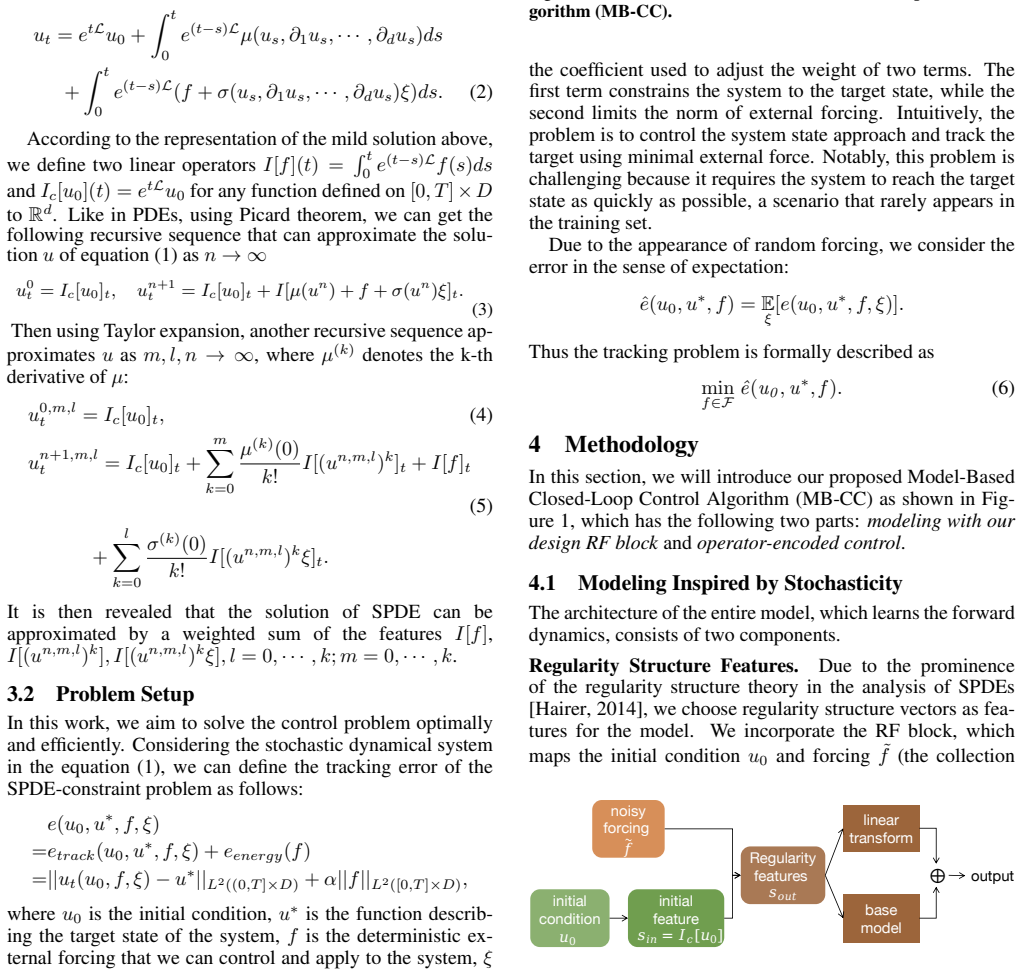
The load-bearing mechanism is the Regularity Feature (RF) block, which generates the feature set $S_{n,m,l}$ by iterating Picard-style integrations of products of the state, its derivatives, and the noise $\xi$ through the discretized linear operator $(\mathrm{Id} - L_{\mathrm{dis}}\delta t)^{-1}$, mirroring the Taylor expansion of the SPDE's mild solution. These features carry the low-regularity part of the dynamics, and the surrogate output is $\tilde{u}_\theta = \theta_1 s_{\mathrm{out}} + W_{\theta_2}(s_{\mathrm{out}}, O)$, so the backbone network only models the truncation residual. The same discretized operator $L_{\mathrm{dis}}$ is injected into the operator-encoded policy network by concatenating $u_t$ and $L_{\mathrm{dis}}u_t$ for the current state and the target state, which gives the feedback law physical information and a single-forward-pass path from state to control.
What would settle it
Run a trained MB-CC policy against a high-accuracy numerical solution of the same SPDE on unseen noise draws and compare the realized tracking objective with the surrogate-evaluated loss; a gap that widens when the noise scale goes from $\sigma=0.05$ to $\sigma=1$ would show that surrogate bias, not just stochasticity, limits the closed-loop claim.
Extended reading notes
Core claim
The paper presents MB-CC as the first model-based closed-loop control method for SPDEs and claims that its two design choices address the two ways noise breaks control: low regularity breaks the surrogate, and open-loop decisions break the feedback. The RF block computes the Picard/Taylor terms that regularity structure theory singles out—integrals of powers of the state, the deterministic forcing, the noise, and their products against the linear evolution operator—and lets the backbone network fit only the truncated remainder; the operator-encoded policy network observes the current and target states, embeds both with the discretized SPDE operator, and outputs the next external force. The policy is trained by backpropagating the tracking loss through the differentiable surrogate with many sampled noise realizations. The experimental claim is that on the 1-D stochastic reaction-diffusion and 2-D stochastic Navier-Stokes benchmarks this combination lowers the tracking objective and cuts control generation from tens of seconds to a fraction of a second, and that the advantage grows when the noise scale is raised.
Load-bearing premise
The policy network is trained entirely on trajectories predicted by the learned surrogate model rather than on the true SPDE, so the controller's quality depends on the surrogate being close enough to the real system in exactly the state regions the policy visits.
Editorial extensions
If this is right
- Control generation becomes a single forward pass: the policy net produces actions in about 0.25–0.31 seconds on the reaction-diffusion task and 0.02–0.10 seconds on the Navier-Stokes task, versus tens of seconds for open-loop optimization.
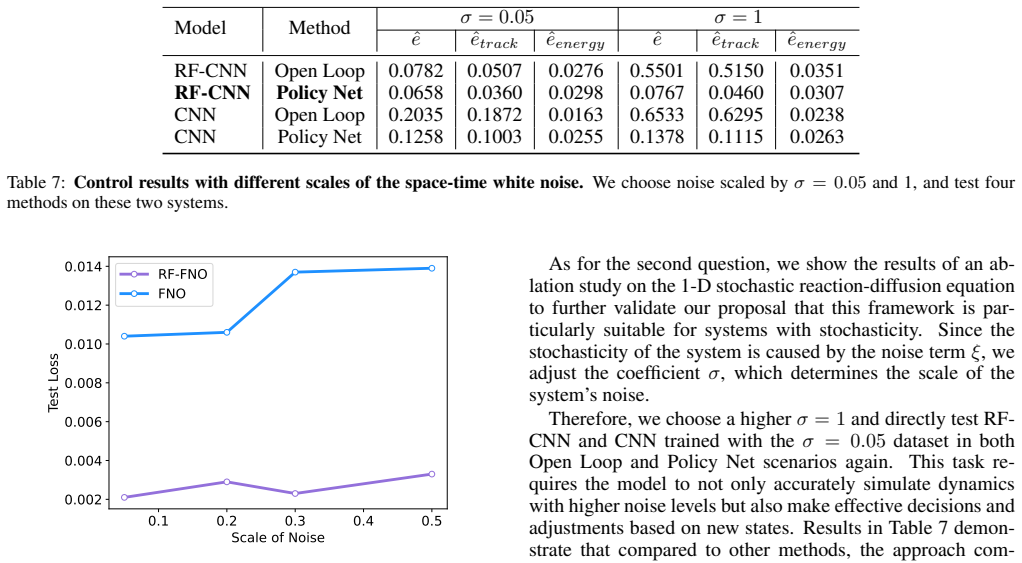
- The RF block is plug-and-play: adding it to a CNN or FNO backbone cuts forward-modeling error on the reaction-diffusion equation from 0.0182 to 0.0115 for CNN and from 0.0138 to 0.0029 for FNO.
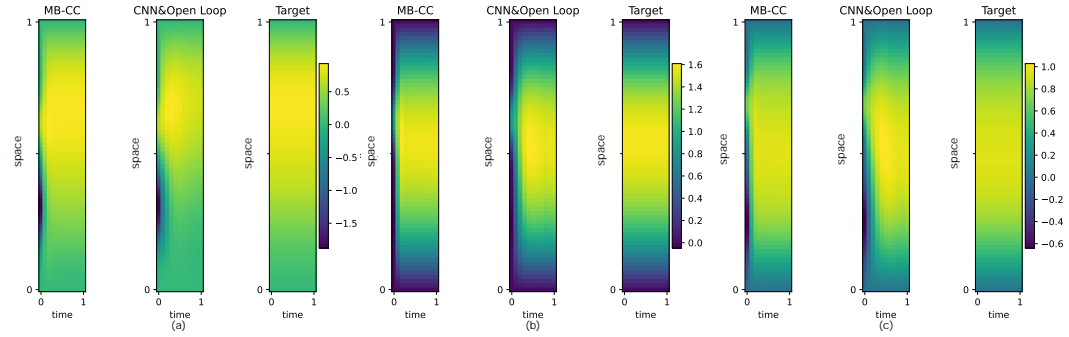
- Every backbone tested works better with the policy net than in open-loop mode, and the full MB-CC combination beats SAC by at least an order of magnitude in objective loss on both benchmark SPDEs.
- Raising the noise scale from $\sigma = 0.05$ to $\sigma = 1$ degrades open-loop control sharply, while the RF-policy combination holds its objective approximately constant, supporting the claim that the gains come from stochasticity handling.
Reading between the lines
- A natural next test is to add a model-bias or adversarial-disturbance term to the policy loss, since the paper's closed-loop claim is only as strong as the surrogate's fidelity and the paper does not quantify that gap.
- The same operator-encoded architecture could be retrained for stabilization, switching setpoints, or energy minimization by changing only the loss functional; the paper demonstrates only tracking, so these remain open extensions.
- Because closed-loop control replaces iterative optimization with one network evaluation, the real bottleneck for deployment is the RF-enhanced surrogate's accuracy on out-of-distribution states, which suggests a fine-tuning-on-real-data stage as the decisive practical next step.
Signed reviews
Editorial analysis
A structured set of objections, weighed in public.
Referee Report
Summary. The paper proposes MB-CC, a model-based closed-loop control algorithm for stochastic partial differential equations (SPDEs). The method has two components: a Regularity Feature (RF) block, inspired by regularity structure theory, which transforms the state and forcing into features used by a neural-operator surrogate model; and an operator-encoded policy network Pγ that maps the current state, target state, and time to a control action, trained by backpropagating a tracking/energy objective through the learned surrogate. The method is evaluated on tracking problems for a 1-D stochastic reaction-diffusion equation and a 2-D stochastic Navier-Stokes equation, comparing against open-loop control with CNN/FNO/RF-based surrogates and a Soft Actor-Critic reinforcement learning baseline. The reported results show substantially lower objective loss and much faster inference for the policy-net variants, with ablations across noise scales.
Significance. If the reported results are obtained by evaluating the learned policy on the true numerical SPDE solver, MB-CC would be a meaningful advance in neural closed-loop control for stochastic systems, combining a physically motivated feature block with a fast, feedback-based policy. The paper provides code, evaluates two different backbone architectures to demonstrate plug-and-play behavior, and includes ablations showing robustness to increased noise amplitude. These are concrete strengths. However, the central quantitative claims hinge on an evaluation-protocol detail that the manuscript does not state explicitly, and the surrogate-to-environment gap is treated only as an assumption rather than a measured quantity. The contribution is therefore defensible but requires additional verification before the headline comparisons can be accepted.
major comments (3)
- [§4.2, §5 (Tables 2, 5, 7)] The evaluation protocol for the control experiments is not stated. Section 4.2 says that 'throughout the process, we use the model's prediction ũ_θ to simulate the trajectories rather than interact with the environment,' and the policy loss in Eq. (8) is computed through the surrogate. It is therefore unclear whether the objective values reported in Tables 2, 5, and 7 are obtained by rolling out Pγ on the true numerical SPDE solver or by re-simulating with the learned surrogate. If the latter, the improvements over open-loop baselines would be in-sample for the surrogate, and the 'closed-loop control' claim for the actual SPDE would not be supported. The manuscript must state explicitly which environment is used for evaluation and, if the reported numbers are surrogate-based, add an evaluation on the true solver.
- [§4.2, §5.1–5.2] The load-bearing premise that the learned surrogate is 'close enough to the environment' for policy training and evaluation is not quantified. Forward-model errors in Tables 1 and 4 are reported on the training data distribution, but the policy induces a different state-action distribution, and the tracking objective involves long-horizon rollouts. The paper does not measure how surrogate prediction error propagates to policy loss or closed-loop tracking error. A concrete fix is to compare policy rollouts under the true solver with those under the surrogate, reporting the resulting tracking error and objective value for at least one configuration per equation.
- [§5.1–5.2, Tables 2–6] The empirical comparisons lack statistical robustness and baseline-detail information. No error bars, standard deviations, or multiple-seed results are reported for the control metrics. The open-loop baselines are underspecified: the manuscript does not describe how the open-loop control sequence is optimized (e.g., gradient descent through the learned model, number of iterations, initialization, or stopping criterion), which is necessary because the open-loop timing comparisons in Tables 3 and 6 depend on that optimization procedure. The SAC baseline also lacks details such as reward shaping, replay buffer size, environment interface, and hyperparameter tuning. These omissions weaken the strength of the claims that MB-CC outperforms the baselines.
minor comments (6)
- [Eq. (8)] The notation in Eq. (8) is ambiguous: the state is written as ũ_{t,θ}(u0, Pγ(ũ_t, u_T, t), ξ_i), but the argument t appears both as the current time index and as the integration interval endpoint [0,T]; the meaning of ũ_t inside Pγ should be defined more precisely, for instance by writing the time subscript explicitly.
- [Algorithm 1] The condition '1 ≤ k + j ≤ m I_{j=0} + ℓ I_{j>0}' in Step 3 is garbled and likely a typesetting artifact; it should be written with explicit indicator functions or a verbal description so that the allowed Taylor orders are unambiguous.
- [§4.1, Data Augmentation] The data augmentation procedure is described only as 'increasing the proportion of difficult-to-fit data in the dataset through duplication.' The paper should specify which samples are considered difficult, the duplication factor, and whether the augmentation is applied to the training set for the forward model, the policy network, or both.
- [§5.1] The distributions of u0 and f are said to 'follow the previous work [Hwang et al., 2021]' without giving the actual distributions. For reproducibility, the manuscript should state the distributional form or provide the generating code in the supplement.
- [Figure 4] The horizontal axis is labeled 'Scale of Noise' but the caption and text refer to specific σ values (0.05, 0.2, 0.3, 0.5). The figure should use σ as the axis label or explain the monotone mapping.
- [Abstract and §1] The claim of being 'the first model-based closed-loop control method for SPDEs' is strong; given the prior DDPG-based SPDE control work of Pirmorad et al. [2021] and the existence of closed-loop neural PDE controllers, the novelty statement should be qualified to 'first model-based closed-loop method that combines a learned surrogate with an operator-encoded policy trained by backpropagation' or similar, to avoid overclaiming.
Circularity Check
No significant circularity: MB-CC's derivation is self-contained; the only concern is an unverified evaluation-protocol caveat, not a demonstrated circular step.
full rationale
The derivation chain is self-contained. The RF block features are constructed from the SPDE's Picard/Taylor expansion (equations 3-5) and the discretized operator L_dis from the SPDE itself, not from the control objective or the reported tracking results. The forward model output in equation (7) is a linear combination of these features plus a learned residual, with an independent test set reported in Tables 1 and 4. The policy loss in equation (8) uses the surrogate model u~_theta to approximate the expected tracking objective in equation (6), but this is an approximation, not an identity: u~_theta is a learned model trained on separately simulated trajectories, and the control evaluation is benchmarked against open-loop and SAC baselines rather than being derived from the policy's own training loss. The self-citations to Hu et al. 2022 and Gong et al. 2023 are used as prior work on regularity features, but the features themselves are re-derived from Hairer's theory, so no load-bearing argument reduces to an unverified self-citation. The one caveat is Section 4.2's statement: "throughout the process, we use the model's prediction u~_theta to simulate the trajectories rather than interact with the environment, as it is supposed to be close enough to the environment." If the control results in Tables 2 and 5 were computed on the same surrogate, those quantitative claims would be in-sample for the learned model and would not establish control of the true SPDE. However, the manuscript does not explicitly confirm that protocol, and the text is also compatible with the charitable reading that the surrogate is used only during policy training while evaluation uses the numerical solver. Since the specific reduction required for a circularity finding cannot be exhibited from the paper's equations, this remains an experimental-reporting ambiguity rather than a demonstrated circular step.
Assumptions & free parameters
free parameters (4)
- RF feature heights n, m, l
- Tracking/energy weight alpha =
0.01 (1D), 100 (2D)
- Data augmentation duplication factor
- Number of noise samples N in policy loss =
50 (1D), 20 (2D)
assumptions (5)
- standard math The SPDE (1) has a unique mild solution under local Lipschitz conditions.
- domain assumption The solution can be approximated by a finite truncation of the Picard/Taylor expansion, and the resulting regularity features S_{n,m,l} are a sufficient basis for the neural network.
- domain assumption The finite-difference discretization L_dis accurately approximates the continuous operator L for feature generation and policy input.
- ad hoc to paper The learned forward model u~_theta is close enough to the true environment to be used for policy training and for simulating the objective.
- domain assumption Noise is smoothed space-time white noise with a moving average window of 3, and the resulting process is representative of the stochastic forcing.
Cite this review
Pith. "Pith review of Model-Based Closed-Loop Control Algorithm for Stochastic Partial Differential Equation Control." pith.science (2026). https://pith.science/paper/E4VWC7Y4
@misc{pith2026250505521,
  author       = {Pith},
  title        = {Pith review of: Model-Based Closed-Loop Control Algorithm for Stochastic Partial Differential Equation Control},
  year         = {2026},
  howpublished = {\url{https://pith.science/paper/E4VWC7Y4}},
  note         = {Machine review of arXiv:2505.05521}
}
read the original abstract
Neural operators have demonstrated promise in modeling and controlling systems governed by Partial Differential Equations (PDEs). Beyond PDEs, Stochastic Partial Differential Equations (SPDEs) play a critical role in modeling systems influenced by randomness, with applications in finance, physics, and beyond. However, controlling SPDE-governed systems remains a significant challenge. On the one hand, the regularity of the system's state (which can be intuitively understood as smoothness) deteriorates, making modeling and generalization more challenging. On the other hand, this stochasticity also renders control more unstable and thus less accurate. To address this gap, we propose the Model-Based Closed-Loop Control Algorithm (MB-CC), the first model-based closed-loop control method for SPDEs. MB-CC introduces two key innovations to enhance control robustness and efficiency: a Regularity Feature (RF) block and a closed-loop strategy with an operator-encoded policy network. The RF block, inspired by the regularity structure theory of SPDEs, addresses noise-induced irregularities by transforming the network's input, including the system state and noise-perturbed external forces, into a refined feature space for improved forward prediction. Compared to previous works using regularity features, we introduce a new parameterization, data augmentation, and extend the RF block as a plug-and-play component. Additionally, to achieve closed-loop control, we introduce an operator-encoded policy network to map the current state to optimal control, which integrates physical priors and swiftly makes decisions based on states returned by the environment. We conduct a systematic evaluation of MB-CC on two notable SPDEs, showcasing its effectiveness and efficiency. The ablation studies show its ability to handle stochasticity more effectively.
Figures

Figures from the paper (3 more)


Reference graph
Works this paper leans on
-
[1]
Pid control system analysis, design, and technology
Kiam Heong Ang, Gregory Chong, and Yun Li. Pid control system analysis, design, and technology. IEEE transactions on control systems technology , 13(4):559--576, 2005
work page 2005
-
[2]
Conditioned stochastic differential equations: theory, examples and application to finance
Fabrice Baudoin. Conditioned stochastic differential equations: theory, examples and application to finance. Stochastic Processes and their Applications , 100(1-2):109--145, 2002
work page 2002
-
[3]
Carlos A Braumann. Introduction to stochastic differential equations with applications to modelling in biology and finance . John Wiley & Sons, 2019
work page 2019
-
[4]
Identification of functional parameters in partial differential equations
Guy Chavent. Identification of functional parameters in partial differential equations. In Joint Automatic Control Conference , number 12, pages 155--156, 1974
work page 1974
-
[5]
Feature engineering with regularity structures
Ilya Chevyrev, Andris Gerasimovi c s, and Hendrik Weber. Feature engineering with regularity structures. Journal of Scientific Computing , 98(1):13, 2024
work page 2024
-
[6]
Michel Cristofol and Lionel Roques. Simultaneous determination of the drift and diffusion coefficients in stochastic differential equations. Inverse problems , 33(9):095006, 2017
work page 2017
-
[7]
Stochastic dynamics of a coupled atmosphere--ocean model
Jinqiao Duan, Hongjung Gao, and Bj \"o rn Schmalfu . Stochastic dynamics of a coupled atmosphere--ocean model. Stochastics and Dynamics , 2(03):357--380, 2002
work page 2002
-
[8]
Deep latent regularity network for modeling stochastic partial differential equations
Shiqi Gong, Peiyan Hu, Qi Meng, Yue Wang, Rongchan Zhu, Bingguang Chen, Zhiming Ma, Hao Ni, and Tie-Yan Liu. Deep latent regularity network for modeling stochastic partial differential equations. In Proceedings of the AAAI Conference on Artificial Intelligence , volume 37, pages 7740--7747, 2023
work page 2023
Show all 43 references
-
[9]
Soft actor-critic: Off-policy maximum entropy deep reinforcement learning with a stochastic actor
Tuomas Haarnoja, Aurick Zhou, Pieter Abbeel, and Sergey Levine. Soft actor-critic: Off-policy maximum entropy deep reinforcement learning with a stochastic actor. In International conference on machine learning , pages 1861--1870. PMLR, 2018
2018
-
[10]
M. Hairer. A theory of regularity structures. Invent. Math , 198(2):269--504, 2014
2014
-
[11]
An algorithmic introduction to numerical simulation of stochastic differential equations
Desmond J Higham. An algorithmic introduction to numerical simulation of stochastic differential equations. SIAM review , 43(3):525--546, 2001
2001
-
[12]
Learning to control pdes with differentiable physics
Philipp Holl, Vladlen Koltun, and Nils Thuerey. Learning to control pdes with differentiable physics. CoRR , abs/2001.07457, 2020
2001 arXiv
-
[13]
Neural operator with regularity structure for modeling dynamics driven by spdes
Peiyan Hu, Qi Meng, Bingguang Chen, Shiqi Gong, Yue Wang, Wei Chen, Rongchan Zhu, Zhi-Ming Ma, and Tie-Yan Liu. Neural operator with regularity structure for modeling dynamics driven by spdes. arXiv preprint arXiv:2204.06255 , 2022
2022 arXiv
-
[14]
Wavelet diffusion neural operator
Peiyan Hu, Rui Wang, Xiang Zheng, Tao Zhang, Haodong Feng, Ruiqi Feng, Long Wei, Yue Wang, Zhi-Ming Ma, and Tailin Wu. Wavelet diffusion neural operator. The Thirteenth International Conference on Learning Representations , 2024
2024
-
[15]
Solving pde-constrained control problems using operator learning, 2021
Rakhoon Hwang, Jae Yong Lee, Jin Young Shin, and Hyung Ju Hwang. Solving pde-constrained control problems using operator learning, 2021
2021
-
[16]
Yun Li, Kiam Heong Ang, and G.C.Y. Chong. Pid control system analysis and design. IEEE Control Systems Magazine , 26(1):32--41, 2006
2006
-
[17]
Multipole graph neural operator for parametric partial differential equations
Zongyi Li, Nikola Kovachki, Kamyar Azizzadenesheli, Burigede Liu, Andrew Stuart, Kaushik Bhattacharya, and Anima Anandkumar. Multipole graph neural operator for parametric partial differential equations. Advances in Neural Information Processing Systems , 33:6755--6766, 2020
2020
-
[18]
Fourier neural operator for parametric partial differential equations
Zongyi Li, Nikola Borislavov Kovachki, Kamyar Azizzadenesheli, Kaushik Bhattacharya, Andrew Stuart, Anima Anandkumar, et al. Fourier neural operator for parametric partial differential equations. In International Conference on Learning Representations , 2021
2021
-
[19]
Continuous control with deep reinforcement learning
Timothy P Lillicrap, Jonathan J Hunt, Alexander Pritzel, Nicolas Heess, Tom Erez, Yuval Tassa, David Silver, and Daan Wierstra. Continuous control with deep reinforcement learning. arXiv preprint arXiv:1509.02971 , 2015
2015 arXiv
-
[20]
Non-homogeneous boundary value problems and applications: Vol
Jacques Louis Lions and Enrico Magenes. Non-homogeneous boundary value problems and applications: Vol. 1 , volume 181. Springer Science & Business Media, 2012
2012
-
[21]
Learning nonlinear operators via deeponet based on the universal approximation theorem of operators
Lu Lu, Pengzhan Jin, Guofei Pang, Zhongqiang Zhang, and George Em Karniadakis. Learning nonlinear operators via deeponet based on the universal approximation theorem of operators. Nature machine intelligence , 3(3):218--229, 2021
2021
-
[22]
Stochastic calculus and differential equations for physics and finance
Joseph L McCauley. Stochastic calculus and differential equations for physics and finance . Cambridge University Press, 2013
2013
-
[23]
Stochastic navier--stokes equations for turbulent flows
Remigijus Mikulevicius and Boris L Rozovskii. Stochastic navier--stokes equations for turbulent flows. SIAM Journal on Mathematical Analysis , 35(5):1250--1310, 2004
2004
-
[24]
An introduction to convolutional neural networks
Keiron O'shea and Ryan Nash. An introduction to convolutional neural networks. arXiv preprint arXiv:1511.08458 , 2015
2015 arXiv
-
[25]
Mistani , Miguel A
Samira Pakravan, Pouria A. Mistani , Miguel A. Aragon-Calvo, and Frederic Gibou. Solving inverse-pde problems with physics-aware neural networks. Journal of Computational Physics , 440:110414, 2021
2021
-
[26]
Deep reinforcement learning for online control of stochastic partial differential equations
Erfan Pirmorad, Faraz Khoshbakhtian, Farnam Mansouri, and Amir-massoud Farahmand. Deep reinforcement learning for online control of stochastic partial differential equations. arXiv preprint arXiv:2110.11265 , 2021
2021 arXiv
-
[27]
Physics-informed neural networks: A deep learning framework for solving forward and inverse problems involving nonlinear partial differential equations
Maziar Raissi, Paris Perdikaris, and George E Karniadakis. Physics-informed neural networks: A deep learning framework for solving forward and inverse problems involving nonlinear partial differential equations. Journal of Computational physics , 378:686--707, 2019
2019
-
[28]
Numerical treatment of stochastic differential equations
W R \"u emelin. Numerical treatment of stochastic differential equations. SIAM Journal on Numerical Analysis , 19(3):604--613, 1982
1982
-
[29]
Neural stochastic partial differential equations
Cristopher Salvi and Maud Lemercier. Neural stochastic partial differential equations. CoRR , abs/2110.10249, 2021
2021 arXiv
-
[30]
Neural stochastic pdes: Resolution-invariant learning of continuous spatiotemporal dynamics
Cristopher Salvi, Maud Lemercier, and Andris Gerasimovics. Neural stochastic pdes: Resolution-invariant learning of continuous spatiotemporal dynamics. In S. Koyejo, S. Mohamed, A. Agarwal, D. Belgrave, K. Cho, and A. Oh, editors, Advances in Neural Information Processing Syst...
2022
-
[31]
Proximal policy optimization algorithms
John Schulman, Filip Wolski, Prafulla Dhariwal, Alec Radford, and Oleg Klimov. Proximal policy optimization algorithms. arXiv preprint arXiv:1707.06347 , 2017
2017 arXiv
-
[32]
Nonlinear filtering of stochastic navier-stokes equation
SS Sritharan. Nonlinear filtering of stochastic navier-stokes equation. In Nonlinear Stochastic PDEs: Hydrodynamic Limit and Burgers’ Turbulence , pages 247--260. Springer, 1996
1996
-
[33]
On the solvability of the main inverse problem for stochastic differential systems
MI Tleubergenov and GT Ibraeva. On the solvability of the main inverse problem for stochastic differential systems. Ukrainian Mathematical Journal , 71(1):157--166, 2019
2019
-
[34]
Wavelet neural operator: a neural operator for parametric partial differential equations
Tapas Tripura and Souvik Chakraborty. Wavelet neural operator: a neural operator for parametric partial differential equations. arXiv preprint arXiv:2205.02191 , 2022
2022 arXiv
-
[35]
Diffphycon: A generative approach to control complex physical systems
Long Wei, Peiyan Hu, Ruiqi Feng, Haodong Feng, Yixuan Du, Tao Zhang, Rui Wang, Yue Wang, Zhi-Ming Ma, and Tailin Wu. Diffphycon: A generative approach to control complex physical systems. In The Thirty-eighth Annual Conference on Neural Information Processing Systems , 2024
2024
-
[36]
B-pinns: Bayesian physics-informed neural networks for forward and inverse pde problems with noisy data
Liu Yang, Xuhui Meng, and George Em Karniadakis. B-pinns: Bayesian physics-informed neural networks for forward and inverse pde problems with noisy data. Journal of Computational Physics , 425:109913, 2021
2021
-
[37]
The deep ritz method: a deep learning-based numerical algorithm for solving variational problems
Bing Yu et al. The deep ritz method: a deep learning-based numerical algorithm for solving variational problems. Communications in Mathematics and Statistics , 6(1):1--12, 2018
2018
-
[38]
Gradient-enhanced physics-informed neural networks for forward and inverse pde problems
Jeremy Yu, Lu Lu, Xuhui Meng, and George Em Karniadakis. Gradient-enhanced physics-informed neural networks for forward and inverse pde problems. Computer Methods in Applied Mechanics and Engineering , 393:114823, 2022
2022
-
[39]
Neural stochastic control
Jingdong Zhang, Qunxi Zhu, and Wei Lin. Neural stochastic control. Advances in neural information processing systems , 35:9098--9110, 2022
2022
-
[40]
Controlgym: Large-scale control environments for benchmarking reinforcement learning algorithms
Xiangyuan Zhang, Weichao Mao, Saviz Mowlavi, Mouhacine Benosman, and Tamer Ba s ar. Controlgym: Large-scale control environments for benchmarking reinforcement learning algorithms. arXiv preprint arXiv:2311.18736 , 2023
2023 arXiv
-
[41]
Lindell, and Gordon Wetzstein
Qingqing Zhao, David B. Lindell, and Gordon Wetzstein. Learning to solve pde-constrained inverse problems with graph networks. In ICML , 2022
2022
-
[42]
Solving time-continuous stochastic optimal control problems: Algorithm design and convergence analysis of actor-critic flow
Mo Zhou and Jianfeng Lu. Solving time-continuous stochastic optimal control problems: Algorithm design and convergence analysis of actor-critic flow. arXiv preprint arXiv:2402.17208 , 2024
2024 arXiv
-
[43]
write newline
" write newline "" before.all 'output.state := FUNCTION fin.entry add.period write newline FUNCTION new.block output.state before.all = 'skip after.block 'output.state := if FUNCTION new.sentence output.state after.block = 'skip output.state before.all = 'skip after.sentence '...
Reviewed August 15, 2026 · model on record in the stance chip above.
Discussion (0). Continue with ORCID to comment.