REVIEW 4 major objections 4 minor 81 references
Design and FPGA Implementation of WOMBAT: A Deep Neural Network Level-1 Trigger System for Jet Substructure Identification and Boosted $H\rightarrow b\bar{b}$ Tagging at the CMS Experiment
T0 review · 4 major / 4 minor · reviewed 2026-08-15 · deepseek-v4-flash
Pith's one-line read An FPGA neural network trigger can select boosted H→bbar jets at a 1 kHz rate with a jet pT threshold about 40 GeV lower than the standard CMS Single Jet 180 trigger.
desk verdict Solid ML trigger proof-of-concept with a real firmware implementation, but the deployability claim is internally contradicted by the 22-cycle latency and the rate normalization needs justification. read the letter →
The pith
A machine-rendered reading of the paper's core claim, the machinery that carries it, and where it could break.
The reading
What carries the argument
The carrying mechanism is a teacher–student knowledge-distillation pair sharing one input representation: the W-MM uses an Embedded Deterministic Autoencoder (EDA) that treats the azimuthal angle φ as cyclic—circularly padding that dimension while keeping η at full resolution—so the network learns jet substructure that wraps across the detector boundary. The distilled W-AM is an 8-bit quantized CNN with a custom pT-threshold layer that subtracts 30 GeV from each trigger region before convolution, filtering low-energy noise at no latency cost; its fixed two-jet output is what keeps it small enough for the FPGA. JEDI, the comparison baseline, is a fully rule-based pipeline of pileup-subtracted 3×3 energy sums, shape masks, and a 64-element bitonic sorter.
What would settle it
Recompute the 1 kHz rate crossing using the raw event counts without the normalization factor, or split the ZeroBias sample into independent run periods and require the threshold difference to reproduce in each; a movement larger than the ±5.5 GeV bin width would falsify the claim as stated.
Extended reading notes
Core claim
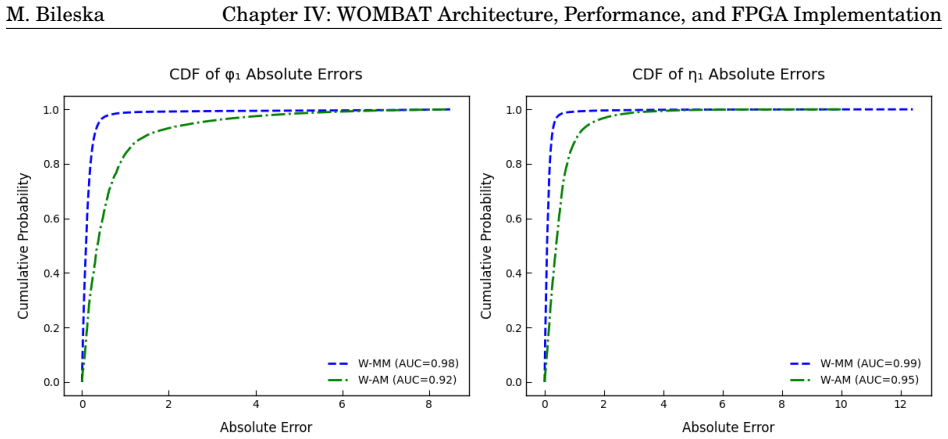
The claim, stated on the paper's own terms, is that WOMBAT—a convolutional-neural-network trigger built around an Embedded Deterministic Autoencoder and a distilled, 8-bit-quantized apprentice—can localize boosted H→bbar jets directly from a 14×18 grid of calorimeter trigger regions. W-MM achieves the 1 kHz rate at 146.8 GeV and W-AM at 140.4 GeV, compared with 187.4 GeV for Single Jet 180, with W-MM maintaining signal efficiency comparable to the baseline and W-AM accepting a lower-efficiency trade for hardware feasibility. The FPGA implementation of W-AM is reported at 22 clock cycles (137.5 ns) pre-place-and-route with resource usage within the target device, while the rule-based JEDI baseline needs 56 cycles and excessive resources. The paper positions the result as a Phase-1 proof of concept for Phase-2 triggers, where larger latency budgets and finer granularity would allow the same method to be deployed online.
Load-bearing premise
The claimed threshold gain rests on a normalization factor that rescales the WOMBAT and Single Jet 180 rate histograms to a common event count; if that factor is correcting for different event selection rather than plain luminosity, the 40 GeV improvement could be an artifact.
Editorial extensions
If this is right
- At a fixed 1 kHz per-trigger rate, the ML trigger accepts events with offline jet pT as low as about 147 GeV, opening the 147–187 GeV window that the standard single-jet trigger cannot record.
- Because W-AM's efficiency is capped by its two-jet output in events with three or more jets, a logical OR of W-AM at low pT with Single Jet 180 at high pT would recover efficiency across the full range without exceeding the rate budget.
- The 22-cycle pre-place-and-route latency exceeds the Phase-1 14-cycle budget, so the immediate claim is not deployment but feasibility: quantization, thresholding, and pipeline restructuring bring an ML tagger within reach of current FPGA capacity.
- JEDI's 56-cycle latency and heavy resource use indicate that rule-based boosted-Higgs tagging is the harder path to fit in the Level-1 hardware, strengthening the case for learned features.
Reading between the lines
- Editorial inference: The 40 GeV threshold gain should be read as conditional on the normalization correction in the rate formula; if the raw event counts for the two triggers differ because of acceptance rather than trigger path, the gain could shrink or vanish.
- Editorial inference: The EDA's circular-φ design is a reusable ingredient for any online trigger that must find objects crossing the detector boundary; one testable extension is to apply the same teacher–student recipe to boosted W/Z or top jets, where the substructure signatures differ but the boundary problem is identical.
- Editorial inference: A stricter test of the claimed gain would be to run W-AM and Single Jet 180 on the same events with identical n-tuple acceptances, or to measure the rate on a second independent sample; the paper does not report such a cross-check, so the numerical threshold difference is not yet settled.
Signed reviews
Editorial analysis
A structured set of objections, weighed in public.
Referee Report
Summary. This thesis-style manuscript presents WOMBAT, a machine-learning-based Level-1 trigger algorithm for boosted H→bbbar jet identification at CMS, together with its FPGA implementation. WOMBAT comprises a high-performance teacher model (W-MM) and a quantized, FPGA-synthesizable apprentice model (W-AM), and is benchmarked against the existing Single Jet 180 trigger and a hand-crafted rule-based algorithm called JEDI. Rates are evaluated with 2023 CMS ZeroBias data, efficiencies with a dedicated H→bbbar Monte Carlo sample, and firmware cost with HLS synthesis on a Xilinx Virtex-7 device. The headline claims are that W-MM and W-AM sustain a 1 kHz trigger rate at offline jet pT thresholds of 146.8 GeV and 140.4 GeV, respectively, compared with 187.4 GeV for Single Jet 180, and that W-AM fits on the target FPGA with a 22 clock-cycle pre-place-and-route latency, while JEDI needs 56 clock cycles and excessive resources. The manuscript explicitly frames WOMBAT as a proof-of-concept for Phase-2 L1 triggers.
Significance. If the quantitative claims survive scrutiny, the paper would be a useful contribution to the L1 machine-learning trigger literature: it pairs a concrete physics target with real ZeroBias rate evaluation, a complete quantized model description, firmware latency/resource numbers, and links to public repositories, which is a strong level of reproducibility for this type of work. The comparison with a deterministic baseline (JEDI) is also valuable because it demonstrates that simple rule-based designs do not automatically dominate learned triggers. However, the central deployability statement is contradicted by the paper's own latency budget, and the rate comparison depends on an unexplained normalization factor. Those two issues must be resolved before the headline threshold improvements can be taken as a reliable physics result.
major comments (4)
- [Ch. V, Sec. 6, Table 7; also abstract] The paper defines the L1T FPGA processing budget as 14 clock cycles (87.5 ns at 6.25 ns/CC) and then states explicitly that none of the algorithms meet that requirement. Table 7 reports W-AM at 22 CC (137.5 ns), i.e., 8 CC over budget, and JEDI at 56 CC. The abstract nonetheless presents the 22 CC latency as evidence that W-AM meets resource constraints, and the concluding summaries describe W-AM as deployable. By the paper's own metric, W-AM does not meet the Phase-1 L1T latency budget. This is an internal contradiction in the central deployability claim, not a matter of external disagreement. Please revise the deployment wording so that W-AM is described as exceeding the Phase-1 latency budget while remaining a hardware-feasibility proof-of-concept, or provide a concrete, reasoned argument for why the 14 CC budget does not apply to this algorithm in its intended position in the L1T chain.
- [Ch. IV, Sec. 7, Eq. (73)] Equation (73) multiplies the cumulative event fraction N_{>=pT(i)}/N_total by the factor N_{h0}/N_{h1}, described as a correction for differences in normalization between the WOMBAT and Single Jet 180 rate histograms. If both algorithms process the same ZeroBias sample, the raw event fractions should already be directly comparable; if the n-tuples have different total counts because of different skim conditions or processing paths, the ratio can compensate for those differences but can also imprint them directly on the derived pT thresholds. The manuscript provides no justification that the ratio is unbiased, no test of its stability, and no uncertainty attached to it. Since the headline 40.6 GeV and 47.0 GeV threshold improvements are computed from this formula, this normalization factor is load-bearing. Please either derive the factor from the sample definitions, demonstrate that the conclusion is unchanged on a common subsample, or remove the factor and recompute the rates.
- [Abstract and Ch. V, Sec. 3, Table 3] The abstract states that W-MM achieves its lower pT threshold while maintaining comparable signal efficiency to Single Jet 180. Under the standard DeltaR < 0.4 matching used in the analysis, Table 3 reports epsilon(pT) = 0.71 for W-MM versus 0.91 for Single Jet 180 at the 1 kHz threshold. That is a substantial efficiency loss, not a comparable one. Under DeltaR < 0.8 the numbers are closer (0.89 vs 0.95), but the abstract does not state this condition. The text should either qualify the efficiency comparison by the matching criterion or soften the claim. The same precision is needed in the conclusion where W-AM is described as deployable; as noted in the first major comment, that wording is contradicted by the latency table.
- [Ch. V, Sec. 6, Table 8] The resource utilization figures are HLS synthesis estimates only, before placement and routing. The manuscript asserts that HLS estimates are usually pessimistic for 7-series devices and therefore adequate for algorithmic comparison, but the central claim that W-AM 'meets resource constraints' on a specific FPGA is stronger than what a pre-P&R report can establish. Please explicitly label the resource numbers as pre-implementation estimates, and either provide post-implementation results or explain in the deployment discussion why the estimates are sufficient for the intended conclusion. This is a correctness-of-wording issue rather than a fundamental flaw, but it feeds the same over-claim identified in the first major comment.
minor comments (4)
- [Ch. IV, Sec. 4, after Eq. (70)] The two equations defining the masks r_eta and r_phi are both labeled r_eta; the second line should define r_phi.
- [Ch. IV, Sec. 7, Eq. (73)] The conversion factor is written as 40x10^6 / 10^3 [kHz]; the dimensional logic would be clearer if the text stated that it converts a per-bunch-crossing fraction to kHz through the 40 MHz bunch-crossing rate.
- [Ch. IV, Sec. 2.2.1, Eq. (27)] The notation in Eq. (27) uses a comma inside the max function arguments in a way that is easy to misread; a clearer formulation would separate the two pooled entries explicitly.
- [Appendix F, Table 12] For reproducibility, the repository list would benefit from commit hashes or version tags; the current table identifies projects but not the exact code versions used for the numbers in Tables 7 and 8.
Circularity Check
No circular derivation: WOMBAT is benchmarked against external triggers on ZeroBias data and MC, and the flagged latency inconsistency is a correctness problem rather than circularity.
full rationale
The performance chain is empirical rather than derivational. W-MM and W-AM are trained on simulated H to b bbar MC and then evaluated on calorimeter trigger primitive data, with rates measured on 2023 ZeroBias data (0.64 fb-1) and efficiencies measured on H to b bbar MC, benchmarked against Single Jet 180 and JEDI. No fitted parameter is renamed as a prediction, and no load-bearing result is imported from a self-citation; the cited references are external CMS and tool documentation. The Nh0/Nh1 factor in Eq. (73) is a normalization calibration applied to the rate histograms; although the paper does not justify why the raw counts differ, this factor is not constructed from the claimed 1 kHz threshold, so the 40.6 GeV improvement is not forced by construction. The abstract's deployability claim is internally contradicted by Chapter V Section 6, which states: 'As shown in Table 7, none of the algorithms meet the L1T FPGA processing time requirement of < 87.5 ns.' That is a correctness and consistency problem, not a circularity. Likewise, possible overlap between training and evaluation samples is a generalization risk rather than a circular reduction. The derivation is self-contained against external benchmarks, so the circularity score is 0.
Assumptions & free parameters
free parameters (6)
- 30 GeV threshold in W-AM and JEDI =
30 GeV
- JEDI pileup offset LUT Delta_i =
pre-calibrated 2D lookup table
- JEDI veto seed threshold Eseed =
10 GeV
- JEDI allowed shape masks =
five binary masks in Table 1
- Delta R < 0.4 matching criterion =
0.4
- Rate normalization factor Nh0/Nh1 =
computed from histogram counts
assumptions (6)
- domain assumption Geant4-based CMS trigger simulation accurately reproduces Level-1 calorimeter trigger primitives.
- domain assumption 2023 ZeroBias Run2023C data is an unbiased and representative sample of L1T input for rate estimation.
- domain assumption Offline AK8 jets with exactly two SoftDrop subjets and one b-hadron per subjet are the correct ground truth for boosted H to bb.
- domain assumption Equation 73 is a valid rate conversion formula.
- domain assumption The relevant L1T latency budget for this algorithm is 14 clock cycles.
- domain assumption Training and evaluation MC samples are statistically independent.
Cite this review
Pith. "Pith review of Design and FPGA Implementation of WOMBAT: A Deep Neural Network Level-1 Trigger System for Jet Substructure Identification and Boosted $H\rightarrow b\bar{b}$ Tagging at the CMS Experiment." pith.science (2026). https://pith.science/paper/7VVUNCHK
@misc{pith2026250505532,
  author       = {Pith},
  title        = {Pith review of: Design and FPGA Implementation of WOMBAT: A Deep Neural Network Level-1 Trigger System for Jet Substructure Identification and Boosted $H\rightarrow b\barb$ Tagging at the CMS Experiment},
  year         = {2026},
  howpublished = {\url{https://pith.science/paper/7VVUNCHK}},
  note         = {Machine review of arXiv:2505.05532}
}
abstract
This thesis investigates the physics performance, trigger efficiency, and Field Programmable Gate Array (FPGA) implementation of machine learning (ML)-based algorithms for Lorentz-boosted $H\rightarrow b\bar{b}$ tagging within the CMS Level-1 Trigger (L1T) under Phase-1 conditions. The proposed algorithm, WOMBAT (Wide Object ML Boosted Algorithm Trigger), comprises a high-performance Master Model (W-MM) and a quantized, FPGA-synthesizable Apprentice Model (W-AM), benchmarked against the standard Single Jet 180 and the custom rule-based JEDI (Jet Event Deterministic Identifier) triggers. All algorithms process calorimeter trigger primitive data to localize boosted $H\rightarrow b\bar{b}$ jets. Outputs are post-processed minimally to yield real-valued $(\eta, \phi)$ jet coordinates at trigger tower granularity. Trigger rates are evaluated using 2023 CMS ZeroBias data (0.64 fb$^{-1}$), with efficiency assessed via a Monte Carlo sample of $H\rightarrow b\bar{b}$ offline reconstructed AK8 jets. W-MM achieves a 1 kHz rate at an offline jet $p_T$ threshold of 146.8 GeV, 40.6 GeV lower than Single Jet 180, while maintaining comparable signal efficiency. W-AM reduces the threshold further to 140.4 GeV, with reduced efficiency due to fixed-output constraints and limited multi-jet handling. FPGA implementation targeting the Xilinx Virtex-7 XC7VX690T confirms that W-AM meets resource constraints with a pre-place-and-route latency of 22 clock cycles (137.5 ns). In contrast, JEDI requires excessive resource usage and a 56-cycle latency, surpassing the 14-cycle L1T budget. Originally developed for Run-3 CMS L1T, WOMBAT serves as a proof-of-concept for Phase-2 triggers, where hardware advances will enable online deployment of more sophisticated ML-based L1T systems.
Figures


Figures from the paper (31 more)





Reference graph
Works this paper leans on
-
[1]
CERN Collaboration. (n.d.). The History of CERN . Timeline CERN. https://timeline.web.cern.ch/timeline-header/89
-
[2]
Fartoukh, S., et al. (2021). LHC Configuration and Operational Scenario for Run 3. CERN Docu- ment Server. CERN-ACC-2021-0007
work page 2021
-
[3]
Ciesla, K. (2024). Heavy-ion physics at ATLAS and CMS. CERN Document Server
work page 2024
-
[4]
Vretenar, M., et al. (2008). The LINAC4 Project: Overview and Status . CERN Document Server
work page 2008
- [5]
-
[6]
Albright, S., et al. (2021). New Longitudinal Beam Production Methods In The CERN Proton Syn- chrotron Booster. JACoW Publishing. https://doi.org/10.18429/JACoW-IPAC2021-THPAB183
-
[7]
CERN Collaboration. (1959). Proton Synchrotron . CERN Document Server
work page 1959
-
[8]
Hori, M., & Walz, J. (2013). Physics at CERN’s Antiproton Decelerator. Progress in Particle and Nuclear Physics, 72, 206-253. https://doi.org/10.1016/j.ppnp.2013.02.004
Show all 81 references
-
[9]
Kugler, E. (1993). The Isolde Facility at the CERN PS booster. Nuclear Instruments and Methods in Physics Research Section B: Beam Interactions with Materials and Atoms , 79(1-4), 322-325. https://doi.org/10.1016/0168-583x(93)95355-9
1993 doi
-
[10]
Etisken, O. (2023). CERN Super Proton Synchrotron and an Alternative Design as Prebooster Ring for the Future Circular Collider e + e - Injector complex. Physical Review Accelerators and Beams. https://doi.org/10.1103/PhysRevAccelBeams.26.081601
2023 doi
-
[11]
Podlaski, P. (2024). NA61/SHINE Overview. arXiv. https://doi.org/arXiv:2402.10973
2024 arXiv
-
[12]
Banerjee, D., et al. (2021). The North Experimental Area at the Cern Super Proton Synchrotron. CERN Document Server. CERN-ACC-NOTE-2021-0015
2021
-
[13]
(n.d.-a)
CERN Collaboration. (n.d.-a). CERN’s Accelerator Complex. CERN. https://www.home.cern/science/accelerators/accelerator-complex
-
[14]
CMS Collaboration. (2006). CMS Physics: Technical Design Report Volume 1: Detector Perfor- mance and Software. https://doi.org/10.2172/2510878
2006 doi
-
[15]
ATLAS Collaboration. (1999). ATLAS Detector and Physics Performance Volume I. CERN/LHCC 99-14
1999
-
[16]
Crosetto, D. B. (1998). A Large Hadron Collider Beauty Experiment for Precision Measurements of CP Violation and Rare Decays. LHCB Technical Proposal. https://doi.org/10.2172/762189
1998 doi
-
[17]
Luciano, M., & Vito, M. (2012). Conceptual Design Report for the Upgrade of the ALICE ITS . CERN-LHCC-2012-005
2012
-
[18]
ATLAS Collaboration. (2016). Measurement of the higgs boson production cross section in Hadronic Final States in 13 TEV proton-proton collisions with the Atlas Detector. Physical Re- view Letters. https://doi.org/10.1103/PhysRevLett.117.182002 114 M. Bileska REFERENCES
2016 doi
-
[19]
Morovic, S. (2023). CMS detector: Run 3 status and plans for Phase. International Workshop on Deep-Inelastic Scattering and Related Subjects. https://doi.org/arXiv:2309.02256
2023 arXiv
-
[20]
CMS Collaboration. (n.d.). CMS luminosity results from pub- lic documents. LumiPublicResultsPAS < CMSPublic < TWiki. https://twiki.cern.ch/twiki/bin/view/CMSPublic/LumiPublicResultsPAS
-
[21]
CMS Collaboration. (2008). The CMS experiment at the CERN LHC. Journal of Instrumentation. https://doi.org/10.1088/1748-0221/3/08/S08004
2008 doi
-
[22]
CMS Collaboration. (2017). Particle-flow reconstruction and global event description with the CMS detector. Journal of Instrumentation. https://doi.org/10.1088/1748-0221/12/10/P10003
2017 doi
-
[23]
Dordevic, M. (2018). The CMS Particle Flow Algorithm. EPJ Web of Conferences. https://doi.org/10.1051/epjconf/201819102016
2018
-
[24]
Bols, E., et al. (2020). Jet flavour classification using DeepJet. Journal of Instrumentation, 15(12). https://doi.org/10.1088/1748-0221/15/12/p12012
2020 doi
-
[25]
CMS Collaboration. (2017b). The CMS trigger system. Journal of Instrumentation . https://doi.org/10.1088/1748-0221/12/01/P01020
2017 doi
-
[26]
Development of the CMS detector for the CERN LHC Run 3
CMS Collaboration. “Development of the CMS detector for the CERN LHC Run 3.” Journal of Instrumentation, 2024, https://doi.org/10.1088/1748-0221/19/05/P05064
2024 doi
-
[27]
LHC Collaboration. (2024). Longer term LHC schedule . LHC Commisioning. https://lhc- commissioning.web.cern.ch/schedule/LHC-long-term.htm
2024
-
[28]
CMS Collaboration. (2021). The Phase-2 Upgrade of the CMS Data Acquisition and High Level Trigger Technical Design Report. CERN Document Server. https://doi.org/CERN-LHCC-2021-007
2021
-
[29]
Tuura, L., Meyer, A., Segoni, I., & Ricca, G. D. (2010). CMS Data Quality Monitoring: Systems and experiences. Journal of Physics: Conference Series, 219(7) , 072020. https://doi.org/10.1088/1742- 6596/219/7/072020
2010 doi
-
[30]
CMS Collaboration. (2013). CMS Technical Design Report for the Level-1 Trigger Upgrade.CERN Document Server. CMS-TDR-012
2013
-
[31]
CMS Collaboration. (2000). The TriDAS Project Technical Design Report, Volume 1: The Trigger Systems. CERN Document Server. CERN/LHCC 2000-38
2000
-
[32]
Tapper, A. (2017). The CMS level-1 trigger for LHC run II. Proceedings of 38th International Conference on High Energy Physics — PoS(ICHEP2016), 242. https://doi.org/10.22323/1.282.0242
2017 doi
-
[33]
Zabi, A. (2015). The CMS calorimeter trigger upgrade for the LHC run II. Proceed- ings of Technology and Instrumentation in Particle Physics 2014 — PoS(TIPP2014), 414. https://doi.org/10.22323/1.213.0414
2015 doi
-
[34]
CMS Collaboration. (2013a). CMS level-1 upgrade calorimeter trigger prototype development. Journal of Instrumentation. https://doi.org/10.1088/1748-0221/8/02/C02013
2013 doi
-
[35]
CMS Collaboration. (2020). Performance of the CMS Level-1 trigger in proton-proton collisions at√s = 13 TeV.Journal of Instrumentation. https://doi.org/10.1088/1748-0221/15/10/P10017 115 M. Bileska REFERENCES
2020 doi
-
[36]
(n.d.-b)
CMS Collaboration. (n.d.-b). High level trigger. SWGuideHighLevelTrigger < CMSPublic < TWiki. https://twiki.cern.ch/twiki/bin/view/CMSPublic/SWGuideHighLevelTrigger
-
[37]
CERN Collaboration. (2020). High-Luminosity Large Hadron Collider (HL-LHC) Technical design report. CERN Document Server. CERN-2020-010
2020
-
[38]
Pasztor, G. (2022). The Phase-2 Upgrade of the CMS Detector. Proceedings of Science
2022
-
[39]
CMS Collaboration. (2017c). The Phase-2 Upgrade of the CMS Level-1 Trigger. CERN Document Server. CMS-TDR-017
2017
-
[40]
Claude, D., & Ball, A. (2015). Technical Proposal for the Phase-II Upgrade of the CMS Detector. CERN Document Server. CMS-TDR-15-02
2015
-
[41]
Thomson, M. (2021). Modern Particle Physics. Cambridge University Press
2021
-
[42]
Xing, Z. (2014). Neutrino Physics. CERN Document Server. https://doi.org/arXiv:1406.7739
2014 arXiv
-
[43]
Tully, C. G. (2013). Elementary Particle Physics in a nutshell. World Publishing Corporation
2013
-
[44]
Glashow, S. L. (1961). Partial-symmetries of weak interactions. Nuclear Physics, 22(4), 579-588. https://doi.org/10.1016/0029-5582(61)90469-2
1961 doi
-
[45]
CMS Collaboration. (2025). Constraints on the Higgs boson self-coupling from the combination of single and double Higgs boson production in proton-proton collisions at √s = 13 TeV. Physics Letters B. https://doi.org/10.1016/j.physletb.2024.139210
2025
-
[46]
CMS Collaboration. (2012). Observation of a new boson at the LHC with the CMS experiment. Physics Letters B. https://doi.org/10.1016/j.physletb.2012.08.021
2012 doi
-
[47]
ATLAS Collaboration. (2012). Observation of a new particle in the search for the Stan- dard Model Higgs boson with the ATLAS detector at the LHC. Physics Letters B. https://doi.org/10.1016/j.physletb.2012.08.020
2012 doi
-
[48]
Physical Measurement Laboratory
Reduced Planck constant in eV s . Physical Measurement Laboratory. (n.d.). https://physics.nist.gov/cgi-bin/cuu/Value?hbarev
-
[49]
2024: Summary tables.Particle Data Group. (n.d.). https://pdg.lbl.gov/2024/tables/contents_tables.html
2024
-
[50]
(n.d.-a)
CMS Collaboration. (n.d.-a). CERN accelerating science. Life of the Higgs boson | CMS Experi- ment. https://cms.cern/news/life-higgs-boson
-
[51]
ATLAS Collaboration. (2018). Observation of H- >bb decays and VH production with the ATLAS detector. Physics Letters B. https://doi.org/10.1016/j.physletb.2018.09.013
2018 doi
-
[52]
CMS Collaboration. (2020a). Inclusive search for highly boosted Higgs bosons decaying to bottom quark-antiquark pairs in proton-proton collisions at√s = 13 TeV. Journal of High Energy Physics. https://doi.org/10.1007/JHEP12(2020)085
2020 doi
-
[53]
CMS Collaboration. (2019). Measurement and interpretation of differential cross sections for Higgs boson production at √s = 13 TeV. Physics Letters B . https://doi.org/10.1016/j.physletb.2019.03.059
2019 doi
-
[54]
M., & Zeng, M
Dawson, S., Lewis, I. M., & Zeng, M. (2015). Usefulness of effective field theory for boosted higgs production. Physical Review D, 91(7). https://doi.org/10.1103/physrevd.91.074012 116 M. Bileska REFERENCES
2015 doi
-
[55]
Grazzini, M., Ilnicka, A., Spira, M., & Wiesemann, M. (2017). Effective field theory in quest to Parametrise higgs properties: The Transverse Momentum Spectrum Case. Journal of Physics: Conference Series, 873, 012050. https://doi.org/10.1088/1742-6596/873/1/012050
2017 doi
-
[56]
Li, Y.-Y., Nicolaidou, R., & Paganis, S. (2019a). Exclusion of heavy, broad resonances from precise measurements of WZ and VH Final States at the LHC. The European Physical Journal C , 79(4). https://doi.org/10.1140/epjc/s10052-019-6858-5
2019 doi
-
[57]
F., & Re, E
Bishara, F., Haisch, U., Monni, P. F., & Re, E. (2017). Constraining light- quark Yukawa couplings from higgs distributions. Physical Review Letters, 118(12). https://doi.org/10.1103/physrevlett.118.121801
2017 doi
-
[58]
Grazzini, M., Ilnicka, A., Spira, M., & Wiesemann, M. (2017b). Modeling BSM effects on the higgs transverse-momentum spectrum in an EFT approach. Journal of High Energy Physics, 2017(3). https://doi.org/10.1007/jhep03(2017)115
2017 doi
-
[59]
CMS Collaboration. (2013c). Identification of b-quark jets with the CMS experiment. Journal of Instrumentation. https://doi.org/10.1088/1748-0221/8/04/p04013
2013 doi
-
[60]
Coleman, E., et al. (2018). The importance of calorimetry for highly-boosted jet substructure. Journal of Instrumentation, 13(01). https://doi.org/10.1088/1748-0221/13/01/t01003
2018 doi
-
[61]
Guest, D., Cranmer, K., & Whiteson, D. (2018). Deep learning and its application to LHC physics. Annual Review of Nuclear and Particle Science , 68(1), 161-181. https://doi.org/10.1146/annurev- nucl-101917-021019
2018 doi
-
[62]
Zabi, A., et al. (2020). The Phase-2 Upgrade of the CMS Level-1 Trigger. CERN Document Server. CERN-LHCC-2020-004
2020
-
[63]
Alwall, J., et al. (2014). The automated computation of tree-level and next-to-leading order dif- ferential cross sections, and their matching to Parton shower simulations. Journal of High Energy Physics, 2014(7). https://doi.org/10.1007/jhep07(2014)079
2014 doi
-
[64]
Lavesson, N., & Lönnblad, L. (2008). Merging Parton showers and matrix elements—back to basics. Journal of High Energy Physics, 2008(04), 085-085. https://doi.org/10.1088/1126- 6708/2008/04/085
2008 doi
-
[65]
Bierlich, C., et al. (2022). A comprehensive guide to the physics and usage of Pythia 8.3. SciPost Physics Codebases. https://doi.org/10.21468/scipostphyscodeb.8
2022 doi
-
[66]
GEANT4 Collaboration. (2002). G eant4 - A Simulation Toolkit. https://doi.org/SLAC-PUB-935
2002
-
[67]
(n.d.-a)
CMS Collaboration. (n.d.-a). CMS guide on how to calculate luminosity.CMS Guide on how to cal- culate luminosity | CERN Open Data Portal. https://opendata.cern.ch/docs/cms-guide-luminosity- calculation
-
[68]
Scripy. PyPI. (n.d.). https://pypi.org/project/Scripy/
-
[69]
S., & Pitts, W
McCulloch, W. S., & Pitts, W. (1943). A logical calculus of the ideas immanent in nervous activity. The Bulletin of Mathematical Biophysics, 5(4), 115-133. https://doi.org/10.1007/bf02478259
1943 doi
-
[70]
Norrstig, A. (2019). Visual Object Detection using Convolutional Neural Networks in a Virtual Environment. Department of Electrical Engineering Linkoping University. 117 M. Bileska REFERENCES
2019
-
[71]
(n.d.-a)
QKeras Collaboration. (n.d.-a). QKeras: A quantization deep learning library for Tensorflow Keras. GitHub. https://github.com/google/qkeras
-
[72]
HLS4ML Collaboration. (n.d.). hls4ml 1.1.0 documentation. https://fastmachinelearning.org/hls4ml/
-
[73]
TensorFlow
Tensorflow. TensorFlow. (n.d.). https://www.tensorflow.org/
-
[74]
TensorFlow
Tf.Keras.Layers.Lambda. TensorFlow. (n.d.). https://www.tensorflow.org/api_docs/python/tf /k- eras/layers/Lambda
-
[75]
Xilinx Sales | FPGAs (Field Programmable Gate Array) | CPLDs (Complex Programmable Logic Devices)
Xilinx: Fpgas: Cplds. Xilinx Sales | FPGAs (Field Programmable Gate Array) | CPLDs (Complex Programmable Logic Devices). (n.d.). https://www.xilinxsemi.com/?search=XC7VX690T-2FFG1927I
-
[76]
Fingeroff, M. (2010). High-level synthesis: Blue Book. Xlibris Corporation: Mentor Graphics Cor- poration
2010
-
[77]
Perry, D. L. (2002). VHDL: Programming by example. McGraw-Hill
2002
-
[78]
Duarte, J., et al. (2018). Fast inference of deep neural networks in fpgas for particle physics. Journal of Instrumentation, 13(07). https://doi.org/10.1088/1748-0221/13/07/p07027
2018 doi
-
[79]
Goswami, P., & Bhatia, D. (2022). Predicting post-route quality of results estimates for HLS designs using machine learning. 2022 23rd International Symposium on Quality Electronic Design (ISQED), 45-50. https://doi.org/10.1109/isqed54688.2022.9806201
2022
-
[80]
Staff. (n.d.). Field-programmable gate arrays explained: A high-level introduction to FPGAs. https://files.digilent.com/reference/Field_Programmable_Gate_Arrays_Explained.pdf
-
[81]
Neutelings, I. (2025). CMS Coordinate System. TikZ.net. https://tikz.net /axis3d_cms/ 118
2025
Reviewed August 15, 2026 · model on record in the stance chip above.
Discussion (0). Continue with ORCID to comment.