REVIEW 2 major objections 4 minor 77 references
The Multiple Paths to Merger of Unequal-Mass Black Hole Binaries in the Disks of Active Galactic Nuclei
T0 review · 2 major / 4 minor · reviewed 2026-08-15 · deepseek-v4-flash
Pith's one-line read Retrograde black hole binaries with mass ratio $q \lesssim 0.4$ embedded in AGN disks damp their eccentricity instead of pumping it, because the primary's minidisk damps eccentricity at pericenter, slowing inspiral to multiple e-folding…
desk verdict Solid 3D survey with a genuinely new low-q retrograde damping result, but the mechanism rests on unconverged minidisks and the abstract's q<0.4 threshold is broader than the paper's own Table 1. read the letter →
The pith
A machine-rendered reading of the paper's core claim, the machinery that carries it, and where it could break.
The reading
What carries the argument
The load-bearing structure is the minidisk around the primary black hole: a small accretion disk retained when ram-pressure stripping is weak at $q \lesssim 0.4$. In such retrograde binaries the secondary sweeps through that minidisk near pericenter at $e \gtrsim 0.3$, and the resulting drag removes more angular momentum than energy, damping eccentricity. The opposing mechanism is the headwind drag near apocenter, which pumps eccentricity in equal-mass and high-$q$ retrograde binaries. The paper also identifies vertical accretion onto the primary and Roche-lobe overflow streams as the machinery controlling mass-ratio evolution: streams transfer material from primary to secondary in prograde systems, equalizing masses, while their absence in retrograde systems makes mass ratios more extreme.
What would settle it
Run a matched 3D shearing-box simulation of a retrograde $q = 0.3$, $e = 0.5$ binary with the sink radius reduced from $0.04a$ to $0.01a$ and the softened potential reduced accordingly, and measure the time-averaged $\dot{e}^2$; if the sign flips from negative to positive, the minidisk-damping mechanism has vanished with the minidisk. An observational cross-check is to search the binary-merger population for the predicted bimodality: massive circular mergers from prograde and low-$q$ retrograde paths versus lower-mass eccentric mergers from high-$q$ retrograde paths.
Extended reading notes
Core claim
Retrograde binaries with $q \lesssim 0.4$ are drawn toward a moderate eccentricity attractor near $e \sim 0.3$--$0.4$ rather than toward unity. At $e \gtrsim 0.3$ the secondary passes close enough at pericenter to interact with a circumprimary minidisk, and this pericentric damping overcomes the apocentric eccentricity pumping that dominates at higher mass ratios. Consequently low-$q$ retrograde binaries inspiral slowly and likely accrete for multiple e-folding timescales before merging, whereas high-$q$ retrograde binaries, whose minidisks are stripped by ram pressure, are pumped toward near-unity eccentricity and may merge before accreting much, potentially entering the gravitational-wave band with measurable eccentricity. The paper also finds that accretion drives prograde binaries toward equal masses through streams that exchange material between the two bodies, while retrograde binaries are driven toward more extreme mass ratios.
Load-bearing premise
The $q \lesssim 0.4$ retrograde damping result rests on the primary retaining a substantial minidisk, and the paper's own Section 4.2 caveat notes that minidisk sizes shrink with smaller sink and softening radii while 2D simulations find no minidisk at all, so if real minidisks are much smaller or absent this channel would instead be pumped toward unity like the equal-mass case.
Editorial extensions
If this is right
- Prograde binaries and low-mass-ratio retrograde binaries will typically spend multiple e-folding timescales accreting at low eccentricity, so they enter the gravitational-wave band as relatively massive, circular binaries.
- High-mass-ratio retrograde binaries can be pumped to near-unity eccentricity within roughly one mass e-folding time, so they may merge before substantial accretion, at lower masses and with potentially detectable eccentricity.
- Accretion drives prograde binaries toward equal mass ratios and retrograde binaries toward more extreme ratios, so the two channels should leave distinct imprints on the mass-ratio and effective-spin distributions of observed mergers.
- The eccentricity attractor near $e \sim 0.3$--$0.4$ for low-$q$ retrograde binaries means that population should be circularized before gravitational-wave emission becomes important, whereas high-$q$ retrograde mergers should preserve eccentricity into the band.
- Future ground-based gravitational-wave observatories with broader low-frequency coverage should be able to separate these populations by eccentricity and mass.
Reading between the lines
- The paper's own caveat implies the low-$q$ retrograde damping channel is not secure: if the primary minidisk shrinks or disappears at higher resolution, those binaries would instead be pumped toward unity and the two-path dichotomy would collapse.
- The threshold at $q \approx 0.4$ likely depends on the disk's thermodynamics and magnetic field content; a non-isothermal equation of state or magnetized gas could shift the boundary and change which binaries retain minidisks.
- If the low-$q$ retrograde damping is real, AGN-assisted mergers should be bimodal in the mass--eccentricity plane at merger: massive and circular from prograde and low-$q$ retrograde paths versus lower-mass and eccentric from high-$q$ retrograde paths.
- The spin-orbit consequences are more tangled than the eccentricity ones: the minidisk handedness flips for low-$q$ retrograde primaries, so those binaries may be driven toward spin-orbit misalignment, which population analyses could test once selection effects are modeled.
Signed reviews
Editorial analysis
A structured set of objections, weighed in public.
Referee Report
Summary. This paper uses three-dimensional shearing-box hydrodynamics simulations with a coupled N-body integrator to study the early orbital evolution of unequal-mass, eccentric black hole binaries embedded in AGN disks. It surveys prograde and retrograde binaries with q = 0.3-0.75 and e = 0-0.5, measuring accretion partitioning, semi-major axis and eccentricity evolution, and phase-resolved contributions near pericenter and apocenter. The authors confirm that prograde binaries inspiral slowly and have their eccentricities damped, while retrograde binaries with near-equal masses are pumped toward high eccentricity. The new claim is that retrograde binaries with q less than about 0.4 retain a primary minidisk that damps eccentricity at e above about 0.3, sending such systems to an e about 0.3-0.4 attractor and slowing their inspiral. They also report that accretion drives prograde binaries toward equal masses and retrograde binaries toward more extreme mass ratios, and they use a toy population calculation to discuss implications for LVK-band eccentricity and multiple e-folding accretion timescales.
Significance. If the low-q retrograde eccentricity-damping results survive resolution and sink-radius tests, they constitute a nontrivial correction to the equal-mass retrograde picture and affect predicted merger eccentricities and mass-ratio evolution for the AGN channel. The paper's strengths are a broad three-dimensional parameter survey, phase-resolved diagnostics that separate apocenter pumping from pericenter damping, a resolution check at q = 0.3, e = 0.5, and a posteriori truncation-error estimates reported at the few-percent level. The mock population calculation with Peters (1964) gravitational-wave losses makes the implications concrete, even though it is explicitly a toy model. However, the central mechanism's sink-radius dependence and the inconsistency between the stated threshold and Table 1 currently leave the abstract-level claim stronger than the evidence.
major comments (2)
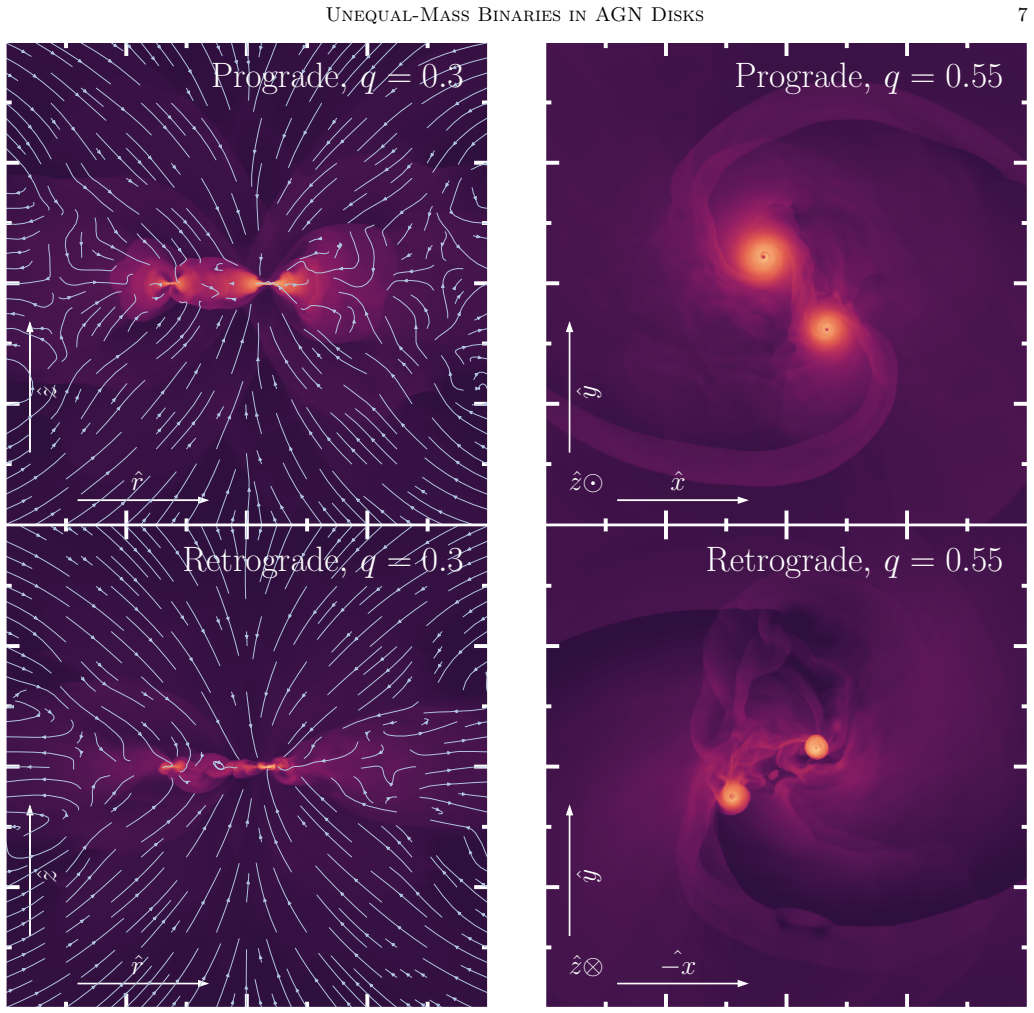
- [Section 4.2; Sections 3.2 and 2.2; Figure 7] The central reversal for retrograde binaries with q less than about 0.4 rests entirely on the primary retaining a substantial minidisk, but the paper itself states in Section 4.2 that "we cannot consider the size of the minidisks in our simulations to be physically realistic" and cites resolution tests showing that minidisk sizes decrease with smaller sink and gravitational softening radii, as well as two-dimensional simulations that find no minidisks at all. Because the mechanism for damping is the secondary's interaction with this minidisk near pericenter, the headline result is not established at converged resolution. The resolution check described in Section 2.2 (q = 0.3, e = 0.5 at twice spatial resolution) does not vary the sink or softening radius and therefore does not test this dependence. Please add convergence tests varying the sink radius and softening length, or explicitly restate the abstract and conclusions as a resolution-dependent finding.
- [Table 1; Abstract; Section 3.2] The claimed damping region q less than about 0.4, e greater than about 0.3 is not supported by the tabulated running averages. Table 1 gives <edot2> / [<mdot>/m] = +0.199 for q = 0.3, e = 0.3; +0.223 for q = 0.35, e = 0.4; and +0.095 for q = 0.4, e = 0.5, all positive, while only q = 0.3, e = 0.4; q = 0.3, e = 0.5; and q = 0.35, e = 0.5 are negative in the low-q retrograde block. The abstract's statement that primaries in retrograde binaries with q less than about 0.4 retain minidisks that "help damp binary eccentricities" and the text's e greater than about 0.3 threshold therefore overstate the data. Please revise the threshold to match the simulations (damping is seen only for q = 0.3 with e = 0.4 or 0.5 and for q = 0.35 with e = 0.5, with no damping at q = 0.4 in the sampled runs) and adjust the e approximately 0.3-0.4 attractor discussion accordingly.
minor comments (4)
- [Table 1] The final column header appears as <dot-vari> twice; based on the preceding columns it should presumably be <dot-vari_g> for the gravitational contribution to pericenter precession.
- [Figure 8 caption] The caption states that the q = 0.3 and q = 0.35 curves appear in "the bottom panel," but those curves appear to be in the middle retrograde panel rather than the bottom prograde panel; please check the panel labels and caption.
- [Section 4.1.1] The phrase "mass-weighed spin" should read "mass-weighted spin."
- [Section 2.2] The citation "(RK2 Heun 1900; Gottlieb & Shu 1998)" is formatted as though Heun were a co-author of the method; consider writing "(RK2; Heun 1900; Gottlieb & Shu 1998)."
Circularity Check
No significant circularity: the orbital evolution rates are measured from first-principles hydrodynamics, and the minidisk caveat is explicitly self-flagged rather than smuggled in.
full rationale
This paper is a simulation study, not a derivation in which an assumed result is recovered from its own definition. The central quantities — da/a, de2, mdot2/mdot1, and dq — are measured from Athena++/REBOUND shearing-box simulations via the exact conservation identities in Equations (9) and (10); no free parameter is fitted to a target eccentricity or merger outcome. The claimed low-q retrograde eccentricity damping is an inference from the phase-resolved force accounting in Figure 8, where pericentric damping and apocentric pumping are separately measured, and from the minidisk morphology directly visualized in Figure 7. The minidisk mechanism is not defined in terms of the damping it is invoked to explain; it is an independent dynamical feature diagnosed from the simulations. The population illustration in Figure 9 is explicitly labeled a "mock calculation" and a "toy model" that interpolates the measured rates in Table 1 and Figure 2, so it is not presented as an independent prediction obtained from fitted inputs. Self-citations to Dittmann et al. (2024) provide the numerical methodology and a resolution caveat, but they are not used as an external authority to force the central claim; in fact, the paper cites its own resolution tests to undermine the physical realism of the minidisk sizes, which cuts against any self-citation chain. Separately, the tabulated values in Table 1 show some runs (e.g., q=0.35, e=0.4 and q=0.4, e=0.5) that do not match the broad q<0.4, e>0.3 damping statement in the text; that is an internal consistency or correctness concern, not a circularity issue. The derivation chain is self-contained against the measured hydrodynamics, and the caveats are explicitly disclosed rather than hidden.
Assumptions & free parameters
assumptions (4)
- domain assumption The AGN disk gas is isothermal, inviscid, and unmagnetized, with a fixed scale height H0 = R0/100.
- domain assumption Accretion onto each black hole is modeled by a sink term of radius rs = 0.04a, and the gravitational potential is softened at the same radius.
- domain assumption The binary remains coplanar and aligned/anti-aligned with the AGN disk, and only prograde center-of-mass motion is considered.
- domain assumption The shearing-box approximation captures the relevant global gas dynamics.
Cite this review
Pith. "Pith review of The Multiple Paths to Merger of Unequal-Mass Black Hole Binaries in the Disks of Active Galactic Nuclei." pith.science (2026). https://pith.science/paper/NSLTW6PE
@misc{pith2026250505555,
  author       = {Pith},
  title        = {Pith review of: The Multiple Paths to Merger of Unequal-Mass Black Hole Binaries in the Disks of Active Galactic Nuclei},
  year         = {2026},
  howpublished = {\url{https://pith.science/paper/NSLTW6PE}},
  note         = {Machine review of arXiv:2505.05555}
}
abstract
The accretion disks that power active galactic nuclei (AGN) are thought to house populations of stars and compact objects; after forming binaries these compact objects may merge, begetting gravitational waves such as those detected by LIGO and VIRGO. We present a comprehensive study of the early evolution of binaries within AGN disks as their orbits are influenced by the surrounding gas, focusing on eccentric and unequal-mass binaries. Nearly-equal-mass binaries behave similarly to their equal-mass counterparts: prograde binaries inspiral, albeit somewhat slowly, and have their eccentricities damped; retrograde binaries inspiral $\sim2-3$ times faster than their prograde counterparts, and those with near-equal masses are driven quickly towards near-unity eccentricities. However, the primaries in retrograde binaries with mass ratios of $m_2/m_1\lesssim0.4$ experience significantly weaker headwinds and retain substantial accretion disks that help damp binary eccentricities, slowing binary inspirals. Additionally, we find that while accretion drives prograde binaries towards equal masses thanks to the exchange of material between the primary and secondary accretion disks, retrograde binaries are driven slowly towards more extreme mass ratios. Prograde binaries, and generally those with low mass ratios, likely accrete for multiple $e$-folding timescales before merger. On the other hand, high-mass-ratio retrograde binaries may merge before accreting substantially, potentially approaching merger with detectable eccentricity. Future ground-based gravitational wave observatories, with their broader frequency coverage, should be particularly useful for studying these populations.
Figures


Figures from the paper (4 more)


Reference graph
Works this paper leans on
-
[1]
2025, arXiv e-prints, arXiv:2503.12263
Abac, A., Abramo, R., Albanesi, S., et al. 2025, arXiv e-prints, arXiv:2503.12263
arXiv 2025
-
[2]
Abbott, R., Abbott, T. D., Abraham, S., et al. 2020, PhRvL, 125, 101102
work page 2020
- [3]
-
[4]
Artymowicz, P., Lin, D. N. C., & Wampler, E. J. 1993, ApJ, 409, 592
1993
-
[5]
R., & Bonnell, I
Bate, M. R., & Bonnell, I. A. 1997, MNRAS, 285, 33
1997
-
[6]
1952, MNRAS, 112, 195
Bondi, H. 1952, MNRAS, 112, 195
1952
-
[7]
Calcino, J., Dempsey, A. M., Dittmann, A. J., & Li, H. 2024, ApJ, 970, 107 Unequal-Mass Binaries in AGN Disks 13
work page 2024
-
[8]
Farr, W. M. 2021, ApJL, 922, L5
work page 2021
Show all 77 references
-
[9]
2023, MNRAS, 525, 2806
Choksi, N., Chiang, E., Fung, J., & Zhu, Z. 2023, MNRAS, 525, 2806
2023
-
[10]
M., Li, H., Mishra, B., & Li, S
Dempsey, A. M., Li, H., Mishra, B., & Li, S. 2022, ApJ, 940, 155
2022
-
[11]
M., Muñoz, D., & Lithwick, Y
Dempsey, A. M., Muñoz, D., & Lithwick, Y. 2020, ApJL, 892, L29
2020
-
[12]
J., & Cantiello, M
Dittmann, A. J., & Cantiello, M. 2025, ApJ, 979, 245
2025
-
[13]
J., Cantiello, M., & Jermyn, A
Dittmann, A. J., Cantiello, M., & Jermyn, A. S. 2021, ApJ, 916, 48
2021
-
[14]
J., Dempsey, A
Dittmann, A. J., Dempsey, A. M., & Li, H. 2024, ApJ, 964, 61
2024
-
[15]
J., & Ryan, G
Dittmann, A. J., & Ryan, G. 2021, ApJ, 921, 71 —. 2024, ApJ, 967, 12
2021
-
[16]
C., Dittmann, A
Duffell, P. C., Dittmann, A. J., D’Orazio, D. J., et al. 2024, ApJ, 970, 156
2024
-
[17]
1988, SIAM Journal on Numerical Analysis, 25, 294
Einfeldt, B. 1988, SIAM Journal on Numerical Analysis, 25, 294
1988
-
[18]
S., Caban, F., et al
Fabj, G., Nasim, S. S., Caban, F., et al. 2020, MNRAS, 499, 2608
2020
-
[19]
D., Duffell, P., MacFadyen, A
Farris, B. D., Duffell, P., MacFadyen, A. I., & Haiman, Z. 2014, ApJ, 783, 134
2014
-
[20]
Frank, J., King, A., & Raine, D. J. 2002, Accretion Power in Astrophysics: Third Edition
2002
-
[21]
2016, ApJ, 832, 105
Fung, J., & Chiang, E. 2016, ApJ, 832, 105
2016
-
[22]
2021, Nature Astronomy, 5, 749
Gerosa, D., & Fishbach, M. 2021, Nature Astronomy, 5, 749
2021
-
[23]
Gilbaum, S., & Stone, N. C. 2022, ApJ, 928, 191
2022
-
[24]
1965, MNRAS, 130, 125
Goldreich, P., & Lynden-Bell, D. 1965, MNRAS, 130, 125
1965
-
[25]
Gottlieb, S., & Shu, C. W. 1998, Mathematics of Computation, 67, 73
1998
-
[26]
J., McKernan, B., Ford, K
Graham, M. J., McKernan, B., Ford, K. E. S., et al. 2023, ApJ, 942, 99
2023
-
[27]
M., Kim, C.-G., & Quataert, E
Guo, M., Stone, J. M., Kim, C.-G., & Quataert, E. 2023, ApJ, 946, 26
2023
-
[28]
2010, ApJ, 708, 485
Hanawa, T., Ochi, Y., & Ando, K. 2010, ApJ, 708, 485
2010
-
[29]
D., & Leer, B
Harten, A., Lax, P. D., & Leer, B. V. 1983, SIAM Review, 25, 35
1983
-
[30]
Heun, K. 1900, Z. Math. Phys, 45, 23
1900
-
[31]
Ho, L. C. 2008, ARA&A, 46, 475
2008
-
[32]
F., Grudic, M
Hopkins, P. F., Grudic, M. Y., Kremer, K., et al. 2024, The Open Journal of Astrophysics, 7, 71
2024
-
[33]
Hunter, J. D. 2007, Computing in Science Engineering, 9, 90
2007
-
[34]
M., & Davis, S
Jiang, Y.-F., Stone, J. M., & Davis, S. W. 2014, ApJ, 796, 106
2014
-
[35]
L., & Upton Sanderbeck, P
Johnson, J. L., & Upton Sanderbeck, P. R. 2022, ApJ, 934, 58
2022
-
[36]
2023, ApJ, 944, 44
Ramirez-Ruiz, E. 2023, ApJ, 944, 44
2023
-
[37]
R., Lubow, S
King, A. R., Lubow, S. H., Ogilvie, G. I., & Pringle, J. E. 2005, MNRAS, 363, 49
2005
-
[38]
I., & Syunyaev, R
Kolykhalov, P. I., & Syunyaev, R. A. 1980, Soviet Astronomy Letters, 6, 357
1980
-
[39]
M., Li, H., Lai, D., & Li, S
Li, J., Dempsey, A. M., Li, H., Lai, D., & Li, S. 2023, ApJL, 944, L42
2023
-
[40]
2022, MNRAS, 517, 1602 —
Li, R., & Lai, D. 2022, MNRAS, 517, 1602 —. 2023, MNRAS, 522, 1881 —. 2024, MNRAS, 529, 348
2022
-
[41]
M., Li, S., Li, H., & Li, J
Li, Y.-P., Dempsey, A. M., Li, S., Li, H., & Li, J. 2021, ApJ, 911, 124
2021
-
[42]
1969, Nature, 223, 690
Lynden-Bell, D. 1969, Nature, 223, 690
1969
-
[43]
A., & Aarseth, S
Mardling, R. A., & Aarseth, S. J. 2001, MNRAS, 321, 398
2001
-
[44]
McKernan, B., Ford, K. E. S., Cook, H. E., et al. 2024, arXiv e-prints, arXiv:2410.16515
2024 arXiv
-
[45]
McKernan, B., Ford, K. E. S., Lyra, W., & Perets, H. B. 2012, MNRAS, 425, 460
2012
-
[46]
McKernan, B., Ford, K. E. S., Bartos, I., et al. 2019, ApJL, 884, L50
2019
-
[47]
J., & Lai, D
Miranda, R., Muñoz, D. J., & Lai, D. 2017, MNRAS, 466, 1170
2017
-
[48]
2024, arXiv e-prints, arXiv:2409.05614 Muñoz, D
Mishra, B., & Calcino, J. 2024, arXiv e-prints, arXiv:2409.05614 Muñoz, D. J., Lai, D., Kratter, K., & Miranda, R. 2020, ApJ, 889, 114
2024 arXiv
-
[49]
H., & Capano, C
Nitz, A. H., & Capano, C. D. 2021, ApJL, 907, L9
2021
-
[50]
2005, ApJ, 623, 922
Ochi, Y., Sugimoto, K., & Hanawa, T. 2005, ApJ, 623, 922
2005
-
[51]
J., Annis, J., & Liu, X
Palmese, A., Fishbach, M., Burke, C. J., Annis, J., & Liu, X. 2021, ApJL, 914, L34
2021
-
[52]
Peters, P. C. 1964, Physical Review, 136, 1224
1964
-
[53]
2024, ApJ, 962, 143
Qian, K., Li, J., & Lai, D. 2024, ApJ, 962, 143
2024
-
[54]
Rein, H., & Liu, S. F. 2012, A&A, 537, A128
2012
-
[55]
Rein, H., & Spiegel, D. S. 2015, MNRAS, 446, 1424
2015
-
[56]
2023, ApJL, 954, L22
Ricarte, A., Narayan, R., & Curd, B. 2023, ApJL, 954, L22
2023
-
[57]
2014, MNRAS, 439, 3476
Roedig, C., & Sesana, A. 2014, MNRAS, 439, 3476
2014
-
[58]
M., Gerosa, D., & Loutrel, N
Romero-Shaw, I. M., Gerosa, D., & Loutrel, N. 2023, MNRAS, 519, 5352
2023
-
[59]
Murray-Clay, R. A. 2020, MNRAS, 498, 2054
2020
-
[60]
2024, ApJ, 977, 16
Rosselli-Calderon, A., Yarza, R., Murguia-Berthier, A., et al. 2024, ApJ, 977, 16
2024
-
[61]
2023, MNRAS, 524, 2770 14 Dittmann, Dempsey, & Li
Rowan, C., Boekholt, T., Kocsis, B., & Haiman, Z. 2023, MNRAS, 524, 2770 14 Dittmann, Dempsey, & Li
2023
-
[62]
Rozner, M., Generozov, A., & Perets, H. B. 2023, MNRAS, 521, 866
2023
-
[63]
2024, MNRAS, 528, 833
Saini, P. 2024, MNRAS, 528, 833
2024
-
[64]
Springel, V., Yoshida, N., & White, S. D. M. 2001, NewA, 6, 79
2001
-
[65]
M., Hawley, J
Stone, J. M., Hawley, J. F., Gammie, C. F., & Balbus, S. A. 1996, ApJ, 463, 656
1996
-
[66]
M., Tomida, K., White, C
Stone, J. M., Tomida, K., White, C. J., & Felker, K. G. 2020, ApJS, 249, 4
2020
-
[67]
C., Metzger, B
Stone, N. C., Metzger, B. D., & Haiman, Z. 2017, MNRAS, 464, 946 Szulágyi, J., Morbidelli, A., Crida, A., & Masset, F. 2014, ApJ, 782, 65
2017
-
[68]
M., Greene, C
Thyng, K. M., Greene, C. A., Hetland, R. D., Zimmerle, H. M., & DiMarco, S. F. 2016, Oceanography
2016
-
[69]
J., Smith, B
Turk, M. J., Smith, B. D., Oishi, J. S., et al. 2011, ApJS, 192, 9 van der Walt, S., Colbert, S. C., & Varoquaux, G. 2011, Computing in Science Engineering, 13, 22 van Leer, B. 1974, Journal of Computational Physics, 14, 361
2011
-
[70]
M., & van Velzen, S
Veronesi, N., Rossi, E. M., & van Velzen, S. 2023, MNRAS, 526, 6031
2023
-
[71]
Veronesi, N., van Velzen, S., & Rossi, E. M. 2025, MNRAS, 536, 3112
2025
-
[72]
2024, MNRAS, 531, 4656
Whitehead, H., Rowan, C., Boekholt, T., & Kocsis, B. 2024, MNRAS, 531, 4656
2024
-
[73]
2025, arXiv e-prints, arXiv:2502.14959
Whitehead, H., Rowan, C., & Kocsis, B. 2025, arXiv e-prints, arXiv:2502.14959
2025 arXiv
-
[74]
Wyithe, J. S. B., & Loeb, A. 2012, MNRAS, 425, 2892
2012
-
[75]
D., Baird, J
Young, M. D., Baird, J. T., & Clarke, C. J. 2015, MNRAS, 447, 2907
2015
-
[76]
2025, arXiv e-prints, arXiv:2505.02924
Zhu, L.-G., & Chen, X. 2025, arXiv e-prints, arXiv:2505.02924
2025 arXiv
-
[77]
2025, arXiv e-prints, arXiv:2503.24084 APPENDIX A
Zwick, L., Takátsy, J., Saini, P., et al. 2025, arXiv e-prints, arXiv:2503.24084 APPENDIX A. QUANTITATIVE ORBITAL EVOLUTION RESULTS Table 1 lists the time-averaged orbital evolution results from our simulations. See Appendix A of Dittmann et al. (2024) for a description of how...
2024 arXiv
Reviewed August 15, 2026 · model on record in the stance chip above.
Discussion (0). Continue with ORCID to comment.