REVIEW 3 major objections 4 minor 77 references
Primordial black hole-star binaries via dynamical friction
T0 review · 3 major / 4 minor · reviewed 2026-08-15 · deepseek-v4-flash
Pith's one-line read Dark-matter drag around primordial black holes forms star–black-hole binaries that merge fast enough to explain fast-decaying X-ray binaries.
desk verdict A genuinely new capture channel with honest cross-checks, but the headline X-ray binary count hangs on an uncomputed final inspiral stage that the author himself flags. read the letter →
The pith
A machine-rendered reading of the paper's core claim, the machinery that carries it, and where it could break.
The reading
What carries the argument
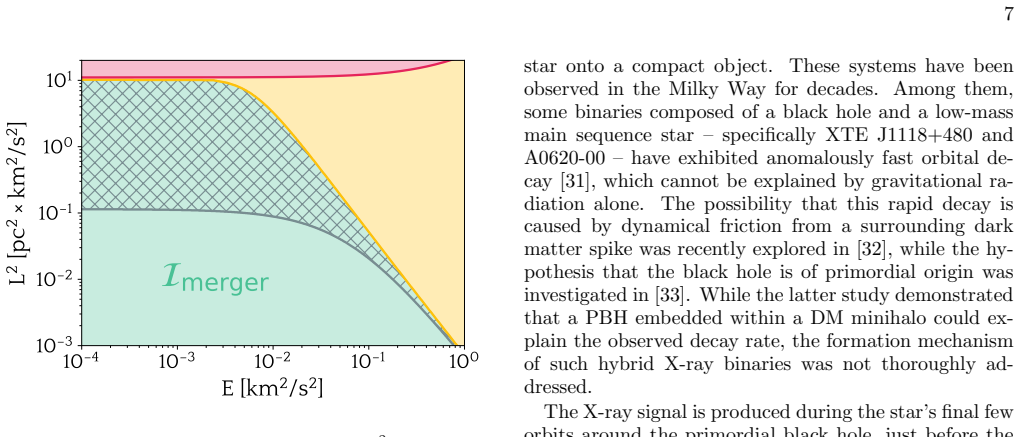
The load-bearing object is the dark-matter minihalo (or spike) around each primordial black hole, with mass $m_{\rm sp}\simeq50\,m_{\rm PBH}$, radius $r_{\rm sp}\simeq1.17\,(m_{\rm PBH}/M_\odot)^{1/3}\,\mathrm{pc}$, and density profile $\rho_{\rm sp}(r)\propto r^{-9/4}$. The argument is carried by the dynamical-friction deceleration $a_{\rm DF}=-4\pi G^2m_*\rho_{\rm sp}(r)\xi(r,v)\ln\Lambda\,\mathbf{v}/v^3$, where $\xi$ is the fraction of dark-matter particles slower than the star; integrating this over a minihalo crossing gives the binary-forming phase-space area $I_{\rm BF}\simeq4G^2m_{\rm sp}m_*\ln\Lambda$. That area is then restricted to orbits whose apastron satisfies the sinking-time bound $r_{\rm max}<r_{\rm crit}$ and that are not braked out of their halo-crossing orbits by passing stars, yielding the merger phase space $I_{\rm merger}(R)$; the final rates are spatial integrals over galactic models of $n_* n_{\rm PBH}\sigma_{\rm rel}^{-3}I_{\rm merger}(R)$.
What would settle it
Follow a captured star and its minihalo together in a numerical simulation: if the minihalo is heated or partially disrupted before the orbit shrinks to about 0.008 AU, the predicted population of one fast-decaying X-ray binary in the Milky Way does not form, and the gravitational-wave rate falls with it.
Extended reading notes
Core claim
The paper's central claim is that a dark-matter minihalo turns each primordial black hole into a capture device. A star whose trajectory passes through the halo loses specific energy $E_{\rm loss}$ to dynamical friction; if that loss exceeds the star's initial orbital energy, the star leaves bound to the dressed black hole, and continued friction on later halo crossings shrinks the orbit until the two bodies merge. Not every formed binary merges: only orbits with apastron below the sinking-time radius $r_{\rm crit}=E_{\rm loss}^2T_u^2/(2\pi^2Gm_{\rm dPBH})$ merge within the age of the Universe, and passing stars act as perturbers that inject energy and angular momentum, braking the inspiral. For $f_{\rm PBH}=0.01$ and a $6\,M_\odot$ primordial black hole with a mean stellar-mass companion, the Milky Way merger rate is computed as $\Gamma_{\rm XRB}=1.46\times10^{-7}\,\mathrm{yr}^{-1}$, which with an X-ray lifetime of order $10^7$ yr yields $\mathcal{O}(1)$ observable short-lived X-ray binaries, consistent with the fast-decaying systems XTE J1118+480 and A0620-00. For the local volume, the paper obtains gravitational-wave merger rates of order $0.3\,\mathrm{Gpc}^{-3}\,\mathrm{yr}^{-1}$ for primordial-black-hole plus stellar-black-hole and primordial-black-hole plus neutron-star binaries, with the largest contributions coming from galaxies below $10^9\,M_\odot$ in stellar mass.
Load-bearing premise
The calculation assumes that the dark-matter clump around each black hole stays dense and undisturbed while the captured star spirals inward, even though the friction itself is expected to heat the clump once the pair is closer than roughly ten times the Earth-Sun distance (10 AU), well before the X-ray-emitting stage near 0.008 AU.
Editorial extensions
If this is right
- At $f_{\rm PBH}=0.01$, the Milky Way should currently host roughly one fast-decaying X-ray binary formed through this channel, with the rate peaking in the inner few kiloparsecs, so targeted searches of the Galactic center and bulge can test the prediction.
- The channel produces gravitational-wave events at roughly $0.3\,\mathrm{Gpc}^{-3}\,\mathrm{yr}^{-1}$, and because the preferred host galaxies are low-mass, identifying host galaxies of future events would discriminate this formation path.
- Rates scale linearly with the PBH abundance, so an upper limit on the fast-decaying X-ray binary population from all-sky surveys translates directly into an upper bound on $f_{\rm PBH}$ in the stellar-mass range.
- Most formed binaries do not merge within a Hubble time; perturber braking suppresses contributions from the densest central regions, which is why the predicted rates are only mildly sensitive to whether galaxy profiles are cuspy or cored.
Reading between the lines
- Beyond the paper, the static-spike assumption is the fragile link: if the same friction that forms the binary heats and erodes the minihalo before the separation reaches the X-ray-emitting stage near $0.008$ AU, the claimed count of observable fast-decaying X-ray binaries could be suppressed even if capture works; a joint binary-spike simulation is the direct test.
- Beyond the paper, the mechanism predicts an environmental signature: merger sites should be dark-matter-dominated dwarf galaxies with low stellar densities, because passing stars brake the inspiral wherever stars are dense; localizing future gravitational-wave events to dwarf hosts would support this channel over standard stellar-binary channels.
- Beyond the paper, the same friction logic opens a late-time route to primordial-black-hole binary formation in unclustered regions, and interactions between dressed black holes and binary star systems could produce second-generation mergers that early-Universe binary channels do not cover.
Signed reviews
Editorial analysis
A structured set of objections, weighed in public.
Referee Report
Summary. This manuscript proposes a new formation channel for hybrid binaries consisting of a primordial black hole (PBH) and a stellar object, mediated by dynamical friction against the dark matter (DM) minihalo surrounding the PBH. The author computes the capture phase space both analytically (Eq. 13) and numerically (Sec. IV C), adds merger criteria based on a sinking-time condition and the disruptive effect of stellar perturbers, and applies the resulting merger rate to two observables: fast-decaying X-ray binaries in the Milky Way and gravitational-wave events in the local Gpc³. With f_PBH = 0.01, a 6 M_sun PBH, and a lifetime drawn from the observed systems, the Milky Way rate Γ_XRB ≈ 1.46×10⁻⁷ yr⁻¹ gives N_XRB ∼ O(1); the volumetric rates in Table I cluster around O(0.3) Gpc⁻³ yr⁻¹ for PBH+NS and PBH+BH mergers. The concluding section acknowledges that the final-stage inspiral through a heated minihalo is not modeled, which is the central uncertainty of the paper.
Significance. If the mechanism operates all the way to merger, this is a genuinely new and potentially important dynamical channel: it uses an established ingredient (DM spikes around PBHs) to produce hybrid binaries at rates far above previously considered capture channels, and it makes a distinctive prediction that low-mass galaxies dominate the gravitational-wave signal. The paper has genuine strengths: the analytic estimate of I_BF in Eq. (13) is checked against explicit numerical orbit integrations over the full (E,L²) phase space; the perturber treatment is physically motivated and its braking effect is incorporated into the merger phase space; and the minihalo survival appendix is unusually careful, including iterative disk-shocking and encounter heating. However, the headline claims rest on an unresolved stage of the inspiral: the X-ray binaries at the separations where they are observed are exactly in the regime that the author states is uncertain, so as written the O(1) X-ray count and the merger rates in Table I should be read as upper-limit/consistency estimates rather than closed predictions.
major comments (3)
- [Sec. VII; Sec. VI A; Eq. (A3)] The headline X-ray binary count is not yet derived because the final inspiral is unresolved. The manuscript states in Sec. VII that once the separation falls below O(10) AU, the energy injected into the spike by dynamical friction becomes comparable to the minihalo binding energy of Eq. (A3), so "the further evolution of the system is uncertain." The X-ray-emitting phase of the systems in Sec. VI A occurs at separations of order 0.01 AU implied by P ~ 0.1 day, roughly three orders of magnitude inside that uncertain region. Since N_XRB = Γ_XRB × τ_XRB counts systems that must have lost energy by dynamical friction all the way down to X-ray-emitting separations, the claimed number N_XRB ∼ O(1) rests on an assumption that the paper itself identifies as key but does not derive.
- [Sec. V A; Eq. (14); Fig. 3] The merger criterion r_max < r_crit in Eq. (14) assumes that dynamical friction by a static spike continues to remove orbital energy until collision. If the spike is heated and partially disrupted once r drops below a few tens of AU, binaries counted in the merger region of Fig. 3 must instead finish their inspiral by gravitational radiation from wide, possibly eccentric orbits. The paper does not report the periastron distribution of the merger region in Fig. 3, so it cannot demonstrate that Peters merger times are shorter than the age of the Universe. This issue affects both the Milky Way rate and the GW rates in Table I, not only the late-time behavior.
- [Sec. VI A] The claimed O(1) population of rapidly decaying X-ray binaries is a consistency check rather than an independent prediction: the PBH mass of 6 M_sun and the lifetime τ_XRB ∼ P/Ṗ are taken from the very systems that the mechanism is invoked to explain. This is not a hidden fit, but the interpretation should be stated carefully: the computation shows that the channel can accommodate the observed systems at f_PBH = 0.01, not that it predicts their number without input from them. If the unresolved final inspiral leads to a shorter X-ray phase or a smaller merger fraction, N_XRB would drop correspondingly.
minor comments (4)
- [Sec. V B; Eq. (18)] In Eq. (18), if ΔE_tot exceeds E_loss(r_min + Δr_min), the right-hand side becomes negative; the text says such cases should yield E_loss = 0, so the definition should explicitly include max(0, ·).
- [Appendix A 5 a] There is a typo in the last paragraph: "substancial" should be "substantial."
- [Fig. 4; Appendix A 5 a] The text says about 50% of the Milky Way merger rate originates within ~10 pc, while the appendix finds minihalos completely disrupted below ~0.03 kpc by high-speed stellar encounters; the two statements should be reconciled, and the resulting reduction of N_XRB by roughly a factor of two should be stated explicitly.
- [Sec. VI B; Eq. (21)] In the sentence defining the stellar mass integration range, the subscript on M_min and M_max is sometimes dropped; using M_star consistently would avoid confusion with the total mass M_T in Eq. (22).
Circularity Check
No circularity found: the XRB and GW rates follow from the spike model and encounter integrals; observed lifetimes and masses enter as consistency inputs, not fitted parameters.
full rationale
The derivation is self-contained: the binary formation and merger rates are computed from a stated spike model (Eqs. 1-3), a dynamical-friction prescription (Eq. 8), phase-space encounter integrals (Eqs. 4-7), and a merger condition evaluated numerically (Eqs. 14, 18-20). None of these integrals is normalized to the X-ray binary or gravitational-wave event counts. The X-ray count N_XRB = Γ_XRB × τ_XRB uses the observed lifetime and PBH mass of the target systems as consistency inputs, but Γ_XRB itself is not fitted to those systems; f_PBH = 0.01 is fixed a priori by constraints, and the rate could have come out very different. The self-citations for the sinking-time and energy-loss estimates ([47,48,50]) are not load-bearing because the relevant formulas are re-derived in the text (Eqs. 12-14) and cross-checked against the numerical solution of the equation of motion. The paper explicitly flags the static-minihalo assumption and the uncertain regime below ~10 AU (Sec. VII) as open limitations; that is a correctness risk, not a circular reduction of the prediction to its inputs.
Assumptions & free parameters
free parameters (4)
- PBH abundance f_PBH =
0.01
- Minihalo mass ratio m_sp/m_PBH =
50
- PBH mass for XRB rate =
6 M_sun
- X-ray binary lifetime tau_XRB =
~1e7 yr
assumptions (6)
- domain assumption Every PBH is surrounded by a DM minihalo with density rho_sp ∝ r^{-9/4}, radius r_sp (Eq. 1), and mass m_sp = 50 m_PBH.
- domain assumption DM particles in the spike follow a Maxwell-Boltzmann velocity distribution with dispersion sqrt(-Phi), truncated at the escape velocity.
- domain assumption The Chandrasekhar dynamical friction formula, Eq. (8), with Coulomb logarithm ln sqrt(m_sp/m_*) applies to a star crossing the minihalo.
- ad hoc to paper Perturbers can be treated in the impulse approximation with a single mass 0.4 M_sun and a single velocity sigma_rel; net angular momentum is replaced by its dispersion.
- domain assumption The minihalo remains static during the binary inspiral.
- domain assumption Galaxy scaling relations (stellar mass to halo mass, size-mass, stellar mass function) can be extrapolated below M* ~ 1e7 M_sun.
Cite this review
Pith. "Pith review of Primordial black hole-star binaries via dynamical friction." pith.science (2026). https://pith.science/paper/IS5ZBSAZ
@misc{pith2026250505564,
  author       = {Pith},
  title        = {Pith review of: Primordial black hole-star binaries via dynamical friction},
  year         = {2026},
  howpublished = {\url{https://pith.science/paper/IS5ZBSAZ}},
  note         = {Machine review of arXiv:2505.05564}
}
abstract
We study a new channel for binary system formation involving stars and stellar-mass primordial black holes (PBHs) embedded in dark matter (DM) minihalos. In this scenario, binaries form when a star passes through the DM minihalo surrounding a PBH and loses sufficient energy due to dynamical friction. The continued energy loss induced by this friction is expected to drive the resulting systems to merge rapidly. We estimate their merger rate and explore the implications for two observables: rapidly decaying X-ray binaries in the Milky Way and gravitational waves sourced by compact object mergers. We find that, for a PBH abundance $\Omega_\text{PBH}/\Omega_\text{DM} = 0.01$, this mechanism naturally produces a population of $\mathcal{O}(1)$ currently observable short-lived X-ray binaries. It also leads to a non-negligible gravitational wave event rate of $\mathcal{O}(0.3)$ Gpc$^{-3}$yr$^{-1}$, potentially involving high mass ratios and black holes in the lower or upper mass gap. Notably, most mergers arise in low-mass galaxies, making the latter rate sensitive to the low-mass end of the galaxy stellar mass function. The dynamical friction channel thus offers a plausible explanation for several unusual observations reported in recent years across both the X-ray and gravitational wave domains.
Figures


Figures from the paper (4 more)


Reference graph
Works this paper leans on
-
[1]
G. Arcadi, M. Dutra, P. Ghosh, M. Lindner, Y. Mam- brini, M. Pierre, S. Profumo, and F. S. Queiroz, The European Physical Journal C 78, 10.1140/epjc/s10052- 018-5662-y (2018)
-
[2]
F. Chadha-Day, J. Ellis, and D. J. E. Marsh, Sci. Adv. 8, abj3618 (2022)
work page 2022
-
[3]
Y. B. Zel’dovich and I. D. Novikov, Soviet Astronomy 10, 602 (1967)
work page 1967
-
[4]
Hawking, Monthly Notices of the Royal Astronomical Society 152, 75 (1971)
S. Hawking, Monthly Notices of the Royal Astronomical Society 152, 75 (1971)
1971
-
[5]
B. Carr, K. Kohri, Y. Sendouda, and J. Yokoyama, Re- ports on Progress in Physics 84, 116902 (2021)
work page 2021
-
[6]
A. M. Green and B. J. Kavanagh, J. Phys. G 48, 043001 (2021)
work page 2021
-
[7]
K. J. Mack, J. P. Ostriker, and M. Ricotti, The Astro- physical Journal 665, 12771287 (2007)
work page 2007
-
[8]
Ricotti, The Astrophysical Journal 662, 5361 (2007)
M. Ricotti, The Astrophysical Journal 662, 5361 (2007)
work page 2007
Show all 77 references
-
[9]
Ricotti, J
M. Ricotti, J. P. Ostriker, and K. J. Mack, The Astro- physical Journal 680, 829845 (2008)
2008
-
[10]
Ricotti and A
M. Ricotti and A. Gould, The Astrophysical Journal707, 979987 (2009)
2009
-
[11]
B. C. Lacki and J. F. Beacom, The Astrophysical Journal 720, L67L71 (2010)
2010
-
[12]
Y. N. Eroshenko, Astronomy Letters 42, 347356 (2016)
2016
-
[13]
S. M. Boucenna, F. K¨ uhnel, T. Ohlsson, and L. Visinelli, Journal of Cosmology and Astroparticle Physics 2018 (07), 003003
2018
-
[15]
Y. N. Eroshenko, International Journal of Modern Physics A 35, 2040046 (2020)
2020
-
[16]
Cai, Y.-C
R.-G. Cai, Y.-C. Ding, X.-Y. Yang, and Y.-F. Zhou, Jour- nal of Cosmology and Astroparticle Physics 2021 (3), 057
2021
-
[17]
Boudaud, T
M. Boudaud, T. Lacroix, M. Stref, J. Lavalle, and P. Salati, Journal of Cosmology and Astroparticle Physics 2021 (08), 053
2021
-
[18]
Agius, R
D. Agius, R. Essig, D. Gaggero, F. Scarcella, G. Suczewski, and M. Valli, Journal of Cosmology and Astroparticle Physics 2024 (07), 003
2024
-
[19]
B. J. Kavanagh, D. Gaggero, and G. Bertone, Physical Review D 98, 10.1103/physrevd.98.023536 (2018)
2018 doi
-
[20]
M. P. Hertzberg, E. D. Schiappacasse, and T. T. Yanagida, Physics Letters B 807, 135566 (2020)
2020
-
[21]
LIGO Scientific Collaboration and Virgo Collaboration, Physical Review Letters 116, 061102 (2016)
2016
-
[22]
LIGO Scientific Collaboration and Virgo Collaboration, Physical Review X 9, 031040 (2019)
2019
-
[23]
LIGO Scientific Collaboration and Virgo Collaboration, Physical Review X 11, 021053 (2021)
2021
-
[24]
LIGO Scientific Collaboration, Virgo Collaboration, and KAGRA Collaboration, Physical Review X 13, 041039 (2023)
2023
-
[25]
Raidal, V
M. Raidal, V. Vaskonen, and H. Veerm¨ ae, Formation of primordial black hole binaries and their merger rates, in Primordial Black Holes , edited by C. Byrnes, G. Fran- ciolini, T. Harada, P. Pani, and M. Sasaki (2024) arXiv:2404.08416 [astro-ph.CO]
2024 arXiv
-
[26]
Vattis, I
K. Vattis, I. S. Goldstein, and S. M. Koushiappas, Phys- ical Review D 102, 061301 (2020)
2020
-
[27]
Kritos, V
K. Kritos, V. De Luca, G. Franciolini, A. Kehagias, and A. Riotto, Journal of Cosmology and Astroparticle Physics 2021 (05), 039
2021
-
[28]
Y.-D. Tsai, A. Palmese, S. Profumo, and T. Jeltema, Journal of Cosmology and Astroparticle Physics 2021 (10), 019
2021
-
[29]
A. H. Nitz and Y.-F. Wang, Physical Review Letters126, 10.1103/physrevlett.126.021103 (2021)
2021 doi
-
[30]
Sasaki, V
M. Sasaki, V. Takhistov, V. Vardanyan, and Y.-l. Zhang, The Astrophysical Journal 931, 2 (2022)
2022
-
[31]
J. I. Gonz´ alez Hern´ andez, R. Rebolo, and J. Casares, Monthly Notices of the Royal Astronomical Society 438, L21 (2014)
2014
-
[32]
M. H. Chan and C. M. Lee, The Astrophysical Journal Letters 943, L11 (2023)
2023
-
[33]
Ireland, Physical Review D 111, 023513 (2025)
A. Ireland, Physical Review D 111, 023513 (2025)
2025
-
[34]
LIGO Scientific Collaboration and Virgo Collaboration, Physical Review Letters 125, 101102 (2020)
2020
-
[35]
LIGO Scientific Collaboration and Virgo Collaboration, 13 The Astrophysical Journal Letters 896, L44 (2020)
2020
-
[36]
Bertschinger, The Astrophysical Journal (supplement series) 58, 1 (1985)
E. Bertschinger, The Astrophysical Journal (supplement series) 58, 1 (1985)
1985
-
[37]
Adamek, C
J. Adamek, C. T. Byrnes, M. Gosenca, and S. Hotchkiss, Physical Review D 100, 023506 (2019)
2019
-
[38]
B. Carr, F. K¨ uhnel, and L. Visinelli, Monthly Notices of the Royal Astronomical Society 506, 36483661 (2021)
2021
-
[39]
Jangra, B
P. Jangra, B. J. Kavanagh, and J. Diego, Journal of Cos- mology and Astroparticle Physics 2023 (11), 069
2023
-
[40]
Berezinsky, V
V. Berezinsky, V. Dokuchaev, and Y. Eroshenko, Jour- nal of Cosmology and Astroparticle Physics 2013 (11), 059059
2013
-
[41]
Binney and S
J. Binney and S. Tremaine, Galactic Dynamics: Second Edition (Princeton University Press, 2008)
2008
-
[42]
W. H. Press and D. N. Spergel, The Astrophysical Jour- nal 296, 679 (1985)
1985
-
[43]
Gould, The Astrophysical Journal 321, 571 (1987)
A. Gould, The Astrophysical Journal 321, 571 (1987)
1987
-
[44]
Kouvaris, Physical Review D 77, 023006 (2008)
C. Kouvaris, Physical Review D 77, 023006 (2008)
2008
-
[45]
K. Choi, C. Rott, and Y. Itow, Journal of Cosmology and Astroparticle Physics 2014 (05), 049049
2014
-
[47]
Capela, M
F. Capela, M. Pshirkov, and P. Tinyakov, Physical Re- view D 87, 123524 (2013)
2013
-
[48]
Tinyakov, Primordial black holes: the asteroid mass window, in Primordial Black Holes, edited by C
P. Tinyakov, Primordial black holes: the asteroid mass window, in Primordial Black Holes, edited by C. Byrnes, G. Franciolini, T. Harada, P. Pani, and M. Sasaki (2024) arXiv:2406.03114 [astro-ph.CO]
2024 arXiv
-
[49]
L. D. Landau and E. M. Lifshitz, Mechanics, Third Edi- tion: Volume 1 (Course of Theoretical Physics) , 3rd ed. (Butterworth-Heinemann, 1976)
1976
-
[50]
Esser and P
N. Esser and P. Tinyakov, Physical Review D 107, 103052 (2023)
2023
-
[51]
P. J. McMillan, Monthly Notices of the Royal Astronom- ical Society 465, 76 (2017)
2017
-
[52]
P. J. McMillan, Monthly Notices of the Royal Astronom- ical Society 414, 2446 (2011)
2011
-
[53]
Paczy´ nski, Acta Astronomica17, 287 (1967)
B. Paczy´ nski, Acta Astronomica17, 287 (1967)
1967
-
[54]
Podsiadlowski, S
P. Podsiadlowski, S. Rappaport, and E. D. Pfahl, The Astrophysical Journal 565, 1107 (2002)
2002
-
[55]
Prunier, G
M. Prunier, G. Morr´ as, J. F. N. Siles, S. Clesse, J. Garc´ ıa- Bellido, and E. Ruiz Morales, Physics of the Dark Uni- verse 46, 101582 (2024)
2024
-
[56]
P. S. Behroozi, C. Conroy, and R. H. Wechsler, The As- trophysical Journal 717, 379403 (2010)
2010
-
[57]
S. Shen, H. J. Mo, S. D. M. White, M. R. Blanton, G. Kauffmann, W. Voges, J. Brinkmann, and I. Csabai, Monthly Notices of the Royal Astronomical Society 343, 978994 (2003)
2003
-
[58]
Lange et al., Monthly Notices of the Royal Astronom- ical Society 447, 2603 (2015)
R. Lange et al., Monthly Notices of the Royal Astronom- ical Society 447, 2603 (2015)
2015
-
[59]
A. V. Kravtsov, The Astrophysical Journal 764, L31 (2013)
2013
-
[60]
A. A. Klypin, S. Trujillo-Gomez, and J. Primack, The Astrophysical Journal 740, 102 (2011)
2011
-
[61]
Retana-Montenegro, E
E. Retana-Montenegro, E. Van Hese, G. Gentile, M. Baes, and F. Frutos-Alfaro, Astronomy and Astro- physics 540, A70 (2012)
2012
-
[62]
S. P. Driver et al., Monthly Notices of the Royal Astro- nomical Society 513, 439467 (2022)
2022
-
[63]
Fukugita and P
M. Fukugita and P. J. E. Peebles, The Astrophysical Journal 616, 643 (2004)
2004
-
[64]
Kroupa, Monthly Notices of the Royal Astronomical Society 322, 231 (2001)
P. Kroupa, Monthly Notices of the Royal Astronomical Society 322, 231 (2001)
2001
-
[65]
J. D. Simon, Annual Review of Astronomy and Astro- physics 57, 375415 (2019)
2019
-
[66]
Liu and V
B. Liu and V. Bromm, Impact of primordial black holes on the formation of the first stars and galax- ies, in Primordial Black Holes , edited by C. Byrnes, G. Franciolini, T. Harada, P. Pani, and M. Sasaki (2024) arXiv:2312.04085 [astro-ph.GA]
2024 arXiv
-
[67]
Zhang, V
S. Zhang, V. Bromm, and B. Liu, The Astrophysical Journal 975, 139 (2024)
2024
-
[68]
LIGO Scientific Collaboration, Virgo Collaboration, and KAGRA Collaboration, Physical Review X 13, 011048 (2023)
2023
-
[69]
P. C. Peters, Physical Review 136, B1224 (1964)
1964
-
[70]
K. Eda, Y. Itoh, S. Kuroyanagi, and J. Silk, Physical Review D 91, 10.1103/physrevd.91.044045 (2015)
2015 doi
-
[71]
Coogan, G
A. Coogan, G. Bertone, D. Gaggero, B. J. Kavanagh, and D. A. Nichols, Physical Review D 105, 10.1103/phys- revd.105.043009 (2022)
2022 doi
-
[72]
B. J. Carr and M. Sakellariadou, The Astrophysical Jour- nal 516, 195 (1999)
1999
-
[73]
Gondolo and J
P. Gondolo and J. Silk, Physical Review Letters 83, 17191722 (1999)
1999
-
[74]
Stref and J
M. Stref and J. Lavalle, Physical Review D 95, 10.1103/physrevd.95.063003 (2017). Appendix A: Survival of the minihalos An important effect that must be considered is the possible disruption of the DM spikes between their time of formation and the capture of a star from the en...
2017 doi
-
[75]
Global tides An object of finite size, such as a DM spike, will be subject to the static tidal field of the galactic halo in which it is embedded. In the distant-tide approximation and assuming a spherically symmetric galaxy, one finds the associated tidal radius [20, 41] rt =...
-
[76]
Minihalo binding energy The stability of the minihalo is maintained by its self- gravitational binding energy. Suppose that some of its outer layers have already been removed – due to, for in- stance, the global tides discussed in the previous sub- section – leaving it with a ...
-
[77]
These fast-moving stars, as they pass through or near the minihalo, will inject energy into it, potentially altering its internal structure
High-speed encounters with stars While star-minihalo interactions leading to binary for- mation typically occur at low relative velocities, the ma- jority of stellar encounters will involve high-velocity stars. These fast-moving stars, as they pass through or near the minihalo...
-
[78]
Disk shocking Rather than adopting a localized approach, where in- dividual stars inject energy into the minihalo, one can take a complementary global approach by estimating the total energy injected into the minihalo as it crosses the galactic stellar disk. The energy per uni...
-
[79]
We consider the Milky Way model described in Sec
Combined effect & discussion We now look at the combined effect of global tides and stellar interactions on minihalos. We consider the Milky Way model described in Sec. VI A, as well as a M∗ = 107M⊙ galaxy with the stellar and DM profiles in- troduced in Sec. VI B. At each gal...
Reviewed August 15, 2026 · model on record in the stance chip above.
Discussion (0). Continue with ORCID to comment.