REVIEW 4 major objections 6 minor 39 references
Unsupervised Anomaly Detection for Autonomous Robots via Mahalanobis SVDD with Audio-IMU Fusion
T0 review · 4 major / 6 minor · reviewed 2026-08-15 · deepseek-v4-flash
Pith's one-line read This paper claims that an autonomous mobile robot can detect collisions and internal mechanical faults in an unsupervised way by fusing audio and IMU signals, using Mahalanobis distance in a deep support vector data description to learn…
desk verdict Useful dataset and a sensible empirical study, but Eq. 8's soft-boundary objective is degenerate: the claimed ellipsoidal boundary is not learned, so the novelty needs re-framing. read the letter →
The pith
A machine-rendered reading of the paper's core claim, the machinery that carries it, and where it could break.
The reading
What carries the argument
The central object is the Mahalanobis SVDD (M-SVDD) module: a deep one-class boundary in latent space measured by Mahalanobis distance instead of Euclidean distance. Its key components are (i) the robust mean and covariance estimate from the minimum covariance determinant over a batch subset $H$, (ii) the soft-boundary loss $L_{\text{MSVDD}} = R^2 + \frac{1}{N}\sum_i \max(0, D_i^2 - R^2)$ with learnable radius $R$, and (iii) a reconstruction branch with Huber loss that keeps features informative. Cross-attention fusion of audio and IMU features feeds this module. The mechanism works by down-weighting high-variance feature directions and capturing inter-feature correlations, so normal samples occupy a compact ellipsoid and anomalies fall outside it.
What would settle it
Train the method on normal data from one floor surface and test on normal data from another surface with no faults; if most test samples exceed the 95th-percentile training threshold, the single-ellipsoid normality assumption fails and the method would raise false alarms on benign surface changes.
Extended reading notes
Core claim
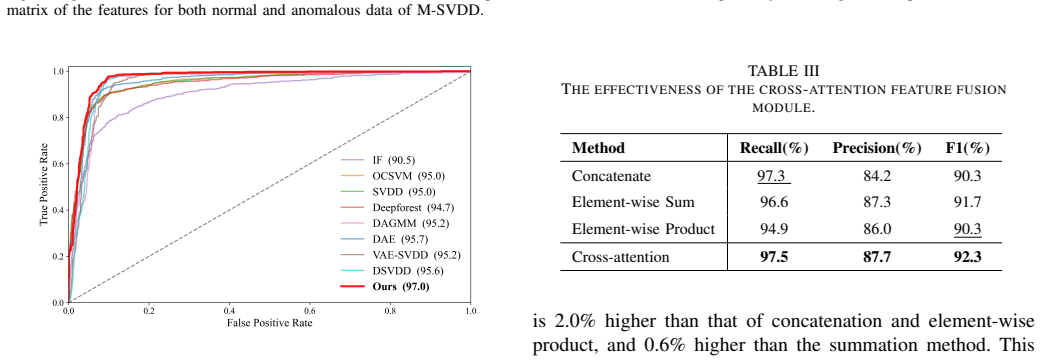
The central discovery claimed is that modeling the latent feature distribution with its covariance structure, rather than assuming isotropic features, substantially improves unsupervised anomaly detection for robots. The M-SVDD module computes an anomaly score as Mahalanobis distance $D_i = \sqrt{(z_i-\mu_z)^T \Sigma_z^{-1}(z_i-\mu_z)}$, where $\mu_z$ and $\Sigma_z$ are estimated from the most compact subset of each training batch via the minimum covariance determinant estimator. This produces an adaptive ellipsoidal boundary around normal audio-IMU features. A parallel reconstruction branch reconstructs audio and IMU inputs from their encodings, preventing representation collapse and yielding a reconstruction-loss term that is combined with the distance score at inference. The authors claim that on their collected mobile robot dataset the method reaches F1 92.3% and AUC 97.0%, and on the MIMII machine-sound dataset an average AUC 81.5%.
Load-bearing premise
The argument assumes that the statistical estimate of normal data's spread, taken from a small most-consistent subset of each training batch, captures the true shape of the normal audio-IMU data well enough to define one stable ellipsoid at both training and inference.
Editorial extensions
If this is right
- Robots could monitor their own health with cheap, low-power sensors and no labeled fault data, making anomaly detection practical for deployment on resource-constrained platforms.
- The method should transfer to other platforms that emit audio and vibration signals, since experiments on the MIMII dataset and three public time-series benchmarks show generalization beyond the collected robot data.
- The anomaly threshold can be set from training scores alone, using the 95th percentile of the training anomaly scores, which removes the need for validation anomalies.
- The ablation results indicate that audio is the primary carrier of anomaly information: removing audio drops recall from 97.5% to 64.4%, while IMU contributes a smaller but consistent improvement.
- The reconstruction branch is load-bearing for precision: removing it drops precision from 87.7% to 81.7%, showing that the auxiliary task prevents the representation collapse that would otherwise degrade the SVDD boundary.
Reading between the lines
- A testable extension would be to replace the fixed subset fraction in the covariance estimator with an adaptive or multimodal estimate, since a single ellipsoid may miss multi-modal normal operation; the paper's own limitation section notes false positives when both modalities react to uneven terrain.
- The same M-SVDD module could be applied to other paired sensor streams, such as vibration plus motor current in industrial equipment, wherever normal data is abundant and faults are rare.
- The reported class-specific AUCs suggest one could test whether the ellipsoid boundary is systematically weaker on mechanical faults when audio is masked, which would reveal whether IMU data is doing the heavy lifting in that regime.
- Because the threshold is fixed at the 95th percentile of training scores, the method implicitly targets a 5% false-positive rate on the training distribution; calibrating the threshold per operating condition could improve precision on the collision-versus-mechanical split.
Signed reviews
Editorial analysis
A structured set of objections, weighed in public.
Referee Report
Summary. The paper proposes an unsupervised anomaly detection framework for mobile robots using audio and IMU data. The architecture encodes the two modalities, fuses them with a cross-attention module, and feeds the fused feature into two branches: a reconstruction branch that reconstructs the inputs, and a Mahalanobis SVDD (M-SVDD) branch that is intended to learn an ellipsoidal boundary around normal data using Mahalanobis distance and Minimum Covariance Determinant (MCD) robust covariance estimates. The final anomaly score combines the Mahalanobis distance with the reconstruction loss, and the decision threshold is set as the 95th percentile of training scores. The method is evaluated on a newly collected mobile-robot dataset and on four public datasets (MIMII, SWaT, SMAP, MSL), with reported F1 and AUC improvements over shallow and deep baselines. The authors also release code and data.
Significance. If the method were implemented as described, it would address a practical gap: detecting collisions and mechanical faults in mobile robots without labeled anomaly data, using cheap and energy-efficient sensors. The paper has concrete strengths: it ships a new multimodal dataset, releases code and a video, reports threshold-independent AUC scores, and evaluates on public benchmarks with ablations on modalities, fusion, and the M-SVDD/reconstruction modules. The reported AUC gains on the collected dataset (97.0%) and on MIMII (average 81.5%) are consistent with a meaningful empirical improvement, assuming the implementation matches the description. However, the central mathematical object of the paper, the soft-boundary M-SVDD loss in Eq. (8), is degenerate as written, and the evaluation protocol for F1 scores leaks test-label information. These issues make the paper's central claim as currently stated unreliable, despite the apparent value of the dataset and experimental setup.
major comments (4)
- [Sec. III-B, Eq. (8)] The soft-boundary objective is degenerate as printed. For fixed network features, L(R)=R^2+(1/N)Σ max(0,D_i^2−R^2). For any R≤min_i D_i, all hinge terms are active and L(R)=(1/N)Σ D_i^2, independent of R; for R>min_i D_i, the derivative is 2R(1−k/N)>0 where k is the number of points with D_i^2>R^2, so the loss is minimized on the whole interval [0,min_i D_i]. Thus the learnable radius never encloses a single training point, and no adaptive ellipsoidal boundary is actually learned. Algorithm 1 confirms that R is not used in inference: the threshold is the 95th percentile of the scores in Eq. (13), which depend on Mahalanobis distance and reconstruction loss only. The standard soft-boundary deep SVDD objective from which Eq. (8) is taken includes a 1/(νN) multiplier on the hinge term; without it, the trade-off between R and violations disappears. This is the central contribution claimed in Sec. I. Please either add the missing multiplier (or otherwise constrain R) and rerun the experiments, or revise the contribution statement to describe the method as Mahalanobis-distance-plus-reconstruction scoring without claiming a learned enclosing boundary.
- [Sec. IV-A, evaluation metrics] The F1 scores in Tables I, II, III, and V are computed by selecting the optimal threshold with the best F1 on the test labels, as explicitly stated in Sec. IV-A. This leaks test information into the decision rule and inflates precision and recall relative to any usable unsupervised deployment. The same threshold-selection protocol is not equally meaningful for all baselines, making the F1-based comparisons unreliable. Please report thresholds chosen from training data only (e.g., the 95th percentile rule already used in Algorithm 1), or make AUC the primary metric. In addition, no standard deviations or repeated-run results are reported anywhere; with 15 training sequences and a single split, the small F1 differences in Table I (0.3–0.7%) cannot be judged significant.
- [Sec. III-D, Eq. (13)] As written, the anomaly score is δ_i = D_i + w (μ_T_D / μ_T_LRec) L_i^Rec. The text states that both metrics are normalized to the same scale, but D_i is not divided by μ_T_D; only the reconstruction term is scaled. If the intended formula is D_i/μ_T_D + w L_i^Rec/μ_T_LRec, please correct it; if not, the normalization claim is inaccurate. Because this formula defines the deployed anomaly score, it directly affects the threshold and all reported P/R/F1 numbers.
- [Sec. III-B, Eqs. (6)–(7) and Sec. IV] The MCD subset size h is never specified in the experimental section, even though h controls the robustness of the covariance estimate used in the Mahalanobis distance. Since Σ_z and μ_z are estimated from a subset H of size h<N, the method is not reproducible without reporting h (or the fraction h/N) and ideally a sensitivity study over h. This is particularly relevant because the paper's robustness claim rests on the MCD estimator.
minor comments (6)
- [Sec. III-B, Eq. (6)] Equation (6) defines μ_z as (1/h)Σ_{i∈H} x_i; this should presumably be z_i, the fused latent features, to be consistent with Eq. (7).
- [Sec. IV-C, Table II] The column header 'Percision' is a typo; it should be 'Precision'.
- [Sec. III-A, Eq. (3)] The cross-attention formula uses Q, K, V without defining the projection matrices that produce them from z_A and z_I. Please clarify whether Q, K, V are the raw features or learned projections.
- [Algorithm 1] Step 2 initializes the radius R but no initialization value or update rule is given for R. After the loss in Eq. (8) is corrected, please specify how R is initialized and updated during training.
- [Sec. IV-E] The time-series experiments use the point-adjust evaluation protocol, which is known to be optimistic for anomaly detection. The authors follow previous work in this regard, but the text should note this explicitly so the F1 numbers are not over-interpreted.
- [General terminology] The terms 'hypersphere', 'hyperspace', and 'ellipsoidal space' are used inconsistently (e.g., Sec. III-B vs. Algorithm 1). Since the proposed boundary is ellipsoidal in feature space, please use consistent geometric terminology.
Circularity Check
No circularity found: M-SVDD is evaluated against external baselines and public datasets, and no central claim reduces by construction to its inputs.
full rationale
The paper's central claim is empirical: M-SVDD with audio-IMU fusion detects collisions and mechanical faults from normal-only training. The derivation chain is explicit: fused features z are obtained from encoders and cross-attention (Eqs. 3-4); robust mean and covariance are estimated from a training batch via MCD (Eqs. 6-7); Mahalanobis distances D_i are computed (Eq. 5); training uses a soft-boundary loss (Eq. 8) plus reconstruction and regularization terms (Eqs. 9-12); inference scores samples by D_i plus reconstruction loss with a 95th-percentile training threshold (Eq. 13). None of these steps defines an output in terms of the target anomaly labels, nor fits a parameter to the test-set labels and then renames it a prediction. The comparisons against Isolation Forest, OCSVM, SVDD, DSVDD, DAGMM, and others on the collected dataset and on MIMII, SWaT, SMAP, and MSL are external benchmarks, giving the empirical claim independent content. There are no load-bearing self-citations: prior works such as DSVDD [22], MCD [25], VAE-SVDD [32], and COUTA [17] are by other groups and serve as standard external foundations. The manually tuned combination weights and the reported optimal-threshold evaluation protocol are evaluation choices, not circular derivation. The skeptic's observation that the learnable radius R in Eq. 8 can degenerate to R being no larger than the minimum training distance is a legitimate internal-consistency and correctness concern about whether the claimed ellipsoidal boundary is actually learned, but it is not a case of the paper's prediction reducing to its input by definition, so it does not raise the circularity score. No self-definitional, fitted-input-as-prediction, or self-citation-chain circularity was found.
Assumptions & free parameters
free parameters (6)
- alpha_1, alpha_2, alpha_3 =
1, 1, 0.001
- w =
0.01
- MCD subset size h =
not reported
- epsilon =
0.001
- latent dimensions d and s =
32
- evaluation threshold for F1 =
optimal threshold on test labels
assumptions (5)
- domain assumption Normal operation data is representative and anomalies are out-of-distribution in the fused feature space.
- ad hoc to paper The normal data distribution in latent space is unimodal enough to be enclosed by a single ellipsoid described by mean and covariance.
- ad hoc to paper The MCD subset H of size h captures the true normal distribution despite unlabeled outliers in training data.
- domain assumption Audio and IMU signals are temporally aligned and synchronized during deployment.
- domain assumption Z-axis IMU velocity alone captures representative anomaly cues.
Cite this review
Pith. "Pith review of Unsupervised Anomaly Detection for Autonomous Robots via Mahalanobis SVDD with Audio-IMU Fusion." pith.science (2026). https://pith.science/paper/2DAFVBQ2
@misc{pith2026250505811,
  author       = {Pith},
  title        = {Pith review of: Unsupervised Anomaly Detection for Autonomous Robots via Mahalanobis SVDD with Audio-IMU Fusion},
  year         = {2026},
  howpublished = {\url{https://pith.science/paper/2DAFVBQ2}},
  note         = {Machine review of arXiv:2505.05811}
}
read the original abstract
Reliable anomaly detection is essential for ensuring the safety of autonomous robots, particularly when conventional detection systems based on vision or LiDAR become unreliable in adverse or unpredictable conditions. In such scenarios, alternative sensing modalities are needed to provide timely and robust feedback. To this end, we explore the use of audio and inertial measurement unit (IMU) sensors to detect underlying anomalies in autonomous mobile robots, such as collisions and internal mechanical faults. Furthermore, to address the challenge of limited labeled anomaly data, we propose an unsupervised anomaly detection framework based on Mahalanobis Support Vector Data Description (M-SVDD). In contrast to conventional SVDD methods that rely on Euclidean distance and assume isotropic feature distributions, our approach employs the Mahalanobis distance to adaptively scale feature dimensions and capture inter-feature correlations, enabling more expressive decision boundaries. In addition, a reconstruction-based auxiliary branch is introduced to preserve feature diversity and prevent representation collapse, further enhancing the robustness of anomaly detection. Extensive experiments on a collected mobile robot dataset and four public datasets demonstrate the effectiveness of the proposed method, as shown in the video https://youtu.be/yh1tn6DDD4A. Code and dataset are available at https://github.com/jamesyang7/M-SVDD.
Figures


Figures from the paper (6 more)




Reference graph
Works this paper leans on
-
[1]
Deep industrial image anomaly detection: A survey,
J. Liu, G. Xie, J. Wang, S. Li, C. Wang, F. Zheng, and Y . Jin, “Deep industrial image anomaly detection: A survey,” Machine Intelligence Research, vol. 21, no. 1, pp. 104–135, 2024
2024
-
[2]
Machine learning for anomaly assessment in sensor networks for ndt in aerospace,
I. Kraljevski, F. Duckhorn, C. Tsch ¨ope, and M. Wolff, “Machine learning for anomaly assessment in sensor networks for ndt in aerospace,” IEEE Sensors Journal, vol. 21, no. 9, pp. 11 000–11 008, 2021
work page 2021
-
[3]
D. Park, Y . Hoshi, and C. C. Kemp, “A multimodal anomaly detector for robot-assisted feeding using an lstm-based variational autoencoder,” IEEE Robotics and Automation Letters , vol. 3, no. 3, pp. 1544–1551, 2018
work page 2018
-
[4]
Y . Yoo, C.-Y . Lee, and B.-T. Zhang, “Multimodal anomaly detection based on deep auto-encoder for object slip perception of mobile ma- nipulation robots,” in 2021 IEEE International Conference on Robotics and Automation (ICRA) . IEEE, 2021, pp. 11 443–11 449. 11
work page 2021
-
[5]
Safe robot navigation via multi-modal anomaly detection,
L. Wellhausen, R. Ranftl, and M. Hutter, “Safe robot navigation via multi-modal anomaly detection,” IEEE Robotics and Automation Letters , vol. 5, no. 2, pp. 1326–1333, 2020
work page 2020
-
[6]
Proactive anomaly detection for robot navigation with multi-sensor fusion,
T. Ji, A. N. Sivakumar, G. Chowdhary, and K. Driggs-Campbell, “Proactive anomaly detection for robot navigation with multi-sensor fusion,” IEEE Robotics and Automation Letters , vol. 7, no. 2, pp. 4975– 4982, 2022
work page 2022
-
[7]
Safe autonomous driving in adverse weather: Sensor evaluation and performance monitoring,
F. Sezgin, D. Vriesman, D. Steinhauser, R. Lugner, and T. Brandmeier, “Safe autonomous driving in adverse weather: Sensor evaluation and performance monitoring,” in 2023 IEEE Intelligent V ehicles Symposium (IV). IEEE, 2023, pp. 1–6
work page 2023
-
[8]
K. Li, Z. Zhao, Q. Cai, Q. Wang, N. Jing, Z. Mao, and J. Jiang, “A novel vehicle collision detection system: Integrating audio-visual fusion for enhanced performance,” Expert Systems with Applications , vol. 249, p. 123828, 2024
work page 2024
Show all 39 references
-
[9]
Fault diagnosis for mobile robots based on spatial-temporal graph attention network under imbalanced data,
L. Zhang, Z. Miao, Y . Xia, F. Zhou, and X. Yuan, “Fault diagnosis for mobile robots based on spatial-temporal graph attention network under imbalanced data,” IEEE Transactions on Instrumentation and Measurement, 2023
2023
-
[10]
A semi-supervised enhanced fault diagnosis algorithm for complex equipment assisted by digital multitwins,
S. Liu, D. Xu, C. Shen, Y . Ye, and B. Jiang, “A semi-supervised enhanced fault diagnosis algorithm for complex equipment assisted by digital multitwins,” IEEE Transactions on Instrumentation and Measure- ment, vol. 74, pp. 1–11, 2025
2025
-
[11]
A few-shot machinery fault diagnosis framework based on self-supervised signal representation learning,
H. Wang, X. Wang, Y . Yang, K. Gryllias, and Z. Liu, “A few-shot machinery fault diagnosis framework based on self-supervised signal representation learning,” IEEE Transactions on Instrumentation and Measurement, vol. 73, pp. 1–14, 2024
2024
-
[12]
Modeling the distribution of normal data in pre-trained deep features for anomaly detection,
O. Rippel, P. Mertens, and D. Merhof, “Modeling the distribution of normal data in pre-trained deep features for anomaly detection,” in 2020 25th International Conference on Pattern Recognition (ICPR) . IEEE, 2021, pp. 6726–6733
2020
-
[13]
The voraus-ad dataset for anomaly detection in robot applications,
J. T. Brockmann, M. Rudolph, B. Rosenhahn, and B. Wandt, “The voraus-ad dataset for anomaly detection in robot applications,” IEEE Transactions on Robotics , vol. 40, pp. 438–451, 2023
2023
-
[14]
Reconstruction-based deep unsupervised adaptive threshold support vector data description for wind turbine anomaly detection,
D. Peng, W. Desmet, and K. Gryllias, “Reconstruction-based deep unsupervised adaptive threshold support vector data description for wind turbine anomaly detection,” Reliability Engineering & System Safety , p. 110995, 2025
2025
-
[15]
A novel methodology for unsupervised anomaly detection in industrial electrical systems,
M. Carrat `u, V . Gallo, S. D. Iacono, P. Sommella, A. Bartolini, F. Grasso, L. Ciani, and G. Patrizi, “A novel methodology for unsupervised anomaly detection in industrial electrical systems,” IEEE Transactions on Instrumentation and Measurement , vol. 72, pp. 1–12, 2023
2023
-
[16]
Data-driven anomaly detection using ocsvm with boundary optimzation,
K. Guo, D. Liu, Y . Peng, and X. Peng, “Data-driven anomaly detection using ocsvm with boundary optimzation,” in 2018 Prognostics and System Health Management Conference (PHM-Chongqing) , 2018, pp. 244–248
2018
-
[17]
Calibrated one-class classification for unsupervised time series anomaly detection,
H. Xu, Y . Wang, S. Jian, Q. Liao, Y . Wang, and G. Pang, “Calibrated one-class classification for unsupervised time series anomaly detection,” IEEE Transactions on Knowledge and Data Engineering , 2024
2024
-
[18]
Pyramid reconstruction assisted deep autoencoding gaussian mixture model for industrial fault detection,
Y . Tian, J. Li, Q. Song, Z. Li, and X. Huang, “Pyramid reconstruction assisted deep autoencoding gaussian mixture model for industrial fault detection,” Information Sciences , vol. 649, p. 119682, 2023
2023
-
[19]
Unsuper- vised anomaly detection for self-flying delivery drones,
V . Sindhwani, H. Sidahmed, K. Choromanski, and B. Jones, “Unsuper- vised anomaly detection for self-flying delivery drones,” in 2020 IEEE international conference on robotics and automation (ICRA) . IEEE, 2020, pp. 186–192
2020
-
[20]
Robust spatial-temporal autoencoder for unsupervised anomaly detection of unmanned aerial vehicle with flight data,
G. Jiang, P. Nan, J. Zhang, Y . Li, and X. Li, “Robust spatial-temporal autoencoder for unsupervised anomaly detection of unmanned aerial vehicle with flight data,” IEEE Transactions on Instrumentation and Measurement, vol. 73, pp. 1–14, 2024
2024
-
[21]
Support vector data description,
D. M. Tax and R. P. Duin, “Support vector data description,” Machine learning, vol. 54, pp. 45–66, 2004
2004
-
[22]
Deep one-class classification,
L. Ruff, R. Vandermeulen, N. Goernitz, L. Deecke, S. A. Siddiqui, A. Binder, E. M ¨uller, and M. Kloft, “Deep one-class classification,” in International conference on machine learning . PMLR, 2018, pp. 4393–4402
2018
-
[23]
Patch svdd: Patch-level svdd for anomaly detection and segmentation,
J. Yi and S. Yoon, “Patch svdd: Patch-level svdd for anomaly detection and segmentation,” in Proceedings of the Asian conference on computer vision, 2020
2020
-
[24]
Is someone speaking? exploring long-term temporal features for audio- visual active speaker detection,
R. Tao, Z. Pan, R. K. Das, X. Qian, M. Z. Shou, and H. Li, “Is someone speaking? exploring long-term temporal features for audio- visual active speaker detection,” in Proceedings of the 29th ACM international conference on multimedia , 2021, pp. 3927–3935
2021
-
[25]
A fast algorithm for the minimum covariance determinant estimator,
P. J. Rousseeuw and K. van Driessen, “A fast algorithm for the minimum covariance determinant estimator,” Technometrics, vol. 41, no. 3, pp. 212–223, 1999
1999
-
[26]
Usad: Unsupervised anomaly detection on multivariate time series,
J. Audibert, P. Michiardi, F. Guyard, S. Marti, and M. A. Zuluaga, “Usad: Unsupervised anomaly detection on multivariate time series,” in Proceedings of the 26th ACM SIGKDD international conference on knowledge discovery & data mining , 2020, pp. 3395–3404
2020
-
[27]
Multivariate time series anomaly detection and interpretation using hierarchical inter- metric and temporal embedding,
Z. Li, Y . Zhao, J. Han, Y . Su, R. Jiao, X. Wen, and D. Pei, “Multivariate time series anomaly detection and interpretation using hierarchical inter- metric and temporal embedding,” in Proceedings of the 27th ACM SIGKDD conference on knowledge discovery & data mining , 2021, ...
2021
-
[28]
Isolation forest,
F. T. Liu, K. M. Ting, and Z.-H. Zhou, “Isolation forest,” in 2008 eighth ieee international conference on data mining . IEEE, 2008, pp. 413–422
2008
-
[29]
One-class svms for document clas- sification,
L. M. Manevitz and M. Yousef, “One-class svms for document clas- sification,” Journal of machine Learning research , vol. 2, no. Dec, pp. 139–154, 2001
2001
-
[30]
Deep isolation forest for anomaly detection,
H. Xu, G. Pang, Y . Wang, and Y . Wang, “Deep isolation forest for anomaly detection,” IEEE Transactions on Knowledge and Data Engineering, vol. 35, no. 12, pp. 12 591–12 604, 2023
2023
-
[31]
Deep autoencoding gaussian mixture model for unsupervised anomaly detection,
B. Zong, Q. Song, M. R. Min, W. Cheng, C. Lumezanu, D. Cho, and H. Chen, “Deep autoencoding gaussian mixture model for unsupervised anomaly detection,” in International conference on learning representa- tions, 2018
2018
-
[32]
Vae-based deep svdd for anomaly detection,
Y . Zhou, X. Liang, W. Zhang, L. Zhang, and X. Song, “Vae-based deep svdd for anomaly detection,” Neurocomputing, vol. 453, pp. 131–140, 2021
2021
-
[33]
Mimii dataset: Sound dataset for malfunction- ing industrial machine investigation and inspection,
H. Purohit, R. Tanabe, K. Ichige, T. Endo, Y . Nikaido, K. Suefusa, and Y . Kawaguchi, “Mimii dataset: Sound dataset for malfunction- ing industrial machine investigation and inspection,” arXiv preprint arXiv:1909.09347, 2019
1909 arXiv
-
[34]
Swat: A water treatment testbed for research and training on ics security,
A. P. Mathur and N. O. Tippenhauer, “Swat: A water treatment testbed for research and training on ics security,” in2016 international workshop on cyber-physical systems for smart water networks (CySWater) . IEEE, 2016, pp. 31–36
2016
-
[35]
Detecting spacecraft anomalies using lstms and nonparametric dynamic thresholding,
K. Hundman, V . Constantinou, C. Laporte, I. Colwell, and T. Soder- strom, “Detecting spacecraft anomalies using lstms and nonparametric dynamic thresholding,” in Proceedings of the 24th ACM SIGKDD international conference on knowledge discovery & data mining , 2018, pp. 387–395
2018
-
[36]
An empirical evaluation of generic convolutional and recurrent networks for sequence modeling,
S. Bai, J. Z. Kolter, and V . Koltun, “An empirical evaluation of generic convolutional and recurrent networks for sequence modeling,” arXiv preprint arXiv:1803.01271, 2018
2018 arXiv
-
[37]
TranAD: Deep Transformer Networks for Anomaly Detection in Multivariate Time Series Data,
S. Tuli, G. Casale, and N. R. Jennings, “TranAD: Deep Transformer Networks for Anomaly Detection in Multivariate Time Series Data,” Proceedings of VLDB , vol. 15, no. 6, pp. 1201–1214, 2022
2022
-
[38]
Angle-based outlier de- tection in high-dimensional data,
H.-P. Kriegel, M. Schubert, and A. Zimek, “Angle-based outlier de- tection in high-dimensional data,” in Proceedings of the 14th ACM SIGKDD international conference on Knowledge discovery and data mining, 2008, pp. 444–452
2008
-
[39]
Robospike: Fully utilizing the heterogeneous system with subcallback scheduling in ros 2,
H. Li, Q. Yang, S. Ma, R. Zhao, and X. Ji, “Robospike: Fully utilizing the heterogeneous system with subcallback scheduling in ros 2,” IEEE Transactions on Computer-Aided Design of Integrated Circuits and Systems, 2025
2025
Reviewed August 15, 2026 · model on record in the stance chip above.
Discussion (0). Continue with ORCID to comment.