REVIEW 3 major objections 4 minor 1 cited by
P-CORONA: A New Tool for Calculating the Intensity and Polarization of Coronal Lines in 3D Models of the Solar Corona
T0 review · 3 major / 4 minor · reviewed 2026-08-15 · deepseek-v4-flash
Pith's one-line read P-CORONA is a new open-source code that calculates the intensity and polarization of forbidden and permitted coronal lines in three-dimensional solar models, treating the Hanle and Zeeman effects consistently.
desk verdict A useful, honest code paper that deserves refereeing; the missing quantitative benchmark and a few scope overclaims are the real soft spots. read the letter →
The pith
A machine-rendered reading of the paper's core claim, the machinery that carries it, and where it could break.
The reading
What carries the argument
The engine is the density-matrix theory of spectral line polarization: the atomic state is represented by multipolar components $\rho^K_Q(\alpha J)$, and the statistical equilibrium equations are solved for them, with radiative rates built from radiation-field tensors that encode the anisotropy of the incident radiation, including Doppler dimming and brightening. The emissivity formula is the load-bearing identity: it couples the density matrix to the emergent Stokes parameters through 3-$j$ symbols and the magnetically split line profile, so the Zeeman effect enters Q, U, and V, not just V. Non-dipole radiative transitions are handled under the strong coupling approximation, meaning they only affect level populations, and a Hanle-saturated mode is offered for faster computations when appropriate.
What would settle it
Recompute the Stokes Q and U profiles of Si ix 39343 Å in the same active-region MURaM snapshot with a code that handles all radiative transition types in full; if the transverse-Zeeman amplitudes differ materially from P-CORONA's, the strong-coupling approximation fails for this line.
Extended reading notes
Core claim
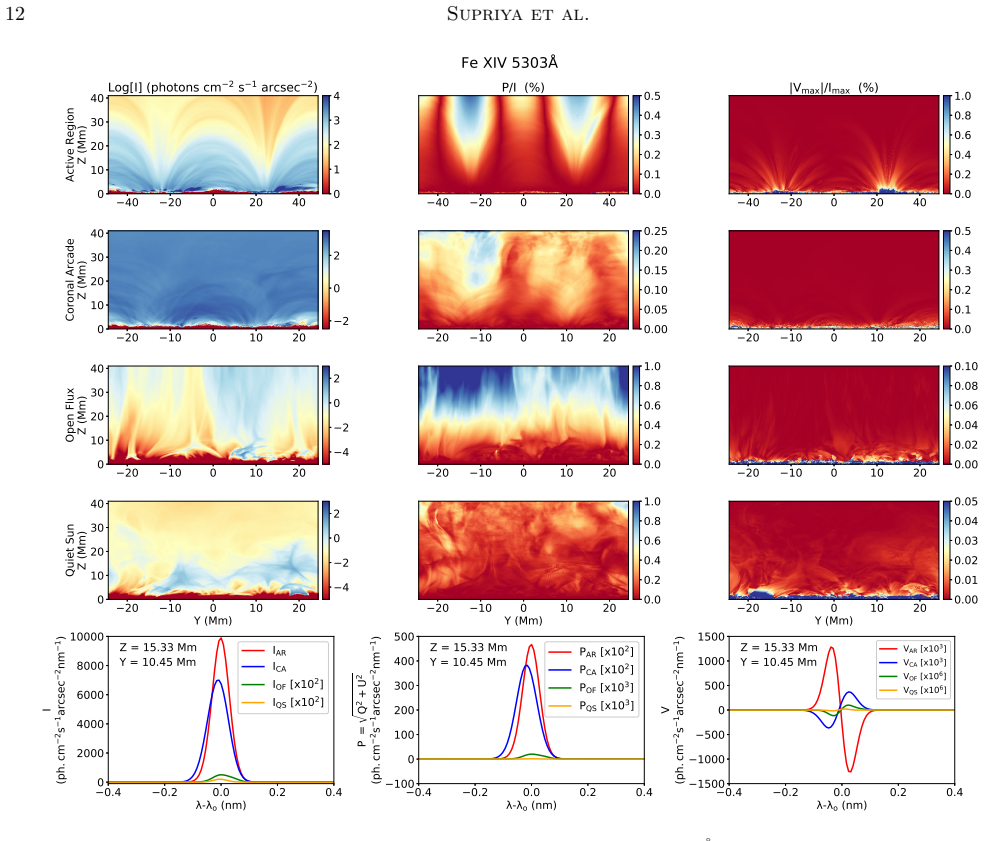
The paper's central claim is that P-CORONA correctly synthesizes Stokes I, Q, U, and V for coronal lines in 3D models by implementing the density-matrix theory of spectral line polarization in full, rather than restricting to the saturated Hanle regime or to the weak-field approximation for Stokes V. The code solves the statistical equilibrium equations for the multipolar components $\rho^K_Q$ of the atomic density matrix for a multilevel atom, then computes frequency-dependent emissivities via the general expression $\epsilon_i(\nu,\Omega)$ that retains the magnetic sublevel splitting in the Voigt and Faraday-Voigt profiles. This is what allows the Zeeman effect to enter all Stokes parameters, including the transverse-field contribution to Q and U; the paper demonstrates the effect on Fe xiii 10747 Å and Si ix 39343 Å in an active-region MURaM model, finding that the transverse Zeeman signatures are visible in the synthesized profiles but too weak for current instruments. The same implementation is applied to six forbidden lines in four MURaM snapshots and to Fe xiii 10747 Å in two large-scale Predictive Science models, and the code is released openly.
Load-bearing premise
The load-bearing premise is the strong-coupling approximation: any radiative transition not satisfying the dipole selection rules is assumed to change only level populations, never polarization; if such transitions do polarize the upper levels of the forbidden lines, the computed Stokes Q, U, and V maps would be systematically too small.
Editorial extensions
If this is right
- P-CORONA provides synthetic Stokes I, Q, U, and V maps for forbidden and permitted coronal lines in 3D MHD models, enabling direct comparison with DKIST, UCoMP, and future coronagraphic polarimetry.
- The full-emissivity treatment means that the Zeeman effect contributes to linear polarization (Q and U) as well as circular polarization (V), so the code can be used to test whether transverse-field signatures are observable in a given line and model.
- The paper's calculations imply that in the lower corona, scattering linear polarization of the six forbidden lines is weak, with Fe xiv 5303 Å and Fe xiii 10747 Å the strongest; such predictions can guide line selection and integration times for observations.
- For Si ix 39343 Å, transverse Zeeman signatures appear at low heights in strong-field active regions but remain near the detectability limit, giving a concrete upper bound on what current instruments can expect.
- Because the code handles spherical Predictive Science models extending to several solar radii, the same synthesis can be applied to off-limb and large-scale coronal observations, not only disk-center geometries.
Reading between the lines
- A natural extension of the code would be to apply it to EUV permitted lines such as O vi 1032 Å and Ne viii 770 Å, where the Hanle effect is not saturated; if the implementation handles them, P-CORONA could produce maps of field strength rather than only field orientation.
- The strong coupling approximation is the main place where the computed Q, U, and V could be underestimated; implementing a full multipole treatment for a line like Si ix 39343 Å would give a direct test of how much polarization the non-dipole transitions actually carry.
- The paper's conclusion that transverse Zeeman linear polarization is unobservable in these forbidden lines suggests that observers should prioritize longitudinal-field diagnostics via Stokes V or seek permitted lines with larger Zeeman sensitivity; P-CORONA could be used to survey candidate lines before committing telescope time.
Signed reviews
Editorial analysis
A structured set of objections, weighed in public.
Referee Report
Summary. The manuscript presents P-CORONA, an open-source Fortran 90 code for synthesizing Stokes I, Q, U, and V of coronal emission lines in 3D MHD models. The code solves multilevel statistical equilibrium equations for the atomic density matrix following Landi Degl'Innocenti & Landolfi (2004), including anisotropic radiative pumping, Hanle and Zeeman effects, electron and proton collisions, and Doppler dimming/brightening. The authors demonstrate the code on six forbidden lines (Fe xiii, Fe xiv, Fe xi, Si ix, Si x) in MURaM and PSI coronal models, and they highlight new predictions for the Zeeman-induced linear polarization of Fe xiii 10747 Å and Si ix 39343 Å. The code is publicly available on GitLab and Zenodo, with documentation.
Significance. If the implementation is correct, P-CORONA fills a real community need: a single public tool that treats both forbidden and permitted lines with a consistent Hanle-Zeeman framework in 3D coronal models, going beyond the saturated-Hanle approximation used by CLE/pyCELP for forbidden lines. The paper has notable strengths: the theoretical basis is established LL04 formalism, no ad-hoc fitted parameters enter the results, the inputs are standard (CHIANTI atomic data, MURaM/PSI models), and the authors explicitly quantify the detectability limitations of the predicted transverse-Zeeman signals. The code availability and strong-scaling tests are also positive. The main concerns are that the claimed benchmark against pyCELP is not shown quantitatively, and the domain of validity of the key emissivity expression is under-specified for non-dipole transitions and for arbitrary magnetic-field orientations.
major comments (3)
- [Section 2.2 (Eq. 1)] The paper states that LL04 theory is valid 'under the dipole approximation,' yet it applies Eq. (1) to all radiative transitions satisfying ΔJ=0,±1, including 'non-dipole transitions.' For an electric quadrupole or higher multipole transition, the emitted photon carries angular momentum beyond rank 1, and the (1 1 K) angular factors and 3-j symbols in Eq. (1) are not the correct emissivity. Since the six showcase forbidden lines are not explicitly classified as pure M1 or E1 transitions, and since the Casini et al. (2024) multipole extension is stated not to be implemented, the code's computed Q, U, and V for any modeled line with non-negligible E2/M1 or higher multipole admixture would be systematically incorrect. The authors should either restrict the stated applicability to pure electric/magnetic dipole (rank-1) transitions, explicitly demonstrate that each modeled line is dipole-dominated, or implement the multipole treatment they cite as future work.
- [Section 2.2 (quantization axis)] The text specifies that the solar radius vector is the quantization axis for total angular momentum, but Zeeman sublevel energies are M-diagonal only when the quantization axis is aligned with the magnetic field. The manuscript does not describe a rotation to the magnetic-field reference frame before evaluating Eq. (1), nor does it explain how the LL04 magnetic-kernel treatment accounts for the arbitrary field orientation. In the MURaM/PSI models the magnetic field direction changes significantly, so the transverse-Zeeman Q and U signatures shown in Figures 13–14 could be misassigned if the profile functions in Eq. (1) are evaluated in the vertical-axis frame without including the required level mixing or frame rotation. The authors need to specify the exact reference-frame procedure, or cite the precise LL04 equations that make the vertical-axis expression exact for arbitrary B.
- [Section 2.2 (benchmark)] The claimed validation against pyCELP is presented only qualitatively: the text states 'good agreement between the results obtained using both codes, except when accounting for the impact of the Zeeman effect on the Stokes Q and U profiles for some IR lines.' This is a load-bearing point for a code paper, and the disagreement is exactly in the new Zeeman Q,U terms. A quantitative comparison, such as maximum relative differences in I, Q, U, and V as functions of wavelength and line-of-sight position for Fe xiii and Si ix, should be included so that the central correctness claim can be verified.
minor comments (4)
- [Figures 5–12] Several figure panels contain corrupted or unreadable text (e.g., 'R/uni2299' in Figure 12 and repeated mangled labels in the colorbar axis text of Figures 5–11); the final version should use clean vector labels.
- [Table 2] The quantity called 'total linear polarization' should be defined precisely; because Q and U vary across the line profile, the frequency-integrated P = sqrt(Q^2+U^2) is not a simple integrated linear-polarization amplitude unless an explicit convention is given.
- [Section 3.1] For the six forbidden lines the manuscript should state the dominant radiative multipole character (M1, E2, or mixed) for each line, since this is directly relevant to the validity discussion in Section 2.2.
- [Section 2.1] The fixed-LOS geometry is clearly acknowledged as unsuitable for near-Sun observers; the text should also state whether the code can be rerun with a rotated LOS to approximate Solar Orbiter/Parker Solar Probe viewing, since several readers may attempt such an use.
Circularity Check
No significant circularity: P-CORONA is an implementation of the external LL04 theory with no fitted parameters and no prediction-equivalent-to-input construction.
full rationale
P-CORONA is presented as an implementation of the published LL04 density-matrix theory: the emissivity in Eq. (1) is taken from LL04 Eq. (7.15e), and the statistical equilibrium equations, radiative rates, collisional rates, and magnetic kernel are cited to LL04 Sections 7.2–7.4. No parameter is fitted to the Stokes outputs, and no claimed prediction is obtained by inverting an input. The atmospheric models (MURaM, PSI), atomic data (CHIANTI), abundances, and disk radiation are all external inputs, so the synthetic Stokes maps are not equivalent by construction to any fitted quantity. The self-citations (Supriya et al. 2021 for permitted-line Ly-alpha modeling and the Doppler-dimming radiation-tensor formula; Del Zanna & Supriya 2025 for Fe xiii atomic data) are prior independent work and are not used as a definitional loop or as the sole justification of the central claim. The paper's own caveats—that LL04 is used under the dipole approximation, that non-dipole transitions are handled by the strong-coupling approximation or deferred to Casini et al. (2024), and that the pyCELP benchmark is described but not shown quantitatively—are correctness and validation risks, not circular reductions. No quoted equation or step reduces to its own input, so the appropriate finding is no circularity.
Assumptions & free parameters
assumptions (5)
- standard math LL04 complete frequency redistribution theory of spectral line polarization is valid for the coronal lines modeled.
- domain assumption Dipole approximation applies to all radiative transitions satisfying ΔJ=0,±1, and other transitions only affect populations (strong coupling approximation).
- domain assumption Coronal lines observed here are optically thin, so LOS integration of emissivities (Eq. 3) is valid without radiative transfer.
- domain assumption Atomic data (CHIANTI v10) and abundances (Schmelz et al. 2012) are accurate.
- domain assumption Fixed LOS geometry (X-axis along LOS) is sufficient for the applications shown.
Cite this review
Pith. "Pith review of P-CORONA: A New Tool for Calculating the Intensity and Polarization of Coronal Lines in 3D Models of the Solar Corona." pith.science (2026). https://pith.science/paper/4M7UPDMU
@misc{pith2026250505962,
  author       = {Pith},
  title        = {Pith review of: P-CORONA: A New Tool for Calculating the Intensity and Polarization of Coronal Lines in 3D Models of the Solar Corona},
  year         = {2026},
  howpublished = {\url{https://pith.science/paper/4M7UPDMU}},
  note         = {Machine review of arXiv:2505.05962}
}
read the original abstract
The critical need to study the magnetic field in the solar corona is highlighted by recent observational facilities, such as DKIST and Aditya-L1. A powerful tool for probing the magnetism of the solar corona is forward modeling of the intensity and polarization of coronal emission lines in three-dimensional (3D) magnetohydrodynamic models. Here we present P-CORONA, a new spectral synthesis code designed to calculate the intensity and polarization of coronal lines in 3D models of the solar corona, taking into account the symmetry breaking induced by magnetic and velocity fields. P-CORONA allows the calculation of the on-disk and off-limb intensity and polarization of forbidden and permitted coronal lines, thus facilitating a wide range of investigations. Applying the quantum theory of atom-photon interactions, P-CORONA accounts for the spectral line polarization caused by anisotropic radiation pumping and the Hanle and Zeeman effects, making it a valuable tool for investigating coronal magnetic fields. This paper details the code's theoretical formulation, the implementation, and illustrative results of calculations in different 3D coronal models (MURaM and Predictive Science Inc.), including the impact of the Zeeman effect from the transverse magnetic field component on selected coronal forbidden lines. P-CORONA is now accessible to the research community on GitLab and Zenodo, providing a resource to facilitate research aimed at advancing our understanding of coronal magnetism and dynamics.
Figures


Figures from the paper (11 more)




Forward citations
Cited by 1 Pith paper
-
Coronal Magnetometry with EUV Permitted Lines
The authors calculate the linear polarization of many permitted EUV coronal lines and identify the most promising ones for measuring the orientation of the coronal magnetic field.
Reference graph
Works this paper leans on
-
[1]
A unifying polarization formalism for electric- and magnetic-multipole interactions
Casini, R., Manso Sainz, R., Lopez Ariste, A., & Kaikati, N. 2024, arXiv e-prints, arXiv:2409.01197, doi: 10.48550/arXiv.2409.01197
work page Pith review arXiv doi:10.48550/arxiv.2409.01197 2024
-
[2]
Casini, R., White, S. M., & Judge, P. G. 2017, SSRv, 210, 145, doi: 10.1007/s11214-017-0400-6 Del Zanna, G., & DeLuca, E. E. 2018, ApJ, 852, 52, doi: 10.3847/1538-4357/aa9edf Del Zanna, G., Dere, K. P., Young, P. R., & Landi, E. 2021, ApJ, 909, 38, doi: 10.3847/1538-4357/abd8ce Del Zanna, G., & Supriya, H. D. 2025, MNRAS, accepted for publication
-
[3]
F., Rimmele, T., Casini, R., et al
Elmore, D. F., Rimmele, T., Casini, R., et al. 2014, in Society of Photo-Optical Instrumentation Engineers (SPIE) Conference Series, Vol. 9147, Ground-based and Airborne Instrumentation for Astronomy V, ed. S. K
work page 2014
-
[4]
Ramsay, I. S. McLean, & H. Takami, 914707, doi: 10.1117/12.2057038
-
[5]
Fehlmann, A., Kuhn, J. R., Schad, T. A., et al. 2023, SoPh, 298, 5, doi: 10.1007/s11207-022-02098-y
-
[6]
P., Ignace, R., Erba, C., et al
Folsom, C. P., Ignace, R., Erba, C., et al. 2022, Ap&SS, 367, 125, doi: 10.1007/s10509-022-04140-8
-
[7]
2016, Frontiers in Astronomy and Space Sciences, 3, 8, doi: 10.3389/fspas.2016.00008
Gibson, S., Kucera, T., White, S., et al. 2016, Frontiers in Astronomy and Space Sciences, 3, 8, doi: 10.3389/fspas.2016.00008
arXiv 2016
-
[8]
Judge, P. G., & Casini, R. 2001, in Astronomical Society of the Pacific Conference Series, Vol. 236, Advanced Solar Polarimetry – Theory, Observation, and Instrumentation, ed. M. Sigwarth, 503
work page 2001
Show all 25 references
-
[9]
G., Low, B
Judge, P. G., Low, B. C., & Casini, R. 2006, ApJ, 651, 1229, doi: 10.1086/507982
2006 doi
-
[10]
2012, A&A, 545, A52, doi: 10.1051/0004-6361/201219404
Khan, A. 2012, A&A, 545, A52, doi: 10.1051/0004-6361/201219404
2012 doi
-
[11]
2011, A&A, 529, A12, doi: 10.1051/0004-6361/201015551
Khan, A., Belluzzi, L., Landi Degl’Innocenti, E., Fineschi, S., & Romoli, M. 2011, A&A, 529, A12, doi: 10.1051/0004-6361/201015551
2011 doi
-
[12]
2012, A&A, 543, A158, doi: 10.1051/0004-6361/201219164
Khan, A., & Landi Degl’Innocenti, E. 2012, A&A, 543, A158, doi: 10.1051/0004-6361/201219164
2012 doi
-
[13]
R., & Tomczyk, S
Landi, E., Habbal, S. R., & Tomczyk, S. 2016, Journal of Geophysical Research (Space Physics), 121, 8237, doi: 10.1002/2016JA022598 Landi Degl’Innocenti, E., Bommier, V., & Sahal-Brechot, S. 1990, A&A, 235, 459 Landi Degl’Innocenti, E., & Landolfi, M., eds. 2004, Astrophysics ...
2016 doi
-
[14]
2017, ApJ, 838, 69, doi: 10.3847/1538-4357/aa6625 Manso Sainz, R., & Trujillo Bueno, J
Li, H., Landi Degl’Innocenti, E., & Qu, Z. 2017, ApJ, 838, 69, doi: 10.3847/1538-4357/aa6625 Manso Sainz, R., & Trujillo Bueno, J. 2009, in Astronomical Society of the Pacific Conference Series, Vol. 405, Solar Polarization 5: In Honor of Jan Stenflo, ed. S. V. Berdyugina, K. ...
2017 doi
-
[15]
E., & Casini, R
Molnar, M. E., & Casini, R. 2024, ApJ, 977, 97, doi: 10.3847/1538-4357/ad8de4
2024 doi
-
[16]
Solanki, S. K. 2016, Frontiers in Astronomy and Space Sciences, 3, 20, doi: 10.3389/fspas.2016.00020
2016
-
[17]
2017, ApJ, 834, 10, doi: 10.3847/1538-4357/834/1/10
Rempel, M. 2017, ApJ, 834, 10, doi: 10.3847/1538-4357/834/1/10
2017 doi
-
[18]
R., Warner, M., Keil, S
Rimmele, T. R., Warner, M., Keil, S. L., et al. 2020, SoPh, 295, 172, doi: 10.1007/s11207-020-01736-7
2020 doi
-
[19]
2020, SoPh, 295, 98, doi: 10.1007/s11207-020-01669-1 —
Schad, T., & Dima, G. 2020, SoPh, 295, 98, doi: 10.1007/s11207-020-01669-1 —. 2021, SoPh, 296, 166, doi: 10.1007/s11207-021-01917-y
2020 doi
-
[20]
A., Petrie, G
Schad, T. A., Petrie, G. J., Kuhn, J. R., et al. 2024, Science Advances, 10, eadq1604, doi: 10.1126/sciadv.adq1604
2024 doi
-
[21]
T., Reames, D
Schmelz, J. T., Reames, D. V., von Steiger, R., & Basu, S. 2012, ApJ, 755, 33, doi: 10.1088/0004-637X/755/1/33
2012 doi
-
[22]
2025, P-CORONA, Zenodo, doi: 10.5281/zenodo.15195460
Shchukina, N., & Trujillo Bueno, J. 2025, P-CORONA, Zenodo, doi: 10.5281/zenodo.15195460
2025 doi
-
[23]
D., Trujillo Bueno, J., de Vicente, ´A., & del Pino Alem´ an, T
Supriya, H. D., Trujillo Bueno, J., de Vicente, ´A., & del Pino Alem´ an, T. 2021, ApJ, 920, 140, doi: 10.3847/1538-4357/ac1068
2021 doi
-
[24]
2021, in AGU Fall Meeting Abstracts, Vol
Tomczyk, S., Landi, E., Berkey, B., et al. 2021, in AGU Fall Meeting Abstracts, Vol. 2021, 2089 Trujillo Bueno, J. 2001, in Astronomical Society of the Pacific Conference Series, Vol. 236, Advanced Solar Polarimetry – Theory, Observation, and Instrumentation, ed. M. Sigwarth, ...
-
[25]
2002, Nature, 415, 403, doi: 10.1038/415403a
Merenda, L., & Manso Sainz, R. 2002, Nature, 415, 403, doi: 10.1038/415403a
2002 doi
Reviewed August 15, 2026 · model on record in the stance chip above.
Discussion (0). Continue with ORCID to comment.