REVIEW 2 major objections 5 minor 65 references
RM jitter: Wavelength-dependent Scatter in Rotation Measure Related to Faraday Complexity
T0 review · 2 major / 5 minor · reviewed 2026-08-15 · deepseek-v4-flash
Pith's one-line read RM scatter in surveys is partly a wavelength-dependent artifact of turbulent plasma near each source.
desk verdict Careful simulations establish that RM scatter is survey-wavelength-dependent and sensitive to the turbulence power spectrum, but the claimed match to Vanderwoude et al. is conditional on untested priors. read the letter →
The pith
A machine-rendered reading of the paper's core claim, the machinery that carries it, and where it could break.
The reading
What carries the argument
The central machinery is a numerical turbulent Faraday screen: a random two-dimensional field of Faraday depth with power spectrum $A(k)=A\,k^{\gamma}$ ($\gamma = -2.0, -2.5, -3.0$), realized with random phases and scaled to a prescribed $\sigma_\phi$, viewed through a Gaussian beam. For each simulated source, Stokes $Q$ and $U$ are integrated across the source via $\theta-\theta_0=\phi\lambda^2$, then processed with RM synthesis and QU fitting using survey-specific wavelength coverage. The key identity connecting jitter to depolarization is the derivative of the polarization angle, $R=d\theta/d\lambda^2$; near minima of $|P|$, $1/|P|$ amplification makes $R$ (and hence the survey-dependent RM) wander far from the true mean Faraday depth, sometimes reversing sign. A discrete analog with $N$ Faraday-thin components yields $\Delta\mathrm{RM} = (\sigma_\phi/\sqrt{N})\,(1+4\sigma_\phi^2\lambda^4)$, showing the linear and wavelength-dependent cubic terms; in the $N\to\infty$ limit it reproduces the standard analytic depolarization models with no jitter.
What would settle it
Take a set of unresolved sources spanning a range of fractional polarization and observe them with two frequency setups whose wavelength coverage overlaps but differs in bandwidth, at matched sensitivity. The turbulent-screen model predicts that scatter between the two measured RMs grows with depolarization and that the slope of the RM-RM relation equals the ratio of the median depolarization factors; if the scatter is independent of fractional polarization, or the slope stays unity while substantial jitter is present, the model is ruled out.
Extended reading notes
Core claim
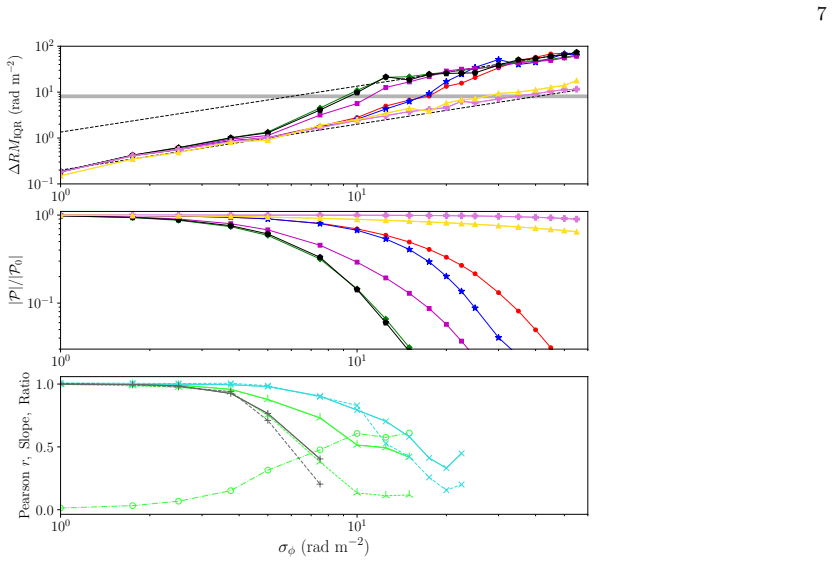
RM jitter is the paper's name for the scatter in measured rotation measure that arises, not from measurement noise or from a common foreground, but from the turbulent Faraday-depth structure within the source region: unresolved structure on scales from below the beam up to the source size leaves each source with its own mean Faraday depth and its own depolarization behavior. The central quantitative claim is that this jitter evolves through three regimes as the Faraday-depth dispersion $\sigma_\phi$ grows: a linear regime with $\Delta\mathrm{RM}_{\mathrm{IQR}} \approx \sigma_\phi/5$, a non-linear regime where wavelength-dependent depolarization amplifies the apparent RM through the $1/|P|$ factor, and a saturated regime where $\Delta\mathrm{RM}_{\mathrm{IQR}}$ approaches the interquartile range of a Gaussian with dispersion $\sigma_\phi$, independent of the power-spectrum slope $\gamma$. Because depolarization and the resulting amplification depend on which wavelengths a survey observes, the same source can yield different RMs in different surveys, and the jitter is independent of Faraday-depth resolution. The paper's application to a flux-density-limited sample claims that this jitter naturally produces the observed increase of RM scatter toward low fractional polarization, and that a power-law slope $\gamma\approx -2.5$ reproduces the scatter of sources below 3% polarization.
Load-bearing premise
The load-bearing premise is that every source in the sample is depolarized by an unresolved turbulent magnetized plasma located in front of the source, described by a single power-law spectrum of Faraday-depth fluctuations. If many low-polarization sources instead depolarize inside the emitting region or through a different kind of plasma, the inferred slope $\gamma\approx -2.5$ and the conclusion that jitter dominates the faintly polarized sample collapse.
Editorial extensions
If this is right
- Surveys cannot quote a single extrinsic RM scatter without specifying their wavelength coverage: the same turbulent screen produces different jitter in different surveys, and the jitter can exceed measurement errors even for broadband surveys.
- Samples selected with a 3% fractional-polarization threshold still contain sources whose RM jitter exceeds the measurement errors; the paper estimates that a threshold near 7% or higher is required for jitter to drop to the level of RM errors.
- Comparisons of RMs from different surveys—variability searches, RM structure functions, cluster and galaxy RM-variance studies, and RRM-redshift analyses—must account for correlated jitter, not just independent Gaussian errors, and narrow-band surveys can produce extreme RM outliers that mimic anomalies.
- The same jitter mechanism explains why RM scatter rises toward low fractional polarization without invoking signal-to-noise artifacts, and it makes the slope $\gamma$ of the Faraday-depth power spectrum a parameter that can be constrained from RM scatter in the RM grid.
- Because jitter is independent of Faraday-depth resolution, improving Faraday-depth resolution does not reduce it; surveys with the same sensitivity to continuous Faraday-depth structure show the same jitter even when their resolution differs by a factor of three.
Reading between the lines
- Beyond the paper, the N-component formula suggests a practical estimator: in the linear regime, RM jitter scales as $\sigma_\phi/\sqrt{N}$, so measuring jitter and $\sigma_\phi$ separately could let a survey estimate the effective number of independent Faraday cells without resolving the source.
- Beyond the paper, if the screen model is right, apparent RM variability between historical narrow-band catalogs and modern broadband surveys is partly a wavelength-sampling artifact; a fair variability search should compare epochs observed with identical $\lambda^2$ coverage.
- Beyond the paper, the model predicts that RM jitter should decrease for larger angular-size sources, since more large-scale structure is resolved out; this could be checked by splitting a sample by source angular size.
- Beyond the paper, a direct measurement of the Faraday-depth power spectrum in resolved radio lobes could be compared with the $\gamma\approx -2.5$ inferred from jitter; agreement would turn the RM grid into a turbulence probe, while disagreement would indicate that unresolved sources sample different structure than resolved lobes.
Signed reviews
Editorial analysis
A structured set of objections, weighed in public.
Referee Report
Summary. This paper introduces and quantifies "RM jitter": the scatter in measured rotation measure (RM) across a sample of unresolved extragalactic sources, caused by turbulent Faraday screens with a given power spectrum of Faraday depth structure. The author simulates screens with power-law indices γ = −2.0, −2.5, −3.0, applies RM synthesis with the frequency coverage of several real and mock surveys (POSSUM Low, POSSUM Low+Mid, THOR, NVSS/CGPS, Wide, B001, B002), and characterizes the interquartile range of RM across 300 independent realizations as a function of the Faraday depth dispersion σφ. Three regimes are identified: a linear regime (ΔRMIQR ≈ σφ/5), a non-linear regime near σφλ² ≈ 1 with 1/|P| amplification, and a saturated regime where ΔRMIQR approaches the IQR of the Faraday depth distribution. The paper argues that RM jitter is independent of Faraday depth resolution (POSSUM Low vs. B001, matched Wmax), shows that cross-survey RM correlations have slopes approximately equal to the depolarization ratios, and discusses implications for RM variability searches, RM structure functions, cluster RM variance, and RRM(z) studies. A flux-limited construction, assuming depolarization by a turbulent screen for all sources, is used to compare with the Vanderwoude et al.
Significance. If the results hold, the paper makes a useful conceptual and practical contribution for the SKA-era RM grid: it separates the monochromatic quantity R from the survey-dependent RM measured by synthesis/QU fitting, provides a three-regime taxonomy of jitter tied to the Rudnick & Cotton (2023) parameter Wmax, and shows that low-polarization subsamples can carry large, survey-specific RM scatter. The core simulations are systematic and clean: the three-regime behavior is shown consistently across three values of γ, the POSSUM Low/B001 pair is a well-designed control demonstrating resolution independence, and the comparison with Vanderwoude et al. (2024) is a forward model against an external benchmark rather than a fit. The paper is also honest about its limitations, explicitly stating that the σφ distribution is unknown and that the intrinsic polarization calibration was adjusted after experimentation. The falsifiable predictions (cross-survey correlation slope equal to the depolarization ratio, jitter depending on λ² coverage, a ~7% polarization threshold to suppress jitter below typical errors) are valuable.
major comments (2)
- [Section 2.4, Figure 9] The central comparison with Vanderwoude et al. (2024) rests on three inputs that the paper itself identifies as unknown or tuned: the distribution of σφ (uniform vs. half-Gaussian), the intrinsic fractional polarization range (10%–20%, selected after "experimentation" to bring the median to 2%), and γ. The outcome is reported only qualitatively: γ = −2.5 "comes close," and it "performs better" with a half-Gaussian σφ distribution, while the only concrete number given is for the equal mixture of the three γ values, ΔRMIQR = 18.3 rad m⁻². Because the text does not report the actual ΔRMIQR for the Π < 3% subsample for each γ and each σφ prior, nor bootstrap uncertainties on the IQR of a 300-source sample, the robustness of the γ ≈ −2.5 inference cannot be evaluated. In addition, the statement that the half-Gaussian prior performs better sits oddly with the adoption of the uniform prior. I request a table of ΔRMIQR(Π < 3%) over the {γ} × {σφ prior} grid, with sampling errors, and an explicit statement of the numerical range of the adopted uniform σφ prior.
- [Section 2.4, Discussion, and Abstract] The flux-limited comparison treats pure simulated RM jitter as the scatter to be compared with the observed total IQR of ~15 rad m⁻², without specifying how measurement errors (Table 1 gives Δ10σ ≈ 2 rad m⁻² for POSSUM Low+Mid, and errors are larger near the detection threshold) and Galactic foreground RM are handled. Since the observed value contains these contributions, the pure jitter component should be below 15 rad m⁻² if it is to dominate, and the abstract's phrasing that the simulated sample "can reproduce" the observed scatter is stronger than the analysis supports; the text in Section 2.4 is appropriately conditional, but the abstract and parts of Section 4 are not. Relatedly, the inference that the Π < 3% scatter is "dominated by RM jitter" assumes that all low-polarization sources depolarize through the same turbulent-screen mechanism (stated in the abstract and Section 2.4). I recommend adding simulated measurement errors and a foreground term, or an explicit quantitative argument that they are negligible, and a short mixture calculation in which a fraction of sources depolarizes internally (e.g., Burn-type, Eq. 7) to show how the inferred γ and the "dominated by jitter" conclusion shift.
minor comments (5)
- [Section 5] The summary states "the inter-quartile radio of a Gaussian"; this should read "inter-quartile range."
- [Section 4] The text contains "the correlation of RM jittter between the two surveys"; "jittter" should be "jitter."
- [Section 3, Eq. (12)] Please verify the typesetting of Equation (12). As printed, the second term in brackets appears to contain (Σ cos)², but consistency with the small-λ limit leading to Eq. (14) requires a factor of (Σ sin/Σ cos)², and the quantity f should be (Σ sin)²/(Σ cos)² rather than the product (Σ sin Σ cos)². The subsequent derivation of Eqs. (14)–(15) is correct.
- [Figure 4 caption] The caption's description of markers as "green with crow foot" and similar is cryptic; a legend or a clear verbal description of each marker style would improve readability.
- [Section 2.4] Please state explicitly the numerical range of the uniform σφ prior (presumably the simulated range of 2.5–55 rad m⁻²) and the number of independent realizations per (γ, σφ) cell that feed the flux-limited draws, since Figure 1 uses 50 realizations per cell while Figure 4 uses samples of 300.
Circularity Check
No circularity: forward simulated RM jitter compared with an external benchmark; Section 2.4 priors are conditional inputs, not by-construction reproductions of the target.
full rationale
After walking the derivation chain, I find no load-bearing circular step. RM jitter is not defined as the observed scatter; it is an output of forward simulations in which random Faraday depth fields with power spectrum A(k)=A k^gamma and prescribed sigma_phi are integrated over a source and processed with RM synthesis (Sections 2.1-2.3). The analytic N-component model in Section 3 is an independent expansion and does not presuppose the survey results. The flux-limited comparison in Section 2.4 is conditional: the intrinsic polarization range 10-20% and the uniform sigma_phi prior are inputs chosen partly to reproduce the observed median fractional polarization (~2%), and gamma is scanned over three externally motivated values (-2.0, -2.5, -3.0) rather than fitted to DeltaRM_IQR. The statement that gamma approximately -2.5 'could reproduce the observed RM scatter' is a model-data comparison under explicitly stated assumptions, not an equation that reduces to its own inputs. Self-citations (Stil et al. 2011, 2014; Shanahan et al. 2023) appear as observational or contextual support, not as the source of the central quantitative claim. The paper's own caveat that the results are preliminary and that more detailed modelling and more data are required reinforces that the match is conditional rather than circular. Robustness of the match to the adopted priors is a correctness and validation concern, not circularity under the defined standards.
Assumptions & free parameters
free parameters (6)
- Power spectrum slope γ =
-2.0, -2.5, -3.0 (scanned, not fitted)
- Faraday depth dispersion σφ distribution =
uniform (half-Gaussian also tested)
- Intrinsic fractional polarization range =
uniform 10-20%
- Detection and depolarization cutoffs =
0.1 mJy polarized threshold; depolarization factor <0.01 set to zero; total flux >10 mJy for fractional polarization
- Beam to source size ratio =
10
- Power spectrum scale range =
from image size to pixel scale
assumptions (6)
- domain assumption Faraday rotation relation θ-θ0=φλ^2 and the integral expression for Faraday depth φ.
- domain assumption RM synthesis inversion and the definition of RM as the peak of the reconstructed Faraday dispersion function.
- domain assumption Power-law power spectrum A(k)=A k^γ for Faraday depth structure.
- domain assumption Uniform intrinsic polarization angle θ0=0 across the source.
- domain assumption Depolarization by a turbulent Faraday screen for all sources in the flux-limited sample.
- domain assumption In the N-component toy model, the expectation value of φj is zero and all component amplitudes are equal.
Cite this review
Pith. "Pith review of RM jitter: Wavelength-dependent Scatter in Rotation Measure Related to Faraday Complexity." pith.science (2026). https://pith.science/paper/RZKX3SRO
@misc{pith2026250506460,
  author       = {Pith},
  title        = {Pith review of: RM jitter: Wavelength-dependent Scatter in Rotation Measure Related to Faraday Complexity},
  year         = {2026},
  howpublished = {\url{https://pith.science/paper/RZKX3SRO}},
  note         = {Machine review of arXiv:2505.06460}
}
read the original abstract
The relation between Faraday Rotation Measure (RM) and differential Faraday rotation by unresolved structure of a turbulent plasma is investigated for extragalactic radio sources. The RM scatter of a sample of sources affected by turbulent Faraday screens with identical power spectra of Faraday depth structure, is referred to as RM jitter. For fixed amplitude and slope of the power spectrum, the range of possible RMs depends on the wavelength coverage of the survey. RM jitter is independent of Faraday depth resolution as it results from the true Faraday depth dispersion and effects of wavelength-dependent depolarization. RM jitter for a flux density limited sample is sensitive to the power law index gamma of the power spectrum of Faraday depth structure. Assuming depolarization by a turbulent Faraday screen for all sources, a simulated flux-density-limited sample can reproduce the high RM scatter found by Vanderwoude et al. (2024) for sources that are less than 3% polarized. RM jitter of sources that are more than 3% polarized, is found to be smaller than the observed scatter, indicating that plasma other than the near-source environment dominates the RM scatter for the more polarized sources. The significance of RM jitter for applications of the RM grid is discussed.
Figures


Figures from the paper (13 more)


Reference graph
Works this paper leans on
- [1]
-
[2]
Anderson, C. S., Gaensler, B. M., Feain, I. J., et al. 2015, , 815, 49
work page 2015
- [3]
-
[4]
Anderson, C. S., Gaensler, B. M., Heald, G. H., et al. 2018, , 855, 41
work page 2018
- [5]
-
[6]
Ar\'amburo-Garcia, A., Bondarenko, K., Boyarsky, A. et al. 2023, , 519, 4030
work page 2023
- [7]
- [8]
Show all 65 references
-
[9]
L., Miniati, F., Lilly, S
Bernet, M. L., Miniati, F., Lilly, S. J. et al. 2008, , 454, 302
2008
-
[10]
L., Miniati, F
Bernet, M. L., Miniati, F. & Lilly, S. J. 2012, , 761, 144
2012
-
[11]
L., Miniati, F., & Lilly, S
Bernet, M. L., Miniati, F., & Lilly, S. J. 2013, , 772, L28
2013
-
[12]
2016, , 595, A32
Beuther, H., Bihr, S., Rugel, M., et al. 2016, , 595, A32
2016
-
[13]
ockmann, K., Br\
B\"ockmann, K., Br\"uggen, M., Heesen, V. et al. 2023, , 678, A56
2023
-
[14]
A., & De Bruyn, A
Brentjens, M. A., & De Bruyn, A. G. 2005, , 441, 1217
2005
-
[15]
Burn, B. J. 1966, , 133, 67
1966
-
[16]
Scaife, A
C\'arcamo, M. Scaife, A. M. M., Alexander, E. et al. 2023, , 518, 1955
2023
-
[17]
E., Kronberg, P
Clarke, T. E., Kronberg, P. P., & B\"ohringer, H. 2001, , 547, L111
2001
-
[18]
W., Cordes, J
Clegg, A. W., Cordes, J. M., Simonetti, J. M. et al. 1992, , 386, 143
1992
-
[19]
D., Dallacasa, D., Fanti, C
Cotton, W. D., Dallacasa, D., Fanti, C. et al. 2003, , 20, 12
2003
-
[20]
S., Gaensler, B
Farnes, J. S., Gaensler, B. M., & Carretti, E. 2014, , 212, 15
2014
-
[21]
S., O'Sullivan, S
Farnes, J. S., O'Sullivan, S. P., Corrigan, M. E. et al. 2014, , 795, 63
2014
-
[22]
M., Haverkorn, M., Burkhart, B
Gaensler, B. M., Haverkorn, M., Burkhart, B. et al. 2011, , 478, 214
2011
-
[23]
Goddi, C., Mart\'i-Vidal, I., Messias, H. et al. 2021, , 910, L14
2021
-
[24]
M., Robishaw, T., & Gaensler, B
Hammond, A. M., Robishaw, T., & Gaensler, B. M. 2013, arxiv:1209.1438v3
2013 arXiv
-
[25]
K., Taylor, A
Grant, J. K., Taylor, A. R., Stil, J. M. et al. 2010, , 714, 1689
2010
-
[26]
A., Norris, R
Hales, C. A., Norris, R. P., Gaensler, B. M. et al. 2014, , 440, 3113
2014
-
[27]
Haverkorn. M. Gaensler, B. M., McClure-Griffiths et al. 2004, , 609, 776
2004
-
[28]
2009, IAUS, 259, 591
Heald, G. 2009, IAUS, 259, 591
2009
-
[29]
2020, Galaxies, 8, 53
Heald, G., Mao, S.-A., Vacca, V., et al. 2020, Galaxies, 8, 53
2020
-
[30]
P., Br\"uggen, M
Heesen, V., O'Sullivan, S. P., Br\"uggen, M. et al. 2023, , 670, L23
2023
-
[31]
H., Michilli, D., Spitler, L
Hilmarsson, G. H., Michilli, D., Spitler, L. G. et al. 2021, , 908, L10
2021
-
[32]
Johnston-Hollitt, M., Govoni, F., Beck, R. et al. 2015, in Proceedings of Advancing Astrophysics with the Square Kilometre Array (AASKA14). 9 -13 June, 2014. Giardini Naxos, Italy, id. 92
2015
-
[33]
S., Stil, J
Johnston, R. S., Stil, J. M., & Keller, B. W. 2021, , 909, 73
2021
-
[34]
2003, , 406, 579
Klein, U., Mack, K.-H., Gregorini, L., & Vigotti, M. 2003, , 406, 579
2003
-
[35]
2014, , 66, 61
Kumazaki, K., Akahori, T., Ideguchi, S., et al. 2014, , 66, 61
2014
-
[36]
A., Bridle, A
Laing, R. A., Bridle, A. H., Parma, P, et al. 2008, , 521, 549
2008
-
[37]
L., Dewdney, P
Landecker, T. L., Dewdney, P. E., Burgess, T. A., et al. 2000, A&AS, 145, 509
2000
-
[38]
Law, C. J. , Gaensler B. M., Bower, G. C., et al. 2011, , 728, 57
2011
-
[39]
M., & Dennison, B
Lawler, J. M., & Dennison, B. 1982, , 252, 81
1982
-
[40]
D., McClure-Griffiths, N
Livingston, J. D., McClure-Griffiths, N. M., Gaensler, B. M., et al. 2021, 502, 3814
2021
-
[41]
2024, , 694, A125
Loi, F., Serra, P., Murgia M., et al. 2024, , 694, A125
2024
-
[42]
M., Michilli, D
McKinven, R., Gaensler, B. M., Michilli, D. et al. 2023, , 950, 12
2023
-
[43]
P., Feain, I
O'Sullivan, S. P., Feain, I. J., McClure-Griffiths, N. M. 2013, , 764, 162
2013
-
[44]
P., Purcell, C
O'Sullivan, S. P., Purcell, C. R., Anderson, C. S. et al. 2017, , 469, 4034
2017
-
[45]
P., Shimwell, T
O'Sullivan, S. P., Shimwell, T. W., Hardcastle, M. J., et al. 2023, , 519, 5723
2023
-
[46]
R., Van Eck, C
Purcell, C. R., Van Eck, C. L., West, J., Sun, X. H., & Gaensler, B. M. 2020, RM-Tools: Rotation Measure (RM) synthesis and Stokes QU-fitting, Astrophysics Source Code Library, record ascl:2005.003
2020
-
[47]
Rudnick, L, & Cotton, W. D. 2023, , 522, 1464
2023
-
[48]
Rudnick, L., & Owen, F. N. 2014, , 785, 45
2014
-
[49]
P., & Button, S
Simard-Normandin, M., Kronberg, P. P., & Button, S. 1981, , 45, 97
1981
-
[50]
H., Rudnick, L., Akahori, T
Sun, X. H., Rudnick, L., Akahori, T. et al. 2015, , 149, 60
2015
-
[51]
2010, , 409, 99
Schnitzeler, D. 2010, , 409, 99
2010
-
[52]
J., Stil, J
Shanahan, R., Lemmer, S. J., Stil, J. M., et al. 2019, , 887, L7
2019
-
[53]
Shanahan, R., Stil, J. M. , Anderson, L., et al. 2023, 957, 60
2023
-
[54]
H., Cordes, J
Simonetti, J. H., Cordes, J. M., & Spangler, S. R. 1984, , 284, 126
1984
-
[55]
M., Taylor, A
Stil, J. M., Taylor, A. R., & Sunstrum, C. 2011, , 726, 4
2011
-
[56]
M., Keller, B
Stil, J. M., Keller, B. W., George, S. J. et al. 2014, , 787, 99
2014
-
[57]
D., Bykov, A
Sokoloff, D. D., Bykov, A. A., Shukurov, A., Berkhuijsen, E. M., Beck, R., & Poezd, A. D. 1998, , 299, 189
1998
-
[58]
R., Stil, J
Taylor, A. R., Stil, J. M., & Sunstrum, C. 2009, ApJ, 702, 1230
2009
-
[59]
Tribble, P. C. 1991, , 250, 726
1991
-
[60]
Vanderwoude, S., West., J., Gaensler, B. M. et al. 2024, , 167, 226
2024
-
[61]
Gaensler, B
Vernstrom, T. Gaensler, B. M., Rudnick, L., & Andernach, H. 2019, , 878, 92
2019
-
[62]
L., Murphy, T., et al
Wang, Z., Kaplan, D. L., Murphy, T., et al. 2021, , 920, 45
2021
-
[63]
J., Stil, J
Weatherhead, K. J., Stil, J. M., Rugel, M., et al. 2024, , 970, 92
2024
-
[64]
Windhorst, R.\ A.\ 2003, The microJansky and nano-Jansky Population, in New Astronomy Reviews , 47, 357
2003
-
[65]
1962, , 136, 1152
Woltjer, L. 1962, , 136, 1152
1962
Reviewed August 15, 2026 · model on record in the stance chip above.
Discussion (0). Continue with ORCID to comment.