REVIEW 3 major objections 5 minor 2 references
Virtualized 3D Gaussians: Flexible Cluster-based Level-of-Detail System for Real-Time Rendering of Composed Scenes
T0 review · 3 major / 5 minor · reviewed 2026-08-15 · deepseek-v4-flash
Pith's one-line read V3DG, a cluster-based level-of-detail system, renders composed 3D Gaussian Splatting scenes with roughly 100 million primitives in real time.
desk verdict Solid systems paper: first post-processing, groundtruth-agnostic cluster LOD for 3DGS assets, validated on ~100M-Gaussian composed scenes; the pseudo-view sensitivity gap is real but revision-worthy, not fatal. read the letter →
The pith
A machine-rendered reading of the paper's core claim, the machinery that carries it, and where it could break.
The reading
What carries the argument
The load-bearing object is the cluster group paired with its bounding sphere. A cluster is 4096 Gaussians; a cluster group is two adjacent clusters that are simplified into one coarser cluster, and the hierarchy continues by halving at each level. Its screen-space footprint, computed from the sphere's projected area, is the single LOD criterion: when $F_c \le \tau < F_p$, the child cluster is rasterized and the parent is not. The other essential mechanism is local splatting: simplified Gaussians are optimized against 640 pseudo-view renders of the original group at 64x64 resolution, with scale initialization increased by $2^{1/6}$ and $\alpha$ supervision, so appearance is preserved without training-view dependence.
What would settle it
Choose a simplified cluster group from one of the paper's assets, render both original and simplified versions from viewpoints far outside the pseudo-view configuration (grazing angle, very close, or after strong rotation and scale), and compare with FLIP or PSNR; if the error exceeds the tolerance used for cluster selection, the appearance guarantee fails in a concrete testable case.
Extended reading notes
Core claim
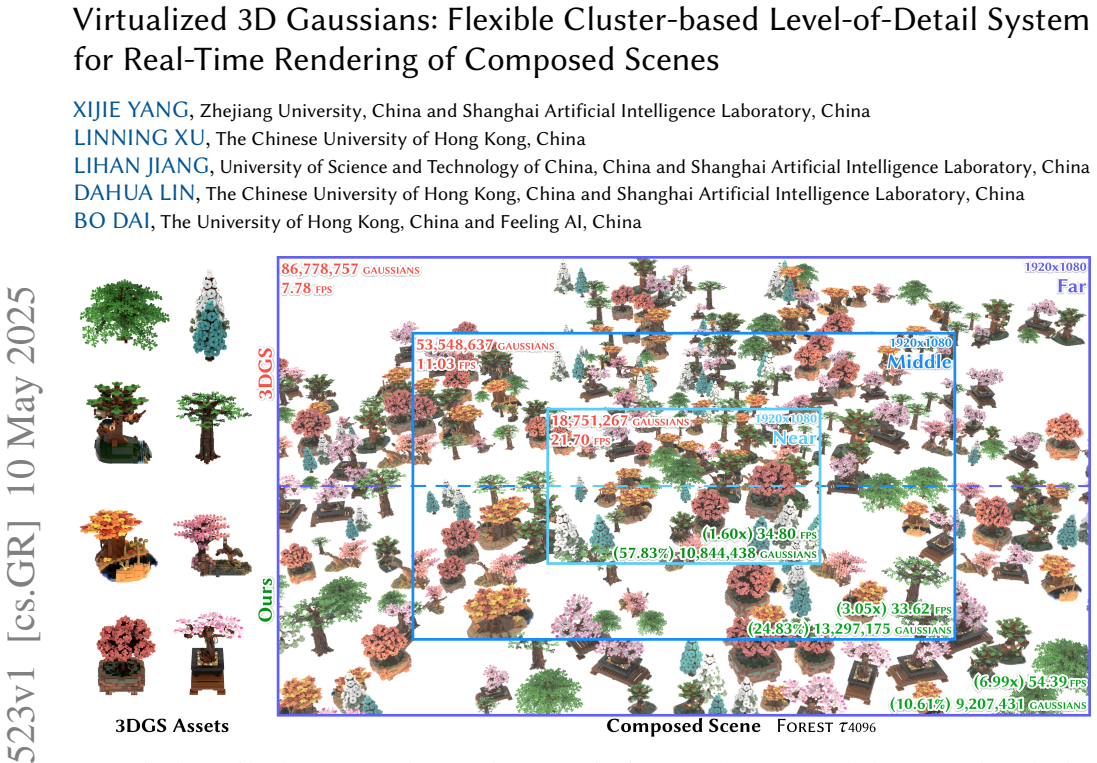
The paper's central claim is that a two-stage cluster-based LOD pipeline keeps composed 3DGS scenes renderable without retraining or new ground-truth views. In the offline build, the Gaussians of an asset are median-split into clusters of 4096 primitives; adjacent clusters are repeatedly merged and simplified by half, guided by a local splatting loss that compares renders from generated pseudo-views, producing a tree of coarser clusters. Each cluster group gets a bounding sphere whose projected screen area forms the footprint; at render time, a footprint tolerance selects the coarsest cluster whose parent is too coarse, via the rule $F_c \le \tau < F_p$. The paper reports that this selection keeps visual fidelity nearly unchanged while reducing the number of rasterized Gaussians and suppressing aliasing, yielding up to an average 6.19x acceleration at the farthest relative distance in four composed scenes of about 0.1 billion Gaussians.
Load-bearing premise
The visual quality claim rests on the assumption that 640 synthetic camera views, placed at four cluster radii away and rendered at 64x64 pixels each, stand in for every real viewpoint and every rotated, scaled placement the simplified clusters will later appear in.
Editorial extensions
If this is right
- Scenes containing roughly 100 million Gaussians can be rendered at real-time rates, with measured acceleration up to an average 6.19x at the farthest relative distance while keeping FLIP error close to the full render.
- A footprint tolerance gives a runtime quality-speed dial: smaller tolerances select finer clusters, larger tolerances select coarser ones, so the same asset bundle serves applications from preview to final quality.
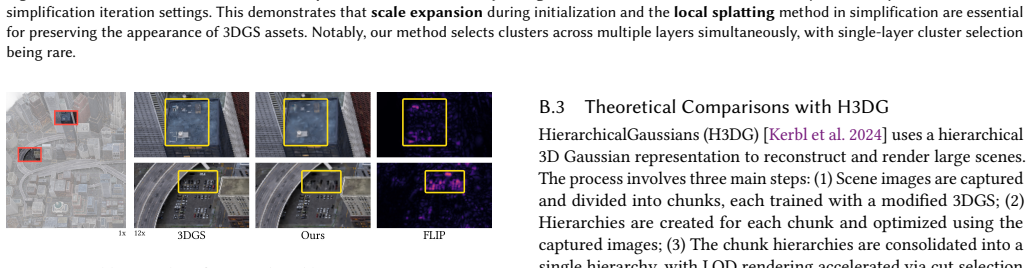
- Because coarse clusters are chosen when their footprint underfills the screen, high-frequency aliasing from undersampled distant Gaussians is reduced, and renders approach the anti-aliased reference.
- The offline build consumes neither camera ground truth nor the original multi-view captures, so any existing high-quality 3DGS asset can be upgraded to LOD as a post-process.
Reading between the lines
- Inference: the pseudo-view simplification makes the build view-independent enough that assets from any 3DGS pipeline, including generated ones, could receive LOD without their original multi-view data; the paper only demonstrates this for its curated assets.
- Inference: the storage doubling and missing disk-to-memory streaming acknowledged as limitations suggest that a production version would combine this selector with a compression scheme and a streaming module, at which point the term 'virtualized' would be literal rather than memory-only.
- Inference: because cluster selection is recomputed per frame per rigid instance, dynamic scenes with many moving rigid objects are already covered in principle; extending to articulated characters would require per-part cluster assignment, which the paper does not address.
Signed reviews
Editorial analysis
A structured set of objections, weighed in public.
Referee Report
Summary. The paper presents V3DG, a cluster-based level-of-detail system for composed 3D Gaussian Splatting scenes. In an offline build stage, 3DGS assets are hierarchically clustered and simplified with a local splatting distillation step; online, cluster groups are projected to screen space and selected according to a user-tunable footprint tolerance. The method is evaluated on four composed scenes with approximately 0.1 billion Gaussians each, using FLIP against SSAA references, FPS/acceleration rates, and selected-Gaussian counts, with comparisons to gsplat clipping and H3DG. The authors also release code, dataset, and a supplementary video.
Significance. If the results hold, V3DG is a practical contribution: it is a post-processing method that requires no training views or ground truth for simplification, handles object- and scene-level assets, and provides continuous, user-defined quality/speed trade-offs. The curated dataset of composed 0.1-billion-Gaussian scenes and the documented comparisons against H3DG and gsplat clipping are useful for the community. However, the load-bearing assumption that simplified clusters generalize from a single pseudo-view configuration to arbitrary composed-scene camera conditions is not yet supported by the experiments, and quantitative claims lack variance estimates.
major comments (3)
- [Sec. 3.2] The visual-fidelity guarantee rests on the assumption that 640 pseudo-views, placed at four times the cluster-group radius and rendered at 64x64, are representative of all later viewing conditions. This assumption is not tested: the composed scenes in Sec. 4.2 apply random 2D rotations and uniform scales, and the evaluation cameras in Sec. 5.2 cover 20 distances, 4 directions, and 5 elevations, while Table 1 varies only simplification iterations and tolerances. Please add a sensitivity analysis that varies pseudo-view count, distance multiplier, and resolution, and report FLIP on held-out camera configurations (e.g., extreme close-ups and scaled or rotated instances). Without this, the claim of maintaining the visual fidelity of 3DGS assets is not fully supported.
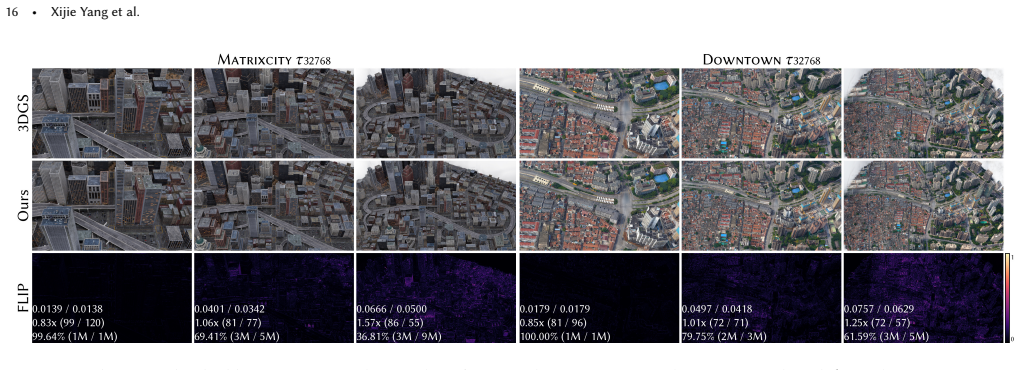
- [Tables 1-2 and Figs. 10/12] All quantitative claims are averages with no variance or error bars. For example, Table 1 reports FLIP 0.0462 for the basic setting versus 0.0509 for 3DGS; this difference could be within run-to-run variation, especially since FPS and percentages are nearly identical across iteration counts. Please report standard deviations or per-camera intervals and state the number of runs. This is needed to support the conclusions of comparable visual quality and superior efficiency.
- [Sec. 5.5.2 and Table 2] The H3DG comparison needs more detail to rule out implementation bias. The paper reports rasterization FPS and full FPS but does not state whether both methods use the same rasterizer, resolution, GPU, and selection code, nor how the 120 tolerances were chosen. Please specify the exact H3DG configuration and report per-tolerance results or a scatter plot with matched Gaussian counts, as in Fig. 14. This matters because the central claim of being more general and faster than H3DG depends on a fair comparison.
minor comments (5)
- [Sec. 3.4 and Fig. 5] The footprint is defined only in the figure; please give an equation number and define f_x, f_y, w, h, and the relationship to pixel area in the text.
- [Sec. 3.4] The statement that r_p > r_c 'prevents simultaneous selection of clusters that overlap in 3D space' needs a proof or a qualifier, since the centers of parent and child clusters can differ and their depths can differ.
- [Sec. 6] The limitations of doubled storage, absence of disk-to-memory streaming, and popping artifacts are disclosed only at the end; consider stating them in the introduction or method discussion, since they qualify the 'virtualized' and 'real-time composed scenes' claims.
- [Appendix C.3, Table 4] Object-level acceleration rates below 1.0x (e.g., donut 0.45x) show selection overhead dominates for small assets; this caveat should appear in the main results, not only in the appendix.
- [Sec. 5.2] Please describe how the 4K SSAA images are downsampled to 1080p and verify that FLIP is computed in the same color space for both 3DGS and Ours; a one-sentence clarification would improve reproducibility.
Circularity Check
No circularity found: V3DG's LOD acceleration and visual-fidelity results are validated on held-out camera trajectories against external baselines, and neither the pseudo-view distillation nor the footprint tolerance is fitted to those evaluation outcomes.
full rationale
The derivation chain is self-contained. The offline build (Sec. 3.2) optimizes each simplified cluster against 640 randomly generated pseudo-views at 4x cluster radius and 64x64 resolution; these pseudo-views are not the evaluation cameras of Sec. 5.2 (20 distances x 4 directions x 5 elevations from the scene center), so the quality comparison does not compare the optimizer to its own training views. The footprint tolerance tau is an explicit user dial: Table 1 and Fig. 12 sweep tau from 512 to 8192, and the chosen 2048 is justified by the quality/speed trade-off rather than fitted to the headline acceleration or FLIP numbers. Acceleration and FLIP are measured against 3DGS and 3DGS-SSAA references, and comparisons to H3DG and gsplat's clipping are external baselines. Self-citations (MatrixCity, Octree-GS) appear as dataset source and related work, not as premises that force the result. The paper's own limitation statements (storage doubling, no disk streaming, possible popping artifacts in Appendix B.2) describe engineering gaps, not circular reasoning. No step renames a fitted parameter as a prediction or imports a uniqueness theorem from the authors' prior work.
Assumptions & free parameters
free parameters (8)
- Cluster size n_G in C (Gaussians per finest cluster) =
4096
- Clusters per cluster group n_C in CG =
2
- Pseudo-view count for local splatting =
640
- Pseudo-view distance =
4x cluster group radius
- Pseudo-view render resolution =
64x64
- Position learning rate =
1.6e-5
- Scale expansion factor =
2^(1/6)
- Footprint tolerance tau =
2048 (Forest), 32768 (large scenes)
assumptions (5)
- domain assumption Bounding sphere projection gives a valid measure of perceptual level of detail for a cluster.
- domain assumption Binary median split clustering is an appropriate grouping for 3D Gaussians.
- standard math The differential rendering of 3DGS is smooth enough for gradient-based local splatting to preserve appearance.
- ad hoc to paper Simplified Gaussians optimized on pseudo-views generalize to all rendering conditions.
- ad hoc to paper The monotonic radius condition r_p > r_c prevents simultaneous selection of overlapping clusters.
Cite this review
Pith. "Pith review of Virtualized 3D Gaussians: Flexible Cluster-based Level-of-Detail System for Real-Time Rendering of Composed Scenes." pith.science (2026). https://pith.science/paper/OIZ25CZM
@misc{pith2026250506523,
  author       = {Pith},
  title        = {Pith review of: Virtualized 3D Gaussians: Flexible Cluster-based Level-of-Detail System for Real-Time Rendering of Composed Scenes},
  year         = {2026},
  howpublished = {\url{https://pith.science/paper/OIZ25CZM}},
  note         = {Machine review of arXiv:2505.06523}
}
read the original abstract
3D Gaussian Splatting (3DGS) enables the reconstruction of intricate digital 3D assets from multi-view images by leveraging a set of 3D Gaussian primitives for rendering. Its explicit and discrete representation facilitates the seamless composition of complex digital worlds, offering significant advantages over previous neural implicit methods. However, when applied to large-scale compositions, such as crowd-level scenes, it can encompass numerous 3D Gaussians, posing substantial challenges for real-time rendering. To address this, inspired by Unreal Engine 5's Nanite system, we propose Virtualized 3D Gaussians (V3DG), a cluster-based LOD solution that constructs hierarchical 3D Gaussian clusters and dynamically selects only the necessary ones to accelerate rendering speed. Our approach consists of two stages: (1) Offline Build, where hierarchical clusters are generated using a local splatting method to minimize visual differences across granularities, and (2) Online Selection, where footprint evaluation determines perceptible clusters for efficient rasterization during rendering. We curate a dataset of synthetic and real-world scenes, including objects, trees, people, and buildings, each requiring 0.1 billion 3D Gaussians to capture fine details. Experiments show that our solution balances rendering efficiency and visual quality across user-defined tolerances, facilitating downstream interactive applications that compose extensive 3DGS assets for consistent rendering performance.
Figures


Figures from the paper (16 more)





Reference graph
Works this paper leans on
-
[2022]
In Proceedings of the IEEE/CVF conference on computer vision and pattern recognition
Mip-nerf 360: Unbounded anti-aliased neural radiance fields. In Proceedings of the IEEE/CVF conference on computer vision and pattern recognition . 5470–5479. Yihang Chen, Qianyi Wu, Weiyao Lin, Mehrtash Harandi, and Jianfei Cai. 2024. Hac: Hash-grid assisted context for 3d gaussian splatting compression. In European Conference on Computer Vision . Spring...
arXiv 2024
-
[2024]
Lightgaussian: Unbounded 3d gaussian compression with 15x reduction and 200+ fps. Advances in neural information processing systems 37 (2024), 140138– 140158. Sara Fridovich-Keil, Alex Yu, Matthew Tancik, Qinhong Chen, Benjamin Recht, and Angjoo Kanazawa. 2022. Plenoxels: Radiance fields without neural networks. In Proceedings of the IEEE/CVF conference o...
arXiv 2024
Reviewed August 15, 2026 · model on record in the stance chip above.
Discussion (0). Continue with ORCID to comment.