Adversarial Coevolutionary Illumination with Generational Adversarial MAP-Elites
Pith reviewed 2026-05-22 16:32 UTC · model grok-4.3
The pith
Generational Adversarial MAP-Elites alternates which side evolves each generation to illuminate solutions in adversarial problems using video embeddings.
A machine-rendered reading of the paper's core claim, the machinery that carries it, and where it could break.
Core claim
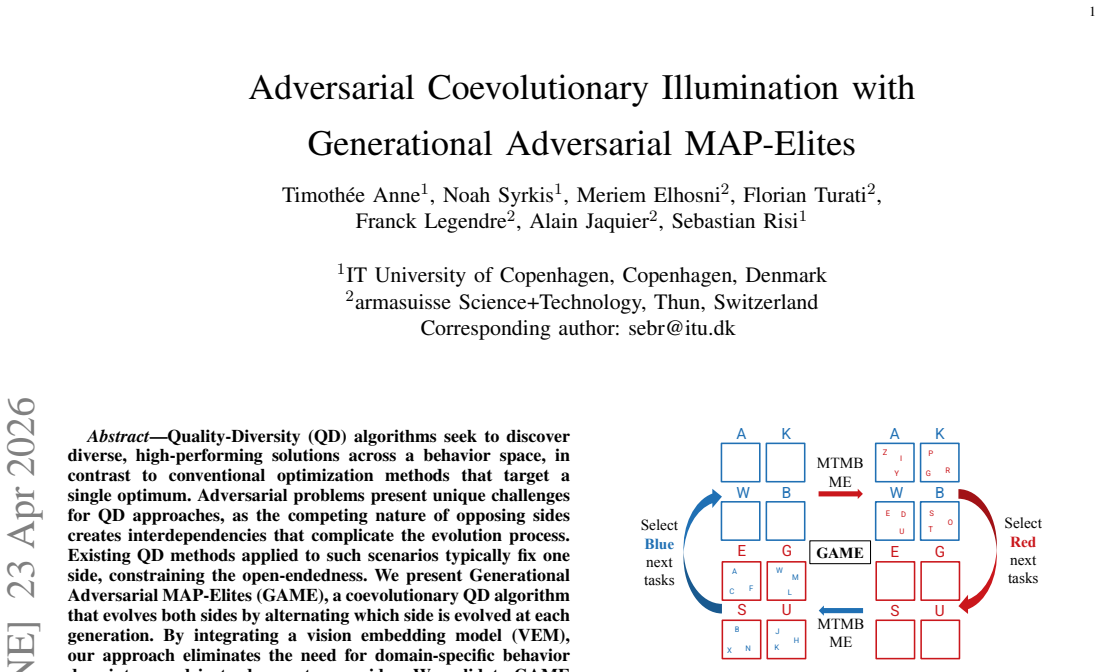
GAME is a coevolutionary QD algorithm that evolves both adversaries by alternating generational updates and employs a vision embedding model to map raw video into a behavior space for the MAP-Elites archive, removing the requirement for domain-specific descriptors.
What carries the argument
Generational alternation of evolutionary updates between opposing populations, paired with a vision embedding model that supplies behavior coordinates from video input for the quality-diversity archive.
If this is right
- Alternating generations produces observable arms-race dynamics between the two evolving sides.
- Periodic extinction of one side increases novelty in the surviving population.
- Neutral mutations are retained and later become useful for reaching higher performance levels.
- All algorithmic components are necessary; removing any one degrades the results.
- The same method works across game, robotics, and card-game domains without custom behavior engineering.
Where Pith is reading between the lines
- The same alternation-plus-embedding pattern could be tested in domains where search spaces permit greater open-ended novelty than the ones used here.
- Vision-based behavior spaces may lower the barrier to applying quality-diversity methods to new competitive settings that lack obvious geometric descriptors.
- Similar coevolutionary illumination could be applied to problems such as automated strategy discovery in security or multi-player economic games.
Load-bearing premise
The vision embedding model supplies a behavior space that remains meaningful and generalizable across adversarial domains without requiring any domain-specific adjustments.
What would settle it
Finding that GAME fails to outperform one-sided QD baselines on any of the three domains, or that the vision embeddings collapse distinct behaviors into indistinguishable points, would falsify the central performance and generality claims.
Figures




read the original abstract
Quality-Diversity (QD) algorithms seek to discover diverse, high-performing solutions across a behavior space, in contrast to conventional optimization methods that target a single optimum. Adversarial problems present unique challenges for QD approaches, as the competing nature of opposing sides creates interdependencies that complicate the evolution process. Existing QD methods applied to such scenarios typically fix one side, constraining the open-endedness. We present Generational Adversarial MAP-Elites (GAME), a coevolutionary QD algorithm that evolves both sides by alternating which side is evolved at each generation. By integrating a vision embedding model (VEM), our approach eliminates the need for domain-specific behavior descriptors and instead operates on video. We validate GAME across three distinct adversarial domains: a multi-agent battle game, a soft-robot wrestling environment, and a deck building game. We validate that all its components are necessary, that the VEM is effective in two different domains, and that GAME finds better solutions than one-sided QD baselines. Our experiments reveal several evolutionary phenomena, including arms race-like dynamics, enhanced novelty through generational extinction, and the preservation of neutral mutations as crucial stepping stones toward the highest performance. While GAME successfully illuminates all three adversarial problems, its capacity for truly open-ended discovery remains constrained by the nature of the search spaces used in this paper. These findings show GAME's broad applicability and highlight opportunities for future research into open-ended adversarial coevolution. Code and videos are available at: https://github.com/Timothee-ANNE/GAME
Editorial analysis
A structured set of objections, weighed in public.
Referee Report
Summary. The manuscript introduces Generational Adversarial MAP-Elites (GAME), a coevolutionary quality-diversity algorithm that alternates generations between evolving two opposing populations in adversarial domains. It integrates a pre-trained vision embedding model (VEM) to map raw video observations to a behavior space, thereby avoiding hand-crafted domain-specific descriptors. The approach is evaluated on three adversarial domains—a multi-agent battle game, a soft-robot wrestling environment, and a deck-building game—with claims that all components are necessary, the VEM is effective in two domains, GAME outperforms one-sided QD baselines, and the method reveals evolutionary phenomena including arms-race dynamics, enhanced novelty via generational extinction, and the role of neutral mutations as stepping stones.
Significance. If the empirical claims hold under rigorous scrutiny, this work advances quality-diversity optimization into coevolutionary adversarial settings, where interdependencies between sides have previously limited open-ended illumination. The VEM integration offers a path toward more generalizable behavior descriptors in video-based domains, and the reported phenomena could inform models of open-ended evolution. The paper itself notes that truly open-ended discovery remains constrained by the chosen search spaces, which tempers the broader implications.
major comments (2)
- [Experiments / VEM integration section] The central claim that the VEM supplies a meaningful, generalizable behavior space for adversarial illumination (eliminating domain-specific descriptors) lacks a direct quantitative validation. No correlation analysis is presented between VEM distances and task-relevant features such as win rates, strategic metrics, or interaction outcomes; nor is there an ablation replacing VEM with random projections or low-level visual statistics to test whether the archive reflects functional rather than superficial diversity. This is load-bearing for the reported arms-race dynamics and component necessity, as misalignment here would mean the illumination metric does not track the adversarial objective.
- [Results / Ablation studies] The assertion that all components are necessary and that GAME finds better solutions than one-sided QD baselines is supported by validation statements, but the results lack detailed ablation tables with quantitative metrics, error bars, and statistical tests. For instance, performance drops when removing generational alternation or the adversarial coevolution loop are not quantified with effect sizes or significance levels across the three domains.
minor comments (2)
- [Abstract] The abstract summarizes success and component necessity but omits any specific quantitative results, error bars, or key performance deltas; including one or two headline metrics would improve clarity for readers.
- [Figures] Figure captions and axis labels in the experimental results could be expanded to explicitly state what is being compared (e.g., archive coverage vs. performance) and whether error bars represent standard deviation or standard error.
Simulated Author's Rebuttal
We thank the referee for their constructive and detailed feedback, which helps us strengthen the presentation of our results. We address each major comment below and will incorporate the suggested improvements in a revised manuscript.
read point-by-point responses
-
Referee: [Experiments / VEM integration section] The central claim that the VEM supplies a meaningful, generalizable behavior space for adversarial illumination (eliminating domain-specific descriptors) lacks a direct quantitative validation. No correlation analysis is presented between VEM distances and task-relevant features such as win rates, strategic metrics, or interaction outcomes; nor is there an ablation replacing VEM with random projections or low-level visual statistics to test whether the archive reflects functional rather than superficial diversity. This is load-bearing for the reported arms-race dynamics and component necessity, as misalignment here would mean the illumination metric does not track the adversarial objective.
Authors: We agree that a more direct quantitative validation of the VEM would strengthen the manuscript. While the current experiments show that GAME with the VEM produces superior performance and interpretable dynamics in two domains (suggesting the embedding captures task-relevant variation), we did not include explicit correlation analyses or ablations against random or low-level baselines. In the revision we will add: (1) correlation coefficients between VEM distances and domain-specific metrics such as win rates and strategic indicators, and (2) ablation experiments replacing the VEM with random projections and basic visual statistics, reporting the resulting archive quality and evolutionary dynamics. These additions will directly test whether the behavior space reflects functional rather than superficial diversity. revision: yes
-
Referee: [Results / Ablation studies] The assertion that all components are necessary and that GAME finds better solutions than one-sided QD baselines is supported by validation statements, but the results lack detailed ablation tables with quantitative metrics, error bars, and statistical tests. For instance, performance drops when removing generational alternation or the adversarial coevolution loop are not quantified with effect sizes or significance levels across the three domains.
Authors: We acknowledge that the ablation results would benefit from more granular quantitative reporting. The manuscript already demonstrates performance differences when components are ablated, supporting the necessity claims, yet these are presented without full tables, error bars, or statistical tests. In the revised version we will expand the results section with comprehensive ablation tables for all three domains. Each table will report mean performance and standard deviation across independent runs, include error bars on the corresponding figures, and provide statistical significance tests (e.g., paired t-tests or Wilcoxon rank-sum tests) together with effect sizes to quantify the impact of removing generational alternation or the coevolutionary loop. revision: yes
Circularity Check
No significant circularity detected in derivation or validation chain
full rationale
The paper describes an algorithmic extension of MAP-Elites for coevolutionary adversarial settings, with the core procedure (alternating generational evolution of opposing sides) and integration of an external VEM for behavior descriptors presented as a direct construction rather than a derived prediction. Validation proceeds via explicit comparisons to one-sided QD baselines across three domains, component ablations, and reported evolutionary phenomena, all of which are externally falsifiable against the stated experimental setups and do not reduce to fitted parameters or self-referential definitions. No load-bearing step equates an output to its input by construction, and the VEM is treated as an off-the-shelf input whose effectiveness is checked empirically rather than assumed via prior self-citation.
Axiom & Free-Parameter Ledger
axioms (1)
- domain assumption Evolutionary algorithms can discover diverse high-performing solutions through selection and variation operators.
Lean theorems connected to this paper
-
IndisputableMonolith/Foundation/AlexanderDuality.leanalexander_duality_circle_linking unclear?
unclearRelation between the paper passage and the cited Recognition theorem.
GAME is a coevolutionary QD algorithm that evolves both sides by alternating which side is evolved at each generation... By integrating a vision embedding model (VEM), our approach eliminates the need for domain-specific behavior descriptors and instead operates on video.
-
IndisputableMonolith/Cost/FunctionalEquation.leanwashburn_uniqueness_aczel unclear?
unclearRelation between the paper passage and the cited Recognition theorem.
Our experiments reveal several evolutionary phenomena, including arms race-like dynamics, enhanced novelty through generational extinction, and the preservation of neutral mutations as crucial stepping stones
What do these tags mean?
- matches
- The paper's claim is directly supported by a theorem in the formal canon.
- supports
- The theorem supports part of the paper's argument, but the paper may add assumptions or extra steps.
- extends
- The paper goes beyond the formal theorem; the theorem is a base layer rather than the whole result.
- uses
- The paper appears to rely on the theorem as machinery.
- contradicts
- The paper's claim conflicts with a theorem or certificate in the canon.
- unclear
- Pith found a possible connection, but the passage is too broad, indirect, or ambiguous to say the theorem truly supports the claim.
Reference graph
Works this paper leans on
-
[1]
Quality diversity: A new frontier for evolutionary computation,
J. K. Pugh, L. B. Soros, and K. O. Stanley, “Quality diversity: A new frontier for evolutionary computation,”Frontiers in Robotics and AI, vol. 3, p. 40, 2016
work page 2016
-
[2]
Robots that can adapt like animals,
A. Cully, J. Clune, D. Tarapore, and J.-B. Mouret, “Robots that can adapt like animals,”Nature, vol. 521, no. 7553, pp. 503–507, 2015
work page 2015
-
[3]
Procedural content generation through quality diversity,
D. Gravina, A. Khalifa, A. Liapis, J. Togelius, and G. N. Yannakakis, “Procedural content generation through quality diversity,” in2019 IEEE Conference on Games (CoG). IEEE, 2019, pp. 1–8
work page 2019
-
[4]
Y . Jiang, D. Salley, A. Sharma, G. Keenan, M. Mullin, and L. Cronin, “An artificial intelligence enabled chemical synthesis robot for explo- ration and optimization of nanomaterials,”Science advances, vol. 8, no. 40, p. eabo2626, 2022
work page 2022
-
[5]
L. Brevault and M. Balesdent, “Bayesian quality-diversity approaches for constrained optimization problems with mixed continuous, discrete and categorical variables,”Engineering Applications of Artificial Intel- ligence, vol. 133, p. 108118, 2024
work page 2024
-
[6]
T. C. Schelling,The Strategy of Conflict: with a new Preface by the Author. Harvard university press, 1980
work page 1980
-
[7]
R. Baldwin, M. Cave, and M. Lodge,Understanding regulation: theory, strategy, and practice. Oxford university press, 2011
work page 2011
-
[8]
Adversarial Attacks and Defences: A Survey
A. Chakraborty, M. Alam, V . Dey, A. Chattopadhyay, and D. Mukhopad- hyay, “Adversarial attacks and defences: A survey,”arXiv preprint arXiv:1810.00069, 2018
work page internal anchor Pith review Pith/arXiv arXiv 2018
-
[9]
Arms race in adversarial malware detection: A survey,
D. Li, Q. Li, Y . Ye, and S. Xu, “Arms race in adversarial malware detection: A survey,”ACM Computing Surveys (CSUR), vol. 55, no. 1, pp. 1–35, 2021
work page 2021
-
[10]
Hearthstone: Heroes of warcraft,
Blizzard Entertainment, “Hearthstone: Heroes of warcraft,” 2014, digital collectible card game. [Online]. Available: https://playhearthstone.com/
work page 2014
-
[11]
Mapping hearthstone deck spaces through map- elites with sliding boundaries,
M. C. Fontaine, S. Lee, L. B. Soros, F. de Mesentier Silva, J. Togelius, and A. K. Hoover, “Mapping hearthstone deck spaces through map- elites with sliding boundaries,” inProceedings of The Genetic and Evolutionary Computation Conference, 2019, pp. 161–169
work page 2019
-
[12]
Covari- ance matrix adaptation for the rapid illumination of behavior space,
M. C. Fontaine, J. Togelius, S. Nikolaidis, and A. K. Hoover, “Covari- ance matrix adaptation for the rapid illumination of behavior space,” inProceedings of the 2020 genetic and evolutionary computation conference, 2020, pp. 94–102
work page 2020
-
[13]
Rainbow teaming: Open-ended generation of diverse adversarial prompts,
M. Samvelyan, S. Raparthy, A. Lupu, E. Hambro, A. H. Markosyan, M. Bhatt, Y . Mao, M. Jiang, J. Parker-Holder, J. Foerster, T. Rocktaschel, and R. Raileanu, “Rainbow teaming: Open-ended generation of diverse adversarial prompts,”ArXiv, vol. abs/2402.16822, 2024. [Online]. Available: https://api.semanticscholar.org/CorpusId:268031888 14 Preprint. IEEE Tran...
-
[14]
Arms races between and within species,
R. Dawkins and J. R. Krebs, “Arms races between and within species,” Proceedings of the Royal Society of London. Series B. Biological Sciences, vol. 205, no. 1161, pp. 489–511, 1979
work page 1979
-
[15]
Open problems in artificial life,
M. A. Bedau, J. S. McCaskill, N. H. Packard, S. Rasmussen, C. Adami, D. G. Green, T. Ikegami, K. Kaneko, and T. S. Ray, “Open problems in artificial life,”Artificial life, vol. 6, no. 4, pp. 363–376, 2000
work page 2000
-
[16]
What is artificial life today, and where should it go?
A. Dorin and S. Stepney, “What is artificial life today, and where should it go?” pp. 1–15, 2024
work page 2024
-
[17]
Poet: open- ended coevolution of environments and their optimized solutions,
R. Wang, J. Lehman, J. Clune, and K. O. Stanley, “Poet: open- ended coevolution of environments and their optimized solutions,” in Proceedings of the Genetic and Evolutionary Computation Conference, 2019, pp. 142–151
work page 2019
-
[18]
R. Wang, J. Lehman, A. Rawal, J. Zhi, Y . Li, J. Clune, and K. Stanley, “Enhanced poet: Open-ended reinforcement learning through unbounded invention of learning challenges and their solutions,” inInternational conference on machine learning. PMLR, 2020, pp. 9940–9951
work page 2020
-
[19]
Exploring the evolution of gans through quality diversity,
V . Costa, N. Lourenc ¸o, J. Correia, and P. Machado, “Exploring the evolution of gans through quality diversity,” inProceedings of the 2020 genetic and evolutionary computation conference, 2020, pp. 297–305
work page 2020
-
[20]
Quality-diversity self-play: Open-ended strategy innovation via foundation models,
A. Dharna, C. Lu, and J. Clune, “Quality-diversity self-play: Open-ended strategy innovation via foundation models,” inNeurIPS 2024 Workshop on Open-World Agents, 2024
work page 2024
-
[21]
Multi-task multi-behavior map-elites,
T. Anne and J.-B. Mouret, “Multi-task multi-behavior map-elites,” in Proceedings of the Companion Conference on Genetic and Evolutionary Computation, 2023, pp. 111–114
work page 2023
-
[22]
Learning transferable visual models from natural language supervision,
A. Radford, J. W. Kim, C. Hallacy, A. Ramesh, G. Goh, S. Agarwal, G. Sastry, A. Askell, P. Mishkin, J. Clarket al., “Learning transferable visual models from natural language supervision,” inInternational conference on machine learning. PmLR, 2021, pp. 8748–8763
work page 2021
-
[23]
A comparison of illumination algorithms in unbounded spaces,
V . Vassiliades, K. Chatzilygeroudis, and J.-B. Mouret, “A comparison of illumination algorithms in unbounded spaces,” inProceedings of the Genetic and Evolutionary Computation Conference Companion, 2017, pp. 1578–1581
work page 2017
-
[24]
Generational adversarial map-elites for multi-agent game illumination,
T. Anne, N. Syrkis, M. Elhosni, F. Turati, F. Legendre, A. Jaquier, and S. Risi, “Generational adversarial map-elites for multi-agent game illumination,”Accepted for presentation at ALIFE ’25, Kyoto, Japan, 2025
work page 2025
-
[25]
——, “Harnessing language for coordination: A framework and bench- mark for llm-driven multi-agent control,”IEEE Transactions on Games, 2025
work page 2025
-
[26]
Evolution gym: A large-scale benchmark for evolving soft robots,
J. Bhatia, H. Jackson, Y . Tian, J. Xu, and W. Matusik, “Evolution gym: A large-scale benchmark for evolving soft robots,”Advances in Neural Information Processing Systems, vol. 34, pp. 2201–2214, 2021
work page 2021
-
[27]
Hearthbreaker: A hearthstone simulator,
Y . Danielet al., “Hearthbreaker: A hearthstone simulator,” 2014. [Online]. Available: https://github.com/danielyule/hearthbreaker
work page 2014
-
[28]
S. G. Ficici and J. B. Pollack, “Challenges in coevolutionary learning: Arms-race dynamics, open-endedness, and mediocre stable states,” in Proceedings of the sixth international conference on Artificial life. MIT Press Cambridge, MA, 1998, pp. 238–247
work page 1998
-
[29]
Evolving complexity in prediction games,
N. Moran and J. Pollack, “Evolving complexity in prediction games,” Artificial Life, vol. 25, no. 1, pp. 74–91, 2019
work page 2019
-
[30]
Escalation of memory length in finite populations,
K. Harrington and J. Pollack, “Escalation of memory length in finite populations,”Artificial life, vol. 25, no. 1, pp. 22–32, 2019
work page 2019
-
[31]
Minimal criterion coevolution: a new approach to open-ended search,
J. C. Brant and K. O. Stanley, “Minimal criterion coevolution: a new approach to open-ended search,” inProceedings of the Genetic and Evolutionary Computation Conference, 2017, pp. 67–74
work page 2017
-
[32]
Coevolution of neural networks for agents and environments,
E. Chigot and D. G. Wilson, “Coevolution of neural networks for agents and environments,” inProceedings of the Genetic and Evolutionary Computation Conference Companion, 2022, pp. 2306–2309
work page 2022
-
[33]
M. Faldor, J. Zhang, A. Cully, and J. Clune, “Omni-epic: Open- endedness via models of human notions of interestingness with environ- ments programmed in code,” inThe Thirteenth International Conference on Learning Representations, 2024
work page 2024
-
[34]
Grand- master level in starcraft ii using multi-agent reinforcement learning,
O. Vinyals, I. Babuschkin, W. M. Czarnecki, M. Mathieu, A. Dudzik, J. Chung, D. H. Choi, R. Powell, T. Ewalds, P. Georgievet al., “Grand- master level in starcraft ii using multi-agent reinforcement learning,” nature, vol. 575, no. 7782, pp. 350–354, 2019
work page 2019
-
[35]
Emergent tool use from multi-agent autocurricula,
B. Baker, I. Kanitscheider, T. Markov, Y . Wu, G. Powell, B. McGrew, and I. Mordatch, “Emergent tool use from multi-agent autocurricula,” in International conference on learning representations, 2019
work page 2019
-
[36]
Evolving a diversity of virtual creatures through novelty search and local competition,
J. Lehman and K. O. Stanley, “Evolving a diversity of virtual creatures through novelty search and local competition,” inProceedings of the 13th annual conference on Genetic and evolutionary computation, 2011, pp. 211–218
work page 2011
-
[37]
Illuminating search spaces by mapping elites
J.-B. Mouret and J. Clune, “Illuminating search spaces by mapping elites,”arXiv preprint arXiv:1504.04909, 2015
work page internal anchor Pith review Pith/arXiv arXiv 2015
-
[38]
Quality diversity for multi-task optimiza- tion,
J.-B. Mouret and G. Maguire, “Quality diversity for multi-task optimiza- tion,” inProceedings of the 2020 Genetic and Evolutionary Computation Conference, 2020, pp. 121–129
work page 2020
-
[39]
K. Steckel and J. Schrum, “Illuminating the space of beatable lode runner levels produced by various generative adversarial networks,” in Proceedings of the genetic and evolutionary computation conference companion, 2021, pp. 111–112
work page 2021
-
[40]
Quality diversity imitation learning,
Z. Wan, X. Yu, D. M. Bossens, Y . Lyu, Q. Guo, F. X. Fan, and I. Tsang, “Quality diversity imitation learning,”arXiv preprint 2410.06151, 2024
-
[41]
Multi-agent diagnostics for robustness via illuminated diversity,
M. Samvelyan, D. Paglieri, M. Jiang, J. Parker-Holder, and T. Rockt¨aschel, “Multi-agent diagnostics for robustness via illuminated diversity,”arXiv preprint arXiv:2401.13460, 2024
-
[42]
Automating the search for artificial life with foundation models,
A. Kumar, C. Lu, L. Kirsch, Y . Tang, K. O. Stanley, P. Isola, and D. Ha, “Automating the search for artificial life with foundation models,”arXiv preprint arXiv:2412.17799, 2024
-
[43]
V . Vassiliades, K. Chatzilygeroudis, and J.-B. Mouret, “Scaling up map-elites using centroidal voronoi tessellations,”arXiv preprint arXiv:1610.05729, 2016
work page internal anchor Pith review Pith/arXiv arXiv 2016
-
[44]
Autonomous skill discovery with quality-diversity and unsu- pervised descriptors,
A. Cully, “Autonomous skill discovery with quality-diversity and unsu- pervised descriptors,” inProceedings of the Genetic and Evolutionary Computation Conference, 2019, pp. 81–89
work page 2019
-
[45]
Dominated novelty search: Rethinking local competition in quality-diversity,
R. Bahlous-Boldi, M. Faldor, L. Grillotti, H. Janmohamed, L. Coiffard, L. Spector, and A. Cully, “Dominated novelty search: Rethinking local competition in quality-diversity,” inProceedings of the Genetic and Evolutionary Computation Conference, 2025, pp. 104–112
work page 2025
-
[46]
JAX: composable transformations of Python+NumPy pro- grams,
J. Bradbury, R. Frostig, P. Hawkins, M. J. Johnson, C. Leary, D. Maclau- rin, G. Necula, A. Paszke, J. VanderPlas, S. Wanderman-Milne, and Q. Zhang, “JAX: composable transformations of Python+NumPy pro- grams,” 2018
work page 2018
-
[47]
M. Colledanchise and P. ¨Ogren,Behavior trees in robotics and AI: An introduction. CRC Press, 2018
work page 2018
-
[48]
Learning behavior trees with genetic programming in unpredictable environments,
M. Iovino, J. Styrud, P. Falco, and C. Smith, “Learning behavior trees with genetic programming in unpredictable environments,” in2021 IEEE International Conference on Robotics and Automation (ICRA). IEEE, 2021, pp. 4591–4597
work page 2021
-
[49]
A quality- diversity approach to evolving a repertoire of diverse behaviour-trees in robot swarms,
K. Montague, E. Hart, G. Nitschke, and B. Paechter, “A quality- diversity approach to evolving a repertoire of diverse behaviour-trees in robot swarms,” inInternational Conference on the Applications of Evolutionary Computation. Springer, 2023, pp. 145–160
work page 2023
-
[50]
Evolving neural networks through augmenting topologies,
K. O. Stanley and R. Miikkulainen, “Evolving neural networks through augmenting topologies,”Evolutionary computation, vol. 10, no. 2, pp. 99–127, 2002
work page 2002
-
[51]
A. E. Elo,The Rating of Chessplayers, Past and Present. Arco Publishing, 1978
work page 1978
-
[52]
The neutral theory of molecular evolution,
M. Kimura, “The neutral theory of molecular evolution,”Scientific American, vol. 241, no. 5, pp. 98–129, 1979
work page 1979
-
[53]
Enhancing divergent search through extinction events,
J. Lehman and R. Miikkulainen, “Enhancing divergent search through extinction events,” inProceedings of the 2015 Annual Conference on Genetic and Evolutionary Computation, 2015, pp. 951–958
work page 2015
-
[54]
C. G. Langton,Artificial life: An overview. Mit press, 1997
work page 1997
-
[55]
Evolving 3d morphology and behavior by competition,
K. Sims, “Evolving 3d morphology and behavior by competition,” Artificial life, vol. 1, no. 4, pp. 353–372, 1994
work page 1994
-
[56]
N. Cheney, R. MacCurdy, J. Clune, and H. Lipson, “Unshackling evolution: evolving soft robots with multiple materials and a powerful generative encoding,”ACM SIGEVOlution, vol. 7, no. 1, pp. 11–23, 2014
work page 2014
-
[57]
A mini- mal developmental model can increase evolvability in soft robots,
S. Kriegman, N. Cheney, F. Corucci, and J. C. Bongard, “A mini- mal developmental model can increase evolvability in soft robots,” in Proceedings of the Genetic and Evolutionary Computation Conference, 2017, pp. 131–138
work page 2017
-
[58]
Scalable co- optimization of morphology and control in embodied machines,
N. Cheney, J. Bongard, V . SunSpiral, and H. Lipson, “Scalable co- optimization of morphology and control in embodied machines,”Journal of The Royal Society Interface, vol. 15, no. 143, p. 20170937, 2018
work page 2018
-
[59]
Modular controllers facilitate the co- optimization of morphology and control in soft robots,
A. Mertan and N. Cheney, “Modular controllers facilitate the co- optimization of morphology and control in soft robots,” inProceedings of the Genetic and Evolutionary Computation Conference, 2023, pp. 174–183
work page 2023
-
[60]
Enhancing adaptability in embodied agents: A multi-quality-diversity approach,
G. Nadizar, E. Medvet, and D. G. Wilson, “Enhancing adaptability in embodied agents: A multi-quality-diversity approach,”IEEE Transac- tions on Evolutionary Computation, 2025
work page 2025
-
[61]
Intelligence without representation,
R. A. Brooks, “Intelligence without representation,”Artificial intelli- gence, vol. 47, no. 1-3, pp. 139–159, 1991
work page 1991
-
[62]
R. Pfeifer and J. Bongard,How the body shapes the way we think: a new view of intelligence. MIT press, 2006
work page 2006
-
[63]
Monte carlo tree search experiments in hearthstone,
A. Santos, P. A. Santos, and F. S. Melo, “Monte carlo tree search experiments in hearthstone,” in2017 IEEE conference on computational intelligence and games (CIG). IEEE, 2017, pp. 272–279. 15
work page 2017
discussion (0)
Sign in with ORCID, Apple, or X to comment. Anyone can read and Pith papers without signing in.