REVIEW 2 major objections 4 minor 2 cited by
Dynamic Safety in Complex Environments: Synthesizing Safety Filters with Poisson's Equation
T0 review · 2 major / 4 minor · reviewed 2026-08-15 · deepseek-v4-flash
Pith's one-line read Solving Poisson's equation on an occupancy map produces a safety function that can certify safe robot motion and drive a CBF-based safety filter.
desk verdict Static Poisson safety-function synthesis is a real contribution, but the paper's dynamic-safety claim rests on an unproven time-varying extension. read the letter →
The pith
A machine-rendered reading of the paper's core claim, the machinery that carries it, and where it could break.
The reading
What carries the argument
The central object is the Poisson safety function: the solution $h$ of the Dirichlet problem $\Delta h = f$ on the occupancy domain with $h=0$ on obstacle boundaries and $f$ strictly negative. The forcing function is the design knob. The paper's main construction routes through a smooth guidance vector field $\vec{v}$: each component solves Laplace's equation with boundary data $b(y)\,\hat{n}(y)$ encoding the desired flux, and the forcing term is a smooth softplus-style function of $\nabla \cdot \vec{v}$ that stays strictly negative, so the solution is automatically smooth and superharmonic. This also makes $h$ the unique minimizer of the variational problem $\min_h \int_\Omega \left(\tfrac{1}{2}|Dh|^2 - h\, \beta^{-1}\ln(1+e^{-\beta \nabla \cdot \vec{v}})\right) dV$. The companion machinery is CBF backstepping: auxiliary safe controllers $k_i$ are designed recursively, and the function $h_B(\vec{y}) = h(y) - \sum_i \tfrac{1}{2\mu_i}\| y^{(i)} - k_i\|^2$ is shown to define a shrunken invariant safe set, with Lemma 1 supplying the Lipschitz regularity of $D^r h$ that makes the controller locally Lipschitz and well-defined.
What would settle it
Run the hardware pipeline with an obstacle moving through the field faster than the roughly 10 Hz update rate; the claim fails if $h$ becomes negative before the next recomputation, or if one can construct two consecutive updates satisfying (41) and the filter constraint yet with $h$ crossing zero in between. A cheaper falsifier is a simulation of the double integrator with a periodically switching occupancy map that checks the continuous trajectory between safety-function updates.
Extended reading notes
Core claim
The paper's central claim is that a single scalar function encoding an entire obstacle field can be manufactured by solving an elliptic boundary value problem. Let $\Omega$ be the unoccupied region bounded by obstacle surfaces $\partial\Omega$, and let $f \in C^{k,\alpha}(\Omega;\mathbb{R}_{<0})$ be H\"older continuous and strictly negative. The unique classical solution $h$ of $\Delta h = f$ in $\Omega$, $h=0$ on $\partial\Omega$, is a safety function of order $2+k$: its zero superlevel set is a compact safe set whose boundary is $\partial\Omega$, and Hopf's lemma guarantees $Dh \cdot \hat{n} < 0$ on the boundary, so the gradient is nonzero exactly where it is needed. Because $\Delta h < 0$, the weak minimum principle keeps $h$ nonnegative inside $\Omega$, so the safe set is the whole free space, and each obstacle interior can be made unsafe by solving with a positive forcing function there. The paper then proves this safety function is a CBF: Proposition 1 gives a Lipschitz controller for $\dot{y} = w$ satisfying $\dot{h} \geq -\gamma h$, and Theorem 6 extends the argument to integrator chains of relative degree $r \geq 2$ using backstepping functions $h_B$ that render a shrunken subset $C_B \subset C \times \mathbb{R}^{3(r-1)}$ forward invariant.
Load-bearing premise
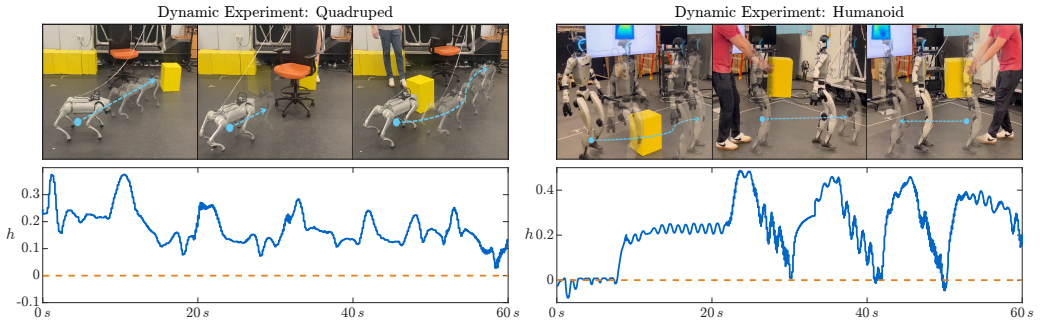
The load-bearing premise is that forward invariance for the static safety function $h$ transfers to the time-varying $h(t,y)$ recomputed online and differentiated by finite differences in (41), an extension the paper assumes but does not prove or cite.
Editorial extensions
If this is right
- Occupancy maps can be converted directly into safety constraints: the same pipeline yields a smooth CBF for arbitrary obstacle geometry, avoiding the gradient discontinuities of signed distance functions that cause chattering in safety filters.
- Safety is decoupled from the goal: the synthesized safety function is geometry-only, so a single $h$ serves any nominal controller in a safety-filter quadratic program.
- The guarantees cover higher-order dynamics, not just kinematic models: for integrator chains of relative degree $r \geq 2$, the backstepped CBF makes a shrunken safe set forward invariant.
- The regularity of the safety function is tunable through the forcing function: H\"older-continuous forcing already suffices for low relative degree, while smooth forcing gives smooth $h$ for higher relative degree.
- On hardware, the pipeline runs at about 10 Hz with PDE solve times of 0.2--0.3 ms, which the experiments indicate is fast enough to keep a quadruped safe while obstacles move.
Reading between the lines
- A rigorous dynamic-safety theorem would need to treat $h(t,y)$ as time-varying; one route is to bound $\|\partial h/\partial t\|$ and add it to the CBF condition, turning the current finite-difference approximation (41) into a provable margin.
- The per-obstacle boundary flux $b$ in (26) is a tuning handle for shaping gradient magnitudes; this suggests a data-driven or optimization-based flux assignment to push the system away from deadlock equilibria, though no such guarantee is given.
- The same variational formulation could be applied to higher-dimensional state spaces or to directly synthesizing a CLF-CBF pair, since the guidance field construction is independent of the robot's dynamics.
Signed reviews
Editorial analysis
A structured set of objections, weighed in public.
Referee Report
Summary. The paper proposes a method for synthesizing safety functions from occupancy-map perception data by solving Poisson's equation with Dirichlet boundary conditions and a strictly negative forcing function. The resulting solution h is shown to be a safety function (Theorem 1), to define a forward-invariant safe set for first-order integrator systems (Proposition 1), and, via control barrier function backstepping, to yield safety filters for higher-order integrator chains (Theorem 6). The authors demonstrate the approach in simulations and on quadruped and humanoid hardware, including dynamic environments where h is recomputed online at about 10 Hz and its temporal derivative is approximated by finite differences in Eq. (41).
Significance. The static theoretical core is a clean, constructive bridge from geometric perception data to smooth safety functions with classical regularity, avoiding the gradient discontinuities of signed distance functions. The variational characterization and the explicit use of Hopf's lemma and elliptic regularity are credible and useful. If the dynamic-environment claims were backed by a time-varying invariance theorem, the paper would be a strong practical contribution to CBF-based safety filtering. As it stands, the static theory is solid, but the title- and abstract-level claim of 'dynamic safety' rests on an unproven extension to time-varying h, and one hardware experiment shows h becoming negative. The paper should be revised to either provide the missing time-varying guarantee or soften the dynamic-safety claims to heuristic demonstrations.
major comments (2)
- [§VI.B.2, Eq. (41)] Proposition 1 and Theorem 6 establish forward invariance only for a time-independent safety function h(y), but the dynamic hardware experiments recompute h from perception at roughly 10 Hz and use the finite-difference term in Eq. (41) to approximate ∂h/∂t. No theorem or prior reference is provided showing that the resulting time-varying filter still enforces the CBF inequality ˙h(t,y) = ∂h/∂t + Dh·u ≥ −γh, and simply applying the static condition at each frozen instant does not preclude a moving obstacle from driving h negative between updates. The paper should either state and prove a time-varying version of the safety-filter guarantee with explicit regularity and rate-of-change assumptions on h(t,y), or explicitly reclassify the dynamic experiments as heuristic demonstrations rather than guaranteed safe.
- [§VI.B.3, Fig. 6] The paper's own data show the humanoid's h(t) becoming briefly negative, and the text attributes this to reduced-order-model mismatch. This contradicts the statement that the safety filter renders C forward invariant, since the filter's guarantee applies to the modeled single-integrator state, not the actual robot state; if the claimed dynamic-safety result requires robustness to tracking error, the manuscript needs a formal treatment of that error (e.g., an input-to-state safety argument with a quantified tracking bound) or should present the humanoid result as a limitation rather than as validation of the invariance guarantee.
minor comments (4)
- [§II.B] There is a typo: 'aribtrary' should be 'arbitrary'; similarly, the Appendix A heading 'POISSION'S EQUATION' should be 'POISSON'S EQUATION'.
- [§V.B] The sentence 'Since hB(y) ≤ h(y) for all y ∈ C' should read 'for all (y, ˙y) ∈ C × R^3', because hB depends on the velocity error as well as the position.
- [§VI.B.1, Fig. 5] The claim that 'h remained positive' is based on evaluation at sampled robot states; the paper should explicitly state the sampling rate and avoid implying a continuous-time certificate from discrete evaluations.
- [References] References [30] and [43] are the same conference paper; please disambiguate or unify the citation entries.
Circularity Check
No circularity found: the Poisson safety functions and CBF filters are derived constructively from standard elliptic PDE theory, and the overlapping-authority backstepping citations are used as published tools rather than as substitutes for the paper's own derivation.
full rationale
The derivation is self-contained in the relevant sense. The safety function h is defined as the unique solution of the Dirichlet problem (16) with a strictly negative Holder forcing function; Theorem 1 derives the safety-function properties (14) and Dh != 0 on dC from the weak minimum principle and Hopf's lemma (Theorem 3, Lemma 2), which are cited to classical external texts, not to the authors' own prior work. The forcing functions in Section IV are user-specified constructions rather than parameters fitted to a desired outcome, and the variational equivalence in Theorem 5 is the standard Dirichlet principle, not a forced identity. Proposition 1 exhibits an explicit locally Lipschitz controller (34) satisfying (33), and Theorem 6/Appendix B invokes the published backstepping result [43, Theorem 5] as an external theorem whose stated assumptions do not include the Poisson-safety-function conclusion; overlapping authorship of [43] is therefore not load-bearing circularity. The only significant weakness is a correctness gap rather than a circularity: the dynamic experiments recompute h at 10 Hz and add a finite-difference dh/dt term (41), but no theorem establishes forward invariance for time-varying h, and the humanoid section admits 'minor safety violations, corresponding to moments when h was briefly negative.' That unsupported time-varying extension does not make any claimed result equivalent to its inputs by construction, so the circularity score remains 0.
Assumptions & free parameters
free parameters (4)
- beta
- mu_i (backstepping margins)
- gamma (class K gain)
- boundary flux b(y)
assumptions (5)
- standard math Classical elliptic regularity and existence for the Dirichlet problem (Theorem 4)
- standard math Weak maximum/minimum principle and Hopf's lemma (Theorem 3, Lemma 2)
- standard math Nagumo's theorem and CBF backstepping theorem [43, Thm 4/5]
- domain assumption Perception pipeline produces a faithful occupancy map and boundary ∂Omega
- domain assumption Single-integrator ROM (32) accurately represents the robot for filtering
Cite this review
Pith. "Pith review of Dynamic Safety in Complex Environments: Synthesizing Safety Filters with Poisson's Equation." pith.science (2026). https://pith.science/paper/GKB77HWE
@misc{pith2026250506794,
  author       = {Pith},
  title        = {Pith review of: Dynamic Safety in Complex Environments: Synthesizing Safety Filters with Poisson's Equation},
  year         = {2026},
  howpublished = {\url{https://pith.science/paper/GKB77HWE}},
  note         = {Machine review of arXiv:2505.06794}
}
read the original abstract
Synthesizing safe sets for robotic systems operating in complex and dynamically changing environments is a challenging problem. Solving this problem can enable the construction of safety filters that guarantee safe control actions -- most notably by employing Control Barrier Functions (CBFs). This paper presents an algorithm for generating safe sets from perception data by leveraging elliptic partial differential equations, specifically Poisson's equation. Given a local occupancy map, we solve Poisson's equation subject to Dirichlet boundary conditions, with a novel forcing function. Specifically, we design a smooth guidance vector field, which encodes gradient information required for safety. The result is a variational problem for which the unique minimizer -- a safety function -- characterizes the safe set. After establishing our theoretical result, we illustrate how safety functions can be used in CBF-based safety filtering. The real-time utility of our synthesis method is highlighted through hardware demonstrations on quadruped and humanoid robots navigating dynamically changing obstacle-filled environments.
Figures


Figures from the paper (4 more)



Forward citations
Cited by 2 Pith papers
-
Grasp Execution Without a Planner: Configuration-Space Grasp Distance Fields with Certified Safety & Guaranteed Quality
Grasp execution via a softmin field over grasp configurations with CBF-QP safety filtering, eliminating trajectory replanning, with a force-closure margin guarantee that fails in one reported trial.
-
Towards General Language-Conditioned Latent Safety Filters
A single Hamilton-Jacobi safety filter conditioned on language constraints reduces violations in simulated pick-and-place, wiping, and stacking, with partial transfer to unseen constraint instances.
Reference graph
Works this paper leans on
-
[1]
Hamilton-Jacobi reachability: A brief overview and re- cent advances,
S. Bansal, M. Chen, S. Herbert, and C. J. Tomlin, “Hamilton-Jacobi reachability: A brief overview and re- cent advances,” in Proc. Conf. Decis. Control, pp. 2242– 2253, 2017
work page 2017
-
[2]
Fastrack: A modular framework for real-time motion planning and guaranteed safe tracking,
M. Chen, S. L. Herbert, H. Hu, Y . Pu, J. F. Fisac, S. Bansal, S. Han, and C. J. Tomlin, “Fastrack: A modular framework for real-time motion planning and guaranteed safe tracking,” IEEE Trans. Autom. Control , vol. 66, no. 12, pp. 5861–5876, 2021
2021
-
[3]
K. P. Wabersich, A. J. Taylor, J. J. Choi, K. Sreenath, C. J. Tomlin, A. D. Ames, and M. N. Zeilinger, “Data- driven safety filters: Hamilton-jacobi reachability, control barrier functions, and predictive methods for uncertain systems,” IEEE Control Systems Magazine, vol. 43, no. 5, pp. 137–177, 2023
work page 2023
-
[4]
F. Borrelli, A. Bemporad, and M. Morari, Predictive con- trol for linear and hybrid systems. Cambridge University Press, 2017
work page 2017
-
[5]
Predictive con- trol barrier functions: Enhanced safety mechanisms for learning-based control,
K. P. Wabersich and M. N. Zeilinger, “Predictive con- trol barrier functions: Enhanced safety mechanisms for learning-based control,” IEEE Transactions on Automatic Control, vol. 68, no. 5, pp. 2638–2651, 2023
work page 2023
-
[6]
Real-time obstacle avoidance for manipu- lators and mobile robots,
O. Khatib, “Real-time obstacle avoidance for manipu- lators and mobile robots,” The international journal of robotics research, vol. 5, no. 1, pp. 90–98, 1986
work page 1986
-
[7]
A. Singletary, K. Klingebiel, J. Bourne, A. Browning, P. Tokumaru, and A. Ames, “Comparative analysis of control barrier functions and artificial potential fields for obstacle avoidance,” in 2021 IEEE/RSJ International Conference on Intelligent Robots and Systems (IROS) , pp. 8129–8136, IEEE, 2021
work page 2021
-
[8]
Control barrier function based quadratic programs for safety critical systems,
A. D. Ames, X. Xu, J. W. Grizzle, and P. Tabuada, “Control barrier function based quadratic programs for safety critical systems,” IEEE Trans. Autom. Control , vol. 62, no. 8, pp. 3861–3876, 2017
work page 2017
Show all 58 references
-
[9]
Nonsmooth barrier functions with applications to multi-robot sys- tems,
P. Glotfelter, J. Cort ´es, and M. Egerstedt, “Nonsmooth barrier functions with applications to multi-robot sys- tems,” IEEE Control Systems Letters , vol. 1, no. 2, pp. 310–315, 2017
2017
-
[10]
Composing control barrier functions for complex safety specifications,
T. G. Molnar and A. D. Ames, “Composing control barrier functions for complex safety specifications,”IEEE Control Systems Letters , 2023
2023
-
[11]
Safety-critical manipulation for collision- free food preparation,
A. Singletary, W. Guffey, T. G. Molnar, R. Sinnet, and A. D. Ames, “Safety-critical manipulation for collision- free food preparation,” IEEE Robotics and Automation Letters, vol. 7, no. 4, pp. 10954–10961, 2022
2022
-
[12]
V oxblox: Incremental 3d euclidean signed distance fields for on-board mav planning,
H. Oleynikova, Z. Taylor, M. Fehr, R. Siegwart, and J. Nieto, “V oxblox: Incremental 3d euclidean signed distance fields for on-board mav planning,” in IEEE/RSJ International Conference on Intelligent Robots and Sys- tems (IROS), pp. 1366–1373, IEEE, 2017
2017
-
[13]
Learning barrier functions with memory for robust safe naviga- tion,
K. Long, C. Qian, J. Cort ´es, and N. Atanasov, “Learning barrier functions with memory for robust safe naviga- tion,” IEEE Robotics and Automation Letters , vol. 6, no. 3, pp. 4931–4938, 2021
2021
-
[14]
Gilbarg and N
D. Gilbarg and N. S. Trudinger, Elliptic partial differen- tial equations of second order , vol. 224. Springer, 1977
1977
-
[15]
Jost, Partial Differential Equations, vol
J. Jost, Partial Differential Equations, vol. 214. Springer Science & Business Media, 3rd ed., 2012
2012
-
[16]
Path plan- ning using laplace’s equation,
C. I. Connolly, J. B. Burns, and R. Weiss, “Path plan- ning using laplace’s equation,” in Proceedings., IEEE International Conference on Robotics and Automation , pp. 2102–2106, IEEE, 1990
1990
-
[17]
The applications of harmonic functions to robotics,
C. I. Connolly and R. A. Grupen, “The applications of harmonic functions to robotics,” Journal of robotic Systems, vol. 10, no. 7, pp. 931–946, 1993
1993
-
[18]
Real-time obstacle avoidance using harmonic potential functions,
J.-O. Kim and P. Khosla, “Real-time obstacle avoidance using harmonic potential functions,” IEEE Transactions on Robotics and Automation , vol. 8, no. 3, pp. 338–349, 1992
1992
-
[19]
Path planning based on fluid mechanics for mobile robots using unstructured terrain models,
D. Gingras, E. Dupuis, G. Payre, and J. de Lafontaine, “Path planning based on fluid mechanics for mobile robots using unstructured terrain models,” in 2010 IEEE International Conference on Robotics and Automation , pp. 1978–1984, 2010
2010
-
[20]
Control bar- rier function based quadratic programs with application to adaptive cruise control,
A. D. Ames, J. W. Grizzle, and P. Tabuada, “Control bar- rier function based quadratic programs with application to adaptive cruise control,” in Proc. Conf. Decis. Control, (Los Angeles, CA), pp. 6271–6278, Dec. 2014
2014
-
[21]
Towards a framework for realizable safety critical control through active set invariance,
T. Gurriet, A. Singletary, J. Reher, L. Ciarletta, E. Feron, and A. Ames, “Towards a framework for realizable safety critical control through active set invariance,” in 2018 ACM/IEEE 9th International Conference on Cyber- Physical Systems (ICCPS) , pp. 98–106, IEEE, 2018
2018
-
[22]
Control barrier functions: theory and applications,
A. D. Ames, S. Coogan, M. Egerstedt, G. Notomista, K. Sreenath, and P. Tabuada, “Control barrier functions: theory and applications,” in Proc. Eur. Control Conf. , pp. 3420–3431, 2019
2019
-
[23]
Model-free safety-critical con- trol for robotic systems,
T. G. Molnar, R. K. Cosner, A. W. Singletary, W. Ubel- lacker, and A. D. Ames, “Model-free safety-critical con- trol for robotic systems,” IEEE Robot. Aut. Lett. , vol. 7, no. 2, pp. 944–951, 2022
2022
-
[24]
Construc- tive safety-critical control: Synthesizing control barrier functions for partially feedback linearizable systems,
M. H. Cohen, R. K. Cosner, and A. D. Ames, “Construc- tive safety-critical control: Synthesizing control barrier functions for partially feedback linearizable systems,” IEEE Control Systems Letters , 2024
2024
-
[25]
Control barrier function synthesis for nonlinear systems with dual relative degree,
G. Bahati, R. K. Cosner, M. H. Cohen, R. M. Bena, and A. D. Ames, “Control barrier function synthesis for nonlinear systems with dual relative degree,” arXiv preprint arXiv:2504.00397, 2025
2025 arXiv
-
[26]
Poisson image editing,
P. P ´erez, M. Gangnet, and A. Blake, “Poisson image editing,” ACM Trans. Graph. , vol. 22, p. 313–318, July 2003
2003
-
[27]
Perko, Differential equations and dynamical systems , vol
L. Perko, Differential equations and dynamical systems , vol. 7. Springer Science & Business Media, 2013
2013
-
[28]
Set invariance in control,
F. Blanchini, “Set invariance in control,” Automatica, vol. 35, no. 11, pp. 1747–1767, 1999
1999
-
[29]
Isidori, Nonlinear control systems: an introduction
A. Isidori, Nonlinear control systems: an introduction . Springer, 1985
1985
-
[30]
Safe backstepping with control barrier functions,
A. J. Taylor, P. Ong, T. G. Molnar, and A. D. Ames, “Safe backstepping with control barrier functions,” in Proc. Conf. Decis. Control , pp. 5775–5782, 2022
2022
-
[31]
Invariant sets for integrators and quadrotor obstacle avoidance,
L. Doeser, P. Nilsson, A. D. Ames, and R. M. Murray, “Invariant sets for integrators and quadrotor obstacle avoidance,” in Proceedings of the American Control Conference, pp. 3814–3821, 2020
2020
-
[32]
Generalizing Hopf’s boundary point Lemma,
L. Rosales, “Generalizing Hopf’s boundary point Lemma,” Canadian Mathematical Bulletin, vol. 62, no. 1, pp. 183–197, 2019
2019
-
[33]
Around the nor- mal derivative lemma,
D. E. Apushkinskaya and A. I. Nazarov, “Around the nor- mal derivative lemma,”arXiv preprint arXiv:2206.08043, 2022
2022 arXiv
-
[34]
Grisvard, Elliptic problems in nonsmooth domains
P. Grisvard, Elliptic problems in nonsmooth domains . SIAM, 2011
2011
-
[35]
Borsuk and V
M. Borsuk and V . Kondratiev, Elliptic boundary value problems of second order in piecewise smooth domains , vol. 69. Elsevier, 2006
2006
-
[36]
Lectures on elliptic and parabolic equa- tions in H ¨older spaces,
N. V . Krylov, “Lectures on elliptic and parabolic equa- tions in H ¨older spaces,” American Mathematical Society, 1996
1996
-
[37]
Fiorenza, H¨older and locally H ¨older continuous func- tions, and open sets of class Ck,Ck,λ
R. Fiorenza, H¨older and locally H ¨older continuous func- tions, and open sets of class Ck,Ck,λ. Birkh ¨auser, 2017
2017
-
[38]
L. C. Evans, Partial differential equations . American Mathematical Society, 1998
1998
-
[39]
J. E. Marsden and A. Tromba, Vector calculus. Macmil- lan, 2003
2003
-
[40]
O. D. Kellogg, Foundations of potential theory , vol. 31. Springer Science & Business Media, 2012
2012
-
[41]
Char- acterizing smooth safety filters via the implicit function theorem,
M. H. Cohen, P. Ong, G. Bahati, and A. D. Ames, “Char- acterizing smooth safety filters via the implicit function theorem,” IEEE Contr. Syst. Lett., vol. 7, pp. 3890–3895, 2023
2023
-
[42]
A Universal Construction of Artstein’s Theorem on Nonlinear Stabilization,
E. D. Sontag, “A Universal Construction of Artstein’s Theorem on Nonlinear Stabilization,” Systems & control letters, vol. 13, no. 2, pp. 117–123, 1989
1989
-
[43]
Safe backstepping with control barrier functions,
A. J. Taylor, P. Ong, T. G. Molnar, and A. D. Ames, “Safe backstepping with control barrier functions,” in 2022 IEEE 61st Conference on Decision and Control (CDC), pp. 5775–5782, IEEE, 2022
2022
-
[44]
Br ´ezis, Functional analysis, Sobolev spaces and par- tial differential equations , vol
H. Br ´ezis, Functional analysis, Sobolev spaces and par- tial differential equations , vol. 2. Springer, 2011
2011
-
[45]
J. C. Strikwerda, Finite difference schemes and partial differential equations. SIAM, 2004
2004
-
[46]
On variational and pde-based distance function approximations,
A. G. Belyaev and P.-A. Fayolle, “On variational and pde-based distance function approximations,” in Com- puter Graphics Forum , vol. 34, pp. 104–118, Wiley Online Library, 2015
2015
-
[47]
On the behavior of the fundamental solution of the heat equation with variable coefficients,
S. R. S. Varadhan, “On the behavior of the fundamental solution of the heat equation with variable coefficients,” Communications on Pure and Applied Mathematics , vol. 20, no. 2, pp. 431–455, 1967
1967
-
[48]
Safety- critical control for autonomous systems: Control barrier functions via reduced order models,
M. H. Cohen, T. G. Molnar, and A. D. Ames, “Safety- critical control for autonomous systems: Control barrier functions via reduced order models,” Annual Reviews in Control, vol. 57, p. 100947, 2024
2024
-
[49]
Sam 2: Segment any- thing in images and videos,
N. Ravi, V . Gabeur, Y .-T. Hu, R. Hu, C. Ryali, T. Ma, H. Khedr, R. R¨adle, C. Rolland, L. Gustafson, E. Mintun, J. Pan, K. V . Alwala, N. Carion, C.-Y . Wu, R. Girshick, P. Doll´ar, and C. Feichtenhofer, “Sam 2: Segment any- thing in images and videos,” 2024
2024
-
[50]
Coron, Control and Nonlinearity
J.-M. Coron, Control and Nonlinearity. American Math- ematical Society, 2007
2007
-
[51]
M. H. Protter and H. F. Weinberger, Maximum principles in differential equations . Springer Science & Business Media, 2012
2012
-
[52]
Fern ´andez-Real and X
X. Fern ´andez-Real and X. Ros-Oton, Regularity Theory for Elliptic PDE . Zurich Lectures in Advanced Mathe- matics, European Mathematical Society, 2022
2022
-
[53]
Dacorogna, Introduction to the Calculus of Variations
B. Dacorogna, Introduction to the Calculus of Variations. World Scientific, 2004
2004
-
[54]
L. A. Caffarelli and X. Cabr ´e, Fully nonlinear elliptic equations, vol. 43. American Mathematical Society, 1995
1995
-
[55]
Dacorogna, Direct methods in the Calculus of Varia- tions, vol
B. Dacorogna, Direct methods in the Calculus of Varia- tions, vol. 78. Springer Science & Business Media, 2007
2007
-
[56]
High-order control barrier func- tions,
W. Xiao and C. Belta, “High-order control barrier func- tions,” IEEE Transactions on Automatic Control, vol. 67, no. 7, pp. 3655–3662, 2021
2021
-
[57]
High-order barrier functions: Robustness, safety, and performance-critical control,
X. Tan, W. S. Cortez, and D. V . Dimarogonas, “High-order barrier functions: Robustness, safety, and performance-critical control,” IEEE Transactions on Au- tomatic Control, vol. 67, no. 6, pp. 3021–3028, 2022
2022
-
[58]
Rectified control barrier functions for high-order safety constraints,
P. Ong, M. H. Cohen, T. G. Molnar, and A. D. Ames, “Rectified control barrier functions for high-order safety constraints,” IEEE Control Systems Letters , 2024. APPENDIX A POISSON ’S EQUATION This appendix reviews key concepts from second-order lin- ear elliptic PDEs, emphasiz...
2024
Reviewed August 15, 2026 · model on record in the stance chip above.
Discussion (0). Continue with ORCID to comment.