Value of Information-based assessment of strain-based thickness loss monitoring in ship hull structures
Pith reviewed 2026-05-22 16:28 UTC · model grok-4.3
The pith
Bayesian value-of-information analysis quantifies benefits of strain-based monitoring for corrosion thickness loss in ship hulls.
A machine-rendered reading of the paper's core claim, the machinery that carries it, and where it could break.
Core claim
This study employs a Bayesian pre-posterior decision analysis to quantify the value of information (VoI) from SHM systems monitoring corrosion-induced thickness loss (CITL) in ship hulls, in a first-of-its-kind analysis for ship structures. We define decision-making consequence cost functions based on exceedance probabilities relative to a target CITL threshold, which can be set by the decision-maker. This introduces a practical aspect to our framework, that enables implicitly modelling the decision-maker's risk perception. We apply this framework to a large-scale, high-fidelity numerical model of a commercial vessel and examine the relative benefits of different CITL monitoring strategies,
What carries the argument
Bayesian pre-posterior value-of-information analysis that ranks monitoring strategies by the expected reduction in consequence costs, where costs are computed from the probability of exceeding a user-chosen thickness-loss threshold.
If this is right
- Different CITL monitoring strategies can be ranked by expected cost savings for any chosen thickness-loss threshold.
- Strain-based SHM can be shown to deliver higher or lower value than periodic on-site inspections depending on the threshold and risk attitude.
- Maintenance planning decisions can be updated in advance of data collection by computing the pre-posterior expected value of each strategy.
- The same cost-function construction can be reused for other degradation modes once the exceedance probability model is available.
Where Pith is reading between the lines
- The same pre-posterior framework could be applied to fatigue crack monitoring or coating breakdown in the same vessel model.
- Real-time sensor data streams could be fed back to update the VoI estimates during a voyage rather than only before deployment.
- The approach offers a template for similar decisions on other large steel structures such as offshore platforms or bridges.
- Extending the model to include sensor failure rates or data-transmission losses would tighten the link to operational conditions.
Load-bearing premise
The numerical model of the commercial vessel and the chosen consequence cost functions based on exceedance probabilities accurately represent real-world decision consequences and sensor performance under operational conditions.
What would settle it
Compare the predicted cost reductions from the VoI calculations against actual maintenance cost and downtime data collected after installing strain-based sensors on a real operating commercial vessel.
Figures


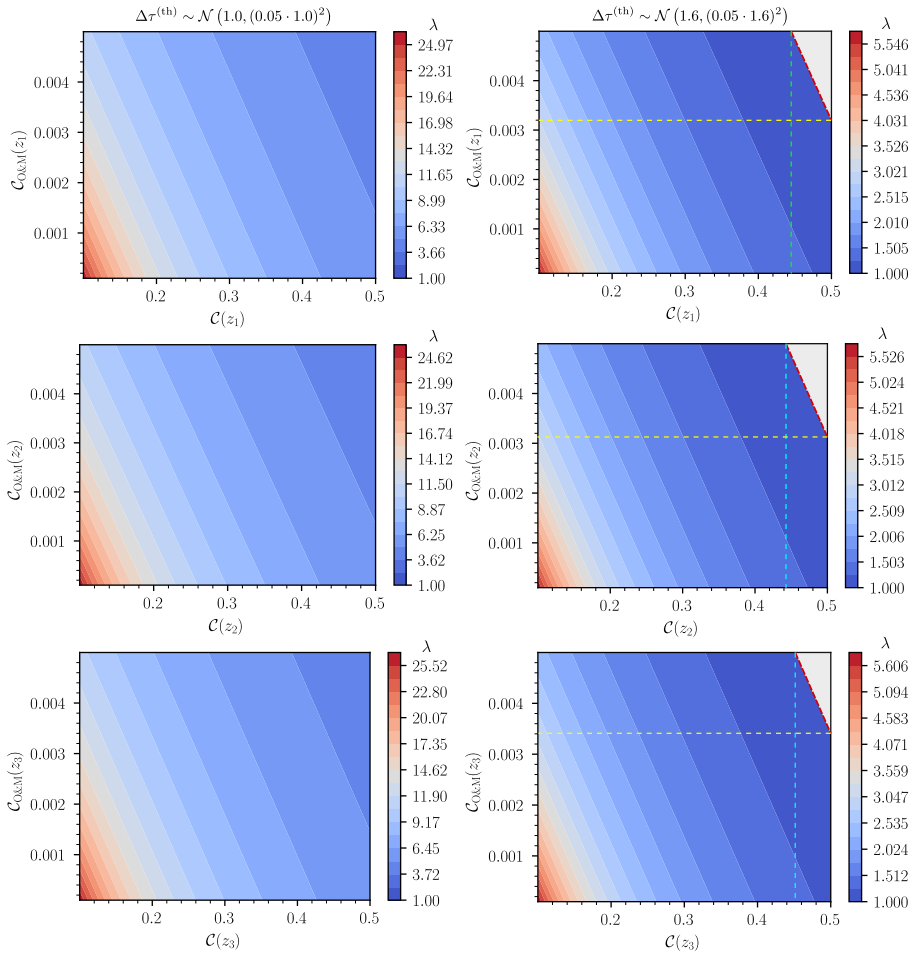


read the original abstract
Recent advances in Structural Health Monitoring (SHM) have attracted industry interest, yet real-world applications, such as in ship structures remain scarce. Despite SHM's potential to optimise maintenance, its adoption in ships is limited due to the lack of clearly quantifiable benefits for hull maintenance. This study employs a Bayesian pre-posterior decision analysis to quantify the value of information (VoI) from SHM systems monitoring corrosion-induced thickness loss (CITL) in ship hulls, in a first-of-its-kind analysis for ship structures. We define decision-making consequence cost functions based on exceedance probabilities relative to a target CITL threshold, which can be set by the decision-maker. This introduces a practical aspect to our framework, that enables implicitly modelling the decision-maker's risk perception. We apply this framework to a large-scale, high-fidelity numerical model of a commercial vessel and examine the relative benefits of different CITL monitoring strategies, including strain-based SHM and traditional on-site inspections.
Editorial analysis
A structured set of objections, weighed in public.
Referee Report
Summary. The manuscript applies a Bayesian pre-posterior decision analysis to quantify the value of information (VoI) from strain-based structural health monitoring (SHM) for corrosion-induced thickness loss (CITL) in ship hull structures. Using a high-fidelity numerical model of a commercial vessel, the authors compare relative benefits of SHM versus traditional on-site inspections by defining consequence cost functions based on exceedance probabilities relative to a target CITL threshold that can be set by the decision-maker.
Significance. If the numerical model and exceedance-based cost functions are representative, the work supplies a quantitative framework for evaluating SHM benefits in maritime maintenance decisions and introduces a practical mechanism for incorporating decision-maker risk perception. This is a first application of VoI analysis to ship hull CITL monitoring and could support more informed adoption of monitoring technologies.
major comments (2)
- [Numerical model section] The central claim that the VoI framework quantifies relative benefits of strain-based SHM versus inspections rests on the high-fidelity numerical model correctly reproducing CITL statistics under operational conditions. The manuscript provides no description of model calibration to historical thickness measurements or validation against real ship data (see the numerical model section and any associated results tables).
- [Cost function and decision analysis sections] The consequence cost functions are defined via exceedance probabilities relative to a target threshold. The paper does not report elicitation of these functions from classification society rules, operator data, or explicit utility assessment, leaving open whether they faithfully encode real decision consequences (see the cost function definition and decision analysis sections).
minor comments (2)
- [Methods] Clarify the exact sensor noise model assumed for strain-based SHM and how it enters the pre-posterior analysis.
- [Results] Add a table or figure summarizing the specific monitoring strategies compared (e.g., sensor placement, inspection intervals) to improve readability of the results.
Simulated Author's Rebuttal
We thank the referee for their detailed and constructive report. We address each major comment below, indicating where revisions will be made to strengthen the manuscript.
read point-by-point responses
-
Referee: [Numerical model section] The central claim that the VoI framework quantifies relative benefits of strain-based SHM versus inspections rests on the high-fidelity numerical model correctly reproducing CITL statistics under operational conditions. The manuscript provides no description of model calibration to historical thickness measurements or validation against real ship data (see the numerical model section and any associated results tables).
Authors: We agree that the manuscript does not provide explicit calibration of the numerical model to historical thickness measurements from the vessel or direct validation against real ship data. The model is a high-fidelity finite-element representation constructed according to standard naval architecture practices and literature on ship structural analysis; however, the study emphasis is on the VoI decision framework rather than on empirical model validation, which would require proprietary operational datasets not available to the authors. In the revised manuscript we will expand the numerical model section with additional detail on the model's formulation, boundary conditions, and material assumptions, and add a new subsection explicitly discussing model limitations and the value of future validation against real thickness-loss records. revision: yes
-
Referee: [Cost function and decision analysis sections] The consequence cost functions are defined via exceedance probabilities relative to a target threshold. The paper does not report elicitation of these functions from classification society rules, operator data, or explicit utility assessment, leaving open whether they faithfully encode real decision consequences (see the cost function definition and decision analysis sections).
Authors: The cost functions are deliberately formulated in terms of exceedance probabilities relative to a decision-maker-specified threshold precisely to allow flexibility and to encode risk perception without requiring a single fixed utility function. The manuscript therefore does not present a formal elicitation exercise from classification societies or operators. We acknowledge that anchoring the functions more explicitly to existing rules would improve practical relevance. In revision we will add references to relevant classification-society thickness-loss criteria and include a short discussion of how the framework can be instantiated with elicited utilities or operator-specific cost data. revision: partial
Circularity Check
No significant circularity; established VoI framework applied to new domain
full rationale
The paper applies a standard Bayesian pre-posterior decision analysis (VoI) to quantify benefits of strain-based SHM versus inspections for CITL in a high-fidelity vessel model. Consequence costs are defined via exceedance probabilities relative to a user-set threshold, which is an explicit modeling choice rather than a self-referential derivation. No equations or steps reduce reported VoI values to parameters fitted by the authors themselves or to self-citations that render the central result tautological by construction. The framework remains independent of the specific numerical model outputs and is presented as a first application to ship structures, with the derivation chain self-contained against external decision-analysis benchmarks.
Axiom & Free-Parameter Ledger
free parameters (1)
- CITL threshold and exceedance cost function
axioms (1)
- domain assumption The high-fidelity numerical model faithfully reproduces real ship response to corrosion and strain monitoring.
Lean theorems connected to this paper
-
IndisputableMonolith/Cost/FunctionalEquation.leanwashburn_uniqueness_aczel unclear?
unclearRelation between the paper passage and the cited Recognition theorem.
We define decision-making consequence cost functions based on exceedance probabilities relative to a target CITL threshold... R(d0,p_ex)=p_ex and R(d1,p_ex)=minR(d1)+[(1−minR(d1))/P_ex,th]·p_ex
-
IndisputableMonolith/Foundation/RealityFromDistinction.leanreality_from_one_distinction unclear?
unclearRelation between the paper passage and the cited Recognition theorem.
high-fidelity numerical model of a commercial vessel... strain-based SHM and traditional on-site inspections
What do these tags mean?
- matches
- The paper's claim is directly supported by a theorem in the formal canon.
- supports
- The theorem supports part of the paper's argument, but the paper may add assumptions or extra steps.
- extends
- The paper goes beyond the formal theorem; the theorem is a base layer rather than the whole result.
- uses
- The paper appears to rely on the theorem as machinery.
- contradicts
- The paper's claim conflicts with a theorem or certificate in the canon.
- unclear
- Pith found a possible connection, but the passage is too broad, indirect, or ambiguous to say the theorem truly supports the claim.
Reference graph
Works this paper leans on
-
[1]
ABS, Advisory on structural health monitoring: The application of sensor-based approaches„ 2020
work page 2020
-
[2]
ABS, Guide for smart functions for marine vessels and offshore units, 2022
work page 2022
-
[3]
Smogeli, Digital twins at work in maritime and energy, DNV GL (2017)
O. Smogeli, Digital twins at work in maritime and energy, DNV GL (2017)
work page 2017
-
[4]
H. E. Torkildsen, A. Grovlen, A. Skaugen, G. Wang, A. E. Jensen, K. Pran, G. Sagvolden, Development and applications of full-scale ship hull health monitoring systems for the royal norwegian navy, 2005
work page 2005
-
[5]
N. E. Silionis, K. N. Anyfantis, From preventive to predictive maintenance of ship hulls: The role of shm, in: Day 2 Wed, March 08, 2023, SNAME, 2023. doi:10.5957/SOME-2023-033
-
[6]
IACS, Common structural rules for bulk carriers and oil tankers, 2021
work page 2021
-
[7]
76 guidelines for assessment and repair of hull structures – bulk carriers, 2007
IACS, No. 76 guidelines for assessment and repair of hull structures – bulk carriers, 2007
work page 2007
-
[8]
J. K. Paik, J. M. Lee, J. S. Hwang, Y. I. I. Park, A time-dependent corrosion wastage model for the structures of single-and double-hull tankers and fsos and fpsos, Marine Technology and SNAME News 40 (2003) 201–217. URL:https://doi.org/10.5957/mt1.2003.40.3.201. doi:10.5957/mt1.2003.40.3.201
-
[9]
Advanced Ship Design for Pollution Prevention
Y. Garbatov, C. G. Soares, Risk based maintenance of deteriorated ship structures accounting for historical data, in: Advanced Ship Design for Pollution Prevention - Proceedings of the International Workshop "Advanced Ship Design for Pollution Prevention", 2010, pp. 131–147
work page 2010
-
[10]
S. Qin, W. Cui, Effect of corrosion models on the time-dependent reliability of steel plated elements, Marine Structures 16 (2003) 15–34. doi:10.1016/S0951-8339(02)00028-X
-
[11]
K. Woloszyk, Y. Garbatov, A probabilistic-driven framework for enhanced corrosion estimation of ship structural components, Reliability Engineering & System Safety 242 (2024) 109721. doi:10.1016/j.ress.2023.109721
-
[12]
D. Georgiadis, M. Samuelides, A methodology for the reassessment of hull-girder ultimate strength of a vlcc tanker based on corrosion model updating, Ships and Offshore Structures 14 (2019) 270–280. doi:10.1080/17445302.2019.1577599
-
[13]
C. Kim, S. Oterkus, E. Oterkus, Y. Kim, Probabilistic ship corrosion wastage model with bayesian inference, Ocean Engineering 246 (2022) 110571. doi:10.1016/j.oceaneng.2022. 110571
-
[14]
L. Bull, P. Gardner, J. Gosliga, T. Rogers, N. Dervilis, E. Cross, E. Papatheou, A. Maguire, C. Campos, K. Worden, Foundations of population-based shm, part i: Homogeneous populations and forms, Mechanical Systems and Signal Processing 148 (2021) 107141. doi:10.1016/j.ymssp.2020.107141
-
[15]
J. Gosliga, P. Gardner, L. Bull, N. Dervilis, K. Worden, Foundations of population-based shm, part ii: Heterogeneous populations – graphs, networks, and communities, Mechanical Systems and Signal Processing 148 (2021) 107144. doi:10.1016/j.ymssp.2020.107144. 35
-
[16]
P. Gardner, L. Bull, J. Gosliga, N. Dervilis, K. Worden, Foundations of population-based shm, part iii: Heterogeneous populations – mapping and transfer, Mechanical Systems and Signal Processing 149 (2021) 107142. doi:10.1016/j.ymssp.2020.107142
-
[17]
A. S. Katsoudas, N. E. Silionis, K. N. Anyfantis, Structural health monitoring for cor- rosion induced thickness loss in marine plates subjected to random loads, Ocean Engi- neering 273 (2023) 114037. URL:https://www.sciencedirect.com/science/article/pii/ S0029801823004213. doi:https://doi.org/10.1016/j.oceaneng.2023.114037
-
[18]
N. E. Silionis, K. N. Anyfantis, Optimal sensor placement for corrosion induced thickness loss monitoring in ship structures, Marine Structures 93 (2024) 103524. doi:10.1016/j.marstruc. 2023.103524
-
[19]
M. Ghasemzadeh, M. Mokhtari, A. Kefal, Localized corrosion damage prediction of steel plates in marine applications using quadrilateral inverse-shell elements based on ifem, in: E. S., S. C.G. (Eds.), Sustainable Development and Innovations in Marine Tech- nologies - Proceedings of the 19th International Congress of the International Maritime Association ...
work page 2022
-
[20]
URL:https://www.scopus.com/inward/record.uri?eid=2-s2.0-85145582241&doi= 10.1201%2f9781003358961-17&partnerID=40&md5=72b61f58fd1fc7a068e50c7fa9669ff8. doi:10.1201/9781003358961-17
-
[21]
M. Ghasemzadeh, M. Mokhtari, M. H. Bilgin, A. Kefal, Pitting corrosion identification ap- proach based on inverse finite element method for marine structure applications, Ocean Engi- neering 273 (2023) 113953. URL:https://www.sciencedirect.com/science/article/pii/ S0029801823003372. doi:https://doi.org/10.1016/j.oceaneng.2023.113953
-
[22]
M. Pozzi, A. D. Kiureghian, Assessing the value of information for long-term structural health monitoring, 2011, p. 79842W. doi:10.1117/12.881918
-
[23]
D. Zonta, B. Glisic, S. Adriaenssens, Value of information: Impact of monitoring on decision- making, Structural Control and Health Monitoring 21 (2014). doi:10.1002/stc.1631
-
[24]
S. Thöns, On the value of monitoring information for the structural integrity and risk manage- ment, Computer-Aided Civil and Infrastructure Engineering 33 (2018) 79–94. doi:10.1111/ mice.12332
work page 2018
-
[25]
D. Straub, E. Chatzi, E. Bismut, W. Courage, M. Döhler, M. H. Faber, J. Köhler, G. Lombaert, P. Omenzetter, M. Pozzi, S. Thöns, D. V. Val, H. Wenzel, D. Zonta, Value of information: A roadmap to quantifying the benefit of structural health monitoring, in: ICOSSAR - 12th International Conference on Structural Safety & Reliability, Vienna, Austria, 2017
work page 2017
-
[26]
D. Straub, Value of information analysis with structural reliability methods, Structural Safety 49 (2014). doi:10.1016/j.strusafe.2013.08.006
-
[27]
S. Thöns, C. Caprani, M. H. Faber, D. M. Frangopol, P. Gardoni, P. F. Giordano, D. Honfi, L. Iannacone, M. S. Khan, J. Köhler, S. Kim, N. de Koker, M. P. Limongelli, S. Miraglia, J. S. Nielsen, M. Pandey, C. Viljoen, On information value and decision analyses, Structural Safety 113 (2025) 102481. doi:10.1016/j.strusafe.2024.102481. 36
-
[28]
A. Kamariotis, E. Chatzi, D. Straub, N. Dervilis, K. Goebel, A. J. Hughes, G. Lombaert, C. Papadimitriou, K. G. Papakonstantinou, M. Pozzi, et al., Monitoring-supported value generation for managing structures and infrastructure systems, Data-Centric Engineering 5 (2024). doi:10.1017/dce.2024.24
-
[29]
A. Kamariotis, E. Chatzi, D. Straub, Value of information from vibration-based structural health monitoring extracted via bayesian model updating, Mechanical Systems and Signal Processing 166 (2022) 108465. doi:10.1016/J.YMSSP.2021.108465
-
[30]
A. Kamariotis, E. Chatzi, D. Straub, A framework for quantifying the value of vibration-based structural health monitoring, Mechanical Systems and Signal Processing 184 (2023) 109708. doi:10.1016/j.ymssp.2022.109708
-
[31]
P. F. Giordano, L. J. Prendergast, M. P. Limongelli, A framework for assessing the value of information for health monitoring of scoured bridges, Journal of Civil Structural Health Monitoring 10 (2020) 485–496. doi:10.1007/s13349-020-00398-0
-
[32]
L. Iannacone, P. F. Giordano, P. Gardoni, M. P. Limongelli, Quantifying the value of in- formation from inspecting and monitoring engineering systems subject to gradual and shock deterioration, Structural Health Monitoring 21 (2022) 72–89. doi:10.1177/1475921720981869
-
[33]
C. Song, C. Zhang, A. Shafieezadeh, R. Xiao, Value of information analysis in non-stationary stochastic decision environments: A reliability-assisted pomdp approach, Reliability Engineer- ing & System Safety 217 (2022) 108034. doi:10.1016/j.ress.2021.108034
-
[34]
M. Chadha, Z. Hu, M. D. Todd, An alternative quantification of the value of informa- tion in structural health monitoring, Structural Health Monitoring 21 (2021) 138–164. URL:https://doi.org/10.1177/14759217211028439. doi:10.1177/14759217211028439, doi: 10.1177/14759217211028439
-
[36]
M. Chadha, Z. Hu, C. R. Farrar, M. D. Todd, A value-of-information-based optimal sensor placement design framework for cost-effective structural health monitoring (with application to miter gate monitoring), Structural Health Monitoring 24 (2025) 2091–2124. doi:10.1177/ 14759217241275643
work page 2025
-
[37]
S. Cantero-Chinchilla, J. Chiachío, M. Chiachío, D. Chronopoulos, A. Jones, Optimal sensor configuration for ultrasonic guided-wave inspection based on value of information, Mechanical Systems and Signal Processing 135 (2020) 106377. URL:https://www.sciencedirect.com/ science/article/pii/S0888327019305989. doi:https://doi.org/10.1016/j.ymssp.2019. 106377
-
[38]
H.-M. Tian, Z.-J. Cao, D.-Q. Li, Y. Wang, Efficient value of information analysis for optimal monitoring placement of reinforced slopes by collaborative reliability updating, Reliability Engineering & System Safety 257 (2025) 110877. doi:10.1016/j.ress.2025.110877. 37
-
[39]
Managing engineering systems with large state and action spaces through deep reinforcement learning
W.-H. Zhang, J. Qin, D.-G. Lu, M. Liu, M. H. Faber, Quantification of the value of condition monitoring system with time-varying monitoring performance in the context of risk-based inspection, Reliability Engineering & System Safety 231 (2023) 108993. doi:10.1016/j.ress. 2022.108993
-
[40]
W. Wu, D. Prescott, R. Remenyte-Prescott, A. Saleh, M. C. Ruano, An asset management modelling framework for wind turbine blades considering monitoring system reliability, Relia- bility Engineering & System Safety 252 (2024) 110478. doi:10.1016/j.ress.2024.110478
-
[41]
Y. Yang, M. Chadha, Z. Hu, M. D. Todd, An optimal sensor design framework accounting for sensor reliability over the structural life cycle, Mechanical Systems and Signal Processing 202 (2023) 110673. doi:10.1016/j.ymssp.2023.110673
-
[42]
G. Arcieri, C. Hoelzl, O. Schwery, D. Straub, K. G. Papakonstantinou, E. Chatzi, Bridging pomdps and bayesian decision making for robust maintenance planning under model uncer- tainty: An application to railway systems, Reliability Engineering & System Safety 239 (2023) 109496. doi:10.1016/j.ress.2023.109496
-
[43]
J. S. Nielsen, D. Tcherniak, M. D. Ulriksen, A case study on risk-based maintenance of wind turbine blades with structural health monitoring, Structure and Infrastructure Engineering 17 (2021) 302–318. doi:10.1080/15732479.2020.1743326
-
[44]
G. Zou, A. Kolios, Quantifying the value of negative inspection outcomes in fatigue mainte- nance planning: Cost reduction, risk mitigation and reliability growth, Reliability Engineering & System Safety 226 (2022) 108668. doi:10.1016/j.ress.2022.108668
-
[45]
F. A. Rezende, P. M. Videiro, L. V. Sagrilo, M. C. Oliveira, Reliability-based fatigue inspection planning for mooring chains of floating systems, Reliability Engineering & System Safety 242 (2024) 109775. doi:10.1016/j.ress.2023.109775
-
[46]
A. Kamariotis, L. Sardi, I. Papaioannou, E. Chatzi, D. Straub, On off-line and on-line bayesian filtering for uncertainty quantification of structural deterioration, Data-Centric Engineering 4 (2023). doi:10.1017/dce.2023.13
- [47]
-
[48]
Z. Y. M. Rangrez, J. Ghosh, C. Caprani, S. Ghosh, Integrating risk perceptions in a value of information framework using cumulative prospect theory, Structural Safety 115 (2025) 102573. doi:10.1016/j.strusafe.2025.102573
-
[49]
D. G. Georgiadis, M. S. Samuelides, The effect of corrosion spatial randomness and model selection on the ultimate strength of stiffened panels, Ships and Offshore Structures 16 (2021) 140–152. URL:https://doi.org/10.1080/17445302.2021.1907063. doi:10.1080/ 17445302.2021.1907063, doi: 10.1080/17445302.2021.1907063
-
[50]
D. Cristiani, C. Sbarufatti, F. Cadini, M. Giglio, Fatigue damage diagnosis and prognosis of an aeronautical structure based on surrogate modelling and particle filter, Structural Health Monitoring 20 (2021) 2726–2746. doi:10.1177/1475921720971551. 38
-
[51]
M. K. Ramancha, M. A. Vega, J. P. Conte, M. D. Todd, Z. Hu, Bayesian model updating with finite element vs surrogate models: Application to a miter gate structural system, Engineering Structures 272 (2022) 114901. URL:https://www.sciencedirect.com/science/article/ pii/S0141029622009798. doi:https://doi.org/10.1016/j.engstruct.2022.114901
-
[52]
N. E. Silionis, K. N. Anyfantis, A hierarchical bayesian approach for parameter identification in structural deterioration models using probabilistic surrogate models, e-Journal of Nonde- structive Testing 29 (2024). doi:10.58286/29571
-
[53]
S. Brooks, A. Gelman, G. Jones, X.-L. Meng, Handbook of Markov Chain Monte Carlo, Chap- man and Hall/CRC, 2011. doi:10.1201/b10905
-
[54]
M. D. Hoffman, A. Gelman, The no-u-turn sampler: adaptively setting path lengths in hamiltonian monte carlo, J. Mach. Learn. Res. 15 (2011) 1593–1623. URL:https://api. semanticscholar.org/CorpusID:12948548
work page 2011
-
[55]
Betancourt, A conceptual introduction to hamiltonian monte carlo, 2017
M. Betancourt, A conceptual introduction to hamiltonian monte carlo, 2017
work page 2017
-
[56]
E. Bingham, J. P. Chen, M. Jankowiak, F. Obermeyer, N. Pradhan, T. Karaletsos, R. Singh, P. A. Szerlip, P. Horsfall, N. D. Goodman, Pyro: Deep universal probabilistic programming, J. Mach. Learn. Res. 20 (2019) 28:1–28:6. URL:http://jmlr.org/papers/v20/18-403.html
work page 2019
-
[57]
D. Phan, N. Pradhan, M. Jankowiak, Composable effects for flexible and accelerated proba- bilistic programming in numpyro, 2019
work page 2019
-
[58]
Rank-normalization, folding, and localization: An improved R for assessing convergence of MCMC
A. Vehtari, A. Gelman, D. Simpson, B. Carpenter, P.-C. Bürkner, Rank-normalization, folding, and localization: An improved ˆRfor assessing convergence of mcmc, Bayesian Analysis 16 (2021). doi:10.1214/20-BA1221. 39
discussion (0)
Sign in with ORCID, Apple, or X to comment. Anyone can read and Pith papers without signing in.