REVIEW 2 major objections 4 minor 1 cited by
Almost prescribing scalar curvature by mixed convex integration
T0 review · 2 major / 4 minor · reviewed 2026-08-15 · deepseek-v4-flash
Pith's one-line read The paper proves that on any smooth manifold of dimension at least three, any smooth metric can be perturbed slightly so its scalar curvature lies below and arbitrarily close to a prescribed negative target, and it derives this…
desk verdict New mixed convex integration proof of Lohkamp's theorem; the method is real, but the induction has a missing k=1 base case that needs to be patched. read the letter →
The pith
A machine-rendered reading of the paper's core claim, the machinery that carries it, and where it could break.
The reading
What carries the argument
The central mechanism is the mixed corrugation process: starting from a function $f$, one defines $F_N(x)=f(x)+N^{-1}\mathrm{Int}(\gamma_x)(N x_i)+N^{-2}\mathrm{Int}^2(\delta_x)(N x_i)$, where $\mathrm{Int}$ is the integral-loop operator that returns the mean-zero primitive of a periodic loop and $\gamma_x,\delta_x$ are smooth families of loops. Proposition 2.2 gives asymptotic formulas showing that the first derivative gains $\gamma_x(Nx_i)$, the pure second derivative gains $N\dot\gamma_x(Nx_i)+\delta_x(Nx_i)$, and mixed second derivatives gain transverse derivatives of $\gamma_x$. Proposition 2.4 converts these formulas into an $\varepsilon$-approximate solution of the semilinear relation, provided the loops satisfy three conditions: zero mean, membership in the kernel of the linear coefficient $L$, and a loop equation $L(x)\cdot(\sigma^2_{11}+\delta_x(t))+R(x,\dots)=0$ for every $t$. The scalar curvature application chooses the loops explicitly, for example $\gamma_x(t)=\sqrt{(\tilde k(x)+\bar\epsilon)/\alpha_x}\cos(2\pi t)$, with $\delta_x$ adjusted to have zero mean.
What would settle it
Run the construction on the two-dimensional torus, where the conclusion is known to fail: the loop equation of Proposition 2.4 should then have no zero-mean periodic solution with the chosen diagonal ansatz, and exhibiting that failure would confirm the mechanism rather than a technical gap. Separately, examine the least verified premise by taking the proposed codimension-two set $\Sigma_3$ in the unit disc and attempting to construct the embedded torus cylinder it is supposed to allow; an explicit neighborhood of $\Sigma_3\cup\partial D^3$ that blocks such an embedding would falsify the gluing step.
Extended reading notes
Core claim
The central claim is Theorem 1.1: for every smooth Riemannian manifold of dimension $n\ge 3$, every smooth metric $g_0$, every smooth positive function $k$, and every $\varepsilon>0$, there exists a smooth metric $g_\varepsilon$ with $\mathrm{Scal}_{g_0}-k-\varepsilon<\mathrm{Scal}_{g_\varepsilon}<\mathrm{Scal}_{g_0}-k$ and $\|g_\varepsilon-g_0\|_{C^0_g}<\varepsilon$. The paper proves this by treating the scalar curvature equation as a semilinear second-order relation of the form $L(x)\cdot \partial_1^2 F + R(x,\text{lower-order jet terms})=0$, after a diagonal deformation of the metric in a frame adapted to $g_0$. A general criterion, Proposition 2.4, solves such relations by inserting two periodic loop families into a corrugation process; the torus case is then globalized simplex by simplex. The proof thereby avoids the covering-and-superposition technique of the earlier argument and replaces it with a local curvature calculus plus a geometric gluing lemma.
Load-bearing premise
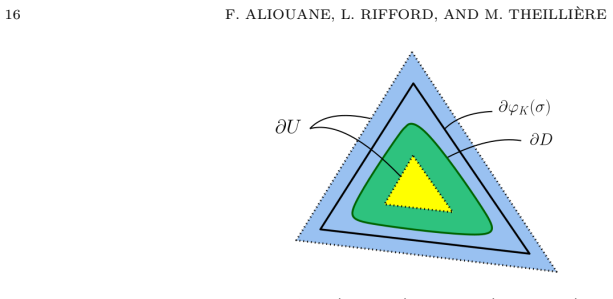
The global gluing step requires Lemma 4.1, which asserts that after removing a codimension-two set from a disc, a thickened torus times an interval can still be embedded with its two ends in any prescribed neighborhood of the disc boundary; if that geometric embedding cannot be arranged, the local metric perturbations cannot be assembled into a metric on the whole manifold.
Editorial extensions
If this is right
- Every smooth metric on an $n$-dimensional manifold with $n\ge 3$ can be approximated arbitrarily well in the $C^0$ norm by a metric whose scalar curvature lies strictly between $\mathrm{Scal}_{g_0}-k-\varepsilon$ and $\mathrm{Scal}_{g_0}-k$.
- The semilinear criterion of Proposition 2.4 becomes a reusable tool: any second-order relation that is affine in the top derivative and admits zero-mean loop pairs satisfying the three conditions can be solved in the same $\varepsilon$-thickened sense.
- The proof recovers the known scalar-curvature flexibility result without the measure-covering superposition argument used previously, replacing it with a local curvature calculus and a simplex-by-simplex gluing scheme.
- Because the metric perturbations are controlled in the $C^0$ norm at every step, the theorem tolerates arbitrary initial metrics and arbitrary local variations of the prescribed positive function $k$.
- The strict inequalities and arbitrary $C^0$ closeness give the result an h-principle-like character: local geometry imposes no obstruction to lowering scalar curvature in dimension at least three, in contrast to the two-dimensional obstruction.
Reading between the lines
- The positivity of $k$ is not an accident: the zero-mean condition on the loop $\delta$ forces $\tilde k(x)+\epsilon$ to be nonnegative, as the paper notes in Remark 3.2. A natural extension, not pursued by the authors, is to test whether allowing the metric perturbation to use more than two diagonal directions removes that restriction for sign-changing $k$.
- The same two-loop splitting should apply to other geometric relations whose highest-order term is linear, such as prescribing a component of the Ricci tensor or prescribing scalar curvature within a fixed conformal class; the paper does not make this claim.
- Lemma 4.1, the embedding lemma used to globalize the construction, is independent of the curvature estimates. The proof would be easier to check if that lemma were replaced by an explicit construction; isolating its first nontrivial case, $k=3$, would separate the geometric gluing content from the PDE mechanism.
Signed reviews
Editorial analysis
A structured set of objections, weighed in public.
Referee Report
Summary. The paper introduces a mixed convex integration method for a class of semilinear second-order partial differential relations and uses it to give a new proof of Lohkamp's theorem: on any smooth Riemannian manifold of dimension n >= 3, any smooth metric can be C^0-approximated by a smooth metric whose scalar curvature lies strictly between Scal_{g0} - k - epsilon and Scal_{g0} - k for any prescribed positive function k. The core tool is Proposition 2.4, a corrugation criterion built from the integral-loop operator, applied to scalar curvature through explicitly constructed loops. The torus cases are proved in Section 3, and Section 4 assembles the general manifold case by induction over a triangulation, using a thick-torus embedding lemma in the simplex-by-simplex construction.
Significance. If the proof is completed, the paper gives a genuinely new proof of an important theorem of Lohkamp and introduces a reusable technique for semilinear second-order differential relations that are not amenable to classical convex integration. The loop constructions are explicit and parameter-free rather than fitted, the local asymptotic expansions are clean, and the overall geometric strategy is well organized. The central claim is not a new theorem but a new proof method, and that method is the paper's main contribution.
major comments (2)
- [Section 4, induction step] The induction proving property (P_d) does not cover the step from d = 0 to d = 1 as written. The proof assumes (P_{d'}) for all d' in {0,...,d} and then, for a (d+1)-simplex, invokes Lemma 4.1 with k = d+1 and property (P_{d-1}). For d = 0 this requires Lemma 4.1 with k = 1, but Lemma 4.1 is stated only for k in [2,n], and property P_{-1} is undefined. Since the proof of Theorem 1.1 requires P_n and the induction starts at P_0, the chain is broken unless a k = 1 version of Lemma 4.1 is supplied and P_{-1} is either defined or the first step is handled separately. This is patchable, but it is a genuine gap in the manuscript as it stands.
- [Section 3.1, displayed scalar curvature formula] The displayed scalar curvature formula for the flat torus contains a sign error in the cross terms for i >= 4: the final sum reads (partial_i h_2)^2 + (partial_i h_3)^2 - partial_i h_2 partial_i h_3, but the general diagonal-metric formula in Proposition A.4 gives + partial_i h_2 partial_i h_3 inside the bracket. Thus the displayed identity is false as an exact formula. Under the corrugation construction the error is O(1/N) and may be absorbable in the epsilon thickening, but the proof of Proposition 3.1 as written relies on this exact identity to define the relation R, so the identity must be corrected or the argument must explicitly carry the error term.
minor comments (4)
- [Section 2, first paragraph] The word 'taylored' should be 'tailored'.
- [Appendix A.4, Proposition A.5] The statement of Proposition A.5 says 'Assume that g is diagonal of the form (A.7)', but equation (A.7) defines \bar g = \bar A^{tr} \bar A, which is not diagonal; the intended hypothesis is that \bar g has the form (A.7) and the perturbation \hat g has the diagonal form (A.8).
- [Section 3.3, notation] In Proposition 3.5, the compact set C is introduced in the statement and then used both as the compact neighborhood C in the proof; this is not an error but the reuse of the symbol C for two different sets can confuse the reader.
- [Section 2.4, geometric interpretation] The notation R_{sigma, partial_1, partial^2_1} is introduced without a precise definition of the subscripts; please clarify that these denote the dependence on the 2-jet components that are fixed in the slice.
Circularity Check
No circularity: the proof constructs the metric deformations from explicit loop families, and the cited corrugation tool is independently established.
full rationale
The derivation chain is self-contained. Proposition 2.4 is a conditional statement: if two loop families satisfy (L1)-(L3), the corrugated function F lands in the thickened relation R_epsilon. The loop families are then constructed explicitly in Propositions 3.1, 3.3, and 3.5, for example (gamma_x)_1(t) = sqrt(k(x)+epsilon) cos(2 pi t) with delta_x determined by equations (3.3), (3.7), and (3.9), and the zero-average condition enforced by the identity integral of cos^2 = 1/2. The target inequality is therefore obtained by direct computation from these explicit choices, not assumed or fitted. The one self-citation, [12] for the corrugation process, is methodological: the needed estimates are proved in Proposition 2.2 within the paper, and [12] is an independent published source, so it is not load-bearing evidence for the scalar-curvature theorem. The only concern found is a correctness gap, not a circularity: in the induction in Section 4, Lemma 4.1 is stated only for k >= 2 but is invoked with k = d+1 = 1 when passing from P_0 to P_1, and the application of P_{d-1} at that step would require P_{-1}. A k = 1 version is plausibly trivial (Sigma_1 = empty) and a separate P_1 base case could repair the proof, but as written the induction is incomplete at that step. This does not make the 'prediction' equal to its inputs, so the circularity score remains 0.
Assumptions & free parameters
assumptions (4)
- standard math Every smooth manifold admits a smooth triangulation, and any triangulation of the boundary extends to the whole manifold.
- standard math The scalar curvature formulas for diagonal and pulled-back metrics in Appendix A are correct.
- domain assumption For any Riemannian metric on a torus, there exists a Z^n-periodic smooth orthonormal frame X1,...,Xn with <X1,e1> > 0 and <Xj,e1> = 0 for j >= 2.
- ad hoc to paper Lemma 4.1 is valid for every k >= 2: the codimension-2 set Sigma_k exists and the torus thickening embeds in its complement.
Cite this review
Pith. "Pith review of Almost prescribing scalar curvature by mixed convex integration." pith.science (2026). https://pith.science/paper/ILENOTKB
@misc{pith2026250508384,
  author       = {Pith},
  title        = {Pith review of: Almost prescribing scalar curvature by mixed convex integration},
  year         = {2026},
  howpublished = {\url{https://pith.science/paper/ILENOTKB}},
  note         = {Machine review of arXiv:2505.08384}
}
read the original abstract
We introduce a method of mixed convex integration and demonstrate its suitability for solving a particular class of semilinear second-order partial differential relations. As an application, we provide a new proof of a result on scalar curvature originally established by Lohkamp.
Figures


Figures from the paper (1 more)

Forward citations
Cited by 1 Pith paper
-
Scalar Curvature Flexibility in the Riemannian Burnett Compactness Class
Every Riemannian metric with scalar curvature at least κ on a closed manifold, or on an open manifold when κ≤0, is a local Burnett-class limit of metrics with scalar curvature exactly κ, with sharp Hölder closures.
Reference graph
Works this paper leans on
-
[12]
M. Theilli` ere. Convex integration without integration.Math. Z., 300(3):2737-2770, 2022. Universit´e Mohammed Seddik Benyahia, LAOTI, D ´epartement de math´ematiques, facult´e des Sci- ences Exactes et Informatique, BP 98, Ouled Aissa, 18000, Jijel, Algeria Email address: f aliouane@univ-jijel.dz Universit´e C ˆote d’Azur, CNRS, Labo. J.-A. Dieudonn ´e, ...
work page 2022
-
[1]
Y. Eliashberg and N. Mishachev. Introduction to the h-principle. Graduate Studies in Mathematics, 48. American Mathematical Society, Providence, RI, 2002
work page 2002
- [2]
-
[3]
M. Gromov. Convex integration of partial differential relations. I Izv. Akad. Nauk SSSR Ser. Mat. , 37(3):329-343 (1973)
work page 1973
-
[4]
M. Gromov. Partial Differential Relations. Ergebnisse der Mathematik und ihrer Grenzgebiete (3), vol. 9. Springer-Verlag, Berlin, 1986
work page 1986
-
[5]
J. Lohkamp. Metrics of negative Ricci curvature. Ann. Math. (2) , 140(3):655-683 (1994)
work page 1994
-
[6]
J. Lohkamp. Curvature h-principles. Ann. Math. (2) , 142(3):457-498 (1995)
work page 1995
-
[7]
J. Lohkamp. Scalar curvature and hammocks. Math. Ann., 313(3):385-407 (1999)
work page 1999
Show all 12 references
-
[8]
Massot and M
P. Massot and M. Theilli` ere. Holonomic integration through convex integration.Int. Math. Res. Not. IMRN, 9, 7486-7501, 2023
2023
-
[9]
J.R. Munkres. Elementary differential topology. Lectures given at Massachusetts Institute of Technology, Fall, 1961. Revised ed. Annals of Mathematics Studies. 54. Princeton, N.J.: Princeton University Press, 1966
1961
-
[10]
J. Nash. C1-isometric imbeddings. Ann. Math. (2) , 60:383-396 (1954)
1954
-
[11]
D. Spring. Convex Integration Theory. Monographs in Mathematics, vol. 92. Birkha¨ auser Verlag, Basel, 1998
1998
Reviewed August 15, 2026 · model on record in the stance chip above.
Discussion (0). Continue with ORCID to comment.