REVIEW 1 major objections 4 minor 39 references
Lower bounds for the reach and applications
T0 review · 1 major / 4 minor · reviewed 2026-08-15 · deepseek-v4-flash
Pith's one-line read This paper proves that a box-subdivision algorithm converts verified gradient and Hessian bounds into a certified lower bound for the reach of a smooth zero set, and applies it to distances, homology, eigenvalues, and smooth deformations.
desk verdict The certified reach lower bound is a solid new tool, but the planar homology application has a real gap in Proposition 6.5 that the authors need to fix. read the letter →
The pith
A machine-rendered reading of the paper's core claim, the machinery that carries it, and where it could break.
The reading
What carries the argument
The load-bearing device is the subdivision-classification loop of Algorithm 1. Starting from the bounding box $[-B_1,B_1]^N$, it halves a box and applies two mean-value-theorem tests based on verified bounds $|\nabla f|_2\le B_2$ and $|\operatorname{Hess} f|_2\le B_3$: if the midpoint value of $f$ is too large for $f$ to vanish inside the box, the box is discarded; if the midpoint gradient is large enough to force $|\nabla f|_1>0$ throughout the box, the box is kept and contributes to the gradient bound. Non-singularity of $V(f)$ rules out an infinite nested sequence of unresolved boxes, so the loop terminates. The reach bound then combines the level-set curvature formula $|II(u,v)|=|\operatorname{Hess} f(u,v)|/|\nabla f|$ and the bottleneck estimate $\lambda\ge|\nabla f|/|\operatorname{Hess} f|$ through the reach decomposition $\tau=\min\{\text{bottleneck radius},\text{curvature radius}\}$.
What would settle it
Take a smooth function with a known exact reach, such as a sinusoidal perturbation of the unit circle whose curvature maxima determine the true reach, and run Algorithm 1 with interval-arithmetic bounds; if the reported lower bound ever exceeds the true reach, or if the loop fails to terminate on a non-singular example, the paper's guarantee is refuted.
Extended reading notes
Core claim
The discovery is that a reach lower bound for $V(f)$ can be assembled from two affordable pieces: a lower bound on $|\nabla f|_1$ along the variety and an upper bound on $|\operatorname{Hess} f|_2$ over the containing convex set. The first piece is produced by a subdivision algorithm that keeps halving boxes until each box either provably contains no point of $V(f)$ or provably has $|\nabla f|_1$ above a positive threshold; non-singularity forces termination (Proposition 3.1). The second piece bounds the second fundamental form by $|\operatorname{Hess} f(u,v)|/|\nabla f|$, and a Rolle-theorem argument along a bottleneck chord bounds the smallest bottleneck from below by $|\nabla f|/|\operatorname{Hess} f|$ (Propositions 4.1 and 4.3). Feeding these into the standard decomposition of reach as the minimum of the bottleneck radius and the curvature radius yields $\tau\ge g_2/(2\sqrt{N}g_1)$, and an analogous determinant-based argument handles varieties defined by several functions.
Load-bearing premise
The load-bearing premise is that the user can supply verified global bounds $B_2$ and $B_3$ on $|\nabla f|$ and $|\operatorname{Hess} f|$ over the entire bounding box, and since the reach bound contains $1/B_3$, a loose Hessian bound can shrink the certified output to a size far below the true reach.
Editorial extensions
If this is right
- Certified reach lower bounds become available for zero sets of transcendental and other non-polynomial smooth functions, where the existing deterministic algorithms may fail or run too long.
- For any two points of $M$ whose extrinsic distance is less than $\tau/2$, the intrinsic distance is at most twice the extrinsic distance (Corollary 5.9).
- The homology of a planar curve $V(f)$ is exactly the homology of the cubical complex formed by boxes whose vertices bracket $f$, provided the box side is at most $\tau/2.37$ (Corollary 6.10).
- A reach lower bound yields a lower bound on the first non-zero Laplacian eigenvalue through the Li and Yau estimate, though the diameter estimate used in the paper makes the resulting numbers far too small for practical computation (Example 7.15).
- For a smooth variety $V(f)$, a perturbation $f+\varepsilon g$ stays smooth for all $\varepsilon\in[0,1)$ whenever $|g|$ and $|\nabla g|$ obey the explicit threshold produced by the box classification (Proposition 8.1).
Reading between the lines
- The classification of each box depends only on local midpoint values and global bounds, so the loop is embarrassingly parallel; a GPU implementation could push the method onto examples that currently take too long, including the Calabi-Yau-relevant cases the paper mentions.
- The eigenvalue application's weakness is traceable to the diameter estimate: replacing the ball-covering count by a tighter certified intrinsic diameter would likely turn the theoretical Laplacian bound into a usable one, independently of improving the reach bound.
- The same midpoint-test pattern could certify other gradient-controlled quantities, such as local feature size or separation between sheets, for smooth implicit sets in non-Euclidean ambient spaces whenever corresponding bounds on first and second derivatives are available.
- Because the final bound is proportional to $1/|\operatorname{Hess} f|$, using local per-box Hessian bounds rather than one global bound is not a minor optimization; it is the difference between a vacuous reach certificate and a useful one for functions with large curvature.
Signed reviews
Editorial analysis
A structured set of objections, weighed in public.
Referee Report
Summary. The paper introduces a deterministic, verified-numerics method to compute rigorous lower bounds for the reach of a smooth submanifold presented as the zero set of one or more smooth functions. The main algorithmic contribution is a recursive subdivision of a bounding box into boxes that are certified either to contain no zero set ('CaseOneBoxes') or to carry a lower bound on |∇f|_1 ('CaseTwoBoxes'); Proposition 3.1 proves termination and the gradient bound. Combining this with a curvature estimate (Proposition 4.1) and a bottleneck estimate (Proposition 4.3) yields the central reach bound Corollary 4.8: for M=V(f)⊂K with |Hess f|_2≤g1 on K and |∇f|_1≥g2 on M, one has τ≥g2/(2√N g1). The paper then derives applications: a comparison inequality between intrinsic and extrinsic distances (Section 5), a homology-computation method for planar curves based on selected grid boxes (Section 6), eigenvalue bounds for the Laplacian (Section 7), and stability bounds for deformations of algebraic varieties (Section 8). Appendix A generalizes the reach bound to higher codimension, and Appendix B gives a proof of the quantitative tubular neighborhood theorem.
Significance. The core reach-bound result is genuinely useful and largely self-contained. It is the first deterministic certified reach bound that works for zero sets of arbitrary smooth functions, not only polynomials, and the constants in Corollary 4.8 are explicit enough for direct use. The proof strategy is clean: the reach lower bound is obtained from rigorous gradient and Hessian bounds produced by the algorithm, not by fitting to the reach itself, and the termination argument in Proposition 3.1 is sound up to minor details. The multi-function generalization in Appendix A is also substantive. If the homology application in Section 6 were fully established, it would be a notable contribution to computing Betti numbers of planar curves from a cubical complex. As written, however, the proof of the key deformation-retraction claim has a gap that currently blocks that application. The eigenvalue application is honestly acknowledged by the authors as too weak for numerical use, which is a limitation rather than an error.
major comments (1)
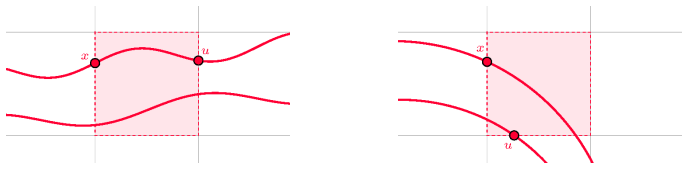
- [Section 6, Proposition 6.5] The proof of Proposition 6.5 does not establish that push∘H is a deformation retraction from \tilde S to M. The homotopy H(t,p)=(1-t)p+tπ(p) is a straight segment, and the fact that p and π(p) lie in adjacent boxes does not imply that the whole segment lies in \tilde S: for F=[0,1]^2 and F'=[1,2]^2, with p=(0.1,0.9) and π(p)=(1.1,1.9), the midpoint (0.6,1.4) lies in neither box. The segment can therefore pass through boxes outside \tilde S, and the map push sends points in an outside box to the boundary of that box, which need not be contained in \tilde S at all; it can even be a boundary shared with another outside box. Moreover, push is undefined at the midpoints of boxes outside \tilde S, and H(t,p) may pass through such a midpoint. Hence the composition push∘H is not shown to be defined with image in \tilde S, and the claimed deformation retraction is not proved. Since Corollary 6.10 relies on Proposition 6.5, the homology claim for planar curves is not established by the present argument. This gap is local to Section 6 and does not affect the reach bounds in Sections 3–5 or Appendix A.
minor comments (4)
- [Theorem 7.7 statement] The statement reads 'Let M be a semi-Riemannian submanifold of M'; the second M should presumably be the ambient manifold, for example ℝ^N or \bar M.
- [Proposition 3.1, termination proof] In the infinite-descent argument, the algorithm's conditions are stated at midpoints, but the proof applies the resulting bounds to arbitrary points D_i∈F_i. The intended argument can be completed by first using the gradient/Hessian bounds to transfer the midpoint bounds to all points of the box; as written, the displayed inequalities skip this step.
- [Section 7, Example 7.15] The authors correctly state that the eigenvalue lower bound is far smaller than the smallest positive floating-point number. This is an honest limitation, but the abstract and introduction present eigenvalue estimation as one of the applications; a sentence there noting that this application is currently only theoretical would better calibrate reader expectations.
- [Section 6, Definition 6.1 and Corollary 6.10] The paper uses closed boxes whose union is the whole square, so 'the homology of the selected boxes' needs a precise convention for the resulting cubical complex on shared boundaries. This is standard and probably harmless, but stating the convention would improve the presentation.
Circularity Check
No significant circularity: the reach bound is derived from explicit gradient and Hessian estimates, not fitted to the reach.
full rationale
The paper's central derivation is self-contained. Algorithm 1 takes user-supplied bounds B2 and B3 on |∇f| and |Hess f| and produces a certified lower bound on |∇f|1 on the zero set; Proposition 3.1 proves correctness by a direct mean value theorem argument. Corollary 4.8 then bounds the reach by combining Proposition 4.1 (curvature bound) and Proposition 4.3 (bottleneck bound via Rolle's theorem and the mean value theorem) with the standard reach decomposition Theorem 2.10. No step fits a parameter to the reach, and no quantity is defined in terms of the reach itself. The user-supplied derivative bounds are inputs to the proof, not the output, and their looseness only affects sharpness, not circularity. Self-citations to [Douglas et al., 2024] appear in motivational remarks, in a performance comparison, and as an analogy for Proposition 8.1; however, Proposition 8.1 is proved in full in the paper, so these citations are not load-bearing. The possible gap in the deformation-retract argument of Proposition 6.5 is a correctness concern in the homology application, not a circularity in the reach derivation. No circular step is identified.
Assumptions & free parameters
free parameters (4)
- B1 (bounding box half-size) =
e.g., 2 in examples
- B2 (gradient bound) =
e.g., 5.66 for f=x^2+y^2-1 on [-2,2]^2
- B3 (Hessian bound) =
e.g., 2 for f=x^2+y^2-1
- grid side length h in homology application =
h <= tau/2.37
assumptions (5)
- domain assumption V(f) is a smooth closed submanifold: 0 is a regular value of f
- standard math Reach = min{minimal radius of curvature, bottleneck radius} (Theorem 2.10 from Aamari et al.)
- standard math The endpoint map of the normal bundle is a diffeomorphism up to the reach (quantitative tubular neighbourhood theorem)
- domain assumption Existence of computable rigorous bounds B2 and B3 for the given function f
- standard math Standard analytic and geometric facts: mean value theorem, Rolle's theorem, Hopf-Rinow, Gauss equation, Li-Yau eigenvalue estimate, Rogers covering theorem
Cite this review
Pith. "Pith review of Lower bounds for the reach and applications." pith.science (2026). https://pith.science/paper/WMQRU3FJ
@misc{pith2026250508427,
  author       = {Pith},
  title        = {Pith review of: Lower bounds for the reach and applications},
  year         = {2026},
  howpublished = {\url{https://pith.science/paper/WMQRU3FJ}},
  note         = {Machine review of arXiv:2505.08427}
}
abstract
The reach of a submanifold of $\mathbb{R}^N$ is defined as the largest radius of a tubular neighbourhood around the submanifold that avoids self-intersections. While essential in geometric and topological applications, computing the reach explicitly is notoriously difficult. In this paper, we introduce a rigorous and practical method to compute a guaranteed lower bound for the reach of a submanifold described as the common zero-set of finitely many smooth functions, not necessarily polynomials. Our algorithm uses techniques from numerically verified proofs and is particularly suitable for high-performance parallel implementations. We illustrate the utility of this method through several applications. Of special note is a novel algorithm for computing the homology groups of planar curves, achieved by constructing a cubical complex that deformation retracts onto the curve--an approach potentially extendable to higher-dimensional manifolds. Additional applications include an improved comparison inequality between intrinsic and extrinsic distances for submanifolds of $\mathbb{R}^N$, lower bounds for the first eigenvalue of the Laplacian on algebraic varieties and explicit bounds on how much smooth varieties can be deformed without changing their diffeomorphism type.
Figures


Figures from the paper (1 more)
Reference graph
Works this paper leans on
-
[1]
Aamari, E., Kim, J., Chazal, F., Michel, B., Rinaldo, A., and Wasserman, L. (2019). Estimating the reach of a manifold. Electron. J. Stat. , 13(1):1359--1399
work page 2019
-
[2]
Aggarwal, D., He, Y.-H., Heyes, E., Hirst, E., Earp, H. N. S., and Silva, T. S. (2024). Machine learning sasakian and G_2 topology on contact C alabi- Y au 7 -manifolds. Physics Letters B , 850:138517
work page 2024
-
[3]
Attali, D., Boissonnat, J.-D., and Edelsbrunner, H. (2009). Stability and computation of medial axes: a state-of-the-art report. In Mathematical foundations of scientific visualization, computer graphics, and massive data exploration , Math. Vis., pages 109--125. Springer, Berlin
work page 2009
-
[4]
Basu, S. (2006). Computing the first few B etti numbers of semi-algebraic sets in single exponential time. J. Symbolic Comput. , 41(10):1125--1154
work page 2006
-
[5]
Breiding, P. and Timme, S. (2025). The reach of a plane curve. https://www.JuliaHomotopyContinuation.org/examples/reach-curve/ . Accessed: 11 Mar 2025
work page 2025
-
[6]
N.K. B ose (ed): Recent trends in multidimensional system theory
Buchberger, B. (1985). An algorithmic method in polynomial ideal theory, in “ N.K. B ose (ed): Recent trends in multidimensional system theory”. Reidel Publishing Co , 1(985):1--84
work page 1985
-
[7]
Buckmaster, T., Cao-Labora, G., and G \'o mez-Serrano, J. (2022). Smooth imploding solutions for 3D compressible fluids. arXiv preprint arXiv:2208.09445
arXiv 2022
-
[8]
B\" u rgisser, P., Cucker, F., and Lairez, P. (2019). Computing the homology of basic semialgebraic sets in weak exponential time. J. ACM , 66(1):Art. 5, 30
work page 2019
Show all 39 references
-
[9]
Choi, H. I. and Wang, A. N. (1983). A first eigenvalue estimate for minimal hypersurfaces. J. Differential Geom. , 18(3):559--562
1983
-
[10]
Cuevas, A., Llop, P., and Pateiro-L\' o pez, B. (2014). On the estimation of the medial axis and inner parallel body. J. Multivariate Anal. , 129:171--185
2014
-
[11]
B., Eklund, D., G\"afvert, O., and Hauenstein, J
Di Rocco, S., Edwards, P. B., Eklund, D., G\"afvert, O., and Hauenstein, J. D. (2023). Computing geometric feature sizes for algebraic manifolds. SIAM J. Appl. Algebra Geom. , 7(4):716--741
2023
-
[12]
Di Rocco, S., Eklund, D., and G\" a fvert, O. (2022). Sampling and homology via bottlenecks. Math. Comp. , 91(338):2969--2995
2022
-
[13]
R., Karp, R
Douglas, M. R., Karp, R. L., Lukic, S., and Reinbacher, R. (2008). Numerical C alabi- Y au metrics. J. Math. Phys. , 49(3):032302, 19
2008
-
[14]
R., Platt, D., and Qi, Y
Douglas, M. R., Platt, D., and Qi, Y. (2024). Harmonic 1 -forms on real loci of C alabi- Y au manifolds. arXiv preprint arXiv:2405.19402
2024 arXiv
-
[15]
Dufresne, E., Edwards, P., Harrington, H., and Hauenstein, J. (2019). Sampling real algebraic varieties for topological data analysis. In 2019 18th IEEE International Conference On Machine Learning And Applications (ICMLA) , pages 1531--1536. IEEE
2019
-
[16]
D., Torr, P., and Kumar, M
Eiras, F., Bibi, A., Bunel, R., Dvijotham, K. D., Torr, P., and Kumar, M. P. (2023). Provably correct physics-informed neural networks
2023
-
[17]
R., Stillman, M., and Sturmfels, B
Eisenbud, D., Grayson, D. R., Stillman, M., and Sturmfels, B. (2001). Computations in algebraic geometry with Macaulay 2 , volume 8. Springer Science & Business Media
2001
-
[18]
Federer, H. (1959). Curvature measures. Trans. Amer. Math. Soc. , 93:418--491
1959
-
[19]
and Schumacher, G
Feng, S.-T. and Schumacher, G. (1999). On the diameter of plane curves. Compositio Math. , 119(3):331--334
1999
-
[20]
Golub, G. H. and Van Loan, C. F. (2013). Matrix computations . JHU press
2013
-
[21]
G\' o mez-Serrano, J. (2019). Computer-assisted proofs in PDE : a survey. SeMA J. , 76(3):459--484
2019
-
[22]
and Granero-Belinch\' o n, R
G\' o mez-Serrano, J. and Granero-Belinch\' o n, R. (2014). On turning waves for the inhomogeneous M uskat problem: a computer-assisted proof. Nonlinearity , 27(6):1471--1498
2014
-
[23]
Gäfvert, O. (2020). Sampling and homology via bottlenecks
2020
-
[24]
Huisken, G. (1998). A distance comparison principle for evolving curves. Asian J. Math. , 2(1):127--133
1998
-
[25]
L., Julian, K., and Kochenderfer, M
Katz, G., Barrett, C., Dill, D. L., Julian, K., and Kochenderfer, M. J. (2017). Reluplex: An efficient smt solver for verifying deep neural networks. In Computer Aided Verification: 29th International Conference, CAV 2017, Heidelberg, Germany, July 24-28, 2017, Proceedings, Pa...
2017
-
[26]
W., and Slov\' a k, J
Kol\' a r , I., Michor, P. W., and Slov\' a k, J. (1993). Natural operations in differential geometry . Springer-Verlag, Berlin
1993
-
[27]
Lee, J. M. (2012). Introduction to Smooth manifolds , volume 218 of Graduate Texts in Mathematics . Springer, second edition
2012
-
[28]
Li, H. (2012). Convergence of L agrangian mean curvature flow in K \" a hler- E instein manifolds. Math. Z. , 271(1-2):313--342
2012
-
[29]
and Yau, S
Li, P. and Yau, S. T. (1980). Estimates of eigenvalues of a compact R iemannian manifold. In Geometry of the L aplace operator ( P roc. S ympos. P ure M ath., U niv. H awaii, H onolulu, H awaii, 1979) , volume XXXVI of Proc. Sympos. Pure Math. , pages 205--239. Amer. Math. Soc...
1980
-
[30]
and Lu, Z
Ling, J. and Lu, Z. (2010). Bounds of eigenvalues on R iemannian manifolds. In Trends in partial differential equations , volume 10 of Adv. Lect. Math. (ALM) , pages 241--264. Int. Press, Somerville, MA
2010
-
[31]
Milnor, J. W. (1963). Morse theory . Number 51. Princeton university press
1963
-
[32]
T., Plum, M., and Watanabe, Y
Nakao, M. T., Plum, M., and Watanabe, Y. (2019). Numerical verification methods and computer-assisted proofs for partial differential equations , volume 53 of Springer Series in Computational Mathematics . Springer, Singapore
2019
-
[33]
Niyogi, P., Smale, S., and Weinberger, S. (2008). Finding the homology of submanifolds with high confidence from random samples. Discrete Comput. Geom. , 39(1-3):419--441
2008
-
[34]
O'Neill, B. (1983). Semi-Riemannian geometry with applications to relativity . Academic press
1983
-
[35]
and Real, P
Pilarczyk, P. and Real, P. (2015). Computation of cubical homology, cohomology, and (co)homological operations via chain contraction. Adv. Comput. Math. , 41(1):253--275
2015
-
[36]
Rogers, C. (1963). Covering a sphere with spheres. Mathematika , 10(2):157--164
1963
-
[37]
Topping, P. (2008). Relating diameter and mean curvature for submanifolds of E uclidean space. Comment. Math. Helv. , 83(3):539--546
2008
-
[38]
and Myers, M
van de Geijn, R. and Myers, M. (2023). Advanced Linear Algebra. Foundations to Frontiers
2023
-
[39]
Verger-Gaugry, J.-L. (2005). Covering a ball with smaller equal balls in R ^n . Discrete & Computational Geometry , 33:143--155
2005
Reviewed August 15, 2026 · model on record in the stance chip above.
Discussion (0). Continue with ORCID to comment.