REVIEW 1 major objections 7 minor 14 references
Influence of Self-Absorption on Pulse Shape Discrimination in Organic Glass Scintillators
T0 review · 1 major / 7 minor · reviewed 2026-08-15 · deepseek-v4-flash
Pith's one-line read Organic glass scintillators lose neutron-gamma discrimination as they grow because self-absorption cuts the number of detected photoelectrons; their normalized discrimination quality remains constant.
desk verdict Solid incremental OGS characterization: normalized FOM is a useful size-scaling metric, but the 'intrinsic' claim needs direct pulse-shape measurements beyond the 25 mm sample. read the letter →
The pith
A machine-rendered reading of the paper's core claim, the machinery that carries it, and where it could break.
The reading
What carries the argument
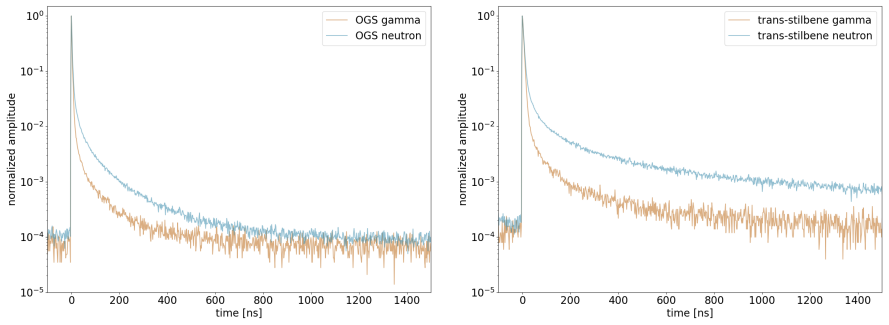
The load-bearing quantity is the normalized figure of merit, $\mathrm{FOM}/\sqrt{N_{\mathrm{phe}}}$, which stays constant across all five heights and is proposed as an intrinsic scintillator property. It is built from charge-comparison pulse shape discrimination, where each pulse gets a parameter $\mathrm{PSD} = (Q_{\mathrm{long}} - Q_{\mathrm{short}})/Q_{\mathrm{long}}$, and the figure of merit is the separation of the neutron and gamma centroids divided by the sum of their full widths at half maximum. The decisive experimental design is a set of five cylinders with identical 25.4 mm diameter and heights from 25 mm to 125 mm, so the self-absorption path length grows with height without any stacked-sample interface losses. The pulse shape itself is examined with a delayed single-photon coincidence setup and fitted with a three-exponential decay using a genetic algorithm, showing no significant change in decay times across energy and supporting the interpretation that FOM loss is statistical rather than a shape change.
What would settle it
Measure the three-exponential decay times and intensities of neutron- and gamma-induced pulses on a 125 mm cylinder with the same delayed single-photon setup; if the fast, medium, and slow component intensities differ from the 25 mm sample beyond uncertainties, then FOM loss is not purely a photoelectron-statistics effect and normalized FOM is not fully intrinsic.
Extended reading notes
Core claim
The central claim is that light self-absorption inside an organic glass scintillator degrades neutron-gamma pulse shape discrimination purely by cutting photoelectron statistics, not by altering the scintillation pulse shape. At 300 keVee the figure of merit drops from $2.37 \pm 0.07$ for the 25 mm sample to $1.70 \pm 0.05$ for the 125 mm sample, while the photoelectron yield falls from $4310 \pm 420$ to $1760 \pm 330$ per MeV. The ratio $\mathrm{FOM}/\sqrt{N_{\mathrm{phe}}}$ stays within $0.066$ to $0.074$, that is, constant within uncertainties. The paper therefore concludes that normalized FOM at a given energy is an intrinsic property of the scintillator, that optimal charge-comparison gates are independent of detector size, and that self-absorption imposes a limit on the maximum useful detector size. The samples retain higher discrimination quality than the EJ-276 plastic comparison and remain broadly comparable to liquid EJ-309.
Load-bearing premise
The argument assumes the scintillation pulse shape does not change as the detector grows, so all loss of discrimination is blamed on fewer detected photons; that assumption is inferred from the constant normalized figure of merit, not measured on the taller samples.
Editorial extensions
If this is right
- Practical detector design must treat self-absorption as a size ceiling: FOM at 300 keVee falls steadily from $2.37$ at 25 mm to $1.70$ at 125 mm, and the trend continues.
- A single measurement of normalized FOM at a given energy, combined with the photoelectron-yield scaling curve, predicts the FOM of untested detector heights.
- Optimal charge-comparison gates are size-independent but energy-dependent; for wide energy ranges, choosing gates tuned to the lowest energy avoids a catastrophic loss of separation at low energy with only a small penalty at high energy.
- With FOM above 1 even for the tallest tested sample, organic glass scintillators remain usable at moderate sizes and, thanks to short pulses, can sustain higher count rates than trans-stilbene crystals.
Reading between the lines
- A direct measurement that would sharpen the claim is a single-photon pulse-shape run on a 125 mm cylinder; the paper's height-independence of pulse shape is inferred, not measured.
- If normalized FOM is truly size-invariant, the same one-sample-plus-scaling characterization could be applied to other self-absorbing scintillators, reducing the number of prototypes needed to predict field performance.
- The linear rather than exponential falloff of yield with height hints that reflective boundaries and source geometry, not simple Beer-Lambert attenuation, set the effective path length; a light-transport model could separate those contributions.
- Because optimal gates vary with energy in every sample tested, a fixed-gate instrument may silently lose low-energy separation; an energy-dependent or two-gate readout scheme is a testable engineering response.
Signed reviews
Editorial analysis
A structured set of objections, weighed in public.
Referee Report
Summary. The manuscript reports a systematic study of five cylindrical organic glass scintillator samples of identical 25.4 mm diameter and heights from 25 mm to 125 mm, plus a trans-stilbene reference. Using the Bertolaccini method it measures photoelectron yield, and using a charge-comparison pulse-shape-discrimination (PSD) analysis with scanned gates it measures the neutron-gamma Figure of Merit (FOM) over energies from 100 to 1000 keVee. It finds that both photoelectron yield and FOM decrease with increasing scintillator height, while the FOM normalized by the square root of the number of photoelectrons remains approximately constant. The decrease is attributed to light self-absorption. The paper also reports Bollinger-Thomas pulse-shape measurements for the 25 mm OGS and for trans-stilbene, fitted with a genetic algorithm to extract three exponential decay components, and compares OGS and stilbene decay times and intensities.
Significance. If the central claim holds, the constant normalized FOM would be a practically useful result: it implies that, at a given deposited energy, the neutron-gamma discrimination performance of an OGS detector can be predicted from a single photoelectron-yield measurement, and that the degradation of PSD with size is driven purely by photoelectron statistics rather than by a change in the intrinsic pulse shape. The dataset is valuable: five physical heights, repeated measurements with re-coupling, propagated uncertainties, and a consistent analysis pipeline. The comparison with EJ-276 plastic and trans-stilbene adds context. The paper's direct measurements of yield and FOM are sound; the main caveat is that the 'intrinsic property' conclusion rests on an assumption about pulse-shape invariance that is supported only indirectly.
major comments (1)
- [Section 2.2 and Table 1] The FOM values in Table 1 are obtained with fixed gates (short = 66 ns, long = 350 ns), which are not exactly the optimal gates for all samples according to Table 2 (for example, at 300 keVee the optimal long gate for the 55, 78, and 102 mm samples is 330 or 350 ns). The fixed-gate choice affects the absolute FOM values but not the overall trend. This is a minor methodological point, but it means that the normalized FOM values in Table 1 are not all evaluated at the maximum FOM for each sample. The authors should either state that the fixed gates are representative and that the maximum-FOM comparison in Table 2 gives the same qualitative result, or justify the use of fixed gates for the intrinsic-property claim.
minor comments (7)
- [Section 3.1] In the paragraph discussing the linear relation between yield and size, the text mentions 'the 136Cs source', which appears to be a typo for '137Cs'.
- [Section 3.1] The sentence 'In case of the scintillators used in our research peak on the right side represents pulses induced by fast neutrons...' is missing a comma after 'research' and should be rephrased for clarity.
- [Figure 13 caption] The caption states that 'R2 and reduced χ2 values were calculated to confirm that the results are reliable' but the actual values are not reported anywhere in the text or tables. Please include them or remove the sentence.
- [Table 2] The footnote says that the uncertainty of the gates can be estimated as the step size (4 ns for short, 50 ns for long), but the text in Section 3.1 says the averaged gates were rounded to 2 ns and 10 ns, respectively. Clarify which uncertainty is meant to be quoted.
- [Section 3.2] The phrase 'the uncertainties of decay times were estimated as 2σ of Gaussian fit' in the note to Table 3 is slightly ambiguous: it should specify that the Gaussian is fit to the distribution of parameter values obtained from the repeated genetic-algorithm runs, and that the reported value is the mean of that Gaussian.
- [Throughout] The paper uses 'we' extensively in the results sections; this is acceptable in this venue, but the manuscript would benefit from a brief list of the analysis software versions and a statement on data availability, since the custom Python software is described but not deposited.
- [References] Reference [6] is an arXiv preprint; if a published version exists by the time of submission, it should be cited. Also, reference [4] is a web page; please add a retrieval date.
Circularity Check
No circular derivation: normalized-FOM constancy is an empirical ratio of measured quantities; the single-height pulse-shape measurement is a limitation, not a circular step.
full rationale
The paper's central claims are based on direct measurements, not on a fitted parameter disguised as a prediction. The normalized FOM is computed as the measured FOM divided by the square root of the measured photoelectron number (Table 1); its approximate constancy across heights is an empirical observation, not an identity enforced by construction. The conclusion that self-absorption reduces neutron-gamma discrimination is supported by the measured decrease of both FOM and photoelectron yield with scintillator height, and the statement that normalized FOM is an intrinsic property is an interpretation of those measurements rather than a definitional restatement. The paper does invoke its own prior work, notably [5] for earlier OGS characterization and [6] for the offline analysis method, but these citations support methodology and context, not the central result; the present data and analysis stand independently. A legitimate weakness is that Bollinger-Thomas pulse shapes were measured only for the 25 mm OGS (Section 3.2), and the size-independence of pulse shape is inferred indirectly from constant normalized FOM and size-independent optimal gates, with the conclusion stating only that 'we found no evidence that the pulse shape itself undergoes any change' (Section 4). This is an evidentiary gap and a correctness-risk concern, not circularity: no equation in the paper reduces the predicted quantity to an assumed input, and no fitted parameter is renamed as a prediction. Therefore the derivation chain is self-contained with respect to circularity.
Assumptions & free parameters
free parameters (5)
- Fast decay time τ1 =
OGS gamma 1.95 ns, OGS neutron 2.32 ns, stilbene gamma 4.98 ns, stilbene neutron 5.88 ns
- Medium decay time τ2 =
OGS gamma 10.0 ns, OGS neutron 24.2 ns, stilbene gamma 23 ns, stilbene neutron 40.5 ns
- Slow decay time τ3 =
OGS gamma 73 ns, OGS neutron 132 ns, stilbene gamma 107 ns, stilbene neutron 291 ns
- Component intensities I1, I2, I3 =
OGS gamma 85%, 9%, 6%; OGS neutron 70%, 17%, 13%; stilbene gamma 89%, 6%, 5%; stilbene neutron 60%, 19%, 21%
- Baseline offset C in Eq. 5 =
Not reported numerically
assumptions (4)
- domain assumption The scintillation pulse shape is described by a sum of three exponential decays (Eq. 5).
- domain assumption The Charge Comparison Method with optimized short/long gates measures the true pulse shape discrimination capability.
- domain assumption The Bollinger-Thomas delayed coincidence setup provides accurate single-photon timing of scintillation pulses.
- domain assumption Photoelectron yield measured via the Bertolaccini method is an accurate measure of light output.
Cite this review
Pith. "Pith review of Influence of Self-Absorption on Pulse Shape Discrimination in Organic Glass Scintillators." pith.science (2026). https://pith.science/paper/UXGZU2JU
@misc{pith2026250508513,
  author       = {Pith},
  title        = {Pith review of: Influence of Self-Absorption on Pulse Shape Discrimination in Organic Glass Scintillators},
  year         = {2026},
  howpublished = {\url{https://pith.science/paper/UXGZU2JU}},
  note         = {Machine review of arXiv:2505.08513}
}
read the original abstract
Organic glass scintillators are an interesting alternative to liquid scintillators, offering many advantageous characteristics with few drawbacks. In this paper we investigate the influence of light self-absorption in the organic glass scintillator on its pulse shape discrimination capability. With five scintillators of different heights but same diameter, we measure photoelectron yield and Figure of Merit in neutron-gamma discrimination. The decrease of both values with increasing size is attributed to light self-absorption, while normalized Figure of Merit remains constant. The choice of gates for charge comparison method is discussed. We also use genetic algorithm to estimate decay times and intensities of fast, medium, and slow components of light pulse shapes measured with Bollinger-Thomas setup. We compare the results to trans-stilbene reference sample.
Figures


Figures from the paper (10 more)



Reference graph
Works this paper leans on
-
[5]
M. Grodzicka-Kobylka, T. Szczesniak, M. Moszyński, L. Swiderski, K. Brylew, P.L. Feng, L. Nguyen, J.S. Carlson, J.J. Valiente-Dobón, J. Trzuskowski, A. Misiarz, Ł. Talarek, and P. Zając. 2 inch molec- ular organic glass scintillator for neutron–gamma discrimination.Nuclear Instruments and Meth- ods in Physics Research Section A: Accelerators, Spectrometer...
-
[1]
URL https://newsreleases.sandia.gov/ glass_scintillators/
Scintillating discovery at Sandia Labs, June 2017. URL https://newsreleases.sandia.gov/ glass_scintillators/. 8 height photoelectron yield Nphe@300keVee FOM F OM/ p Nphe[mm] [phe/MeV] 25 4310 ± 420 1290 ± 130 2.37 ± 0.07 0.066 ± 0.005 55 3570 ± 320 1072 ± 97 2.11 ± 0.06 0.064 ± 0.004 78 2980 ± 140 894 ± 41 2.01 ± 0.06 0.067 ± 0.002 102 2020 ± 240 606 ± 73...
work page 2017
-
[2]
P.L. Feng and J.S. Carlson. High-efficiency organic glass scintillators, December 2017. URLhttps: //www.osti.gov/biblio/1414412. US Patent 9,845,334
-
[3]
P.L. Feng and J.S. Carlson. Mixed compound organic glass scintillators, December 2019. URL https://www.osti.gov/biblio/1600406. US Patent 10,508,233
-
[4]
Blueshift Optics and Sandia Partner to Commercialize Organic Glass Scintillators. URL https://ip.sandia.gov/opportunity/ blueshift-optics-and-sandia-partner-to-commercialize-organic-glass-scintillators/
-
[6]
L. Adamowski, M. Grodzicka-Kobylka, T. Szczesniak, A. Syntfeld-Każuch, L. Swiderski, and A. Kisiel. Advantages of off-line analysis of digitally recorded pulses in case of neutron-gamma discrimination in scintillators, April 2025. URLhttps://arxiv.org/abs/2504.11963
work page Pith review arXiv 2025
- [7]
-
[8]
L. Swiderski, M. Moszyński, W. Czarnacki, J. Iwanowska, A. Syntfeld-Każuch, T. Szczesniak, G. Pausch, C. Plettner, and K. Roemer. Measurement of Compton edge position in low-Z scin- tillators. Radiation Measurements, 57:605–607, 2010. ISSN 1350-4487. doi: https://doi.org/ 10.1016/j.radmeas.2009.10.015. URL https://www.sciencedirect.com/science/article/pii...
Show all 14 references
-
[9]
Bertolaccini, S
M. Bertolaccini, S. Cova, and C. Bussolatti. A technique for absolute measurement of the effective photoelectron per kev yield in scintillation counters. In Proc. of the Nuclear Electronics Symp., Versailles, France, 1968
1968
-
[10]
URLhttps://www.caen.it
CAEN website. URLhttps://www.caen.it
-
[11]
Bollinger and G.E
L.M. Bollinger and G.E. Thomas. Measurement of the time dependence of scintillation intensity by a delayed-coincidence method. Review of Scientific Instruments, 32(9):1044–1050, 09 1961. ISSN 0034-6748. doi: 10.1063/1.1717610. URL https://doi.org/10.1063/1.1717610
1961 doi
-
[12]
Grodzicka-Kobylka, T
M. Grodzicka-Kobylka, T. Szczesniak, M. Moszyński, K. Brylew, L. Swiderski, J.J. Valiente-Dobón, P. Schotanus, K. Grodzicki, and H. Trzaskowska. Fast neutron and gamma ray pulse shape discrimination in EJ-276 and EJ-276G plastic scintillators. Journal of Instrumentation, 15(03...
2020 doi
-
[13]
Katoch, S.S
S. Katoch, S.S. Chauhan, and V. Kumar. A review on genetic algorithm: past, present, and future. Multimedia Tools and Applications, 80:8091–8126, 2021. doi: 10.1007/s11042-020-10139-6. URL https://doi.org/10.1007/s11042-020-10139-6
2021 doi
-
[14]
PyGAD library online documentation
Ahmed Fawzy Gad. PyGAD library online documentation. URL https://pygad.readthedocs. io/en/latest/. 10 Figure 9: Example of FOM dependence on short and long gates for variety of energies in 25 mm organic glass scintillator. Best (maximum) FOM gates data are marked red. 11 Figur...
2000
Reviewed August 15, 2026 · model on record in the stance chip above.
Discussion (0). Continue with ORCID to comment.