REVIEW 4 major objections 5 minor 44 references
Learning cardiac activation and repolarization times with operator learning
T0 review · 4 major / 5 minor · reviewed 2026-08-15 · deepseek-v4-flash
Pith's one-line read This paper shows that Fourier Neural Operators and Kernel Operator Learning can learn the stimulus-to-activation and stimulus-to-repolarization time maps directly from Monodomain simulation data, making fast cardiac timing surrogates…
desk verdict Useful benchmark of FNO vs KOL for cardiac activation/repolarization surrogates, but the abstract overstates accuracy and robustness and the KOL kernel's centroid-only dependence limits the claim. read the letter →
The pith
A machine-rendered reading of the paper's core claim, the machinery that carries it, and where it could break.
The reading
What carries the argument
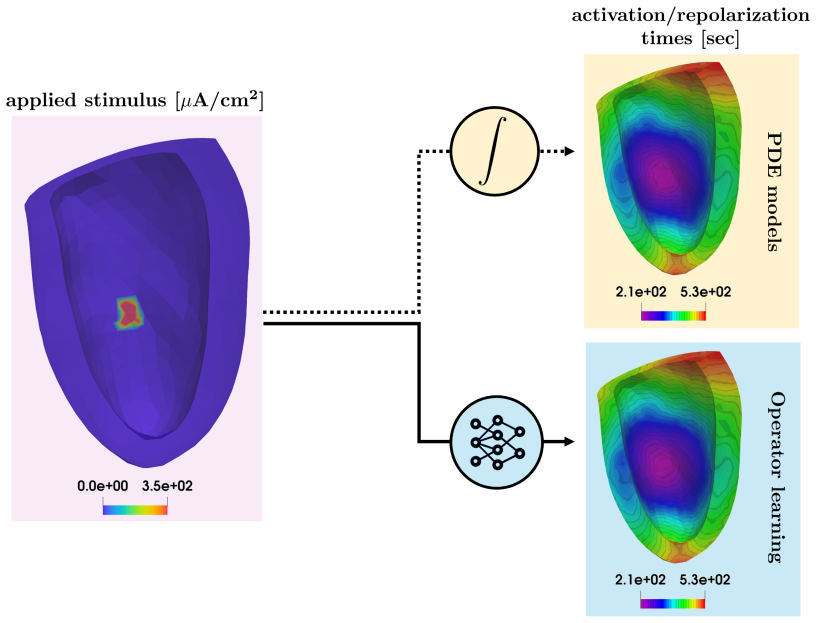
The machinery is a pair of learned surrogate maps $\widehat{\mathcal{G}}$ approximating $\mathcal{G}: I_{\text{app}} \mapsto (t_{\text{act}}, t_{\text{rep}})$. For Fourier Neural Operators, the key identity is the convolution theorem used in equations (11)-(13): each integral kernel layer is applied in Fourier space as $\mathcal{F}^{-1}(R_\theta \cdot \mathcal{F}(a_t))$, with the weight tensor $R_\theta$ parameterizing the kernel. For Kernel Operator Learning, the key object is the closed-form kernel-regression predictor of equation (14), $\bar{\mathcal{G}}(a)(x)=K(x,X)K(X,X)^{-1}\sum_j S(\phi(a),A_j)\alpha_j$, where $S$ is an inverse-quadratic kernel built from the centroid of the stimulated region; training consists of solving one symmetric positive-definite linear system by Cholesky factorization rather than iterative optimization. These surrogates do the work of replacing repeated full-order Monodomain solves with a single function evaluation.
What would settle it
Run the trained KOL model on two held-out stimuli that share the same centroid but have very different shapes, for example a point cluster versus a thin stripe. Because the IQ kernel used for KOL depends only on the centroid of the stimulus support, the model will return nearly identical activation and repolarization maps for the two inputs, while a fresh Monodomain solve will show different timing distributions; that discrepancy would falsify the claim that the learned operator is the full stimulus-to-timing map rather than a centroid-only map.
Extended reading notes
Core claim
The central claim is that the operator $\mathcal{G}$ sending a 1 ms applied-current stimulus to the spatial distribution of activation time, and the analogous operator for repolarization time, can be learned from Monodomain simulation data by both Fourier Neural Operators and Kernel Operator Learning, and that the learned surrogates are accurate and vastly cheaper to evaluate than the full PDE model. The paper studies this on a 2D square, a 3D slab, and a realistic unstructured left-ventricle mesh of about 35k degrees of freedom, using Rogers-McCulloch or Ten Tusscher ionic models to produce ground truth. It reports that Kernel Operator Learning outperforms Fourier Neural Operators in accuracy and training time on all test cases, while Fourier Neural Operators remain competitive and have faster per-sample inference; both remove the need to re-solve the Monodomain equations for each new stimulus. The paper highlights that the repolarization-time map has no known Eikonal-style reduced PDE, so the learned surrogate approximates a map for which no cheap classical model exists.
Load-bearing premise
The load-bearing premise is that Monodomain simulations of randomly placed 1 ms pulses are representative of the stimuli and tissue conditions the surrogate will actually face; if the real operating regime differs, the reported held-out errors no longer measure the surrogate's accuracy.
Editorial extensions
If this is right
- A clinician or researcher can obtain activation and repolarization time maps for a new stimulus location in tens of milliseconds on a laptop rather than minutes of GPU-accelerated Monodomain simulation.
- Repolarization time, which has no known Eikonal-style reduced PDE, becomes accessible through a trained surrogate built from Monodomain data alone.
- Kernel Operator Learning with a physics-informed inverse-quadratic kernel is the more accurate and faster-to-train of the two methods on these tasks, including on an unstructured 35k-node ventricle mesh.
- Fourier Neural Operators, with a non-uniform Fourier transform modification, can be applied to unstructured cardiac meshes, giving an alternative when many fast predictions are needed.
- Both methods are robust to hyperparameter choices over the tested ranges, with Kernel Operator Learning deterministic and Fourier Neural Operators showing small variation across random initializations.
Reading between the lines
- Because Kernel Operator Learning's IQ kernels collapse each stimulus to its centroid, the method is unlikely to transfer to multi-site pacing, extended scar-adjacent wavefronts, or stimuli whose shape matters; a natural test is adding same-centroid, different-shape stimuli to the training distribution and measuring the drop in accuracy.
- The reported cost comparison compares a single surrogate inference with one full Monodomain solve; including training-data generation and kernel selection, the surrogate pays off only when many evaluations are needed, so the efficiency claim is an amortized one.
- Since repolarization time has no Eikonal-style reduced model, the learned operator could be used in reverse, for example inferring the stimulus region from observed repolarization maps, an inverse problem the paper does not address.
- The same operator-learning pipeline should extend to tissue-conductivity or fiber-orientation inputs, not just stimulus location; if it does, it would give clinicians a single surrogate spanning multiple patient-specific parameters.
Signed reviews
Editorial analysis
A structured set of objections, weighed in public.
Referee Report
Summary. The manuscript presents an operator-learning study of the map from an applied current stimulus to cardiac activation and repolarization times, comparing Fourier Neural Operators (FNO) and Kernel Operator Learning (KOL) on synthetic 2D domains, a 3D slab, and an unstructured left-ventricle mesh. Training data are Monodomain simulations with random 1 ms stimuli, and the outputs are activation and repolarization time fields. The authors report that KOL generally achieves lower test errors and shorter training times than FNO, while FNO offers faster inference, and they claim both methods are robust and accurate, with errors generally below 1%, and promising for clinical integration. The central goal is a surrogate for the stimulus-to-time operator, including the repolarization map for which no Eikonal-style PDE is known.
Significance. If the claimed accuracy held across the intended input class, the paper would provide a practically useful surrogate for cardiac activation and repolarization times at a fraction of the Monodomain cost, and the repolarization result would go beyond what Eikonal-type models offer. The study has several strengths: a systematic 2D sensitivity analysis over KOL kernel families and FNO learning-rate policies, a nontrivial 3D unstructured-mesh experiment with about 35k degrees of freedom, and a transparent comparison of training time, memory, and inference time. The KOL formulation is deterministic and exact within its kernel-regression framework. However, the paper's headline claims overstate what the reported numbers and the chosen kernels support, as detailed in the major comments.
major comments (4)
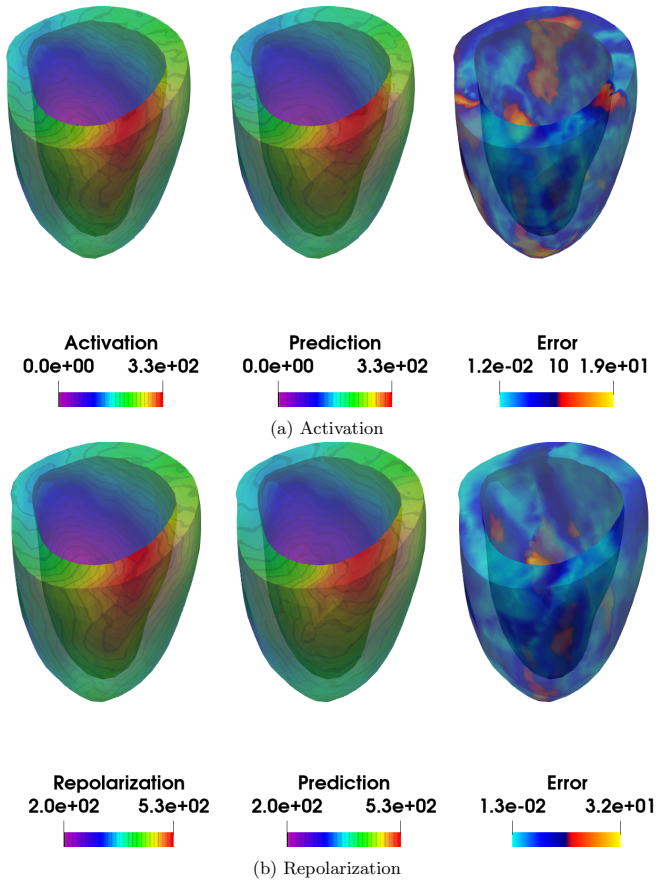
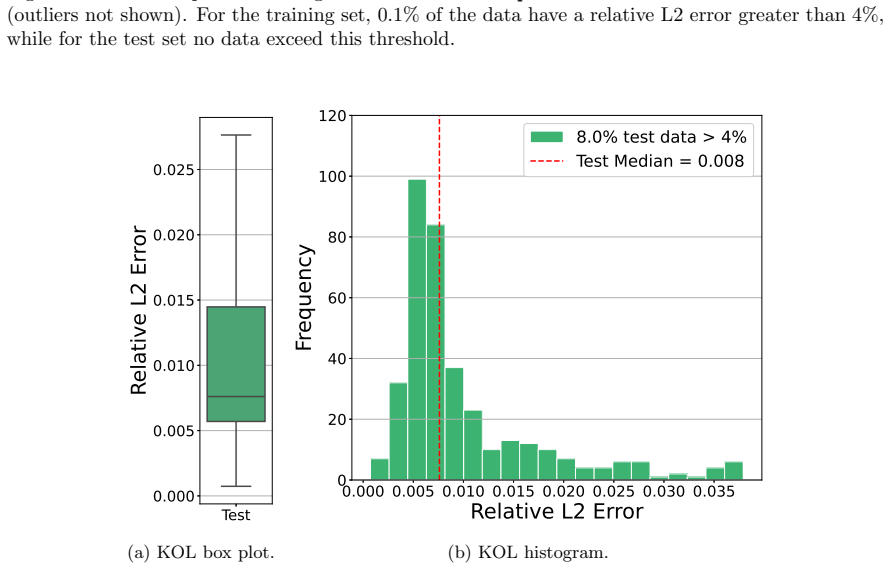
- [Section 4 (Conclusions) and Abstract] The statement 'errors generally below 1%' is contradicted by the paper's own tables. In Table 2 (3D slab), FNO activation error is 3.27e-2 for acti(2000) and KOL activation error is 1.82e-2 for acti(2000). In Table 3 (ventricle), KOL activation error is 1.22e-2 and FNO activation error is 7.15e-2, while FNO repolarization error is 4.86e-2. Additionally, Figure 13 shows KOL activation test medians around 0.027 with 1.5% of test samples above 10% relative L2 error. The claim needs to be restricted to specific datasets and to a statement like 'errors range from below 1% in the 2D and some 3D repolarization cases to several percent in activation cases.'
- [Section 2.4 (KOL kernels), especially the IQ kernel definition] The IQ kernel used for KOL is defined as S(A1,A2)=1/(sigma1*||c_A1-c_A2||+sigma2), where c_A is the centroid of the non-zero entries of the discrete input. Consequently, Eq. (14) makes KOL's prediction invariant to every property of the stimulus except its centroid. Two stimuli with the same centroid but different shape, size, or connectivity produce identical activation and repolarization maps. The RBF kernel has the same centroid-only defect. The held-out test sets in Section 3.1 are random stimuli from the same generative family, so the reported L2 errors certify accuracy only for that specific family, not for the broader class of pacing protocols, scarred tissue, or shape-varying stimuli invoked in the clinical-integration claim in Section 4. The authors should explicitly state this boundary of validity, or use a kernel that encodes shape information, before claiming clinical relevance.
- [Section 3.2 and Tables A2, A3, A4] The abstract's statement that both FNO and KOL are 'robust to hyperparameter choices' is not supported by the sensitivity analysis. In Tables A2 and A3, KOL with NTK or RBF kernels gives errors around 1e-1, three orders of magnitude worse than the IQ kernels, while the IQ kernels themselves vary by up to a factor of about 1.5 (for example, iq1 vs iq5 for repo(2000) in Table A3). In Table A4, FNO test errors on the ventricle range from 7.15e-2 to 1.44e-1 as width changes from 32 to 2, and depth changes from L=1 to L=3 produce differences of 7.15e-2 versus 8.81e-2. These are meaningful sensitivities, not robustness.
- [Sections 3.3 and 3.4, Tables 2 and 3] The comparison of KOL and FNO would be considerably stronger if the test-error distributions were discussed in the conclusion, since the mean relative L2 errors hide substantial outliers. For the 3D slab acti(2000) dataset, Figure 13 reports 1.5% of KOL test data above 10% error, while Figure 12 reports 3.5% of FNO test data above 4%. For the ventricle activation data, Table 3 reports KOL at 1.22e-2 and FNO at 7.15e-2; those are point estimates with no uncertainty interval for KOL. The paper should either report median errors and outlier proportions in the main text or temper the 'generally below 1%' claim, since a reader cannot assess the reliability of the surrogate from the mean alone.
minor comments (5)
- [Section 1, paragraph 2] The phrase 'we compare the performances of FNO e KOL' contains a typo: 'e' should be 'and'.
- [Eq. (17), Section 3.1] The quantity Np in the definition of the discrete L2 relative error is not defined. It should be stated whether Np is the number of test samples or the number of spatial points, because the current notation is ambiguous.
- [Figure 4 caption] The caption reads '3D unstructed ventricle'; this should be 'unstructured'.
- [Section 3.1] The Ten Tusscher model is spelled twice as 'Ten Tuss-cher' in the text; the standard spelling is 'Ten Tusscher'.
- [Section 3.4 and Tables 2 and 3] The inference-time comparison would be easier to interpret if the hardware and software versions (e.g., PyTorch version, CPU/GPU details) for both the training and inference runs were reported in a single table, since the paper currently mixes an Apple M1 Pro laptop for prediction with different machines for training and for the Monodomain reference.
Circularity Check
No significant circularity: the surrogate benchmarks are standard supervised evaluations against held-out Monodomain solutions, and no load-bearing claim reduces to its inputs by construction.
full rationale
The paper's central claim is that FNO and KOL trained on Monodomain-generated stimulus-to-time pairs produce accurate held-out approximations of activation and repolarization times. This is a conventional supervised learning evaluation: labels are produced by solving the Monodomain model, inputs are random stimulus regions, and test errors are measured on withheld samples from the same simulated distribution. The predicted time maps are never used to define the training inputs, the kernels, or the loss function, so the reported errors are not forced by construction. The KOL formula in Eq. (14) is a standard kernel-regression interpolant over training pairs, and while the IQ and RBF kernels depend only on stimulus centroids, this is a modeling limitation rather than circularity: the output labels still come from full Monodomain simulations, and the held-out error is a genuine measure of fit for the tested stimulus family. The observation that no Eikonal-like PDE is known for repolarization times is a statement about the absence of a classical model, not a claim that the surrogate derives repolarization from first principles. Self-citations, including reference [44] for the KOL formulation and kernel options, are used to introduce methodology rather than to justify the numerical results or to exclude alternative approaches, so they are not load-bearing. The conclusion's statement that errors are 'generally below 1%' is inconsistent with some reported test errors in Tables 2 and 3, but that is a factual/correctness concern, not circularity. Overall, the derivation chain is self-contained as a benchmark study, and no specific equation or claim reduces to its own input.
Assumptions & free parameters
free parameters (4)
- FNO frequency modes per axis =
2D: 16x4; 3D slab: 16x8x4; ventricle: 4x4x4
- FNO width and depth =
width 32, depth 3 layers for ventricle; four layers for structured cases
- KOL IQ kernel hyperparameters =
sigma1=1e-4, sigma2=1e-1 (iq4)
- KOL regularization penalty =
1e-10
assumptions (5)
- domain assumption The Monodomain model (2) coupled with the Rogers-McCulloch (2D) or Ten Tusscher (3D) ionic model produces clinically meaningful activation and repolarization times.
- domain assumption The random stimulus regions used in training and testing are drawn from a distribution that covers the intended use cases.
- domain assumption Activation and repolarization times are uniquely determined by threshold post-processing of the transmembrane potential.
- domain assumption The NUDFT implementation from [24] correctly extends FNO to the unstructured ventricle mesh.
- standard math FNO relies on the convolution theorem and Fourier series truncation on the periodic torus.
Cite this review
Pith. "Pith review of Learning cardiac activation and repolarization times with operator learning." pith.science (2026). https://pith.science/paper/BYJBWH23
@misc{pith2026250508631,
  author       = {Pith},
  title        = {Pith review of: Learning cardiac activation and repolarization times with operator learning},
  year         = {2026},
  howpublished = {\url{https://pith.science/paper/BYJBWH23}},
  note         = {Machine review of arXiv:2505.08631}
}
read the original abstract
Solving partial or ordinary differential equation models in cardiac electrophysiology is a computationally demanding task, particularly when high-resolution meshes are required to capture the complex dynamics of the heart. Moreover, in clinical applications, it is essential to employ computational tools that provide only relevant information, ensuring clarity and ease of interpretation. In this work, we exploit two recently proposed operator learning approaches, namely Fourier Neural Operators (FNO) and Kernel Operator Learning (KOL), to learn the operator mapping the applied stimulus in the physical domain into the activation and repolarization time distributions. These data-driven methods are evaluated on synthetic 2D and 3D domains, as well as on a physiologically realistic left ventricle geometry. Notably, while the learned map between the applied current and activation time has its modelling counterpart in the Eikonal model, no equivalent partial differential equation (PDE) model is known for the map between the applied current and repolarization time. Our results demonstrate that both FNO and KOL approaches are robust to hyperparameter choices and computationally efficient compared to traditional PDE-based Monodomain models. These findings highlight the potential use of these surrogate operators to accelerate cardiac simulations and facilitate their clinical integration.
Figures


Figures from the paper (14 more)




Reference graph
Works this paper leans on
-
[1]
Africa, Pasquale Claudio. lifex: A flexible, high performance library for the numerical solution of complex finite element problems.SoftwareX20 (2022): 101252
work page 2022
-
[2]
Anderson, Mark E., Sana M. Al-Khatib, Dan M. Roden, Robert M. Califf, and Duke Clinical Research Institute. Cardiac repolarization: current knowledge, critical gaps, and new approaches to drug development and patient management.American heart journal144, no. 5 (2002): 769-781
work page 2002
-
[3]
Balay, Satish, Shrirang Abhyankar, Mark Adams, Jed Brown, Peter Brune, Kris Buschelman, Lisandro Dalcin et al. PETSc users manual. (2019)
work page 2019
-
[4]
Batlle, Pau, Matthieu Darcy, Bamdad Hosseini, and Houman Owhadi. Kernel methods are com- petitive for operator learning.Journal of Computational Physics496 (2024): 112549
work page 2024
-
[5]
The lifex library version 2.0.arXiv preprintarXiv:2411.19624 (2024)
Bucelli, Michele. The lifex library version 2.0.arXiv preprintarXiv:2411.19624 (2024)
arXiv 2024
-
[6]
Centofanti, Edoardo, and Simone Scacchi. A comparison of Algebraic Multigrid Bidomain solvers on hybrid CPU–GPU architectures.Computer Methods in Applied Mechanics and Engineering 423 (2024): 116875
work page 2024
- [7]
-
[8]
Clayton, R. H., Olivier Bernus, E. M. Cherry, Hans Dierckx, Flavio H. Fenton, Lucia Mirabella, Alexander V. Panfilov, Frank B. Sachse, Gunnar Seemann, and H. Zhang. Models of cardiac tissue electrophysiology: progress, challenges and open questions.Progress in biophysics and molecular biology104, no. 1-3 (2011): 22-48
work page 2011
Show all 44 references
-
[9]
Pavarino, and Simone Scacchi
Colli Franzone, Piero, Luca F. Pavarino, and Simone Scacchi. Mathematical Cardiac Electro- physiology. Vol. 13.Springer, 2014
2014
-
[10]
Wavefront propagation in an activation model of the anisotropic cardiac tissue: asymptotic analysis and numerical simulations.Journal of mathematical biology28 (1990): 121-176
Colli Franzone, P., Luciano Guerri, and Sergio Rovida. Wavefront propagation in an activation model of the anisotropic cardiac tissue: asymptotic analysis and numerical simulations.Journal of mathematical biology28 (1990): 121-176
1990
-
[11]
Coronel, Ruben, Francien JG Wilms-Schopman, Tobias Opthof, and Michiel J. Janse. Dispersion of repolarization and arrhythmogenesis.Heart Rhythm6, no. 4 (2009): 537-543
2009
-
[12]
Delving deep into rectifiers: Surpass- ing human-level performance on imagenet classification
He, Kaiming, Xiangyu Zhang, Shaoqing Ren, and Jian Sun. Delving deep into rectifiers: Surpass- ing human-level performance on imagenet classification. InProceedings of the IEEE international conference on computer vision, pp. 1026-1034. 2015
2015
-
[13]
Impulses and physiological states in theoretical models of nerve membrane
FitzHugh, Richard. Impulses and physiological states in theoretical models of nerve membrane. Biophysical journal1, no. 6 (1961): 445-466
1961
-
[14]
Deep learning-based reduced order models in cardiac electrophysiology.PloS one15, no
Fresca, Stefania, Andrea Manzoni, Luca Ded` e, and Alfio Quarteroni. Deep learning-based reduced order models in cardiac electrophysiology.PloS one15, no. 10 (2020): e0239416
2020
-
[15]
A physics-informed variational DeepONet for predicting crack path in quasi-brittle materials.Computer Methods in Applied Mechanics and Engineering391 (2022): 114587
Goswami, Somdatta, Minglang Yin, Yue Yu, and George Em Karniadakis. A physics-informed variational DeepONet for predicting crack path in quasi-brittle materials.Computer Methods in Applied Mechanics and Engineering391 (2022): 114587
2022
-
[16]
Fitzhugh-nagumo model.Scholarpedia1, no
Izhikevich, Eugene M., and Richard FitzHugh. Fitzhugh-nagumo model.Scholarpedia1, no. 9 (2006): 1349. 29
2006
-
[17]
Neural tangent kernel: Convergence and generalization in neural networks.Advances in neural information processing systems31 (2018)
Jacot, Arthur, Franck Gabriel, and Cl´ ement Hongler. Neural tangent kernel: Convergence and generalization in neural networks.Advances in neural information processing systems31 (2018)
2018
-
[18]
P., and James Sneyd.Mathematical physiology1: Cellular physiology
Keener, J. P., and James Sneyd.Mathematical physiology1: Cellular physiology. (2009)
2009
-
[19]
An eikonal-curvature equation for action potential propagation in myocardium
Keener, James P. An eikonal-curvature equation for action potential propagation in myocardium. Journal of mathematical biology29.7 (1991): 629-651
1991
-
[20]
Witschey, John A
Kissas, Georgios, Yibo Yang, Eileen Hwuang, Walter R. Witschey, John A. Detre, and Paris Perdikaris. Machine learning in cardiovascular flows modeling: Predicting arterial blood pressure from non-invasive 4D flow MRI data using physics-informed neural networks.Computer Methods...
2020
-
[21]
On universal approximation and error bounds for Fourier neural operators.The Journal of Machine Learning Research22, no
Kovachki, Nikola, Samuel Lanthaler, and Siddhartha Mishra. On universal approximation and error bounds for Fourier neural operators.The Journal of Machine Learning Research22, no. 1 (2021): 13237-13312
2021
-
[22]
Neural operator: Learning maps between function spaces with applications to PDEs.Journal of Machine Learning Research24, no
Kovachki, Nikola, Zongyi Li, Burigede Liu, Kamyar Azizzadenesheli, Kaushik Bhattacharya, Andrew Stuart, and Anima Anandkumar. Neural operator: Learning maps between function spaces with applications to PDEs.Journal of Machine Learning Research24, no. 89 (2023): 1-97
2023
-
[23]
Li, Zongyi, Nikola Kovachki, Kamyar Azizzadenesheli, Burigede Liu, Kaushik Bhattacharya, An- drew Stuart, and Anima Anandkumar, Fourier neural operator for parametric partial differential equations.arXiv preprintarXiv:2010.08895 (2020)
2020 arXiv
-
[24]
Michelis, Emmanuel de Bezenac, Sirani M
Lingsch, Levi, Mike Y. Michelis, Emmanuel de Bezenac, Sirani M. Perera, Robert K. Katzschmann, and Siddhartha Mishra. Beyond Regular Grids: Fourier-Based Neural Operators on Arbitrary Domains.arXiv preprintarXiv:2305.19663 (2023)
2023
-
[25]
Learning nonlinear operators via DeepONet based on the universal approximation theorem of operators
Lu, Lu, Pengzhan Jin, Guofei Pang, Zhongqiang Zhang, and George Em Karniadakis. Learning nonlinear operators via DeepONet based on the universal approximation theorem of operators. Nature machine intelligence3, no. 3 (2021): 218-229
2021
-
[26]
A comprehensive and fair comparison of two neural operators (with practical extensions) based on fair data.Computer Methods in Applied Mechanics and Engineering 393 (2022): 114778
Lu, Lu, Xuhui Meng, Shengze Cai, Zhiping Mao, Somdatta Goswami, Zhongqiang Zhang, and George Em Karniadakis. A comprehensive and fair comparison of two neural operators (with practical extensions) based on fair data.Computer Methods in Applied Mechanics and Engineering 393 (20...
2022
-
[27]
Kernel methods through the roof: handling billions of points efficiently.Advances in Neural Information Pro- cessing Systems33 (2020): 14410-14422
Meanti, Giacomo, Luigi Carratino, Lorenzo Rosasco, and Alessandro Rudi. Kernel methods through the roof: handling billions of points efficiently.Advances in Neural Information Pro- cessing Systems33 (2020): 14410-14422
2020
-
[28]
Kernel flows: From learning kernels from data into the abyss.Journal of Computational Physics389 (2019): 22-47
Owhadi, Houman, and Gene Ryan Yoo. Kernel flows: From learning kernels from data into the abyss.Journal of Computational Physics389 (2019): 22-47
2019
-
[29]
Regazzoni, Francesco, Luca Ded` e, and Alfio Quarteroni. Machine learning of multiscale active force generation models for the efficient simulation of cardiac electromechanics.Computer Meth- ods in Applied Mechanics and Engineering370 (2020): 113268
2020
-
[30]
Learn- ing the intrinsic dynamics of spatio-temporal processes through Latent Dynamics Networks.Na- ture Communications15, no
Regazzoni, Francesco, Stefano Pagani, Matteo Salvador, Luca Ded` e, and Alfio Quarteroni. Learn- ing the intrinsic dynamics of spatio-temporal processes through Latent Dynamics Networks.Na- ture Communications15, no. 1 (2024): 1834
2024
-
[31]
McCulloch
Rogers, Jack M., and Andrew D. McCulloch. A collocation-Galerkin finite element model of cardiac action potential propagation.IEEE Transactions on Biomedical Engineering41, no. 8 (1994): 743-757. 30
1994
-
[32]
Cajas, Eva Casoni, and Mariano V´ azquez
Santiago, Alfonso, Jazm´ ın Aguado-Sierra, Miguel Zavala-Ak´ e, Ruben Doste-Beltran, Samuel G´ omez, Ruth Ar´ ıs, Juan C. Cajas, Eva Casoni, and Mariano V´ azquez. Fully coupled fluid-electro- mechanical model of the human heart for supercomputers.International journal for num...
2018
-
[33]
Iterative kernel regression with preconditioning.Analysis and Appli- cations22, no
Shi, Lei, and Zihan Zhang. Iterative kernel regression with preconditioning.Analysis and Appli- cations22, no. 06 (2024): 1095-1131
2024
-
[34]
The connection between regular- ization operators and support vector kernels.Neural networks11.4 (1998): 637-649
Smola, Alex J., Bernhard Sch¨ olkopf, and Klaus-Robert M¨ uller. The connection between regular- ization operators and support vector kernels.Neural networks11.4 (1998): 637-649
1998
-
[35]
Computing the electrical activity in the heart.Springer Science & Business Media
Sundnes, Joakim, Glenn Terje Lines, Xing Cai, Bjørn Frederik Nielsen, Kent-Andre Mardal, and Aslak Tveito. Computing the electrical activity in the heart.Springer Science & Business Media
-
[36]
Panfilov
Ten Tusscher, Kirsten HWJ, Denis Noble, Peter-John Noble, and Alexander V. Panfilov. A model for human ventricular tissue.American Journal of Physiology-Heart and Circulatory Physiology 286, no. 4 (2004): H1573-H1589
2004
-
[37]
PDE-aware deep learning for inverse problems in cardiac electrophysiology.SIAM Journal on Scientific Computing 44, no
Tenderini, Riccardo, Stefano Pagani, Alfio Quarteroni, and Simone Deparis. PDE-aware deep learning for inverse problems in cardiac electrophysiology.SIAM Journal on Scientific Computing 44, no. 3 (2022): B605-B639
2022
-
[38]
Popescu, and Julie K
Trayanova, Natalia A., Dan M. Popescu, and Julie K. Shade. Machine learning in arrhythmia and electrophysiology.Circulation research128, no. 4 (2021): 544-566
2021
-
[39]
A., Lyon, A., Shade, J., and Heijman, J
Trayanova, N. A., Lyon, A., Shade, J., and Heijman, J. Computational modeling of cardiac elec- trophysiology and arrhythmogenesis: toward clinical translation.Physiological reviews, 104(3), 1265-1333 (2024)
2024
-
[40]
Tripura, Tapas, and Souvik Chakraborty. Wavelet neural operator for solving parametric par- tial differential equations in computational mechanics problems.Computer Methods in Applied Mechanics and Engineering404 (2023): 115783
2023
-
[41]
Cardiac ventricular repolarization reserve: a principle for understanding drug-related proarrhythmic risk.British journal of pharmacology164, no
Varr´ o, Andr´ as, and Istv´ an Baczk´ o. Cardiac ventricular repolarization reserve: a principle for understanding drug-related proarrhythmic risk.British journal of pharmacology164, no. 1 (2011): 14-36
2011
-
[42]
Frangi, and Alfio Quarteroni
Vergara, Christian, Matthias Lange, Simone Palamara, Toni Lassila, Alejandro F. Frangi, and Alfio Quarteroni. A coupled 3D–1D numerical monodomain solver for cardiac electrical activation in the myocardium with detailed Purkinje network.Journal of Computational Physics308 (201...
2016
-
[43]
Vergara, Christian, Simone Stella, Massimiliano Maines, Pasquale Claudio Africa, Domenico Catanzariti, Cristina Dematt` e, Maurizio Centonze, Fabio Nobile, Alfio Quarteroni, and Maurizio Del Greco. Computational electrophysiology of the coronary sinus branches based on electro...
2022
-
[44]
Learning epidemic trajectories through Kernel Operator Learning: from modelling to optimal control.Numerical Mathematics: Theory, Methods and Applications(2025): 104208
Ziarelli, Giovanni, Nicola Parolini and Marco Verani. Learning epidemic trajectories through Kernel Operator Learning: from modelling to optimal control.Numerical Mathematics: Theory, Methods and Applications(2025): 104208. 31
2025
Reviewed August 15, 2026 · model on record in the stance chip above.
Discussion (0). Continue with ORCID to comment.